
Pre-Employment Diagrammatic Reasoning Tests for Recruitment | 2026 Guide



Diagrammatic reasoning tests are commonly used in recruitment to assess how well candidates interpret visual information, identify patterns, and apply logical rules to solve unfamiliar problems.
These tests present candidates with shapes, sequences, symbols, and diagrams to measure their abstract reasoning, problem-solving skills, and learning agility.
Keep reading to explore how a diagrammatic reasoning test can help you hire top talent and make smarter, data-driven hiring decisions.
Contents:
- What is a diagrammatic reasoning test?
- What does a diagrammatic reasoning test measure?
- Why use diagrammatic reasoning tests for pre-employment screening?
- What are the diagrammatic reasoning questions commonly used in job interviews?
- Which industries and roles benefit most from diagrammatic reasoning tests?
- Which employers use diagrammatic reasoning assessments for hiring?
- Diagrammatic reasoning tests: Client success story
- Why leading companies choose Assess Candidates’ diagrammatic reasoning tests
Now, let’s start with the basics: what are diagrammatic reasoning tests?
1. What is a diagrammatic reasoning test?
A diagrammatic reasoning test is a pre-employment aptitude assessment that measures how well candidates interpret visual information, identify patterns, and apply logical rules to solve unfamiliar problems.
Boost your hiring accuracy with our scientifically validated diagrammatic reasoning tests. Hire For Free
Let’s explore the core skills measured by pre-employment diagrammatic reasoning tests.

2. What does a diagrammatic reasoning test measure?
Diagrammatic reasoning tests help employers assess visual reasoning, abstract thinking, pattern recognition, problem-solving, learning agility, and attention to detail.
Let’s dive into further details in how diagrammatic tests measure these major skills:
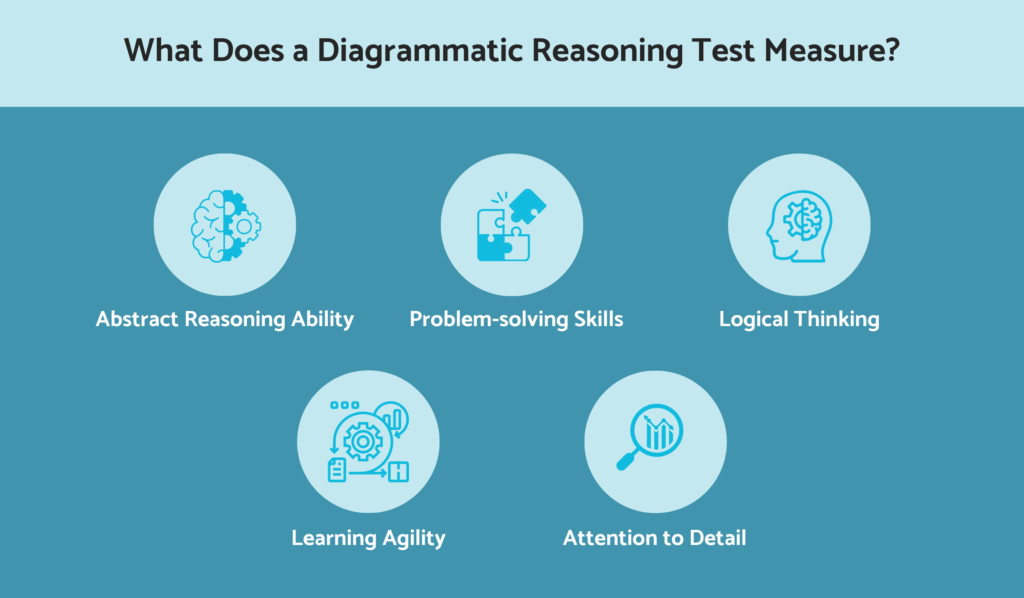
1. Abstract Reasoning Ability
Diagrammatic reasoning tests measure a candidate’s abstract reasoning ability by assessing how effectively candidates understand concepts and patterns that are not directly explained in words or numbers.
It is especially valuable for roles such as UX designers and architects.
2. Problem-solving Skills
Diagrammatic reasoning tests also measure a candidate’s problem-solving skills by analyzing their ability to identify rules, relationships, and sequences within the given timeframe.
This is essential in roles like business analysts and AI researchers.
3. Logical Thinking
Logical thinking is yet another core skill measured by diagrammatic reasoning tests. These tests assess whether a candidate can apply logic consistently when interpreting visual changes and transformations.
This skill plays a key role in recruiting data analysts and software engineers.
4. Learning Agility
Diagrammatic reasoning tests measure a candidate’s learning agility by involving questions that often include unfamiliar symbols or patterns. This helps analyze how quickly a candidate can learn and apply new rules.
Learning agility is key for jobs such as consulting and finance.
5. Attention to Detail
Attention to detail is yet another core skill assessed by diagrammatic assessments. It measures a candidate’s ability to identify small visual changes, such as direction, shading, rotation, or position.
This skill is particularly important for quality assurance testers and forensic analysts.
Incorporating our top pre-employment tests with your hiring strategy for an effective hiring. LEARN MORE
Next, let’s look at why employers use these tests in screening.
3. Why use diagrammatic reasoning tests for pre-employment screening?
Diagrammatic reasoning tests offer several benefits in recruitment as they help evaluate a candidate’s logical thinking and problem-solving ability fairly and efficiently.
Benefits of diagrammatic reasoning tests in hiring
Diagrammatic reasoning tests can support recruitment by giving employers a structured way to compare how candidates process visual information and solve unfamiliar problems.
The following are the 5 main benefits of a diagrammatic reasoning test in hiring:
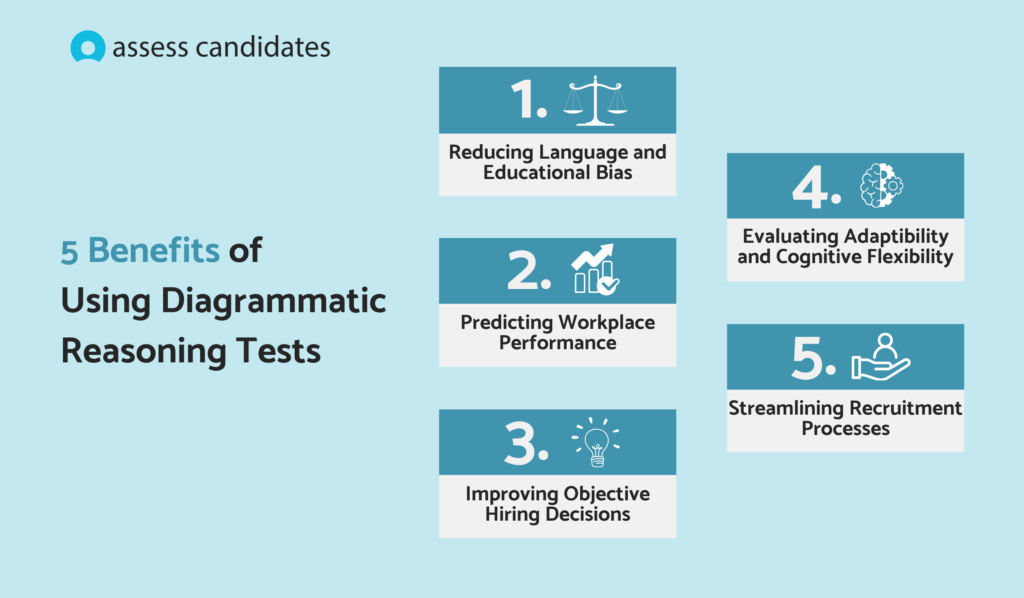
1. Reducing Language and Educational Bias
Diagrammatic reasoning tests help reduce language and educational bias since they focus on visual logic instead of verbal ability or memorization. This allows you to identify candidates more fairly across different languages and educational backgrounds and levels of professional experience.
2. Predicting Workplace Performance
Diagrammatic reasoning tests can provide useful evidence of cognitive ability, especially for roles that require abstract thinking, systems reasoning, and problem-solving. They should be used alongside interviews, work samples, and role-specific assessments.
3. Improving Objective Hiring Decisions
Diagrammatic reasoning tests improve objective hiring decisions by providing standardized and measurable results. These assessments will also help you reduce bias and make more data-driven hiring decisions by focusing on demonstrated reasoning ability rather than subjective impressions.
4. Evaluating Adaptability and Cognitive Flexibility
Diagrammatic reasoning tests also help you evaluate the candidate’s adaptability and cognitive flexibility. It presents them with questions involving multiple changing rules, including shape rotation, movement, and sequence progression.
5. Streamlining Recruitment Processes
Diagrammatic reasoning tests help screen a large number of candidates efficiently and identify top candidates early in the hiring process. This helps you further in the reduction of recruitment time, improves candidate shortlisting, and optimizes hiring resources.
While diagrammatic reasoning tests offer many benefits, it’s equally important to consider certain factors before using them in the hiring process.
5 things to consider before using a diagrammatic reasoning test for hiring
- Test Anxiety: Candidates may underperform due to nervousness, time pressure, or unfamiliarity with psychometric assessments.
Solution: Provide candidates with clear instructions, practice tests, and clear information about the test format before the assessment.
- Risk of Over-reliance on Test Scores: Focusing solely on the diagrammatic reasoning test scores and overlooking important factors like experience, communication skills, and role fit may lead to mis-hires.
Solution: Combine diagrammatic reasoning tests with other selection methods such as job simulations, structured interviews, work samples, and role-specific assessments. This gives a more comprehensive view of each candidate.
- Limited Role Relevance: Diagrammatic reasoning assessments may not be useful for every role, especially for jobs that require creativity, emotional intelligence, or communication.
Solution: Integrate these tests only when the role requires logical thinking, problem-solving, learning agility, and abstract reasoning.
- Accessibility Concerns: Diagrammatic reasoning assessments are visually based tests and may create barriers for applicants with visual impairments, neurodivergent conditions, or other accessibility needs.
Solution: Use accessible test platforms like Assess Candidates, which prioritize inclusivity by offering extra time options, Zoom functionality, accessible color schemes, and screen reader compatibility, all compliant with WCAG standards.
- Cheating: Candidates can attempt to cheat on online diagrammatic tests or ask others to take the test for them, undermining the test’s validity.
Solution: Choose assessment providers that offer strong cheat prevention tools, such as remote proctoring, identity verification, randomized question banks, and cheat detection technology. Providers like Assess Candidates implement these safeguards to maintain test integrity.
Explore our assessments to identify talent with strong pattern recognition skills. LEARN MORE
4. What are the diagrammatic reasoning questions commonly used in job interviews?
Diagrammatic reasoning test questions analyze how well candidates can identify visual patterns, follow logical rules, and solve abstract problems on time.
The following are the most common types of diagrammatic reasoning test questions used in job interviews:
- Logical Sequence Tests: Logical sequence tests present candidates with a sequence of shapes or symbols that change according to certain rules. Candidates will be required to choose the next diagram in the sequence.
- Flowchart or Process Diagram Tests: Flowchart or process diagram tests require candidates to analyze flowcharts or process diagrams and predict the outcome by following the logic.
- Diagram Completion Tests: Diagram completion tests require candidates to analyze incomplete diagrams or matrices that follow specific rules. Candidates have to select the option that would complete the pattern.
- Odd-One-Out Questions: Odd-one-out questions require candidates to choose the pattern that does not follow the same pattern as the others.
Optimize your recruitment strategy with Assess Candidates’ reasoning tests. VIEW PLANS.
Let’s take a look at the key industries and roles that should use diagrammatic reasoning tests for hiring.
5. Which industries and roles benefit most from diagrammatic reasoning tests?
Diagrammatic reasoning tests are most useful for roles that require candidates to interpret visual information, follow logical processes, and adapt quickly to unfamiliar patterns or systems.
The following are the top 5 industries that use diagrammatic reasoning tests as a part of their hiring process:
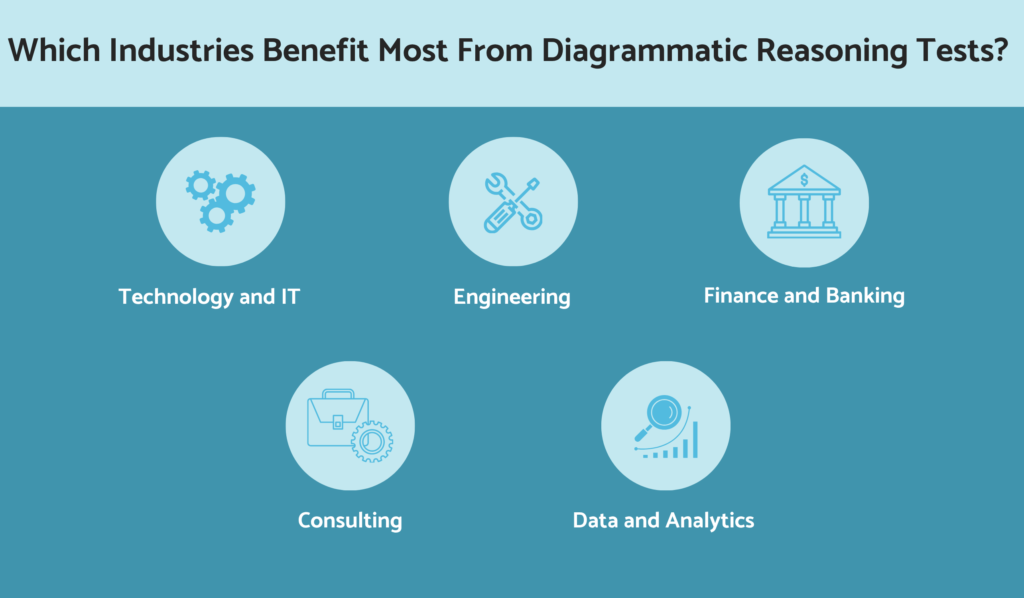
1. Technology and IT
Technology and IT roles require candidates to understand systems, troubleshoot problems, and work with abstract logic. Diagrammatic reasoning tests help identify candidates with strong analytical thinking skills who can solve complex technical problems.
Major employers using these tests include Microsoft and IBM.
2. Engineering
Engineering roles involve spatial thinking, process understanding, and technical problem-solving. Diagrammatic reasoning tests help in understanding how well candidates can interpret visual problems and apply logical rules.
Leading firms that use diagrammatic assessments include Bosch and Siemens.
3. Finance and Banking
Finance and banking roles require candidates to regularly identify trends, analyze complex information, and make decisions based on patterns. Diagrammatic reasoning tests help analyze analytical ability beyond numerical skills.
Major companies that have integrated these tests into their hiring processes are JP Morgan and HSBC.
4. Consulting
Consultants are required to solve unfamiliar business problems, identify patterns quickly, and structure information clearly. Diagrammatic reasoning tests help assess logical thinking and learning agility.
Deloitte and McKinsey & Company are examples of consulting firms where candidates may encounter reasoning-based assessments during recruitment.
5. Data and Analytics
Data and analytics roles usually require candidates to possess strong pattern recognition and logical reasoning skills, and the ability to interpret relationships between information. Diagrammatic reasoning tests help hire candidates who can think clearly and analytically.
Some data analytics platforms that use these tests include SaS and Palantir.
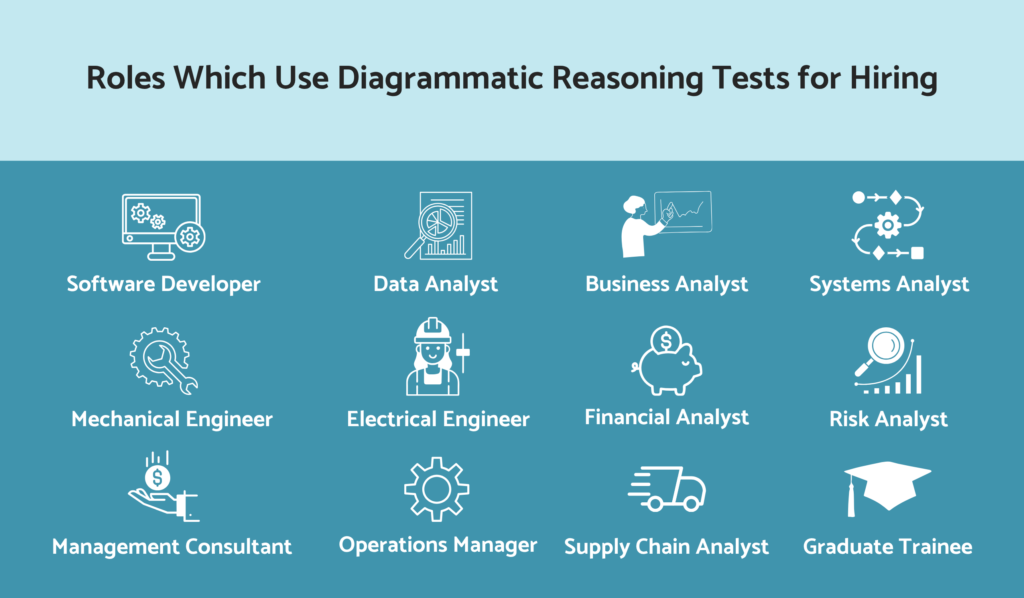
Roles that use diagrammatic reasoning tests for hiring
- Software Developer
- Data Analyst
- Business Analyst
- Systems Analyst
- Mechanical Engineer
- Electrical Engineer
- Civil Engineer
- Process Engineer
- Financial Analyst
- Risk Analyst
- Management Consultant
- Operations Manager
- Supply Chain Analyst
- Logistics Coordinator
- Graduate Trainee
Discover top candidates seamlessly with our advanced talent assessment platform. LEARN MORE
6. Which employers use diagrammatic reasoning assessments for hiring?
Diagrammatic reasoning tests have long been a key part of recruitment at major global corporations. SMEs and startups are also adopting these assessments to improve candidate selection, make objective hiring decisions, and identify individuals with strong problem-solving, logical thinking, and pattern recognition skills.
Examples of employers and sectors where candidates may encounter reasoning-based assessments include:
- Microsoft
- IBM
- Siemens
- HSBC
- JP Morgan
- KPMG
- Deloitte
- PwC
- Audi
- BMW
- Boeing
- Johnson & Johnson
Identify the best candidates quickly by top psychometric tests with your diagrammatic reasoning tests. HIRE FOR FREE
7. Diagrammatic Reasoning Tests: Client Success Story
Client Problem Statement
Suppose a growing engineering firm is hiring graduate engineers and technical trainees, but struggles to assess candidates beyond their academic qualifications. While many applicants have strong degrees, the company finds it difficult to evaluate their ability to interpret visual information, understand technical patterns, and solve unfamiliar problems quickly. This leads to inconsistent shortlisting, longer training periods, and reduced confidence among hiring managers.
The company needs a reliable assessment method to measure candidates’ visual reasoning, pattern recognition, and problem–solving skills for technical and engineering-focused roles.
Assess Candidate Proposal
At Assess Candidates, we recommend using diagrammatic reasoning tests at the early stage of recruitment. This assessment evaluates candidates’ ability to identify visual patterns, understand abstract rules, interpret diagrams, and apply logical thinking to solve unfamiliar problems.
These skills are essential for roles where employees must work with technical processes, systems, layouts, workflows, and visual information.
Result
By integrating diagrammatic reasoning tests into the hiring process, the company can identify candidates with the visual logic, analytical thinking, and problem-solving skills needed for engineering and technical roles. This structured approach improves hiring accuracy, reduces training time, and supports better workforce planning.
Ultimately, the company will build a stronger technical talent pipeline, enable teams to understand complex systems faster, solve problems more effectively, and contribute to long-term business growth.
Partner with Assess Candidates for our scientifically validated pre-employment tests. VIEW PLANS.
8. Why leading companies choose Assess Candidates’ diagrammatic reasoning tests
At Assess Candidates, we offer a wide range of pre-employment aptitude tests, including diagrammatic reasoning tests as a part of our logical reasoning tests, and create recruitment campaigns customized to each organization’s unique hiring needs.
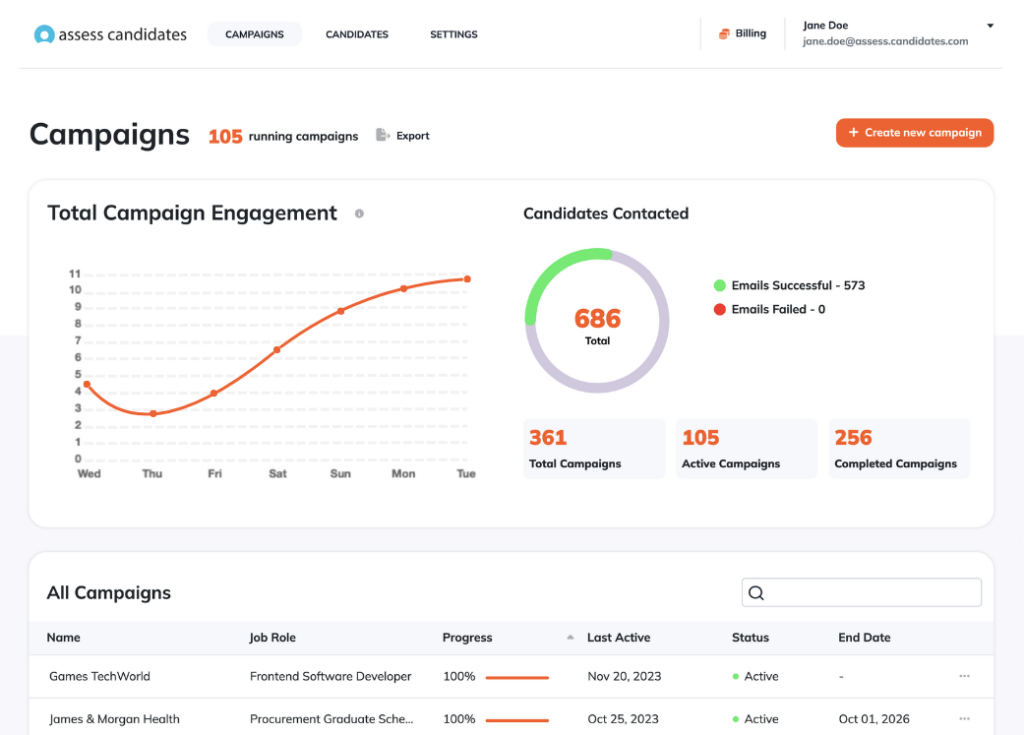
Here is an example of our campaign reporting dashboard available on Assess Candidates.
Here are 4 reasons employers use Assess Candidates’ assessment tests in recruitment:
- Design Scientifically Validated by Expert Psychologists: Assess Candidates’assessments are developed by Chartered Scientists, Psychologists, and Psychometricians with decades of experience creating assessments for leading organizations such as SHL and IBM Kenexa.
Carefully tested and validated, these assessments accurately measure candidates’ visual reasoning, pattern recognition, logical thinking, and problem-solving skills, helping employers identify high-potential talent across technical, analytical, and graduate roles.
- Expert Reporting: Our intuitive platform enables employers to analyze candidate performance and make confident hiring decisions quickly. Recruiters can review individual results, compare scores, filter, rank, and shortlist candidates with ease. For added convenience, the talent assessment platform integrates seamlessly with your existing ATS, helping streamline the recruitment workflow
- Positive Candidate Experience: The assessments work on any device and features a clear, user-friendly interface. Candidates receive simple instructions, navigate with minimal clicks, and progress smoothly through visual reasoning questions. The test can also be branded to match your organization, creating a professional candidate experience that strengthens your employer brand.
- Candidate Accessibility Support: We prioritize inclusivity by offering extra time options, Zoom functionality, accessible color schemes, and screen reader compatibility, all aligned with WCAG standards. These features help candidates with disabilities, visual impairments, or accessibility needs complete the assessment fairly and confidently.
Assess Candidates provides reliable, end-to-end pre-employment assessment solutions for employers of all sizes. Explore our logical reasoning tests today and start hiring the best-fit candidates with confidence.
Not sure if diagrammatic reasoning tests suit your recruitment process? Contact us for a free analysis of your hiring needs.
Conclusion: Key Takeaway
Diagrammatic reasoning tests help employers evaluate candidates’ logical thinking, pattern recognition, abstract reasoning, and problem-solving skills through visual information and symbolic patterns. Widely used across industries, these assessments are used alongside other assessments and interviews to support fairer, more objective hiring decisions by identifying candidates with strong cognitive ability and learning agility.
Interested in learning more about effective candidate assessment? Continue reading for frequently asked questions, and sign up with your email to get started.
Frequently Asked Questions
When should a diagrammatic reasoning test be introduced in the recruitment process?
A diagrammatic reasoning test should be introduced early in the hiring process. This will help you screen candidates more objectively before interviews, especially when receiving a high volume of applications. However, it should not be used as the sole decision factor.
How to determine if a diagrammatic reasoning test is fair?
A diagrammatic reasoning test is fair when it uses validated questions, clear instructions, an accessible design, and consistent scoring. Review results across all the candidate groups to check for adverse impact.
How do diagrammatic reasoning tests improve hiring quality?
Diagrammatic reasoning tests improve hiring quality by providing a reliable insight into a candidate’s cognitive ability and problem-solving approach. This helps in reducing hiring bias, improving role fit, and choosing candidates with long-term potential.
Can diagrammatic reasoning tests be used for non-technical roles?
Yes, diagrammatic reasoning tests can be used for non-technical roles. However, they should only be used for non-technical roles when the job requires logical thinking, process understanding, or quick decision-making.
How to use diagrammatic reasoning test results effectively?
Diagrammatic reasoning test results can be used to compare candidates objectively, identify strong problem-solvers, and shortlist the top candidatesfor the next hiring stage. However, the scores should be reviewed alongside work samples, interviews, and role-specific assessments to make balanced decisions.


 English
  Arabic