
The Pros And Cons Of AI In Recruitment
If you are in charge of hiring today, you are already under pressure. The volume of applications continues to increase, timeframes continue to shorten, and job seekers demand more prompt and impartial hiring. At the same time, managements desire quality recruits with minimal risk. That is why AI in recruitment has moved from a trend to a practical hiring tool.
AI, when applied correctly, assists you in narrowing down candidates faster, finding good employees, and using uniform criteria. When used poorly, it can undermine trust, inhibit diversity, and frustrate candidates. The real impact of AI in recruitment depends on how thoughtfully you design and manage the process.
Around 44% of organizations already use AI for hiring and recruitment. AI tools reduce recruitment costs by up to 30% while cutting time-to-hire by about 50%.
This guide walks you through what AI really means in recruitment, where it delivers value, where it falls short, and how to use it responsibly in your hiring process.
Contents
- What is AI in recruitment?
- What are the benefits of AI in recruitment?
- What are the drawbacks of AI in recruitment?
- When does AI work best in recruitment?
- When to Use AI Cautiously in Recruitment
- Why Assess Candidates is a trusted partner for AI-powered recruitment
Let’s start with understanding what AI in recruitment means!
1. What Is AI in Recruitment?
AI in recruitment refers to the use of artificial intelligence to support, enhance, and automate hiring activities. These tools analyze data, identify patterns, and automate tasks that would otherwise take recruiters a longer period of time.
In practice, AI supports the recruitment process by handling resume screening, candidate matching, assessments, interview scheduling, and candidate communication. Many teams now use generative AI in recruitment to draft job descriptions and personalize outreach.
Examples of AI in recruitment include resume parsing software, AI-powered pre-employment assessments, recruitment chatbots, AI-driven video interview platforms, automated interview scheduling, and predictive hiring analytics.
Research shows that 45% of organizations already use AI in recruitment and talent acquisition.
Hire smarter with science-backed assessments. HIRE FOR FREE
Once you understand what AI in recruitment means, the next question is why many employers are adopting AI in recruitment.

2. What Are the Benefits of AI in Recruitment?
AI is transforming how the recruitment process is carried out by making it quicker, fairer, and more efficient. It helps you to sift through applications, enhance interactions, and make smarter hiring decisions based on real-time information. This enables your staff to spend more time with qualified people and less time on administration.
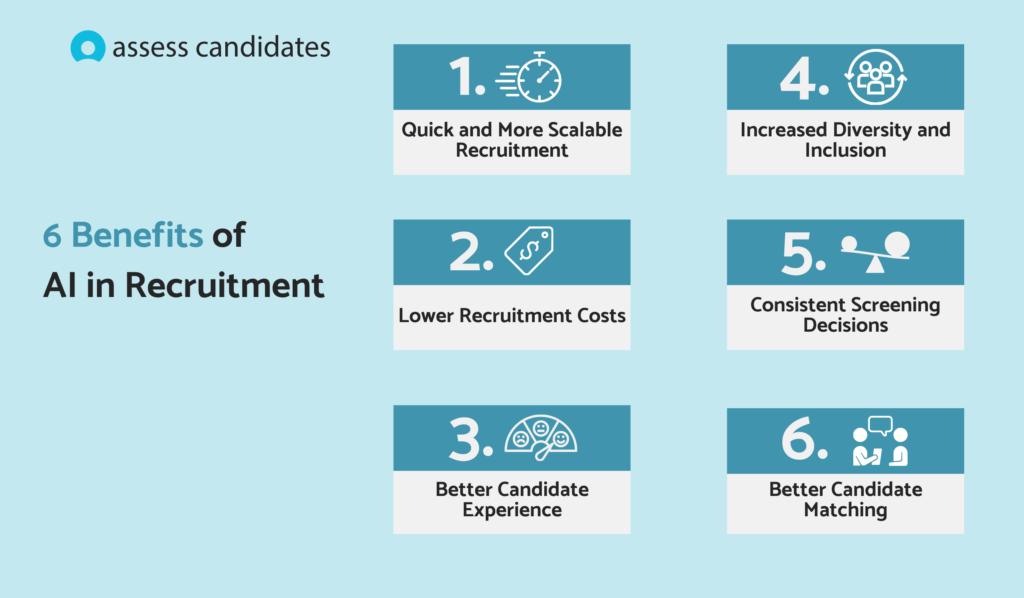
1 . Quick and More Scalable Recruitment:
Thousands of applications can be processed in minutes using AI automation. This reduces the manpower and time-to-hire of the recruiters, especially in large-scale employment.
2 . Better Candidate Matching:
AI candidate matching applies job requirements, skills, experience, and evaluation outcomes to find a match. This enhances the quality of the shortlist and minimizes guesswork.
3 . Consistent Screening Decisions:
AI uses the same standards for all applicants. Such consistency helps in making fair decisions as well as decreasing subjective screening at the early stages of decision-making.
4 . Better Candidate Experience:
AI candidate engagement tools provide faster responses and automated updates, keeping candidates informed and valued. This also improves acceptance rates and your employer brand.
5 . Lower Recruitment Costs:
AI makes it easier to hire employees, minimizes paperwork, and also enables your workforce to be staffed without significantly relying on external recruiters. In the long term, this saves costs in recruitment.
6 . Increased Diversity and Inclusion:
AI reduces unconscious bias and leads to more diverse hiring outcomes by ensuring that screening during the initial stages is standardized and focused on objective data.
According to companies, AI in recruitment saves 30% of the cost of recruitment, reduces time-to-hire by 50%, improves talent matching by 67%, and boosts workforce diversity by 35%.
Test candidates confidently with our automated assessments developed by Chartered Scientists. View Plans
Nonetheless, there is no perfect job recruitment tool; AI is no exception. Now, we will look at the weaknesses of AI in recruitment.
3. What Are the Drawbacks of AI in Recruitment?
Although AI enables hiring companies to improve speed and efficiency, it is also associated with some risks. From prejudice and privacy concerns, to lack of a human touch, these disadvantages indicate why human involvement is still an essential part of the recruitment process.
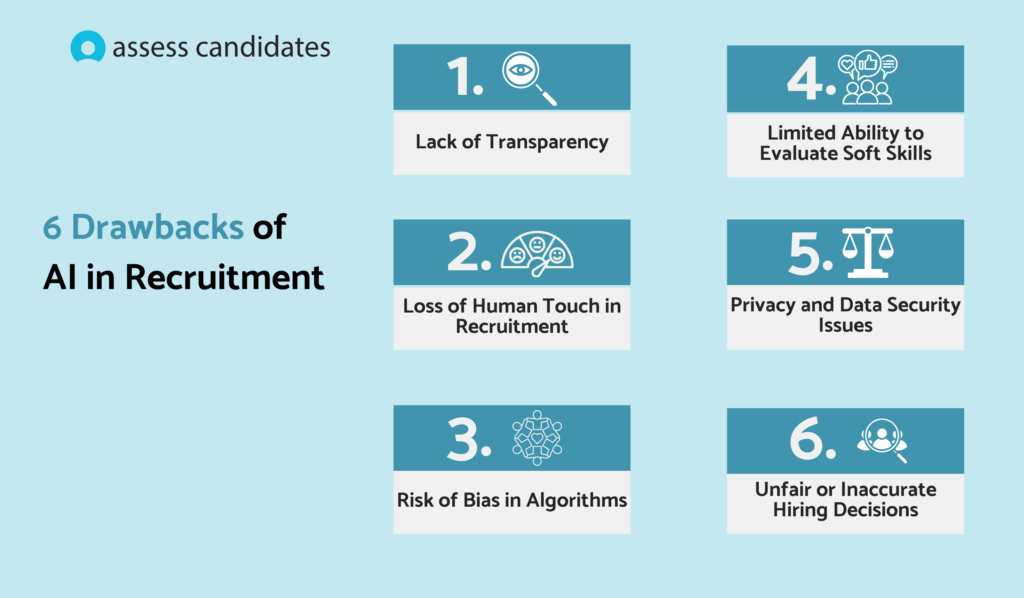
1 . Risk of Bias in Algorithms:
The danger of AI recruitment bias arises when systems are trained on biased past information. Without any supervision, AI might contribute to the increase of inequality, rather than its decrease.
2 . Limited Ability to Evaluate Soft Skills:
AI has difficulties in assessing empathy, leadership style, motivation and cultural fit. These areas still demand human judgment.
3 . Privacy and Data Security Issues:
AI recruiting software relies on large volumes of candidate information. This raises concerns around consent, storage, and regulatory compliance.
4 . Lack of Transparency:
Certain AI tools do not define decision-making processes. This creates trust issues for candidates and recruiters.
5 . Unfair or Inaccurate Hiring Decisions:
AI systems can misread context or put too much weight on certain keywords, formatting or past indicators of success. This can lead to unfair results, especially in cases where you do not fit the AI model to developed and tested job specifications.
6 . Loss of Human Touch in Recruitment:
Candidates still want empathy, clarity, and a meaningful conversation. If AI replaces personal communication, the hiring experience can feel cold and transactional, and that will hurt your employer brand and acceptance rates.
About 40% of HR teams report bias in AI hiring tools, and 26% posit that AI struggles with soft skills, highlighting key recruitment risks.
Elevate your recruitment process using our AI-driven talent tests. Learn More
Having examined the weaknesses of AI in recruitment, let’s take a look at when AI is most effective in hiring.
4. When Does AI Work Best in Recruitment?
The most viable use of AI is in high-volume, repetitive, and data-intensive tasks. Knowing where it can contribute the most value enables recruiters to save time, increase their level of accuracy and make enhanced hiring decisions.
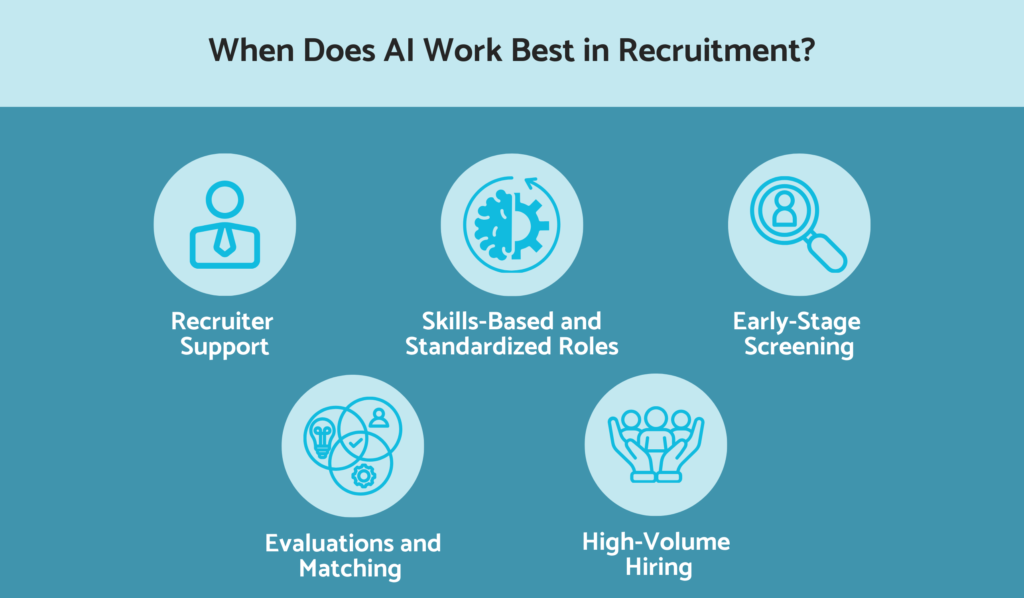
- High-Volume Hiring: AI works better in cases where there is a large number of applicants that recruiters need to work with. Using AI can help make screening resumes, online assessments, and shortlisting faster and more efficient.
- Early-Stage Screening: AI excels at screening candidates according to job-related factors. This helps recruiters to filter and assess quality candidates quickly.
- Skills-Based and Standardized Roles: AI-based recruitment and assessments work best for roles with clearly defined skills and standard measures of success.
- Evaluations and Matching: AI testing increases accuracy in cases where it’s set to the job requirements, enabling more objective recruiting.
- Recruiter Support: AI can be used most effectively when it helps recruiters, rather than replaces them. The AI collaboration in staffing provides better results.
63% of recruiters apply AI to repetitive tasks, cutting time-to-hire by up to 50%.
Use AI where it excels to find top talent faster. HIRE FOR FREE
Although AI is very effective in some stages, it is not suitable for all hiring decisions. Knowing when to proceed with AI carefully ensures fairness, accuracy, and a positive candidate experience.
5. When to Use AI Cautiously in Recruitment
Artificial Intelligence can be incredibly beneficial, but there are areas in the recruitment process where human judgment is necessary. You need to employ AI cautiously to avoid bias, errors, and candidates’ frustration.
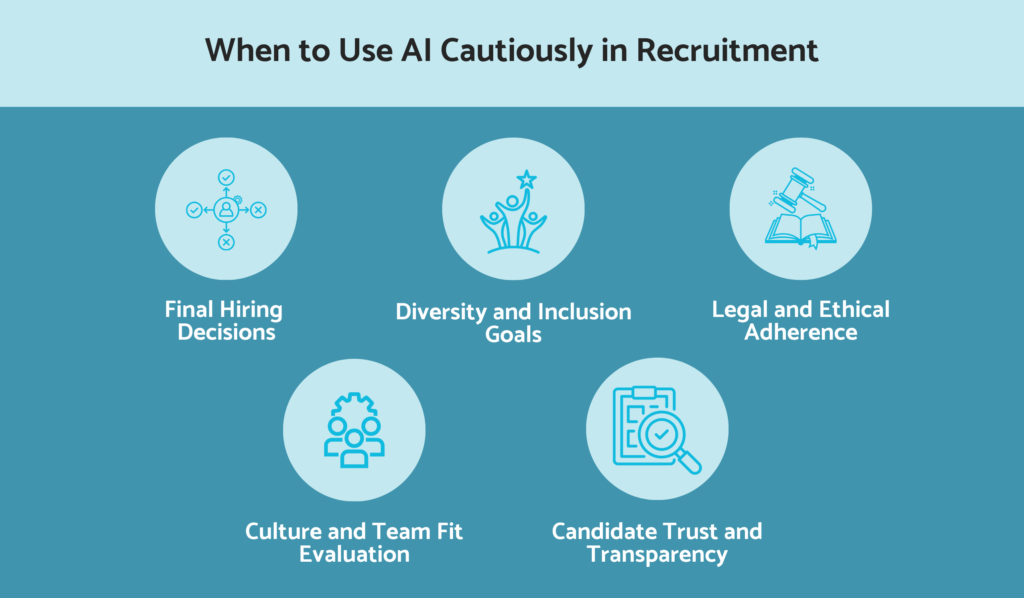
- Final Hiring Decisions: AI should not be used to make final selection decisions. Human insight and responsibility are required in leadership roles and other complex positions.
- Culture and Team Fit Evaluation: AI has limits when it comes to understanding context, values, cultural fit and interpersonal skills, so recruiters should focus on assessing these areas themselves.
- Diversity and Inclusion Goals: AI may negatively affect workplace diversity unless it is checked regularly. The implementation of AI needs to be monitored and adjusted.
- Legal and Ethical Adherence: AI recruitment must meet legal requirements and ethical standards, with clear documentation, transparency, and fairness checks in place.
- Candidate Trust and Transparency: Candidates expect clarity on how AI is used. Clear communication builds trust and protects the employer brand.
26% of hiring teams state that AI struggles to assess soft skills. This necessitates human judgment alongside AI.
Discover top talent faster with AI-driven hiring tools. View Plans
Using AI responsibly comes down to choosing the right tools and partners, ones built for fairness, transparency, and human oversight.
6. Why Assess Candidates is a Trusted Partner for AI-Powered Recruitment
To hire faster without sacrificing fairness, quality, or candidate experience, you need AI tools that support good hiring decisions. Assess Candidates combines AI automation with science-backed tests, allowing you to shortlist the right candidates without doubting your process, while remaining transparent, consistent and human-centered.
How Assess Candidates Uses AI to Help You Hire Better
- Simple, Automated Hiring Technology: Assess Candidates gives you an easy-to-use assessment platform that automates time-consuming hiring processes such as invitations, test delivery, and scoring. This enables your team to spend less time on admin and more time engaging the right candidates.
- Fair, Objective, and Inclusive Hiring: Assess Candidates uses AI to help ensure hiring is fair and inclusive. Our validated tests, developed by Chartered Scientists, assist you in measuring job-related capabilities and potential rather than using gut feeling. The goal is to reduce bias, increase fairness, and support confident, evidence-based hiring decisions without removing human oversight.
- Improved Candidate Experience: Our system tailors the evaluation experience with the information about your hiring campaign, such as the company name and email. This makes the process professional and standardized. There is no guessing on the part of the candidates as regards where they are, which builds confidence in your brand.
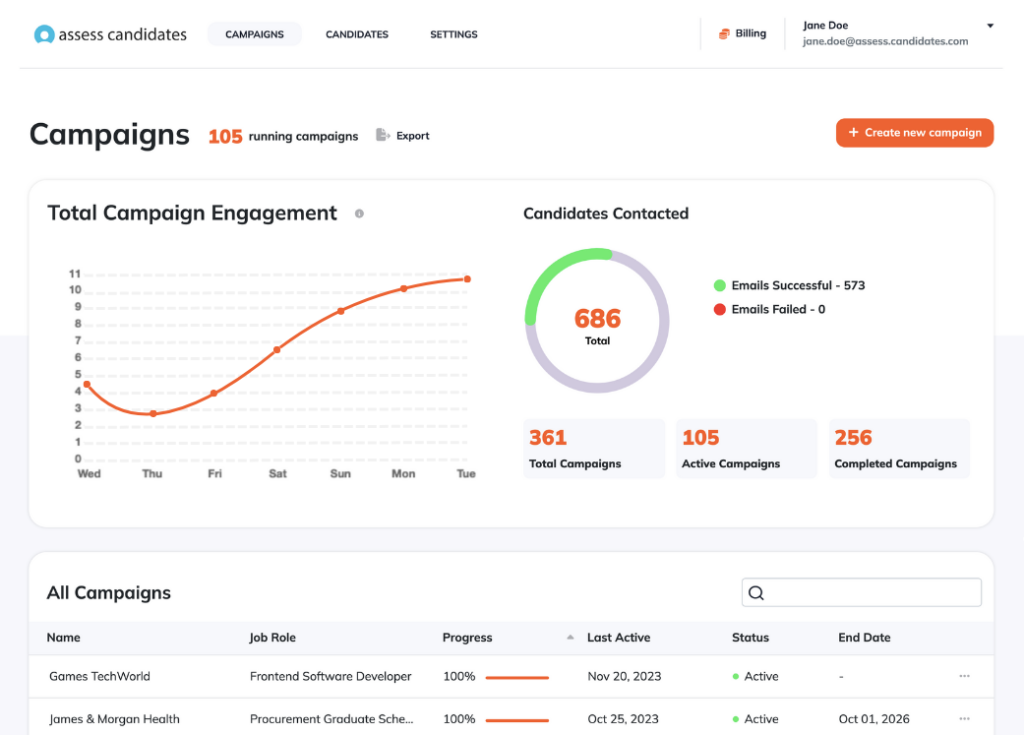
With Assess Candidates, you get a platform that helps to make the hiring process smarter, fairer, and more consistent. It aids your team to be more precise when hiring, establishes a justifiable method, enhances inclusion, reduces administrative work, and offers a better experience to every candidate. Above all, AI does not replace your recruiters but collaborates with them, which means that humans will always be in control of final recruitment decisions.
Conclusion: Key Takeaway
Artificial Intelligence in hiring enables you to work faster, remain consistent, and make clearer hiring choices, provided that you apply it thoughtfully and keep humans in the loop. Optimal outcomes are achieved by letting AI do the monotonous work, such as screening and scheduling, while you handle more complex judgment-heavy decisions like interviewing, culture fit, and final selection.
By matching AI technology with job-related parameters, equity standards, and effective human controls, you create a hiring process that is scalable, defensible, and candidate-friendly. Those who do it effectively reap long-term benefits in quality of hire, recruiter productivity, and overall hiring performance without sacrificing the human component of the hiring process appreciated by applicants.
Recruit the best candidates with AI-powered tools that support fair, data-driven hiring. HIRE FOR FREE
Would you like to know more about AI in recruitment? Explore the FAQs below and sign up with your email to get started!
Frequently Asked Questions
How can AI reduce hiring bias in recruitment?
AI in recruitment helps you reduce bias by applying consistent, job-related criteria to every applicant. You eliminate many gut-feeling decisions and substitute them with measured, validated evaluations. However, regular bias audits, fairness checks, and human control to put the system on the right path are still needed
How effective is AI in recruitment?
AI is effective in early-stage screening, large-scale recruitment, and evaluation analytics. It makes resume review more rapid, increases the accuracy of shortlisting, and provides you with more transparent information, which can be used to make decisions.
Can AI make unfair or inaccurate hiring decisions?
Yes. If you give AI biased or incomplete information, it can amplify those biases. It can also be over-focused on keywords, formatting or narrow success profiles. This is why you have to correlate AI tools with the proven job requirements and fairness testing.
How reliable is AI at assessing soft skills and culture fit?
AI still struggles with empathy, motivation, leadership style, and cultural fit.These areas require structured interviews, behavioral assessments, and experienced recruiters. Think of AI as support, not a replacement.
Is AI in recruitment legal?
Yes, though you have to adhere to EEOC guidelines, data privacy regulations and local regulations on AI. Numerous states have adopted bias audits, transparency communications, and documentation in instances where AI is involved in hiring decisions to ensure ethical use of AI.
What’s the best way to combine AI and human judgment?
Let AI handle screening, matching, scheduling, assessments, and analytics. Let humans focus on interviews, decision-making, soft-skill evaluation, and candidate relationships. This balance gives you speed without losing fairness or human judgment.


 English
  Arabic