
How to Use AI and Automation Ethically in Recruitment



In 2025/26, organizations are increasingly adopting Artificial Intelligence (AI) and automation to streamline hiring, while raising important questions about their ethical use. Although technological advancements have led employers to place greater trust in AI, concerns persist around potential bias, data privacy, and the risk of over-reliance on algorithms.
According to Harvard Business Review (2019), many AI and automation tools promise to help organizations improve hiring efficiency and select top talent. And as noted by Codeaid, AI can increase recruiting productivity by 60%. Many companies are therefore turning to innovative pre-employment assessment tools, such as automated psychometric tests and AI-powered video interview platforms, to recruit candidates.
When used responsibly and ethically, AI and automation can ensure fair and unbiased recruitment, allowing hiring managers to assess candidates based on skills, competencies, and cultural fit beyond just credentials. Companies embracing these tools have seen stronger alignment between hires and company values and goals due to being the right fit for the role and organization.
If you have questions like the following on your mind:
- Are AI automations more effective than human recruiters?
- What is the primary function of AI in a recruitment process?
- What are automated hiring tests?
- How can I use AI ethically to hire Gen Z employees?
Then this guide holds the answers!
Whether you’re a recruiter, hiring manager, or talent acquisition professional, this article provides valuable insights, key benefits, challenges, and practical strategies for ethical AI and automation in recruitment. It will help you confidently identify candidates with the right skills who align with your team and company culture.
Firstly, we will look at what is AI in recruitment, its ethical considerations, and how it benefits companies for hiring.
Contents
- What is AI in recruitment?
- What are the top examples of AI in recruitment?
- How is AI used in pre-employment testing?
- Why is AI automation used in the hiring process?
- How to use AI and automation ethically in hiring?
- What are the risks of not using AI and automation ethically in recruitment?
- What is the future of AI in hiring?
- How can Assess Candidates help you achieve your goal in hiring best-fit applicants?
1. What is AI in recruitment?
AI in recruitment refers to the use of artificial intelligence technologies to automate, optimize, and enhance various stages of the hiring process. These technologies include machine learning algorithms, natural language processing, and data analytics, which streamline time-consuming tasks like candidate sourcing, resume screening, interview scheduling, and talent assessment.
By reducing manual effort, AI aims to improve efficiency, reduce bias, and support more accurate, data-driven hiring decisions.
When used ethically in hiring, AI and automation empower employers to promote positive work environments with individuals who align with organizational values and motivation. Using AI to recruit the right candidates reduces unconscious bias, leading to increased job satisfaction, higher retention rates, and greater long-term productivity and growth.
LinkedIn’s 2024 Workforce Report reveals that 75% of HR professionals believe skills-based hiring is the future of recruitment. Ethical AI and automation tools support this shift by filtering applicants based on their skills, not just their CVs, to select only those best suited to succeed in the role.
Use our science-backed automated assessments to hire top talent who best fit your role and company. HIRE FOR FREE
What is the difference between human and AI recruitment?
The key difference between human and AI recruitment lies in the strengths and weaknesses of each approach. Human recruiters excel at building relationships, understanding subtle cues and emotions, and making nuanced decisions based on intuition and experience. In contrast, AI excels at handling large volumes of data, automating repetitive tasks, and providing objective analysis.
Let us now explore how AI recruitment compares to traditional human-led hiring and how it can enhance, rather than replace, your role as a recruiter.
Now that you can distinguish between human recruiters and AI automation, you can weigh your options between the two, especially when looking to hire without bias.
Now, let’s examine some top uses and examples of AI and automation in recruitment.

2. What are the top examples of AI in recruitment?
AI is now embedded across nearly every stage of the hiring process to streamline workflows and improve decision-making. You will likely come across the uses of AI in recruitment when sourcing candidates, screening and tracking applications, and assessing fit.
Below are 9 of the most common and effective AI and automation tools transforming recruitment today:
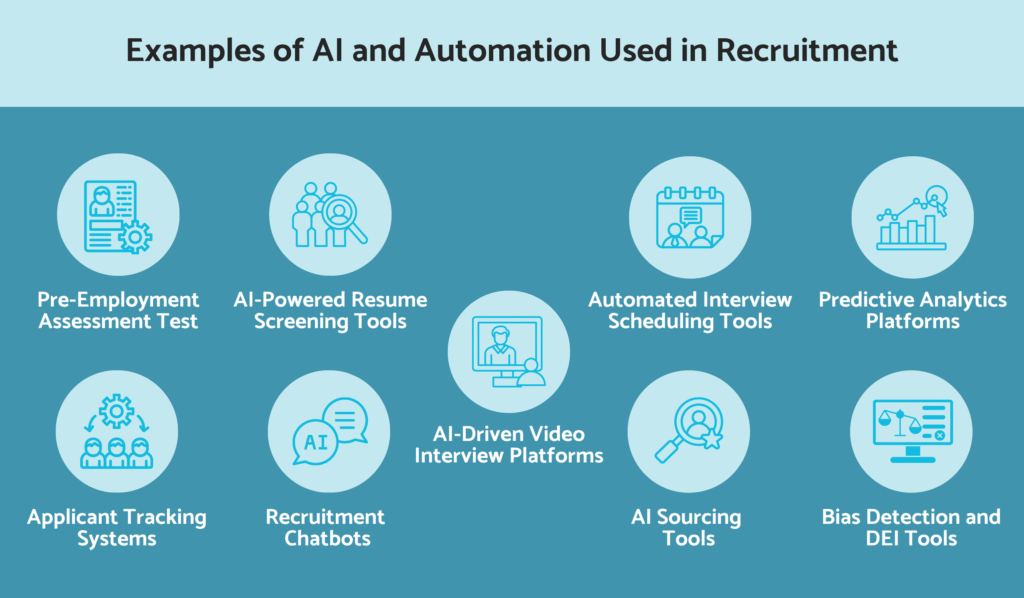
1. Pre-Employment Assessment Tests
AI automation is a powerful tool in pre-employment assessment tests, enhancing the efficiency and effectiveness of candidate evaluation. These tools assess candidates across multiple aspects objectively and at scale, including cognitive skills, technical expertise, workplace behaviors, personality traits, and cultural fit.
AI enhances pre-hire assessments by automatically analyzing responses for accuracy and speed, providing objective, consistent scoring, and recognizing patterns that predict job success. Additionally, it supports adaptive testing, adjusting question difficulty in real-time according to the candidate’s performance. Companies like Unilever, Deloitte, and Hilton already use AI-automated pre-employment tests as part of their recruitment process.
Popular platforms offering AI-powered assessments are Assess Candidates, HireVue, and Pymetrics.
2. Applicant Tracking Systems (ATS)
ATS software is another example of AI in recruitment, used by companies like Google, Accenture, and Microsoft, to manage and streamline the application process. These systems collect, organize, and track candidate information throughout the hiring journey. ATS platforms can also automatically screen CVs using keyword algorithms, filter applicants based on qualifications, and integrate with job boards and career sites, saving time and reducing manual effort.
Examples of ATS softwares are Greenhouse, Zoho Recruit, and SmartRecruiters.
3. AI-Powered Resume Screening Tools
These AI recruitment tools use machine learning algorithms to screen resumes and match candidates to job descriptions. Companies like Coca-Cola, PwC, and Amazon, particularly for roles in marketing, use AI-powered resume screening tools to analyze candidates’ skills, experience, education, and career progression, ranking them based on relevance. This speeds up the shortlisting process and adds consistency and objectivity to the evaluation of resumes.
Some AI-powered resume screening tools include Jobscan and Eightfold.ai.
4. Recruitment Chatbots
Companies like L’Oreal, Siemens, and Accenture use AI recruitment chatbots to engage with candidates in real-time, answering frequently asked questions, collecting initial application data, and assisting candidates in navigating the hiring process. By automating early-stage communication, chatbots enhance the candidate experience, increase engagement, and streamline time-consuming tasks, allowing recruiters to focus on higher-value jobs.
Examples of these chatbots are JobPal, Talla, and Mya.
5. AI-Driven Video Interview Platforms
Video interview platforms ask candidates to record their responses to pre-set interview questions in video format. When powered by AI, these platforms then analyze the content and delivery of those responses through language, tone, and facial expressions, providing hiring teams with data-driven insights to support more objective and consistent candidate evaluations. Companies like Goldman Sachs, Deloitte, and Amazon particularly when hiring for financial analysts utilize AI-driven video interview platforms as part of their hiring process.
Video interview platforms with AI are becoming increasingly popular among companies to enhance candidate evaluation. Examples include Assess Candidates, XOR, Spark Hire, Talview, and Pymetrics.
Discover our AI-powered video interviews to streamline hiring and make objective, consistent decisions. LEARN MORE
6. Automated Interview Scheduling Tools
Automated interview scheduling tools, such as those used by Google, Walmart, and Slack, eliminate the hassle of coordinating interviews by syncing calendars, integrating email systems, and suggesting available time slots to candidates. Once a time is selected, the system sends automated confirmations and reminders. This reduces scheduling delays and improves overall efficiency in the recruitment workflow.
Examples are Vidcruiter, GoodTime, and Calendly.
7. AI Sourcing Tools
AI-powered sourcing platforms proactively search for potential candidates across multiple online sources, such as job boards and internal databases. They analyze job requirements and identify matching profiles, often ranking candidates by fit. This enables recruiters to identify top talent more quickly and strategically. Companies that utilize AI sourcing tools include Amazon, LinkedIn, and PwC, among others.
Examples of these tools are Fetcher, hireEZ, Hiretual, Entelo, and many more.
8. Predictive Analytics Platforms
Predictive analytics platforms utilize data from past hiring decisions to forecast which candidates are most likely to succeed in a specific role. By analyzing performance trends, tenure, and cultural fit, predictive tools enable companies like Microsoft, General Electric, and Bank of America to gain key insights, optimize operations, and make more informed, long-term hiring decisions.
Examples of these platforms are HireVue, Pymetrics, and LinkedIn Talent Insights.
9. Bias Detection and DEI Tools
Ethical recruitment often includes the use of AI tools that can detect bias in job descriptions, application forms, and hiring patterns. These systems automatically flag biased language, recommend neutral alternatives, and track demographic data to support diversity, equity, and inclusion (DEI) goals. They help companies, such as Facebook (Meta), Adobe, and Accenture, to create a fairer and more inclusive hiring process.
The following are examples of bias detection and DEI tools: Blendoor, DiversityInc, Unbiasify.
After discussing the primary examples and uses of AI and automation in recruitment, let’s explore more specifically how employers can utilize AI automations during pre-employment testing.
3. How is AI used in pre-employment testing?
Once candidates pass through initial screening stages like CV filtering or ATS sorting, many companies use AI-driven pre-employment assessment tests to assess shortlisted candidates in more detail.
The most common types of AI-automated tests include:
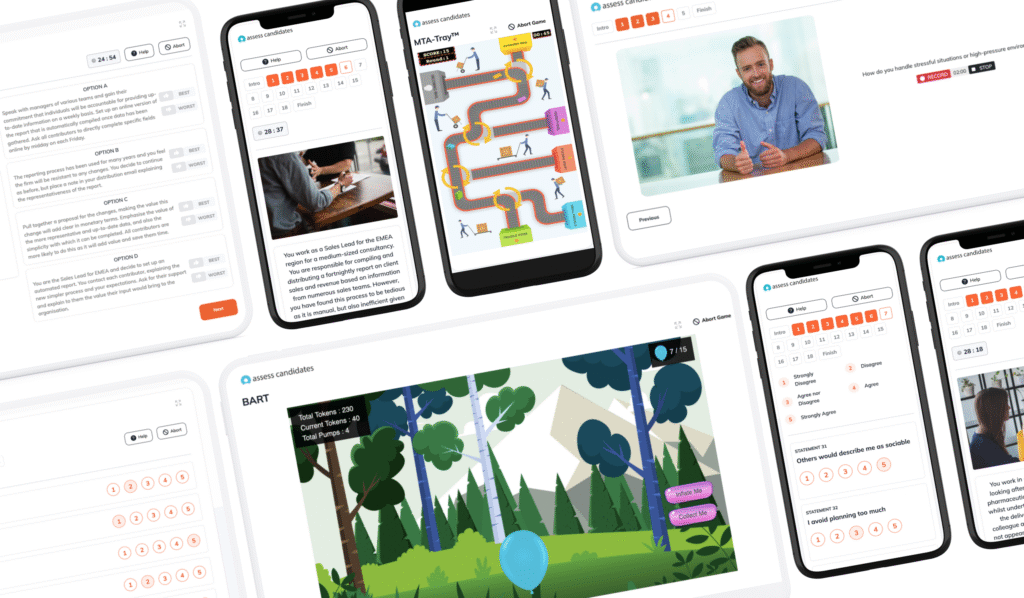
Without further ado, let’s explore how AI enhances each of these assessments:
Psychometric Tests
A lot of global companies use psychometric tests in their hiring processes to ensure early on candidates are the right fit for the role and organization. These assessments measure a range of job-relevant traits and include:
- Numerical Reasoning Tests
- Logical Reasoning Tests
- Verbal Reasoning Tests
- Abstract Reasoning Tests
- Diagrammatic Reasoning Tests
- Critical Reasoning Tests
- Error-Checking Tests
AI is revolutionizing psychometric testing, making it faster, more adaptive, and more predictive.
Here are key 4 ways AI is used in psychometric testing:
- Test Design and Personalization: AI is improving psychometric testing by making assessments more adaptive and personalized. For instance, adaptive tests use AI to tailor questions in real time based on a candidate’s responses, allowing for more accurate measurement of abilities with fewer questions and less stress.
- Personality and Behavioral Analysis: When analyzing work personality and behaviors, AI interprets results from tests such as the Big Five or situational judgment tests to identify patterns that align with specific roles or organizational cultures.
- Predictive Analytics: AI is also used in predictive analytics to link psychometric test results with job performance data. If top performers share certain psychological traits, AI can use that information to help identify candidates with similar profiles.
- Scoring and Interpretation: AI can deliver immediate results and provide quantifiable insights into complex personality or cognitive profiles, enabling recruiters to make faster, more informed decisions.
Some providers for psychometric tests are Assess Candidates, SHL, and TestGorilla.
Game Assessments
Game-based assessments, unlike traditional tests or interviews, are an interactive, engaging evaluation tool that accurately measures candidates’ job-relevant skills, traits, and cognitive abilities through short game-like tasks.
AI, in the form of machine learning algorithms and behavioral data points, tracks behaviors, decision-making patterns, and performance to evaluate how quickly candidates respond, strategize, make decisions under pressure, and problem solve.
These games boost candidate experience while providing deep insights for employers.
Providers of game-based assessments are Assess Candidates and HireVue.
Check out our range of popular game assessments to hire candidates below:
Here are the top 4 ways AI is used in game-based assessments:
- Adaptive Difficulty Adjustment: AI continuously monitors a player’s performance during gameplay and dynamically adjusts the difficulty level of tasks accordingly. This ensures that the assessment remains appropriately challenging, preventing boredom from overly simple tasks or frustration from those that are too difficult.
- Personalized Task Sequencing: AI personalizes the sequence and type of tasks based on each player’s behavior and responses. This customization allows for a more accurate assessment of strengths and weaknesses, adapting to the user’s pace and learning style.
- Machine Learning for Trait Prediction: Machine learning algorithms trained on large datasets link gameplay patterns with psychological traits or performance. These models can predict traits such as emotional stability, reasoning, and leadership based on player interactions.
- Scalability and Automation: AI automates a significant portion of the assessment process, from data collection to scoring and interpretation. This enables organizations to efficiently assess large numbers of individuals, eliminating the need for human evaluators at each session and ensuring consistency in evaluation criteria.
Video Interviews
Video interviews use live or recorded video to assess candidates remotely, saving time and reducing scheduling issues. AI-powered video interviews analyze verbal and non-verbal cues, including facial expressions, tone, and speech patterns, to evaluate skills and fit, streamlining the hiring process without requiring constant human oversight.
Companies that provide video interviews are Assess Candidates and HireVue.
Here are the 4 top functions of AI in video interviews:
- Behavioral Pattern Recognition: AI analyzes how consistently and naturally candidates respond to different types of questions. For example, it may track reaction times, body language shifts, or use of filler words, offering insights into traits like composure, adaptability, and thoughtfulness.
- Scoring and Ranking Candidates: Based on predefined competencies and benchmarks, AI can automatically score candidates. It compares their verbal and non-verbal indicators to ideal profiles and ranks applicants based on cultural fit, efficiency, and potential.
- Voice and Speech Analysis: AI evaluates aspects of a candidate’s speech, such as tone, pitch, volume, pace, and clarity. It can detect enthusiasm, hesitation, confidence, and communication skills based on how someone speaks, not just what they say.
- Candidate Screening at Scale: AI enables organizations to screen hundreds or thousands of video interviews efficiently without overloading HR teams. It allows early-stage filtering so human interviewers can focus on top-tier candidates.
Interested in hiring candidates using pre-employment psychometric tests, games, and video interviews? HIRE FOR FREE
Next up: why are companies using AI and automation in hiring?
4. Why is AI automation used in the hiring process?
Human recruiters have been the primary method of recruitment for decades. However, with the evolution of technology and the introduction of AI and automation, many time-consuming tasks and roles have been replaced, raising the question of why AI is being used in HR and recruitment?
What are the benefits of AI in recruitment?
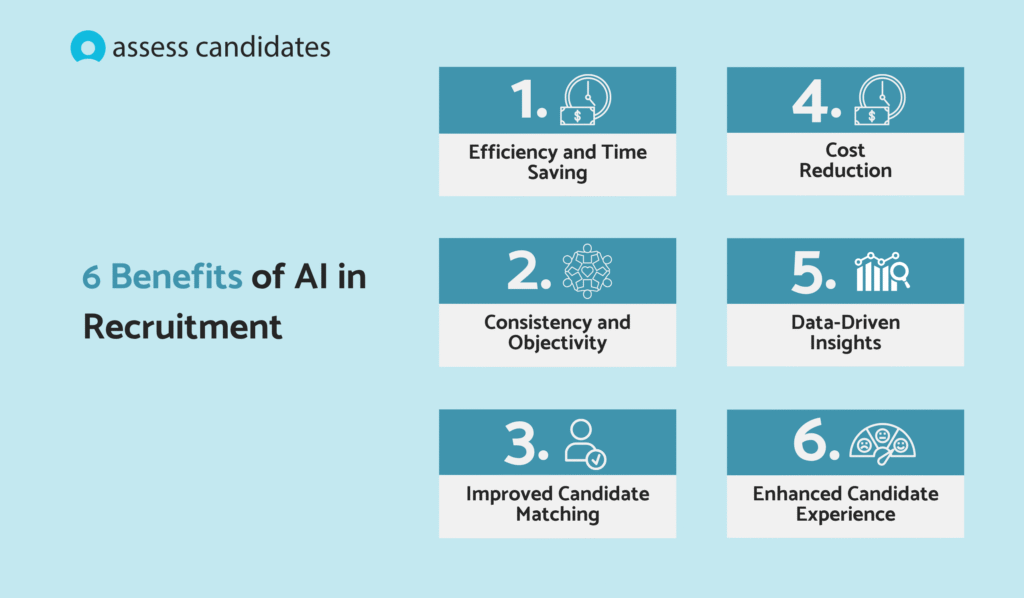
Here are the top 6 reasons AI automation is so popular in hiring:
- Efficiency and Time Saving: AI can quickly analyze resumes, applications, and candidate profiles, significantly reducing the time it takes to review large volumes of applications. For example, AI-powered chatbots or video interview software can conduct initial interviews, ask standardized questions, and even analyze candidates’ responses, which helps save recruiters’ time.
- Consistency and Objectivity: When designed correctly, AI systems can help reduce human biases in the hiring process by focusing solely on skills and competencies. AI also applies standardized criteria to all candidates, ensuring that every candidate is assessed consistently, reducing the chances of favouritism or subjective judgment.
- Improved Candidate Matching: AI tools can analyze a candidate’s skills, qualifications, and work experience against job requirements, ensuring that only the most suitable candidates are selected for the position. They also utilize predictive models to identify candidates who are more likely to succeed in a role, based on historical data from previous hires.
- Cost Reduction: Automating parts of the hiring process means fewer resources are required for manual tasks, such as resume screening or initial candidate vetting. This can help companies reduce recruitment costs.
- Data-Driven Insights: AI tools collect valuable data during the recruitment process, allowing employers to evaluate the effectiveness of their hiring strategies and adjust their approach accordingly.
- Enhanced Candidate Experience: AI can help ensure that candidates receive quicker responses regarding their application status, whether they are moving forward or being rejected. It can also provide personalized feedback to candidates based on their reactions during interviews or assessments, improving the candidate experience.
Explore reliable automated assessments developed by Chartered Scientists for candidate evaluation. VIEW PLANS
Now we have covered what AI in recruitment is, how it is used, and why, let’s dive into some practical best practices to ensure you use AI and automation ethically for hiring. This next section will explain everything you need to know.
5. How to use AI and automation ethically in hiring?
To harness the full potential of AI in recruitment, you must use it ethically and transparently. Ethical AI hiring demands selecting responsible technologies, being open about how decisions are made, and a strong commitment to fairness, privacy, and inclusion throughout the process.
Best strategies for ethical AI and automation in recruitment
While many employers praise AI and automation for their effectiveness in streamlining the recruitment process, sourcing 75% more candidates than traditional methods, there are also concerns regarding their ethics and privacy violations.
Below are some proven methods of using AI ethically in recruitment:
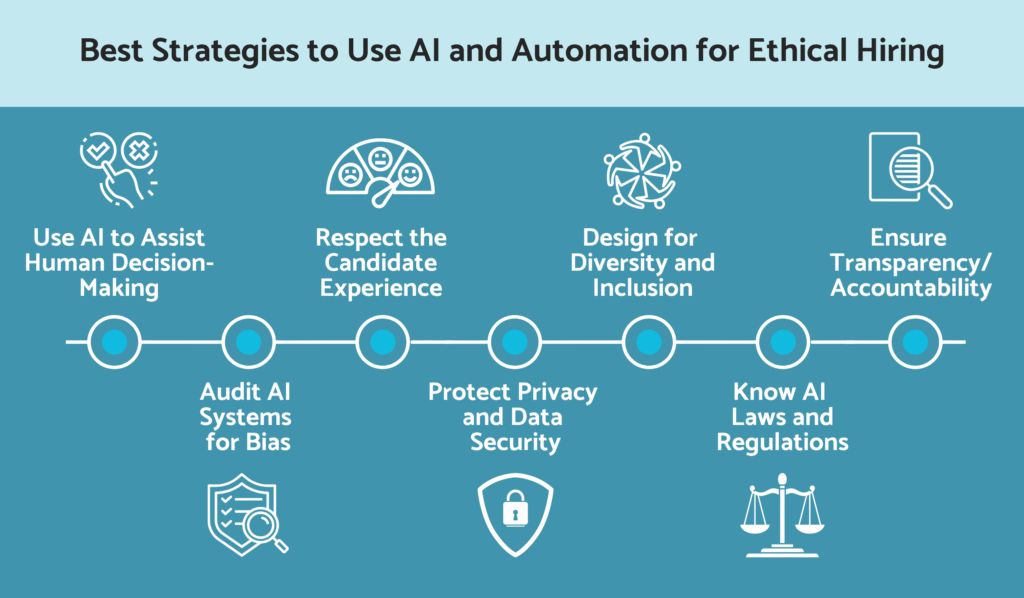
Use AI to Assist Human Decision-Making
AI should support recruiters by handling repetitive tasks (like resume screening or scheduling), but final hiring decisions should remain with humans. This maintains accountability and ensures empathy and context are not lost.
Audit AI Systems for Bias
Ensuring fairness and accessibility in AI algorithms is crucial for preventing conscious or unconscious bias and discrimination against candidates with disabilities or those from underrepresented groups. You should also implement accessible tools and technologies, such as text-to-speech or captioning for video interviews, to accommodate various needs and make the process inclusive for all applicants.
Respect the Candidate Experience
Like fully AI-driven interviews, over-automated interviews can create a cold, impersonal process. Ethical use means using AI to enhance efficiency but preserving human interaction where it matters, such as in interviews or feedback. This ensures a human-centric, positive candidate experience.
Protect Privacy and Data Security
AI systems collect and process personal information. You should ensure that all data handling complies with privacy laws and inform candidates about how you will use their data.
Design for Diversity and Inclusion
Ethical AI should be intentionally designed to support diverse hiring by mitigating unconscious bias in algorithms, using inclusive language in job ads, and widening talent sourcing.
Know AI Laws and Regulations
Staying updated on AI laws and regulations is crucial for organizations using AI in recruitment and other processes. As AI technology evolves, governments and regulatory bodies introduce new rules to ensure ethical use, prevent discrimination, and protect privacy.
Ensure Transparency and Accountability
To ethically use AI and automation in recruitment, you must be open with candidates about the hiring and assessment process. They should know the extent to which their data will be used by AI and the company’s stand against using the collected data for malicious or external purposes.
When implemented consciously and carefully, ethical AI-driven recruitment enhances fairness, reduces bias, and supports inclusive hiring practices. Contact us and get a complimentary analysis of your recruitment process and how you can use AI and automation to build a diverse and high-performing workforce with ethical strategies. We will be happy to guide you!
Enhance your role as a recruiter with a reliable AI-powered talent assessment platform. LEARN MORE
Now that we have understood the requirements of ensuring ethical automation recruitment, you must know the ethical risks and considerations if you don’t use AI and automation correctly during hiring.
6. What are the risks of not using AI and automation ethically in recruitment?
According to the Harvard Business Review, AI algorithms trained on historical hiring data can unintentionally embed biases against specific demographic groups. When human biases shape AI, it may internalize and reproduce those patterns, even without explicit awareness of its gender or ethnicity discrimination.
What are the ethical risks of AI in recruitment?
These are the 6 top risks of not using AI ethically in recruitment:
- Bias and Discrimination: If AI tools are trained on biased historical data, they can reinforce existing inequalities, such as favouring certain genders, ethnicities, or educational backgrounds. This can result in unfair hiring practices and legal exposure for discriminatory outcomes.
- Legal and Regulatory Risks: Using AI in a way that leads to discrimination or privacy violations can breach employment and data protection laws. Organisations may face lawsuits, fines, and reputational damage if found to be non-compliant.
- Loss of Candidate Trust: When candidates feel that recruitment is overly automated or lacks transparency, it undermines trust. People may withdraw from the process or speak negatively about their experience, thus damaging the company’s employer brand.
- Reduced Diversity and Inclusion: Ethically misused AI can exclude qualified candidates from underrepresented groups, weakening diversity efforts. A lack of diverse hires affects team performance and innovation, and poorly reflects a company’s values and culture.
- Ineffective Hiring: Over-reliance on poorly designed AI systems can lead to poor hiring decisions, either overlooking top talent or selecting candidates based on flawed data. This can lead to a reduction in workforce quality and an increase in turnover.
- Damage to Employer Reputation: The unethical use of AI in hiring can lead to negative publicity, particularly if bias or unfair practices are exposed. This can deter customers and future applicants, affecting brand loyalty and talent acquisition.
So, with the pace of technology advancing, what does the future of AI and automation in recruitment look like?
7. What is the future of AI in hiring?
The future of AI and automation in hiring is shaping up to be transformative, with several key trends and advancements expected to play a significant role. As technology advances, ethical and intelligent AI automation will become central to how companies attract, assess, and retain top talent.
Here are the top trends that will define the future of ethical AI-powered recruitment:
- AI-Driven Candidate Sourcing and Screening
AI will enhance recruitment through automated sourcing and intelligent screening. It will scan multiple platforms to identify qualified candidates and utilize advanced algorithms with Natural Language Processing (NLP) to contextualize resumes, thereby reducing manual effort and enhancing the accuracy of matches.
- Bias Reduction
AI can minimize hiring biases by using data-driven algorithms that objectively assess candidates based on their qualifications and experience. This necessitates training AI on diverse data. Consequently, many companies are developing AI systems designed to promote fairness and eliminate demographic biases.
- Automated Interviewing
Companies globally will increasingly adopt AI recruitment tools, such as our Assess Candidates video interview tool, to evaluate candidate skills. These tools utilize AI to analyze responses based on speech, tone, facial expressions, and body language, ensuring both qualifications and cultural fit. AI skills assessments, including coding tests, deliver faster and unbiased results.
- Predictive Analytics
AI will analyze historical data and patterns to identify the best candidates for a role and predict their long-term retention and cultural fit. This enables recruiters to make more informed, data-driven decisions, reducing reliance on intuition and minimizing bias in the hiring process.
- Continuous Learning and Adaptation
AI systems in hiring will continue to evolve through machine learning, becoming increasingly accurate in matching candidates as they adapt to shifting job market trends and evolving hiring practices. By analyzing data over time, these systems can refine their algorithms to predict candidate success better and improve overall recruitment outcomes.
- Ethical and Legal Considerations
As AI increasingly influences hiring, ethical and legal challenges, particularly concerning data privacy and discrimination, intensify. Companies must ensure the transparency, auditability, and compliance of their AI systems with labor laws while actively reducing algorithmic bias to avoid perpetuating inequalities.
- Job Creation in AI and Automation
While AI and automation will facilitate hiring processes, new jobs will emerge around the development, maintenance, and oversight of these systems. Employers will increasingly demand AI specialists, data scientists, and ethicists to apply AI responsibly in their hiring processes.
In a nutshell, AI automation in recruitment will continue gaining significant traction across various sectors due to its ability to streamline processes, improve efficiency, and enhance decision-making.
Employers are increasingly leveraging cost-effective, automated pre-employment assessment tools and AI-powered automation within hiring platforms to improve candidate evaluation. Trusted third-party SaaS providers deliver reliable solutions with flexible pricing models that can accommodate any recruitment volume or need, helping organizations overcome infrastructure challenges like outdated technology or limited budgets for implementing candidate testing systems.
This is where Assess Candidates plays a vital role, supporting leading companies in making the right hiring decisions throughout their recruitment process.
8. How can Assess Candidates help you achieve your goal in hiring best-fit applicants?
Most companies choose Assess Candidates because it offers a streamlined, data-driven approach to accurately and efficiently evaluate applicants’ skills, competencies, and behaviors, utilizing its:
- Cognitive ability tests
- Big Five personality test
- Situational judgment tests
- Game-based assessments
- Video interviews
Our platform provides a wide range of customizable assessments tailored to various roles and industries, allowing employers to identify top talent based on actual ability, not just resumes. Its user-friendly interface, reliable scoring, and real-time analytics help hiring teams make informed decisions quickly.
Assess Candidates supports fair and unbiased evaluations, contributing to more equitable hiring practices and better long-term hiring outcomes.
5 reasons companies should use Assess Candidates’ recruitment assessments to assess applicants’ abilities and cultural fit
- Real-Time Insights and Analytics: Assess Candidates provides instant, data-driven insights into candidate performance, helping recruiters make informed decisions at every stage of the hiring process.
- Objective Skill Evaluation: Assess Candidates helps evaluate applicants based on their skills and performance, not just their resumes. This ensures that hiring decisions are based on data and merit, thereby reducing the influence of unconscious bias.
- Scalable for Any Hiring Volume: Whether hiring for a single role or conducting high-volume recruitment, Assess Candidates scales easily to meet your needs. Its SaaS-based model is flexible and cost-effective, supporting small and large enterprises.
- Enhanced Candidate Experience: Candidates benefit from a smooth, user-friendly interface with clear instructions and accessible formats, contributing to a positive impression of your employer brand.
- Automation of Routine Tasks: From screening and assessments to scheduling and communication, Assess Candidates automates repetitive tasks, freeing HR teams to focus on strategic work and meaningful interactions with top talent.
Assess Candidates is a trusted provider of pre-employment assessment solutions, offering accurate, end-to-end testing for employers of all sizes, from small businesses to large enterprises.
Our intuitive platform makes it easy to identify and recruit top talent confidently. Explore our leading assessment tools today and start making smarter, more informed hiring decisions!
Interested in knowing more about how to use AI and Automation in recruitment ethically? Continue scrolling to learn more about the frequently asked questions, and sign up with your email to get started.
Frequently Asked Questions
What is Machine Learning?
Machine learning, in the context of AI, refers to a subset of AI that focuses on building systems that can automatically learn from data and improve their performance over time without requiring explicit programming.
How can we ensure candidate consent when using AI tools?
Maintain transparency to ensure candidate consent for AI in recruitment. Begin by disclosing the role of AI in hiring and its effects. Provide consent forms for AI assessments and offer opt-out options for individuals who prefer human evaluations. These steps foster trust and uphold ethical standards.
Are there certifications for ethical AI recruitment tools?
Yes, some organizations and independent bodies certify AI tools for their adherence to ethical practices. These certifications, such as AWS Certified AI Practitioner, Ethical AI Certification by CertNexus, and IAPP AI Governance Professional (AIGP), evaluate and ensure the tool’s fairness, transparency, and privacy standards.
Can AI improve diversity in recruitment?
Yes, AI has the potential to promote diversity by removing human biases. When appropriately designed, AI can focus on skills and qualifications rather than subjective factors (like appearance or social background) that might otherwise influence human recruiters.
How can we explain AI decisions to candidates?
AI decisions should be clearly communicated to candidates, explaining when and why AI is used in the recruitment process. Organizations should also provide accessible evaluation reports and offer the right to appeal, allowing candidates to request a second review if they believe an error has occurred.
How is AI being used in HR and recruitment?
AI is being used in HR and recruitment to optimise processes, boost efficiency, and support better decision-making. In recruiting, AI automates resume screening, uses predictive analytics to identify leading candidates, and matches applicants to roles based on their skills and experience. AI-driven chatbots manage candidate questions, arrange interviews, and offer immediate feedback, enhancing the candidate experience and saving time for HR teams.


 English
  Arabic