
How To Improve Your Employer Brand: Effective Strategies To Attract Top Talent



Your employer branding is one of your most powerful tools for attracting and retaining top talent in today’s competitive job market. A strong employer brand goes far beyond protecting company reputation; it showcases the unique culture, values, and employee experience in ways that resonate with candidates and inspire them to choose your organization over others.
Compelling employer branding builds trust and enhances candidate engagement and perception during recruitment, while weak or inconsistent branding can deter qualified candidates and increase turnover rates. For these critical reasons, leading companies invest in building a clear, authentic, and data-driven employer branding strategy to reflect who they are and why candidates should join them.
Did you know? According to a LinkedIn report, 59% of recruiting leaders worldwide are investing more in employer branding.
As candidate expectations rise and job seekers gain more control in the hiring process, recruiters must adopt a holistic approach, combining storytelling, data insights, and digital tools, to shape and promote an employer brand that truly stands out for top talent.
If you’re a recruiter, hiring manager, or talent acquisition expert asking yourself:
- What defines a strong employer brand?
- How does employer branding shape candidate perception?
- What are some employer branding tips?
- Can pre-employment assessments help improve your employer brand?
- Which industries and roles demand stronger employer branding?
Then this article will serve as your go-to guide! Continue reading to discover key strategies to improve your employer branding in recruitment and attract the talent your business needs to grow.
Contents
- What is an employer brand?
- What is the importance of employer branding?
- How does employer branding influence candidate perception during recruitment?
- Effective strategies for enhancing your employer brand
- How do pre-employment assessments help improve your employer brand?
- Which industries are prioritizing employer branding strategies?
- Leading employers using pre-employment assessments to strengthen their brand
- Strengthen your employer brand with Assess Candidates: Why partner with us?
Now, with an overview of what the article covers, let’s dive into defining what an employer branding strategy is.
1. What is an employer brand?
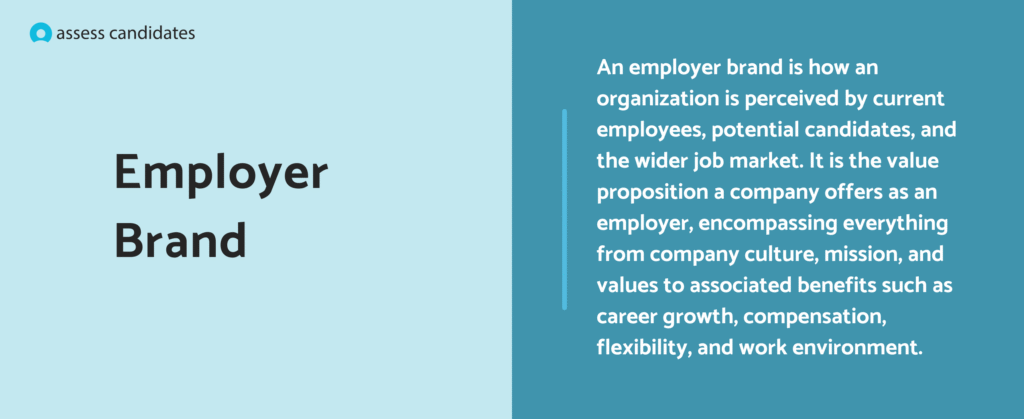
Your employer branding strategy is your opportunity to proactively manage your brand, shape perceptions, and market your organization as a desirable place to work. It is a strategic tool to help recruiters attract, engage, and retain top talent by communicating the company’s differentiating features and benefits.
Did you know? According to LinkedIn, 72% of recruiting leaders worldwide agree that employer branding has a significant impact on hiring success.
Enhance your employer branding strategy with our scientifically validated psychometric tests. HIRE FOR FREE
Company branding vs. Employer branding
Although closely related, company branding and employer branding serve distinct purposes and speak to different audiences.
- Company branding is outward-facing, aimed at showcasing a business’s products or services to customers and the general public.
- Employer branding is inward-facing, shaping how current and potential employees perceive the organization as a workplace.
Below is a detailed breakdown of the key differences between company branding and employer branding.
By aligning both branding strategies, companies can not only drive business growth but also strengthen their talent acquisition efforts, creating a consistent, strong brand inside and out.
Now, let’s take a look at what the employee value proposition (EVP) is in an organization.
What is an employee value proposition (EVP)?
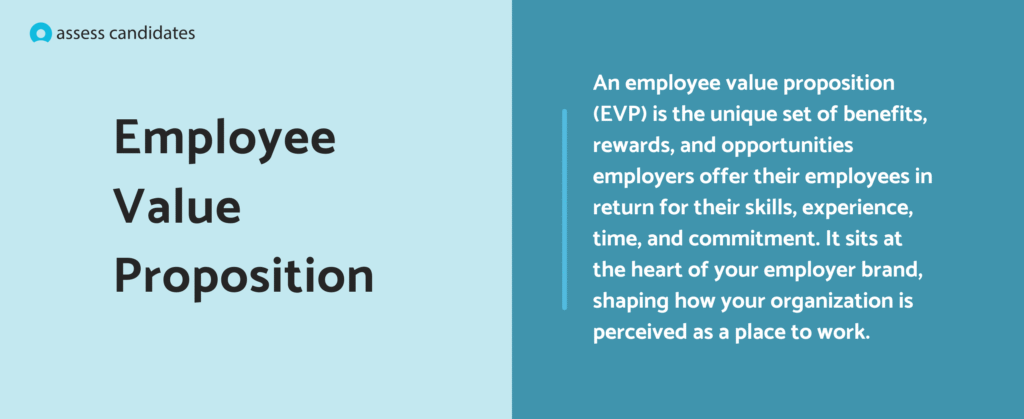
An employee value proposition (EVP) is the unique set of benefits, rewards, and opportunities employers offer their employees in return for their skills, experience, time, and commitment. It sits at the heart of your employer brand, shaping how your organization is perceived as a place to work.
A well-crafted EVP can enhance an employer brand, helping to:
- Attract and retain high-performing talent
- Align employee expectations with company values and goals
- Boost engagement and re-energize a disengaged workforce
- Lower hiring and turnover costs
- Create a consistent, compelling message across all hiring channels
What should you include in your EVP for a strong employer brand?
The 5 key components to include in your employee value proposition are:
- Compensation and Benefits: Competitive salaries, bonuses, stock options, health insurance, retirement plans, and wellness programs.
- Career Growth and Development: Training programs, mentorship, promotion paths, and skill-building facilities, such as tuition reimbursement and certifications.
- Work Culture and Environment: Remote/hybrid work, flexible hours, diversity, equity, and inclusion (DEI) initiatives, collaborative/autonomous work styles.
- Purpose and Impact: Mission-driven work, such as sustainability and social responsibility, and the ways in which employees contribute to larger goals.
- Recognition and Work-life Balance: Employee recognition programs, generous annual leave, parental leave, and sabbaticals.
In short, your EVP is your promise to employees. When it is authentic, specific, and employee-centric, it ensures a resilient and attractive employer brand that acts as a talent magnet in a competitive job market.
Now that we’ve explored the basics of employer branding, let’s discuss its importance.

2. What is the importance of employer branding?
A strong employer brand is more than just an asset for company reputation, it directly influences talent acquisition, recruitment costs, employee retention, and overall organizational success. It serves as a powerful differentiator in a competitive hiring market that shapes how both candidates and employees perceive your company.
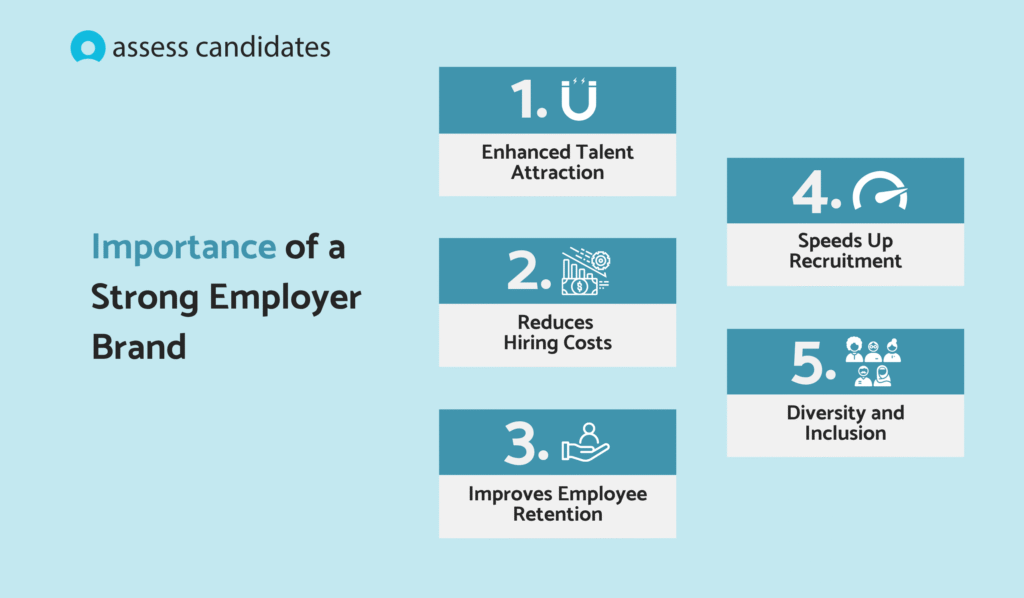
The top 5 reasons why a strong employer brand is crucial
- Enhances Talent Attraction:
A compelling employer brand sets your organization apart against competitors and attracts top-tier candidates who align with your values, mission, and workplace culture. Improving your employer brand ranking expands the pool of qualified applicants – often organically. Industry leaders, such as Google and Salesforce, actively promote their culture and employee experience to consistently attract top talent.
Did you know? Companies with a strong employer brand receive 50% more qualified applicants, according to LinkedIn.
- Reduces Hiring Costs:
With a strong employer brand that resonates with candidates, employers rely less on expensive recruitment agencies, advertising, and incentive programs. Companies can fill roles faster at lower costs. Cisco and Zappos strengthened their employer brand and successfully cut hiring expenses whilst improving the quality of hires.
Did you know? According to a LinkedIn report, organizations with a strong employer brand reduce their cost-per-hire by up to 50%.
- Improves Employee Retention:
A positive, well-communicated employer brand helps employees feel valued and aligned with the company’s mission. This directly boosts employee retention, reduces voluntary turnover, and cuts the costs of hiring replacements.
Example: Companies like Zoom and Southwest Airlines build people-first cultures focused on employee well-being that strengthen employee satisfaction and retention.
- Speeds Up Recruitment:
Candidates who are familiar with and trusting of a strong, credible employer brand are more likely to accept job offers quickly, especially in competitive industries. Reputed brands like Airbnb and NVIDIA leverage innovative digital storytelling and their strong brand presence to streamline the recruitment cycle.
Did you know? LinkedIn reports that organizations with a strong employer brand hire candidates 1–2 times faster.
- Promotes Diversity and Inclusion:
A transparent and inclusive employer brand actively attracts talent from diverse demographics. By demonstrating real commitments to diversity and equity, companies access untapped talent pools and build more innovative, high-performing teams. Many tech and finance companies now incorporate D&I messaging directly into recruitment campaigns to improve both employer brand and candidate engagement.
Did you know? According to McKinsey & Company, businesses in the “top quartile for ethnic diversity show an average 27% financial advantage over others.“
Ready to improve your employer brand and attract top talent? Start with a targeted hiring strategy. HIRE FOR FREE
In the following section, we will discuss the connection between employer branding and candidate perception in hiring.
3. How does employer branding influence candidate perception during recruitment?
Employer branding actively shapes candidate perception throughout the recruitment process – not just at the offer stage, but from the very first touchpoint. A strong, consistent brand builds trust, drives engagement, and influences candidates’ decision-making at every stage of the hiring journey.
Here’s how employer branding shapes candidate perception
1. First Impressions Shape Perception:
A candidate’s first interaction with your brand, whether it’s a job post, career page, or your social media presence, instantly influences how they view your company. Actively aiming to improve employer branding during these early touchpoints are your opportunity to communicate company values, culture, and employee experience authentically.
For Example: Tesla’s innovation-focused careers page reflects its cutting-edge brand, setting clear expectations.
Tip: Use tools like Workable or Beaery to craft branded career pages and streamline first-stage candidate experiences.
2. Trust and Credibility Matter:
A credible employer brand has a foundation of trust earned through consistent, transparent communication. When companies publicly share their mission, diversity metrics, and internal growth initiatives, they demonstrate accountability. When candidates see your company following through on its values, their confidence in your brand increases.
For Example: Salesforce builds trust with candidates by publishing annual Equality Reports that detail pay equity, diversity stats, and social impact initiatives.
Tip: Use platforms like Culture Amp or Glint to track internal feedback and share culture stories externally.
3. Word of Mouth and Social Proof Shape Decision-making:
Today’s candidates actively research companies through review sites, social media, and conversations with current or former employees. Every candidate interaction, positive or negative, shapes the word-of-mouth impact. A strong employer brand ensures that positive feedback is amplified and engages employees as brand ambassadors to align the company message.
For Example: Google’s “Life at Google” YouTube series showcases real employees, discussing their work lives, reinforcing Google’s authenticity and reputation as a top employer.
Tip: Use tools like Stories Inc. or Seenit to create and distribute employee-generated content.
4. Reduces Uncertainty and Mismatch:
reduce ambiguity in your recruitment process. When your employer brand provides clarity around expectations, company values, and work style, candidates are better able to self-assess their fit. Transparency leads to more qualified applicants and fewer mishires.
For Example: Netflix’s widely viewed “Culture Memo” clearly outlines its high-performance expectations, helping candidates assess fit before applying.
Tip: Leverage candidate experience platforms like Harver or PathMotion to share FAQs and behind-the-scenes content.
5. Influences Positive Candidate Behaviour:
Strong employer branding drives positive candidate engagement throughout the recruitment process – from more prompt application submissions to more enthusiastic interviews. Candidates are less likely to drop out of the process and more likely to respond to outreach and approach the opportunity with genuine interest.
For Example: Shopify’s “Digital by Design” policy signals a strong commitment to remote work, attracting global talent and making the brand more appealing to candidates who value flexibility.
Tips: Use career page chatbots like Phenom and Mya (AI Recruiter) for real-time interactions with candidates, reducing hesitation and boosting engagement.
In the following section, we’ll now move onto our recommended employer branding best practices and tips to help you improve your employer brand and attractiveness.
4. Effective strategies for enhancing your employer brand
In today’s competitive talent landscape, the most sought-after employers are those with strong, authentic brands that reflect their culture, values, and employee experience. Every candidate interaction, from job posts to interviews, shapes your employer brand. That’s why building and maintaining it requires thoughtful, consistent strategies.
9 employer branding strategies to improve your employer brand

1. Define your Employee Value Proposition (EVP)
Your employee value proposition (EVP) should form the foundation of your employer brand strategy. It sets you apart from the competition by showcasing the unique employee experience of your company and what benefits, values, culture, and opportunities you offer.
To develop an authentic, positive EVP, you must start with:
- Surveying current employees about what they truly value about working at your organization.
- Looking for common themes around culture, growth opportunities, work-life balance, mission, and purpose.
- Communicating your EVP consistently across all platforms.
2. Optimize your Careers Page
Optimizing your careers page or site plays a critical role in improving your employer brand as often it is the first impression a candidate will make of your company. Transforming this page from a basic job board into an engaging showcase of workplace culture makes it more appealing for candidates.
To make your career page a positive touchpoint for candidates, you must:
- Incorporate video testimonials from various employees across different levels and departments.
- Make the page easy to navigate and mobile-friendly.
- Craft job descriptions using inclusive language that focuses on impact rather than rigid requirements.
- Provide clear information about the hiring process.
3. Enhance your Online Reputation
In our modern digital era, online platforms like Glassdoor and LinkedIn are central to creating a positive employer brand as candidates extensively research employers online before applying. They act as the face of your company, offering honest testimonials from current or former employees and candidates.
To enhance your online reputation, you must:
- Develop a digital branding content strategy to showcase your workplace culture through behind-the-scenes office tours, team events, and day-in-the-life employee features.
- Respond to reviews, both positive and negative, professionally and constructively.
- Encourage satisfied employees to share their experiences and leave reviews online.
- Regularly update LinkedIn and your other employer profiles.
Did you know? 52% of candidates first seek out a company’s sites and social media to learn more about them as an employer.
4. Leverage Employee Advocacy
Leveraging employee advocacy is a strategic way to improve your employer brand, build trust, and boost visibility. Current employees in your organization are your best promoters and they can attract like-minded talent more effectively than any corporate message can.
To implement an effective advocacy program, you must:
- Create an employee brand ambassador program.
- Encourage staff to share company news and job openings.
- Provide social media guidelines to help employees represent the brand positively.
- Encourage organic sharing on platforms like LinkedIn and TikTok through gamification and recognition.
5. Enhance the Candidate Experience
Encouraging a positive candidate experience at every recruitment stage strengthens the employer brand. When employers communicate clearly, interact respectfully, and provide timely responses, they drive participation, engagement, and positive feedback, even from candidates who don’t receive an offer.
To enhance the candidate experience, you must:
- Streamline application with mobile-friendly formats and one-click apply options.
- Maintain clear communication throughout the process with regular status updates.
- Use automated psychometric assessments to ensure fast and objective evaluation of candidate skills and strengths.
- Provide constructive feedback for all candidates that gives a positive impression.
6. Transparency is Key
Championing transparency throughout your recruitment process is essential for improving your employer brand. When candidates clearly understand the hiring process, how you use assessments, and what to expect, they feel respected and gain confidence due to your company’s integrity.
To foster transparency, you must:
- Clearly explain the purpose and relevance of each assessment before candidates begin.
- Share detailed information about the hiring timeline and next steps.
- Provide honest and timely feedback on assessment results and decisions.
7. Leverage Modern Game-Based Assessments
Interactive assessments are an innovative way of improving the employer brand. Modern game-based assessments engage candidates with fun and immersive game-like challenges, while accurately measuring their skills and personality traits.
By using game assessments effectively, you can demonstrate your modern outlook, commitment to technology, and candidate-friendly practices – all factors which appeal to candidates, especially the younger, tech-savvy talent.
To effectively use game-based assessments, you must:
- Choose assessments that combine fun with scientifically validated metrics.
- Ensure assessments are mobile-friendly and easy to access.
- Highlight the innovative nature of the assessment process in candidate communications.
8. Reduce Bias to Strengthen Inclusion
When employers actively try to reduce bias in their recruitment process, they show that their company values fairness and diversity, improving their employer brand.
By using skills-based assessments that value objective skills and competencies over subjective qualifications and education, you create a level playing field, giving all candidates an equal opportunity to succeed. This commitment to equity and inclusion will help you attract a broader and more diverse talent pool.
To reduce bias in your recruitment process, you must:
- Incorporate validated assessments that focus on job-relevant skills and behaviors.
- Remove identifying information from candidate profiles during initial screening.
- Train hiring teams to recognize and mitigate unconscious bias.
9. Use Clear Brand Messaging
From job descriptions and application forms to careers pages and pre-employment assessments, you should use consistent brand messaging to reflect your company’s culture and values. Aligned brand messaging gives candidates an authentic view of what it is like to work at your company, making your brand more memorable and appealing.
To align brand messaging at every stage, you must:
- Design assessments that mirror relevant job challenges and company culture.
- Clearly communicate the same message at all touchpoints.
- Incorporate your brand’s tone and language into all candidate communications.
Strengthening your employer brand is a continuous process that involves listening, authentic engagement, and a willingness to evolve. To truly stand out, align your company values with everyday actions, empower employees to share their experiences, and foster a transparent, inclusive culture that naturally attracts top talent.
Want more expert advice from our organisational psychologists to improve your employer brand? CONTACT US
5. How do pre-employment assessments help improve your employer brand?
Pre-employment assessments do more than just streamline hiring, they enhance how your company is perceived by candidates. These standardized tests are designed to reduce bias and discrimination, lower candidate stress, shorten time-to-hire, and make the hiring process more data-driven. In addition, they allow recruiters to identify the right talent for the role while showcasing the organization’s commitment to quality, transparency, inclusion, and professionalism.
8 types of pre-hire assessments to help you enhance your brand reputation
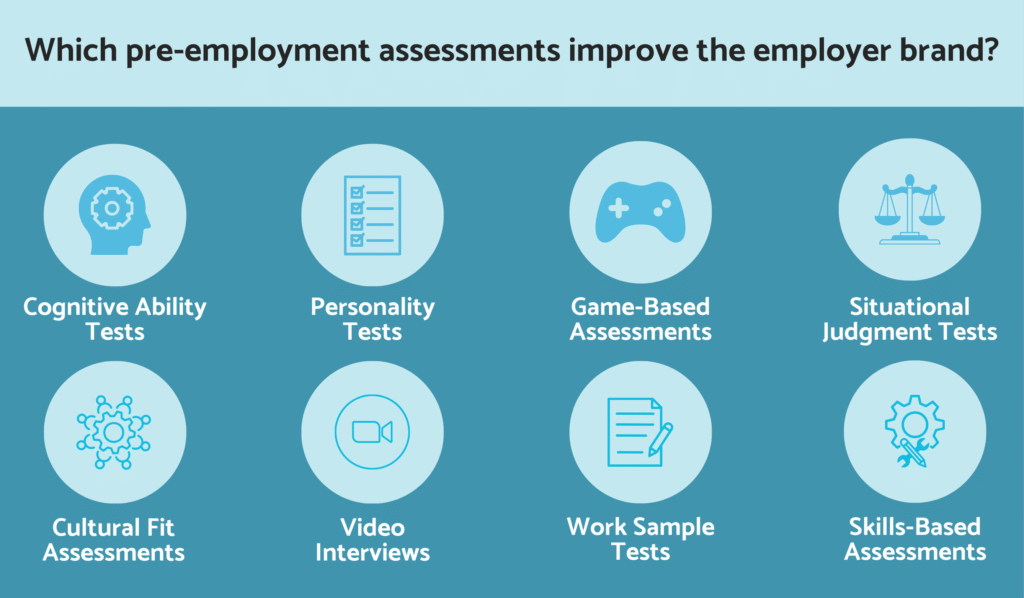
- Cognitive Ability Tests
Employers use cognitive ability tests across various roles, from graduate trainees and interns to seasoned professionals and specialists. Delivering these tests with transparency, relevance, and objectivity, builds credibility and improves the employer brand, especially among high-caliber applicants seeking challenging roles.
Some of the common cognitive ability tests include:
- Numerical Reasoning Test
- Verbal Reasoning Test
- Logical Reasoning Test
- Abstract Reasoning Test
- Diagrammatic Reasoning Test
- Critical Thinking Test
- Spatial Reasoning Test
- Error Checking Test
Top software providers for cognitive ability tests are Assess Candidates, SHL, and TestGorilla.
- Personality Tests
Recruiters use personality assessments to determine how candidates behave, communicate, and approach their work. Including these tests in your hiring process shows that your company has a genuine interest in each individual’s unique traits, and not just their qualifications. Personality questionnaires can help strengthen the employer brand as inclusive, empathetic, and people-focused and provide an insight for candidates into company culture and values.
The leading software providers for personality tests include Assess Candidates, Talogy, and Hogan Assessments.
- Game-based Assessments
Game-based assessments use interactive, game mechanics to measure job-related cognitive abilities, behaviors, and personality traits, such as numerical aptitude, problem-solving, risk-taking, and decision-making, in an engaging manner. These innovative tools can highlight a modern, candidate-centric culture and a forward-thinking and dynamic employer brand, which is particularly appealing to younger, tech-savvy candidates.
Leading platforms that provide game-based assessments for recruitment include Assess Candidates, Pymetrics, and Arctic Shores.
- Situational Judgment Tests
Situational judgment tests (SJTs) are scientifically validated to accurately predict candidates’ job performance. These tests enhance employer branding by demonstrating that your company prioritizes job relevance and workplace authenticity. Candidates also value being assessed on realistic workplace scenarios that provide insight into daily challenges, role requirements, and team dynamics.
Some leading providers for situational judgment tests include Assess Candidates, Clevry, and Test Partnership.
Combining situational judgment tests with other psychometric assessments, such as numerical, verbal, logical reasoning, and personality tests, enhances their ability to predict job performance. This comprehensive approach offers a holistic view of each candidate’s skills, behavior, and personality, enabling more informed hiring decisions. Over time, consistently choosing the right talent improves performance, retention, and your employer brand.
- Cultural Fit Assessments
Employers use cultural fit assessments to ensure candidates align with the company’s values, work style, and mission. By prioritizing culture, employers reinforce that they care about team harmony and employee satisfaction, qualities that enhance employer brand appeal and attract value-aligned talent.
Some well-known providers for cultural fit assessments include Assess Candidates, Predictive Index (PI), and Traitify.
- Video Interviews
Companies improve their brand perception by using video interviews to showcase flexibility, efficiency, and technological readiness. In particular, by offering a pre-recorded interview method, employers signal a tech-savvy and inclusive culture, qualities that directly improve employer branding in today’s competitive talent market.
Platforms that offer video interviews include Assess Candidates, HireVue, and Spark Hire.
- Work Sample Tests
Work sample tests require candidates to complete tasks that closely mirror actual job duties. As these tests are job-relevant and directly tied to performance, candidates view them as fair, meaningful, and respectful of their time and skills. By focusing on practical ability, employers demonstrate a transparent, merit-based approach to hiring, which reinforces a strong employer brand that values capability and attracts serious, high-performing candidates.
Some of the top platforms that offer work sample tests or job simulations include Assess Candidates, TestGorilla, and Vervoe.
- Skills-Based Assessments
Skills-based assessments are scientifically validated to predict candidates’ job performance. These assessments focus on specific skills, such as error-checking tests for clerical roles, coding challenges for developers, or sales simulations for account executives. Replacing guesswork with skills tests improves fairness and signals that the company values real-world ability over credentials. This improves the employer brand by promoting transparency, equity, and opportunity.
Some of the top platforms that offer skill-based tests include Assess Candidates, eSkill, and Vervoe.
At Assess Candidates, we encourage recruiters to combine psychometric assessments with human judgment to evaluate candidates more holistically and make well-informed hiring decisions.
Explore our science-backed, user-friendly pre-employment assessments to improve your employer brand. LEARN MORE
Let’s take a look at which roles and industries use these techniques for improving their employer brand ranking.
6. Which industries are prioritizing employer branding strategies?
Organizations across industries are increasingly prioritizing strong employer branding strategies to stay competitive in the talent market. By actively investing in best practices that strengthen their employer brand ranking, they aim to attract, engage, and retain top-tier professionals.
Industries implementing employer branding best practices:
- Technology: The tech industry actively enhances its employer brand to attract high-demand talent such as software engineers, data scientists, and product managers. They highlight innovation, remote work options, and learning opportunities as their EVP. In particular, they stand out by showcasing employee stories, inclusive hiring, and engaging candidate experiences.
- Healthcare: Healthcare companies strengthen their employer brand in roles that demand both technical skill and emotional resilience, such as nurses, physicians, and healthcare technicians. They invest in values-driven storytelling, DEI initiatives, and transparent career growth opportunities to attract and retain talent.
- Finance and Banking: Financial institutions strengthen their employer brand by targeting analytical, compliance-driven, and risk-aware professionals such as financial analysts, auditors, and investment bankers. They highlight integrity, global career opportunities, and continuous learning to attract top-tier talent and build long-term appeal.
- Consulting and Professional Services: Management consulting firms and legal services companies strengthen their employer brand to attract top-tier consultants, lawyers, and business strategists. They highlight mentorship, global exposure, and high-impact projects in their EVP to engage ambitious professionals looking for fast-paced growth and meaningful career advancement.
- Retail and E-commerce: Retailers and e-commerce companies enhance their employer brand by targeting roles such as supply chain analysts, digital marketers, and customer experience leads. They emphasize agility, consumer impact, and rapid career growth in their employer brand strategy, using employee testimonials and social proof to build credibility and attract talent.
- Manufacturing and Engineering: Manufacturing and engineering companies strengthen their employer brand by focusing on skilled roles like mechanical engineers, quality control specialists, and process improvement experts. They highlight innovation, long-term job security, and sustainability in their employee value propositions, using plant tours, internships, and clear recruitment messaging to engage and attract talent.
By actively showcasing their culture, growth opportunities, and employee benefits, employers strengthen their appeal to top talent. As the job market continues to evolve, employer branding will remain essential for attracting and retaining high-quality candidates.
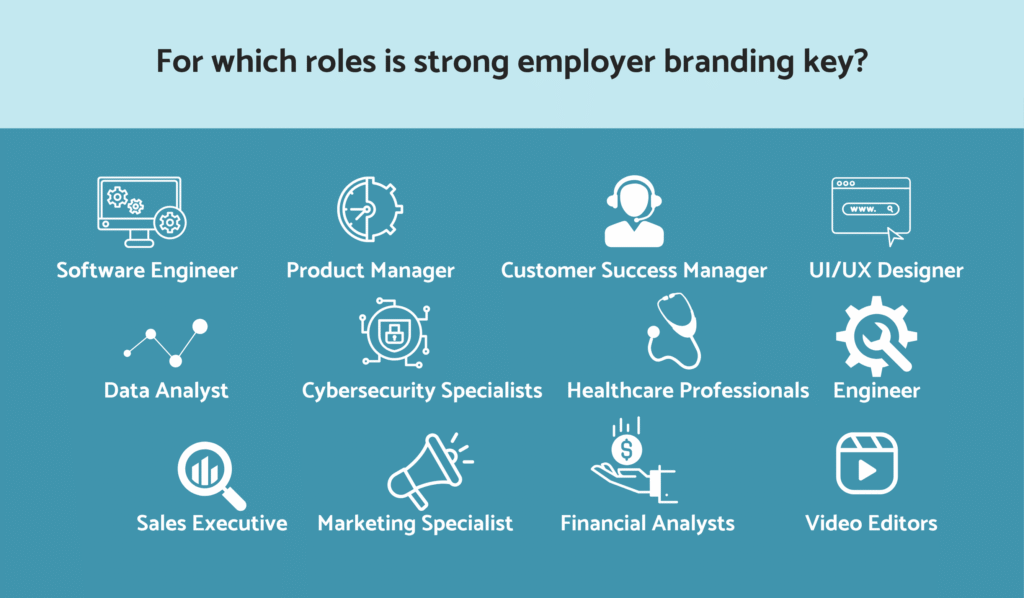
Roles that receive special employer branding focus across industries include:
- Software Engineers/Developers
- Data Scientists/Analysts
- Product Managers
- Sales Executives
- Customer Success Managers
- Marketing Specialists
- UX/UI Designers
- Cybersecurity Specialists
- Healthcare Professionals
- Engineers
- Financial Analysts
- Accountants
- Human Resources/Talent Acquisition Specialists
- Video Editors
- Designers
Enhance your employer brand with our extensive range of standardized assessments. HIRE FOR FREE.
Now, let’s look into real-world employer case studies using assessments to improve their employer brand.
7. Leading employers using pre-employment assessments to strengthen their brand
Leading companies use pre-employment assessments to enhance hiring outcomes and improve their employer brand. These tools help companies deliver a fairer, more engaging candidate experience while identifying top talent.
Below are some notable case studies showcasing the impact of these standardized assessments.
SEB (Skandinaviska Enskilda Banken): Elevating Employer Brand with a Data-Driven EVP
Challenge: SEB, one of the largest financial services groups in the Nordics, was struggling to attract top-tier talent amid growing competition in the industry.
Solution: SEB partnered with Universum to create a data-driven EVP built on Talent Insights. This EVP emphasized core values identified as priorities by their target talent pool, including professional development opportunities, work-life balance, and corporate social responsibility.
The messaging was consistently applied across external recruitment campaigns and internal communications to boost employee engagement.
Results:
- Achieved a 61% increase in applications per open position.
- Reached over 6.7 million impressions on social media.
- Achieved an employee engagement rating of 82%.
- Achieved a 91% follower increase on Instagram.
- Improved employer brand perception by aligning talent expectations with a compelling, values-driven narrative.
Accelleron: Building a Global Employer Brand with a Data-Driven EVP
Challenge: Following its spin-off from ABB, Accelleron needed to establish a distinct employer brand from the ground up. With a diverse workforce spanning over 50 countries, the company faced the complex task of unifying internal culture while appealing to a global talent pool.
Solution: Accelleron partnered with Universum to develop a data-driven EVP grounded in employee feedback and survey insights. The EVP reflected Accelleron’s new identity as an independent company and aligned with its HR priorities.
It was designed to be globally consistent yet adaptable for local relevance. The EVP was embedded into recruitment marketing and employee engagement initiatives and used as a practical training resource for hiring teams.
Results:
- Developed a globally valid EVP adaptable to local employee needs.
- Strengthened internal alignment by engaging employees across all levels.
- Improved external visibility and recruitment outcomes through targeted campaigns
- Integrated EVP messaging into recruiter and manager training, enhancing candidate experience
- Improved employer brand credibility by uniting internal culture with external messaging across over 50 countries.
L’Oréal: Improving Employer Brand through a Purpose-Driven EVP
Challenge: Despite being a globally recognized brand, L’Oréal sought to build a stronger emotional connection with potential candidates by articulating what it truly means to work at the company.
Solution: L’Oréal developed a new, employee-informed EVP by gathering insights from its workforce. This resulted in the tagline “a thrilling experience, a culture of excellence”, supported by three EVP pillars:
- A thrilling experience
- An inspiring company
- A school of excellence
The company launched strategic employer branding campaigns across multiple digital platforms, such as YouTube, LinkedIn, and Flipboard, to deliver tailored, engaging content to different segments of their talent audience.
Results:
- 70% of L’Oréal’s LinkedIn followers expressed interest in applying to the company.
- Gained over 1.8 million followers on LinkedIn.
- Increased engagement and visibility across key social platforms.
- Improved employer brand recognition by showcasing an authentic and aspirational employee experience across global touchpoints.
Partner with Assess Candidates for fully automated solutions to improve your employer brand. VIEW PLANS
8. Strengthen your employer brand with Assess Candidates: Why partner with us?
At Assess Candidates, we don’t just help you hire smarter; we help you leave a lasting impression on your talent pool. Our tailored pre-employment assessment solutions are designed to align with your brand values, hiring goals, and candidate experience expectations, ensuring every touchpoint reinforces your reputation as an employer of choice.
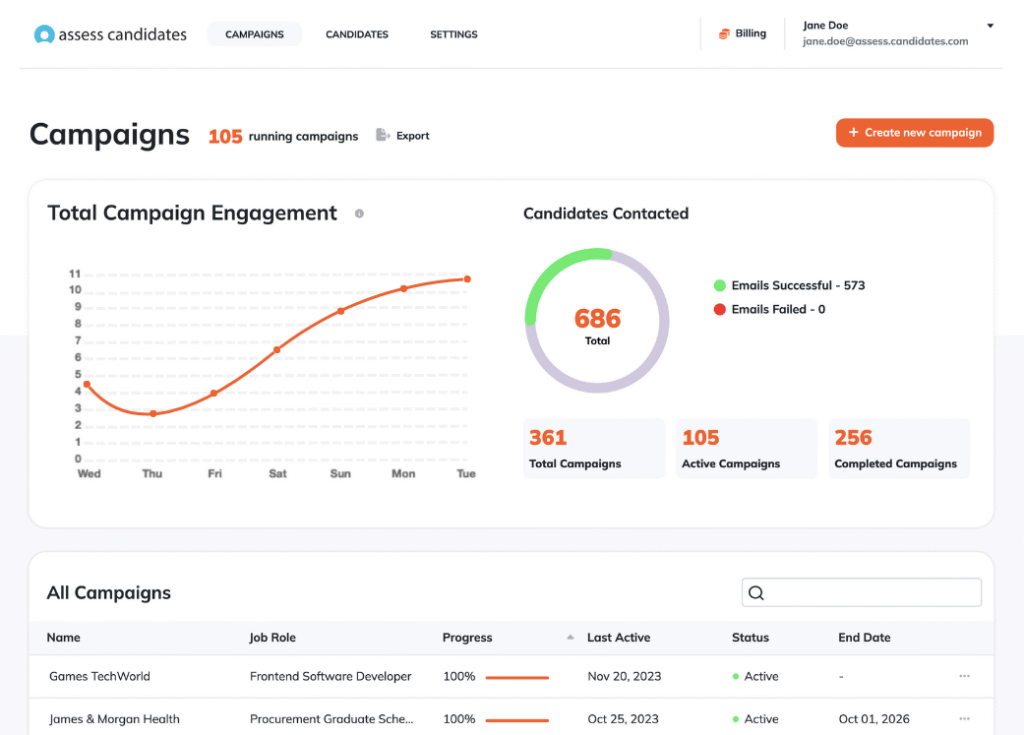
Below is a sample of the campaign reporting dashboard on the Assess Candidates platform. With an intuitive interface and advanced filtering tools, it provides HR teams and hiring managers with data-driven insights that drive better hiring decisions and a better brand perception.
The top 4 reasons why you should use Assess Candidates for improving employer branding
- Built by Experts, Backed by Science: Chartered Scientists, Psychologists, and Psychometricians with experience at leading firms like SHL and IBM Kenexa design Assess Candidates’ pre-employment tests to help you make smarter hiring decisions.
Each test is rigorously validated to measure real-world skills and role-specific competencies, helping you consistently hire top talent while demonstrating a commitment to fairness and quality. This scientific rigor enhances your credibility as an employer who values merit and precision.
- Insightful Reporting that Reflects Professionalism: Assess Candidates’ intuitive and easy-to-navigate platform allows employers to evaluate candidates confidently.
Moreover, our talent assessment platform makes it easy for recruiters to compare individual and group performance, apply custom filters, rank candidates, and build shortlists with ease. It also integrates smoothly with your Applicant Tracking System (ATS), ensuring a seamless and efficient hiring workflow.
- Enhanced Candidate Experience that Boosts Brand Appeal: Assess Candidates’ pre-employment tests are easily accessible on any device, delivering a visually engaging and user-friendly interface that keeps candidates attentive and confident.
Employers can tailor instructions to reflect their brand identity, while the user-friendly design minimizes friction and guides candidates effortlessly. This smooth and engaging process leaves a lasting, positive impression, reinforcing your company’s reputation as a professional, candidate-centric employer and helping attract top-tier talent.
- Inclusive and Accessible for All Candidates: Assess Candidates is committed to inclusion by designing every assessment with built-in accessibility features that support individuals with disabilities and visual impairments.
All our hiring assessments include features such as extended time options, zoom functionality, accessible color schemes, and WCAG-compliant designs that integrate smoothly with screen readers and assistive technologies.
Assess Candidates is a leading pre-employment hiring assessment provider offering end-to-end assessment tools for small, medium, and large businesses. Our intuitive platform helps you confidently identify and hire top talent. Explore our range of hiring assessments and take the next step toward smarter, data-driven recruitment decisions today.
If you are an employer who is unsure if using a pre-employment assessment is the right choice for you, get in touch with us, and we will do a free-of-charge analysis of your recruitment needs.
Interested in learning more about effective candidate assessment? Continue reading for frequently asked questions, and sign up with your email to get started.
Frequently Asked Questions
How does storytelling improve the employer brand?
Authentic storytelling establishes an emotional connection with your audience. It showcases the company’s unique culture, values, and employee experiences. We recommend sharing real success stories, workplace achievements, and day-in-the-life content through videos, blogs, and social media. Showcasing what sets your organization apart makes your employer brand more relatable and compelling.
Should leadership be involved in improving the employer brand?
Yes, leadership involvement is crucial in improving an employer brand as it demonstrates commitment from above. Leaders can strengthen credibility by sharing their vision, actively participating in recruitment marketing, and engaging with employees in public forums.This visible authenticity shows candidates that your company’s values are practiced at every level, not just promoted by HR.
Does an employer brand impact candidate perception during recruitment?
Employer branding significantly impacts candidate perception by clearly communicating a company’s values, culture, and expectations from the very first interaction. It allows organizations to trust and credibility, reduces uncertainty about the recruitment process, and fosters positive candidate engagement.
Does flexibility work in improving the employer brand?
Yes, flexibility strengthens your employer brand. Offering remote or hybrid work options shows that you value employee well-being and trust, which appeals to top talent seeking work-life balance. It also positions your company as progressive, increasing appeal to younger generations and diverse candidates.
Can a strong employer brand reduce time-to-hire?
Yes, a strong employer brand reduces time-to-hire by building a talent pipeline of pre-engaged candidates. When a company is known for its positive culture and growth opportunities, qualified professionals are more likely to seek out roles proactively. This reduces the need for lengthy sourcing, speeds up hiring, and lowers cost-per-hire while improving candidate quality.


 English
  Arabic