
Pre-employment Numerical Reasoning Tests for Hiring | The 2026 Recruiter’s Guide



Numerical reasoning tests are one of the most popular hiring tools in recruitment today!
According to the Talent Strategy Group 2025 Potential Report, 80% of organizations use psychometric tests, such as numerical reasoning assessments, to identify internal leadership potential.
Numerical assessments are standardized, science-backed cognitive ability tests that help recruiters identify top talent with the necessary numerical reasoning skills for a wide range of roles. With rapid technological advancements and the rise of hybrid positions, employers rely on employees with strong cognitive abilities – particularly those who can manage numbers, interpret data, and make logical decisions under pressure.
That’s why recruiters are revamping their recruitment strategies, designing candidate-friendly processes that combine different psychometric testing, game-based assessments, video interview tools, and assessment center exercises. Together, these assessment tools create an efficient recruitment funnel that helps recruiters quickly and accurately screen candidates and select only the most qualified for the role.
The cognitive ability test for hiring we will focus on in this article is the pre-employment numerical reasoning test. This assessment is especially valuable when hiring for roles that require a firm grasp of mental math, quick data interpretation, and strong problem-solving skills.
If you have ever wondered:
- Are numerical assessments timed?
- What data does numerical testing use?
- How do numerical reasoning testing tools differ from numeracy tests?
- What are common numerical reasoning interview questions?
- How to create a numerical reasoning test?
Then, this guide is definitely for you! Here, we will explore what numerical reasoning tests measure, and how they help recruiters make more informed, data-driven hiring decisions to build higher-skilled teams.
Whether you’re a hiring manager or HR professional, continue reading to discover how to use numerical assessments to select and hire your next best-fit candidate.
Contents
- What are numerical reasoning tests?
- How do numerical tests work in hiring?
- Common question types in numerical reasoning tests
- Typical numerical reasoning interview questions
- Why do employers use numerical reasoning tests for hiring?
- When to give candidates a numerical test?
- How to effectively use numerical reasoning assessments to maximize ROI?
- Which industries use pre-employment numerical testing the most?
- Choosing the right candidate assessment platform
- Why do top companies trust Assess Candidates’ numerical reasoning tests to hire?
- Numerical reasoning tests: Client Success story
Now, without further ado, let’s start by answering what is a numerical reasoning test?
1. What are numerical reasoning tests?
Pre-employment numerical reasoning tests are timed, online, multiple-choice aptitude assessments designed to evaluate a candidate’s ability to work with numbers and accurately understand and interpret numerical data.
Numerical aptitude tests are a recruiter’s top choice for data-heavy roles, involving financial analysis and data interpretation.

Hire top talent with our expert-designed numerical reasoning tests. HIRE FOR FREE
But what does numerical reasoning mean? Let’s discuss this below.
What is numerical reasoning?
Numerical reasoning is the cognitive ability to interpret, analyze, and draw logical conclusions from numerical data. It involves working with numbers to solve problems, identify relationships, recognize patterns, and make decisions based on quantitative information.
How are numerical reasoning skills different from numeracy?
While numeracy covers basic mathematical knowledge and calculations, numerical reasoning skills go further, requiring candidates to interpret charts, tables, and graphs logically to reach valid conclusions. Numerical reasoning combines core arithmetic and mathematics with advanced concepts like percentages, ratios, averages, sequences, and data interpretation.
Although a basic knowledge of mathematics is expected, it is important to note that numerical reasoning assessments are not math tests, nor does it follow any school syllabus.
Why are numerical reasoning skills important?
Numerical reasoning is one of the most valuable skills in modern business. Across nearly every sector, from finance to sales, employees increasingly work with numerical data, reports, and metrics.
With the digital revolution, more companies, including small and medium enterprises (SMEs), are adopting online numerical tests to ensure they hire high-quality professionals who can:
- Analyze datasets
- Interpret graphs
- Draw meaningful insights from data for informed decision-making
- Read financial statements and manage budgets, assess risk, and optimize operational strategies
- Evaluate performance analytics and solve problems
Investing in the numerical reasoning skills of your current and future employees enhances company performance, modernizes business, and gives a competitive edge. Teams who lack these skills risk costly financial errors, missed opportunities, poor strategic decision-making, and data inaccuracies.
Despite this, many companies still rely on CVs to assess numerical reasoning, a method proven to be a poor predictor of cognitive abilities. On the other hand, pre-employment numerical reasoning tests are a scientifically validated, objective method of measuring a candidate’s skills during hiring, efficiently filtering out those who don’t meet the minimum requirements and advancing those with the desired numerical skills.
So, what specific abilities do numerical reasoning tests assess? Let’s find out next.
What specific skills do numerical reasoning tests measure?
Numerical reasoning tests measure a wide range of skills that collectively indicate a candidate’s numerical reasoning ability.

The top 10 skills numerical assessments measure
- Arithmetic Ability: The capability to perform mathematical operations such as addition, subtraction, multiplication, and division using decimals, fractions, ratios, averages, and percentages, reflecting everyday workplace calculations.
- Data Analysis: Drawing observations, insights, and trends from complex datasets.
- Interpreting and Visualizing Graphical Data: The understanding of charts, graphs, and tables, and the ability to extract and communicate relevant insights.
- Problem-Solving Skills: The ability to use logical deductions and analytical thinking to solve work-related challenges involving numerical data.
- Financial Literacy: The capability to handle financial data, such as currencies and currency conversions, reflecting work tasks involving transactions, financial analysis, budgeting, and investing.
- Balancing Speed and Accuracy: The balance between working efficiently without sacrificing precision, helping predict how candidates might react in fast-paced work conditions.
- Statistical Knowledge: The understanding of statistical methods.
- Numerical Estimation: The ability to estimate and approximate numerical data.
- Attention to Detail: How candidates maintain focus and accuracy when completing numerical tasks.
- Commercial Awareness: How candidates effectively identify business-related issues and make informed decisions based on data.
Now we understand the foundation of what numerical reasoning tests and numerical reasoning are, let’s explore how numerical ability testing tools work in hiring.

2. How do numerical tests work in hiring?
Pre-employment numerical reasoning tests usually form part of the online assessment stage before interviews and an assessment center. These timed standardized tests consist of 15-30 multiple-choice questions that candidates must attempt on an online testing platform within the given time limit.
Candidates receive a link to the numerical assessment platform and have a dedicated period of time (usually several days) to complete the assessment. Depending on the type of test, these numerical tests can be adaptive, i.e., as the test progresses, the difficulty of questions increases or decreases based on the candidate’s most recent responses.
Recruiters then review candidate results via an online reporting dashboard and select the top candidates to advance to the next round of hiring tests.
How do online numerical assessments help recruiters hire effective candidates?
Numerical reasoning tests are a reliable predictor of how individuals handle numbers and numerical problems in the workplace, helping recruiters predict candidates’ on-the-job performance. For example, candidates identified as having strong numerical reasoning skills in the workplace are likely to be able to:
- Confidently utilize numbers to solve challenges and problems logically
- Identify trends and patterns in data
- Successfully conduct numerical analyses
- Undertake strategic data-driven decisions to optimize business processes
- Work efficiently under time pressure
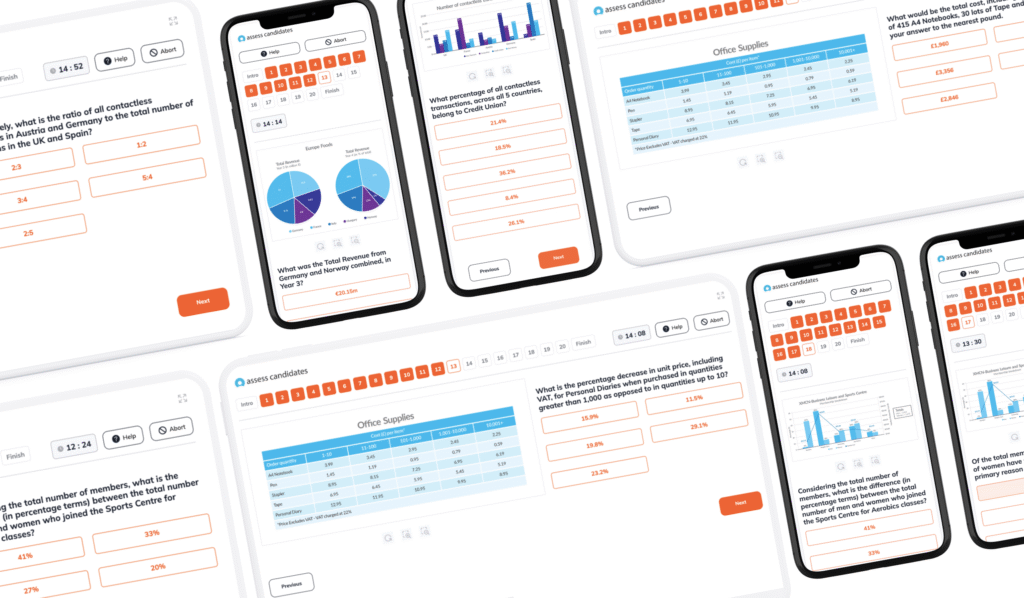
Choose the best talent for your organization with our numerical reasoning assessments! LEARN MORE
After discussing how they work, let’s cover the example types of numerical reasoning questions candidates find in recruitment.
3. Common question types in numerical reasoning tests
On numerical aptitude tests, candidates are presented with a variety of questions with numerical information in different formats. Ranging from testing mental ability to balancing speed and accuracy, these questions evaluate a candidate’s ability to effectively handle various types of numerical data under time pressure.
The Top 4 types of numerical reasoning questions
- Numerical Operation Questions
- Numerical Estimation Questions
- Word Problems Questions
- Data Interpretation Questions
Let’s now discuss each of the above broad types of numerical reasoning test questions in the following section.
- Numerical Operation Questions: These form the core math part and aim to test candidates’ arithmetic skills through basic math operations, fractions, percentages, averages, ratios, and decimals.
Example 1: A shopkeeper buys 120 apples at €15 each. He sells them at a profit of 20%. What is the selling price of each apple?
- Numerical Estimation Questions: These test candidates’ estimation and approximation skills and include questions on concepts such as estimating square roots, large multiplications/divisions, choosing the closest answer in multiple-choice options, and rounding off percentages.
Example 2: Estimate √48 × 19 without using pen and paper.
- Word Problem Questions: These test the candidate’s ability to logically use the given numerical data to solve word-based or situational problems. These numerical assessment questions assess concepts such as speed, distance, time, work problems, profit and loss, age problems, and interpreting conditions to form equations.
Example 3: A product is bought for €800 and sold for €1,000. What is the profit percentage?
- Data Interpretation Questions: These test candidates’ real-world data-interpretation skills. They include questions that involve reading bar graphs, line graphs, pie charts, and tables, comparing growth rates or percentages from graphs, identifying trends, and making informed decisions based on data, etc.
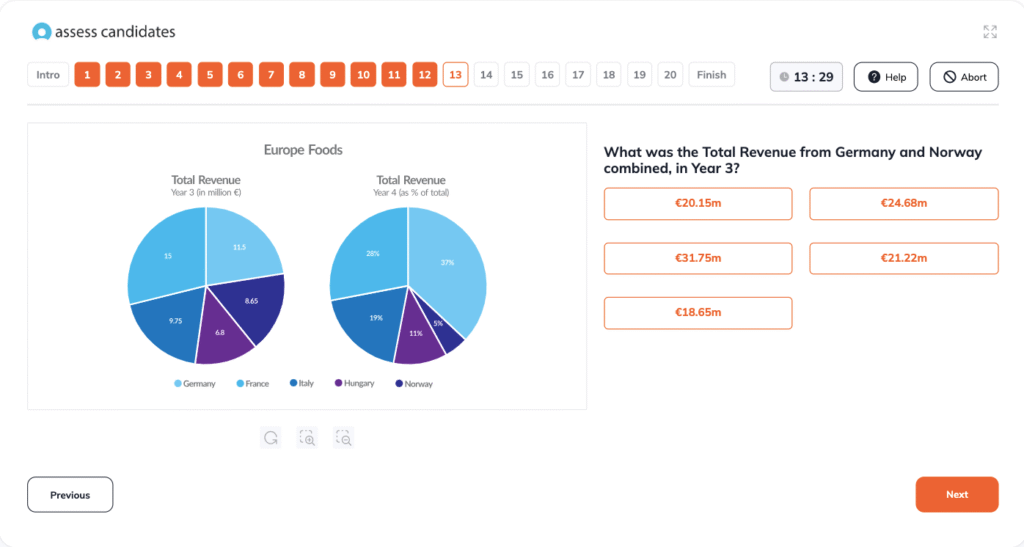
Example 4: Here’s one of the example numerical reasoning test questions from Assess Candidates!
For answers to all the above questions, head to the end of the article!
It is important that candidates prepare and practice for these numerical tests by revising basic arithmetic concepts and familiarizing themselves with interpreting different datasets and graphs in the format of a real numerical reasoning test.
Discover how numerical reasoning tests can strengthen your hiring process. VIEW PLANS
But can you also test candidates on their numerical reasoning using interview questions? Let’s find out in the following section.
4. Typical numerical reasoning interview questions
Recruiters can also use numerical tests for the interview stage to assess candidates’ numerical aptitude in real time. This helps to validate the numerical assessment results and also assess the candidates based on their overall personality and professional acumen.
The Top 3 types of numerical reasoning interview questions
- General Numerical Reasoning Interview Questions: These assess candidates’ basic arithmetic abilities for everyday work tasks, such as how well they perform mathematical calculations, analyze data, work with ratios and probabilities, and make quick, accurate estimations.
Some example general numeracy interview questions include:
- “Share the key trends you can identify from this financial graph.”
- “What is the probability of rolling a die and showing a multiple of 2?”
- “How would you calculate a 30% increase in website traffic from last month?”
- Behavioral Interview Questions: These focus on assessing candidates’ past experiences using their numerical reasoning skills in order to predict their potential performance with numerical challenges in the workplace.
Some example behavioral interview questions include:
- “Tell me about a time when you made a decision based on numerical data.”
- “Describe a time when you successfully influenced others using numerical data and analysis.”
- “Can you share an example of how you overcame a challenge by utilizing numerical data?”
- Situational Interview Questions: These questions aim to evaluate candidates’ ability to practically apply their numerical reasoning and problem-solving skills to specific workplace scenarios and challenges.
Some example situational interview questions include:
- “You notice potential statistical errors in a financial report. How would you approach identifying and solving these errors?
- “Imagine your client has a new investment idea. How would you utilize numerical data to assess the risk and provide informed advice to your client?”
- “Describe the method you would use to determine the most cost-effective business strategy for reducing costs and increasing profits.”
At Assess Candidates, we recommend combining numerical reasoning interview questions with pre-screen questions that also test other vital soft skills for the role. These skills may include critical thinking, decision-making, teamwork, communication, adaptability, and time management.
This approach helps you select well-rounded candidates with strong analytical skills and cultural alignment, contributing to overall team success and organizational goals.
Leverage our numerical tests and video interviews developed by expert chartered psychologists. HIRE FOR FREE
So, why do top organizations like Microsoft choose numerical assessments? Let’s find out their key benefits below.
5. Why do employers use numerical reasoning tests for hiring?
Employers use numerical reasoning assessments to gain objective insights into candidates’ numerical abilities so they can confidently select the best talent with the required skills for the role. Additionally, numerical tests help efficiently narrow down large applicant pools, making them particularly beneficial for graduate employers.
What are the benefits of using numerical reasoning tests for hiring?
Numerical reasoning tests offer a wide range of benefits for both recruiters and candidates. From streamlining the recruitment process to providing a positive candidate experience, numerical assessments make the hiring process more engaging and effective.

Here are the top 10 benefits of using numerical tests in recruitment:
1. Supports Efficient Candidate Screening
Numerical reasoning tests are an easy-to-administer, automated pre-employment tool that streamlines the hiring process. Instead of lengthy manual sifting, online numerical tests can assess thousands of candidates in minutes, with the results immediately accessible in one click.
This allows employers to determine early on which candidates meet the role’s requirements, enabling hiring managers and recruiters to screen applicants quickly and efficiently, saving valuable time by avoiding multiple interviews with unqualified candidates.
Using pre-employment aptitude tests, such as the numerical reasoning aptitude test, for initial screening can reduce a large candidate pool by up to 50%. This helps especially in graduate recruitment by making the process quicker and more efficient.
2. Objective Assessment
Numerical reasoning assessment tests allow recruiters to evaluate the candidate’s numerical aptitude objectively based off a standardized benchmark. Instead of relying solely on resumes or subjective impressions based on a candidate’s background, education, gender, ethnicity, or race, recruiters receive a measurable score that reflects actual ability.
The result reduces unconscious bias in the hiring process and offers all candidates, including those from underprivileged backgrounds, a fair, inclusive, and legally defensible evaluation process.
Example: A manufacturing company combined supervisor feedback with numerical reasoning test scores; this balanced human judgment with objective skill measurement.
3. Cost-effective
Numerical reasoning assessments help minimize the high financial costs associated with high-volume recruitment. Administered online and typically priced per test or as a flat fee, numerical assessments are often customizable and offer a relatively low cost per candidate, making them an efficient and cost-effective selection method prior to advancing candidates to more expensive methods like in-person interviews or assessment centers.
Example: A bank combined its CV screening with numerical tests; this ensured that candidates with diverse academic backgrounds were fairly compared on financial problem-solving ability.
4. Improving the Quality of Hire
Numerical reasoning tests are scientifically proven to accurately predict candidates’ job performance in solving numerical problems in the workplace. This is a more reliable predictor of potential and success than CVs, especially since applicants often exaggerate their own skills and abilities. Numerical tests remain a staple tool for employers to select higher-quality hires who will be happier, perform better, and stay longer in their roles and organization.
Numerical reasoning tests, when combined with other cognitive ability tests, such as verbal and logical reasoning and a video interview tool, become even better at predicting performance. Multi-assessment hiring facilitates a comprehensive evaluation of a candidate’s skill sets and potential on-the-job performance.
5. Highlights Potential Leaders
Online numerical reasoning tests require candidates to strike a balance between accuracy and speed under time pressure. Since leadership roles often require making quick yet informed, data-driven decisions, candidates with a high speed-to-accuracy ratio in numerical tests tend to indicate a potential future leader.
A strong performance highlights their ability to handle actual job responsibilities and make confident decisions, signalling leadership potential.
Example: A telecom company ran numerical data-analysis tests alongside leadership exercises; the overlap identified individuals who could make quick, data-based decisions.
6. Improves Workforce Productivity and Retention
Recruiters with numerical assessments can hire candidates with proven analytical and problem-solving abilities. This hiring approach helps them ensure higher workplace productivity with a minimal chance of errors in financial, technical, or operational decisions.
Additionally, numerical tests help hire job-fit candidates, i.e., those with baseline numerical skills, who can effectively handle budgets, sales data, or operational metrics. This promotes long-term employee satisfaction and their motivation to be in the role.
Example: A logistics firm included delivery-route graph problems in numerical tests alongside group discussions; candidates who performed well demonstrated both data skills and teamwork.
7. Ensuring a User-friendly Candidate Experience
From the candidate’s perspective, the numerical assessment platform is easily accessible, user-friendly, and can be conveniently accessed at home at any time, ensuring a positive candidate experience. The numeric reasoning questions are designed to be approachable, requiring math skills at the level of a basic high-school graduate.
By integrating a numerical reasoning assessment into your hiring assessment process, you can confidently select candidates with the necessary numerical comprehension skills for the role. This leads to a more successful and productive workforce that performs better and stays longer.
Example: A tech startup integrated numerical reasoning tests into its remote hiring process, alongside video interviews. Candidates gave positive feedback with this flexible approach, while recruiters gained reliable data on problem-solving skills, leading to stronger and more engaged hires.
8. Supports Data-driven Decision-making
Numerical reasoning tests are invaluable for recruitment strategies focused on making data-driven decisions and eliminating guesswork in the hiring process. A numerical ability test provides accurate, quantifiable data on candidates’ numerical skills, ensuring only those with the necessary abilities move forward in the recruitment process.
This approach helps avoid the costly mistake of a bad mis-hire, thereby improving the employer brand as candidates value organizations with a structured assessment approach.
Example: An accounting firm used numerical reasoning test scores alongside partner interviews. The test data provided a clear benchmark of applicants’ ability to handle financial ratios and ensure data accuracy. This helped them reduce their reliance on intuition and ensured that new hires met the firm’s analytical standards.
9. Improving Diversity and Inclusion
By using online numerical reasoning tests, employers make their application processes accessible to a broader range of candidates, including neurodivergent candidates and those who might not be able to travel for interviews. By relying less on academic prestige or prior experience, numerical reasoning tests open doors for candidates from varied backgrounds.
Employers can adjust the assessment’s cut-off rates accordingly to diversify the talent pool and target certain skills while also identifying knowledge gaps in their current team. This fosters a more diverse and inclusive workforce, thereby helping to build the company’s reputation in competitive job markets.
Example: A finance agency combined portfolio reviews with numerical reasoning tests on campaign ROI data; this ensured candidates from both creative and analytical backgrounds were fairly evaluated on their ability to interpret performance numbers.
10. Supports Succession Planning
Employers can use numerical reasoning assessments to evaluate employees and plan their ongoing development programs. Additionally, they can use a reliable numerical assessment platform to shortlist candidates for promotion and various upskilling and reskilling programs. This allows you to have a future-ready workforce, thus giving a competitive edge in the market.
Example: A pharmaceutical company assessed managers with numerical reasoning and leadership simulations; this dual approach identified future R&D leaders.
Leverage the benefits of numerical reasoning tests in your recruitment process. LEARN MORE
However, as with any assessment methodology, numerical reasoning assessments also pose some challenges. Let’s discuss what those are and how to avoid them.
What are some common challenges recruiters face when using numerical reasoning tests for recruitment?
Recruiters might face somd challenges when using numerical reasoning tests in the hiring process. However, with an evidence-backed strategy, you can tackle these head-on for a successful and efficient assessment process.
Here are the top challenges with numerical reasoning tests:
- Test Anxiety
Completing numerical tests, similar to any assessment, can cause candidates stress and anxiety.
Solution: Encourage your candidates to practice a numerical assessment test before the actual test. This helps them become familiar with the numerical question types and format, putting them at ease and allowing them to showcase their natural abilities under standard working conditions.
- Accessibility and Fairness
Not all candidates have equal access to fast internet, suitable devices, or test environments. This can unintentionally disadvantage some applicants, compromising the inclusivity and fairness of the hiring process.
Solution: Offer both online and in-person testing options, ensure tests are mobile-friendly, and allow flexible scheduling. Choose reliable test providers, such as Assess Candidates, which offer advanced accessibility features and accommodations, including extra time, zoom functionalities, accessible color schemes, and images in compliance with Web Content Accessibility Guidelines (WCAG) for compatibility with screen readers.
- Overemphasis on Numerical Ability
Recruiters may place too much weight on numerical reasoning scores, unintentionally filtering out candidates with strong creative, interpersonal, or leadership qualities. This can narrow the selection process too much, overlooking the candidates’ overall skills, such as soft skills and motivation to excel in the role.
Solution: Use numerical reasoning tests as a screening tool rather than the sole decision factor. Focus on multi-assessment hiring by also using other selection methods, such as personality, logical, verbal reasoning, situational judgement, and critical reasoning tests. Combine them with role-specific tasks, team-based exercises, and behavioral interviews for a holistic candidate evaluation, significantly boosting the predictive validity of the assessment process.
- Cultural and Educational Bias
Some numerical ability tests may assume candidates’ familiarity with specific notations, currencies, or measurement systems, unintentionally disadvantaging candidates from different backgrounds. This lowers the test validity, compromising the objective evaluation of the intended analytical and numerical aptitude.
Solution: Use standardized tests that rely on universally understood data formats (e.g., percentages, ratios) and avoid culturally specific contexts. Always validate test fairness across different candidate groups.
- Risk of Candidate Drop-Off Due to Fatigue
Numerical assessments that are too long, complex, or poorly designed can frustrate candidates, leading them to abandon the application process. This risks losing top talent and compromising the company’s long-term growth.
Solution: Keep tests concise, i.e., around 20-30 minutes, visually apparent, and aligned with job-relevant tasks. Communicate the value of the test to candidates so they see it as an opportunity rather than a barrier.
- Data Security and Cheating Concerns
In remote settings, there is a risk that candidates may use unauthorized help or share the test content, undermining test integrity.
Solution: Use secure platforms such as Assess Candidates that offer randomized question banks, time-tracking, and cheating prevention measures such as proctoring features. Pair numerical reasoning tests with follow-up interviews to validate the candidate’s ability in real time.
So, when should these numerical assessments be used? Let’s explore this in detail below.
6. When to give candidates a numerical test?
From apprenticeship programmes to managerial recruitment, customizable numerical ability testing tools serve as powerful assets to ensure improved quality of hire and avoid mis-hires.
- High-volume recruitment: Numerical reasoning testing tools help you sift through a large number of applications and CVs from seemingly equally qualified candidates efficiently. These numerical aptitude tests serve as excellent high-volume assessments when hiring for graduate schemes and entry-level positions, enabling you to concentrate your time on the most qualified candidates.
Example: A multinational bank received 10,000+ applications for its graduate analyst program. By introducing numerical reasoning tests early in the process, they quickly filtered out unqualified applicants and focused interviews on the top 15%, saving weeks of recruiter time while still maintaining quality hires.
- Low-volume recruitment: Numerical assessment platforms also work for shortlisting candidates for experienced professional roles. Online numerical tests help you evaluate and validate the specific analytical and numerical aptitude skills required for each candidate while keeping the process fair and legally defensible.
Example: A consulting firm used numerical reasoning tests when hiring senior analysts. The assessments validated candidates’ ability to interpret complex cost data, ensuring only those with proven analytical skills moved forward, which minimized the risk of a costly mis-hire.
- Rolling recruitment: Employers use numerical and reasoning ability tests to review applications on a continuous rolling basis and fill vacancies as they arise. These standardized tests help streamline the hiring process for both candidates and hiring managers. By quickly identifying high-performing candidates, the recruitment cycle is shorter and more efficient, enabling employers to confidently advance applicants to the initial interview stages as soon as opportunities become available.
Example: A fast-growing e-commerce company adopted numerical reasoning tests to continuously assess applicants for analyst roles. This allowed them to build a ready pool of pre-screened candidates and cut average time-to-hire from 8 weeks to 3 weeks.
- Internal promotions: These standardized tests also help employers create a transparent and fair process for succession planning. This helps to create efficient individualized upskilling and reskilling initiative pathways, evaluating employees’ quantitative reasoning skills alongside managerial feedback.
Example: An engineering firm implemented numerical reasoning tests alongside manager reviews for team-lead promotions. The company created a transparent process that rewarded true analytical ability, helped identify hidden talent, and built trust in the fairness of promotions.
At what stage are numerical reasoning tests used in the hiring process?
Recruiters use pre-employment numerical reasoning tests at various stages of the hiring assessment process, depending on the role. However, they are most effective at the initial sifting and screening stage, as they offer a quick and efficient method for shortlisting candidates.
Below is a detailed explanation of the purpose and role of numerical reasoning tests at different stages of the hiring process:
Here’s a graphical depiction of the above hiring stages where online numerical tests work:
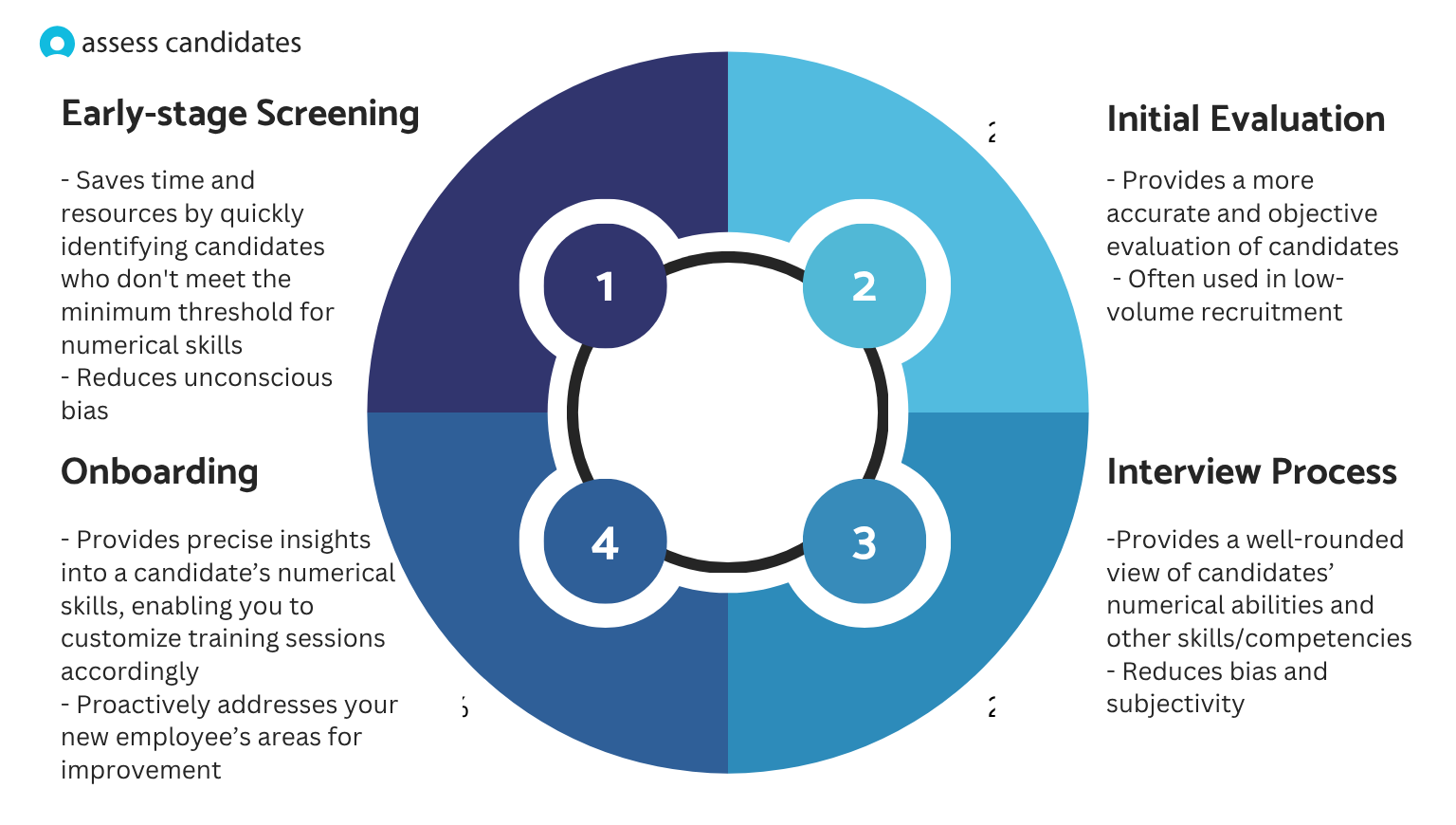
The incorporation of numerical reasoning assessments at different stages of the hiring process helps organizations save time and resources, reduce biases, ensure a positive candidate experience, and customize onboarding and training according to each new employee. Use a numerical reasoning test at the assessment stage that works for you!
Numerical reasoning tests also boost your leadership development and other upskilling programmes! Ask your current employees to take a numerical test to identify their numerical skills, strengths, and areas for improvement. Whether it’s for interpreting financial data effectively, managing budgets, or accurately performing data analysis tasks, these objective insights will help you design targeted employee learning and development programs.
In the next section, we outline step-by-step the best practices for incorporating a numerical reasoning test into your hiring process. Ready to dive in?
7. How to effectively use numerical reasoning assessments to maximize ROI?
Numerical reasoning testing tools work best for graduate and mass recruitment. However, they also help shortlist candidates for medium and low-volume assessment, in particular for technical roles such as a financial analyst and a mechanical engineer.
Here is a simple 3-step guide and best practices for using a numerical ability testing platform such as ours at Assess Candidates:
How to effectively use a numerical assessment platform?
- Create your psychometric test campaign:
- Clearly define the specific skills, behaviors, and personality traits necessary for the role. Then, depending on your recruitment campaign, choose a combination of psychometric assessments for a holistic candidate evaluation. For eg, for the finance assessment process, a multi-assessment approach with a numerical reasoning test, a situational judgement test with our MathBubbles™ game assessment will be effective.
- Combine these standardized tests with other assessment tools, such as video interviews and assessment centers.
- Choose a test provider like Assess Candidates, which provides scientifically validated assessments to predict job performance. Avoid the use of generic assessment tests that fall short of validity.
- Establish a clear deadline and make sure candidates have sufficient time to complete their psychometric assessments. Ensure that all candidates have a consistent time limit, with the option to offer accessibility features for neurodivergent candidates. This standardization guarantees that applicants are evaluated under equitable conditions, promoting fairness and objectivity in the hiring process.
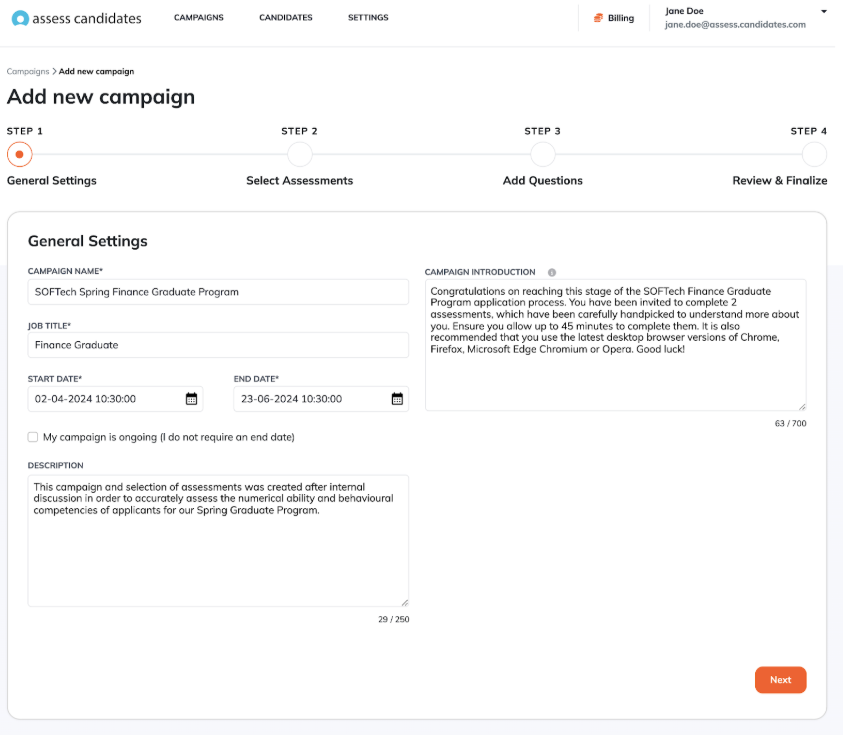
2. Invite candidates to your numerical ability test:
Invite candidates in a single click to complete your numerical reasoning test by individual email, CSV file upload, or public link.
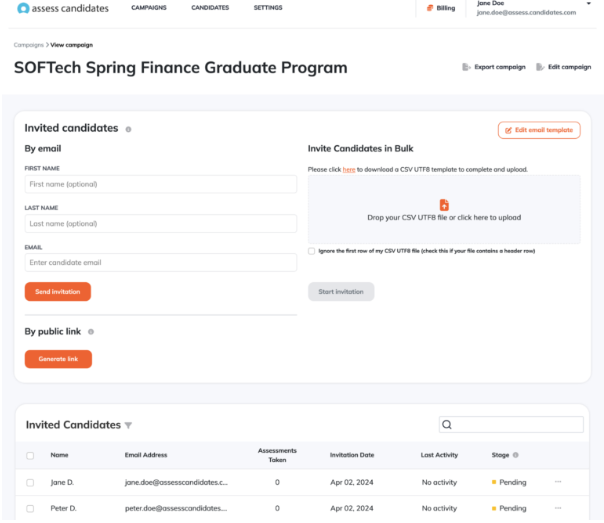
3. Analyze candidate results and shortlist candidates:
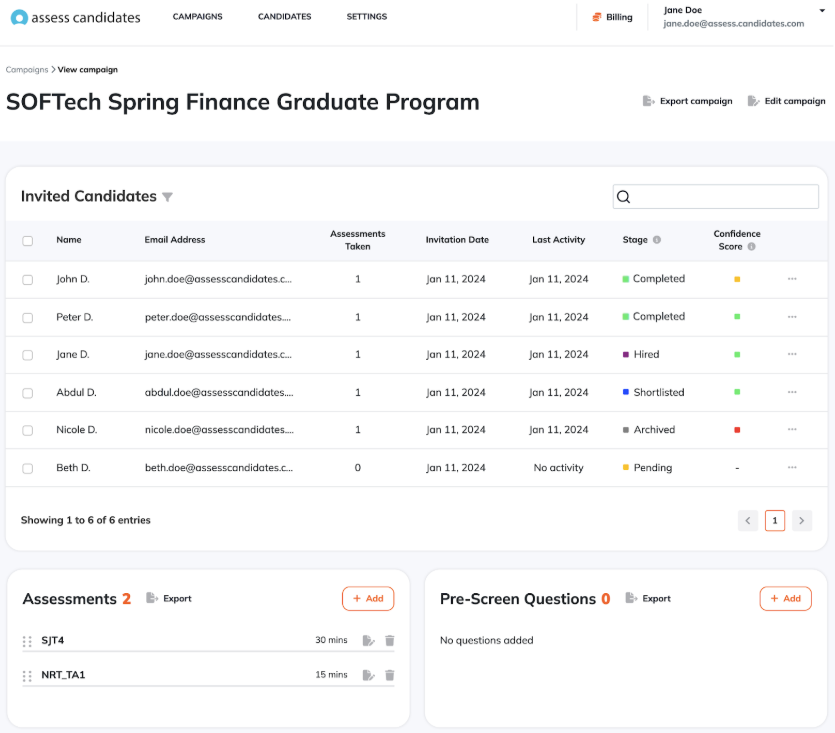
- Monitor candidates’ progress in real-time as they complete your numerical reasoning test and other psychometric tests. You can access automatically graded results and detailed reports immediately after test completion.
- You can use advanced tools to rank, filter, and sort candidates based on criteria such as performance score, number of assessments completed, hiring status, confidence score, and more. This feature allows you to quickly and effortlessly view, compare, and select top talent for your role and organization to progress to the next assessment stage.
- Ensure the training of hiring managers and recruiters to interpret psychometric tests accurately and avoid misinterpretation.
For the best results, at Assess Candidates, we always recommend a multi-assessment approach for the most effective hiring. Combine logical and numerical reasoning tests with other cognitive assessment tests, behavioral tests such as job simulations, and video or in-person interviews, or assessment center exercises.
Streamline your hiring with reliable standardized psychometric tests. LEARN MORE
So, which industries use online numerical tests in recruitment? Let’s find out below.
8. Which industries use pre-employment numerical testing the most?
We have explored how pre-employment numerical reasoning tests are a reliable tool for evaluating a candidate’s numerical aptitude, accuracy, speed, and attention to detail.
Now, let’s see which roles and industries use these cognitive ability tests the most in their hiring.
Top industries that use numerical reasoning tests for hiring include:
- Engineering: Numerical reasoning tests help engineering companies assess candidates’ ability to analyze technical data, apply mathematical principles, and design safe, efficient systems and structures.
- Banking, Finance, and Accounting: Employers in banking, finance, and accounting use numerical tests to evaluate candidates’ ability to create reports, conduct audits, make investment decisions, and forecast outcomes with accuracy.
- Consulting: Numerical reasoning tests help consulting firms assess candidates’ analytical thinking, data interpretation, and problem-solving abilities across graduate schemes, internships, and senior-level roles.
- Technology: Employers in IT use numerical reasoning assessments to identify candidates’ ability to analyze numerical data, troubleshoot systems, and support data-driven innovation.
- Data Analytics: Numerical tests help data analytics employers evaluate candidates’ ability to interpret statistical information, identify patterns, and turn raw data into actionable insights.
- Healthcare: Healthcare organizations use numerical assessments to ensure candidates can accurately interpret clinical data, analyze health statistics, and make precise, evidence-based decisions.
- Marketing: Marketing employers use numerical ability tests to assess candidates’ skills in analyzing sales figures, measuring campaign performance, and identifying market trends to drive strategies.
- Retail: Numerical reasoning tests help retail companies evaluate candidates’ abilities in budgeting, costing, and inventory management to optimize efficiency and profitability.
Top roles that use numerical reasoning tests for candidate assessment
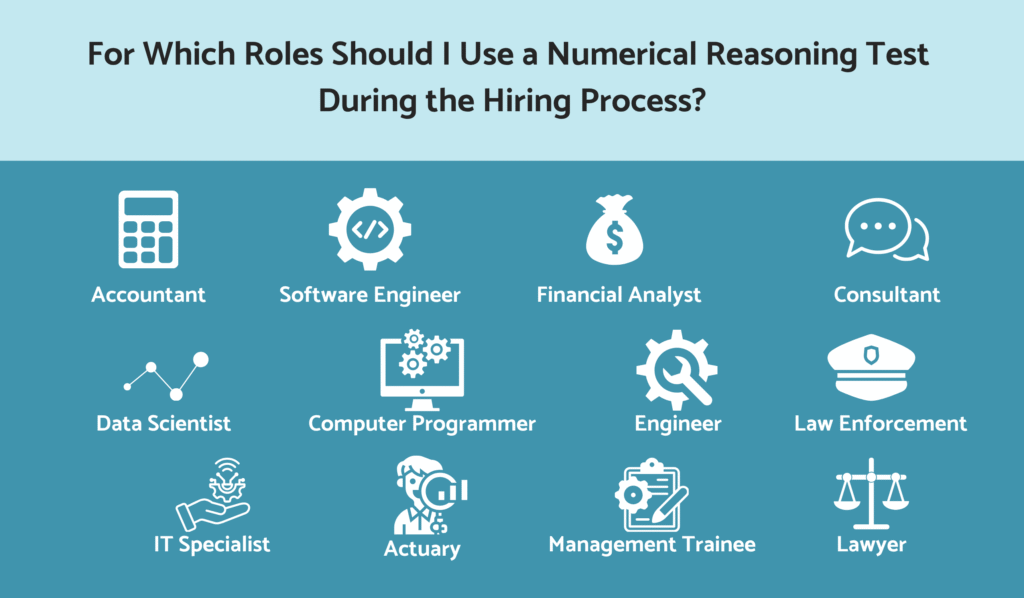
Roles that use numerical reasoning tests for hiring include:
- Accountant
- Auditor
- Financial Analyst
- Consultant
- Data Analyst
- Actuary
- Engineer
- Software Developer
- Market Research Analyst
- Law Enforcement
- Computer Systems Analyst
- Management Trainee
For non-technical roles, such as human resources or customer service executive, numerical Numerical reasoning tests remain important for assessing skills before employment. For instance, even customer service roles often require employees to perform basic mathematical calculations for customers.
For roles that don’t require high levels of numerical reasoning skills, simpler numeracy tests for jobs outline candidates’ basic numeracy skills, attention to detail, and how they manage challenging tasks.
What employers use numerical reasoning tests for hiring?
Large multinational companies have been using numerical reasoning tests in their recruitment processes for decades. Small and medium-sized enterprises (SMEs) and startups are also increasingly leveraging numerical reasoning tests to enhance their hiring processes.
Here is a list of some of the top companies using pre-employment numerical reasoning tests:
- Deloitte
- Morgan Stanley
- KMPG
- RBS Natwest
- Goldman Sachs
- Barclays
- HSBC
- Unilever
- IBM
- EY
- BP
- Lloyds Banking Group
- Bain
- TD Bank
- Amazon
Overlooking the importance of assessing candidates’ numerical reasoning skills during your hiring process could lead to a decline in team performance and overall company success. Therefore, prioritizing numerical tests in your recruitment strategy is essential.
If you are an employer that is unsure if using a numerical test is the right choice for you, learn more here or get in touch with us for a free-of-charge analysis of your recruitment needs.
Now let’s discuss the leading providers of candidate assessment software that you should consider to help implement your numerical reasoning test
9. Choosing the right candidate assessment platform
When selecting a candidate assessment platform for implementing a numerical reasoning test, recruiters should evaluate both the quality of the numerical assessment tools and the overall functionality of the recruitment platform. Consider the following questions:
- Does the candidate assessment software efficiently accelerate candidate evaluation?
- Can I assess the numerical reasoning skills of multiple candidates simultaneously?
- Can I access candidate results and insights in a single click?
- Does the numerical assessment platform provide an objective evaluation of candidates?
- Can I customize the numerical reasoning test and questions to fit my specific role and organization?
- Is the talent assessment platform user-friendly, and does it ensure a positive candidate experience?
By addressing these questions, you can ensure the candidate assessment platform you choose for your numerical reasoning test meets your needs and enhances your recruitment process.
Top 9 pre-employment screening providers to help you assess candidates’ numerical reasoning:
- Assess Candidates
- SHL Verify
- TestGorilla
- Cappfinity
- BRYQ Assessment
- Criteria Corp
- Concentrix
- Aon Assessment
- Caliper Assessment
Use our reliable hiring platform to select top talent with strong numerical reasoning skills. LEARN MORE
Now we will delve into why employers are using the Assess Candidates numerical reasoning tests to enhance their hiring processes.
10. Why do top companies trust Assess Candidates’ numerical reasoning tests to hire?
At Assess Candidates, we specialize in a variety of pre-employment aptitude tests, including numerical reasoning tests, and can build a recruitment campaign tailored to meet the unique hiring needs of any organization.
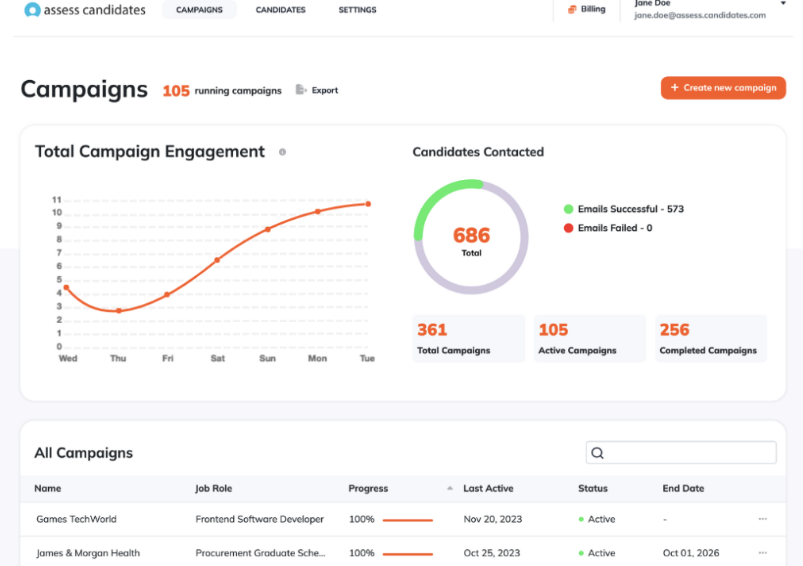
Below is an example of the campaign reporting dashboard available on Assess Candidates. This tool is accessible to hiring managers and talent acquisition professionals, providing valuable insights and easy-to-use sorting functions to streamline candidate assessment.
Here are the top four reasons why you should use Assess Candidates’ numerical reasoning assessments:
1. Scientifically Validated Design: Assess Candidates’ numerical reasoning tests are developed by Chartered Scientists, Psychologists, and Psychometricians with decades of experience designing assessment solutions for companies like SHL and IBM Kenexa. Our numerical reasoning tests have undergone rigorous testing and validation to measure candidates’ numerical reasoning skills accurately. These tests consistently have proven successful in selecting and hiring top talent across various organizations and industries.
2. Expert Reporting: Assess Candidates’ user-friendly and easy-to-navigate assessment platform enables employers to analyze candidate reports in detail and make informed hiring decisions based on flexible criteria. Recruiters can easily view individual candidates’ performance on the numerical reasoning test, then filter, rank, and shortlist candidates. Additionally, our talent assessment platform also offers the option to integrate with your existing ATS for a seamless experience.
3. Positive Candidate Experience: Assess Candidates’ numerical assessment platform is easily accessible from any device and features an aesthetic and easy-to-use interface for candidates. It provides clear assessment instructions and can be fully customized to match your organization’s branding. The tests are designed to require minimal clicks to complete, with the assessment automatically advancing to the next question once an answer is provided. This ensures a seamless and positive candidate experience, which they will associate with your brand.
4. Accessibility Support: Assess Candidates offers support for individuals with disabilities and visual impairments. All our assessments have the option to add extra time, include zoom functionalities, and ensure the use of accessible color schemes and images in compliance with Web Content Accessibility Guidelines (WCAG) to ensure compatibility with screen readers.
Assess Candidates is a leading provider of pre-employment aptitude tests, which have been proven to help small, medium, and large employers successfully hire the best-fit candidates. Why not explore Assess Candidates’ numerical reasoning tests and start hiring today!
11. Numerical reasoning tests: Client Success story
Client Problem Statement:
Consider a mid-sized financial institution facing challenges in selecting and hiring suitable candidates for its investment banking graduate scheme. Their current recruitment process successfully attracts candidates who are a good fit for the organization. Still, it falls short in evaluating essential numerical reasoning skills and candidates’ ability to work with complex numerical data. This gap in the assessment process results in mis-hires, increased training costs, and dissatisfaction among HR and business leaders. The organization needs a more effective selection method to assess candidates’ numeracy, critical thinking, and problem-solving abilities to determine if they are fit to recruit into the graduate scheme.
Assess Candidates’ Proposal:
Assess Candidates would recommend that this company ask candidates to take a numerical reasoning test at the initial screening stage of its hiring process. The numerical test would assess candidates’ aptitude in handling numerical data, performing quick and accurate calculations, and solving complex numerical problems under time pressure, like those faced day-to-day in the workplace. This would enable recruiters and hiring managers to efficiently sift through large volumes of applications and determine the individuals with the desired numerical skills for the role who should advance to the next assessment stage.
Result:
By incorporating the numerical reasoning test, this financial institution can better identify and hire top talent who have the necessary numerical reasoning and problem-solving skills for success in the graduate program and across the wider business. This approach provides a reliable and accurate method for assessing candidate skills, empowering recruiters to make informed hiring decisions with confidence. Utilizing numerical reasoning tests aids the organization in meeting its talent acquisition needs for the investment banking graduate program, fostering the development of future industry leaders, and maintaining competitiveness in the financial sector.
Answers to the above questions:
- €18
- ~131 (approximation)
- 25% profit
- €21.22m
Interested in getting the latest insights and advice on candidate assessment? Keep reading for frequently asked questions and to sign up with your email below to get started.
Frequently Asked Questions
What is a numeracy test for a job interview?
A numeracy test for a job interview is a cognitive ability test that measures how well a candidate can work with numbers in practical, work-related contexts. These tests typically assess their basic arithmetic (addition, subtraction, multiplication, and division), fractions, decimals, percentages, ratios, proportions, and word problems.
How do online numerical assessments help recruiters hire effective candidates?
Numerical reasoning tests are a reliable predictor of how individuals may handle numerical information and workplace problems. Thus, those with strong numerical reasoning skills are likely capable of:
- Confidently utilize numbers to solve challenges and problems logically
- Identify trends and patterns in data
- Successfully conduct numerical analyses
- Undertake strategic data-driven decisions to optimize business processes
- Work efficiently under time pressure
Why do organizations use online numerical tests?
Large organizations use numerical reasoning tests to conduct efficient, yet cost-effective and objective, candidate assessments. These tests help recruiters improve the quality of hire through a data-driven recruitment process that supports an inclusive and candidate-friendly hiring process. Additionally, companies use online numerical tests to identify potential leaders to support their succession planning and thus boost their workforce productivity and employee retention.
Do online numerical tests work for small and medium-sized enterprises (SMEs)?
Yes, online numerical tests have made candidate profiling easier, more efficient, and more affordable for all employers, including SMEs. Popular providers such as Assess Candidates offer Saas (Software-as-a-Service). These include fully automated, cloud-based tests that can seamlessly integrate into existing recruitment campaigns for a smooth and efficient assessment process.
How to prevent cheating during numerical ability testing?
You can effectively prevent attempts to cheat during candidate numerical ability testing by using advanced anti-cheat technology to avoid compromising test integrity. Top providers, such as Assess Candidates, offer anti-cheating features, including web proctoring for remote tests, screen-sharing monitoring, and facial recognition, to ensure the assessment process remains fair and objective.


 English
  Arabic