
Best Practices for Skills-Based Hiring in 2026



Skills-based hiring is growing as employers increasingly need people who can do the work, not just describe their credentials. Traditional hiring methods still rely heavily on CVs, degrees, and job titles, which can exclude strong candidates who have the right capabilities but less conventional backgrounds.
According to McKinsey, skills–based hiring practices could be among the definitive hiring trends that help companies maximize their recruiting and gain access to a wider pool of talent.
This guide explains what skills-based hiring is, what it measures, how it differs from traditional hiring, which assessment tools support it, and how to implement it effectively.
CONTENTS:
- What is skills-based hiring?
- What does skills-based hiring measure?
- What is the difference between skills-based hiring and traditional hiring?
- Which assessment tools support skills-based hiring?
- What are the benefits of skills-based hiring?
- Best practices to implement skills-based hiring
- Roles and sectors that use skills-based hiring
- Client success stories about skills-based hiring
- Future of recruitment with skills-based hiring
- Why do employers use Assess Candidates for skills-based hiring?
Let’s start with the basics; what skills-based hiring actually changes.
1. What is Skills-Based Hiring?
Skills-based hiring is a recruitment approach that prioritizes verified competencies and practical ability over credentials such as job titles, degrees, or years of experience.
According to a LinkedIn survey, job listings have increased by 21% that prioritize skills over academic credentials.
Start your skills-based hiring process with our psychometric assessments. HIRE FOR FREE
But what does skills-based hiring actually measure? We have the answers below. Keep reading!

2. What does skills-based hiring measure?
Skills-based hiring measures whether candidates can demonstrate the abilities required for the role, including both technical and transferable skills.
According to McKinsey, skills-based recruitment is a worldwide phenomenon, and recruiters have come to realize that college education is expensive and not affordable for everyone in the workforce.
This is one of the key reasons for the boost in skills–based hiring, so top candidates without a college degree will have an opportunity in the recruitment process, as long as they possess the required skills.
Top skills measured in skills-based hiring
1 . Technical Skills
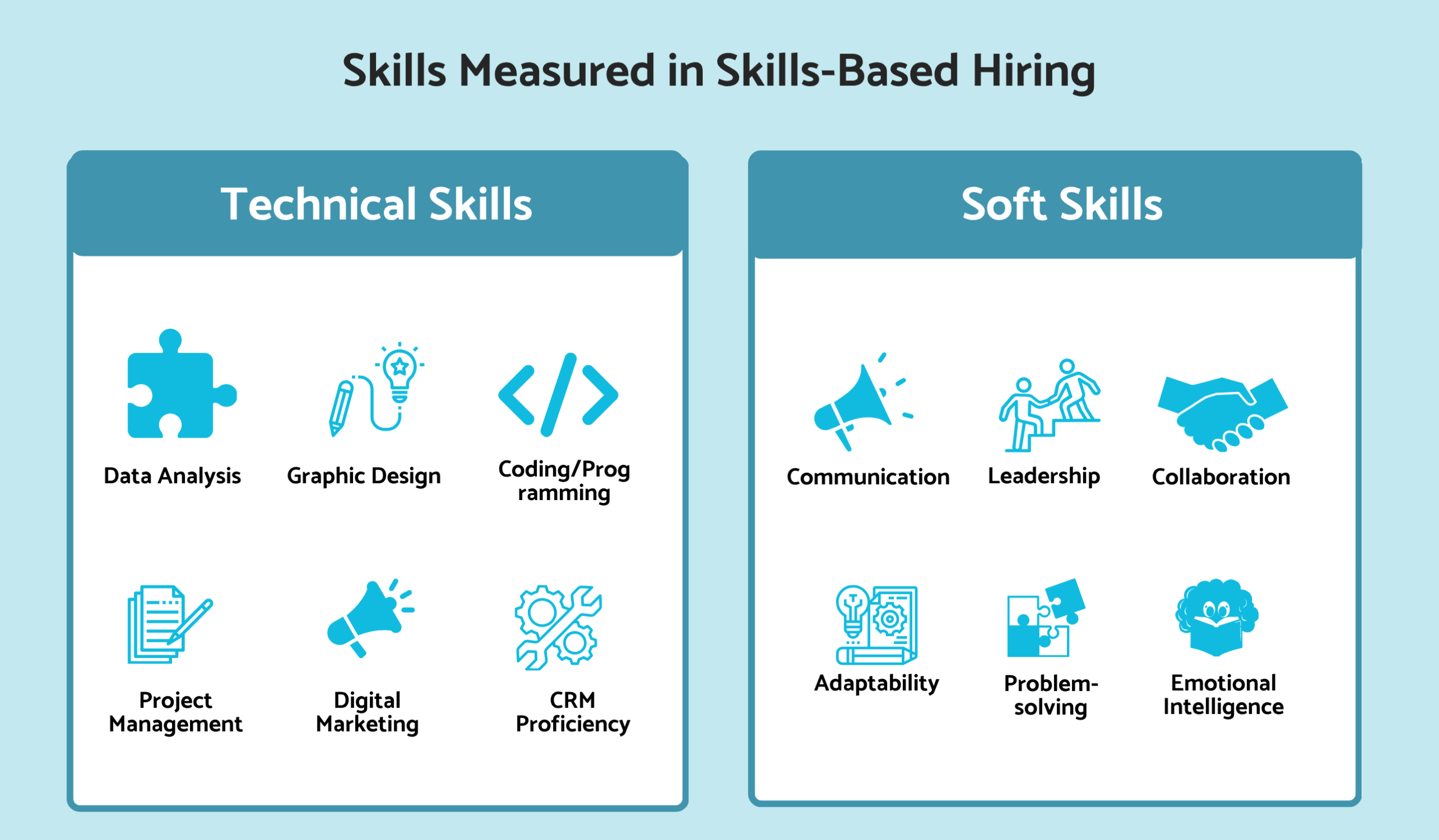
Skills-based hiring measures technical or hard skills by evaluating your candidates’ skills and knowledge. These assessments include portfolio reviews, psychometric assessment tests, and simulation tasks, and they are designed to assess the specialized skills of the candidates you are recruiting.
- Data Analysis: This involves processing large datasets to identify trends, insights, and patterns. Candidates are expected to be knowledgeable with tools such as Excel, SQL, and Python.
- Project Management: This focuses on testing your candidates’ skills in organizing teams, deliverables, and resources using Agile, Scrum, or Waterfall methodologies.
- Graphic Design: Depending on the role you are recruiting for, assess your candidates’ ability to produce visually appealing graphics, layouts, and branding materials. These can all be done with tools such as Figma, Adobe Photoshop, and Adobe Illustrator.
- Digital Marketing: It encompasses the creation and optimization of online campaigns, including social media strategies, SEO, and Google Ads. These tools help to drive traffic and conversions.
- Coding/Programming: This skill focuses on debugging, developing, and optimizing software code in languages such as JavaScript, Java, and Python. You can assess these skills through live coding assessments.
- CRM Proficiency: It assesses your candidates’ ability to use customer relationship management tools such as Salesforce and HubSpot to monitor leads, manage interactions, and create reports.
2 . Soft Skills
Skills-based hiring also evaluates soft skills, such as communication, collaboration, adaptability, and emotional intelligence, which influence how effectively someone works with others and responds to change. These skills are interpersonal traits that are assessed through behavioral assessments, video interviews, situational judgment tests, and personality questionnaires.
- Communication: This skill involves articulating ideas clearly and eloquently in writing, presentations, or conversations. The candidates’ communication skills are tested on how well they can adapt to the audience while listening actively to encourage collaboration.
- Leadership: Your candidates must be skilled in inspiring others, delegating tasks, making decisions, and driving results within a department or a team. These skills must be demonstrated in group exercises or leadership scenarios, even without a formal title.
- Collaboration: Collaboration skills involve working harmoniously with colleagues in groups, sharing responsibilities, settling conflicts, and actively contributing to the collective success of a project and your company.
- Adaptability: The adaptability skill evaluates your candidates’ flexibility in responding to unexpected changes, such as shifts in priorities or new technologies. The candidates are tested on how quickly they learn and maintain performance without disrupting their workflow.
- Problem–solving: This problem-solving skill entails your candidates identifying challenges, brainstorming creative solutions, and efficiently implementing them under limited time or resources.
- Emotional Intelligence: This skill encompasses self–awareness, empathy, and emotion regulation to build relationships, manage stress, and navigate interpersonal dynamics effectively.
How does skill-based hiring differ from traditional hiring methods? Read on as we cover the key differences below.
3. What is the difference between skills-based hiring and traditional hiring?
The main difference between skills-based hiring and traditional hiring is that one focuses on demonstrated ability, while the other often relies on credentials as a proxy for capability.
According to Clevry, studies have shown that skills–based hiring practices are five times more effective in recruitment than traditional hiring practices.
Differences between skills-based hiring and traditional hiring
Having seen the differences between these two, let us take a look at the skills–based hiring assessment tools.
4. Which Assessment Tools Support Skills-Based Hiring?
Employers use skills-based assessment tools to measure candidates’ skills, cognitive abilities, behavioral tendencies, and both hard and soft skills.
1. Psychometric Assessment Tests
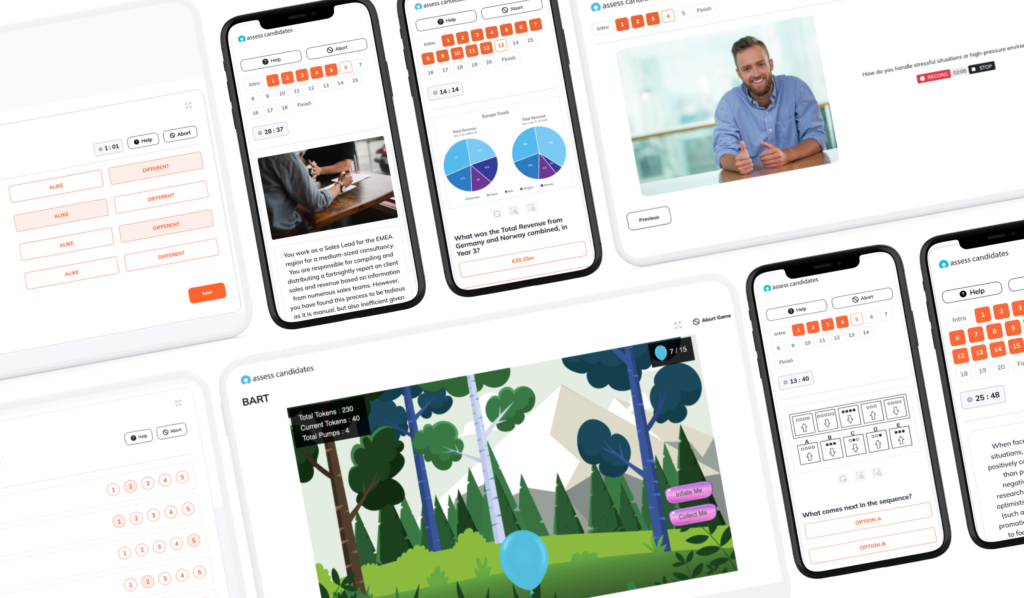
Psychometric and aptitude assessments can help employers evaluate reasoning ability, attention to detail, and other job-relevant cognitive strengths that support performance.
- Numerical Reasoning Tests: Numerical reasoning tests are set to test your candidates’ skill in interpreting, analyzing, and drawing conclusions from numerical data. A numerical test proves to employers that candidates can handle numerical data, including basic arithmetic, statistics, and other calculations required in their roles.
- Verbal Reasoning Tests: Verbal reasoning tests assess your candidates’ abilities to analyze and comprehend written information in documents. The verbal test is designed to measure skills such as comprehension, logic, and critical thinking.
- Logical Reasoning Tests: Logical reasoning tests examine your candidates’ skills in identifying patterns, thinking critically, and understanding sequences. The logical test assesses your candidates’ ability to draw conclusions from the situations and arguments they are presented with.
- Error–Checking Tests: Error-checking tests evaluate a candidate’s skills in identifying errors in data or documents and accurately comparing and verifying the information. The error-checking test is created to measure your candidates’ attention to detail, accuracy, and focus.
- Critical Reasoning Tests: Critical thinking tests gauge the ability of your candidates to examine information, think critically to determine what is important, make judgments, and solve problems. The critical tests assess a candidate’s ability to think critically and logically and to make sound decisions.
Companies such as Assess Candidates, SHL, and Korn Ferry offer psychometric assessment tests to employers seeking to recruit candidates while prioritizing skills-based hiring.
2. Behavioral Assessments
Behavioral assessments are designed to evaluate the interpersonal and social abilities candidates must possess when applying for a role in your organization. The skills are how the candidates will interact with other staff members, how they manage themselves, and how they navigate situations.
- Situational Judgment Tests: Situational judgment tests present candidates with realistic, work-based scenario questions and responses ranging from extreme to reasonable actions. The situational judgment test assesses their behavior and reactions in workplace scenarios.
- Workplace Personality Questionnaire: Personality questionnaire tests are used to measure and categorize a candidate’s personality traits, behaviors, preferences, and tendencies. These personality questionnaire tests are designed to provide insight into how someone thinks, feels, interacts with others, and approaches tasks.
Assessment platforms like Assess Candidates, Pymetrics, and SHL each offer behavioral assessments to assess candidates’ behavioral tendencies and how well they align with your organization’s culture.
3. Video Interviews
A video interview is conducted remotely using video technology, allowing candidates and interviewers to connect virtually instead of in person. Recruiters can evaluate a candidate’s qualifications, communication skills, and overall suitability for a role by observing both verbal and non–verbal cues in real time or through pre-recorded questions.
Assess Candidates, HireVue, and Pymetrics provide candidates with a seamless video-interviewing platform that accurately assesses their skills during the recruitment process.
4. Game-Based Assessments
Game-based assessments, unlike traditional tests or interviews, are interactive, engaging evaluation tools that accurately measure candidates’ job-relevant skills, traits, and cognitive abilities through short game-like tasks.
Platforms like Assess Candidates, Arctic Shores, and Codility enable employers to assess candidates’ skills through gamified assessments.
5. Coding Tests
Coding tests are used by recruiters to examine the candidates’ abilities in programming and solving technical problems using code. Coding assessments often include tests that focus on algorithmic thinking, software development, and proficiency in programming languages such as Java, C++, and Python.
Assess Candidates, Codility, and HackerRank all provide employers with the right assessment platforms to test candidates’ coding skills before they are recruited.
6. Language Tests
Language tests evaluate your candidates’ ability to read, write, and speak a particular language that is core to the role and company they are applying for. The language assessment is designed for roles that involve communication between executives and clients.
Platforms like Tracktest, Mercer, and Pipplet all offer employers language testing platforms that help with hiring decisions.
7. Assessment Centers
Assessment centers are conducted either virtually or in person and evaluate a candidate’s skills through a series of curated, role-related activities. These activities take the form of case studies, presentations, group exercises, and role–plays.
Assessment centers can be found in pre-hire platforms such as Assess Candidates, SHL, and Clevry.
Hire the perfect candidates with our unique assessment platform. LEARN MORE
The next section covers the main benefits of skills-based hiring.
5. What are the benefits of skills-based hiring?
Skills-based hiring can improve hiring quality, widen the talent pool, and reduce overreliance on credentials that do not always predict performance.
According to NACE research, about 64.8% of employers in the United States prefer skills-based hiring to recruit candidates, particularly for entry–level roles.
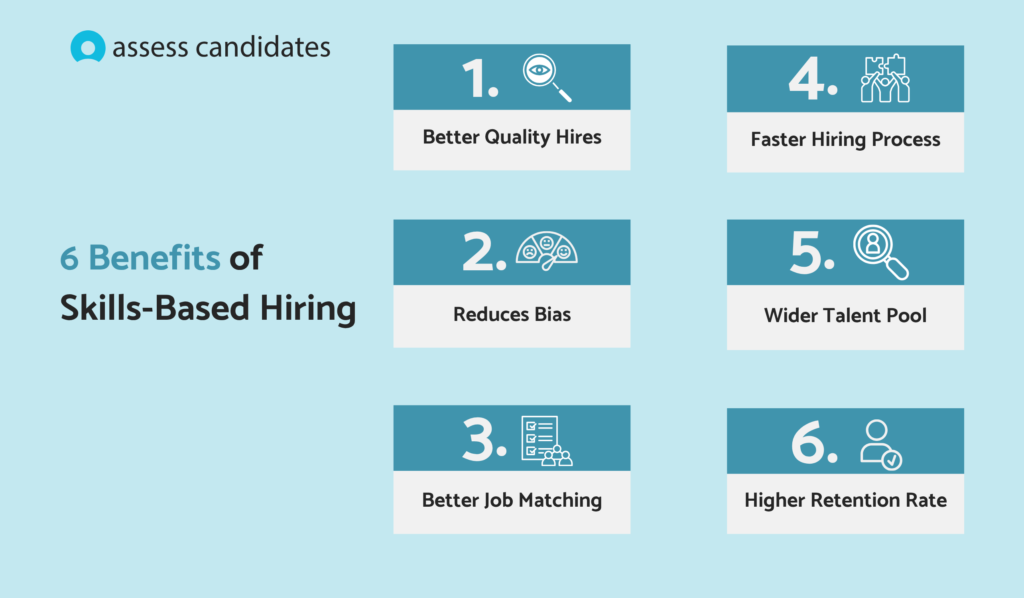
Top 6 benefits of skills-based hiring
1. Better Quality Hires
Recruiting through skills–based hiring ensures that candidates prove their ability before joining your organization, so their performance on the job is expected. Assessing your candidates’ talent can be done using any of the skill-based recruiting tools available to you.
2. Reduces Bias
Using objective assessments helps replace subjective resume screening, thereby minimizing the unconscious bias related to names, educational institutions, or socioeconomic status. Skills-based hiring helps ensure that all candidates have the same positive experience in your recruitment process, regardless of their background.
3. Better Job Matching
By assessing your candidates through direct skill demonstrations such as assessment tests or work samples, you will be able to identify the candidates whose abilities align with the role’s requirements. Doing this will result in a successful hire who understands their role and contributes meaningfully from the start.
4. Faster Hiring Process
Skills-based screening can shorten hiring cycles by helping employers identify stronger candidates earlier in the process. This hiring method also helps cut costs in talent sourcing and initial screening compared to the lengthy traditional interview processes.
5. Wider Talent Pool
The exclusion of degree credentials or the reduction of experience thresholds during a recruitment process creates more room for a larger number of eligible candidates. This talent pool will also include skilled professionals who have non–traditional career paths. This is an advantage for your organization, as access to talented candidates is a core hiring skill in today’s competitive talent market.
6. Higher Retention Rate
Your employees feel encouraged and confident when your candidates match the roles based on their verified skills. This is because this recruitment reduces employee turnover, as you will have avoided the role mismatches that occur in traditional hiring.
Are you wondering about the best practices to implement skills–based hiring?
Here are the practices that matter most.
6. Best practices to implement skills-based hiring
Skills-based hiring works best when job requirements, assessments, interviews, and decision criteria all focus on the same role-relevant capabilities.
According to AIHR, most organizations, whether small, medium, or large, implement skills-based hiring techniques in their employee recruitment processes.
Best strategies to implement skills-based hiring
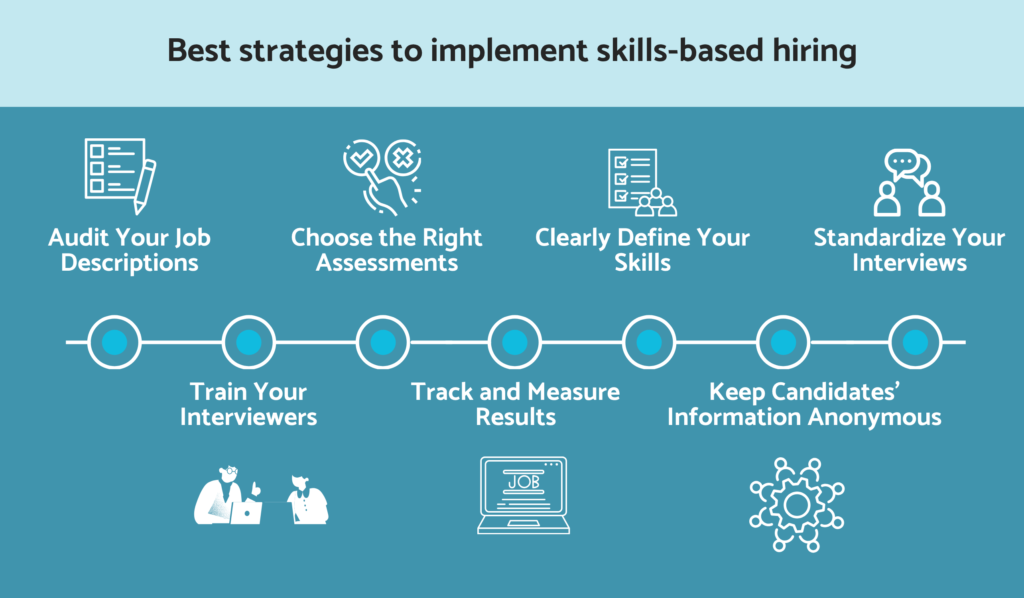
- Audit Your Job Descriptions
We recommend that you rewrite your job postings to explicitly state the tasks and outcomes rather than qualifications and years of experience. You should replace the requirements for a BSc degree with the actual competencies the role you are applying for requires of its candidates.
- Choose the Right Assessments
Ensure that you align your skills-based hiring assessment tools with what the job description demands of its candidates. Avoid using generic psychometric assessment tests as your only filter, as they measure potential rather than your candidate’s readiness to perform in the role.
- Clearly Define Your Skills
Before you post a job ad on any platform, we suggest identifying the specific skills the role you are recruiting for requires. Be sure to separate the non–negotiable skills that prospective candidates are to have from the skills you would like them to have. You can also remove credentials that are not relevant to job performance.
- Standardize Your Interviews
Using structured interviews with consistent questions and a distributed scoring rubric among all your interviewers will ensure that your candidates receive the same treatment throughout the hiring process. This improves your candidate’s experience and eliminates the subjectivity that allows room for bias after creating a fair assessment.
- Train Your Interviewers
Skills-based hiring will only function properly in your company if your hiring managers and interviewers are on board with the goal and process. This is why we recommend training your recruiters to evaluate assessment results, how to operate structured interviews, and how to avoid returning to credential–based instincts under pressure.
- Track and Measure Results
Regularly monitor whether your hires are performing well, retaining their positions, and applying from diverse backgrounds. You can use this information to refine your assessment tests and spot where bias or drop–off is occurring in your recruitment process.
- Keep Candidates’ Information Anonymous
To ensure you achieve premium skills-based hiring results, we recommend removing candidates’ names and identities from your application process. Doing this further promotes diversity and inclusion, so your candidates do not have a negative candidate experience due to unconscious bias.
Create the perfect hiring process for your candidates with our assessment gallery. HIRE FOR FREE
Following these strategies, let us take you through some roles that require skills–based hiring. Keep reading!
7. Roles and Sectors That Use Skills-Based Hiring
In the modern recruitment age, where employers are increasingly leaning towards skills-based hiring to ensure they get the top candidates in the industry, we will show you some sectors and roles that require skills-based recruitment.
Sectors that use skills-based hiring
- Technology
This is one of the biggest adopters of skills-based recruitment, as tech companies like Google, Apple, and IBM have all dropped degree requirements for most of the tech roles they recruit for.
- Financial Services
Banks and fintechs that continue to hire are also increasingly using numerical reasoning tests, case studies, and job simulations to recruit for roles such as financial analysts and accountants. Companies like Goldman Sachs, JP Morgan, and Bank of America are all examples of companies that support skills-based hiring.
- Healthcare
Healthcare companies such as Johnson & Johnson, Pfizer, and Mayo Clinic often rely on competency-based skills, simulation-based assessments, and licensing verifications to assess candidates during the recruitment process.
- Retail
Retail companies such as Amazon, Walmart, and Unilever have demonstrated their commitment to skills-based hiring. The companies use methods such as screening with situational judgment tests to handle high–volume recruitment and improve customer service experiences.
- Government & Public Sector
Government and public-sector companies such as the UK Civil Service, the Australian State Police, and the US Office of Personnel Management have all embraced competency evaluations and structured assessments to help reduce credential bias.
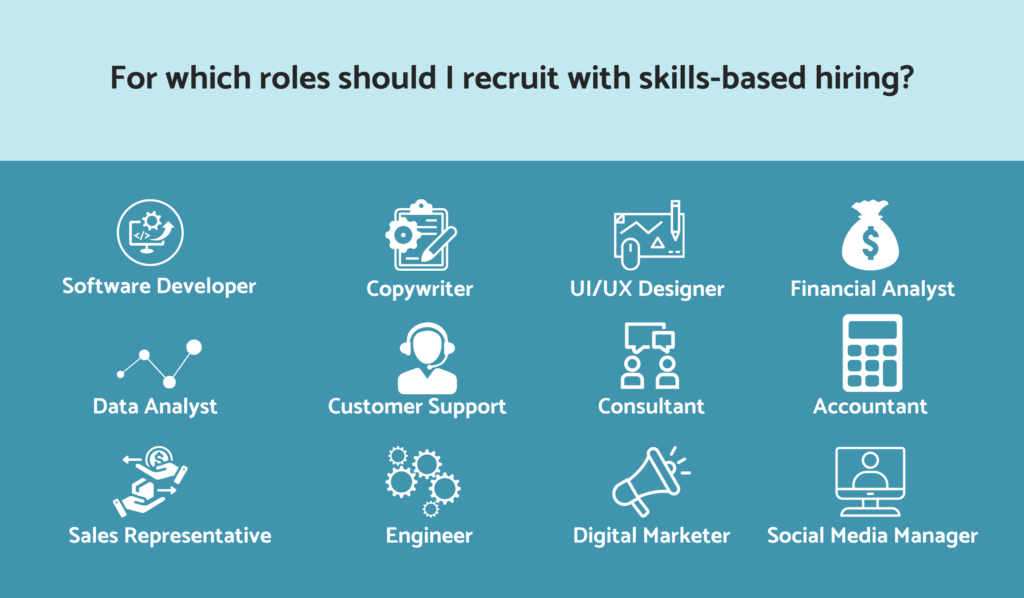
Roles that recruit with skills-based hiring
- Software Developer
- Copywriter
- UI/UX Designer
- Financial Analyst
- Data Analyst
- Customer Support
- Consultant
- Accountant
- Sales Representative
- Engineer
- Digital Marketer
- Social Media Manager
Are you wondering how to customize your pre-employment psychometric assessments to ensure they include skills-based assessments in your recruitment process? You can contact us for a detailed examination of your hiring needs to ensure you hire and retain the perfect candidates who meet your skills-based hiring requirements.
Employers that Practice Skills-Based Hiring
- Unilever
- Mayo Clinic
- JP Morgan
- Apple
- IBM
- Goldman Sachs
- Johnson & Johnson
Discover more skills-based assessments designed by Chartered Scientists to recruit the right talent. VIEW PLANS
8. Client success stories about skills-based hiring
Various employers have shared their testimonials about the quality of applications they have received from top candidates since adopting skills-based hiring. Let us take a look at some of them.
1. Steelcase
Challenge:
Steelcase, the furniture manufacturing company, noticed an under representation of women and minorities in its recruitment due to biased job descriptions and experience requirements. The company’s traditional recruiting methods had failed to attract diverse talent organically, and this was affecting its employer branding.
Solution:
Steelcase updated its hiring practices by prioritizing skills over resumes, eliminating experience requirements, and reducing biased language in job descriptions. They focused on their diverse candidates and ensured that everyone got equal treatment throughout the skills assessment.
Results:
- Steelcase recorded a new peak with its hires, reaching 55% women
- Achieved a recruitment of 30% racial or ethnic minorities
- Broadened its talent pool organically and without quotas
2. Cleveland Clinic
Challenge:
Cleveland Clinic’s traditional hiring relied heavily on educational degrees and resumes, thereby limiting access to diverse talent for its operational roles. This obstacle slowed the company’s internal mobility and created barriers for qualified candidates without formal credentials.
Solution:
The company collaborated with third–party firms to remove resume requirements, shift to task performance evaluations, and provide hands–on learning opportunities. The candidates were then able to demonstrate their abilities through practical assessments and apprenticeships.
Results:
- Recruited or promoted 1,600 individuals into new positions within the company
- Created a more diverse leadership pipeline through skill-based apprenticeships
- Improved internal mobility by prioritizing candidate potential over pedigree
9. Future of recruitment with skills-based hiring
Skills-based hiring is likely to become more embedded in recruitment as employers improve skills mapping, assessment design, and internal mobility decisions.
According to Skill Sauce, skills-based hiring is becoming a more strategic recruitment method that many employers are adopting.
What is the future of recruitment with skills-based hiring?
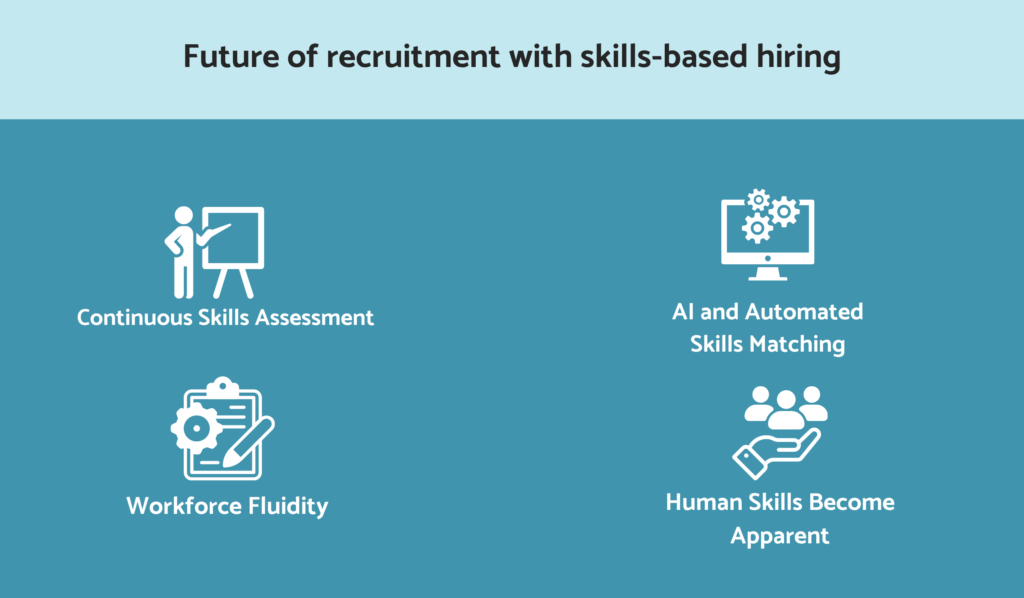
1. Continuous Skills Assessment
Organizations will eventually move beyond one-time hiring evaluations to ongoing skills monitoring throughout the recruitment process, enabling smarter internal mobility and targeted upskilling. Centralized skill profiles will track your employees’ growth, helping you retain your top talent.
2. Workforce Fluidity
Your company’s teams, made up of global hires and experts, will be formed around skills rather than fixed roles, as this strategy will make your organization more productive. The future of recruitment will include dynamic staffing that will attract experts from internal pools or gig platforms for projects without fixed hierarchies.
3. AI and Automated Skills Matching
Platforms will use AI to match candidates to job roles based on proven skills rather than CV keywords. AI and automation will draw on work samples, portfolios, and candidates’ online activity. Doing this will minimize unconscious bias in early screening and give lesser-known candidates a fair chance in the recruitment process.
4. Human Skills Become Apparent
Human skills such as collaboration, communication, adaptability, and critical thinking will become more apparent in the future of recruitment. These soft skills will be made measurable criteria, making hard skills easier to verify and automate. Companies that establish reliable methods for assessing these skills will have an edge in building high-performing teams.
Explore our assessments created by Chartered Scientists to hire the top talent. VIEW PLANS
Skills-based hiring only works consistently when assessments, interviews, and scoring all point back to the same role requirements.
So, why choose Assess Candidates for your skills–based recruitment?
10. Why do employers use Assess Candidates for skills-based hiring?
Assess Candidates helps employers build a more structured skills-based hiring process through assessments, reporting, and fairer candidate evaluation.
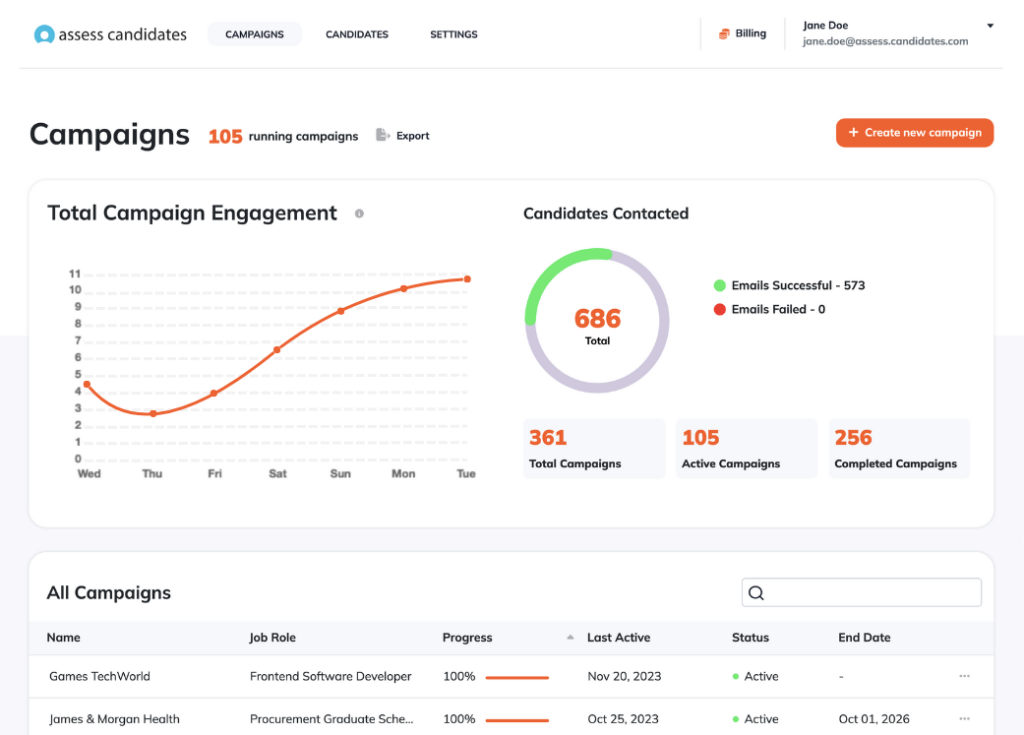
- Bias Reduction and Inclusivity: Assess Candidates incorporates accessibility tools, such as additional time options, screen reader compatibility, and blind scoring, to help you reduce bias. These tools help employers expand their talent pool to include diverse and non-traditional candidates.
- Positive Candidate Experience: Our platform boasts of branded candidate portals, a seamless admin setup, and short assessment durations. This enhances the candidate experience, boosting completion rates and employer branding.
- Science–Backed Assessments: Assess Candidates’ pre-employment psychometric assessment tests are developed by psychologists. These tests predict on–the–job performance with valid reliability and help you reduce the risk of having a mis-hire.
- Video Interviewing Integration: We offer an AI-powered video interviewing platform that evaluates candidates’ body language, and its content scoring is linked to skill assessments. Our video interviewing platform adds behavioral depth and reveals communication skills and cultural fit in your organization.
- Customizable Assessment Builder: With Assess Candidates, you are able to choose and drop the assessment tests that you require when making skills-based hires. You can combine assessment tests and include some company-specific questions to ensure that you hire the right candidates for the vacant roles in your organization.
Hire the right candidates with our assessment tool platform. LEARN MORE
Conclusion: Key Takeaway
Skills-based hiring gives employers a more direct way to assess whether candidates can perform in the role. When paired with clear job requirements, structured interviews, and relevant assessments, it can improve hiring quality, widen access to talent, and reduce costly mis-hires.
Want to know more about using skills-based recruitment when hiring candidates? Keep scrolling to explore our frequently asked questions, and enter your email to get started today.
Frequently Asked Questions
How does the process of skills-based hiring work?
The skills-based hiring process begins with a skill-defined job description. You screen your candidates with pre-employment psychometric assessment tests, then screen the top candidates with video interviews or assessment center exercises.
Does skill-based recruitment mean removing all degree requirements?
Skills-based recruitment means you only need to include the genuine, relevant degree requirements for the role you are recruiting for. You can request degrees in critical roles that require degrees, such as medicine, law, and more.
How do I identify the right skills to assess?
You can identify the right skills by speaking with top candidates already in the role and observing what they actually do day to day. Design your assessment process around these specific tasks rather than creating generalized competency frameworks.
How do candidates feel about skills-based hiring?
Many candidates have shared positive experiences with skills-based assessments, as they feel they are more relevant to the role and respectful of their time in the recruitment process. Creating a lengthy or poorly designed assessment process will result in a mis-hire, as candidates may withdraw during the recruitment process.
How do I measure whether skills-based hiring is working?
You can track and monitor metrics such as new performance ratings, time-to-fill, regular check-ins on your retention rates at six and twelve months, and the diversity of your hires over time. These indicators will show whether your skills-based recruitment is working for your company.


 English
  Arabic