
When is the Right Time for a Pre-Employment Assessment, Before or After Reviewing CVs?



Many employers around the globe have shared their thoughts on implementing pre-employment psychometric assessment tests for candidates during recruitment. Many have continued to argue for or against before and after reviewing the candidates’ CVs.
The timing of your assessment process matters in any hiring process; however, it can make or break your candidate selection, depending on the methods you use and the steps you take to mitigate potential problems.
In this guide, we will explain the differences and impacts of including your pre-employment assessments before and after reviewing your candidates’ CVs during the recruitment process.
Contents
- What are pre-employment assessment tests?
- Differences between using pre-employment testing before or after reviewing CVs
- Should I add pre-hire assessments before reviewing CVs?
- Should I implement pre-hire assessments after reviewing CVs?
- When should you add assessment tests to your recruitment process?
- The future of pre-employment assessments
- Why do companies prefer Assess Candidates’ assessments for recruitment?
Are you interested in knowing which method is preferable for your company’s recruitment process? Dive in!
1. What are pre-employment assessment tests?
Pre–employment assessment tests are standardized evaluations used in recruitment processes to examine the candidates’ cognitive abilities, personality traits, skills, and workplace behaviors. The psychometric test helps recruiters make data-driven hiring decisions that will benefit the company.
Many employers often find themselves asking when the right time is to add assessment tests in their recruitment processes? First, it’s important to consider the different stages you can follow as a recruiter.
The stages of recruitment that you can follow as a recruiter may involve various steps, depending on the role you’re hiring for. Let’s dive into this further below.
What are the stages to consider when recruiting?
Recruiting can be stressful if not done properly, which is why employers use a common format that ensures a steady, consistent recruitment process for candidates and recruiters. The following are the stages of recruitment that almost every employer follows:
- Job Posting: Companies announce vacancies by posting on sites and apps like LinkedIn, Jobberman, Upwork, and others. This job posting includes the role descriptions, employer expectations, skill requirements, and salary range.
- CV/Resumé Collection: Organizations begin the collection of candidate applications, including their CVs and personal information, to build candidate profiles.
- Candidate Screening: Most employers go right into screening their candidates, which involves reviewing the candidates’ skills and abilities, assessing whether they are a good fit. They then shortlist the top candidates for the next stage of the recruitment process.
- Assessment Process: At this stage, the shortlisted candidates are required to participate in an assessment process to determine their skills and psychometric abilities. Each test is specifically designed to evaluate a skill desired and required for the role they are applying for.
- Assessment Centre: Some companies will have their candidates take part in an assessment center right after the assessment tests. The assessment centres are like a job simulation, where applicants engage in real-world scenarios or tasks that may occur in the workplace.
- Interviews: Upon passing the assessment process, successful candidates are often contacted to participate in an interview or a series of interviews with department heads, recruiters, or employers to ensure their values align with the company and the team.
- Onboarding: The final stage of recruitment is onboarding, which comes after the company has offered the successful candidates an employment letter. Existing employees show candidates around the team and organization.
Kickstart your recruitment process with pre-employment assessments that accurately shortlist candidates. HIRE FOR FREE
There are many different outcomes between including your assessment process before and after reviewing CVs. Let us take a look.

2. Differences between using pre-employment testing before or after reviewing CVs
There are various outcomes recorded by employers who have tried reviewing CVs either before or after implementing assessment tests for their candidates.
Explore our science-backed psychometric tests that quickly assess and filter candidates. LEARN MORE
Want to know if adding your assessments before reviewing CVs is the ideal plan? Read on below!
3. Should I add pre-hire assessments before reviewing CVs?
If you are unsure whether it is better to add assessments before reviewing your candidates’ CVs, we have drafted a few reasons why it might be.
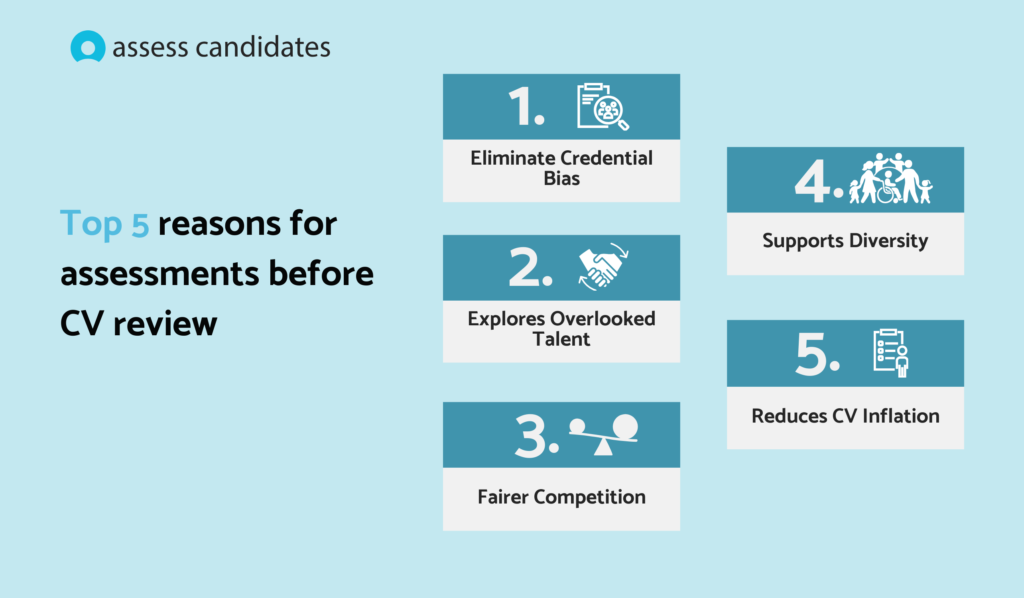
Top 5 reasons for assessments before CV review
1. Eliminate Credential Bias
Reviewing CVs before assessments can trigger unconscious bias on the recruiter’s part, which is why testing all the candidates first means they can be judged equally, regardless of their background and location.
2. Explores Overlooked Talent
Many candidates are likely overlooked because they do not possess certain traditional talents and skills. For example, self-taught developers or career changers who worked while studying may not be selected.
3. Fairer Competition
Assessing your candidates before reviewing their CVs offers everyone an equal opportunity, as they each have the chance to prove their skills and talents in the role and your organization.
4. Supports Diversity
If diversity and inclusion are priorities, more employers will recruit more, focusing on skills-based hiring, which will inarguably increase diversity and reduce the barriers that traditional CV screenings often create for minority groups.
5. Reduces CV Inflation
Candidates will occasionally inflate their resumés and CVs, claiming skills and talents that they do not possess in reality, and the inclusion of assessment tests before CV review minimizes this from occurring in your recruitment.
If you are also interested in the benefits of reviewing resumes before setting assessment tests, we have them listed below.
4. Should I implement pre-hire assessments after reviewing CVs?
Employers have also shared testimonials about setting assessments after reviewing CVs during recruitment.
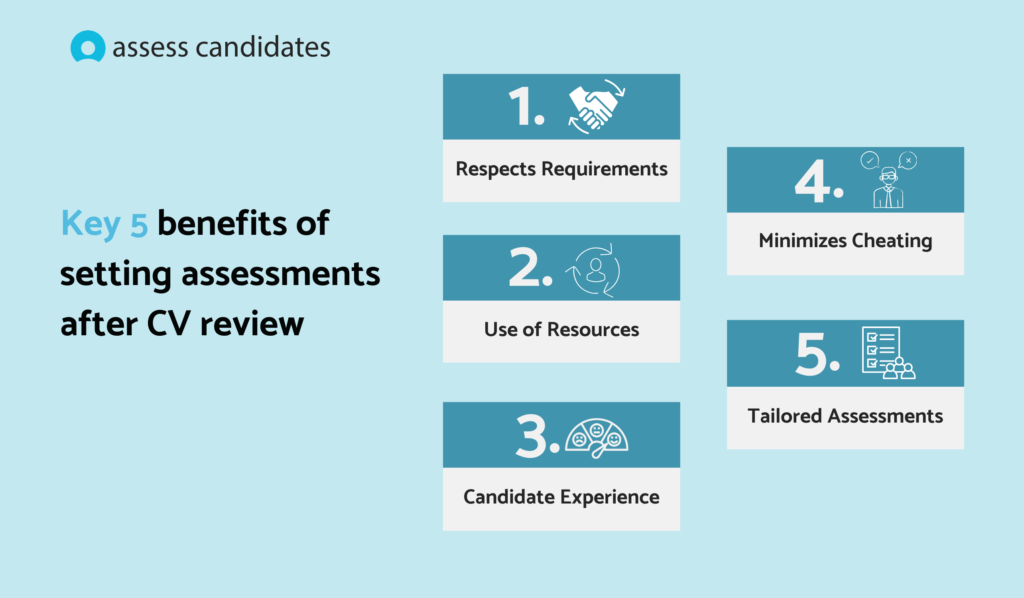
5 Key benefits of setting assessments after CV review
- Respects Requirements
There are some roles that actually require certain legal licences, certifications, and degrees, so it may be contradictory to test and recruit candidates who cannot work legally, regardless of their skills.
- Use of Resources
It is more economical to assess a shortlisted number of candidates who pass the CV screening stage because you will spend more of your resources, time, and funds to assess hundreds of candidates before you review their resumes.
- Candidate Experience
Candidates get a better candidate experience with this approach because asking them to spend an hour or two on pre-employment assessment tests before their CV screening may ruin your employer brand.
- Minimizes Cheating
When you open the assessments to everyone, there is a risk of cheating by candidates who try to outsmart the assessment process. However, a smaller, more concentrated candidate list will be easier to monitor.
- Tailored Assessments
After reviewing CVs, you can choose to design your assessment process and create assessment tests that are specific to the skills that you are recruiting for. You can also tailor the assessments to candidates’ backgrounds.
Explore reliable assessments developed by Chartered Scientists to hire the ideal candidates. VIEW PLANS
Are you considering how to include pre-employment assessment tests in your recruitment process? You can contact us to conduct a thorough examination of your hiring needs and ensure you hire the right candidates who will drive productivity and culturally fit within your organization.
Thinking about when you should add the assessment tests? We have answers to that, just keep reading!
5. When should you add assessment tests to your recruitment process?
Adding a pre-employment psychometric assessment test to your recruitment process essentially depends on the scale you are recruiting for. It can be large or small-scale recruitment, and whichever approach you implement will be helpful to your organization.
According to Score App, candidate screening should be done before requiring participation in the candidate assessment, as it filters applicants and shortlists them. This gives you a data-driven result about those who possess the basic requirements to advance in the selection process.
Want to know when you should add an assessment to your recruitment process? Check out the real–world scenarios that we have for you.
Employers adding assessment tests before reviewing CVs
1. ALDI
Challenge:
Aldi had received hundreds of Resumés per role; most were from candidates who met the basic requirements but did not have problem-solving and communication skills. Employers spent their time reviewing screening CVs that did not translate into on-the-job performance.
Solution:
Aldi released a short, role-specific assessment test as the first step in the recruitment process before conducting its CV review. This allowed only candidates who met the required benchmark advance to the CV screening stage.
Results:
- Minimized CV screening time by 65% for employers
- Increased first-year retention by 25%
- Improved hiring manager satisfaction with candidate quality
Now, we take a look at the real-world sample of employers using assessment tests after reviewing candidates’ CVs.
Employers adding assessment tests after reviewing CVs
1. Notion
Challenge:
Though CVs helped employers identify qualified candidates, the interview stage revealed that many candidates lacked consistent practical skills and problem-solving abilities. Due to this, hiring managers struggled to separate those who are similarly experienced.
Solution:
After the initial CV screening, the shortlisted candidates were invited to participate in a technical and cognitive assessment process. The assessment results were then used alongside interviews to make data-driven hiring decisions.
Results:
- The quality-of-hire scores rose by 31%
- Minimized the failed probation rate by 22%
- Improved confidence in the final hiring decision among teams
This is where Assess Candidates comes in; we help ensure your candidates are well-skilled, as our pre-employment psychometric assessment tests measure skills and provide data-driven analytics to inform your hiring decisions.
Up next is the future of recruitment with the inclusion of assessment tests and CV screening. Want to know if it is important? Check out our predictions!
6. The future of pre-employment assessments
The future of pre-employment assessments is moving toward skills–based, data–driven, and technology–centric recruitment that reimagines how employers use CV reviews and assessment tests interchangeably to ensure they hire the right candidates.
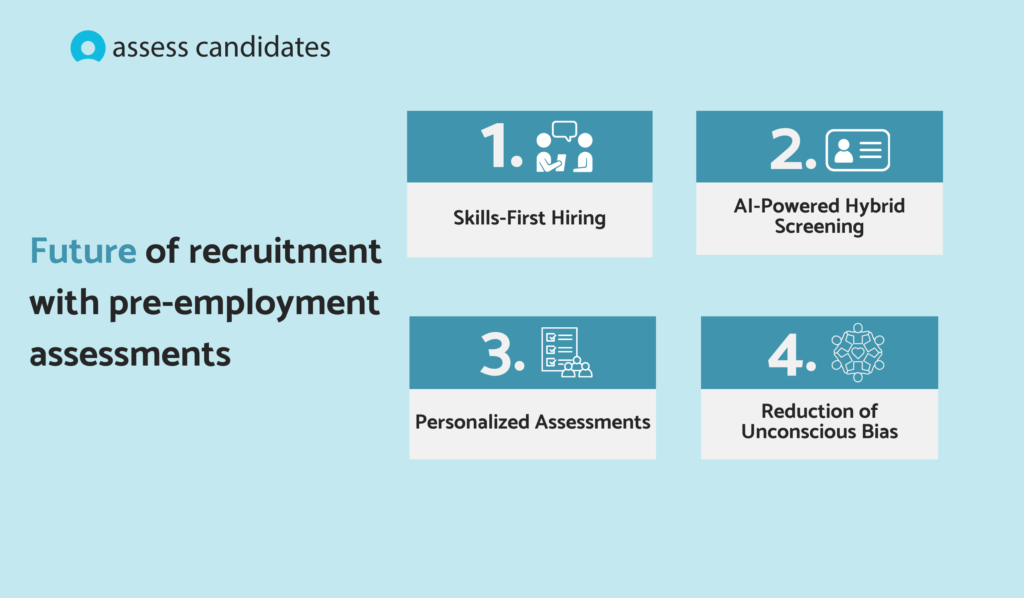
What will the future of recruitment look like with pre-employment assessment and CV review?
- Skills-First Hiring
Traditional credential-focused recruitment is slowly declining in this modern era, as big-tech companies like Google, Apple, and IBM no longer require degrees for many roles, seeing as skills and demonstrated abilities are more important. Assessment tests will therefore be the primary screening tool, while CV reviews will serve a supplementary rather than gatekeeping role.
- AI-Powered Hybrid Screening
The future is about choosing which of the two to use, rather than using both simultaneously. AI can help you scan résumés and pre–employment assessment tests together to look for patterns in predicting success, and machine learning algorithms can identify which combination of credentials and experiences correlates with job performance.
- Personalized Assessments
Assessment tests are adaptive and adjust difficulty based on candidates’ responses and provide results more quickly, while game-based assessments test your candidates’ cognitive and problem–solving abilities and personality through engaging simulations instead of regular multiple-choice questions.
- Reduction of Unconscious Bias
The future of recruitment will embrace technology to reduce bias in hiring processes by offering blind CV screening tools that hide names, photos, and other details that might trigger unconscious bias among recruiters.
Explore more flexible assessment solutions curated by experts to help you hire the right candidates. VIEW PLANS
So, why choose Assess Candidates for your recruitment process?
7. Why do companies prefer Assess Candidates’ assessments for recruitment?
Many employers choose Assess Candidates for their recruitment process because it offers features that ensure your candidates are recruited equally without giving any preference to a demographic, and the quality of hire is to your preference.
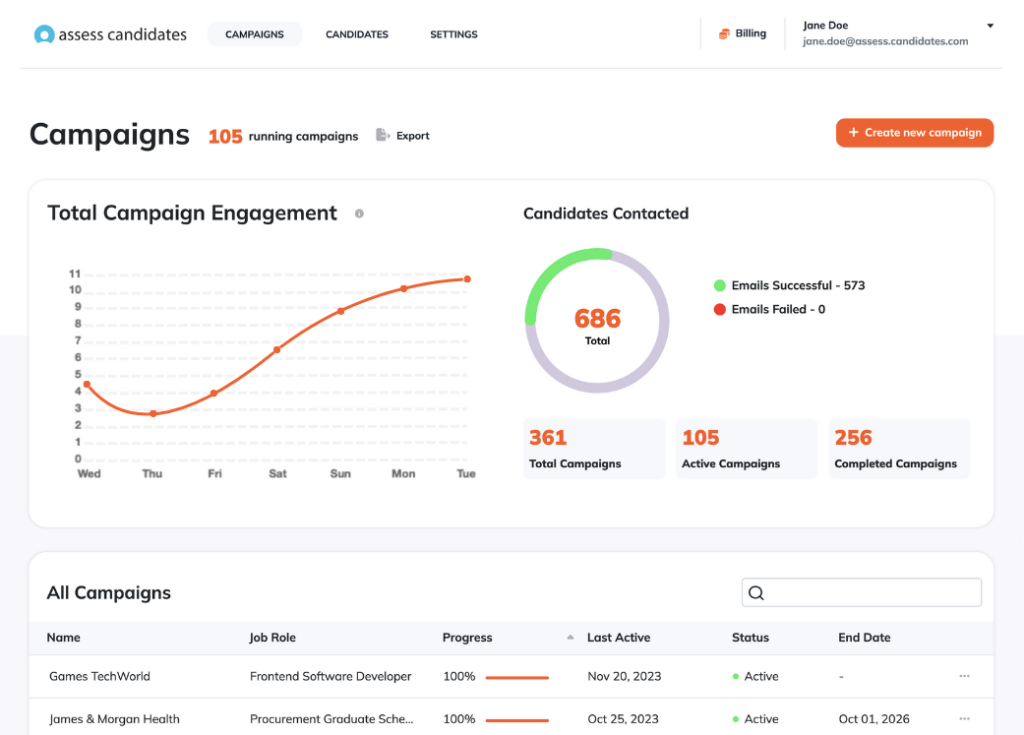
Why is Assess Candidates better when recruiting candidates with pre-employment assessment tests?
- Scientifically Backed Assessments: Our assessments are created by a team of chartered scientists and psychologists to make sure they are thoroughly validated for reliability and predictive accuracy.
- Fairness and Accessibility: The platform promises features that can provide candidates who need additional time, have visual disabilities, or face other disadvantages with assistance. This reduces bias and gives all your candidates an equal opportunity in the recruitment process.
- Anti–Cheating: The Assess Candidates platform includes a cheat detection technology that records certain candidate behaviors during the assessment process, and it offers you an overall candidate score that helps you trust the validity of the results.
- User–Friendly Experience: Your candidates do not need to create an account to access the user-friendly interface and participate in branded assessments, allowing them to take the assessment tests on any device.
- Automatic Administration: Candidates are automatically sent invitations to take our pre–employment psychometric assessment tests so they can begin immediately, or they can be customized to start at specific times.
Hire the ideal candidates with our fully equipped assessment platform. LEARN MORE
Key Takeaway
Deciding when to use pre-employment assessment tests during recruitment processes should be based on a few factors, such as the number of hires, available resources, and the quality of hires.
If you are recruiting for a niche role and require a few qualified candidates to examine, you can set the assessment tests after reviewing their Resumés if you are unsure about who might be the ideal candidate.
However, if you are recruiting and receive hundreds or thousands of applications, you can narrow down the candidates by requesting that everyone take your assessment tests to filter for the skilled ones and hire solely on skills, without bias, and before reviewing their CVs.
Want to know more about using our pre-employment psychometric assessment tests in your recruitment process? Keep scrolling to explore our frequently asked questions, and enter your email to get started today.
Frequently Asked Questions
Should I always use assessment tests before reviewing CVs?
You should include the assessment process depending on your hiring goals, role requirements, and the volume of applicants you are recruiting. You can use assessments before when you want to reduce bias, and use them after CV review when you want to filter and focus on qualified candidates.
How early in the recruitment process should I use assessments?
If you are going for skills-based hiring, you can make it the first step after the application submission, and if you are taking the traditional recruitment route, you can use them after screening CVs.
What types of assessments are good before CV reviews?
When setting assessment tests for your candidates, we recommend using psychometric assessments such as numerical, verbal, logical, and critical reasoning tests, coding tests, and situational judgment tests.
Should I set personality tests before or after CV reviews?
Personality questionnaire tests and culture fit assessments should generally come after Resumé screening, as you should have been able to verify your candidates’ basic qualifications at this stage in the recruitment process.
How do I deal with candidates who refuse to take the assessments?
You can combat this issue by making pre-employment assessment tests mandatory for all candidates to ensure fairness in the application process. Clearly communicate with your candidates in the job postings, and if anyone refuses to partake in the assessment, they would have self-selected themselves out of the recruitment.


 English
  Arabic