
Can AI Really Predict Job Performance? A Practical Look at the Future of Hiring



Recruiters have always faced the same question: How can we actually know who will perform well once they are hired?
A candidate can ace every interview and seem confident and enthusiastic, yet struggle when the real work begins. Meanwhile, someone quieter and more methodical might turn out to be the team’s top performer. For decades, hiring decisions have relied heavily on intuition, a manager’s gut feeling, impressive résumés, or merely a good conversation. But in today’s competitive talent market, it is clear that intuition alone is no longer enough.
That’s where Artificial Intelligence (AI) and predictive analytics are completely changing the game.
By analyzing data from thousands of past hiring decisions, performance records, and assessment results, AI-driven tools can uncover patterns that humans often miss. They can identify not only who can do the job, but also who will excel, stay longer, and naturally align with your company values and culture.
Predictive analytics brings science to what was once guesswork. It turns the hiring process into a data-backed decision system, capable of forecasting outcomes with impressive accuracy.
According to IBM’s Smarter Workforce Institute, organizations that use predictive analytics in hiring achieve 25% higher productivity and 35% lower turnover within their first year.
But, as with any powerful tool, AI has its limitations.
Questions of bias, transparency, and ethical use have emerged alongside its rapid rise. Can AI truly understand human potential beyond data points? Can it predict creativity, resilience, or leadership under pressure? These are the questions shaping the future of recruitment.
By the end of this article, you will understand how AI helps predict job performance and how your organization can use it to hire smarter, faster, and more fairly.
Contents
- What is predictive analytics in recruitment?
- How AI models actually predict job performance
- What popular AI-driven tools do employers use for hiring?
- What are the key strengths of AI in recruitment?
- How to use AI predictive analytics responsibly and ethically
- Which top employers use predictive analytics in recruitment?
- The future of AI in hiring
- Why use Assess Candidates for AI-powered predictive hiring
1. What is predictive analytics in recruitment?
Predictive analytics in recruitment is the practice of using historical data, statistics, and machine learning to forecast future hiring outcomes. This helps employers to understand which candidates are likely to perform well in the role, stay longer, and be a good cultural fit based off accurate evidence.
Rather than treating hiring as a one-off judgment call, predictive recruitment turns hiring into a repeatable, measurable process that helps recruiters make more informed decisions with confidence.
At its heart, predictive analytics aims to answer these 3 questions:
- What attributes or behaviors are linked to on-the-job success?
- How strong is the relationship between those attributes and actual performance?
- Given what we know, how likely is it that a new candidate will suceed?
See predictive hiring in action with Assess Candidates. HIRE FOR FREE
Understanding predictive analytics in recruitment
Predictive analytics is not mind-reading, and it does not guarantee that every recommended candidate will be a perfect hire. Instead, it raises the probability of good hiring decisions by spotting patterns humans might not notice. It is a decision-support tool: you still make the final call, but now with more accurate information.
What predictive analytics is:
- A method to uncover patterns in historical hiring and performance data.
- A way to prioritize candidates based on those patterns so recruiters can focus their attention where it matters most.
- A tool to measure and improve hiring decisions over time.
What predictive analytics is not:
- A replacement for human judgment, context, or ethical oversight.
- A single score that should be used as the only hiring decision metric.
- A system that eliminates uncertainty completely.
Research published in Harvard Business Review shows that structured, predictive approaches outperform unstructured hiring methods by a sizable margin, improving hiring quality and reducing early attrition.
What are the core components of a predictive hiring system?
A robust predictive analytics system in recruitment requires 3 interlocking components:
1. High-quality input data
Garbage in, garbage out. The predictive power and reliability of any model depends on the quality, relevance, and diversity of its training data. Useful sources include:
- Validated psychometric test results
- Structured interview ratings
- Objective performance metrics such as sales figures, client NPS, and code-quality scores
- LMS/certification records
- Historical turnover records.
The richer and more relevant the data, the more reliable the model’s predictions.
2. Model selection and training
Predictive models range from logistic regression and decision trees to ensemble methods and neural networks. The choice depends on the hiring challenge, predicting performance, turnover, productivity, etc. Simpler models often offer easier interpretation and auditing, especially in regulated hiring environments.
3. Validation, monitoring, and governance
Predictive models must be validated on test data, monitored for performance drift, and audited for fairness. Without continuous monitoring, models can degrade as the business, labor market, or job roles evolve
Gartner’s research indicates that ongoing model governance is the single most crucial factor in maintaining predictive validity over time.
Typical predictive targets and outcome measures
Predictive analytics can forecast many hiring-related outcomes, including:
- First-year performance rating: Often drawn from calibrated performance review scales.
- Time-to-productivity: How long before a hire reaches expected contribution levels?
- Retention risk: Probability a candidate will leave within a defined period (e.g., 6–12 months).
- Promotion or progression likelihood: Useful for succession planning or graduate programs.
- Cultural or team alignment: Predicted alignment with team working style or organizational values, often triangulated with survey data.
Choosing the right target outcome is critical. Predicting a well-defined, measurable outcome, such as sales revenue, the number of closed tickets, or peer-rated performance, works far better than attempting to predict vague outcomes like “leadership potential” without clear operational definitions.
IBM’s Smarter Workforce Institute found that organizations using predictive hiring techniques reduced time-to-hire by up to 35% while improving role fit.
Now that we understand predictive analytics, let’s see how AI models actually work in recruitment and how they analyze data to predict who will likely succeed on the job.

2. How AI models actually predict job performance
- The Science Behind the Algorithms
Predictive AI in recruitment relies on data-driven insights to forecast how a candidate is likely to perform in a specific role. Unlike traditional hiring, CVs, and interviews, which often depend on human judgment and intuition, AI models leverage real data to uncover subtle patterns that directly correlate with job success.
In simpler terms, these models compare candidates with thousands of similar profiles and outcomes. They don’t just look at what a candidate says they can do; they evaluate what candidates with similar abilities actually achieved in comparable roles.
- The Data That Drives Predictive AI
To make accurate predictions, AI models are trained on large, diverse datasets that include both internal and external data sources.
This includes information collected throughout the hiring and employment lifecycle, such as:
- Employee performance records: Historical data showing which employees excelled, stayed long-term, or left early.
- Assessment results: Cognitive ability, personality, and behavioral test outcomes that correlate with high performance.
- Job descriptions and role requirements: Data that define what success looks like for each specific position.
- Recruitment process metrics: Interview scores, reference feedback, and candidate engagement levels.
- External data: Public professional profiles, educational backgrounds, and skill endorsements that help fill in missing context.
Each data point becomes a signal within the model. For instance, consistent achievement in team-based roles might help predict collaboration skills, while high scores in problem-solving assessments may indicate technical aptitude.
AI models process thousands of such data points simultaneously, something even the most experienced recruiter could never do manually.
- How do the algorithms learn and improve over time?
The process begins with training the model on historical recruitment data. Here’s how it works step by step:
- Data collection and cleaning: The system gathers and refines data to remove noise such as incomplete candidate profiles or inconsistent evaluation metrics.
- Model training: Machine learning algorithms analyze relationships between inputs (e.g., test scores, interview results) and real outputs, such as performance ratings and retention.
- Pattern recognition: The model identifies which factors matter most for success in each role. For example, problem-solving tests may be more important than years of experience for a data analyst role.
- Validation and testing: The AI is tested on new candidate data to measure its predictive accuracy.
- Continuous improvement: As more hiring data accumulates, the system retrains itself, refining predictions with each cycle.
Over time, this creates a powerful feedback loop which helps HR teams optimize their hiring criteria and the AI become more accurate. This ensures you can focus on predicting which candidates will actually thrive in your roles, not just who looks good on paper.
Combine AI insight with human judgment with our validated predictive assessments. LEARN MORE
Now that you understand how AI models predict job performance, from the data they analyze to the algorithms that power their insights, the next question is: where do these tools truly deliver the most value?
In the following section, we will discover the top AI-driven tools employers use for recruitment globally.
3. What popular AI-driven tools do employers use for hiring?
AI is now embedded in modern recruitment. Instead of manual work, employers use a growing number of smart hiring platforms to screen and assess candidates efficiently, predict job fit, manage communication, and analyze trends. These tools go beyond automation; they apply predictive analytics, behavioral science, and natural language processing to make hiring more precise and fair.
Below are some of the common areas in which AI-driven tools are transforming the hiring process today.
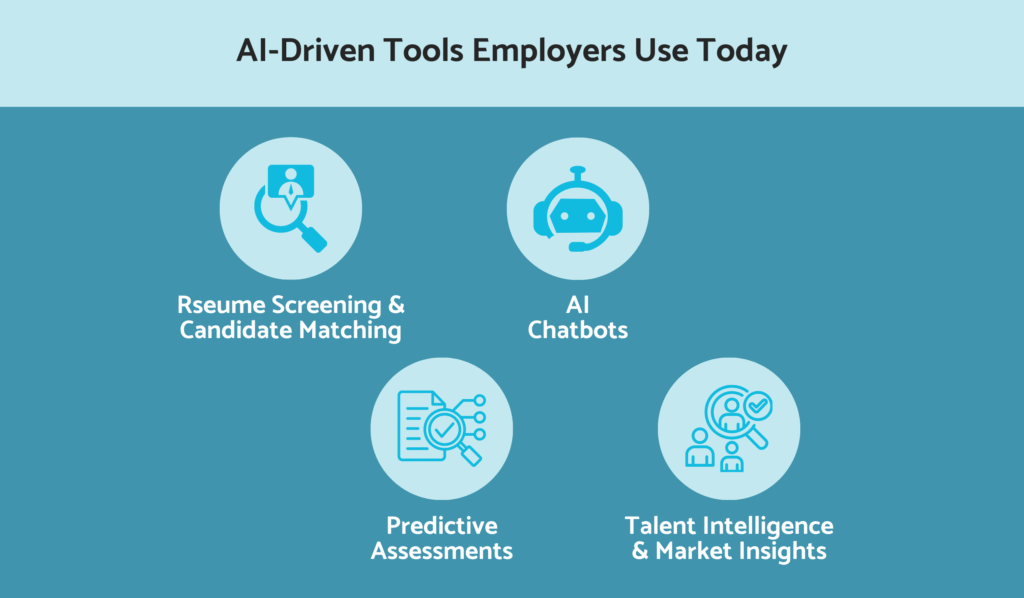
- Resume Screening and Candidate Matching
AI-powered screening tools like HireVue, Pymetrics, and Eightfold AI analyze resumes far beyond simple keyword matching. They look for transferable skills, experience, and potential for growth to find candidates who might otherwise be overlooked.
For example, Eightfold AI utilizes deep learning to predict candidate success by comparing millions of career paths, enabling employers to identify high-potential talent, even if their CV doesn’t perfectly match the job description.
- AI Chatbots for Candidate Engagement
Chatbots such as Olivia by Paradox, XOR, and Humanly.io have become essential for maintaining communication and candidate engagement throughout the hiring journey. They answer FAQs, schedule interviews, and send reminders automatically, ensuring no candidate feels ignored.
Recruiters using Olivia report significant time savings, while candidates appreciate 24/7 availability and faster responses.
- Predictive Assessments
Platforms like Assess Candidates, HireVue, and Harver go a step further, using predictive models and pre-employment assessments to evaluate how candidates will likely perform in a specific role and if they will thrive.
Assess Candidates, for instance, blends validated psychometric science with behavioral data to show you not only who can do the job, but who is likely to stay and grow.
- Talent Intelligence and Market Insights
AI also goes beyond hiring and supports workforce planning. Tools like LinkedIn Talent Insights, Crunchr, and Gloat give HR leaders real-time data on:
- Which skills are in demand
- Where talent is moving to
- How competitive the market is
- What roles are hard to fill.
With these insights, recruiters can design proactive hiring strategies instead of simply reacting to vacancies.
LinkedIn’s Global Talent Trends Report notes that 75% of HR leaders now rely on AI-based insights to inform workforce planning.
Let’s now understand why employers are using predictive analytics. What strengths does AI actually bring to the table? Let’s discuss below.
4. What are the key strengths of AI in recruitment?
AI is transforming recruitment by tackling long-standing inefficiencies that human-led processes alone cannot fix. It speeds up time-consuming, manual tasks, brings consistency to hiring decisions, and gives recruiters clearer insights into potential on-the-job performance.
Here are key strengths that make AI a valuable partner in recruitment:
Strengths of AI in Hiring
AI-driven hiring systems shine when it comes to precision, speed, and consistency when analyzing large amounts of complex information. Instead of replacing recruiters, AI supports hiring teams by removing guesswork and highlighting the insights that matter most, helping make deeper, science-backed decisions.
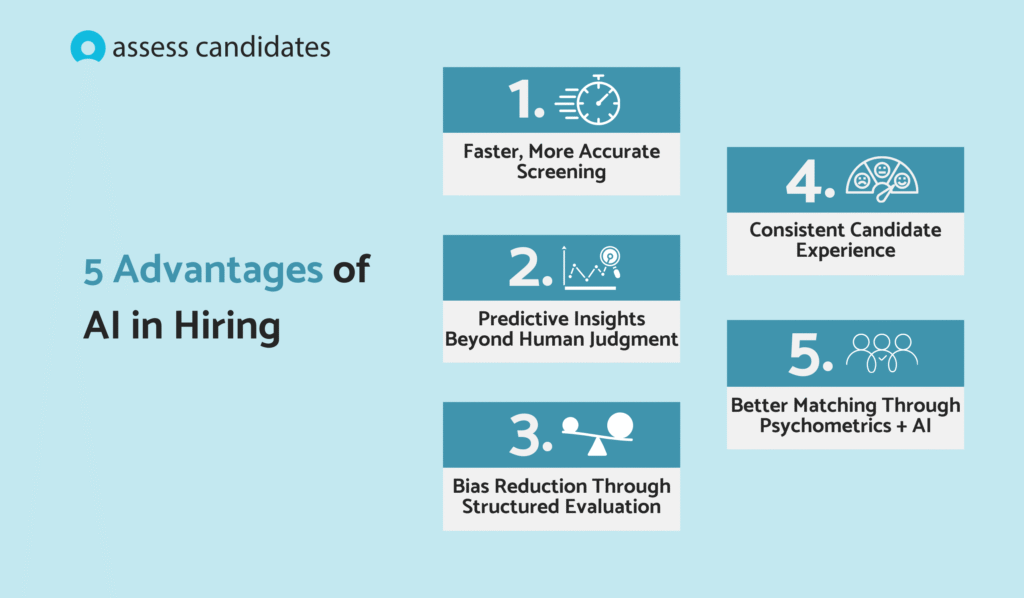
1. Faster, more accurate screening
AI tools can analyze thousands of CVs and assessment responses in seconds, ranking candidates based on job-relevant criteria, skills, and experience rather than subjective factors. This drastically speeds up early-stage filtering without compromising quality.
Why it matters: Recruiters spend less time sorting CVs and more time engaging top talent.
According to LinkedIn’s Future of Recruiting Report, 67% of recruiters say AI helps them save significant time in screening.
2. Predictive insights beyond human judgment
AI models identify subtle behavioral and performance patterns that are easy to miss, such as consistency in problem-solving, communication style, or task approach.
Why it matters: Recruiters can predict job performance more accurately by relying on data instead of assumptions.
Best Use Case: Early-stage prediction of high performers for graduate hiring, customer service, sales, or technical roles.
3. Bias reduction through structured evaluation
AI standardizes evaluation criteria, ensuring all applicants are measured against the same competencies and job requirements.
Why it matters: This reduces subjective bias that often appears in manual screening, helping to make recruitment fairer and build diverse, high-performing teams.
4. Consistent candidate experience across high volumes
AI tools deliver instantaneous responses, updates, and next steps, so that no candidate is left waiting or wondering where they stand.
Why it matters: Consistency and communication builds trust and reduces dropouts (especially in high-volume hiring).
Best Use Case: Graduate hiring, bulk recruitment, and multi-location hiring.
5. Better matching through psychometrics and AI
When AI is paired with validated psychometric assessments, recruiters get deeper insights into cognitive ability, personality traits, and role alignment with greater accuracy.
Why it matters: Recruiters get a 360° view of each candidate – capability, behavior, and motivation – going beyond who can merely do the job.
Now that we have covered the strengths, we will explore challenges that you might face and how predictive AI addresses these.
What challenges does predictive AI help address in recruitment?
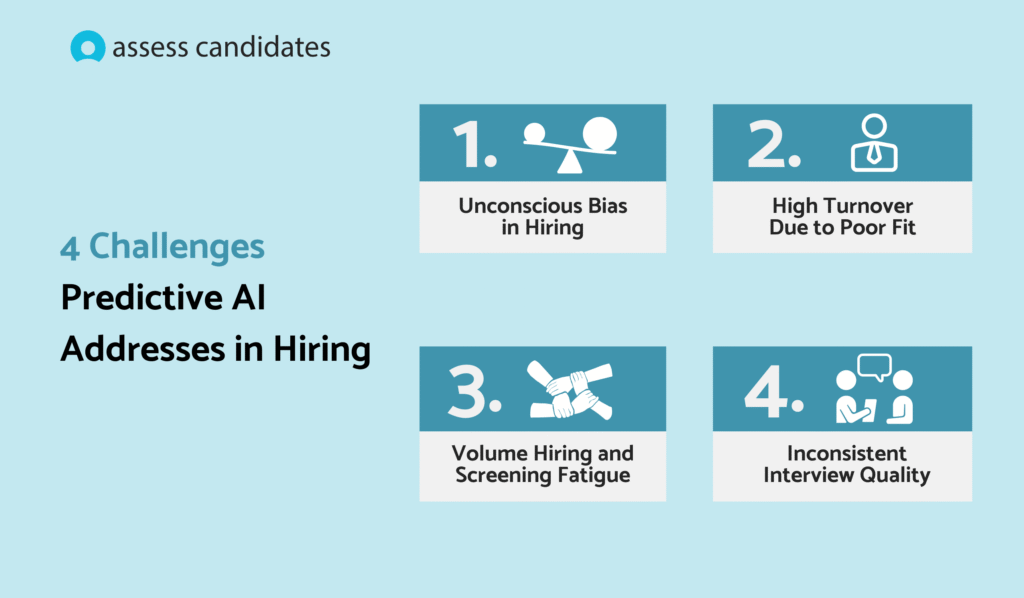
Challenge 1: Unconscious Bias in Hiring
Even the most experienced recruiters can be influenced by unconscious bias, like preferring certain institutions, accents or communication styles in candidates. These subtle preferences often skew hiring decisions, leading to less diverse, less effective teams.
How does AI help?
AI predictive models focus on objective data over subjective impressions. Tools like Assess Candidates use structured pre-employment assessments that measure cognitive ability, behavior, and personality traits linked to performance, not background or demographics. This reduces bias as candidates are evaluated based on potential, not profile.
Research from McKinsey shows that companies in the top quartile for ethnic diversity are 36% more likely to outperform their peers financially.
Challenge 2: High Turnover Due to Poor Fit
Replacing an employee can cost up to 6–9 months of their salary (SHRM). Many of these costly exits happen because a candidate wasn’t actually a good job fit.
How does AI help?
Predictive analytics connects pre-hire data (skills, personality, motivation) with real post-hire outcomes (retention, engagement, productivity) to flag which candidates are most likely to stay and succeed long-term.
At Assess Candidates, retention-based predictive scoring helps recruiters identify not just who can do the job, but who will stay to grow with the company.
IBM Smarter Workforce Institute found that employees who are well-matched to roles are 42% more likely to stay at the company for 3+ years.
Challenge 3: Volume Hiring and Screening Fatigue
Recruiters often face thousands of applications for a single role, making manual screening impractical. This leads to missed talent, rushed decisions, and recruiter burnout.
How does AI help?
AI automates early screening by scanning resumes, assessments, and digital interviews for predictive indicators of success. It instantly shortlists candidates helping recruiters to engage only with top prospects.
For example, Accenture’s global recruitment platform uses predictive AI to rank applicants at scale across 30+ skills and cultural indicators. This has helped them reduce average time-to-hire by 43% while improving candidate satisfaction scores globally.
Challenge 4: Inconsistent Interview Quality
Different interviewers assess candidates differently. One panelist might focus on technical ability, another on personality, leading to inconsistent, unreliable results.
How does AI help?
AI tools bring structure and data to interviews. By analyzing responses and linking them to predictive success models, recruiters can assess candidates objectively against validated behavioral frameworks.
Challenge 5: Predicting Future Leaders and High Performers
Leadership potential isn’t often visible on resumes. Companies need a way to identify who will excel beyond current skills, who can adapt, innovate, and grow.
How does AI help?
AI predictive analytics evaluates traits correlated with long-term success, such as adaptability, decision-making, and learning agility to determine which candidates have leadership potential.
For example, Google’s People Analytics team already uses predictive modeling to forecast employee performance and promotion likelihood.
Harvard Business Review (2023) found that companies that identify and develop predictive leadership traits achieve 29% higher revenue growth.
AI’s power lies not just in speed, but in its ability to create a hiring process that is fair, consistent, and grounded in real evidence. Used responsibly, predictive analytics helps companies build teams that perform better and stay longer.
Transform your hiring decisions from intuition to intelligence. LEARN MORE
While the advantages of AI in hiring are undeniable, it is equally important to recognize its limitations. Even the most advanced predictive models can fall short, and without responsible use, they can unintentionally reinforce bias or compromise fairness.
In the next section, we will explore the legal, technical, and ethical challenges of AI in recruitment, and how you can ensure your data-driven hiring remains both accurate, fair, and genuinely helpful for candidates.
What are the common myths and ethical considerations of AI in predicting job performance?
Despite AI’s impressive accuracy and efficiency, it is not flawless. Every system operates within the constraints of the data it is trained on, the algorithms that power it, and the ethical boundaries that govern its use.
Here, we will look at the 4 major myths to understand what AI can and cannot do when predicting job performance.
Myth 1: “AI can perfectly predict job performance.”
Reality:
AI doesn’t “know” the future; it estimates probabilities based on patterns in past data. These models identify correlations between attributes (like test scores, experience, or communication styles) and job success. However, human performance is dynamically influenced by countless factors – motivation, leadership, company culture, and life circumstances – variables that no algorithm can fully capture.
Even the most advanced predictive models have a margin of uncertainty. For instance, IBM’s 2024 AI in HR Report found that while AI-driven assessments improved role fit accuracy by 32%, human oversight was still essential to interpret context-sensitive factors like adaptability or creativity.
According to Gartner (2025), organizations using AI-only hiring processes saw a 19% higher mis-hire rate compared to those that combined AI insights with structured human interviews.
Myth 2: “AI eliminates all bias from hiring.”
Reality:
AI can help reduce bias, but only when used responsibly. Algorithms learn from historical data, and if that data reflects human bias (for instance, fewer women in senior roles or underrepresentation of certain ethnicities), the model can unintentionally reproduce those patterns. This phenomenon is known as algorithmic bias.
In 2018, Amazon famously scrapped an internal AI recruiting tool after discovering it downgraded female applicants because the training data was drawn mostly from male resumes.
At Assess Candidates, fairness is part of the system’s core design. Our assessment platform regularly performs bias audits on its models, ensuring that assessment outcomes remain objective and inclusive across demographics.
Myth 3: “More data always leads to more accurate predictions.”
Reality:
Quality trumps quantity in AI. Feeding a model vast amounts of unstructured or irrelevant data can cause overfitting, where the system performs exceptionally well on past data but poorly in real-world hiring scenarios.
Predictive models work best when trained on diverse, high-quality, and job-relevant datasets. For example, combining structured psychometric data with behavioral interview results often yields far more reliable predictions than using social media data or keyword-matched resumes.
Assess Candidates uses scientifically validated psychometric data, not personal or social information, ensuring ethical and evidence-based predictions that reflect real workplace competencies.
Myth 4: “AI recruitment tools can replace human recruiters.”
Reality:
AI enhances human decision-making; it doesn’t replace it. Algorithms can screen thousands of candidates, identify high-potential profiles, and predict role fit with remarkable speed, but the final judgment still requires human input and strategic context.
Recruiters bring something no algorithm can replicate: the ability to build relationships, interpret nuance, and make values-based decisions that align with company culture.
Responsible use of AI in recruitment
AI is a powerful tool, but only responsible deployment ensures that it empowers rather than excludes. Companies using these tools can build ethical, compliant systems by:
- Conducting regular bias audits on their predictive models.
- Using scientifically validated assessments over arbitrary data points.
- Maintaining human oversight in every key hiring decision.
- Prioritizing data privacy and candidate consent at every step.
Understanding the ethical and legal challenges of AI in hiring is only half the story. The real impact comes from how organizations respond to these limitations, turning potential risks into opportunities for smarter, fairer recruitment.
In the next section, let’s outline the practical strategies you can implement to use predictive analytics responsibly, ensuring that technology enhances effective human judgment rather than replacing it.
5. How to use AI predictive analytics responsibly and ethically
AI can optimize recruitment, but only when used with integrity, transparency, and purpose. You shouldn’t treat responsible AI as just a compliance checkbox, but as a strategic commitment to fairness and trust.
Below are key strategies every HR leader, recruiter, and hiring manager should implement when using AI predictive analytics.
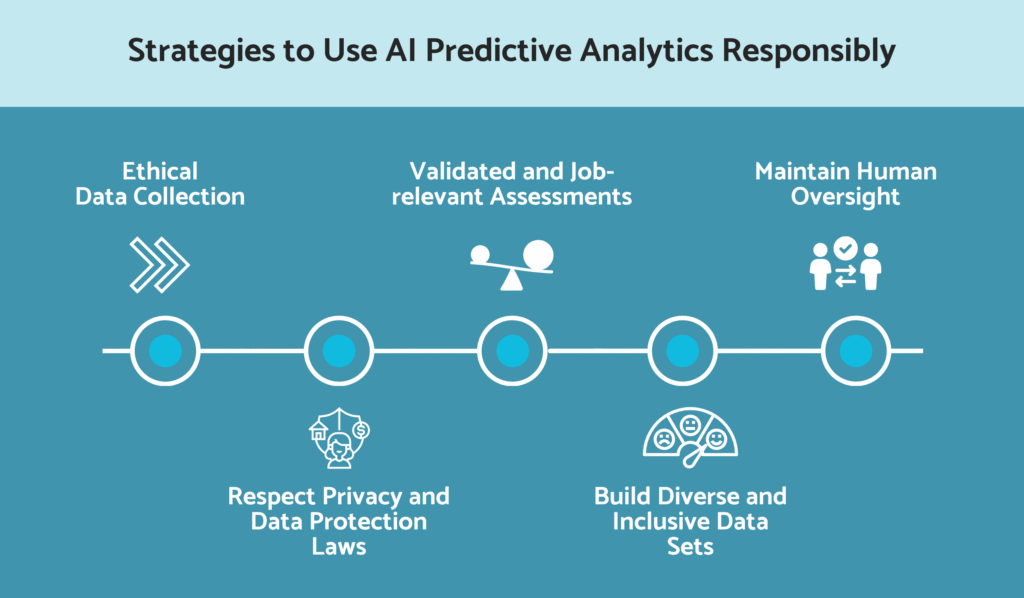
1. Start with Ethical Data Collection
Collect only relevant data
Only gather data directly related to job performance and candidate suitability. Avoid social media profiles or irrelevant personal information.
Ensure informed consent
Be transparent with candidates about what data is being collected, how it will be used, and who will access it.
2. Use Validated and Job-Relevant Assessments
Base predictions on science, not guesswork
Predictive models must rely on validated psychometric assessments, not unverified behavioral metrics. For example, Assess Candidates uses data from structured cognitive and personality tests, validated by occupational psychologists, to predict job fit with statistical precision.
3. Maintain Human Oversight
AI informs, humans decide
AI can rank candidates based on predicted performance, but recruiters must interpret these results within context. For example, a candidate who is ranked “medium fit” by AI may in reality thrive under a specific manager’s leadership style, something algorithms cannot yet detect.
A Harvard Business Review (2024) study found that AI-plus-human evaluation reduced mis-hires by 29% compared to AI-only processes.
4. Respect Privacy and Data Protection Laws
Comply with global regulations
Follow standards such as GDPR, EEOC, and the EU AI Act when processing candidate data.
Practical Tip: Store assessment results securely and anonymize data whenever possible to protect candidate identity.
5. Build Diverse and Inclusive Data Sets
Diversity strengthens accuracy
Train AI models on data that represents multiple genders, regions, and career paths. Homogeneous data creates biased predictions.
LinkedIn’s AI hiring tool improved fairness metrics by 35% after expanding its dataset across 20+ industries and 50 countries.
Final Takeaway
Our assessment experts say that responsible AI hiring doesn’t just help you avoid human errors, but also to build systems that enhance human judgment.
By combining scientific assessments, ethical data use, and continuous oversight, you can use AI to hire smarter, fairer, and faster, while keeping humanity at the center of every decision.
Want to build hiring models that rely on science, not assumptions with us? LEARN MORE
So, which top employers use predictive hiring models in recruitment? Let’s find out.
6. Which top employers use predictive analytics in recruitment?
Several global companies are leading the way in applying predictive analytics to modern hiring. These organizations use AI-driven insights to identify top talent faster and improve hiring outcomes at scale.
1. Unilever
Unilever revolutionized its global recruitment process by integrating predictive analytics into video interviews and assessments. The system uses AI to analyze candidates’ facial expressions, tone, and language, alongside psychometric data.
By doing this, Unilever shortened its hiring process by up to 75%, handled over 250,000 applications annually, and significantly improved diversity outcomes by basing decisions on data rather than intuition.
2. Deloitte
Deloitte uses predictive analytics to match candidates’ skills with business needs more accurately. Through AI-powered platforms, the firm analyzes historical hiring data and project outcomes to forecast which candidates are most likely to succeed in specific roles.
This approach helps Deloitte reduce early turnover and maintain stronger alignment between candidate potential and organizational goals.
3. Hilton
Hilton leverages predictive analytics to streamline candidate screening for high-volume roles, such as front desk agents and housekeepers. AI models assess factors such as previous work experience, personality fit, and availability patterns to predict job success.
This system enables Hilton to cut down screening time dramatically while improving overall candidate satisfaction through quicker feedback loops.
4. IBM
IBM integrates predictive analytics into its “Watson Recruitment” system, which evaluates applicant data to identify the best-fit candidates for technical and leadership roles. The AI considers multiple factors, including career progression, skill overlap, and project success rates.
As a result, IBM has enhanced hiring accuracy and reduced bias, creating a fairer, data-driven recruitment process.
From Prediction to Action: Turning Insights into Decisions
Predictive AI isn’t just about producing scores or probabilities. The real value lies in actionable insights, giving recruiters and hiring managers clear, evidence-based recommendations.
For instance, an AI tool might highlight that a candidate has an 80% likelihood of thriving in analytical environments but a lower fit for customer-facing roles. Recruiters can then tailor their approach, assigning the candidate to roles where they are most likely to succeed.
Predictive analytics empowers hiring teams to focus their human judgment on the why behind the prediction, not just the number itself.
Yet, as technology evolves, so does its influence on recruitment. From adaptive learning models to predictive behavioral analytics, the future of AI in hiring is rapidly transforming how talent is discovered, evaluated, and retained.
7. The Future of AI in Hiring
AI is transforming recruitment faster than any other period in modern HR history. What started as automated CV screening and chatbots is now evolving into systems that can forecast success, cultural fit, and long-term retention. Yet, we are only at the beginning.
The next decade will redefine how organizations attract, evaluate, and retain talent. Below are the emerging trends that will shape the future of AI-driven hiring, and how forward-thinking companies can prepare for them today.
AI Will Move From Prediction to Prescription
From “Who to Hire” to “How to Help Them Succeed”
Most current AI models in recruitment focus on predicting performance, identifying which candidate is likely to excel in a role. The next wave will go beyond prediction to prescription, offering actionable recommendations on how to help hires succeed once onboarded.
Imagine a system that not only flags top candidates but also suggests onboarding modules, team dynamics insights, or personalized training plans. This is already underway at companies like IBM, which use AI to recommend learning paths for new employees based on role-specific data and behavioral patterns.
Human-AI Collaboration Becomes the Norm
Recruiters as Data Interpreters
AI will not replace recruiters; it will elevate them. As algorithms handle repetitive screening and pattern detection, recruiters will evolve into data interpreters, combining AI insights with human intuition to make strategic decisions.
For instance, Unilever’s AI recruitment platform uses gamified assessments and video interviews analyzed by algorithms. However, final hiring decisions still depend on human reviewers who contextualize AI-generated recommendations.
A LinkedIn Talent Insights Report (2024) found that 74% of talent acquisition leaders see AI as a “decision-support tool,” not a replacement for human judgment.
Hyper-Personalized Candidate Experiences
AI Will Tailor the Hiring Journey
Tomorrow’s AI won’t deliver generic assessments or one-size-fits-all interviews. Instead, it will personalize the candidate experience from the first interaction to the final offer.
Imagine AI systems that adjust question difficulty based on candidate skill levels or tailor communication tone based on personality data, creating a smoother, more authentic interaction. This approach increases engagement and decreases drop-offs, especially among passive candidates.
Research by SHRM (2024) shows that personalization in recruitment increases candidate satisfaction by up to 48% and reduces ghosting rates by 32%.
The Rise of Predictive Hiring Ecosystems
From Isolated Tools to Integrated Systems
Currently, most organizations use separate tools for assessments, interviews, and onboarding. The next generation of hiring technology will unify these into AI-driven ecosystems, where data flows seamlessly between recruitment, learning, and performance management.
This integration means hiring isn’t an event; it is a continuous data journey. With every hire, the AI learns and refines its predictions, making each subsequent decision smarter.
Forrester Research (2025) forecasts that 80% of enterprise-level companies will adopt integrated AI hiring ecosystems within the next five years.
Ready to use AI responsibly in your recruitment strategy? HIRE FOR FREE
As the future of recruitment becomes increasingly data-driven, one thing is clear: organizations need trusted platforms that balance innovation with responsibility.
This is where Assess Candidates stands out. By combining scientific rigor, ethical AI, and an engaging candidate experience, we help organizations turn predictive analytics into confident, bias-free hiring decisions. Let’s explore how.
8. Why use Assess Candidates for AI-powered predictive hiring
As recruitment becomes more data-driven, organizations can no longer depend on instinct or unstructured interviews to identify top performers. The question is no longer “Can AI predict job performance?”, it is “How do we use AI responsibly, fairly, and effectively to do so?”
That is where Assess Candidates comes in.
Our AI-powered platform is built on scientifically validated psychometrics and predictive analytics, empowering recruiters to make confident, evidence-based hiring decisions that reduce bias, improve engagement, and increase retention.
Assess Candidates bridges science and strategy, combining psychological research, machine learning, and behavioral analytics to deliver hiring outcomes you can trust. From pre-employment screening to performance forecasting, we ensure that every hiring decision is grounded in data, not guesswork.
How Does Assess Candidates Drive Predictive Hiring Success?
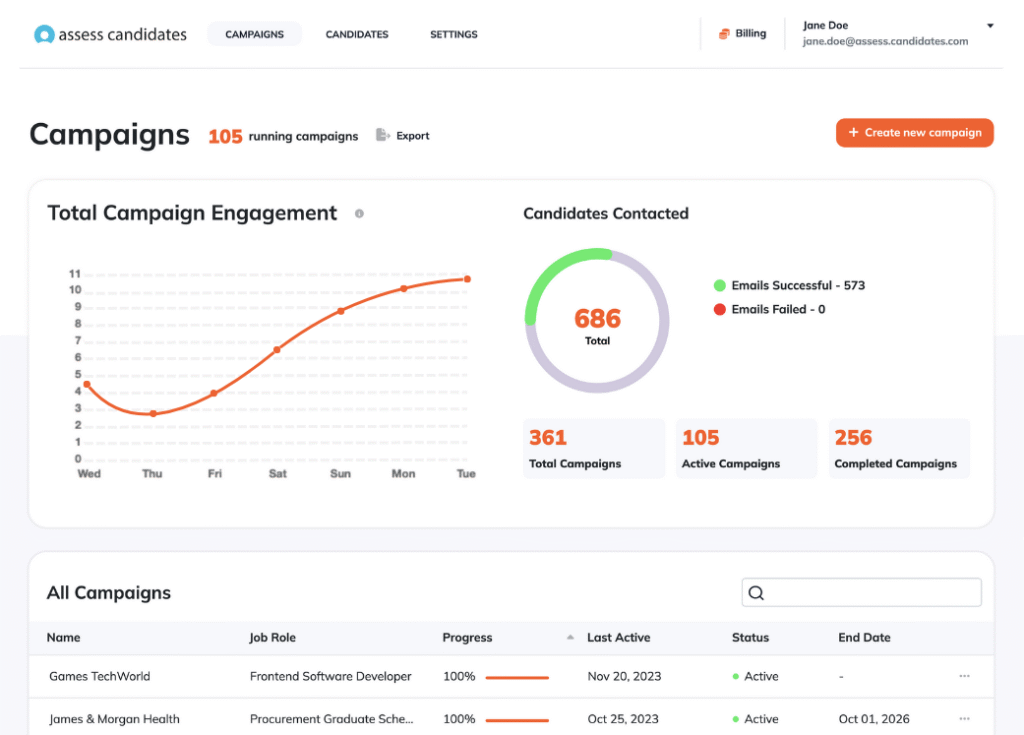
Step 1: Leverage Scientifically Validated Assessments
At the heart of predictive hiring lies accurate measurement, and that is exactly what Assess Candidates delivers.
Every test is designed by Chartered Psychologists, Scientists, and Psychometricians, ensuring validity, reliability, and fairness.
- Assess job-relevant skills, cognitive abilities, and workplace behaviors.
- Identify the competencies that truly predict success in specific roles.
- Eliminate guesswork from early-stage screening.
Research by the British Psychological Society (BPS) confirms that structured psychometric assessments are up to 3x more predictive of job performance than unstructured interviews.
Step 2: Harness Data-Driven AI Insights
Assess Candidates combines advanced AI algorithms with human insight to predict how candidates will perform, adapt, and grow within your organization.
- AI models analyze behavioral patterns, learning agility, and problem-solving approaches.
- Predict high-performers early, minimizing time spent on mismatched profiles.
- Identify potential red flags like low engagement or poor team fit before making an offer.
These predictive analytics not only streamline recruitment but also reduce mis-hires, saving time, cost, and morale.
A Deloitte Human Capital Trends (2025) study found that organizations using AI-based predictive analytics improved hiring accuracy by 41% and reduced first-year attrition by 27%.
Step 3: Personalize the Candidate Experience
AI works best when candidates feel seen, valued, and respected. Assess Candidates personalizes every interaction through adaptive, mobile-friendly, and branded assessments.
- Adaptive tests adjust difficulty based on candidate responses.
- Mobile-optimized interfaces ensure accessibility and engagement.
- Personalized feedback reports give candidates insight into their performance.
This transparency builds trust and enhances your employer brand, transforming assessments from nerve-wracking hurdles into engaging experiences.
According to Glassdoor, candidates are 38% more likely to accept offers from companies that provide transparent feedback during recruitment.
Step 4: Reduce Bias and Improve Fairness
Fairness and inclusivity are non-negotiable in AI hiring. Assess Candidates integrates bias-mitigation algorithms and inclusive design principles to ensure every candidate is evaluated equitably.
- Screen-reader compatibility for visually impaired users.
- WCAG-compliant design for accessibility.
- Bias detection tools that monitor fairness across demographics.
- Structured scoring systems that reduce subjective bias.
By using ethically aligned AI, you strengthen diversity, compliance, and brand trust, while ensuring merit remains the central hiring criterion.
The European AI Act (2025) requires explainability and fairness in AI hiring tools, emphasizing transparency in data-driven recruitment.
Step 5: Turn Predictive Data Into Long-Term Value
Predictive analytics shouldn’t stop at the offer letter. Assess Candidates continues to provide insights even after hiring, helping you track performance, engagement, and retention trends.
- Identify skill gaps early and recommend targeted development plans.
- Predict which employees are most likely to excel or disengage.
- Use post-hire data to refine future recruitment strategies.
By connecting hiring outcomes to on-the-job performance, Assess Candidates helps you continuously improve, making every hire smarter than the last.
The Assess Candidates Advantage
What sets Assess Candidates apart is not just its technology, it is the science behind it. Our candidate assessment platform integrates psychology, AI, and predictive analytics to make hiring fairer, faster, and more insightful.
- Predict success. Identify who will perform best before the first day.
- Engage candidates. Create an assessment experience they’ll love.
- Empower recruiters. Make informed, confident hiring decisions.
- Strengthen your brand. Build a reputation for fairness, innovation, and trust.
Confident hiring starts with science-backed intelligence. LEARN MORE
Interested in learning more about how AI is transforming hiring and how Assess Candidates can help you recruit with confidence? Continue reading for our Frequently Asked Questions, and sign up with your email to get started.
Frequently Asked Questions
What exactly does AI do in modern recruitment?
AI in recruitment goes beyond automation; it screens resumes, shortlists candidates, and personalizes engagement. By analyzing language, behavior, and psychometric data, AI systems identify candidates who best fit a role based on evidence; they predict performance and reduce bias. Platforms like Assess Candidates merge AI with science to ensure evidence-based, data-driven hiring decisions.
How can organizations maintain ethical use of AI in hiring?
Ensuring ethical AI in hiring starts with transparency and accountability. Recruiters must clearly communicate how candidate data is collected and used. It is also crucial to combine AI insights with human judgment. Accessibility should remain a priority, offering fair assessments for candidates of all backgrounds. At Assess Candidates, we emphasize responsible AI practices that balance automation with thoughtful human review.
What does the future of AI in hiring look like?
The future of AI in hiring is centered on precision. Predictive analytics evolves to forecast not just performance, but also long-term retention and cultural alignment. We’ll see advanced tools integrating candidate sentiment analysis and real-time adaptability during assessments. Recruiters will move from intuition-led decisions to data-backed, human-validated hiring strategies. As conversational AI matures, candidates will enjoy seamless and transparent experiences.
How does Assess Candidates use AI differently?
Assess Candidates combines AI-driven insights with scientifically validated psychometric assessments. Rather than depending solely on algorithmic matching or keyword scanning, it measures each candidate’s skills and behavioral traits, offering a holistic view of potential and role fit. This balance between machine precision and human science ensures more predictive hiring outcomes.
Is AI replacing recruiters?
No, AI isn’t replacing recruiters; AI supports them by automating repetitive tasks like resume screening and scheduling, allowing them to focus on relationship-building and strategic decision-making. Rather than replacing human intuition, AI enhances it with data-driven insights that make hiring faster, fairer, and more accurate. The key is balance – recruiters should use AI as a strategic assistant.


 English
  Arabic