
Top 50 Pre-Screening Interview Questions Every Recruiter Should Ask



Pre-screen interviews are usually the first formal step in an organization’s hiring process.
With 118 candidates on average applying for a vacancy (Forbes), only 22% reach the interview stage. This makes an effective pre-screening process critical for identifying top talent early.
A well-structured pre-screen interview helps recruiters shortlist the most suitable candidates efficiently, saving time and resources while improving the overall quality of hire.
Contents
- What is a pre-screen interview?
- What are the different types of pre-screen interview questions?
- Top questions for assessing candidate qualifications and eligibility
- Top questions for assessing candidate skills and work experience
- Top questions for evaluating role understanding and culture fit
- Top questions for assessing soft skills
- Top questions for assessing strengths and weaknesses
- Top questions for assessing candidate motivation and career goals
- Top questions on past roles and employment gaps
- Top questions for assessing organizational and commercial awareness
- Top questions on candidate availability and salary expectations
- Why top companies prefer Assess Candidates’ pre-screening video interviews
Now, without further ado, let’s start with the definition of a pre-screen interview.
1. What is a pre-screen interview?
A preliminary screening interview is a short, goal-oriented conversation that typically lasts 15-30 minutes, designed to quickly evaluate a candidate’s suitability for a role.
Conducted as either in-person, telephonic, pre-recorded, or a 2-way video interview after CV screening, hiring managers use pre-screen interviews to assess basic qualifications, required skills, and cultural alignment. This helps them shortlist best-fit candidates who should progress to the next stage of the hiring process, whether online assessments, interviews, or assessment centers, thus saving valuable time and resources.

Why are pre-screen interviews important in hiring?
Pre-screen interviews allow recruiters to identify the best-fit candidates early, focusing on essential qualifications outlined in the job description, skills, and cultural fit. Standardized pre-screening questions also:
- Clarify non-negotiables such as salary expectations
- Save time and resources for both recruiters and candidates
- Improve candidate experience
- Reduce the risk of mis-hires
- Improve quality of hire
- Ensure alignment on decision-making
Boost your hiring efficiency with scientifically validated pre-screening interviews and pre-employment tests. HIRE FOR FREE
So, what different interview questions can you ask candidates during pre-screening? Let’s find out below.

2. What are the different types of pre-screen interview questions?
Employers use a variety of interview questions in their preliminary screening process. Ranging from educational, motivation-based, and availability questions, they ensure basic candidate evaluation before more intensive assessment rounds, such as assessment days.

9 Major Types of Pre-screen interview questions in recruitment
- Qualifications and Eligibility
- Skills and Work Experience
- Role Understanding and Culture Fit
- Soft Skills
- Strengths and Weaknesses
- Motivation and Career Goals
- Past Employment Gaps and Experience
- Organizational and Commercial Awareness
- Candidate Availability and Salary Expectations
Explore our AI-enhanced video interview tool for your preliminary interview screening. LEARN MORE
Let’s now move on to our first set of pre screening questions focused on evaluating candidate qualifications and eligibility.
3. Top questions for assessing candidate qualifications and eligibility
These pre-screen interview questions help recruiters quickly ascertain if the candidate meets essential role requirements. This includes verifying their educational qualifications, degrees, skills, and certifications on their CVs.

Q1: Do you meet the minimum educational requirement for this role?
Tips to Evaluate the Answer: Assess the candidate on their ability to present direct, factual answers with confidence. Ensure that their degree, diploma, or qualification matches the job description.
In case of a non-traditional candidate, such as a freelancer or one with a slightly different qualification, focus on skills-based recruitment. Ask them about relevant coursework, projects, or work experience that makes them suitable for the role.
Q2: Do you hold any certifications relevant to this position?
Tips to Evaluate the Answer: Ascertain if the certifications the candidate has are directly relevant to the role (e.g., PMP, CFA, AWS, HR certifications). If they are currently pursuing one, ask them about it to ensure they understand its importance and value tied to the role.
However, if they lack a certification, see if they have any relevant experience that they can use to validate their skills. This helps prevent losing out on a strong candidate who can gain the certification on the go as part of your company’s development and upskilling programs.
Q3: Are you legally authorized to work in this country?
Tips to Evaluate the Answer: See if the candidate directly answers with a clear yes/no without overexplaining.
If not, assess whether they are open and transparent about their need for sponsorship or a visa. This helps you gauge the candidate’s honesty and motivation for the role, preventing the risk of mis-hires in the long term.
Q4: Are you willing to undergo a pre-employment drug test if required?
Tips to Evaluate the Answer: Check if the candidate is confident in their ability to meet the policy, responding with a short, transparent, and compliant answer.
If the candidate hesitates or cites their opinion on the drug test, it can be a red flag. However, if it’s conditional, for example, with prescription medication, then their transparency is an insight into their integrity.
Q5: Do you currently hold a security clearance? If not, are you eligible for one?
Tips to Evaluate the Answer: This pre-screen interview question, similar to the drug test question, also aims to check candidates on their transparency and honesty. Since security checks can’t be faked or skipped, you can get an idea of the value candidates give to this step of the recruitment and onboarding process.
Check their level of security clearance and their motivation to undergo one in case they haven’t yet, which is common in the case of fresh graduates.
Q6: Are you willing to relocate if required?
Tips to Evaluate the Answer: This interview question helps assess a candidate’s flexibility and commitment to the job in the long run. Candidates who are open to relocation often show adaptability and a willingness to invest in the role long-term.
If they aren’t willing or can’t commit to working from the office the whole week, check whether their skills are niche enough to consider hybrid or remote work. Gauge not only their yes/no response but also how thoughtfully they’ve considered personal or family factors in the decision.
Q7: Are you comfortable with the working hours/travel requirements mentioned?
Tips to Evaluate the Answer: With this question, you can screen candidates who can realistically commit to the demands of the role. Look for honesty and awareness in their responses, with strong candidates acknowledging challenges (e.g., long commutes, late hours, frequent travel) but also demonstrating coping strategies and commitment.
However, keep an option for hybrid and remote work if the position and role can offer, depending on the candidate’s skill set and potential to manage and be efficient.
Q8: Can you provide professional references from your previous roles?
Tips to Evaluate the Answer: Aim to check the candidate’s credibility and authenticity through their answers, voice, and body language. Strong candidates should confidently provide at least 2 reliable references who can vouch for their work ethic, skills, and integrity.
If they hesitate or provide only personal references, evaluate whether this is due to being fresh to the workforce or potential performance issues in previous roles. A willingness to cooperate and clarity about which references they can provide (e.g., managers, colleagues, clients) show accountability and transparency.
Shortlist effective candidates with Assess Candidates standardized assessments. HIRE FOR FREE
Now, let’s move on to our next set of pre-screen interview questions that focus on candidate skills and work experience assessment.
4. Top questions for assessing candidate skills and work experience
These skills-based pre-screening interview questions aim to evaluate candidates on their ability to showcase the required skillset and experience to determine their job fit.

Q9: How many years of experience do you have in this role?
Tips to Evaluate the Answer: Assess their answer using our TRS method, which stands for time in the role, relevance of past experience, and transferable skills gained, even if their time and the past roles do not precisely match the job description. Ascertain if the candidate factually answers the question and is not undercutting or overstating themselves.
These types of pre-screen interview questions are crucial for quickly determining whether candidates meet the job’s required experience level. This prevents mis-hires and losing out on high-potential candidates who may not have the exact experience as per the job description.
Q10: Have you used Salesforce in a professional setting?
Tips to Evaluate the Answer: This pre-screen interview question aims to check for the candidate’s relevance and depth of technical exposure. Since Salesforce is crucial for a diverse range of professionals from IT to those in sales, it’s a key way to assess their work experience and motivation to learn.
Look for the context, scope, and quantifiable impact, such as “automated 30% of manual reporting from last year”, showing a clear progression from beginner to proficient. For those without
Salesforce experience, evaluate their motivation to learn, and transferable CRM skills.
Q11: Can you briefly describe your previous work experience in this field?
Tips to Evaluate the Answer: Here, candidates often use the STAR+R technique (Situation, Task, Action, Result, and Reflection). As a recruiter, gauge for:
- Situation: Is the place of experience reliable, and at what level did the candidate work there?
- Task: Do they describe a role or project relevant to the field?
- Action: Do they clearly state what they did vs. the team?
- Result: Do they highlight measurable outcomes or improvements
- Reflection: Do they elaborate on the lessons they learnt and how they will help them in the role?
Strong answers demonstrate progression (e.g., “Started as an assistant, grew into leading X project”), transferable skills, and alignment with the current role. Vague answers without outcomes signal a weaker fit.
Q12: What tools or software are you most proficient in?
Tips to Evaluate the Answer: This pre-screening interview question aims to assess the candidate’s understanding of the software skills required for the job. Look for direct alignment between their listed tools and the role requirements. Strong answers balance breadth (range of tools) with depth (mastery of 1-2 key ones).
Watch for candidates who list only generic tools (e.g., MS Office) if specialized tools are expected, indicating a weaker fit. Ideal answers include examples of usage (e.g., “Used Tableau for quarterly BI dashboards seen by 200+ stakeholders”) and adaptability to new platforms. If they lack exact matches, assess their learning agility by asking about how they pick up new software quickly.
Q13: Have you taken any professional entrance exams?
Tips to Evaluate the Answer: This pre-screen question can both indicate a candidate’s technical readiness and soft skills, such as persistence and resilience. A strong answer includes the exam name, status (passed/attempted/preparing), and motivation behind it. For example, “Cleared CFA Level 1 to strengthen financial analysis skills.” Even unsuccessful attempts can show persistence if framed positively (what they learned, how they’re preparing again).
Recruiters should evaluate honesty, alignment of the exam with the role (e.g., GRE vs PMP), and seriousness of career planning. Avoid penalizing candidates if the role does not explicitly require such exams; use them to get insights into their growth mindset.
Q14: Can you walk me through your resume?
Tips to Evaluate the Answer: This helps in preliminary assessing a candidate’s ability to articulate their transferable skills gained through their work experience chronologically. Strong candidates will first set the background and key experiences, followed by what brought them to the role they are applying for, with strong emphasis on the job description. They emphasize 2-3 key highlights per role, including achievements, growth, and career direction, and explain how these align with the job opportunity.
However, watch out for scripted responses, overemphasis on irrelevant or too much detail, and employment gaps or frequent job changes not explained logically if they exist.
Next, we will cover the top pre-screening questions you can ask candidates to assess their role understanding and culture fit.
5. Top questions for evaluating role understanding and culture fit
To minimize the risk of mis-hires, it is essential to evaluate candidates’ understanding of the role and how well they align with your company culture. Additionally, you can use a variety of interview questions alongside cultural fit assessments to ensure you hire the best candidate who contributes to improving the quality of your brand in the long run.

Q15: Are you comfortable with the key responsibilities mentioned in the job description?
Tips to Evaluate the Answer: This interview question aims to check whether the candidate has carefully reviewed the job description and self-assessed their ability to perform the duties. Strong answers will confirm comfort with most or all of the responsibilities and, if there are areas they lack experience in, show openness to learn.
Pay attention to how confident and realistic they sound, as overconfidence without proof doesn’t guarantee a strong candidate profile. Look for candidates who balance honesty with enthusiasm to take on challenges.
Q16: What kind of work culture do you thrive in?
Tips to Evaluate the Answer: This pre-screen interview question helps you assess whether the candidate will integrate smoothly into the company’s existing environment. Strong candidates will provide thoughtful reflections, such as valuing collaboration, inclusivity, transparency, or autonomy, and overall demonstrate alignment with the company’s mission and vision. Their answers should not clash with the company’s known culture.
Watch for vague or generic answers, as they may signal a lack of self-awareness. Evaluate if their response suggests adaptability as well as a genuine understanding of what motivates them to do their best work.
Q17: How do you handle working in diverse teams?
Tips to Evaluate the Answer: This measures adaptability, inclusivity, and interpersonal skills. Strong candidates will give concrete examples of working with people of different backgrounds, roles, or opinions and highlight how they contributed positively to team dynamics.
Look for keywords such as respect, empathy, communication, and collaboration. Candidates who show openness to learning from others and navigating differences constructively demonstrate strong cultural competence and teamwork ability.
Q18: Are you comfortable with 60% of the role being customer-facing?
Tips to Evaluate the Answer: This preliminary interview question assesses the candidate’s suitability and willingness for a heavily customer-facing role, such as in HR and marketing. Look for signs of comfort with communication, patience, and problem-solving. If they have prior experience in customer-facing roles, strong candidates will mention this with confidence.
If they haven’t, assess their openness to develop these skills and their understanding of what customer-facing work entails. Hesitation or avoidance may indicate a mismatch with the role’s requirements.
Q19: Do you understand that this is a night-shift role?
Tips to Evaluate the Answer: This assesses candidates’ thorough understanding of the role’s compliance requirements and expectations. Strong candidates will demonstrate a clear understanding of the work hours and confirm that they have no issues with the shift pattern. Evaluate whether they also demonstrate practical considerations (e.g., comfort with commute, health management).
Red flags include uncertainty, reluctance, or unrealistic assumptions about being able to switch shifts soon. Transparency here ensures fewer drop-offs after hiring.
Q20: Do you have any medical restrictions that affect your work?
Tips to Evaluate the Answer: This basic eligibility question can be a follow-up question after asking the candidate about their comfort with the pre-employment drug test. Strong candidates will provide honest and transparent answers focused on ability over limitation, if they have one, or directly say no. They will be open about the accommodations, showcasing self-awareness and responsibility.
However, weak candidates often appear defensive, evasive, or share irrelevant and excessive personal details that focus on their limitations. Watch out for contradictory responses, such as saying “no restrictions” but later contradicting with frequent absences or sick leave when asked about reasons for the employment gap.
Q21: What will you bring to the organization?
Tips to Evaluate the Answer: This tests self-awareness, confidence, and alignment with organizational needs. Strong candidates highlight specific skills, experiences, and personal qualities that directly add value. They often connect their strengths with the company’s goals, culture, or current challenges. Look for clarity, relevance, and enthusiasm in their response.
Watch out for candidates who give generic or vague answers like “I’ll work hard” or “I’m a quick learner” without examples. Minimizing their unique contributions or failing to tie their answer to the company signals low preparation, poor differentiation, or a lack of strategic thinking, like “I’ll just do whatever tasks are given to me and learn along the way.”
Now, let’s move on to another set of pre-screening questions to help you assess soft skills in recruitment.
6. Top questions for assessing soft skills
Recruiters often use competency-based interview questions as part of pre-screening, especially as part of their video interviews. These preliminary interviewing questions usually elicit STAR+R responses from the candidates, so understanding how to evaluate these responses for accurate soft skills assessment is key.

Q22: Tell me about a time when you had to work in a team to solve a problem.
Strong Candidate Response:
- Situation(S): Is the team/project clearly described and realistic? E.g., “In my previous role as a marketing coordinator, we faced declining engagement on social media.”
- Task(T): Was the candidate’s role defined within the group? E.g., “My role was to collaborate with designers and analysts to create a new campaign strategy.”
- Action(A): Do they explain their contribution (not just “we”)? E.g., “I proposed running A/B tests and coordinated the content calendar. I also ensured open communication between design and analytics.”
- Result(R): Did the team achieve a measurable/clear outcome? E.g., “Within 6 weeks, engagement increased by 25% and follower growth by 15%.”
- Reflection(R): Did they mention what they learned about teamwork? E.g., “This experience reinforced the importance of clear role division and proactive communication in teamwork.”
Weak Candidate Response:
Look out for vague, non-measurable responses with no elaboration of the specific action they took in the role. Such candidates also fail to share a clear reflection and key learning from the situation, which they can transfer to the current situation. E.g., “I get along with people and usually contribute. We worked together and it went fine.”
Q23: Can you describe a situation where you had to adapt quickly to a change?
Strong Candidate Response:
- Situation(S): Was the change realistic (e.g., leadership, project scope, deadlines)? E.g., “When my manager unexpectedly left the company during my last job role at a sales firm, I had to take over client communications.”
- Task(T): Did they clarify their role in adapting to it? E.g., “I needed to maintain client trust and ensure project continuity.”
- Action(A): Did they show flexibility and decision-making? E.g., “I scheduled regular client updates, documented progress, and reassigned tasks to teammates.”
- Result(R): Did adaptation lead to success? E.g., “Clients were satisfied, and we delivered all milestones on time. The director later recognized my efforts in a review.”
- Reflection(R): Did they explain what it taught them about handling change? E.g., I learned that staying calm and structured helps others stay confident during transitions.”
Weak Candidate Response:
Look out for vague responses with no demonstration of adaptability or reliable experience to back their resilience, and give more generic statements. Candidates with a lack of preparation usually demonstrate no clear learnings they could gauge from their previous role or work experience. E.g., “I just adjust quickly. I don’t have issues with changes.”
Q24: Tell me about the time you had to handle a conflict with a coworker.
Strong Candidate Response:
- Situation(S): Did they describe a real workplace conflict (not just a minor disagreement)? E.g.: “At my last job, a colleague and I disagreed on the direction of a project presentation.”
- Task(T): Did they show ownership in resolving it? E.g., “My responsibility was to ensure the client’s expectations were met while keeping harmony in the team.”
- Action(A): Did they use professional, constructive methods? E.g., “I initiated a one-on-one discussion, listened to their perspective, and suggested merging both approaches into a stronger solution.”
- Result(R): Did the conflict resolution lead to a positive outcome? E.g., “The client praised the final presentation, and our manager later noted that the collaboration strengthened our team.”
- Reflection(R): Did they explain how it improved their approach to collaboration? E.g., “Looking back, I learnt that addressing conflicts early and respectfully prevents bigger issues later.”
Weak Candidate Response:
Watch out for candidates who prefer to avoid conflicts or engage in healthy conflict resolution. Such candidates reflect poor culture fit and would be detrimental to the interpersonal dynamics in the organization. Moreover, inaction reflects poor emotional intelligence and accountability skills, highlighting a potential misfit in the workplace that values diversity, inclusion, and a positive work environment. E.g., “I don’t really face conflicts; I just ignore them until they go away.”
Q25: Tell me about a time when you had to persuade or influence someone.
Strong Candidate Response:
- Situation(S): Was the persuasion in a relevant, professional context (client, manager, team)? E.g., “While working as a sales associate, a client was hesitant about upgrading their software package.”
- Task(T): Did they clarify the goal of persuasion? E.g., “My role was to highlight the value of the premium package.”
- Action(A): Did they use reasoning, data, or communication skills? E.g., “I presented data showing cost savings over time and shared customer success stories.”
- Result(R): Was the persuasion effective? E.g., “The client agreed to upgrade, leading to a 20% revenue increase from that account.”
- Reflection(R): Did they mention what they learned about influence? E.g., “I learned that persuasion works best when it focuses on solving the client’s problem rather than pushing features.”
Weak Candidate Response:
Watch out for candidates who describe persuasion as simply giving their opinion and expecting others to agree, without demonstrating active listening, use of data, or problem-solving. This signals a lack of strategy and interpersonal skill. Also, be cautious if they focus only on winning an argument or pushing features rather than addressing the other person’s needs. Such responses suggest weak influence skills and a transactional mindset that may not build long-term trust. E.g., “I usually just tell people my opinion, and they often agree.”
Q26: Tell me about a mistake you made at work and how you handled it.
Strong Candidate Response:
- Situation(S): Did they pick a real and professional mistake? “During my last internship at an accounting firm, in one report, I accidentally included outdated financial data.”
- Task(T): Did they show accountability (vs. blaming others)? “I realized I needed to fix the error before it impacted client decisions.”
- Action(A): Did they explain the steps taken to fix the issue? “I immediately notified my manager, corrected the data, and set up a checklist system to avoid such errors in the future.”
- Result(R): Was the mistake resolved or minimized? “The corrected report was delivered in time, and the client appreciated the transparency.”
- Reflection(R): Did they explain what they learned and how they prevent it now? “This taught me that admitting mistakes early and implementing safeguards builds trust.”
Weak Candidate Response:
Watch out for candidates who deny making mistakes, shift blame to others, or describe only vague corrective actions. Minimizing errors or refusing to acknowledge them indicates low accountability and poor self-awareness. Candidates who fail to explain what they learned or how they prevent similar mistakes in the future may struggle in roles that require continuous improvement, reliability, and ownership. E.g., “I don’t really make mistakes, but if I did, I’d fix them.”
Q27: Tell me about a time you had to handle an angry customer.
Strong Candidate Response:
- Situation: Did they describe a real customer incident with clear context and stakes? E.g., “At my last role as a support associate, a customer called in furious about a double charge the day before their renewal deadline.”
- Task: Did they show ownership in resolving it (not deflecting/escalating immediately)? E.g., “I was responsible for de-escalating the situation, correcting the billing error, and restoring the customer’s trust before renewal.”
- Action: Did they use professional, constructive methods (empathy, active listening, options, follow-up)? E.g., “I acknowledged their frustration, apologized sincerely, verified the transaction, reversed the duplicate charge, expedited the refund, and offered a one-month service credit. I stayed on the line until they received the confirmation email and documented the case for finance.”
- Result: Did the resolution lead to a positive, measurable outcome? E.g., “The customer renewed their annual plan, left a 5/5 CSAT with a positive comment, and my manager recognized the case in our weekly huddle.”
- Reflection: Did they explain what they learned and how it improves future handling? E.g., “I learned that leading with empathy and clear next steps diffuses tension fast. I turned my approach into a ‘de-escalation checklist’ the team now uses.”
Weak Candidate Response:
Watch out for candidates who avoid ownership, immediately pass the customer to a supervisor, minimize the issue, or become defensive. This signals low emotional intelligence and poor accountability that can harm service culture. E.g., “If a customer starts yelling, I just transfer them to my manager; it’s not my job to calm them.”
7. Top questions for assessing strengths and weaknesses
Recruiters use these behavioral interview questions both as part of the pre-screening, usually as part of a video interview, and final interview rounds. These questions give you insights into the candidate’s self-awareness of their strengths and weaknesses. Additionally, they help evaluate how the candidate takes accountability to work on their weaknesses.

Q28: What is your top strength?
Tips to Evaluate the Answer: This pre-screen interview question explores the candidate’s self-awareness and whether their strengths align with job requirements.
Strong candidates will provide a specific, job-relevant strength, backed by an example of application. Such answers reveal evidence of real impact, ownership, and transferable skills. In contrast, weak candidates tend to give generic traits like “I’m hardworking” or “I’m a perfectionist” without context, which shows low self-awareness. Others may choose irrelevant strengths unrelated to the job, or fail to provide an example, suggesting surface-level reflection.
Watch out for candidates who overstate without evidence or select strengths that are actually disguised weaknesses.
Q29: What is your biggest weakness, and how are you working to overcome it?
Tips to Evaluate the Answer: This interview question uncovers self-awareness, humility, and commitment to growth. Strong candidates choose a genuine but manageable weakness that does not undermine their core job ability, and clearly explain steps they are taking to improve. This shows maturity, proactivity, and honesty.
However, weak candidates either deny having a weakness, give a cliché disguised as a strength like “I’m a perfectionist”, or reveal a critical weakness that directly affects job performance without showing improvement efforts. Watch out for responses that sound defensive, evasive, or lack any actionable development plan, as this indicates poor adaptability and a limited self-improvement mindset.
Let’s now cover the pre-screening interview questions for checking candidate motivation and long-term goals.
8. Top questions for assessing candidate motivation and career goals
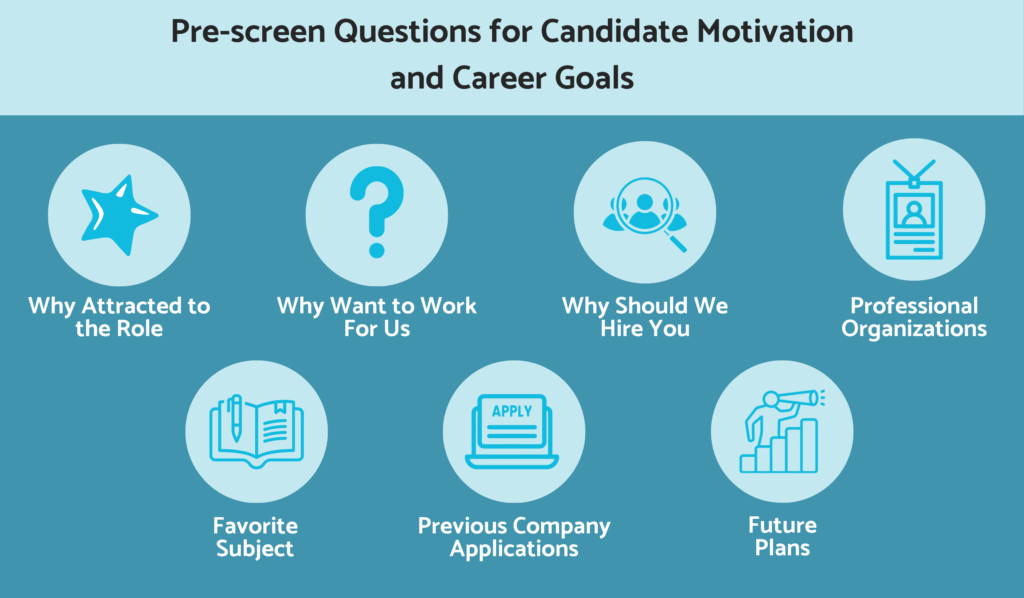
Q30: What attracted you to this role?
Tips to Evaluate the Answer: Here, the goal is to assess alignment between the candidate’s motivations and the organization’s offering. Look for answers that go beyond generic statements like “I need a job” and reflect a genuine interest in the responsibilities, company values, or growth opportunities.
Strong candidates will demonstrate that they have researched the company and role, linking their skills and career goals with the development programs and the position you offer. This demonstrates initiative and long-term thinking, ensuring a strong culture fit.
Q31: Why do you want to work with us?
Tips to Evaluate the Answer: Assess the candidate’s motivation for the role through their enthusiasm, company knowledge, and showcase of long-term intent. Strong answers will include how specific aspects of the company, such as its values, mission, and vision, align with theirs.
Additionally, candidates with strong enthusiasm for the role will also demonstrate knowledge of the developmental programs your company offers and how they align with their career goals. Evaluate how genuine, specific, and aligned their reasoning is; this signals whether they’re likely to stay and grow within your organization.
Q32: Why should we hire you?
Tips to Evaluate the Answer: This question tests confidence, self-awareness, and the ability to articulate value. Strong candidates confidently connect their specific skills, experience, and personality traits that match the role. Additionally, look into how the candidates enthusiastically showcase alignment of their personal strengths with the company goals, like “Your focus is on innovation, and I’ve led projects where I introduced process improvements saving 15% time.”.
Weak candidates often either remain generic (“I work hard, I’m loyal”) or focus solely on their desired role benefits, such as stability and salary.
Q33: Are you a member of any professional organizations?
Tips to Evaluate the Answer: Pre-screening questions like these aim to check the candidate’s initiative, love for the field, and interest in ongoing development. Strong candidates who actively participate in professional development (attending conferences, certifications, networking) likely bring updated knowledge and have stronger professional engagement. They understand the importance of forming professional relationships and emerge as strong team players.
For academic roles, candidates who have presented their research papers portray confidence, reliability, commitment, and sheer determination in their work.
Q34: What was your favorite subject and why?
Tips to Evaluate the Answer: Check if the choice of subject aligns with the role they are applying for (e.g., Statistics for a statistician role, Web development for engineering). A strong candidate will list concrete reasons passionately for and why he enjoyed that subject, with its role in building him valuable skills for the role. This pre-screen question will also give insights into the candidate’s mindset and clarity on why they’re pursuing this role.
Watch out for generic or irrelevant answers with no reasoning to back them, like “My favorite was Art because I liked doing it.”. Any negative contrast, such as “I hated most subjects, only liked this one,” signals a negative mindset.
Q35: Have you previously applied for a position at our company?
Tips to Evaluate the Answer: This interview question is suitable for both culture fit evaluation and candidate motivation for the role. Strong candidates would display honesty and elaborate with context if they had applied previously. Shows persistence and growth since the last attempt, without sounding desperate. If “No,” they might instead highlight how they’ve admired the company and now found the proper role that matches their skills.
However, weaker responses are usually vague or evasive, with overemphasis on rejection (“Yes, I guess I did, but I didn’t get it for some reason”) without showing growth or learning, and as if they apply to every role without tailoring.
Q36: Where do you see yourself in 5 years?
Tips to Evaluate the Answer: This question assesses the candidate’s career goals, ambition, and alignment with the company’s growth. Strong candidates will demonstrate long-term commitment, realistic progression, and how their goals align with the organization. Their answers will reflect loyalty, foresight, and a growth mindset.
However, weak responses will appear directionless, give vague or generic responses like “I haven’t thought about it much”, or show intentions of job-hopping, such as “I see myself starting my own business” or “I hope to be working abroad in a completely different field.” Watch out for overly ambitious goals disconnected from the role, or a lack of clarity, which signals poor career planning and potential attrition risk.
Let’s now cover some key pre-screen questions you ask for evaluating a candidate’s attitude on past employment and reasons for any gaps.
9. Top questions on past roles and employment gaps
Recruiters can identify and eliminate candidates with questionable employment gaps and attitudes toward past employers through preliminary screening. Pre-screen interviews are great tools for employers to assess candidates’ attitude towards their career and long-term planning for the role they are applying for.

Q37: Can you explain the gaps in your resume?
Tips to Evaluate the Answer: This pre-screen question will help you assess the candidate’s integrity and ability to give logical reasons for employment gaps. Strong candidates will provide a clear, professional explanation for employment gaps, whether it’s pursuing further education, upskilling, personal reasons, or exploring opportunities. They will demonstrate accountability by explaining how they used that time productively, often highlighting skills gained that make them stronger for the role.
However, weak candidates tend to be evasive, defensive, or overly vague, making it appear like they are hiding something. Watch out for contradictions, dismissive tones, or an attitude of blaming external factors as the reasons for their difficulties, as this highlights a lack of accountability and a pessimistic attitude. Eg., “Oh, it’s just so difficult to get jobs these days due to the government’s inability to provide good opportunities.”
Q38: You’ve changed jobs frequently. Can you tell me why?
Tips to Evaluate the Answer: Strong candidates will frame their transitions positively, emphasizing career growth, skill development, and alignment with goals. They will show self-awareness and reassure recruiters about their commitment going forward. Look for genuine reasons for their frequent change of job roles, such as exploring the opportunities that could offer them growth by challenging them in a healthy way.
Weak candidates may sound defensive, blame past employers, or appear opportunistic, suggesting they may leave this role quickly, too. Additionally, they may shift the blame to their past employers for being unfair or biased as the reasons for quitting the role. This showcases a lack of adaptability, self-awareness, and the ability to take responsibility, making them a risky hire. Eg., “My managers were always unfair, so I left each time.”
Q39: Why did you leave your previous job?
Tips to Evaluate the Answer: Strong candidates will give an honest but professional explanation, focusing on the future opportunity rather than complaining about the past. They may mention seeking growth, new challenges, or cultural fit while maintaining respect for the previous employer.
Weak candidates often become negative, blame-oriented, or vague, which signals poor professionalism and possible cultural mismatch. Eg., “My boss was terrible, I just couldn’t stand it anymore.”
Q40: How would you describe your experience in your last role?
Tips to Evaluate the Answer: Strong candidates will provide a balanced and reflective answer, highlighting key achievements, learning, and growth areas while staying professional even about challenges. They will show gratitude and maturity, demonstrating they can learn from any environment.
Weak candidates may give one-sided answers that are either overly negative or too superficial, without reflecting on lessons learned or value gained. This signals a lack of engagement with the role and its responsibilities that are essential for long-term retention of the employee. Their response might be something like “It was boring, I didn’t learn anything there.”
Q41: What if another company offers you a higher salary than us?
Tips to Evaluate the Answer: Strong candidates will focus on long-term growth, learning, culture, and alignment with the role, not just compensation. They will demonstrate commitment and intrinsic motivation, showing that salary is one factor but not the only driver.
Weak candidates may signal uncertain or purely transactional motives, showing that they will quickly leave if offered more money. Eg., “I have not thought about it before, but I think I will choose the company that will pay more for my efforts.” Hiring such candidates will prove detrimental to the company’s long-term success and growth and will just waste its valuable resources.
Next, we will be covering the top interview questions you can ask candidates as part of your pre-screening process to uncover their organizational and commercial knowledge.
10. Top questions for assessing a candidate’s organizational and commercial awareness
Company and commercial awareness questions in pre-screen interviews allow recruiters to assess candidates’ understanding of the company and its industry focus. Additionally, these interview questions also check candidates for their motivation, role understanding, confidence, and alignment with the company’s values and culture.

Q42: What value of yours best aligns with our company’s values?
Tips to Evaluate the Answer: This pre-screen interview question tests cultural fit, self-awareness, and whether the candidate has researched the company. Strong candidates connect one of their personal values (e.g., integrity, innovation, teamwork) to the organization’s stated values, showing alignment and authenticity. They demonstrate they can thrive in the culture and stay motivated long-term.
Watch out for generic answers that don’t show a real connection or copying company values without personalization. Weak candidates may sound rehearsed or vague. E.g., “Uh, I also believe in honesty and hard work like every company does, so I think I fit.”
Q43: Which of our programs do you like the most?
Tips to Evaluate the Answer: This pre-screen question tests the candidate’s research, interest, and alignment with the organization. Strong candidates mention a program that genuinely resonates with them, explaining why it stands out and how it connects with their values, career goals, or skills. They may also demonstrate that they’ve done their homework on the organization’s initiatives. This reveals motivation, preparation, and cultural fit.
However, weak candidates give generic or uninformed answers without detail, or admit to not knowing much about the programs. This signals poor preparation or a lack of genuine interest. Eg., “I don’t know much about your programs, but I’m sure they’re good.”
Q44: What is your favorite product/service of ours and why?
Tips to Evaluate the Answer: This pre-screen interview question tests research, enthusiasm, and brand awareness. Strong candidates mention a specific product/service, show they’ve engaged with it, and explain why it stands out (innovation, user experience, impact). This indicates a genuine interest in the company beyond just the job.
Weak candidates give vague, uninformed answers or admit they don’t know the products. Eg., “I haven’t really looked at your products, but I’m sure they’re good since you’re a big company.”
Q45: What new development in the industry excites you most?
Tips to Evaluate the Answer: This preliminary interview question evaluates curiosity, industry knowledge, and forward-thinking. Strong candidates bring up a recent relevant trend (AI, sustainability, digital transformation, regulation change, etc.) and connect it to the company’s mission or their role, showing awareness and adaptability.
Weak candidates show little knowledge or say they haven’t recently explored or looked at any industry changes. Eg., “I don’t really follow industry trends, I just focus on my work.”
Next, we have those pre-screen interview questions that HR asks before termination of the interview round, focusing on availability and salary expectations.
11. Top questions on candidate availability and salary expectations
These questions form the end of the pre-screening interview process. Recruiters here focus on candidates’ availability, flexibility, and negotiation skills. They also help in clearing any candidate’s doubts on the role and simultaneously gauge their level of interest and analytical thinking skills through the unique set of questions that they bring to the table.

Q46: Are you open to weekend or shift work?
Tips to Evaluate the Answer: This pre-screen interview question helps you check if the candidate is clear on their priorities, flexible, and honest while maintaining professionalism. Strong candidates will be upfront and showcase adaptability without sounding reluctant. Weak responses fall flat with a blunt yes or no, offering no clear explanation to cite their preferences or decision. Also watch out for unrealistic or desperate responses such as “No, I don’t work weekends,” “Yes, anytime, no problem at all” desperate/unrealistic) or “I’ll try, but it’s difficult.”.
Such weak responses show rigidity, lack of planning, or lack of seriousness about the role. However, in case the candidate has realistic constraints such as family, travel, or health, look out for their readiness to support business needs when possible, showcasing initiative and seriousness to help the team.
Q47: What are your current and expected Salary?
Tips to Evaluate the Answer: This pre-screen interview question indicates whether the candidate has thoroughly researched the role according to market standards. Strong candidates are transparent and clearly state current compensation, providing a justified and realistic salary expectation. Their responses showcase thorough analysis done on their part, so they avoid underselling themselves, but at the same time exhibit flexibility.
However, weak candidates showcase a vague or defensive attitude, such as “I don’t know, you decide,” or may even give unrealistic numbers or respond like “Money isn’t important to me,”. This not only showcases poor market research but also a lack of sincerity and poor negotiation skills.
Q48 When can you start if selected?
Tips to Evaluate the Answer: This question evaluates availability, commitment, thoroughness with the job description, and seriousness about the role. Strong candidates give a clear timeline aligned with their current obligations and express enthusiasm for joining. They balance eagerness with professional responsibility by honoring notice periods in line with the requirements of the role if the project hiring is ongoing.
Watch out for weak candidates who respond vaguely, show indecision, or indicate they need an unusually long time to start without explanation. Eg., “I’m not sure, maybe in a few months if things work out.” This may indicate low prioritization of the opportunity. Additionally, if the job description clearly calls for an ongoing project and requires immediate joiners, recruiting uncertain candidates who are not thoroughly familiar with the role before applying is not advisable.
Q49: Do you have any questions for us?
Tips to Evaluate the Answer: This pre-screen interview question tests the candidate’s interest level, engagement, and research preparation. Strong candidates ask thoughtful questions about the role, team structure, company culture, or growth opportunities. This shows they are proactive, have come prepared after research on the role, and are genuinely evaluating fit.
Watch out for candidates who say they have no questions or ask only about salary or perks too early. E.g., “No, I don’t have anything to ask. I’ll find out once I join.”. This signals a weak response and reflects low curiosity, a lack of preparation, or a transactional mindset.
Q50: If, instead of the job, we offer you an internship opportunity, would you consider it?
Tips to Evaluate the Answer: This is a critical pre-screen question that evaluates a candidate’s flexibility, learning orientation, and long-term interest in the company. Strong candidates respond openly, showing a willingness to learn and build experience, while also clarifying career goals. They balance practical considerations with positivity toward the organization. This question is also key to hiring a candidate whose profile may not be strong enough for the full-time role but potentially can be upskilled through an internship or traineeship.
Watch out for candidates who dismiss the idea outright or show rigidity without context. Eg., “No, sorry, I only want a full-time role and am not looking for any internship.” While it’s fine for experienced professionals to decline politely, an arrogant or dismissive tone may raise concerns about adaptability.
At Assess Candidates, we always recommend recruiters to combine their preliminary screening with a combination of different pre-screen interview questions and pre-employment assessments, such as personality assessments and situational judgment tests, for a holistic candidate evaluation.
Pair your pre-screen interviews with our pre-employment assessments to validate skills and competencies. VIEW PLANS
12. Why top companies prefer Assess Candidates’ pre-screening video interviews
At Assess Candidates, we specialize in offering a wide range of pre-employment assessments, including our pre-recorded video interview tool. We can also tailor recruitment strategies and tests to meet the unique hiring needs of any organization.
We are a leading pre-employment recruitment assessment and video interview provider that is proven to offer end-to-end assessment solutions for small, medium, and large employers. With our user-friendly platform, you can confidently and successfully recruit top candidates.
Here is an example of the campaign reporting dashboard that you will come across on the Assess Candidates platform. This user-friendly tool offers hiring managers and HR professionals valuable insights and advanced sorting functions, streamlining candidate assessment and selection.
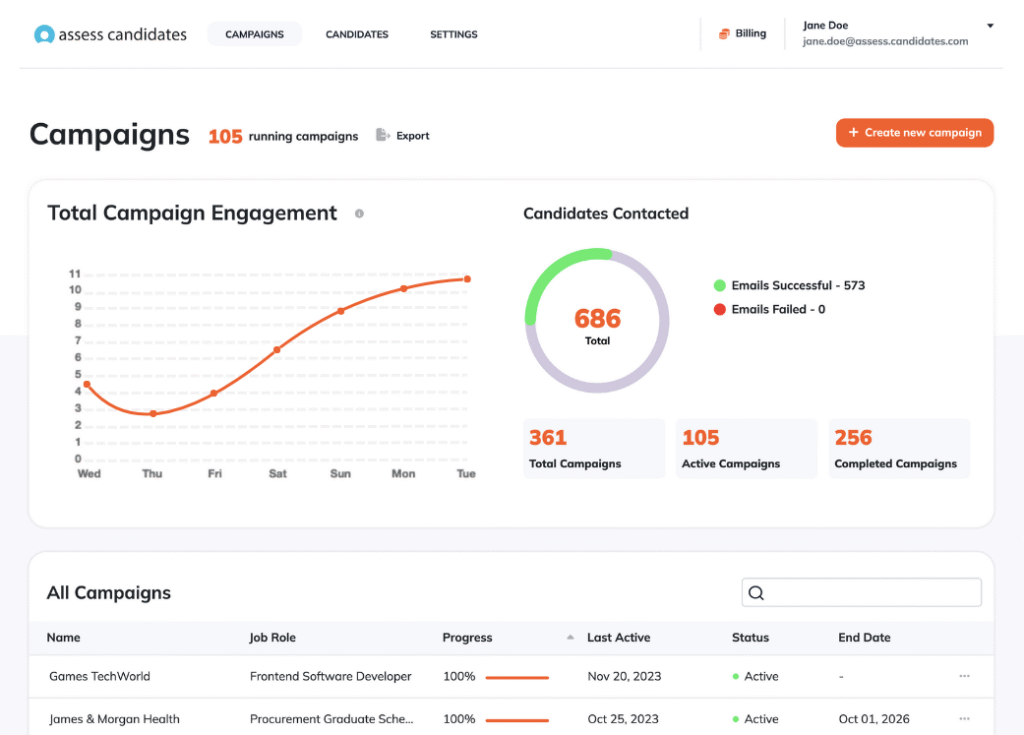
Here are the top 4 reasons why you should use Assess Candidates’ video interview tools for your recruitment process:
- Designed and Scientifically Validated by Expert Psychologists: Assess Candidates’ pre-screening hiring tools are developed by Chartered Scientists, Psychologists, and Psychometricians with decades of experience developing assessment solutions for companies like SHL and IBM Kenexa. Our psychometric and interviewing assessment tools are rigorously tested and validated to measure candidates’ skills across multiple dimensions. These tests have invariably selected and hired top talent across various organizations and industries.
- Expert Reporting: Assess Candidates’ user-friendly and easy-to-navigate assessment platform allows employers to evaluate candidate reports in detail and make informed hiring decisions based on flexible criteria. Recruiters can effortlessly review individual candidates’ performance on multiple assessments and then filter, rank, compare, and shortlist candidates. Moreover, our talent assessment platform also offers the option to integrate with your existing ATS for a seamless recruitment process.
- Positive Candidate Experience: Assess Candidates’ pre-screening video interviews are easily accessible from any device and feature an aesthetic and user-friendly interface for candidates. The assessment instructions are displayed clearly and can be fully customized to match your organization’s needs. All pre-screen interviews also require minimal clicks to complete, with the assessment automatically progressing to the next question once answered. This guarantees a smooth and optimistic candidate experience, enabling a positive association with your brand.
- Candidate Accessibility Support: Assess Candidates offers support for individuals with disabilities and visual impairments. All our pre-screening tools offer options to add extra time, zoom functionalities, and accessible color schemes and images in compliance with Web Content Accessibility Guidelines (WCAG), ensuring compatibility with screen readers.
Assess Candidates is a leading pre-employment recruitment assessment and video interview provider that is proven to offer end-to-end assessment solutions for small, medium, and large employers. With our user-friendly platform, you can confidently and successfully recruit top candidates. Why not discover the top hiring tests and make the right hiring decisions today?
Interested in learning more about effective pre-screening tools and assessments? Continue reading for frequently asked questions, and sign up with your email to get started.
Frequently Asked Questions
How many questions to ask the candidate in the pre-screening interview?
Pre-screen interviews are meant to be short, focused, and efficient. Therefore, most recruiters aim for 5-10 essential questions covering eligibility, basic skills, motivation, culture-fit, commercial awareness, elaboration of employment gaps, and attitude on past employers, availability, and salary expectations. They avoid asking too many questions as it would defeat the purpose of preliminary screening and risk disengaging the candidate.
What types of questions are usually asked in pre-screen interviews?
Pre-screen interview questions usually fall under 7 domains, and recruiters use a few from all of these for shortlisting. These are qualifications & eligibility, skills & work experience, role understanding & culture fit, motivation and career goals, past employment gaps and experience, organizational and commercial awareness, and availability and salary expectations.
What to do if the candidate doesn’t meet the age criteria for the role?
If the candidate doesn’t meet the age criteria, check if their skills make them eligible to work in the job role. For work eligibility assurance, verify that they are not violating labor laws, as is the case for apprentices in the UK, where the government mandates an age of 16 years. Be objective, fair, and transparent in the decision-making process.
What other things should I clarify when evaluating a candidate on their basic eligibility and availability?
In addition to evaluating candidates’ basic job eligibility, work experience, salary expectations, and availability, make sure to ask candidates the following pre-screen questions:
- Do you have any criminal record?
- Are you comfortable with the background checks?
- Are your salary expectations flexible?
- What is your notice period with your current employer?
- Can you clarify your job responsibilities at your last position?
Which is the most popular method of pre-screen interviews?
Out of the 4 popular pre-screen interview methods, depending on their format, telephonic interviews are the most sought after. Video interviews are also popular, but most employers pair them with the online assessments. Video conferencing is the most preferred method in case of a full interview round, while the questionnaire-based pre-screening method is popular for high-volume recruitment.


 English
  Arabic