
Upskilling And Reskilling Initiatives To Bridge The Skills Gap And Future-Proof Your Workforce



Upskilling and reskilling initiatives are critical for organizations determined to stay competitive in today’s fast-changing business landscape.
Did you know? According to the World Economic Forum’s Future of Jobs Report, 92% of employers, who see growing working-age populations as a key driver of transformation, plan to prioritize upskilling and reskilling by 2030.
As technology advances and roles evolve, forward-thinking employers are realizing that relying solely on external hiring to drive business success is no longer enough. Instead, they are investing in internal employee development to avoid delays in productivity and strengthen cultural alignment.
Unlike traditional, one-size-fits-all training methods, modern upskilling and reskilling programs are targeted, data-informed, and closely tied to organizational objectives. They focus on equipping employees with the technical, digital, and interpersonal skills needed to adapt to changing demands, take on new responsibilities, or transition into adjacent roles, building a more adaptable, loyal, and future-ready workforce.
By nurturing talent from within, companies future-proof their foundations, reduce long-term hiring risks, and address skill shortages in a more cost-effective and sustainable way, all while boosting retention rates, enhancing quality of hire, and reinforcing their employer brand.
Whether you are a recruiter, hiring manager, or talent acquisition expert, you may find yourself asking:
- Why is upskilling important?
- How do pre-employment assessments enhance upskilling and reskilling initiatives?
- What are some upskilling and reskilling challenges?
- In which roles do upskilling and reskilling deliver the highest value?
In this comprehensive guide, we explore what upskilling and reskilling mean, why they matter now more than ever, and effective strategies to implement them, ensuring you develop talent that aligns with your company’s evolving needs while maintaining a fair, consistent, and objective approach.
Contents
- What are upskilling and reskilling initiatives?
- How do upskilling and reskilling programs work?
- Why are upskilling and reskilling initiatives important?
- How to upskill and reskill employees?
- Which psychometric assessments can be used for skills development?
- Common challenges with upskilling and reskilling strategies
- Which roles and industries benefit the most from upskilling and reskilling programs?
- Real-world examples from leading employers prioritizing employee development
- Upskilling and reskilling in action: A success story
- Why choose Assess Candidates?
1. What are upskilling and reskilling initiatives?
Upskilling and reskilling initiatives are structured development programs designed to enhance employees’ existing skills (upskilling) or train them in entirely new competencies for different roles (reskilling).
These strategies help organizations adapt to evolving industry demands, close critical skill gaps, and prepare their workforce for future challenges, while empowering employees to grow and progress in their careers.
Enhance your upskilling and reskilling initiatives with our scientifically validated psychometric tests. HIRE FOR FREE
So, what exactly differentiates upskilling programs from reskilling?
Upskilling and reskilling: Key differences and examples
Upskilling and reskilling have become essential workforce development strategies in industries where skills demands are constantly evolving. Although the two terms are often conflated, they have different approaches, objectives, and implementations.
Upskilling focuses on expanding employees’ existing skills through targeted training and development opportunities. The goal is to enhance performance in a current role and prepare for future advancement. Upskilling keeps employees sharp, competitive, confident, and capable of meeting changing job requirements
Example: A factory worker learns to operate AI-powered machinery or uses predictive maintenance tools to improve efficiency.
Reskilling, on the other hand, equips employees with entirely new skills, enabling them to transition into different roles within the organization. Employers often introduce these programs in response to technological changes, industry shifts, or internal restructuring. Reskilling initiatives are most effective when employees already possess some transferable or adjacent skills that they can build upon.
Example: A Python or JavaScript developer takes a technical writing certification and transitions into a technical writer role.
Here’s a quick sum-up of the differences between upskilling and reskilling:

2. How do upskilling and reskilling programs work?
Upskilling and reskilling programs work by systematically identifying skill gaps within the workforce and delivering targeted, relevant learning opportunities to bridge those gaps. While the specifics vary by organization, employers follow a structured approach to ensure training is relevant, measurable, and aligned with business goals.
Here’s how upskilling and reskilling programs typically operate:
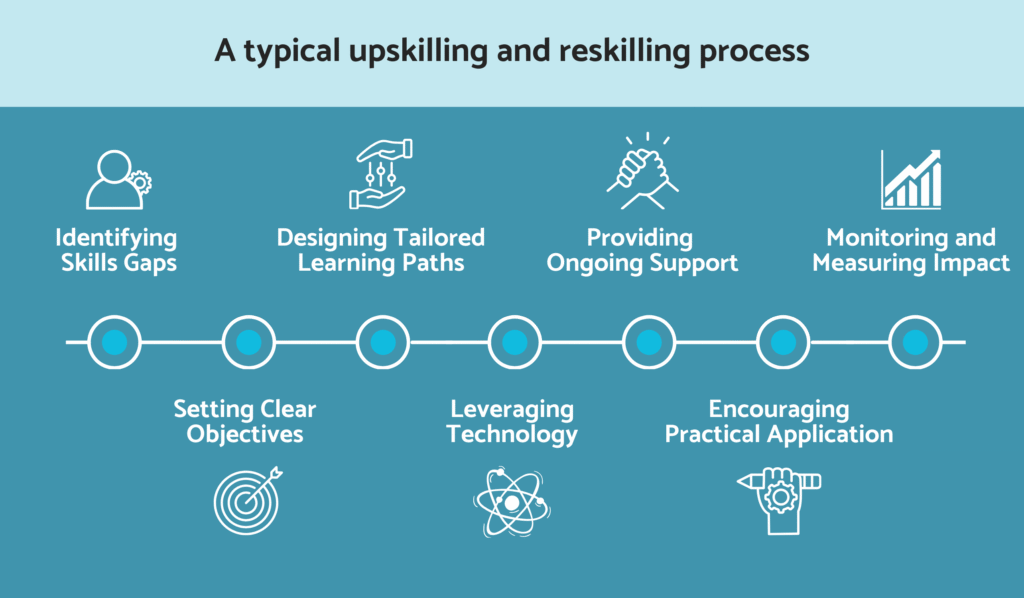
- Identifying Skill Gaps
Employers launch upskilling and reskilling programs by first gaining a clear understanding of current workforce capabilities. They assess employee skills using performance reviews, skills assessments, skills mapping, and job role analyses. This reveals where existing skills and competencies fall short of future requirements and provides a clear target for development plans.
- Setting Clear Objectives
After identifying skill gaps, employers define specific learning goals based on business priorities and strategic direction. They use upskilling to deepen employees’ expertise in current roles for new projects or reskilling to prepare them for transitions into new positions or shifts in customer demand.
- Designing Tailored Learning Paths
Instead of a one-size-fits-all approach, employers create personalized training plans for each employee’s role, career goals, and learning style, using formats like online courses, classroom sessions, live workshops, certifications, or hands-on projects. These may be self-paced, instructor-led, or blended learning that combines theory with practical application.
- Leveraging Technology
Digital platforms like Learning Management Systems (LMS), AI-powered content recommendations, and analytics tools help personalize learning, monitor progress, and deliver content at scale.
- Providing Ongoing Support
Employers support employees throughout the training journey through mentorship, coaching, and regular feedback to keep them engaged and adjust content to learner needs.
- Encouraging Practical Application
Employees are actively encouraged to apply their new skills in real-world tasks, daily projects, cross-collaboration, or stretch assignments. This hands-on practice engrains learning, builds confidence, and boosts long-term retention.
- Monitoring and Measuring Impact
For maximum effectiveness, employers constantly measure what is working and not. They track metrics like engagement levels, skill growth, productivity, and performance improvements, while also collecting employee feedback to refine the program.
Now, let’s dive into what upskilling and reskilling strategies are based on.
What are the key features of upskilling and reskilling initiatives?
Effective upskilling and reskilling initiatives for employees are built on a clear, strategic foundation that considers both current business needs, evolving industry trends, and future skill demands. Key elements include:
- Skill Gaps Analysis: Targeting training to the most urgent needs.
- Industry and Business Trends: Adapting to technological change and market shifts so skills are useful in the present and future.
- Talent Development Alignment: Supporting long-term workforce planning, internal mobility, and succession for leadership roles.
- Employee Performance and Potential: Personalizing the learning experience for better engagement and retention of skills.
- Proven Science and Learning Design: Utilizing microlearning, blended learning, and hands-on practice for real-world application.
- Smart Technology and Tools: Delivering, tracking, and improving learning efficiently at scale.
Discover how our expert-backed psychometric tests can enhance your upskilling and reskilling initiatives. LEARN MORE
Now that we’ve explored the basics of upskilling and reskilling, let’s take a look at their importance.
3. Why are upskilling and reskilling initiatives important?
Upskilling and reskilling strategies help employees and employers adapt to evolving industry and skill demands. Their benefits range from boosting productivity and enhancing job satisfaction to closing critical skill gaps.
Investing in continuous learning shows employees that their development and employability are priorities. This ensures a future-ready workforce that can face new challenges confidently.
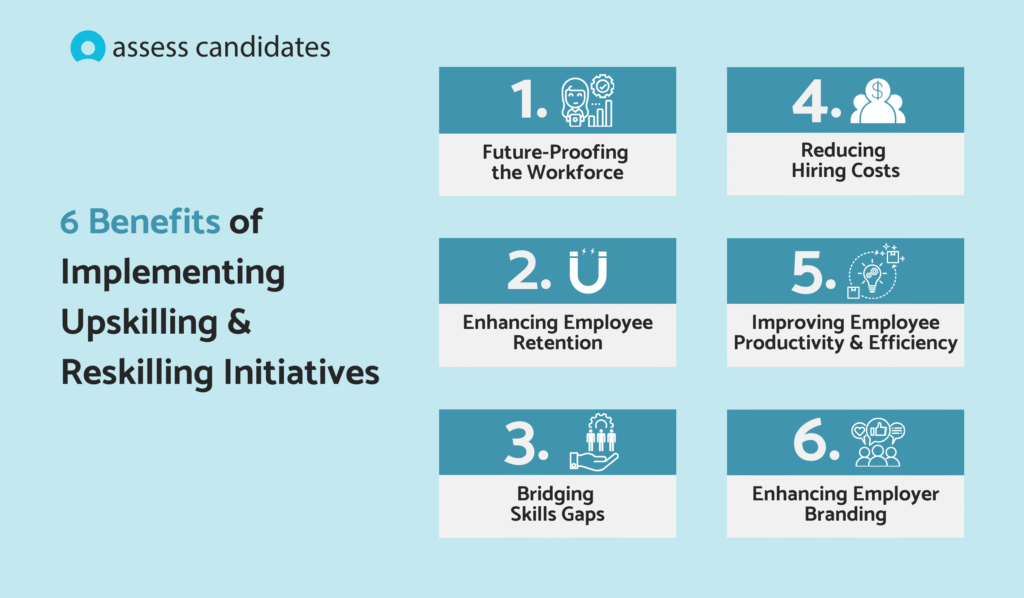
Top 6 benefits of upskilling and reskilling initiatives
- Future-Proofing the Workforce:
Organizations that incorporate upskilling and reskilling initiatives actively prepare their employees to adapt to organizational, market, and technological changes. By fostering continuous learning, businesses stay competitive while equipping teams with the skills that are relevant today and in the future.
Did you know? According to the World Economic Forum’s Future of Jobs Report 2025, skills gaps will be the most significant barrier to business transformation over the next 5 years.
- Enhancing Employee Retention:
When organizations offer structured learning and development opportunities they boost employee job satisfaction, loyalty, and engagement. Employees are more likely to stay with employers who actively invest in their long-term career development. This approach is especially effective for retaining millennial and Gen Z talent, who value personal growth and meaningful work more than salary alone.
Did you know? HRDrive found that 80% of employees say professional development and training offerings are important when accepting a new job.
- Bridging Skill Gaps:
As industries undergo digital transformations, skills become outdated faster than ever. Organizations utilize upskilling to help individuals adapt to new tools, platforms, and technologies and enhance their expertise and skills within their current roles. Reskilling, on the other hand, enables employees to shift into new career paths with new skills.
Did you know? According to WorldMetrics, 50% of all employees will need to reskill in 2025 to adapt to the increasing adoption of digital technologies across industries.
- Reducing Hiring Costs:
Hiring new talent externally is expensive, from investing in advertising, conducting interviews, onboarding, training, and mitigating the risks of a poor hiring decision. In contrast, upskilling and reskilling allow companies to develop existing employees who already understand the organization’s culture, systems, and workflows. Promoting from within saves both time and money while strengthening internal capabilities.
Did you know? Pluralsight’s 2024 Technical Skills Report states hiring a new tech employee costs an average of $23,450, whereas upskilling the same employee costs only $15,231, saving over $8,200 per person.
- Improving Employee Productivity and Efficiency:
When organizations upskill their workforce, employees perform tasks more efficiently, make smarter decisions and less errors. Reskilling further empowers them to step into new roles or responsibilities with ease, avoiding the steep learning curve typically faced by external hires. As a result, productivity rises across teams and departments.
Did you know? “59% of employees say training improves their overall job performance.” (SurveyMonkey).
- Enhancing Employer Branding
Companies that prioritize learning and development build a strong employer brand as employers of choice. Top candidates are drawn to organizations that offer clear growth paths and development opportunities. This also differentiates the company in competitive job markets.
Did you know? According to a LinkedIn report, a strong employer brand attracts 50% more qualified candidates.
Improve your upskilling and reskilling initiatives with a targeted hiring strategy with Assess Candidates. HIRE FOR FREE
In the following section, we will discuss the most effective strategies for upskilling and reskilling employees.
4. How to upskill and reskill employees?
Organizations gain a competitive edge in today’s fast-changing job market by actively upskilling and reskilling their workforce. Following effective strategies and best practices will enable you to close skills gaps and drive organizational success, while helping employees advance in their careers and adapt to new technologies and evolving business needs.
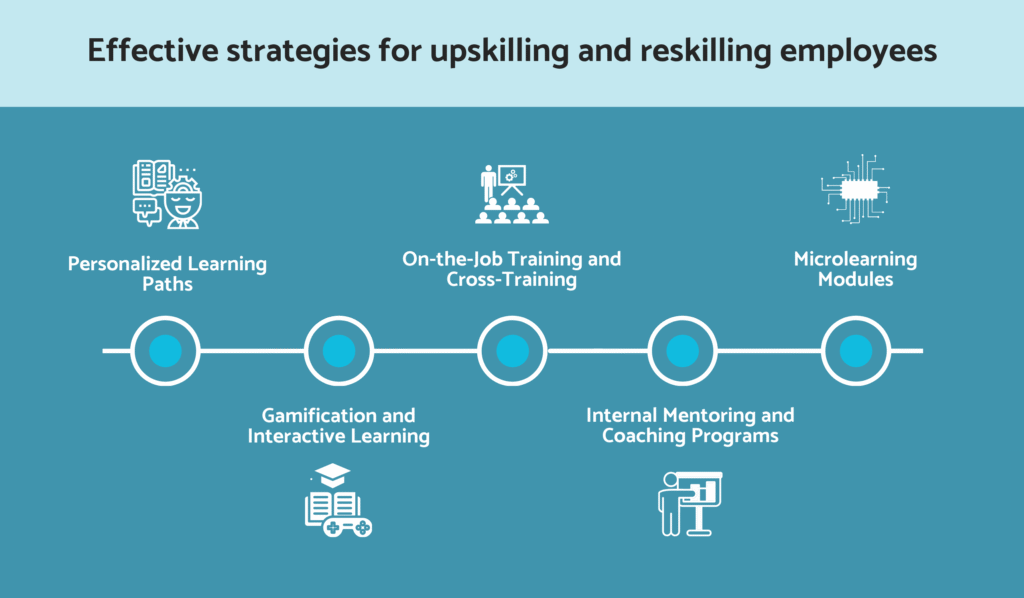
The most effective strategies for upskilling and reskilling employees include:
Personalize Learning Paths:
One of the most effective strategies for upskilling and reskilling employees is personalizing their learning paths. Align learning experiences with each employee’s role, current skill level, and career aspirations. Conduct skill gap analyses to tailor the content, pace, and delivery format to meet individual learning needs.
This targeted approach increases engagement, enhances the relevance of training, and speeds up development by focusing on the employee’s most critical growth areas.
Use tools like Coursera or Degreed to analyze skill gaps and recommend relevant courses.
Prioritize On-the-Job Training and Cross-Training:
On-the-job training and cross-training are highly effective strategies for promoting upskilling and reskilling. Encourage experiential learning by integrating skills development into daily tasks. Allow employees to shadow colleagues, take on stretch assignments, or temporarily switch roles to gain hands-on exposure.
This practical approach reinforces learning through experience, strengthens cross-team collaboration, and prepares employees for internal mobility.
Use platforms like WorkRamp or WalkMe to offer on-the-job training and cross-training to employees.
Utilize Microlearning Modules:
Microlearning modules are another effective strategy for upskilling and reskilling employees. Break complex topics into bite-sized, focused lessons that employees can complete in 5-10 minutes.
Use microlearning to deliver just-in-time training or reinforce previously learned concepts. This approach boosts retention, fits seamlessly into busy workflows, and keeps learning continuous and consistent.
Use microlearning platforms like LinkedIn Learning or SafetyCulture Training.
Leverage Gamification and Interactive Learning:
Enhance the engagement and effectiveness of upskilling and reskilling initiatives by incorporating game-like elements, such as points, badges, leaderboards, and challenges, into training programs.
A gamified and interactive learning strategy boosts participation, enhances course completion rates, and encourages healthy competition across teams, making learning both enjoyable and impactful.
Leverage game-based learning platforms like Kahoot! or TalentLMS to incorporate gamification and interactive learning modules.
Create Internal Mentoring and Coaching Programs:
Establish internal mentoring or coaching programs by pairing senior employees with less experienced team members. These relationships accelerate skill development, reinforce company values, and prepare high-potential employees for future leadership roles.
Use software like MentorcliQ or CoachHub to integrate internal mentoring or coaching programs.
Let’s now take a closer look at what psychometric tests help the most with upskilling and reskilling initiatives.
5. Which psychometric assessments can be used for skills development?
Psychometric assessments can play a valuable role in shaping upskilling and reskilling programs. They help uncover skill gaps by assessing employees, evaluate learning agility, and reveal behavioral traits, enabling personalized, targeted growth pathways for each employee.
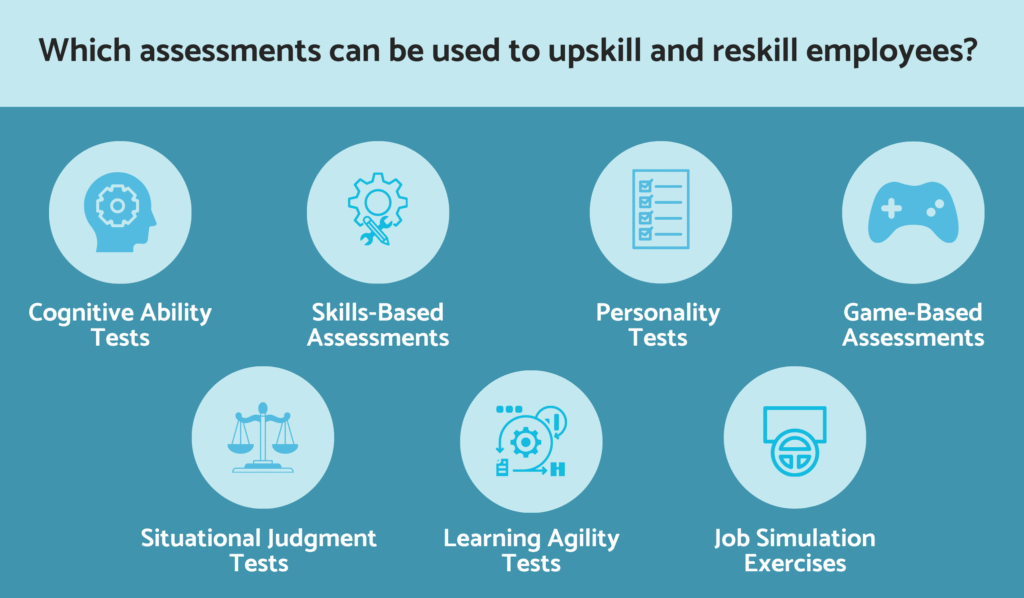
Here are 7 types of assessments that employers use to implement upskilling and reskilling initiatives:
1. Cognitive Ability Tests
Cognitive ability tests evaluate an individual’s ability to solve problems, reason logically, and comprehend information. Employers use these tests particularly when reskilling employees to identify individuals who can quickly learn new concepts and adapt to unfamiliar tasks.
Some of the common cognitive ability tests include:
- Numerical Reasoning Test
- Verbal Reasoning Test
- Logical Reasoning Test
- Abstract Reasoning Test
- Diagrammatic Reasoning Test
- Critical Thinking Test
- Spatial Reasoning Test
- Error Checking Test
The leading assessment providers for cognitive ability tests include Assess Candidates, IBM Kenexa, and SHL.
2. Skills-Based Assessments
Skills-based assessments are scientifically validated to predict candidates’ job performance in specific technical or job areas such as coding, writing, or data analysis. Employers use these assessments to identify current capabilities and pinpoint areas that need improvement. This insight helps them design targeted upskilling programs.
The top platforms that offer skill-based tests include Assess Candidates, Mercer Mettl, and iMocha.
3. Personality Tests
Personality assessments allow organizations to evaluate an employee’s behavioral traits and work-style preferences, such as adaptability, openness to learning, and conscientiousness. Employers use these insights to create personalized learning paths and leadership development programs that align with individual strengths.
Some of the leading providers for personality tests include Assess Candidates, TestGorilla, and Criteria Corp.
4. Game-based Assessments
Interactive game-based assessments measure decision-making, adaptability, and learning agility through engaging, game scenarios. These tools are especially effective for digital-native roles, enabling employers to assess a candidate’s potential for success in tech-driven reskilling programs.
Leading platforms that provide game-based assessments are Assess Candidates, Pymetrics, and Arctic Shores.
5. Situational Judgment Tests
Situational judgment tests (SJTs) are scientifically validated to accurately predict candidates’ job performance. These tests place employees in realistic workplace scenarios to evaluate how they would respond. Employers use these tests to assess soft skills, including decision-making, emotional intelligence, and interpersonal communication for their upskilling initiatives and leadership development programs.
The leading providers for situational judgment tests include Assess Candidates, Cubiks, and Kenexa.
6. Learning Agility Tests
Learning agility tests assess how quickly and effectively individuals can acquire new skills and apply them across different contexts. Employers use these assessments to identify employees with strong potential for reskilling into new roles.
Some well-known providers for learning agility and cultural fit assessments include Harver, Metti, and iMocha.
7. Job Simulation Exercises
Job simulation exercises actively support upskilling and reskilling by replicating real job tasks through hands-on, immersive experiences. Employers use these simulations to identify skill gaps, deliver targeted practice, and reinforce learning through direct application and feedback. By exposing employees to real-world responsibilities in a low-risk environment, simulations effectively prepare them for role transitions, such as shifting from customer service to sales.
Some of the top platforms that offer job simulation exercises include Assess Candidates, TestGorilla, and Vervoe.
At Assess Candidates, we advise combining psychometric assessments with human judgment to evaluate candidates more holistically and make more informed hiring decisions.
In the following section, we will dive into the ways in which these assessments can be utilized for upskilling and reskilling.
Explore our comprehensive assessment library to enhance your upskilling and reskilling initiatives. LEARN MORE
How to use employee assessments for upskilling and reskilling?
Strategically implementing assessments for employees ensures that they receive personalized training, which boosts performance, supports career growth, and aligns with evolving business needs.
Here is how to use assessments to upskill and reskill employees:
- Define Objectives Clearly
Define your objectives clearly. Decide if you want to reskill employees for new roles or upskill them to improve their current job performance. Pinpoint the specific skills and competencies critical for these future roles or improvements.
This clarity ensures that your chosen assessments align closely with your organizational needs and training goals.
- Select the Right Assessments
Choose the right types of assessments when leveraging them for upskilling or reskilling employees. Use cognitive ability tests to measure learning potential, problem-solving, and critical thinking, which are proven indicators of training success. Evaluate employees’ current technical or job-specific skills with skills tests to identify gaps.
Employ personality and behavioral assessments to gain insight into how individuals learn and adapt, and use situational judgment tests to assess practical decision-making relevant to the job.
- Integrate Assessments into Processes
Integrate accurate, reliable assessments into your internal mobility processes. Use assessments to identify candidates with strong learning potential or foundational skills for growth.
Embed assessments into performance reviews and talent development programs using an assessment platform for current employees. This integration ensures you base your upskilling and reskilling initiatives on accurate, up-to-date information about each individual’s capabilities.
- Analyze Assessment Data to Refine Programs
Collect and analyze assessment data carefully. Use the results to identify skill gaps at both individual and group levels, while highlighting strengths you can leverage. This data-driven approach helps you predict which employees are most likely to succeed in training programs and focus development resources effectively.
- Design Personalized Learning Paths
Use the insights you gain from analyzing assessment data to design personalized learning paths. Tailor upskilling and reskilling plans to each employee’s unique needs by combining various learning methods such as online courses, in-person workshops, and mentoring. Personalizing training increases engagement and effectiveness by targeting specific needs.
Want expert guidance from our organizational psychologists to improve your upskilling and reskilling? CONTACT US
Whilst upskilling and reskilling have many benefits, there are some challenges faced by organizations which you should also consider.
6. Common challenges with upskilling and reskilling strategies
Upskilling and reskilling are crucial for building a future-ready workforce, but organizations often face some challenges. Difficulties in identifying skill gaps, allocating resources, and engaging employees can hinder the success and scalability of learning and development programs.
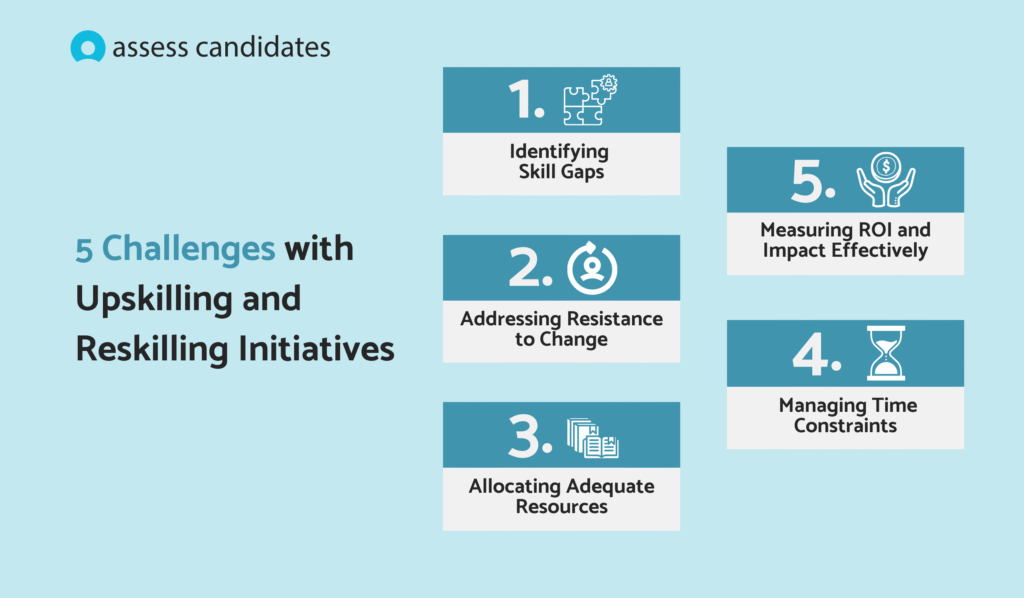
5 common upskilling and reskilling challenges that organizations face
- Identifying Skill Gaps
While implementing upskilling and reskilling initiatives, organizations often fail to accurately assess their workforce’s current capabilities and align them with future business needs. When they fail to collect reliable data or conduct proper assessments, they struggle to pinpoint skill shortages and identify employees who require development. As a result, they design training programs that fall short.
Solution: Use AI-powered skills mapping tools like Eightfold and Gloat, and partner with industry experts to forecast emerging skill trends accurately.
- Addressing Resistance to Change
While upskilling or reskilling, employees often feel overwhelmed or anxious about learning new technologies or processes, especially when they believe their current skills suffice. Fear of failure, lack of confidence, or doubt about the training’s value can cause disengagement.
Solution: To overcome this resistance, organizations must communicate clearly, motivate consistently, and foster a culture of continuous learning.
- Allocating Adequate Resources
Upskilling and reskilling require organizations to invest heavily in tools, platforms, facilitators, and budgets. Many small and mid-sized businesses fail to secure these resources, limiting their ability to deliver scalable, high-quality programs. Without adequate support, training efforts fall short in reach and impact.
Solution: Leverage affordable e-learning platforms like Coursera and Udemy Business, and tap into government-funded training grants or industry partnerships to supplement your training budget.
- Measuring ROI and Impact Effectively
Many organizations fail to link training directly to performance or business outcomes. They do not set clear metrics or use systems to evaluate the return on investment (ROI) of their upskilling and reskilling initiatives. This lack of visibility makes it harder to justify ongoing investment in training.
Solution: Track metrics such as promotion rates, project outcomes, and skill proficiency improvements before and after training to measure impact effectively
- Managing Time Constraints
Organizations often expect employees to balance learning with full workloads, leaving little time for training. In fast-paced or understaffed environments, employees may deprioritize development activities. Without setting aside dedicated time for learning, even well-designed programs struggle to gain traction.
Solution: Embed learning into daily workflows through microlearning, on-the-job training, and just-in-time resources. Offer flexible training schedules and set aside dedicated time during the workweek to ensure consistent learning without disrupting productivity.
Now we have covered the benefits, challenges, and strategies to upskill and reskill employees, we will explore the industries and roles that benefit the most from continuous learning and development.
7. Which roles and industries benefit the most from upskilling and reskilling programs?
Upskilling and reskilling initiatives are essential across today’s workforce, but certain roles and industries benefit more due to rapid technological change and evolving skill demands.
Industries that value upskilling and reskilling
- Technology
Tech companies lead the way in upskilling and reskilling to keep pace with the rapid innovation in the sector. They train software engineers, data scientists, cybersecurity analysts, and cloud specialists to stay ahead of the evolving tools and frameworks. These organizations invest heavily in certifications, structured training programs, and internal learning platforms to drive continuous development.
Major tech giants, such as Google and Amazon, run comprehensive reskilling programs to prepare their workforces for AI, cloud computing, and automation.
- Healthcare
Healthcare organizations actively upskill their workforce to adopt emerging technologies like telemedicine, AI-assisted diagnostics, and electronic health records (EHR). They provide regular training to nurses, medical technologists, and health informatics professionals, improving patient care, operational efficiency, and compliance.
Healthcare institutions, such as the Cleveland Clinic and Kaiser Permanente, implement structured reskilling strategies to transition staff into tech-enabled roles.
- Manufacturing and Logistics
Manufacturers invest in reskilling programs to adapt their workforce to automation, robotics, and smart systems. They train machine operators, technicians, and logistics coordinators in digital systems, predictive maintenance, and supply chain analytics.
Siemens and Caterpillar run digital learning programs that equip employees to manage smart machines and IoT-based technologies.
- Finance
Financial institutions are upskilling employees in fintech, financial analytics, and regulatory technology to meet the evolving demands of the industry. They train risk analysts, compliance officers, and investment advisors to stay current with digital platforms and shifting regulations.
Leading firms, such as JPMorgan Chase and Goldman Sachs, offer in-house training and collaborate with online platforms to future-proof their workforces.
- Retail and Customer Service
Retailers invest in reskilling to support e-commerce, digital sales tools, and customer engagement platforms. They train store managers, sales associates, and customer service representatives in omnichannel operations and digital communication strategies.
Companies like Walmart and Target lead with internal mobility programs and digital upskilling to keep pace with transformation
By actively promoting a strong learning culture, skill development programs, and internal mobility opportunities, organizations enhance their appeal to growth-minded talent. As the job market evolves, upskilling and reskilling initiatives will play a key role in strengthening employer branding and retaining high-quality employees.
Let’s now take a look at the roles where upskilling and reskilling initiatives are valued.
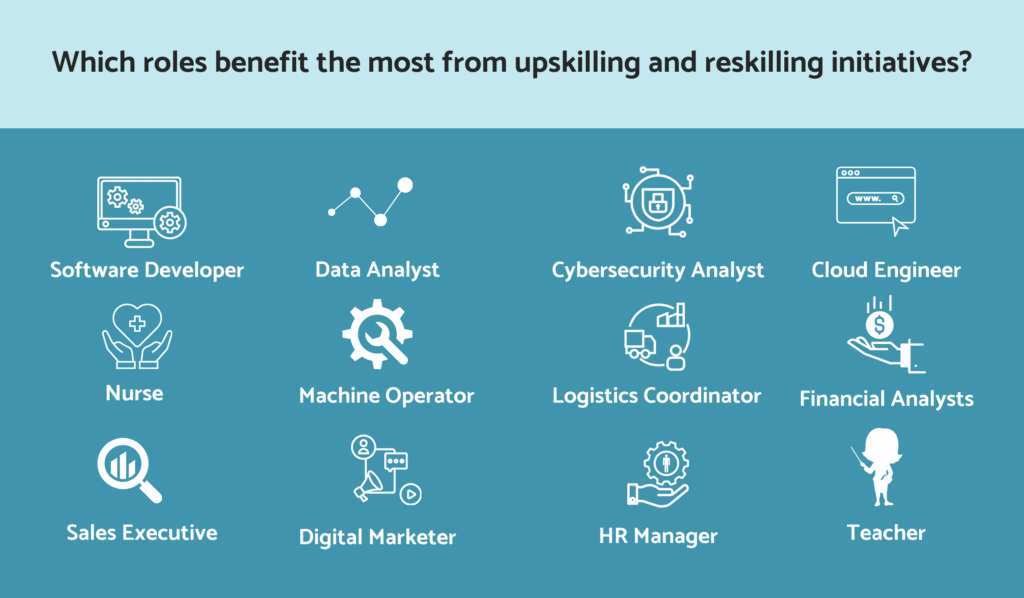
Roles that benefit the most from upskilling and reskilling initiatives
- Software Developer
- Data Analyst
- Cybersecurity Analyst
- Cloud Engineer
- Nurse
- Machine Operator
- Logistics Coordinator
- Financial Analyst
- Compliance Officer
- Digital Marketer
- Sales Executive
- Customer Service Representative
- HR Manager
- Teacher
- Project Manager
Now, let’s examine real-world employer case studies that utilize upskilling and reskilling initiatives to enhance employee retention.
Optimize your upskilling and reskilling strategies with our extensive range of standardized assessments. HIRE FOR FREE
8. Real-world examples of leading employers prioritizing employee development
Leading employers recognize that investing in upskilling and reskilling strategies is key to retaining talent in today’s fast-changing work environment. By equipping employees with opportunities to grow their skills, they not only strengthen career progression but also boost engagement, job satisfaction, and loyalty.
Below are some standout examples of companies using these strategies successfully to drive employee retention and build a future-ready workforce.
Amazon: Elevating Employee Retention through Strategic Upskilling
Amazon invested $1.2 billion in its “Upskilling 2025” program to train 300,000 employees in advanced technical skills like cloud computing, machine learning, and software engineering. This initiative helps workers, especially those in entry-level roles, move into higher-skilled positions within the company.
By offering clear career pathways, Amazon has boosted employee retention and lowered turnover.
AT&T: Strengthening Workforce Agility with Comprehensive Reskilling
AT&T launched its “Future Ready” initiative, investing $1 billion to reskill employees in growing fields such as software development, cybersecurity, and data science. Through partnerships with online education platforms, the program offers flexible learning opportunities.
By aligning employee skills with evolving technology needs, AT&T has enhanced workforce agility, increased engagement, and improved retention.
Walmart: Improving Employee Loyalty through Accessible Education
Walmart’s “Live Better U” program offers employees affordable access to college degrees and vocational training, including technology and management courses. By supporting career advancement and financial well-being, the program has fostered greater employee loyalty and improved retention rates.
Now, let’s see how implementing upskilling and reskilling initiatives can increase your growth with this short success story.
9. Upskilling and Reskilling in action: A Success Story
Client Problem Statement:
Suppose a rapidly expanding manufacturing company faced challenges adapting to fast-changing automation technologies on its production floor. Although they hired experienced workers, many lacked the technical skills needed to operate and maintain the new machinery effectively.
This skills gap led to frequent production delays, increased machine downtime, and growing employee frustration. As workers felt unprepared for evolving job demands, turnover rates rose.
To address these issues, the company sought a strategic solution to upskill and reskill its workforce, aiming to boost operational efficiency and retain talent.
Assess Candidates’ Proposal:
At Assess Candidates, we recommend starting with detailed skills assessments to identify skill gaps in automation, machinery operation, and safety protocols. Based on these insights, we enhance the hiring process by incorporating practical skill tests and learning agility evaluations, ensuring candidates possess the technical ability and adaptability needed for evolving roles.
This integrated approach helps organizations build a more capable, confident, and engaged workforce aligned with long-term operational goals.
Result:
By prioritizing targeted skills assessments and tailored upskilling programs, the manufacturing company built a technically proficient and adaptable workforce. This focused approach improved production efficiency, reduced machine downtime, and increased employee confidence.
Equally important, it boosted employee retention and strengthened the company’s employer brand by showcasing a clear commitment to continuous learning and career growth, making it more attractive to skilled talent in a competitive market.
Partner with us to elevate your upskilling and reskilling initiatives. VIEW PLANS
10. Why choose Assess Candidates?
At Assess Candidates, we go beyond smarter hiring; we help you create a lasting, positive impression on your talent pool. Our customized pre-employment assessment solutions are designed to align with your company’s values, business goals, and employee experience expectations, ensuring every learning touchpoint reinforces your reputation as a future-focused employer.
Below is a preview of the campaign reporting dashboard on the Assess Candidates Talent Assessment platform.
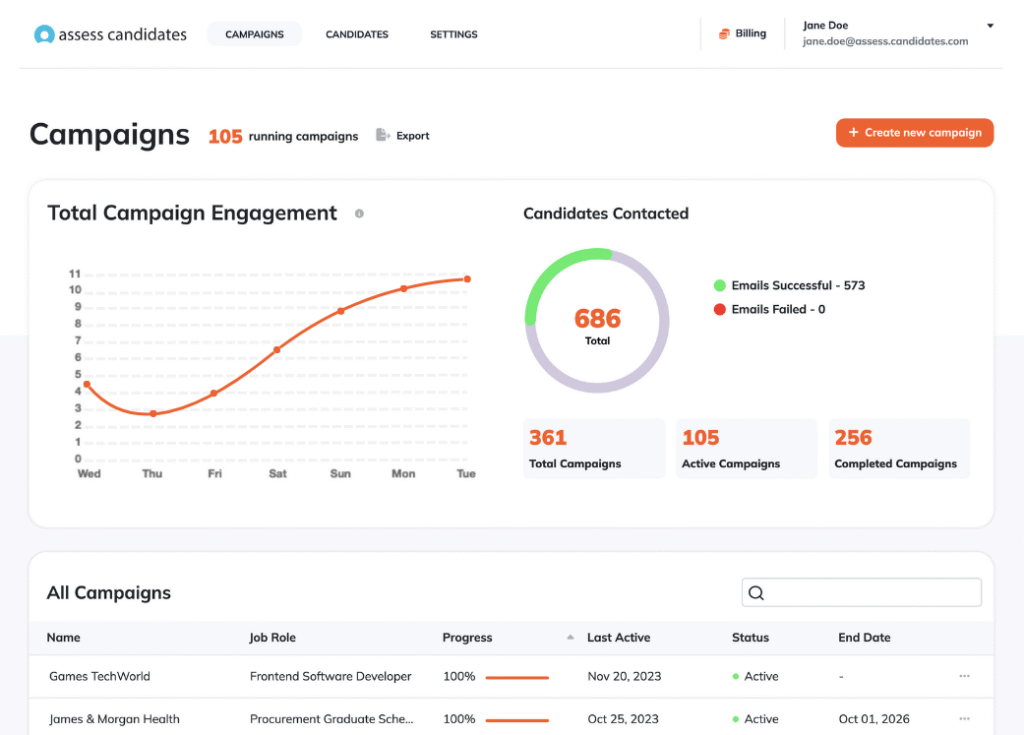
The top 4 reasons why you should use Assess Candidates for upskilling and reskilling
- Expertly Designed and Scientifically Backed: Assess Candidates’ pre-employment tests are created by a team of Chartered Scientists, Psychologists, and Psychometricians with experience at top firms like SHL and IBM Kenexa. Each test is rigorously validated to assess real-world skills and role-specific competencies, as well as practical, on-the-job skills. This scientific foundation ensures your upskilling and reskilling programs are effective, targeted, and aligned with business goals, positioning your organization as one that values continuous growth and data-driven development.
- Actionable Insights to Guide Learning Pathways: Our platform provides intuitive, detailed reports that highlight individual and team skill gaps, learning readiness, and potential for role progression. You can easily identify training needs, group employees by development level, and track improvement over time. These insights enable learning and development teams to personalize learning journeys and align skill-building efforts with organizational needs.
- Positive Learner Experience that Reinforces Engagement: Assess Candidates delivers mobile-friendly, interactive assessments that engage learners and build confidence. The platform allows you to customize the experience to reflect your company’s tone and branding, creating a seamless extension of your employee value proposition. A smooth and encouraging assessment journey enhances employee motivation and signals your commitment to career development and growth.
- Inclusive and Accessible for Every Employee: We design all assessments with accessibility in mind, ensuring every employee, regardless of ability, can fully participate in upskilling and reskilling initiatives. Features like extended time options, zoom functionality, screen reader compatibility, and WCAG-compliant design support diverse learning needs and promote an inclusive workplace culture rooted in equal opportunity.
Assess Candidates is a leading provider of pre-employment assessment solutions, offering comprehensive, end-to-end tools for small, medium, and large businesses. Our intuitive platform empowers you to identify and hire top talent with confidence through data-driven decision-making. Explore our wide range of hiring assessments and take the next step toward smarter, more efficient recruitment today.
Not sure if pre-employment assessments are right for your hiring process? Get in touch with us for a free-of-charge analysis of your recruitment needs.
Interested in learning more about effective candidate assessment? Continue reading for frequently asked questions, and sign up with your email to get started.
Frequently Asked Questions
Can small businesses implement upskilling and reskilling initiatives with limited resources?
Yes, small businesses can implement upskilling and reskilling initiatives by utilizing cost-effective online courses, collaborating with local training organizations, and fostering peer-to-peer learning. Focusing on essential skills that align with business objectives and offering flexible, short learning modules allows them to achieve significant results without requiring large investments.
How can upskilling and reskilling help bridge the skills gap within a diverse workforce?
Upskilling and reskilling promote knowledge sharing across generations by equipping employees of all ages with the necessary skills. It enhances collaboration, minimizes age-related biases, and supports both older and younger workers in adapting collectively to changing technologies and workflows.
Can upskilling and reskilling reduce bias in hiring decisions?
Yes, upskilling and reskilling initiatives help reduce bias by emphasizing objective, measurable skills and competencies instead of subjective opinions. Using data-driven assessments ensures fair evaluation of employee potential and performance, which minimizes unconscious bias and fosters equal opportunities for promotion and career growth.
How do personalized learning paths enhance the effectiveness of upskilling and reskilling efforts?
Personalized learning tailors training to each employee’s strengths, career aspirations, and skill gaps, making development more meaningful and engaging. This customized approach boosts motivation, speeds up skill mastery, and enhances long-term retention of knowledge, resulting in more effective upskilling and reskilling outcomes.
What metrics should companies track to measure the success of their upskilling and reskilling initiatives?
To measure upskilling and reskilling success, track employee skill improvements, program completion rates, internal mobility, productivity, and retention. Additionally, gather feedback through learner satisfaction and confidence surveys to gain insights into the program’s impact and identify areas for continuous improvement.


 English
  Arabic