
Pre-Employment Verbal Reasoning Tests For Hiring | 2026 GUIDE FOR RECRUITERS



Verbal reasoning tests have become a key tool for modern candidate assessment, measuring a candidate’s ability to read, interpret, and analyze written information.
Since strong comprehension and communication skills are vital across nearly every industry, verbal tests help employers identify individuals who can process complex information effectively, think critically, and make informed, accurate decisions.
Unlike resumes or interviews that are influenced by subjectivity, verbal reasoning pre-employment tests deliver objective, standardized insights into a candidate’s reasoning and communication abilities. By offering fair and consistent evaluation, they minimize bias, and accurately predict workplace performance. This makes them especially valuable for roles that demand analytical thinking, problem-solving, and clear communication.
From global corporations to SMEs and startups, verbal reasoning assessments provide a cost-effective, efficient way to improve hiring outcomes. When incorporated into your hiring process, you can streamline candidate selection, leading to higher-quality hires, reduced turnover, and a more capable, productive workforce that supports long-term business growth.
Whether you’re a hiring manager or HR professional, you might find yourself asking questions like:
- Why is verbal reasoning important?
- What are the benefits of verbal reasoning tests in hiring?
- Are there any challenges when using pre-employment verbal tests?
- At what stage of my recruitment process should I include verbal reasoning tests?
- How can I effectively implement verbal reasoning assessments?
This guide explores these questions in depth. Keep reading to learn how verbal reasoning testing tools can help you consistently hire the best talent for your role and organization.
Contents
- What is a verbal reasoning test?
- What skills does a pre-employment verbal reasoning test measure?
- How do verbal reasoning tests work?
- Why do employers use verbal reasoning tests for pre-employment screening?
- When are verbal reasoning assessments used in the hiring process?
- Best practices for integrating verbal tests into your recruitment strategy
- Which industries and roles should use verbal reasoning tests for hiring?
- Verbal reasoning tests: Client Success story
- Why top companies choose Assess Candidates’ verbal reasoning tests to hire
Next, let’s start with the basics: what are verbal reasoning tests?
1. What is a verbal reasoning test?
A verbal reasoning test, also known as a verbal reasoning aptitude test, is a type of pre-employment aptitude assessment that evaluates how effectively a candidate can comprehend, analyze, and interpret written information. These tests typically present short passages of text, requiring applicants to identify key ideas and apply logical reasoning to draw accurate conclusions.

Verbal reasoning assessments offer recruiters objective, standardized insights into a candidate’s critical thinking, verbal comprehension, and problem-solving – skills that CVs and interviews alone cannot reliably measure. These tests are scientifically proven to predict job performance more accurately than CVs, helping employers select candidates who have the required skills and are more likely to succeed in the role.
Strengthen your pre-employment hiring process with our scientifically validated verbal reasoning tests. HIRE FOR FREE
But what does verbal reasoning mean?
What is verbal reasoning?
Verbal reasoning is the ability to understand and reason with written information. It goes beyond basic language and reading skills, instead involving verbal comprehension, analysis, identification of key details, and thinking critically to draw logical conclusions and build clear, coherent arguments based on the information provided.

Why are verbal reasoning skills important?
Verbal reasoning skills are fundamental to modern workplace success. Most roles require employees to interpret complex documents, draw accurate conclusions, clearly communicate ideas to colleagues, managers, and clients, and make decisions based on written material.
Particularly in customer-facing roles, strong verbal reasoning reduces misunderstandings and improves daily collaboration and customer interactions. Verbal reasoning skills are even more critical in remote or hybrid work environments, where clear and effective written communication is key to maintaining productivity and alignment.
Why do employers assess verbal reasoning during hiring?
Measuring verbal reasoning during hiring is a reliable indicator of how individuals might inherently write, communicate, and express themselves professionally in the workplace.
Candidates who score well on the verbal reasoning test have strong verbal reasoning skills and, in the workplace, are more likely to be able to:
- Effectively communicate solutions to colleagues, senior staff, and customers across various academic and professional domains
- Write professionally in presentations, projects, and emails
- Accurately interpret reports, policies, technical documents, and statements
- Follow complex instructions precisely
- Spot inconsistencies or errors in written material
- Synthesize information and express ideas with clarity and conciseness
- Draw logical conclusions and make sound decisions using language and facts
In the following section, we will look into what specific skills verbal reasoning pre-employment tests measure.

2. What skills does a pre-employment verbal reasoning test measure?
Verbal reasoning pre-employment tests measure critical thinking, logical reasoning, attention to detail, and communication strengths; all vital for workplace success.
What specific skills are measured by a verbal reasoning test?
Verbal reasoning aptitude tests typically measure these 4 major skills:

1. Verbal Comprehension
A verbal assessment test evaluates how well candidates read and understand written passages. Candidates must identify main ideas, key details, and underlying messages from written reports, documents, and statements within a limited timeframe. Strong verbal comprehension is especially crucial for roles like consulting, law, or HR, where professionals must grasp key points without misinterpretation.
2. Logical Reasoning
A verbal reasoning test also measures an applicant’s reasoning abilities and critical thinking skills when connecting information, analyzing arguments, and using logic to draw conclusions. This skill is critical for roles like analysts, researchers, and auditors, where accurate decision-making under time pressure depends on clear, text-based reasoning.
Verbal reasoning tests ensure that candidates answers rely solely on the text and information provided rather than external knowledge or assumptions.
3. Attention to Detail
Verbal reasoning questions challenge candidates to spot subtle differences in wording, which can completely alter a statement’s meaning, and avoid misinterpretation. This highlights their precision and focus, which play a crucial role in roles like law, finance, or compliance, where missing small details can cause significant errors.
4. Vocabulary and Grammar
Verbal reasoning tests also measure a candidate’s grasp of language, including grammar and vocabulary. Strong language skills enable accurate comprehension, interpretation, and communication of complex information, while a wide vocabulary allows candidates to recognize meanings, distinguish word differences, and avoid misinterpretation. In roles like teaching, client communication, law, or marketing, professionals need strong grammar and vocabulary for clarity and credibility.
Identify top candidates by incorporating a high-quality verbal reasoning test into your recruitment process. LEARN MORE
In the following section, we will explore how verbal reasoning tests actually work in hiring.
3. How do verbal reasoning tests work?
Recruiters widely use verbal ability tests in hiring, administering them online or during assessment centers based on organizational needs. These tests assess a candidate’s ability to handle complex written information, evaluate arguments, and make sound decisions.
Typically timed in nature, these assessments include 10–20 multiple-choice questions delivered through an online assessment platform. Candidates are required to analyze written passages, draw logical conclusions, and classify statements as “true,” “false,” or “cannot say,” making them especially valuable for roles that demand strong communication, critical thinking, and problem–solving skills.
Did you know? According to the Society for Industrial and Organizational Psychology, candidates who score well on verbal reasoning tests are 4× more likely to succeed in their roles compared to lower scorers.
But what are verbal reasoning questions in hiring?
Verbal reasoning test questions are carefully designed to assess a candidate’s ability to comprehend, interpret, and analyze written information. These questions can appear in formal verbal reasoning tests, skills-based assessments, or even during job interviews.
If you decide not to use a verbal reasoning assessment during initial screening, it is important to assess candidates’ verbal reasoning skills in other ways. Through structured in-person or video interviews or written exercises, recruiters can evaluate how well a candidate processes information and articulates responses. This helps reduce the risk of mis-hires and ensures candidates have the necessary communication and comprehension abilities for the role.
Below are the main types of verbal questions for interview and hiring tests:
Tue, False, Cannot Say
The most common type of verbal reasoning question asks candidates to evaluate the truthfulness of statements based on a given passage. Candidates must answer true, false, or cannot say using only the information provided. These statements may be direct or inferential, requiring logical deduction rather than simple text matching.
Example.1:
Passage: “All employees at the company receive annual training. Some employees also participate in monthly workshops.”
Statement: “All employees at the company participate in monthly workshops.”
Spelling and Grammar Tests
Spelling and grammar tests evaluate a candidate’s ability to apply correct grammar, punctuation, and spelling – all crucial for clear communication in professional settings.
Example.2 “Choose the sentence that is grammatically correct:
A) She don’t have enough experience for the role.
B) She doesn’t has enough experience for the role.
C) She doesn’t have enough experience for the role.
D) She not have enough experience for the role.”
Vocabulary Tests
Vocabulary-based questions assess the range and understanding of a candidate’s word knowledge. They are often part of verbal aptitude and ability assessments and may include various types of questions to evaluate how well candidates understand and use word meanings, synonyms, and antonyms in context.
Example.3 “Choose the word that is most similar in meaning to abundant:
A) scarce
B) plentiful
C) tiny
D) empty.”
Word Analogy Tests
Word analogy tests are frequently used in standardized assessments to evaluate verbal reasoning and cognitive skills. In these tests, candidates are presented with a pair of related words and must find another pair that shares a similar relationship.
Example.4 “Dog is to Puppy as Cat is to:
A) Kitten
B) Cub
C) Foal
D) Calf”
Critical Reasoning Questions
Verbal critical reasoning questions present short written passages to assess a candidate’s ability to analyze arguments, identify assumptions, evaluate evidence, and draw logical conclusions. They are especially useful for roles that require problem-solving and evidence-based decision-making.
Example.5
Passage: “Many companies that have introduced flexible work schedules report higher employee morale and lower turnover. Higher morale tends to increase engagement, which then boosts productivity. For these reasons, offering flexible schedules is an effective way to improve overall company performance.”
Question: “Which of the following sentences weakens the argument above?
A) Some employees are less productive when given flexible schedules due to poor time management.
B) Flexible work hours improve employee morale.
C) Most employees prefer fixed schedules for clarity.
D) Flexible schedules reduce the need for office space.”
Reading Comprehension Questions
Reading comprehension questions measure a candidate’s ability to quickly and accurately read and understand written information, requiring them to interpret passages and ideas and extract relevant details.
Example.6
“Passage: Many companies are adopting remote work to improve satisfaction and cut costs, but it can cause communication challenges.
Question: What challenge does remote work create?
A) Higher rent
B) Longer hours
C) Collaboration issues
D) Turnover”
Let’s take a glimpse at a verbal reasoning test question example below:
Assess Candidates’ Verbal Reasoning Test Examples Question:
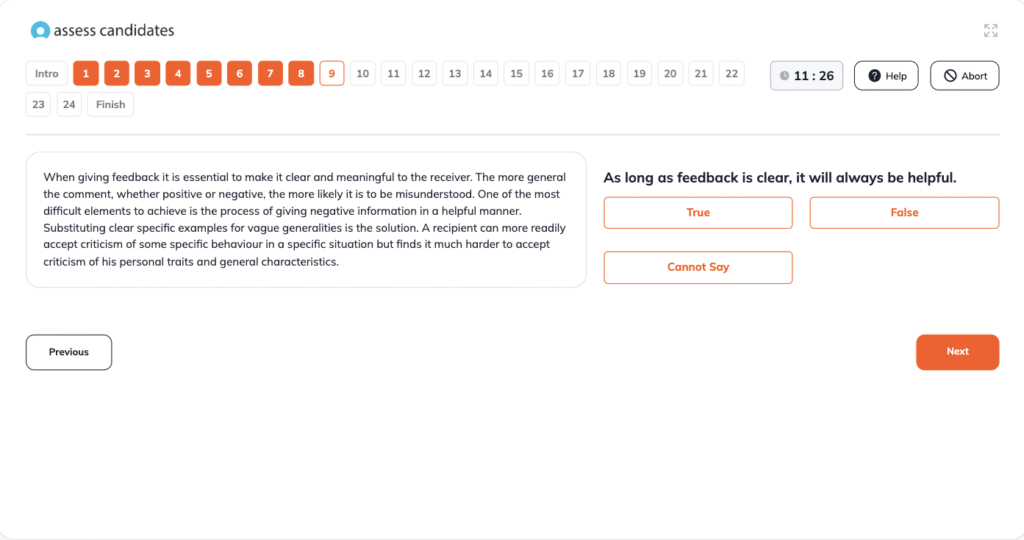
This example comes from Assess Candidates’ off-the-shelf verbal reasoning tests, which employers can also customize to match the specific demands of a role. Customization allows recruiters to evaluate candidates’ verbal reasoning skills in direct relation to job requirements.
Explore more sample verbal reasoning question examples or get in touch with us to discuss tailored assessment options!
Leverage our verbal tests to identify top talent with strong analytical and communication abilities. HIRE FOR FREE
To get answers to all the questions mentioned above, head down to the end of the article.
In the following section, we will delve into the reasons why employers incorporate verbal tests into their recruitment process.
4. Why do employers use verbal reasoning tests for pre-employment screening?
Verbal reasoning tests are used in pre-employment screening to spot candidates who demonstrate strong critical thinking, accurate data interpretation, and effective communication. Unlike resumes or academic records, these tests provide a fair and standardized measure of reasoning ability, enabling organizations to make more informed and reliable hiring decisions.
Furthermore, verbal reasoning assessments streamline the hiring process by quickly filtering large candidate pools, reducing the time and cost involved in recruitment. They also help remove unconscious bias by focusing solely on a candidate’s skills and reasoning abilities, supporting an inclusive hiring process
Top reasons why employers use verbal reasoning tests for hiring

- Saving Time and Money
Employers administer verbal reasoning tests early in the hiring process to filter out unsuitable applicants. This step prevents wasted resources on candidates who look strong on paper but lack essential reasoning skills. By focusing on the best-fit candidates upfront, companies save time, reduce recruitment costs, and improve hiring efficiency.
Organizations that apply pre-employment testing early on in the recruitment process avoid costly hiring mistakes and build stronger, more dependable teams.
Did you know? Using pre employment aptitude tests, such as a verbal reasoning aptitude test, during the initial screening can reduce a large candidate pool by up to half. This approach proves especially valuable in graduate program recruitment, where employers need to distinguish effectively between a large number of seemingly equally qualified applicants
- Fairness in Hiring
Employers use verbal tests to create a level playing field in recruitment. These standardized tests present the same questions and conditions to every candidate, which allows recruiters to compare applicants objectively. As a result, hiring decisions become fairer and less influenced by bias, which aligns with company policies and is legally defensible.
HR teams evaluate candidates from diverse educational, cultural, or professional backgrounds without giving an unfair advantage to those with more polished resumes.
- Predicting Workplace Performance
Employers rely on pre-employment verbal reasoning tests to predict how effectively candidates will perform once hired. Strong performers on these tests typically have sharper problem-solving skills, stronger decision–making, and better adaptability under pressure. Since the test measures reasoning instead of memorized knowledge, it gives employers a reliable preview of how candidates handle workplace challenges.
These tests help managers, analysts, and strategists assess large volumes of information and make well-justified recommendations that influence business outcomes.
- Assessing Comprehension and Analysis Skills
Verbal reasoning assessments are invaluable in measuring how well candidates understand, interpret, and analyze written information. These tests confirm whether applicants can identify main ideas, evaluate arguments, and draw accurate conclusions without misinterpretation.
This skill becomes crucial in roles that involve processing reports, contracts, or policies, where small mistakes can cause costly errors.
- Ensuring a User-friendly Candidate Experience
Candidates generally find their online verbal reasoning test accessible, user-friendly, and convenient to complete from home at a time that suits them. This flexibility reduces stress and removes logistical barriers, creating a smoother and positive candidate experience. Test providers design the questions to be clear, fair, and unbiased, assessing reasoning ability rather than knowledge of specific languages or specialist topics.
Employers use verbal reasoning tests to shortlist candidates with key reasoning and communication skills, improving performance, productivity, and retention. To add value and ensure fairness, tests should be paired with the right platform, clear benchmarks, and other recruitment tools like interviews or job simulations.
While verbal reasoning tests offer many benefits, it’s equally important to consider certain factors before using them in the hiring process.
7 things to consider before using a verbal reasoning test for hiring
- Test Anxiety: Candidates often feel stress and anxiety when completing a verbal reasoning test, which can affect their performance.
Solution: Encourage candidates to practice a verbal test before the actual assessment. Familiarity with sample questions and formats helps reduce anxiety, making it easier for candidates to perform under typical working conditions.
- Poor Predictive Validity: A verbal aptitude test alone does not capture a candidate’s full range of cognitive abilities. Strong performance on the test does not always translate into success in real-world job scenarios.
Solution: Combine verbal reasoning assessments with other tools such as logical and numerical reasoning tests, situational judgement tests, structured interviews, and assessment centers. This integrated approach provides a well-rounded view of candidates’ technical skills, competencies, and personality traits, improving predictive validity.
- Language Barrier: Non-native speakers may struggle with verbal reasoning tests if the assessment’s language is not their first language, which could disadvantage them.
Solution: Set lower and more flexible cut-off scores to ensure fair assessment. The test should emphasize reasoning with written information rather than language proficiency, allowing candidates to demonstrate their ability to draw accurate conclusions.
- Cheating: An online verbal reasoning test carries the risk of cheating, as candidates might seek external help or have someone else take the test.
Solution: Choose assessment providers with strong cheating prevention measures. Platforms like Assess Candidates include built-in cheat detection technology to maintain fairness and integrity in the recruitment process.
- Overemphasis on Test Scores: Important qualities like creativity, interpersonal skills, and practical experience are often overlooked by employers who tend to rely too much on test results.
Solution: Incorporate verbal ability test scores as one part of a holistic hiring process. Combine them with structured interviews, job simulations, and reference checks to gain a complete view of a candidate’s potential.
- Limited Context of Real Job Performance: Verbal tests measure general reasoning ability but often fail to reflect job-specific skills or real-world decision-making.
Solution: Create role-specific verbal reasoning scenarios that mirror real job tasks. Supplement them with situational judgment tests and work samples that replicate actual workplace challenges.
- Cost and Resource Intensive: Employers must invest in technology, expert result interpretation, and costly recruitment process integration to implement high-quality tests properly.
Solution: Select reliable, scalable online platforms like Assess Candidates that provide automated scoring and integrate with your applicant tracking system (ATS). Opt for a validated off-the-shelf verbal assessment instead of developing new ones in-house, unless absolutely needed.
Guarantee an effective recruitment strategy by incorporating a science-backed verbal reasoning test. LEARN MORE
Next up, we will explore the stages of the hiring process where verbal reasoning tests can be presented to candidates.
5. When are verbal reasoning assessments used in the hiring process?
Pre-employment verbal reasoning tests can be implemented at multiple stages of the hiring process but work best during early screening. They quickly shortlist candidates and, when combined with other pre employment aptitude tests like numerical or logical reasoning, deliver more comprehensive and reliable results.
Candidates are sent a link to the talent assessment platform and get a set timeframe, often a few days, to complete the verbal reasoning test.
Below is a detailed explanation of the various hiring stages in which verbal reasoning tests are used:
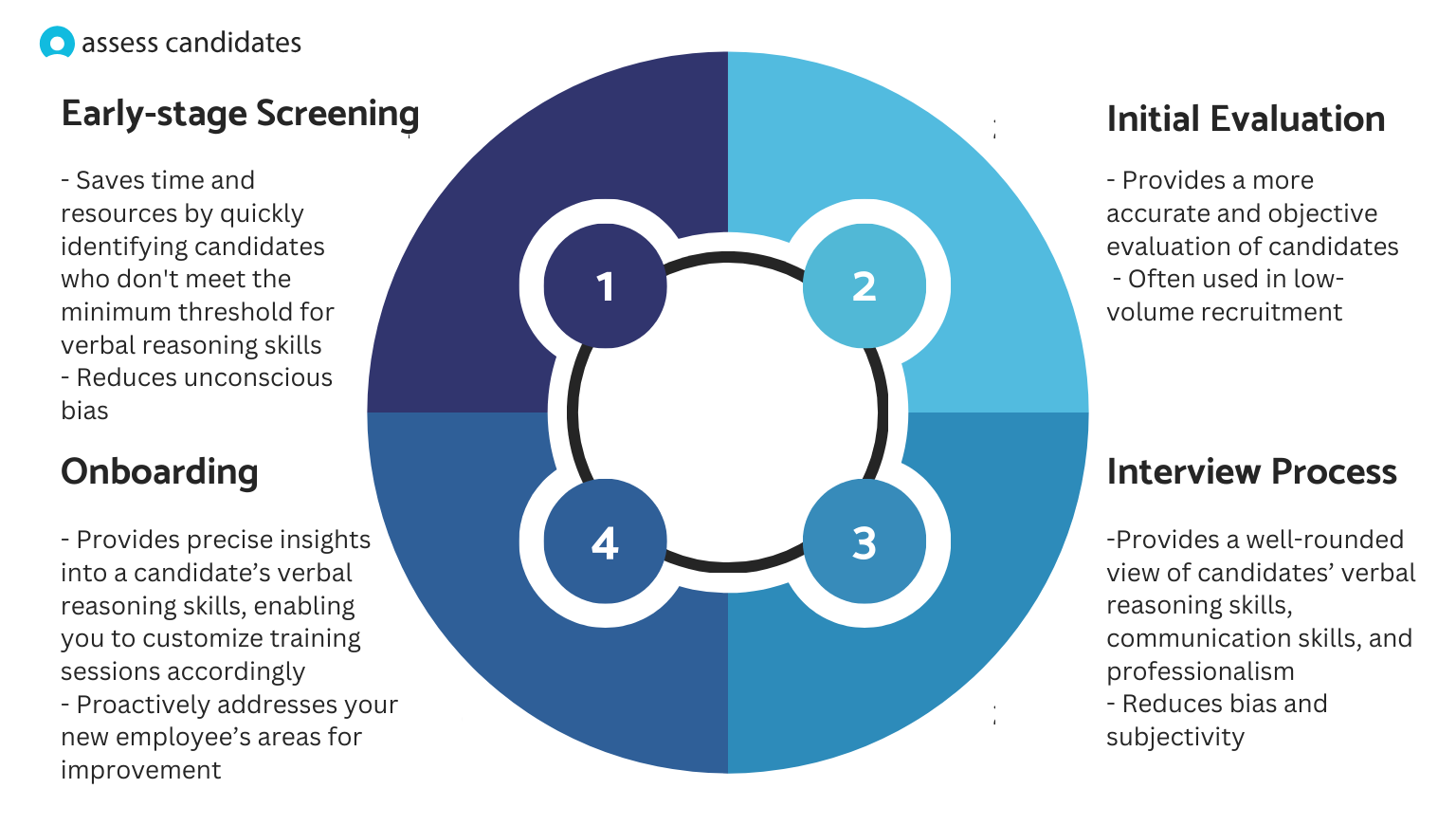
In the following section, we will explore the best practices for including a verbal assessment in your recruitment process.
6. Best practices for integrating verbal tests into your recruitment strategy
Pre-hire verbal reasoning tests can add significant value to a hiring process, but their impact depends on how you use them. Applying best practices ensures the tests remain fair, relevant, and effective in identifying candidates with the right skills for the role.

Define the Role Requirements Clearly
Conduct a job analysis to pinpoint the tasks and skills that are the most essential for the role. Match these requirements to the skills a verbal reasoning test measures, such as comprehension, critical thinking, and reasoning.
Adjust test difficulty and timing to the role’s seniority. Avoid generic tests and design tailored blueprints for each job family.
Combine with Other Assessments
Strengthen your hiring process by pairing verbal reasoning with numerical or logical reasoning tests, situational judgment tests, or structured interviews. This blended approach boosts predictive validity and reduces false results.
Plan weightings and sequence in advance, for example, screen with verbal and numerical reasoning first, then follow with interviews for top scorers.
Set Fair and Realistic Cut-off Scores
Establish cut-off scores with data from pilot tests, benchmarks, or proven standard-setting methods. Replace rigid thresholds with score bands such as “pass,” “strong,” and “exceptional” to manage borderline cases more effectively.
Revisit cut-off scores regularly and allow retests when necessary to maintain fairness.
Ensure Accessibility and Fairness
Provide candidates with practice questions and clear instructions before the test. Write questions in simple, job-relevant language and avoid culture-specific references or obscure vocabulary.
Support non-native speakers by focusing on reasoning instead of advanced language fluency. Offer reasonable accommodations such as extended time or screen-reader compatibility. Always ensure the test works smoothly on both desktop and mobile devices.
Monitor Test Security
Select pre-employment assessment platforms, such as Assess Candidates, with strong security features like randomized questions, restricted test windows, anti-tab switching, and identity verification. Refresh question banks frequently and apply proctoring when roles demand high security.
Track unusual behavior, such as inconsistent device use or abnormal response times, and investigate fairly. Balance integrity with user comfort to avoid creating a poor candidate experience.
Communicate with Candidates
Set expectations by explaining the purpose, length, format, and deadline of the test. Provide a practice link and technical requirements in advance. Keep candidates informed about next steps and timelines after they complete the test.
When possible, share constructive feedback. Clear communication reduces anxiety and improves completion rates.
Now that you have the top tips and proven strategies to implement a verbal reasoning assessment in your recruitment process, let’s take a look at the key industries and roles that should use verbal reasoning tests for hiring.
7. Which industries and roles should use verbal reasoning tests for hiring?
Verbal reasoning assessments evaluate a candidate’s ability to understand, interpret, and draw conclusions from written information. These skills are particularly crucial in industries and roles where strong communication, critical thinking, and decision-making are key.
Industries that use verbal reasoning tests for recruitment
The following are the top 5 industries that use verbal tests as a part of their recruitment process:
- Finance and Banking
Banks and financial institutions use verbal reasoning tests to evaluate candidates’ ability to read financial reports, contracts, and compliance documents under time pressure. These tests ensure accuracy and reduce risk.
Leading employers, including HSBC, Goldman Sachs and Morgan Stanley, incorporate verbal aptitude tests into their hiring processes.
- Law
Law firms administer verbal reasoning assessments to identify candidates who can interpret legal documents, evaluate clauses, and detect inconsistencies in arguments. They need employees who can make precise decisions from dense legal texts.
Top law firms such as Freshfields Bruckhaus Deringer, DLA Piper, and Dentons use verbal assessments to screen candidates.
- Consulting
Consulting firms use online verbal reasoning tests to measure how well candidates analyze reports, extract insights, and provide logical recommendations. This ensures consultants can solve client problems using only the data provided.
Some leading consulting firms, including Deloitte, KPMG, and McKinsey & Company, rely on verbal reasoning tests for graduate recruitment.
- Healthcare and Pharmaceuticals
Pharmaceutical companies and healthcare organizations use verbal tests to ensure candidates accurately interpret medical research, patient data, and regulatory documents. This minimizes compliance errors and supports patient safety.
Top companies like GlaxoSmithKline (GSK) and Pfizer include verbal reasoning tests in their pre-employment hiring process.
- Public Sector
Government agencies use verbal assessment tests to select candidates who can analyze policy documents, interpret regulations, and make informed decisions based on written instructions. This ensures clarity and fairness in decision-making.
The UK Civil Service and the European Union institutions integrate verbal reasoning tests into their competitive entry exams.
Roles that use verbal reasoning tests for hiring
- Graduate Analyst
- Investment Banker
- Financial Auditor
- Management Consultant
- Paralegal
- Lawyer
- Teacher/Lecturer
- Civil Servant
- Marketing Manager
- Brand Manager
- Human Resources Officer
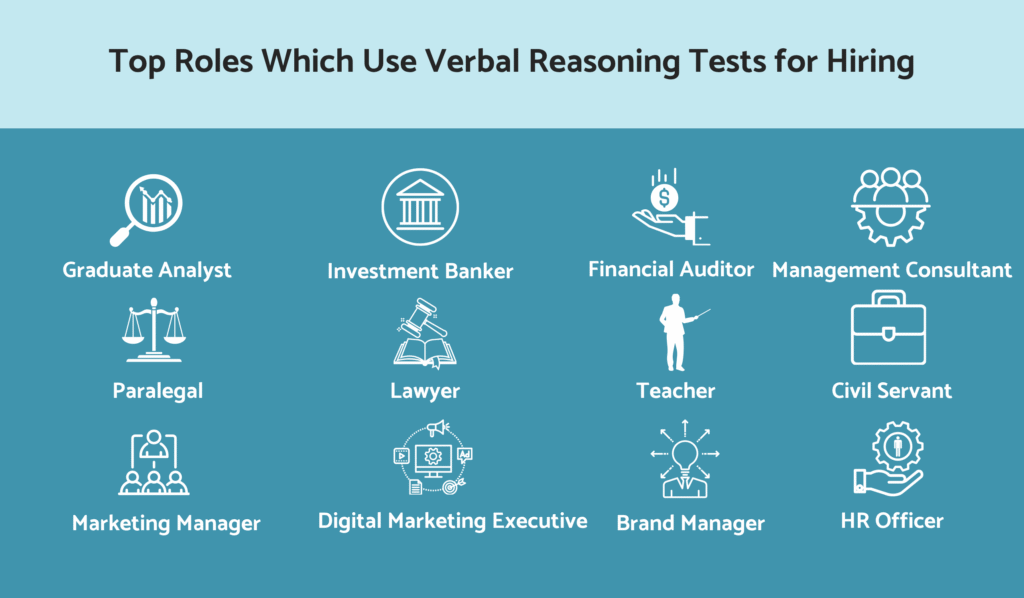
Let’s take a look at the leading employers who include verbal reasoning testing tools in their pre-employment recruitment process.
Which employers use verbal reasoning tests for hiring?
For years, global companies have used verbal tests to evaluate candidates’ comprehension and communication skills. Today, many SMEs and startups are also integrating these assessments into their hiring processes. By doing so, they gain a fairer, more consistent, and objective way to select talent.
Here are some well-known companies that use verbal assessments:
- Deloitte
- PwC
- EY
- KPMG
- HSBC
- Accenture
- Unilever
- Goldman Sachs
- Morgan Stanley
- Amazon
- Barclays
Discover how our talent assessment platform will help you identify top talent. LEARN MORE
8. Verbal Reasoning Tests: Client Application Story
Client Problem Statement
Imagine a leading financial services firm is facing difficulties in hiring for financial analyst and client advisory roles. While the company attracts strong applicant numbers, its current recruitment process does not effectively measure candidates’ ability to interpret complex information or communicate it clearly to clients. This gap results in poor hiring decisions, higher training costs, and dissatisfaction among HR teams and senior management.
The firm requires a more reliable assessment method to evaluate candidates’ verbal comprehension, reasoning, and communication skills to ensure success in client-facing and analytical positions.
Assess Candidates Proposal
At Assess Candidates, we recommend that this financial services firm introduce a verbal reasoning test at the initial stage of the recruitment process. The assessment evaluates candidates’ ability to understand, analyze, and interpret written data, as well as their communication and problem-solving skills.
These are critical for roles where clear reasoning and effective client interaction are essential. Results from the test would help recruiters efficiently filter applicants and shortlist the strongest candidates for further evaluation.
Result
By embedding verbal reasoning tests into their recruitment process, the firm can better identify top-performing candidates with the communication and critical thinking abilities required for analyst and advisory roles. This structured approach improves the quality of hires, reduces onboarding and training costs, and enhances client satisfaction.
Ultimately, the company strengthens its workforce, enabling teams to deliver more accurate insights and superior service, while ensuring long-term performance and growth.
Partner with Assess Candidates for scientifically validated verbal reasoning tests. VIEW PLANS
9. Why top companies choose Assess Candidates’ verbal reasoning tests to hire
At Assess Candidates, we offer a wide range of pre-employment aptitude tests, including verbal reasoning, and create recruitment campaigns customized to each organization’s unique hiring needs.
Here is an example of our campaign reporting dashboard available on Assess Candidates.
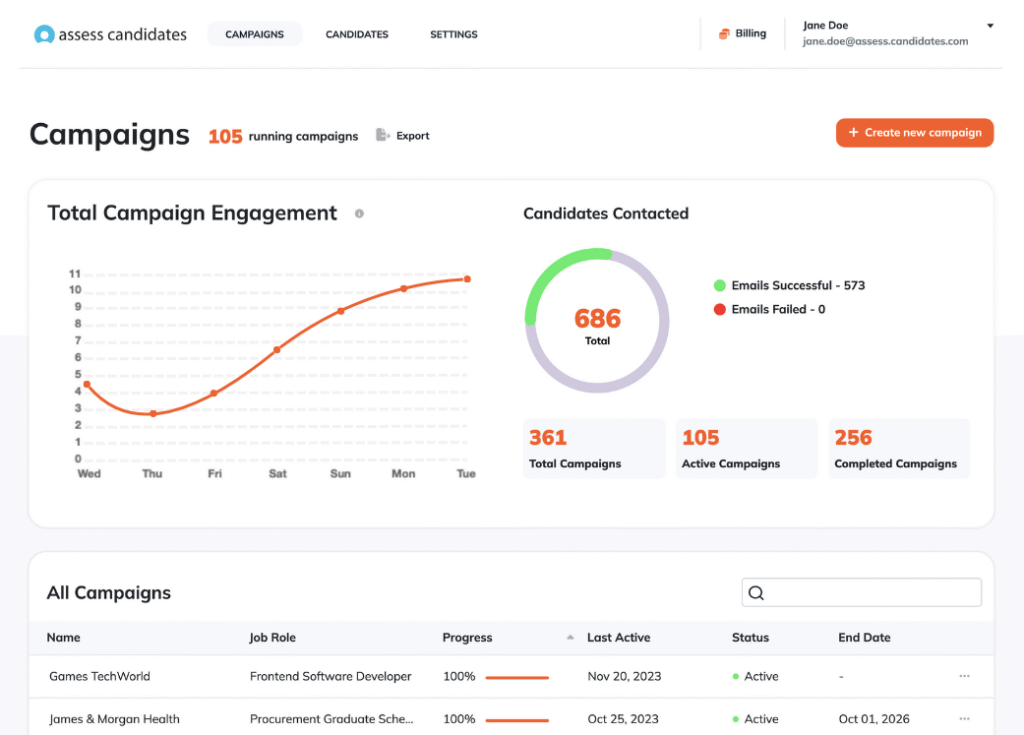
Here are the top 4 reasons why you should use Assess Candidates’ verbal reasoning assessments for your pre-employment hiring process:
- Design Scientifically Validated by Expert Psychologists: Assess Candidates’ verbal reasoning tests are created by Chartered Scientists, Psychologists, and Psychometricians with decades of expertise in developing assessments for leading companies like SHL, IBM Kenexa. Rigorously tested and validated, these assessments reliably measure candidates’ verbal reasoning skills and have consistently helped organizations across industries identify and hire top-performing talent.
- Expert Reporting: Our intuitive platform allows employers to easily analyze candidate reports and make informed hiring decisions. Recruiters can review individual results, filter, rank, and shortlist candidates with ease. For added convenience, the talent assessment platform integrates seamlessly with your existing ATS, ensuring a smooth hiring workflow.
- Positive Candidate Experience: The verbal assessment is accessible on any device and features a clear, user-friendly interface. Candidates receive straightforward instructions, minimal clicks are required, and questions progress automatically once answered. Tests can also be branded to reflect your organization, leaving candidates with a seamless and positive experience that strengthens your employer brand
- Candidate Accessibility Support: We prioritize inclusivity by offering features such as extra time allowances, zoom functionality, accessible color schemes, and screen reader compatibility, all compliant with WCAG standards. This ensures candidates with disabilities or visual impairments can participate fairly.
Assess Candidates is a trusted provider of pre-employment aptitude tests, delivering end-to-end solutions for employers of all sizes. Explore our verbal reasoning tests today and start hiring the best-fit candidates with confidence.
Answers to the above example questions:
- True, False, Cannot Say: False
- Spelling and Grammar Tests: C
- Vocabulary Tests: B
- Word Analogy Tests: A
- Critical Reasoning Tests: A
- Reading Comprehension Tests: C
Assess Candidates’ Verbal Reasoning Test Example Question: False
Interested in learning more about effective candidate assessment? Continue reading for frequently asked questions, and sign up with your email to get started.
Frequently Asked Questions
Are verbal reasoning tests suitable for SMEs and startups?
Yes, SMEs and startups gain just as much value from verbal reasoning tests as large corporations. These assessments give smaller organizations a structured, cost-effective way to spot high-quality candidates. By basing hiring decisions on objective data instead of intuition, employers improve long-term performance, lower turnover, and build stronger, more reliable teams.
How do verbal reasoning tests improve hiring accuracy?
Verbal reasoning aptitude tests offer employers standardized insights into candidates’ comprehension and communication skills. Unlike resumes or interviews that may be influenced by bias, these assessments measure abilities objectively. By evaluating candidates against consistent benchmarks, employers minimize the risk of mis-hires, ensure fairer decisions, and enhance the overall accuracy and reliability of their hiring process.
How long does a verbal reasoning test usually take?
Most verbal reasoning tests take candidates 10 to 20 minutes to complete. Employers use this short, focused format to evaluate skills without disrupting the hiring timeline. A verbal test quickly reveals how well candidates understand and analyze written information, allowing recruiters to gain meaningful insights while keeping the process efficient and streamlined.
Can verbal reasoning tests be customized for specific roles?
Yes, employers can customize verbal reasoning tests to reflect the language skills the specific role requires. They select appropriate question types, complexity levels, and formats to match industry or job needs. This tailoring ensures candidates face challenges similar to real workplace tasks, which makes the assessment more relevant and predictive of performance.
How to interpret verbal reasoning test results?
Employers interpret results using detailed verbal reasoning test reports that highlight scores, rankings, and strengths. They compare candidates against benchmarks and identify top performers quickly. Recruiters then filter, shortlist, and advance candidates based on data-driven insights. This process allows organizations to replace guesswork with objective evidence, making hiring decisions more accurate and reliable.


 English
  Arabic