
Pre-Screening Interviews: What They Are and How to Use Them Effectively?



Pre-screen interview questions are a key tool to make hiring more efficient and effective. According to a study by Aberdeen Group, organizations that use pre-hire assessments, including pre-screen interviews, report 39% higher recruiter satisfaction with their decisions.
An effective pre-screening interview process not only helps employers cut total time and costs by filtering out candidates who don’t meet the basic role requirements, but also makes the hiring process more engaging, especially when combined with other pre-employment assessments.
By eliminating unqualified applications early on, you can focus your resource-intensive hiring stages, such as online assessments, assessment centers, and panel interviews, on shortlisted candidates who are most likely to succeed in the role.
78% of applicants, in a survey by Checkster, admit to misrepresenting themselves on their resumes, highlighting the need for streamlined pre-screening interview tools to verify candidate information.
Therefore, companies globally are updating and modernizing their recruitment strategy, integrating the latest technology like blockchain-based verification and AI-powered video interviews into their pre-screening processes.
So, how do you select the most effective preliminary interview questions for the best long-term results? What should you consider before finalizing them, and how can you ensure they’re both effective and legally sound?
In this latest guide, we will answer these key questions and more, including:
- What is a preliminary interview in hiring?
- How do questionnaire-based screening methods work?
- What are the best types of pre-screen interview questions to ask?
- What common challenges should you avoid?
- What areas can pre-screening interview questions cover effectively?
Whether you are a recruiter, hiring manager, or talent acquisition expert, here we will provide examples, insights, and strategies so you can design pre-screening interviews that ensure efficient hiring decisions and long-term organizational success.
Contents
- What are pre-screen interviews?
- What is the importance of asking the right pre-screen questions in hiring?
- What are the different types of pre-screen interview questions?
- What are some common challenges with pre-screen interviews?
- Best practices and common mistakes to avoid with pre-screening interviews
- Why do top companies prefer Assess Candidates’ pre-screening video interviews?
So, without further ado, let’s get started by defining what pre-screen interviews are in the hiring process.
1. What are pre-screen interviews?
Pre-screen interviews are short, focused conversations, typically lasting 15-30 minutes, that hiring managers conduct early in the hiring process, after initial application and CV screening. They can be over the phone, via live video or as pre-recorded video interviews, and are designed for basic candidate job and culture-fit evaluation.

Preliminary screening interviews allow employers to quickly assess whether a candidate meets the minimum qualifications and aligns with the company culture before investing in more resource-intensive stages like skills assessments, assessment centers, or final interviews. This style of interview saves valuable time and resources and keeps the process focused on the highest quality candidates.
Boost your hiring efficiency with scientifically validated pre-screening interviews and assessments. HIRE FOR FREE
So, what are some types of pre-screen interviews? Discover below.
What are the different types of pre-screen interviews?
Here are the 4 key types of pre-screen interviews recruiters use for a candidate’s preliminary evaluation:
1. Telephone Interview
Telephone interviews are a straightforward, convenient, and cost-effective pre-screening tool. They help recruiters to quickly verify a candidate’s stated skills and experience verbally whilst determining their confidence, communication, and enthusiasm for the job. However, since phone interviews are audio-only, they offer limited insights into a candidate’s non-verbal behavior, particularly body language, thereby limiting its validity to assess professionalism and engagement.
2. Video Screening Interview
Video screening interviews help evaluate both verbal and non-verbal behavior. They are standardized and conducted in either real-time or with one-way video screening technology:
- One-way (Pre-recorded) Video Screening Interviews: Candidates share answers to pre-recorded video interview questions which recruiters or HR professionals review at their convenience. This format makes the hiring process more accessible across geographical areas and time zones; however, weak internet connections and technical issues may impact the quality of the audio and video.
- Two-way Screening Interviews: Conducted in real-time via online video conferencing, these interviews help recruiters evaluate candidates on their demonstrated skills and experience, while candidates can determine their own fit for the role and organization. These offer both parties dynamic interaction, the opportunity to ask follow-up questions and clarify doubts. While more engaging than one-way video interviews, they also present similar challenges including accessibility and connectivity issues and scheduling difficulties across time zones.
As per a study by Zirtual, around 44% of companies now conduct remote job interviews, reflecting a shift towards virtual pre-screening methods in modern recruitment.

3. Questionnaire Screening Interview
Questionnaire screening interviews are standardized, automated hiring tools that allow recruiters to quickly filter candidates early, especially in high-volume recruitment. Candidates either answer specific written questions manually or respond to an AI chatbot, evaluating their qualifications, skills, and cultural alignment at scale.
However, like telephonic screening methods, questionnaires lack the ability to capture candidates’ level of confidence, professional demeanor, and how honestly they have answered the questions. These are more easily observed through video interactions.
4. Technical Screening Interview
Technical screening interviews focus on technical questions, assessing job-relevant practical skills and role-specific knowledge. Recruiters may ask candidates to solve technical problems, explain industry concepts, or discuss their most recent projects and the key learnings. These screening interviews are usually conducted in combination with skill assessment interviews, either via phone or video.
So, how is a pre-screen interview different from later-stage job interviews? Keep reading to find out!
How are pre-screening interviews different from interviews?
Pre-screen interviews are brief, direct conversations that help recruiters verify whether candidates meet the role’s minimum qualifications, including essential skills, relevant experience, and availability. Unlike later-stage interviews, preliminary interview questions tend to be more informational and motivational than situational or behavioral, though recruiters may also touch on basic skills and work experience as an initial evaluation.
In contrast, later-stage, standard interviews aim to provide a comprehensive evaluation of the candidate’s suitability for the job. These interview questions focus on in-depth candidate assessment through competency-based, strength-based, and culture-fit questions, often accompanied by practical exercises or job simulations, to gauge both capability and long-term potential.
Next up: let’s discuss the importance of preliminary screening interview questions in hiring.

2. What is the importance of asking the right pre-screen questions in hiring?
Asking the right pre-screen interview questions is an effective way to identify top candidates quickly, accurately, and cost-effectively, while ensuring fair hiring practices by reducing bias and maintaining legal compliance.
What are the benefits of pre-screening interviews and questions?

- Saves Time and Resources
Pre-screening interview questions help recruiters filter out unqualified candidates early, saving time and resources that would otherwise be spent on final interviewing unsuitable applicants. It quickly narrows down the talent pool to those who meet the basic qualifications and align with company culture.
- Improves the Quality of Hire
Effective pre-screening questions can accurately assess essential skills, experience, and cultural fit, ensuring that only high-potential candidates proceed to the next stage. This leads to better informed hiring decisions, stronger candidate alignment with role expectations, higher quality of hire, and reduced turnover rates.
- Identifies Deal Breakers Early
Preliminary interview questions help identify and address non-negotiable factors, such as availability, salary expectations, location preferences, and work schedule, thus preventing last-minute surprises and negotiation failures as candidates are already aligned with role requirements and organizational needs.
- Ensures Legal Compliance
Well-structured pre-screening interviews help organizations stay legally compliant by avoiding discriminatory or invasive questions. This minimizes legal risks and promotes fair hiring practices.
- Enhances Candidate Experience
A streamlined pre-screening process, especially with video interview questions, provides candidates with clarity about the role and expectations of the company and work environment. It helps build a positive employer brand by showing respect for the candidate’s time and effort and promotes a positive candidate experience.
- Assesses Communication and Interpersonal Skills
Preliminary screening questions allow recruiters to gauge a candidate’s essential soft skills, such as confidence, communication, professionalism, and interpersonal abilities, which are essential for many roles, especially in client-facing positions.
- Reduces Mis-hires
Pre-screen interviews help accurately determine a candidate’s basic qualifications, experience, and cultural fit early, thereby reducing the likelihood of mis-hires, which can be costly for an organization.
- Streamlines Decision-making
Standardized pre-screening questions ensure consistent evaluation criteria, making it easier to compare candidates objectively, form a consensus amongst decision-makers, and make informed hiring decisions.
- Reduces Hiring Bias
Pre-screen interview questions evaluate candidates using a standardized set of criteria, rather than relying solely on resumes for shortlisting which can be manipulated and unreliable. Additionally, one-way video interview methods have blind scoring, meaning evaluators can assess responses without seeing the candidate’s identity, thus further reducing unconscious bias.
Boost your preliminary interview screening with our video interview tool. LEARN MORE
Now, we have explored the benefits of pre-screen interviews, let’s look at the different types of questions you can ask.
3. What are the different types of pre-screen interview questions?
The types of pre-screen interview questions you choose will depend on the role, seniority level, and the skills required. These questions can be incorporated as phone, questionnaire-based, or video interview questions, allowing recruiters to evaluate candidates both verbally and non-verbally before moving them to more technical stages.
7 key areas pre-screening questions focus on

- Legality and Availability: These screening questions allow recruiters to verify whether candidates are available and legally allowed to work in the country. For example, determining whether a candidate requires visa sponsorship (e.g., a H-1B visa) can prevent later-stage disqualifications and avoid mis-hires.
Example legality and availability pre-screen interview questions:
- “Are you open to remote work, hybrid work, or working on-site as required by the role?”
- “This role requires you to be authorized to work in the US. Are you legally allowed to work here?”
How they help? If an international HR candidate needs visa sponsorship and has a 3-month notice period, which the company can’t offer due to budget constraints, they can be filtered out early to narrow down the talent pool.
- Language Skills: Language-based pre-screening gauges a candidate’s proficiency in written and verbal business communication, especially crucial for client-facing roles in sales and HR.
Example language skills pre-screening questions:
- “How comfortable are you with communicating in English?”
- “How do you handle language barriers in a multicultural team?”
How they help? If a sales candidate is fluent in written English but lacks verbal communication skills, you can filter them out to avoid poor client relationships.
- Technical Skills: Technical interview questions evaluate a candidate’s ability to perform role-specific, technical tasks and their familiarity with relevant tools and softwares (e.g., Python knowledge).
Example technical screening interview questions:
- “What important skills do you think are most important for this job role and why?”
- “Which AI tools do you have experience working with?”
How they help? If a data analyst lacks sufficient experience in data visualization software like Power BI, pre-screening questions offer insight into the candidate’s ability to handle the role effectively and prevent wasted time.
- Basic Educational Qualifications: These questions verify the candidate’s educational qualifications, degrees, and certifications mentioned in their CVs.
Example educational pre-screen questions:
- “Why did you choose to study for this degree?”
- “What was your favorite course or subject, and why?”
How they help? If an accountant applicant doesn’t hold an ACCA certification, we recommend filtering them out early to avoid the risk of any legal and compliance issues.
- Soft Skills: Brief situational or judgment-based pre-screen questions assess soft skills like collaborative skills, problem-solving, creativity, and decision-making.
Example soft skills pre-screening interview questions:
- “If you have two tasks with similar deadlines, which one will you prioritize and why?”
- “How do you handle difficult colleagues or clients?”
How they help?: If a leadership candidate lacks empathy and has poor active listening skills, hiring them will likely be a mis-hire and negatively affect team cohesion and performance.
- Motivation and Culture Fit: These questions explore a candidate’s enthusiasm and expectations for the role, and their alignment with the company’s values and culture.
Example motivational and culture-fit screening questions:
- “What excites you about this position, and how does it align with your career goals?”
- “Which of our core values relates to you the most?”
How they help?: If a financial analyst is driven more by salary than the company’s mission and core values, the recruiter will likely filter them out to avoid high turnover rates and disengagement.
- Achievements and Impact: Framing your pre-screening questions to encourage candidates to discuss their achievements and the impact of their work, reveals their self-esteem, self-awareness, and ability to deliver results.
Example achievement and impact-based pre-screen interview questions:
- “Can you describe a project where your contribution significantly impacted the outcome?”
- “What accomplishment are you most proud of in your career so far?”
How they help? If a retail associate candidate fails to demonstrate clear examples of boosting sales and handling high-pressure customer situations during a pre-screening interview, this can signal a lack of impact and accountability.
Pair your pre-screen interviews with our pre-employment assessments to validate skills and competencies. HIRE FOR FREE
Do recruiters face challenges when using pre-screening interview questions? Let’s find out below.
4. What are some common challenges with pre-screen interviews?
While pre-screen interviews can be a powerful asset for an organization to help quickly filter unqualified candidates early on, they also have a few disadvantages.
Here are the common challenges recruiters face with pre-screening interviews:
- Limited Time: Short pre-screening interviews can’t comprehensively capture a full picture of a candidate’s skills and competencies – and they shouldn’t try to.
- Lack of Objective Evaluation: Preliminary interview questions can be unstandardized and unreliable as they rely on subjective impressions over objective measurable competency criteria.
- Low Candidate Experience: Pre-screen interviews can be one-way, providing little opportunity for the candidates to ask questions and know more about the job and development opportunities.
- Unintentional Discrimination: Even well-meaning questions such as “Will your condition affect attendance?” or “Do you need time off for religious holidays?” can be discriminatory.
- Accommodation-related Misunderstanding: The recruiter may not be able to gauge what could be a reasonable or permissible accommodation for the candidate for the job without further discussion.
- Over-reliance on Resumes: Pre-screen interview questions are used by recruiters to verbally verify stated skills and competencies, which is not always reliable, as candidates may exaggerate their abilities.
- Cultural Sensitivity Issues: A neutral question in one culture can be offensive in another, requiring careful wording and review.
- Local Anti-discriminatory Regulations: Anti-discrimination laws differ by region, making it complex for global companies to standardize pre-screen questions globally for multinational hiring.
- Limited Non-verbal Communication: Most organizations pre-screen candidates via phone or one-way video interview, which risks misinterpretation of tone, body language, and engagement.
- Potential to Miss Top Talent: Poorly designed questions, overly rigid criteria, or biased phrasing can unintentionally eliminate high-potential candidates.
At Assess Candidates, we always recommend pairing pre-screening interviews with validated assessments for holistic and objective hiring. Unsure how to foolproof your recruitment process with a reliable assessment strategy? Contact us, and we will be happy to help you come up with the best hiring solutions!
Still interested in designing your own pre-screening questions? Let’s dive into what you should consider beforehand.
5. Best practices and common mistakes to avoid with pre-screening interviews
As an HR professional, it is essential you ensure your recruitment process is efficient and effective – starting with the pre-screening interview stage. To achieve this, you need to design questions that are legally compliant, culturally sensitive, and job-relevant, while avoiding common pitfalls that could slow hiring or create bias.
9 best practices for framing your pre-screening interview questions – and the mistakes to avoid

1. Comply with Anti-discrimination Laws
Ensure your pre-screen interview questions comply with local and international anti-discriminatory laws. Don’t ask anything related to race, gender, age, religion, sexual orientation, or any other protected characteristics to avoid legal trouble on top of losing out on potential talent.
Collaborate with legal counsel to ensure your pre-screen templates comply with laws, such as US Equal Employment Opportunity (EEO) laws. and the UK Equality Act.
Questions to avoid:
- Do you have children?
- Do you need time off for religious holidays?
2. Be Culturally Sensitive
Ensure your preliminary screening questions are free from interviewer bias and promote diversity and inclusion practices. Strategize with the right interviewing expert advice to ensure your hiring process is bias-free.
Create a standardized preset of job-relavant questions, ensuring consistency and fairness. Conduct regular training for recruiters and hiring managers on unconscious bias and legal compliance, and ensure their alignment with the company’s DEI standards.
Questions to avoid:
- What is your native language?
- What is your take on the latest US elections?
3. Avoid Discrimination on the Grounds of Disability
Frame pre-screen questions around the candidate’s ability to perform the job duties, with or without reasonable accommodation, rather than the disability itself.
Train recruiters on disability etiquette and disability inclusion practices as per Americans with Disabilities Act (ADA) or Equality Act 2010 (UK) requirements, and guide accommodations in line with legal compliance.
Screening questions to avoid:
- Does anyone in your family also have a disability?
- Do you have any chronic illnesses?
4. Respect The Candidate’s Right to Privacy
Focus pre-screening questions only on the role and company culture, and respect the candidate’s privacy and personal life. Avoid topics such as marital status, family life, social media activity, and politics unless directly tied to the job.
Train recruiters on asking role-relevant questions and data privacy regulations, such as GDPR. Use third-party tools that can anonymize protected information when conducting background checks.
Pre-screen interview questions to avoid:
- Do you own or rent your home?
- What social media platforms do you use?
5. Address The Non-negotiables Early
Be upfront about the non-negotiable early in your preliminary interview, such as salary range, work location, hours, and benefits, even if it’s mentioned in the job description. This helps save both the candidate’s and your time.
Ask targeted job-relevant questions about the candidate’s background, skills, and experience relevant to the job.
Pre-screen questions to avoid:
- How long would it take you to commute?
- Are you planning to take a long vacation soon?
6. Be Clear and Concise
Keep pre-screen questions short, focused, and easy to understand. Use open-ended prompts to ensure candidates elaborate on their skills using the STAR technique, drawing on specific past work experiences and learning.
Pre-screen questions to avoid:
- Can you effectively handle work pressure?
Instead ask:
- “Can you provide an example of how you managed tight deadlines in your previous role?”
7. Avoid Overly Complex and Leading Questions
Minimize overly complex and leading questions in your pre-screening process. Stay neutral. Avoid hinting at the “desired” answer or tacking on confirmation tags like “right?” or “isn’t it?” and don’t ask too many questions.
Questions to avoid:
- “You’re good at problem-solving, right?”
- You’re okay with the mentioned starting salary for this entry-level role, right?
Instead ask:
- “Can you share an example of a challenging project you recently worked on and how did you approach it?”
8. Use Technical Screening Questions
For technical roles, adapt your pre-screening questions to test proficiency and practical application. Avoid yes/no confirmation questions and encourage candidates to elaborate on their technical knowledge.
Questions to avoid:
- You’re comfortable with C++, right? That’s what we mostly use.
Instead ask:
- “Can you explain your experience with C++ and how you used it in past projects?”
9. Ask for Consent
Before conducting pre-screening interviews, especially with AI-based pre-recorded interviews, clearly explain the process, the purpose of the interview, how data will be used, and secure written consent in line with country-specific data protection laws like GDPR, CCPA (California).
Anti-ethical interviewing practices to avoid:
- Recording the interview session without informing the candidate.
- Doesn’t inform the candidate on how their data will be used, stored, and shared.
Boost your pre-interview screening with our compliant, reliable candidate assessment platform. VIEW PLANS
Here’s where our role comes. Explore why leading companies are using our pre-screen assessment tools and video interviews.
6. Why do top companies prefer Assess Candidates’ pre-screening video interviews?
At Assess Candidates, we specialize in offering a wide range of pre-employment assessments, including our pre-recorded video interview tool. We can also tailor recruitment strategies and tests to meet the unique hiring needs of any organization.
Here is an example of the campaign reporting dashboard that you will come across on the Assess Candidates platform. This user-friendly tool offers hiring managers and HR professionals valuable insights and advanced sorting functions, streamlining candidate assessment and selection.
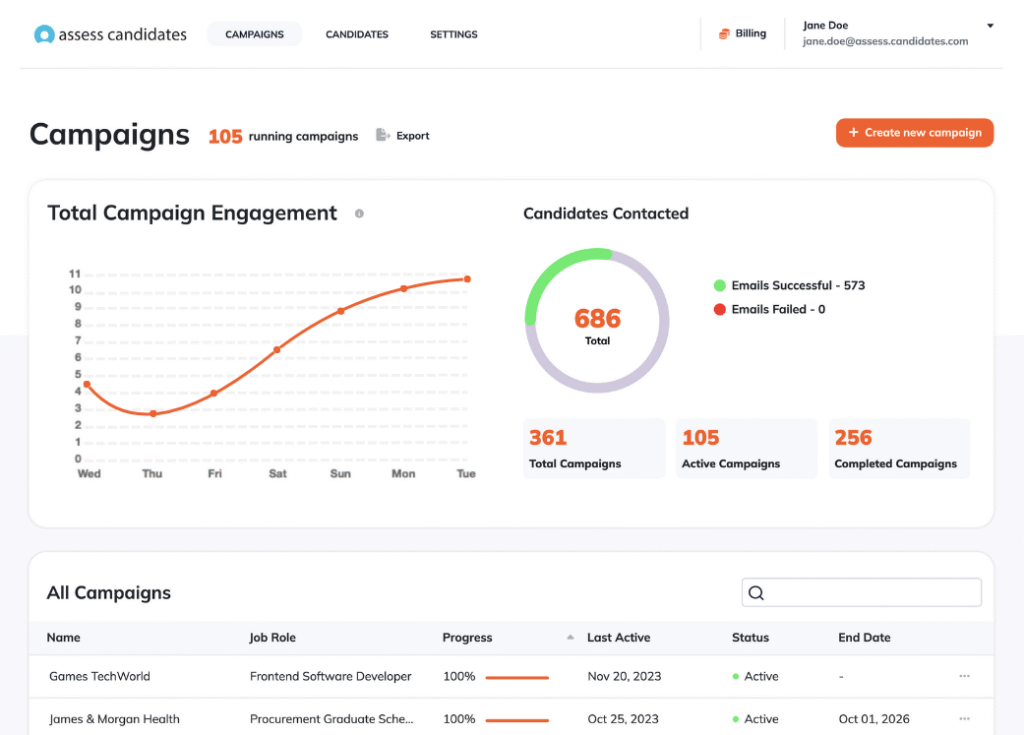
Here are the top 4 reasons why you should use Assess Candidates’ video interview tools for your recruitment process:
- Designed and Scientifically Validated by Expert Psychologists: Assess Candidates’ pre-screening hiring tools are developed by Chartered Scientists, Psychologists, and Psychometricians with decades of experience developing assessment solutions for companies like SHL and IBM Kenexa. Our psychometric and interviewing assessment tools are rigorously tested and validated to measure candidates’ skills across multiple dimensions. These tests have invariably selected and hired top talent across various organizations and industries.
- Expert Reporting: Assess Candidates’ user-friendly and easy-to-navigate assessment platform allows employers to evaluate candidate reports in detail and make informed hiring decisions based on flexible criteria. Recruiters can effortlessly review individual candidates’ performance on multiple assessments and then filter, rank, compare, and shortlist candidates. Moreover, our talent assessment platform also offers the option to integrate with your existing ATS for a seamless recruitment process.
- Positive Candidate Experience: Assess Candidates’ pre-screening video interviews are easily accessible from any device and feature an aesthetic and user-friendly interface for candidates. The assessment instructions are displayed clearly and can be fully customized to match your organization’s needs. All pre-screen interviews also require minimal clicks to complete, with the assessment automatically progressing to the next question once answered. This guarantees a smooth and optimistic candidate experience, enabling a positive association with your brand.
- Candidate Accessibility Support: Assess Candidates offers support for individuals with disabilities and visual impairments. All our pre-screening tools offer options to add extra time, zoom functionalities, and accessible color schemes and images in compliance with Web Content Accessibility Guidelines (WCAG), ensuring compatibility with screen readers.
Assess Candidates is a leading pre-employment recruitment assessment and video interview provider that is proven to offer end-to-end assessment solutions for small, medium, and large employers. With our user-friendly platform, you can confidently and successfully recruit top candidates. Why not discover the top hiring tests and make the right hiring decisions today?
Interested in learning more about effective pre-screening tools and assessments? Continue reading for frequently asked questions, and sign up with your email to get started.
Frequently Asked Questions
How are pre-screen interviews different from standard job interviews?
Pre-screen interviews typically involve straightforward questions that recruiters ask over the telephone or via videos. These questions aim to check candidates’ qualifications, skills, work experience, motivation, salary expectations, and availability for the role. While later-stage interview questions are usually situational, competency-based, or commercial-awareness oriented, and aim to evaluate candidates in-depth on their skills and job fit.
How can I screen candidates early for salary, location, and work preference fit?
You can pre-screen candidates early for their satisfaction with the job offer by conducting a pre-screen interview with questions that gauge their alignment with the job responsibilities, expectations, work culture, company’s values, vision, and job benefits.
How can video interview questions help to evaluate a candidate’s job-related personality?
Pre-recorded video interview questions that evaluate a candidate’s workplace behaviors and alignment with company culture will give you insights into their job-related personality. In addition, situational interview questions can also give insights into their industry-relevant knowledge and decision-making skills.
What pre-screen questions should I ask in the interview to ensure the candidate’s commitment to the role?
Gauge candidate’s potential commitment to the role with pre-screen questions that focus on assessing their job motivation, career goals, job stability record, and availability. In addition, focus on also evaluating their understanding of the role’s demands and company values.
Why is it important to obtain candidate consent before conducting pre-screen interviews?
Obtaining pre-screen interview consent is essential to comply with employment laws and avoid any legal issues related to data privacy. Preliminary interviewing consent questions also help build a candidate’s trust through transparency in the screening process.


 English
  Arabic