
Writing Job Descriptions That Stand Out To Hire The Right Talent



Job descriptions are often a candidate’s first touchpoint with your company and can be the deciding factor in attracting top talent. In fact, according to Digital Cube, companies that invest in a strategic approach to writing job descriptions report 25% more qualified applicants and 23% faster time-to-hire.
In today’s competitive job market, applicants expect clear, transparent, and relevant job postings that accurately reflect the role. Vague or outdated descriptions don’t just slow hiring, they risk poor candidate matches, damaging your employer brand and making it more difficult to differentiate your company from competitors as an employer of choice.
Well-crafted job descriptions, on the other hand, align hiring teams by clearly defining the role’s purpose, responsibilities, requirements, and success metrics. By establishing consistent, measurable criteria, recruiters can objectively assess candidates and make informed hiring decisions. This clarity reduces bias, streamlines evaluation, and supports data-driven hiring that ensures the right fit for both the role and organization.
Did you know? Job descriptions written with gender-neutral, inclusive language receive up to 42% more responses than those using gendered terms (Compono).
Modern job descriptions are increasingly influenced by technology, inclusivity, and behavioral insights. AI-powered tools help refine language, eliminate unconscious bias, and improve visibility in search results, while also ensuring compliance with legal standards and alignment with long-term business goals and strategies.
Whether you are a recruiter, hiring manager, or talent acquisition expert who wants to learn more about job descriptions and their importance, you may find yourself asking:
- Are job descriptions and specifications the same?
- What are the key elements of a strong job description?
- Why are job descriptions essential for any brand?
- How to create good job descriptions?
Keep reading this comprehensive guide to learn what makes a great job description and explore the proven strategies to ensure you write effective ones that attract the right talent, align with your company’s evolving needs, and support fair, consistent hiring decisions.
Contents
- What are job descriptions?
- What are job specifications?
- Why are job descriptions important for recruitment?
- How to craft compelling job descriptions that attract top talent?
- How do well-written job descriptions influence the quality of resumes employers receive?
- What are some examples of job descriptions for different roles?
- Job description: A Success story
- Why do top companies prefer Assess Candidates for hiring?
1. What are job descriptions?
A job description is a formal document that clearly outlines a role’s main duties, responsibilities, purpose, required qualifications and skills, and reporting structure.
For recruiters and hiring managers, job descriptions are essential for attracting candidates; but they also serve as a useful benchmark for performance evaluations. They make it easier to assess whether a new employee is meeting expectations, identify potential areas for development, and ensure alignment with organizational goals.

A well-written job description:
- Sets clear expectations and measurable criteria for employees.
- Guides hiring by attracting qualified candidates and deterring unqualified ones.
- Supports career development through promotions and internal mobility.
- Protects against legal risks by helping avoid discrimination claims.
Improve your hiring process with compelling job descriptions and scientifically validated psychometric tests. HIRE FOR FREE
Now, let’s take a look at the main elements of a typical job description format.
What are the key components of job descriptions?
A strong job description clearly outlines the core details of a role. This helps employers attract the right candidates and enables applicants to quickly assess whether the position aligns with their skills, interests, and career goals.

Here are the 9 main elements of a job description:
- Job Title
The job title is arguably the most important component of a job description. It is often what candidates first see and can help them decide whether to click to learn more about the role. A clear, specific title communicates the position’s level and focus, helping applicants quickly determine if it is relevant to them. Using common, searchable terms also enhances visibility on job boards.
- Job Purpose
A job description is incomplete without a clear and concise job purpose. It defines the role’s primary objective and highlights how it contributes to the organization’s overall success. This statement must immediately capture candidates’ attention and set the tone of the rest of the description to help them understand the position’s impact.
- Job Duties and Responsibilities
This section outlines the core tasks and expectations associated with the role. It explains what the employee regularly does and how their work supports broader organizational goals. By clearly listing specific responsibilities, you give candidates a realistic picture of the job’s scope, level of involvement required, and the expected outcomes.
- Reporting Structure
The reporting structure section clarifies where the role sits within the organization, who the employee will report to, and whether they will be required to supervise others. This helps candidates understand the level of responsibility, the flow of communication, and the team dynamics.
- Essential Qualifications and Work Experience
This section lists the minimum criteria candidates must meet to be considered for the role. This typically includes education, relevant work experience, and skills. These requirements allow applicants to self-assess whether they are a good fit before applying, reducing unqualified applications and streamlining recruitment.
- Preferred Qualifications
The preferred qualifications section highlights the additional skills, experiences, or credentials that would set a candidate apart from others. While not mandatory, these qualifications indicate a higher potential for success and productivity in the role.
- Working Conditions and Culture
Working conditions provide insight into the work environment, location (remote, hybrid, or office-based), working hours, travel requirements, and company culture, mission, and values. This allows potential employees to analyze their cultural fit as well as logistical compatibility with the role upfront.
- Compensation
This section clearly outlines salary ranges and additional financial benefits such as bonuses, incentives, stock options, or commissions, helping to set expectations early for potential candidates. Including transparent compensation details in your job descriptions not only attracts more serious applicants but also reduces negotiations later.
- Growth Opportunities
The growth opportunities section highlights the potential for career progression, skill development, and internal mobility within the organization. It is a signal to candidates that the company invests in its employees’ futures, making the role more attractive to ambitious candidates.
Did you know? In competitive roles, some organizations increase transparency by including details in the job description about the hiring process stages and the performance metrics, such as KPIs or ROI, that will be used to evaluate candidates post-hire. This upfront clarity helps set expectations and attracts candidates who are confident in meeting these standards.
Now that we’ve explored the key components of a job description, let’s take a closer look at what job specifications are.

2. What are job specifications?
A job specification is a detailed document that outlines the qualifications, skills, experience, and personal attributes a candidate must have to succeed in a role. While a job description explains what the job entails, like tasks, responsibilities, and reporting structure, a job specification identifies who is best suited to perform the job effectively.
Now, let’s examine how job descriptions differ from job specifications.
What is the difference between job descriptions and specifications?
Discover how well-crafted job descriptions with smart psychometric tests can elevate hiring outcomes. LEARN MORE
We have covered the basics, you might be wondering: are job descriptions required in a hiring process? The answer is yes, so let’s now take a closer look at why they are important.
3. Why are job descriptions important for recruitment?
Job descriptions do more than list duties, they set the foundation for a successful hiring process and a productive workplace. By clearly communicating responsibilities, qualifications, and expectations, they align employers and employees, guide recruitment decisions, support performance management, and help maintain legal compliance.
In recruitment, a well-crafted job description is a strategic tool for building efficient teams, boosting engagement, and driving long-term success.

The top 5 reasons why job descriptions are important for recruitment
- Clarity and Expectations
Clear job descriptions communicate exactly what a role involves, helping applicants understand their responsibilities and duties from the getgo. Without a well-defined job description, teams risk misunderstandings that can lead to inefficiencies, poor performance, and employees not meeting the company’s expectations.
Did you know? According to ThriveMap, 55% of employees have left a job because it didn’t match what was described during the hiring process.
- Recruitment Efficiency
A precise job description attracts candidates who genuinely fit the role’s requirements and deters unqualified applicants. By detailing necessary skills, experience, and qualifications early on, recruiters streamline the screening process, shorten time-to-hire, and improve the quality of hires.
Did you know? The average time-to-hire in the UK is 4.9 weeks, clear job descriptions can reduce this (StandOut CV).
- Performance Management
Employers use job descriptions as a baseline for performance reviews, assessing employees objectively against predefined responsibilities and goals. They identify strengths, areas for improvement, and training needs, ensuring fair and consistent evaluations.
- Legal Compliance
Well-documented job descriptions help employers comply with labor laws and regulations and avoid discrimination claims by ensuring hiring and promotions are based on transparent, objective criteria.
- Employee Engagement
When employees clearly understand their role, they feel more motivated and valued. Job descriptions help workers see how their contributions align with broader company goals, boosting morale, engagement, and retention.
Enhance your job descriptions with a targeted hiring strategy. HIRE FOR FREE
In the following section, we will learn more about writing job descriptions effectively to attract the best candidates.
4. How to craft compelling job descriptions that attract top talent?
Writing job descriptions effectively is a key marketing tool to attract top talent to your role. By clearly and concisely communicating the job’s purpose, necessary skills, and company culture, you can differentiate your opportunity and quickly connect with the best candidates.
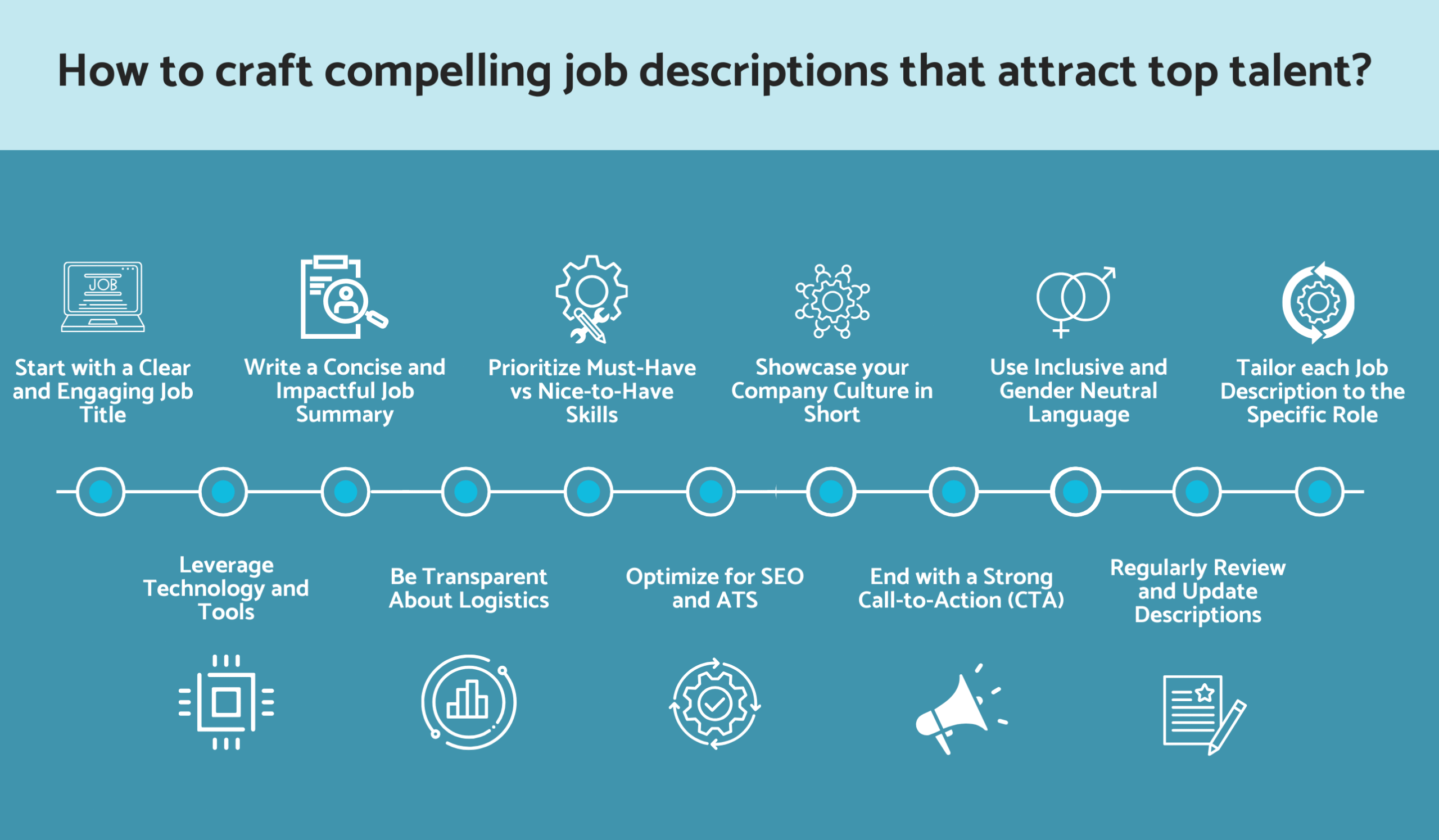
Top strategies for writing job descriptions that stand out
- Start with a Clear and Engaging Job Title
Begin your job description with a clear, straightforward, and engaging job title that accurately reflects the role and matches terms candidates commonly search for. Avoid vague language or internal jargon that could confuse applicants and cause them to abandon the application process.
Did you know? Clear job descriptions can lead to an 84% increase in employee retention rates and higher recruitment success (Compono).
- Write a Concise and Impactful Job Summary
Start the job description with an engaging and concise summary or overview that clearly highlights the role’s purpose, its impact on the business, and what makes the opportunity exciting and unique. Aim to capture interest quickly, as most candidates skim descriptions within 2–3 minutes.
Did you know? According to Online Marketplaces, 40% of candidates read job ads in under 45 seconds.
- Prioritize Must-Have vs Nice-to-Have Skills
Specify clearly the non-negotiable qualifications, education, experience, or certifications needed for the role in the job description. Separate them from optional requirements and avoid listing too many demands, as an overloaded list can discourage strong candidates from applying.
Did you know? Approximately one-third of job seekers skip applying because they lack the listed experience (31%), education (31%), or technical skills (29%) (Indeed).
- Showcase your Company Culture in Short
Briefly describe what it’s like to work at your company, highlighting core values, team spirit, perks, and recent achievements. Keep it short and engaging, as most candidates prefer a quick snapshot over detailed culture descriptions.
Did you know? According to a LinkedIn report, only 28% of candidates want to learn about your company culture in the job description.
- Use Inclusive and Gender Neutral Language
Use inclusive, unbiased language in your job descriptions to appeal to a diverse pool of candidates. Avoid gender-coded or stereotypical terms that may unintentionally exclude qualified applicants from different backgrounds.
Did you know? After viewing a job, men apply 13% more often than women, and the language used in job posts is often the culprit (LinkedIn).
- Tailor each Job Description to the Specific Role
Avoid generic templates and customize details to closely match the job to attract the right candidates. Highlight the unique responsibilities, qualifications, and expectations relevant to that position. For example, emphasize tools, systems, and measurable outcomes in technical roles, while focusing on portfolios, teamwork, and creative freedom in creative positions.
Did you know? According to a report by Nijobs, 65% of job seekers find expectations in job ads unclear.
- Leverage Technology and Tools
Use job description tools or AI platforms like Textio or Ongig to enhance structure, eliminate bias, and optimize keyword usage. These solutions help create inclusive, SEO-friendly, and mobile-optimized job descriptions that attract a wider, more qualified talent pool.
Did you know? According to a Genius report, 30% of companies are using AI to write more accurate and appealing job descriptions.
- Be Transparent About Logistics
Clearly mention salary ranges, benefits, work arrangements (remote, hybrid, or on-site), and opportunities for career growth upfront. Transparency builds trust, sets accurate expectations, and increases your chances of attracting top-tier candidates who value clarity and honesty.
Did you know? 61% of candidates say the salary range is the most important part of the job description (LinkedIn).
- Optimize for SEO and ATS
Include relevant keywords that candidates are likely to use when searching for the role. This improves the job description’s visibility and ranking on job boards and search engines, helping you reach a broader and more targeted audience.
Did you know? According to a LinkedIn report, careers sites that use keywords see a click-through rate (CTR) increase of around 47%.
- End with a Strong Call-to-Action (CTA)
End your job description with a clear, engaging call to action that encourages candidates to apply. Add a human touch by expressing genuine interest to hear from them and outlining the next steps in the hiring process to build a stronger connection.
Did you know? A compelling call to action directly impacts engagement and response rates, boosting clicks by anywhere from 70% to 1600%, depending on its clarity and appeal (Hiring People).
- Regularly Review and Update Descriptions
As roles evolve, job descriptions must keep pace and stay relevant. Review and revise them every 6-12 months or whenever key responsibilities shift to help align job expectations with business goals and candidate needs. Collect feedback from recent hires to assess accuracy, and track performance metrics like drop-off rates and applicant quality to identify areas for improvement.
Did you know? According to a survey by Medium, 43% of respondents said their company’s job descriptions aren’t updated regularly at all.
Boost your hiring process with strong job descriptions and our expert-designed psychometric tests. LEARN MORE
Next up: how well-written job descriptions impact the quality of resumes received.
5. How do well-written job descriptions influence the quality of resumes employers receive?
Well-crafted job descriptions for resume targeting don’t just attract the right candidates, they shape the type and quality of resumes employers get. By clearly defining the role’s responsibilities, qualifications, and expectations, they prompt applicants to tailor their resumes so they directly address the job requirements.
The result: more relevant, high-quality submissions and fewer irrelevant applications.
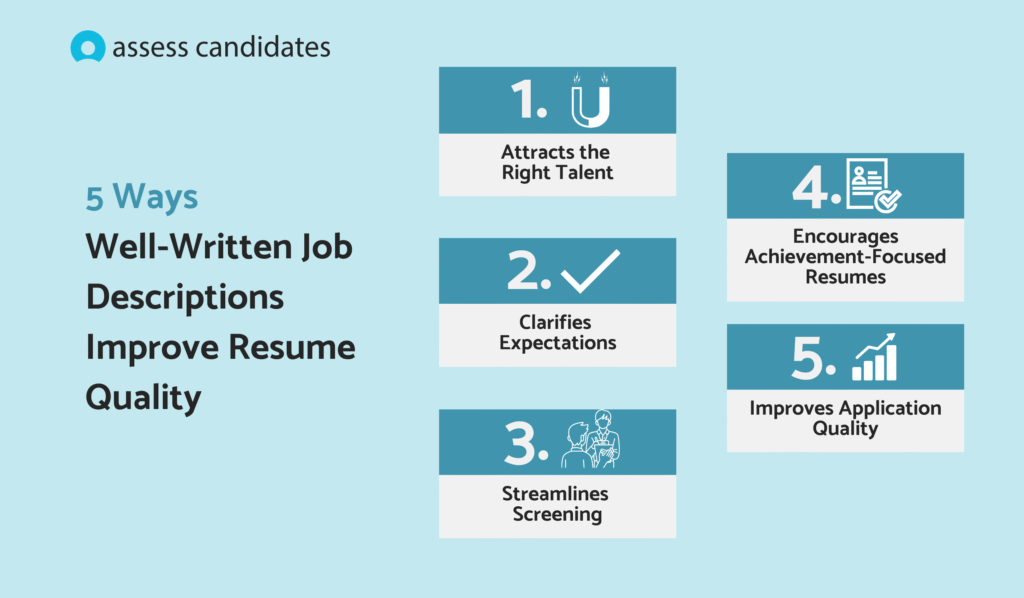
5 ways well-written job descriptions improve resume quality
- Attracts the Right Talent:
Specific, detailed job descriptions draw in candidates who see themselves as a good fit for the role, while discouraging those who are unqualified and not a good match. This self-selection means employers only receive resumes from applicants with genuinely relevant skills and experience.
Did you know? According to a report by Glassdoor, Groupon doubled applicant quality and lowered cost-per-applicant to $13 by enhancing job listings.
- Clarifies Resume Targeting:
When job descriptions use action-oriented language and the required responsibilities, qualifications, and skills are crystal clear, candidates can tailor their resumes accordingly to match. This leads to applications that directly highlight relevant experience, rather than generic career histories.
- Streamlines Screening:
Job descriptions that clearly define role requirements and align with the expected qualifications help hiring managers quickly filter out unsuitable resumes and only focus on the most qualified ones, saving both time and money.
Did you know? A detailed job description, with specific daily duties and technical needs, can reduce resume screening time by up to 40%, while also boosting qualified applications by 35% (Qualified).
- Encourages Achievement-Focused Resumes:
Clear and specific job descriptions motivate candidates to showcase measurable achievements. By aligning their accomplishments with the role’s expectations, candidates tend to apply with impact-focused resumes that help employers easily assess their potential performance.
- Improves Overall Application Quality:
Candidates who apply to well-defined roles tend to be informed, motivated, and aligned with company needs, which raises the overall quality of applicants. This selective approach leads to a stronger, more relevant talent pool and fewer wasted applications.
Hire with our top pre-employment assessments and enhance your hiring process. HIRE FOR FREE
Next, let’s take a look at some job descriptions examples for various roles.
6. What are some examples of job descriptions for different roles?
You must tailor your job descriptions to each role and its unique set of responsibilities and duties, skill requirements, and performance expectations. A well-crafted, role-specific job description not only helps attract the right candidates but also sets clear benchmarks for success within that role.
Below are some examples of job description formats for various roles:
Sample Job Description for IT Specialist
Job Title: IT Specialist
Location: [Your City / Remote / Hybrid]
Job Type: Full-Time
We are in search of a detail-oriented and proactive IT Specialist to join our team. This role will require you to maintain the organization’s technology infrastructure, ensuring system efficiency, and offer technical support to staff. If you are someone who is passionate about problem-solving, cybersecurity, and keeping systems running smoothly, we’d love to hear from you.
Key Responsibilities
- Install, configure, and maintain hardware, software, and network systems.
- Monitor and troubleshoot system performance and network issues.
- Provide technical support and training to employees across departments.
- Maintain system security and ensure data backup and recovery procedures are in place.
- Evaluate and recommend technology solutions for organizational needs.
- Manage user accounts, permissions, and access rights across systems.
- Coordinate with vendors and service providers for tech-related services and support.
- Document IT procedures, incidents, and resolutions.
Required Qualifications
- Bachelor’s degree in Information Technology, Computer Science, or a related field.
- 2+ years of experience in IT support or systems administration.
- Strong knowledge of Windows/Mac OS, networking, and cybersecurity best practices.
- Hands-on experience with system installation, configuration, and analysis.
- Excellent problem-solving and communication skills.
- Ability to manage multiple tasks and priorities in a fast-paced environment.
Preferred Qualifications
- Industry certifications (e.g., CompTIA A+, Network+, Microsoft Certified IT Professional).
- Experience with cloud platforms (e.g., AWS, Azure, Google Cloud).
- Familiarity with help desk and remote support tools.
Perks & Benefits
- Competitive salary and performance bonuses
- Flexible work arrangements (remote/hybrid)
- Health and travel insurance
- Learning and development support
- Paid time off and wellness days
Ready to join our growing team who are obsessed with innovation and continuous improvement? Click “Apply Now” and submit your resume.
Sample Job Description for Administrative Assistant
Job Title: Administrative Assistant
Location: [Your City / Remote / Hybrid]
Job Type: Full-Time
We are on the lookout for a highly organized and proactive Administrative Assistant to support our daily office operations and improve workplace efficiency. The role will require you to handle schedules, communications, organize documents, and assist various departments with administrative tasks.
Key Responsibilities
- Manage calendars, schedule meetings, and coordinate appointments.
- Prepare and edit documents, reports, and presentations.
- Handle incoming calls, emails, and correspondence professionally.
- Maintain organized filing systems (both digital and physical).
- Order office supplies and oversee inventory management.
- Support HR or finance teams with data entry and document processing.
- Greet visitors and provide administrative support during company events or meetings.
- Assist with travel arrangements and expense reporting.
Required Qualifications
- High school diploma or equivalent; associate’s or bachelor’s degree preferred.
- Proven experience in an administrative or office support role (1–2 years).
- Proficiency in Microsoft Office Suite (Word, Excel, Outlook, PowerPoint).
- Strong verbal and written communication skills.
- Excellent time management, multitasking, and organizational skills.
- Ability to handle sensitive information with discretion.
Preferred Qualifications
- Familiarity with office management software or tools (e.g., Google Workspace, Trello, Asana).
- Experience supporting multiple departments or executives.
- Strong attention to detail and a proactive attitude.
Perks & Benefits
- Competitive salary
- Health and wellness benefits
- Paid time off and holidays
- Opportunities for professional development
- Collaborative and supportive work environment
Ready to bring your organizational talents to a dynamic team? Submit your resume through the “Apply Now” button below.
Sample Job Description for Medical Assistant
Job Title: Medical Assistant
Location: [Your City / Clinic / Hospital / Remote for admin roles]
Job Type: Full-Time / Part-Time
We are looking to hire an understanding and detail-oriented Medical Assistant to support our physicians and healthcare professionals in delivering high-quality patient care. This role involves both administrative and clinical tasks, including scheduling appointments, preparing patients for exams, updating medical records, and assisting with procedures.
Key Responsibilities
- Greet and prepare patients for examinations and procedures.
- Measure and record vital signs such as blood pressure, pulse, and temperature.
- Assist physicians during exams and minor procedures.
- Administer medications or injections as directed by a physician (where permitted by law).
- Collect and prepare laboratory specimens or perform basic lab tests.
- Maintain accurate and up-to-date patient records using electronic health record (EHR) systems.
- Schedule patient appointments and manage follow-ups.
- Handle administrative tasks such as answering phones, verifying insurance, and processing billing or payments.
Required Qualifications
- High school diploma or equivalent.
- Completion of a Medical Assistant training program or certification.
- Basic understanding of medical terminology and procedures.
- Proficiency in using electronic health records (EHR) and office software.
- Excellent communication and interpersonal skills.
- Strong attention to detail and ability to multitask in a fast-paced environment.
Preferred Qualifications
- 1–2 years of experience in a clinical setting.
- BLS/CPR certification.
- Familiarity with HIPAA regulations and patient confidentiality standards.
- Experience in both administrative and clinical responsibilities.
Perks & Benefits
- Competitive salary and shift differentials (if applicable)
- Health, dental, and vision insurance
- Paid time off, holidays, and sick leave
- Professional development and continuing education opportunities
- Supportive and team-oriented work environment
Passionate about patient care and want to be part of a reliable healthcare team? Click “Apply Now” to submit your resume.
Want to elevate your job descriptions with insights from our organizational psychologists? CONTACT US
Next up, we will get a glimpse into how well-crafted job descriptions can improve your hiring process with this short success story.
7. Job description: A Success story
Client Problem Statement:
Suppose a mid-sized technology consulting firm struggles with high employee turnover and frequent mis-hires across key roles. Their job descriptions are overly generic, emphasizing degrees and years of experience rather than the actual skills required for success.
This lack of clarity creates mismatched expectations between candidates and hiring managers. As a result, new hires often lack essential competencies, causing project delays, reduced productivity, and wasted resources. Frustrated by repeated hiring cycles and poor fit, the company seeks a more structured, skills-based approach to recruitment.
Assess Candidates’ Proposal:
At Assess Candidates, we recommend transforming job descriptions to focus on role-specific skills, clear performance outcomes, and essential behavioral traits. Through close collaboration with team leaders, we define success criteria for each role and map them to measurable competencies.
We further enhance the hiring process by integrating targeted skill assessments and psychometric evaluations. This ensures that candidates have a clear understanding of the role from the start, and the right skills and mindset to thrive. With this approach, organizations attract applicants who are both capable and well-aligned with their culture and goals.
Result:
With structured, skills-first job descriptions in place, the company starts seeing measurable improvements in both time-to-hire and quality of hire. New employees arrive better informed and more aligned with role expectations, resulting in stronger initial performance and lower early attrition.
The recruiters also note an increase in best-fit applicants, while hiring managers feel more confident in their selection decisions. As a result, the company enhances its overall hiring effectiveness and builds a reputation for clarity, fairness, and preparedness, critical factors in sustaining long-term talent success.
Partner with Assess Candidates for fully automated solutions that enhance your job descriptions. VIEW PLANS
8. Why do top companies prefer Assess Candidates for hiring?
At Assess Candidates, we don’t just support smarter hiring; we help you shape a strong, lasting impression on your talent pool from the very first interaction. Our tailored pre-employment assessment solutions are built to reflect your company’s values, strategic goals, and employee experience standards, ensuring every assessment touchpoint enhances your reputation as a forward-thinking employer.
Below is a preview of the campaign reporting dashboard available on the Assess Candidates platform.
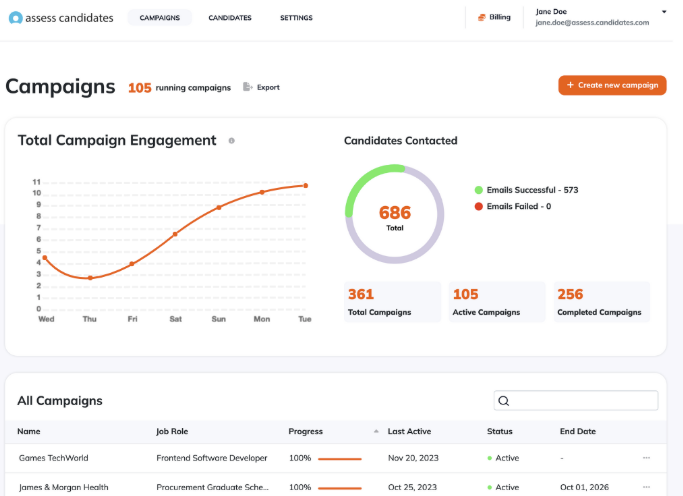
The top 4 reasons why you should use Assess Candidates for hiring
- Scientifically Developed and Expertly Crafted: The strongest job descriptions now include details about the assessment process, whether that’s cognitive, behavioral, or role-specific skill testing. Doing this signals transparency, objectivity, and a commitment to fair hiring. Assess Candidates’ pre-employment assessments are built by Chartered Scientists, Psychologists, and Psychometricians with backgrounds at leading firms like SHL and IBM Kenexa. Each assessment is rigorously validated to accurately measure real-world capabilities and job-relevant competencies, helping you define precise requirements in your job descriptions that attract the right talent.
- Insightful Data to Shape Role Requirements: Our intuitive platform generates clear, detailed reports on skills and competencies, making it easier to identify must-have abilities for each position. These insights allow you to set specific, evidence-based criteria in your job descriptions, ensuring they reflect the true demands of the role and reduce irrelevant applications.
- Engaging Branded Candidate Experience: Job descriptions aren’t just lists of duties, they are an extension of your employer brand. By integrating Assess Candidates’ mobile-optimized, interactive assessments into your recruitment process (and mentioning them in your job ads), you demonstrate your organization’s commitment to professional growth, fairness, and innovation. This encourages top candidates to apply and submit higher-quality, tailored resumes.
- Built for Accessibility and Inclusion: Inclusive job descriptions attract a broader, more diverse pool of candidates. Our assessments are fully accessibility-compliant, offering features like extended time, zoom functionality, screen reader compatibility, and WCAG-compliant design. By embedding this commitment to accessibility into your job descriptions, you show applicants that your organization values equal opportunity and supports every individual’s success.
Assess Candidates is a leading provider of pre-employment assessment solutions that empowers organizations to create job descriptions that are not only informative but also strategic. With our scientifically validated assessments and customizable integration, you can take the next step toward smarter, more efficient recruitment today.
Not sure if pre-employment assessments are right for your hiring process? Get in touch with us for a free-of-charge analysis of your recruitment needs.
Interested in learning more about effective candidate assessment? Continue reading for frequently asked questions, and sign up with your email to get started.
Frequently Asked Questions
What is the purpose of a job description?
A job description defines the core duties, responsibilities, qualifications, and expectations of a role. It acts as a crucial hiring tool that aligns candidate capabilities with organizational needs, supports fair performance evaluations, and promotes legal compliance by clearly outlining the position’s scope and requirements.
How are job descriptions different from job postings?
Job descriptions and job postings play distinct roles in the hiring process. Hiring teams use job descriptions as internal documents to outline a role’s duties, responsibilities, required qualifications, and reporting structure. These descriptions clarify expectations and guide performance. In contrast, employers create job postings to attract potential applicants, presenting key aspects, like company culture, benefits, and growth opportunities, in a persuasive and engaging tone.
How do job descriptions impact the quality of applicants?
Well-crafted job descriptions help attract candidates whose skills and goals align with the role by outlining expectations, key qualifications, and company values. This leads to more relevant applications, fewer hiring mismatches, and a faster, more efficient recruitment process, reducing both time-to-hire and employee turnover.
Can job descriptions be changed?
Yes, job descriptions should ideally be reviewed and updated every 6 to 12 months or whenever there’s a significant change in the role. Regular updates keep them aligned with evolving business goals, technologies, and compliance needs, ensuring your hiring process stays accurate, relevant, and effective.
What are the best practices for writing effective job descriptions?
A well-crafted and compelling job description is clear, concise, and customized to the specific role. Use inclusive language, focus on essential qualifications, and mention work arrangements and company culture. Add relevant keywords to boost search visibility, and end with a strong call to action that guides candidates on how to apply.
Can technology help improve job descriptions?
Yes, AI-powered platforms like Textio and Ongig can enhance job descriptions by optimizing language, eliminating bias, and improving clarity. These tools help you craft inclusive, engaging, and keyword-rich listings that perform better on job boards, resulting in increased visibility and higher-quality applications.


 English
  Arabic