
Diversity Washing: Key Features and How to Avoid it in 2026



Diversity washing is a serious concern across industries, undermining genuine diversity, equity, and inclusion (DEI) efforts. In today’s workplace, where diversity is a buzzword for progressiveness and ethical responsibility, some companies are guilty of superficially promoting diversity without delivering real structural or cultural change.
Instead of addressing systemic inequities, these organizations rely on deceptive tactics and gestures: token diversity panels, vague diversity statements, flashy DEI reports, or staged marketing campaigns.
The result? A carefully curated image that masks a stagnant or even exclusionary reality within internal culture. Much like greenwashing in sustainability, diversity washing gives the illusion of progress.
According to a 2024 study by Baker et al. (Journal of Accounting Research), U.S. public companies with the most extensive DEI disclosures from 2008 to 2021 often showed little actual improvements in workplace diversity.
For recruiters and hiring managers, the implications are serious. Diversity washing erodes trust, damages employer brands, and limits meaningful representation in hiring. To counter this, you must move beyond checklists and statistics. Instead, focus on investing in evidence-based anti-diversity washing tools and strategies that cultivate a culture of accountability and transparency reflecting the lived experiences of employees.
If you have common questions, such as:
- What is performative activism in diversity washing?
- What are the common signs of diversity washing?
- What are the most effective tools to avoid diversity washing?
- Which strategies can small and medium-sized businesses use to counter diversity washing?
- What are some strategies to reduce diversity washing in finance?
This guide unpacks it all! So, whether you are a recruiter, hiring manager, or talent acquisition expert, here we will explore the features of diversity washing, why employers use it, and how to avoid diversity washing in recruitment.
Contents
- What is diversity washing?
- Why do companies engage in diversity washing?
- Key red flags: How to spot diversity washing
- What are the costs of diversity washing?
- Best practices to avoid diversity washing and promote diversity-first policies
- Popular tools to avoid diversity washing
- Success stories: Employers who beat diversity washing
- The future of DEI: Trends to watch in 2025 and beyond
1. What is diversity washing?
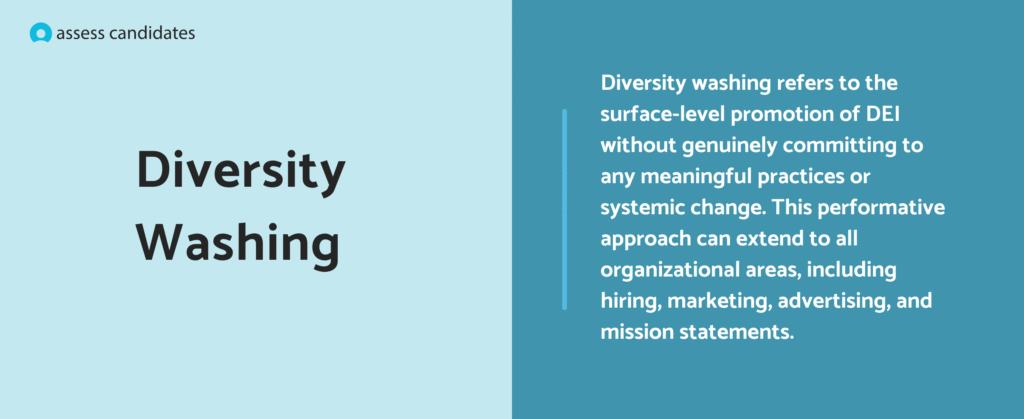
Diversity washing is an umbrella term that refers to the surface-level promotion of diversity, equity, and inclusion (DEI) without genuinely committing to any meaningful practices or systemic change. It is when organizations display “diversity” through campaigns, statements, or policies, but fail to follow through in hiring practices, leadership representation, internal culture, or decision-making. This performative approach can extend to all organizational areas, including recruitment, marketing, advertising, and mission statements.
Example: A cosmetics brand that launches a “diversity-inclusive” foundation campaign, yet offers a limited shade range that in reality excludes many different dark-skinned consumers.
While seeming to generate short-term praise or media attention, diversity washing causes damaging long-term consequences such as higher employee turnover and lower morale, especially among marginalized employees who feel tokenized rather than valued. Moreover, this performative strategy is increasingly under scrutiny from stakeholders, job seekers, and consumers due to higher public awareness and focus on corporate ethics.
In today’s climate of heightened transparency and accountability, diversity washers risk reputational damage to the employer brand, reduced investor confidence, and loss of brand loyalty and trust. Therefore, organizations must move beyond diversity washing and build accountable, inclusive systems that prioritize equity, representation, and inclusion at every level of decision-making – from hiring to culture and leadership.
What is diversity washing in hiring?
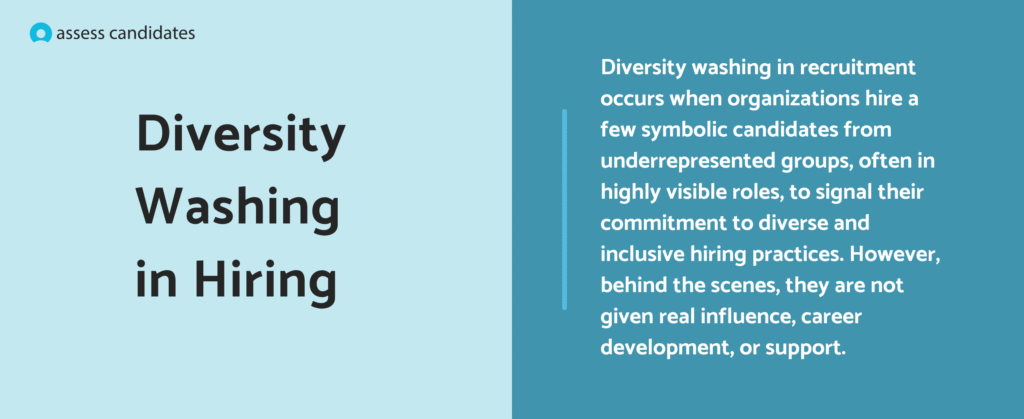
Diversity washing in recruitment occurs when organizations hire a few symbolic candidates from underrepresented groups, often in highly visible roles, to signal their commitment to diverse and inclusive hiring practices. However, behind the scenes, they are not given real influence, career development, or support. This representational diversity hiring approach focuses more on appearance than on impact.
For Example: A tech company publicly announces a new “diversity hiring initiative” with press releases and career fair appearances. Yet, in reality, their candidate screening algorithms are consistently filtering out resumes with ethnic-sounding names, thus undermining their DEI goals and revealing a deeper pattern of diversity washing in hiring.
Ensure a high-quality, diversity-inclusive hiring process with our objective assessments. HIRE FOR FREE
How does diversity washing differ from genuine DEI efforts?
Diversity washing involves superficial actions that companies use to project themselves as “diverse and inclusive”. These actions often include token hires, overuse of diverse imagery, performative social media posts, or isolated initiatives that lack depth or follow-through. While these may serve marketing or public relations purposes, they rarely foster true inclusivity within the workplace.
In contrast, genuine DEI efforts are strategic, transparent, and deeply embedded at all organizational levels including operations and company culture. They go beyond appearances, focusing on lasting systemic change through inclusive hiring practices, equitable promotion pathways, ongoing bias training, and measurable progress toward DEI goals.
For Example: Delta Air Lines demonstrates a genuine DEI commitment through investments in DEI training, racial equity workshops, and employee resource groups. Meanwhile, United Airlines has faced criticism for promoting diversity in ads while lacking transparency about its internal DEI progress, raising concerns of diversity washing.
The key distinction lies in the intent, authenticity, and depth of the commitment. While diversity washers focus on optics and public relations, genuine DEI-compliant firms prioritize substantive progress, action, and accountability to create inclusive environments where all employees can thrive.
So, why do employers use diversity washing despite its superficial nature? Let’s find out below.

2. Why do companies engage in diversity washing?
Companies are under growing pressure from consumers, stakeholders, employees, and candidates to demonstrate real progress on DEI. Diversity washing serves as an easy and quick shortcut for corporations to relieve some of this pressure without disrupting their existing systems or addressing uncomfortable truths. Below are the most common reasons why employers use diversity washing.
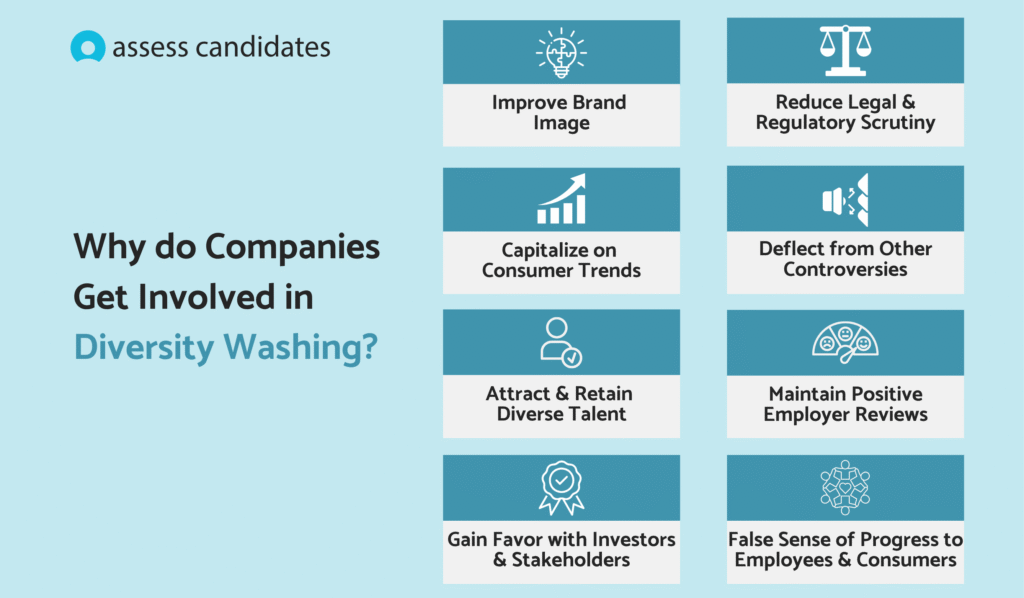
Why employers use diversity washing as a quick-fix tactic:
- To Improve Brand Image: Superficial diversity initiatives help brands appear progressive, socially responsible, and aligned with public values to attract customers and gain positive publicity.
- To Capitalize on Consumer Trends: With rising consumer demand for ethical and inclusive brands, some organizations superficially portray inclusivity and social justice as a marketing strategy, without addressing workplace discrimination issues.
- To Attract and Retain Talent from Marginalized Groups: By boosting their employer brand through superficial hiring practices, companies attempt to attract candidates from marginalized groups and outshine competitors, even if company culture doesn’t truly support inclusion.
- To Gain Favor with Investors and Stakeholders: A diversity facade can help businesses gain funding from investors and appease stakeholders who prioritize meeting Environmental, Social, and Governance (ESG) criteria, without making actual internal changes.
- To Reduce Legal and Regulatory Scrutiny: Some companies use diversity window dressing to appear compliant and avoid government and regulatory body-enforced diversity efforts, without changing their status quo.
- To Deflect from Other Controversies: Diversity washers use social washing campaigns as a distraction and PR shield from their scandals or unethical business practices and repair their public image.
- To Maintain Positive Employer Reviews and Ratings: Representational diversity hiring allows companies to manipulate external perceptions on public forums like Glassdoor and LinkedIn to boost ratings and attract high talent.
- To Give a False Sense of Progress to Employees and Consumers: Organizations showcase a few visible DEI efforts to create an illusion of progress without disrupting their existing corporate culture and structures.
Explore our scientifically backed objective assessments as part of your inclusive recruitment process. LEARN MORE
So, how can you identify a diversity facade in organizations? Here are the top features to look for when spotting diversity washers.
3. Key red flags: How to spot diversity washing
Diversity washing can be difficult to identify, especially when organizations craft polished messaging and marketing campaigns. However, there are recurring patterns and warning signs of diversity washing. Below are the key red flags and signs, grouped into 3 common categories: superficial actions, performative actions, and inconsistent safeguarding actions:
1. Superficial Actions
Tokenism: Hiring a few candidates from cultural or ethnic minorities to signal inclusivity, but providing no real influence, decision-making power, or opportunities for their growth.
For Example: An investment banking firm frequently uses buzzwords such as “diverse” and “inclusive” job descriptions and recruitment, yet has no diverse representation in leadership – this is is a superficial hiring practice.
Superficial Marketing: Featuring diverse faces in adverts and promotional material without internal diverse representation. Often, once established as a diversity-inclusive brand, companies will quietly drop these diversity policies when public interest wanes.
For Example: An engineering business has diverse employees as models in their ads and marketing, yet the leadership remains homogenous – this is a likely feature of diversity washing.
Lack of Inclusive Workplace Policies: No equal pay, parental leave, and anti-bias training, nor any proper budget allocation for mentorship programs, sponsorships, and Employee Resource Groups (ERGs).
For Example: Company leadership publicly celebrates Pride Month but doesn’t have any internal policies protecting LGBTQ+ employees and dismisses discrimination complaints as overreactions.
2. Performative Actions
Performative Social Media Activism: Posting about social causes and diversity without aligning internal policies or taking real action. This social washing is evident when companies claim their DEI issues are already “fixed” to avoid scrutiny.
For Example: A consulting firm frequently posts on social media about celebrating cultural events such as #BlackLivesMatter, but doesn’t donate or update its internal policies for the cause – demonstrating a likely diversity facade.
Misleading or Vague Diversity Reports: Intransparent diversity reports and statements that are broad, overly polished, or lacking demographic breakdowns. Businesses tweak numbers to appear more inclusive to attract positive public attention.
For Example: A financial company promotes its diversity initiatives but refuses to share employee representation data at different levels (e.g., leadership vs. entry-level). This selective discourse is one of the features of diversity washing.
Stereotypical Representation: Promoting clichés or reinforcing cultural stereotypes, while at the same time excluding authentic representation or diverse perspectives in decision-making with a culture of ‘One size fits all’.
For Example: An e-commerce brand whose PR and mission statements describe Asian employees as “smart” and Black employees as “tough” is perpetuating stereotypes and engaging in diversity washing.
Failure to Support Diverse Employees: Hiring diverse talent without providing real-time opportunities to succeed. Also engaging in unfair practices such as cultural appropriation, wage inequality, lack of mentorship, and unequitable growth.
For Example: A finance company fosters a “diverse work culture”, when in reality diverse hires remain stuck in entry-level roles with limited advancement opportunities – this highlights a potential sign of diversity washing
Defensive or Vague Answers During Interviews: A lack of transparency when sharing company DEI goals, such as representation targets and pay equity audits, or dodging DEI-related questions.
For Example: A retail CEO gets dismisses and deflects questions about DEI with generic statements like “We hire the best candidate regardless of race/gender,” – this is often a red flag of performative hiring practices.
3. Inconsistent or unaddressed DEI safeguarding actions:
Unaddressed Workplace Discrimination or Harassment: A company may claim to foster a positive work environment, yet have a high turnover rate among underrepresentes groups and a history of discrimination complaints or lawsuits.
For Example: A marketing agency with a “zero-tolerance” policy for discrimination still has frequent reports of bias and high attrition among minority staff – a key sign of a toxic culture.
Lack of Accessibility Efforts: Failure to provide necessary accommodations for people with disabilities, religious practices, or cultural traditions suggests inclusion is not reflected in operations.
For Example: Leadership hosts events on the importance of cultural diversity in the workplace, but fails to provide a prayer room or respect cultural holidays, indicating one of the signs of diversity washing.
No Formal Culture-inclusive Practices or Policies: Without formal guidelines on cultural diversity, equal employment, and anti-discrimination practices, the organization lacks real infrastructure supporting DEI.
For Example: A sales company employs diverse staff but fails to provide them flexibility for cultural or regional holidays and instead demands overtime, undermining its inclusivity claims.
Excuses to Avoid Inclusive Policies: Frequent claims of high costs, regulations, or “diversity fatigue” to avoid doing business with minority-owned vendors or addressing systemic issues.
For Example: An IT firm allegedly fired whistleblowers who voiced their prejudicial practices against minority-owned businesses, which indicates the company’s engagement in diversity washing.
One-dimensional Focus: Prioritizes one aspect of diversity, like gender, while ignoring race, disability, age, ethnicity, etc.
For Example: A university supports gender equality but mostly hires alumni from the same background, limiting broader inclusion.
Mismatch Between Public Statements and Internal Actions: Leadership publicly supports DEI practices, while simultaneously cutting funding and budget allocation to diversity programs or portraying contradictory views elsewhere.
For Example: The CEO of a clothing brand supports diversity in the workplace, but their personal social media opposes racial equity policies – revealing a key sign of diversity washing
Prioritze accessibility and diversity with our bias-free Talent Assessment Platform. LEARN MORE
After understanding the red flags for diversity washers, let’s discuss the significant costs of diversity washing below.
4. What are the costs of diversity washing?
Although diversity washing offers a quick, easy image boost, it harms the business tremendously in the long term. Once exposed, performative DEI efforts can damage everything from internal culture to public trust, leading to financial, legal, and reputational fallout.
The 10 long-term costs of using diversity washing:
- Loss of Investors’ Trust and Credibility: Once performative diversity efforts become evident, especially through social media’s deceptive marketing, investors quickly lose confidence in the organization’s credibility, risking financial loss, divestment, and brand damage.
- Loss of Valuable Talent: Diversity washing in hiring drives away top global talent, especially from underrepresented groups, as organizations lack innovation and inclusivity. Candidates see through empty promises and seek real opportunity for growth and belonging.
- Employee Disengagement and High Turnover: Diversity washing limits growth for minority employees, who also feel tokenized and unsupported. This leads to high turnover, internal conflict, and workplace dissatisfaction.
- Legal and Compliance Risks: Deceptive diversity claims can result in lawsuits, investigations, or penalties for noncompliance with anti-discriminatory laws, which may exacerbate dissatisfaction with leadership.
- Wasted Resources on Superficial Initiatives: Representational and hollow diversity – without strategy, accountability, or follow-through – wastes invaluable resources, time, and money away from meaningful, systemic change for long-term innovative business strategies.
- Missed Business Growth Opportunities: A diversity facade results in organizations limiting their ability to expand diverse customer cases, losing out on revenue, brand loyalty, and long-term growth.
- Mental Health Toll on Employees: Tokenism, exclusion, and discrimination negatively affects the mental health of employees. Diversity washing can create emotional exhaustion, psychological stress, and burnout among employees who feel exploited or unheard.
- Increased Risk of Whistleblowing and Scandals: Diversity washing increases the risk of leaked internal documents, exposing hypocrisy and sparking public scandals that attract legal scrutiny and governmental sanctions.
- Perpetuates Social Inequalities: Token hiring, unequal pay, lack of representation, and performative allyship all perpetuate systemic inequities, undermining social progress in the workplace.
- Losing the Core Customer Base: Once exposed, performative diversity causes core audiences to abandon or mass boycott the brand. Consumers expect business to act ethically and they won’t tolerate being misled.
Use standardized and legally defensible hiring solutions for your diversity-inclusive recruitment process. HIRE FOR FREE
After discussing the costs of diversity, let’s discuss the most effective strategies to reduce diversity washing and boost DEI efforts in your organization.
5. Best practices to avoid diversity washing and promote diversity-first policies
Employers must prioritize reducing diversity washing and instead promoting diversity-first policies with effective strategies. We recommend the following 10 best practices:
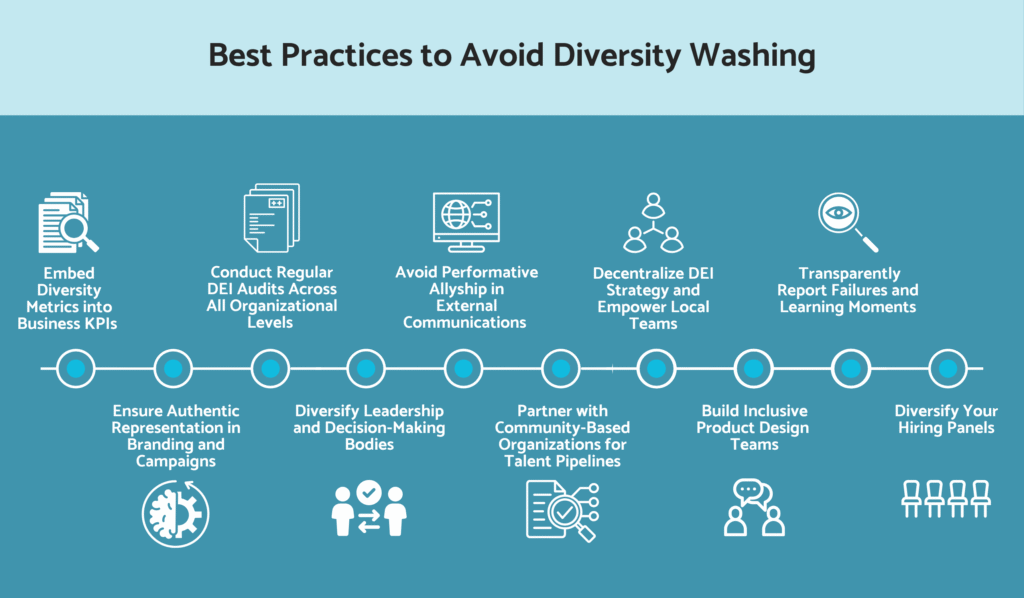
1. Embed Diversity Metrics into Business KPIs
Integrate your diversity and inclusion targets directly into your core business performance metrics rather than treating them as optional initiatives. This ensures your DEI efforts don’t just become a “nice-to-have,” but are treated with the same rigor as revenue or operational goals. Integrating DEI into business KPIs ensures that diversity efforts are not just performative but are tied to tangible outcomes, promoting sustained commitment and progress.
How to do this: Establish clear, measurable DEI goals such as representation across levels, pay equity, and promotion rates. Assign ownership of these metrics to senior leaders and tie executive compensation to the achievement of DEI milestones. Ensure leadership and management are on the same page, see DEI as a core value and organizational priority, and set a clear direction for action.
For Example: Companies like Microsoft tie executive compensation directly to diversity outcomes, using data-driven DEI KPIs to ensure long-term accountability across leadership roles.
2. Ensure Authentic Representation in Branding and Campaigns
Use marketing campaigns with authentic diversity representation to build trust and reflect genuine DEI commitment. Avoid overreliance on superficial hiring practices like overdependence on diverse imagery without internal support, which signals diversity washing. Authentic brand image representation in campaigns fosters resonance with audiences, enhances brand credibility, and avoids the pitfalls of tokenism.
How to do this: Co-create campaigns with individuals from underrepresented groups, ensuring their voices and stories are central. Use skills-based hiring to build a team that reflects a diverse and inclusive work culture. Incorporate inclusive language in job descriptions and talent assessments to assess candidates on their aptitude, personalities, and culture-fit. This helps to have diverse team members in the creative process to capture authentic perspectives.
For Example: Ben & Jerry’s regularly collaborates with grassroots organizations and marginalized communities to co-develop social justice-themed campaigns, ensuring authentic representation and impact.
3. Conduct Regular DEI Audits Across All Organizational Levels
Engage third-party consultants or internal audit teams to assess diversity in hiring, retention, promotion, pay equity, and workplace culture. Publish annual findings to maintain transparency. Without structured audits, organizations are unaware of systemic inequalities and unconscious biases, leading to a disconnect between DEI statements and actual practices, enabling diversity washing.
How this works: Regular audits identify areas for improvement, foster accountability, and demonstrate a commitment to continuous DEI advancement.
For Example: Salesforce publishes an annual Equality Report that outlines workforce demographics and progress, including candid insights into areas where representation lags.
4. Diversify Leadership and Decision-Making Bodies
Set targets for leadership diversity, create advisory councils with real decision-making power, and ensure succession planning includes diverse talent pipelines. This is because when leadership lacks diversity, DEI initiatives lack effectiveness and promote diversity washing as decisions may not reflect the true workplace experiences and needs of underrepresented groups.
How this works: Diverse leadership fosters inclusive policies, enhances decision-making, and signals a genuine commitment to DEI principles.
For Example: Accenture has set clear goals to increase diversity in its executive leadership and has seen measurable gains by holding leaders accountable through public commitments and timelines.
5. Avoid Performative Allyship in External Communications
Before making public DEI statements, assess internal policies and practices to ensure alignment. Commit to tangible actions with clear timelines and communicate these alongside public statements to avoid diversity washing. This step is essential as public statements on social issues without corresponding internal actions constitute performative allyship, undermining credibility and trust.
How this works: Aligning words with actions builds trust among stakeholders and reinforces the organization’s integrity.
For Example: After facing criticism in 2020, Adidas overhauled its internal hiring and promotion practices to align with its public anti-racism messages, demonstrating a shift from performative to actionable allyship.
6. Partner with Community-Based Organizations for Talent Pipelines
Collaborate with HBCUs, tribal colleges, LGBTQ+ networks, and disability advocacy groups to create internships, mentorships, and job shadowing opportunities. Superficial diversity hiring can lead to tokenism. Therefore, building relationships with community organizations ensures access to diverse talent and supports genuine inclusion, and avoids diversity washing.
How this works: These partnerships cultivate a diverse talent pool and demonstrate a long-term commitment to equity.
For Example: Google’s Code Next and Howard West initiatives are long-term investments in developing tech talent from underrepresented communities, avoiding quick-fix hiring approaches.
7. Decentralize DEI Strategy and Empower Local Teams
Develop a centralized DEI vision while allowing regional offices to tailor strategies through local DEI councils and community engagement, ensuring cultural relevance. A centralized DEI approach may not address regional and cultural nuances, leading to ineffective implementation. Therefore, decentralization enhances the effectiveness of DEI initiatives by respecting local contexts and empowering teams, reducing diversity washing.
For Example: Unilever has decentralized DEI councils in multiple regions, tailoring inclusion strategies to local contexts while aligning with global DEI goals.
8. Build Inclusive Product Design Teams
Assemble diverse teams for product design, employ inclusive design frameworks, and conduct user testing with varied demographic groups to ensure products are accessible and equitable. Lack of diversity in product development can result in biased products that do not meet the needs of all users. Therefore, using inclusive design leads to products that serve a broader audience, enhancing user satisfaction and market reach, curbing diversity facade.
For Example: Airbnb launched its “Project Lighthouse” initiative in partnership with Color Of Change to identify and reduce racial bias in user experiences, improving design inclusivity from end to end.
9. Transparently Report Failures and Learning Moments
Share both achievements and setbacks in DEI reports, including employee testimonials and detailed action plans for addressing identified issues. Only highlighting successes in DEI efforts can create a facade of progress, while transparency about challenges fosters trust and continuous improvement. This anti-diversity washing strategy works as transparency demonstrates authenticity, encourages stakeholder engagement, and positions the organization as a learning entity committed to growth.
For Example: Pinterest openly acknowledged internal failings in diversity and used whistleblower testimony to reform HR policies, increasing internal trust and external credibility.
10. Diversify your Hiring Panels
Ensure that you cater to diversity on hiring panels to minimize the risk of unconscious bias affecting hiring decisions. Complement your pro-diversity efforts by providing recruiters and hiring managers with the right training through effective programs focused on inclusive hiring, bias awareness, and equity-centered evaluation frameworks. These initiatives ensure that even well-intentioned recruiters are equipped with the tools to identify and diversity washing in recruitment, creating fairer evaluation processes.
In addition, leverage technology such as Assess Candidates’ pre-employment assessments for hiring to build a competent and diverse workforce. Train them through DEI training to convey the importance of empathy, diversity, and inclusivity in the workplace. Ongoing pro-diversity programs focusing on spreading awareness on unconscious bias, discrimination, and intentional inclusion will help foster a positive work environment.
For example: Google introduced structured interviewer training on unconscious bias and forming diverse hiring committees. This led to measurable improvements in both their hiring equity and employee retention across underrepresented groups.
Adopt authentic, long-term diversity strategies with Assess Candidates. VIEW PLANS
After the top strategies, let’s discuss which methods and tools to use to reduce diversity washing below.
6. Popular tools to avoid diversity washing
Organizations can use the following popular tools to avoid diversity washing:
DEI Strategy and Governance
- DEI Maturity Models (Deloitte, BCG, Gartner): Evaluate diversity strategy.
- Global Diversity, Equity & Inclusion Benchmarks (GDEIB): Measure DEI effectiveness.
- Stakeholder Engagement Mapping: Identifies who drives DEI efforts.
- Diversity Council & ERG Effectiveness Assessment: Ensures groups have a real impact.
- Corporate DEI Pledge Audits: Compare public commitments vs. actual impact.
These anti-diversity washig strategies are helpful for mid-to-large scale organizations to assess organizational commitment and execution for HR, DEI officers, and leadership teams for corporate, government, non-profits, and education.
Leadership and Accountability
- Inclusive Leadership 360° Assessments (Korn Ferry, Catalyst): Evaluate leadership inclusivity.
- Board Diversity Tracker (Equilar, MSCI ESG Ratings): Monitors board representation.
- Executive DEI Scorecard: Measures leadership commitment.
- Linking DEI Metrics to Executive Bonuses: Holds leadership accountable.
These tools to avoid diversity washing are most suitable for mid-to-large organizations for C-suite, managers, and corporate boards to ensure leadership accountability for DEI in tech, finance, healthcare, law, and consulting.
Structural Equity and Policy Evaluations
- Equity Gap Analysis: Assesses disparities in hiring, pay, and promotions.
- Accessibility Audits (WCAG, ADA Compliance): Ensure workplace inclusion.
- Bias Incident Reporting System Review: Tests fairness in discrimination cases.
- Parental Leave & Caregiver Policy Analysis: Reviews inclusivity in benefits.
These anti-diversity washing strategy tools are most suitable for small to large organizations for HR, compliance teams, and DEI officers to identify systemic barriers in investment banking, healthcare, education, and manufacturing.
Recruitment and Hiring
- AI Bias Audits in Hiring (HireVue AI Audit, IBM AI Fairness 360): Detect biased algorithms.
- Structured Interview Bias Assessments: Ensure fair interview processes.
- Inclusive Job Description Checkers (Textio, Gender Decoder): Remove biased language.
- Blind Resume Review Platforms (Blendoor, Applied, GapJumpers): Reduce unconscious bias.
- Pre-employment Psychometric Testing Platforms: Allow objective, bias-free, and legally-defensible hiring through psychometric assessments. Check out our expert-designed pre-employment tests below to avoid diversity washing in recruitment below!
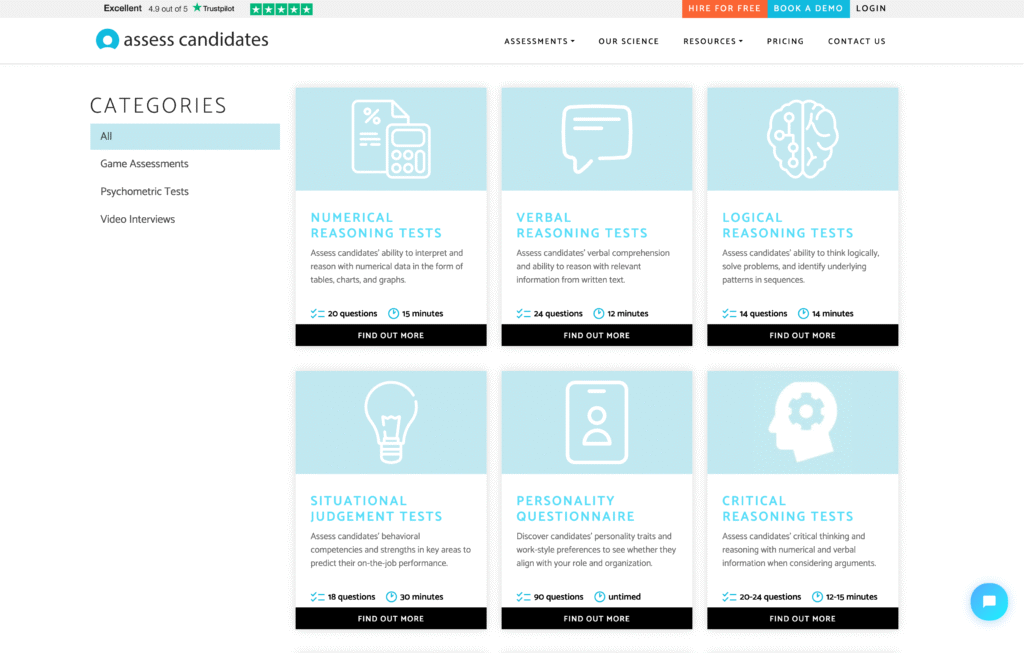
These tools to counter diversity washing in recruitment are helpful for small- to large-scale organizations to ensure bias-free hiring for finance, data analysis, government, tech, retail, and education.
Employee Experience and Psychological Safety
- Employee Net Promoter Score (eNPS) by Demographics: Tracks if employees feel valued.
- Psychological Safety Index (Edmondson Scale): Tests workplace safety for all.
- Inclusion Sentiment Surveys (CultureAmp, Peakon, Glint): Track microaggressions & bias.
- Exit & Stay Interviews by Demographics: Identify why employees leave or stay.
These tools to avoid diversity washing are most suitable for mid-to-large organizations for HR, DEI teams, and employee engagement managers to measure real inclusion beyond diversity numbers in corporate, healthcare, and finance.
External Perception and Reputation
- Glassdoor & LinkedIn DEI Sentiment Analysis: Monitors employee feedback.
- Social Media DEI PR Audit: Analyzes authenticity in diversity messaging.
- Third-party DEI Benchmarks (HRC Corporate Equality Index, Bloomberg Gender Equality Index): Compare with industry leaders.
These anti-diversity washing tools are most suitable for mid-to-large organizations for PR teams, brand managers, and executives to ensure DEI efforts align with public perception for roles in marketing, leadership, and finance.
Data Transparency and Reporting
- Global Reporting Initiative (GRI) DEI Framework: Ensures DEI transparency.
- SASB DEI Metrics: Track workforce diversity in financial reports.
- Fair Pay & Equity Audits (Syndio, PayScale, Visier): Check wage equity.
- DEI Dashboards (Tableau, Workday DEI Analytics): Track real-time diversity trends.
These anti-diversity washing tools are most suitable for mid-to-large organizations for: CFOs, financial data analyst teams, HR, compliance teams, and accountants. They prevent misleading diversity claims for roles in corporate, non-profit, healthcare, and government.
Bias and Fairness in AI and Technology
- Google PAIR & What-If Tool: Tests AI fairness.
- Fairlearn (Microsoft), Aequitas (University of Chicago): Open-source bias testing tools.
- Facial Recognition Bias Audits (NIST Face Recognition Vendor Test): Prevent discriminatory AI practices.
These popular tools to avoid diversity washing are most suitable for mid-to-large organizations for tech teams, HR, compliance officers, and product managers to prevent AI-driven diversity washing for roles in HR, tech, engineering, security, and SaaS.
Intersectionality and Inclusion-Specific Audits
- Racial Equity Impact Assessments (REIA): Evaluate policies affecting different racial groups.
- LGBTQ+ Workplace Inclusion Audits (HRC Corporate Equality Index, Out & Equal): Track LGBTQ+ inclusion
- Neurodiversity Inclusion Audits: Test workplace accessibility for neurodivergent employees.
These anti-diversity washing tools are effective for mid-to-large organizations for data analyst teams, HR, DEI teams, and compliance teams to ensure diversity in organizations for roles in Corporate, healthcare, government, and education.
What are some top industry-specific strategies to reduce diversity washing?
Here are the top industry-specific strategies to reduce diversity washing in organizations:
- Tech and AI Companies:
Tech and AI companies can avoid diversity washing by focusing on bias reduction and ensuring fairness in AI. Employers can use diversity dashboards such as Tableau and Workday DEI Analytics and online tools such as Google PAIR, Fairlearn, and Aequitas along with Structured Interview Bias Assessments.
- Finance and Corporate:
Finance and corporate firms should prioritize leadership accountability to counter diversity washing with tools such as DEI Scorecards and linking DEI to Bonuses. Use diversity governance models such as Global Diversity, Equity & Inclusion Benchmarks (GDEIB) and Sustainability Accounting Standards Board (SASB) to make your recruitment equitable. Conduct Fair Pay & Equity Audits with tools such as Syndio and PayScale.
- Healthcare and Education:
Healthcare and education sectors must focus on structural equity audits, such as ADA Compliance and Racial Equity Impact Assessments, to reduce diversity washing. Use the Psychological Safety Index for healthcare workers and conduct Exit & Stay interviews by tools such as Demographics to reinforce DEI initiatives.
So who are some top employees who overcame diversity washing in recruitment successfully? Keep reading to find out.
7. Success stories: Employers who beat diversity washing
1. Tapestry Inc.
Tapestry Inc., from 2020-2022, made public statements about supporting racial equity and gender diversity; however, critics noted the lack of transparency and accountability behind those commitments. The brand conveyed no clear diversity goals, timelines, or measurable DEI outcomes, and their reports published minimal data on progress or demographic representation, indicating signs of diversity washing. Globally, Tapestry was seen as indulging in performative allyship, brand-driven rather than structure-driven.
Now, since 2023 onwards, Tapestry has turned that reputation around by:
- Appointing a Chief Inclusion & Social Impact Officer.
- Linking executive compensation to DEI performance.
- Creating employee-led resource groups and a transparent DEI dashboard.
- Partnering with external organizations to audit and advise on internal DEI practices.
Results:
- Increased underrepresented U.S. leadership from 17% to 27% (2021–2024)
- Achieved gender pay equity globally by 2024
- Ranked in the Forbes 2024 list of Best Employers for Diversity
Lesson: Companies can recover from surface-level DEI if they genuinely institutionalize accountability, transparency, and internal ownership.
2. Accenture
Accenture, until 2019, like many consulting giants, used to release broad statements about gender parity and racial equity, but much of the focus was external PR and awards, not internal reform. For example, their early DEI dashboards highlighted intentions rather than actionable goals, indicating features of diversity washing. Internal voices throughout the company questioned inclusion for non-visible minorities like neurodivergent individuals.
Now, from 2020 onwards, Accenture’s transformation has been substantial:
- Established 32 accessibility centers for disabled and neurodivergent employees.
- Developed inclusive hiring pipelines with gamified, bias-reducing tools
- Created a global LGBTQ+ ally network (120,000+ strong).
- Promoted intersectional inclusion, not just demographic parity.
Results:
- Increased employee engagement scores by 12% in diverse teams
- Reached 50/50 gender balance in the global workforce in 2024.
- Increased LGBTQ+ leadership by 16% as of 2025.
Lesson: Companies can go beyond race/gender quotas to embed inclusion for less-visible groups, and support long-term retention and equity, diversity progression and success are ensured.
3. Sodexo
Sodexo, starting from 2010 to 2017, often cited surface metrics like “diverse hiring” without addressing barriers to promotion or cultural equity. Critics throughout these seven years often called out the organization for their tokenized approach, where women and minorities were hired but rarely promoted to influential roles. Their marketing campaigns didn’t match employee experiences, indicating practice of potentially social washing.
Now, following 2018, Sodexo’s DEI strategy has been revamped:
- Women now make up 60% of its board and 37% of the executive team.
- Launched a Global Gender Balance Strategy focused on mentorship, sponsorship, and leadership visibility.
- Embedded DEI into client relationships and procurement policies.
Results:
- 60% of global boards are women as of 2025.
- 37% of senior leadership in the company are ethnic minorities.
- Increased employee satisfaction on DEI by 30% in 3 years.
Lesson: An organization’s true commitment to internal equity and career mobility is what separates real inclusion from numbers-based diversity washing.
4. DoorDash
DoorDash, until 2022, celebrated workforce diversity in its tech and delivery teams, but faced internal criticism that underrepresented groups were not advancing into leadership. There was no clear framework to support women of color or BIPOC employees in career growth, a classic case of diversity without equality or diversity washing.
Now, from 2022 onwards, the company has overhauled their internal pipelines:
- Launched Elevate, a program tailored for women of color, resulting in a 35% promotion rate.
- Expanded employee feedback loops and ERGs focused on intersectionality.
- Partnered with nonprofits to funnel untapped talent into tech roles.
Results:
- Women of color saw a 35% higher promotion rate post-program.
- Increased BIPOC representation in tech roles by 28%.
- 95% of DEI program participants said they feel more supported at work.
Lesson: DoorDash’s latest anti-diversity strategy reflects on how DEI must go beyond recruitment. It shows how organizations need to remove barriers to advancement and address internal gaps in equity to remove diversity washing in recruitment.
5. Mastercard
Mastercard’s early DEI efforts from 2016 to 2020 focused heavily on external diversity events, campaigns, and awards. Internally, however, it lacked pay transparency and fair hiring practices. Employee surveys revealed frustration over pay gaps and a lack of racial representation in senior leadership, indicating diversity-washing practices.
From 2021 onwards, Mastercard made real structural changes:
- Conducted annual pay parity audits, achieving 100% pay parity by 2024.
- Implemented mandatory diverse candidate slates for all leadership roles.
- Created a “Pathways to Leadership” program for underrepresented employees.
Results:
- Achieved 100% global pay equity by 2024.
- 42% of global senior leadership now comes from underrepresented groups.
- Named among Bloomberg’s Gender Equality Index 2025.
Lesson: MasterCard’s success by doing away with anti-diversity washing practices shows how key DEI is for success. It shows how real change in line with diversity, inclusivity, and equity means aligning compensation, career development, and making hiring processes more inclusive.
Looking to achieve success over diversity washing similar to these top companies? Contact us, and our top organizational psychologists will be happy to guide you!
Now, what does the future of diversity and inclusion entail? Let’s find out below.
8. The future of DEI: Trends to watch in 2025 and beyond
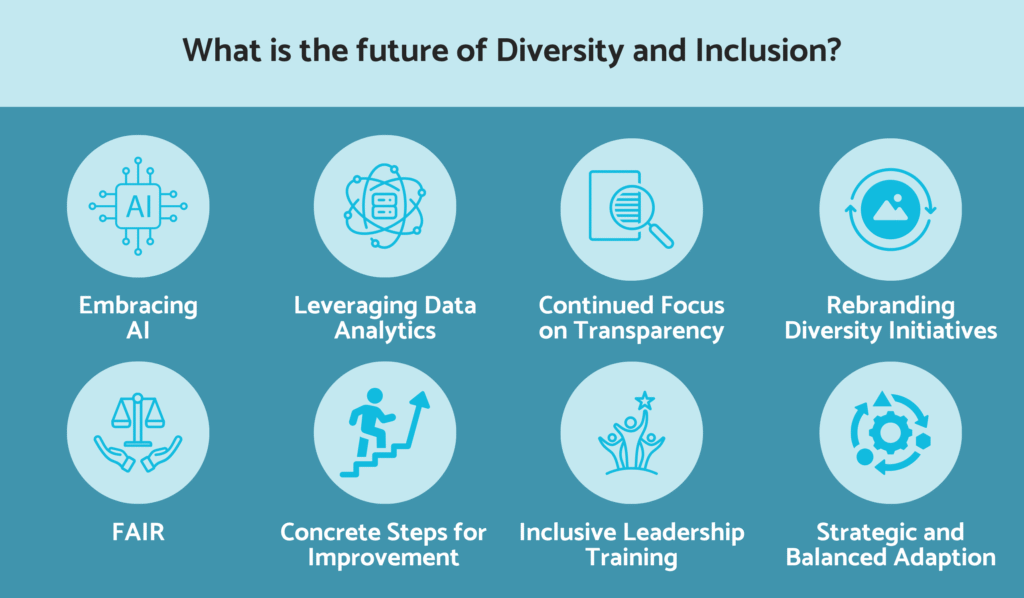
The future of diversity and inclusion will see more focus on leveraging AI and embracing data analytics and metrics to evaluate the impact of DEI training and initiatives, identifying and curbing diversity washing. With increased public awareness and demand, there will be a continued focus on transparency in DEI metrics, acknowledging shortcomings, and outlining concrete steps for improvement to to avoid diversity washing in their organization.
More employers will continue to focus on fostering belongingness through models and techniques such as Fairness, Access, Inclusion, and Representation (FAIR), employee resource groups, mentorship opportunities, and inclusive leadership training. There will be focus on key diversity KPIs, such as diversity rates, retention rates, and employee engagement, to identify areas of improvement and demonstrate accountability, which will allow them to make informed decisions
Though challenges remain in fully operationalizing D&I guidelines, from legal restrictions such as Executive Orders 14151 and 14173 (2025), the future of corporate DEI lies in strategic and balanced adaptation with long-term inclusion goals, which includes foregoing performative practices such as diversity washing. From rebranding diversity initiatives to avoid societal backlash and political attention to fostering an authentic brand and sustainable work culture, brands will do the best to support this shift.
In a nutshell, the future of DEI is bright, highlighting shifts toward data-driven strategies, technological integration, and a genuine focus on fostering a culture of belonging.
Interested in learning more about diversity washing? Continue reading for frequently asked questions.
Frequently Asked Questions
How is diversity washing different from social washing?
Diversity washing is a specific type of social washing highlighting the company‘s surface-level commitment to diversity, equity, and inclusion practices. Social washing is a broad, superficial practice that includes all ethical and social aspects, including labor rights, philanthropy, and social justice.
How does AI cause diversity washing?
AI can cause diversity washing when biased algorithms or automated DEI tools give the illusion of fairness without real inclusion. Tools may exclude diverse candidates, promote rigid culture fit, or track diversity metrics without accountability.
How to avoid diversity washing with AI?
Employers can check diversity washing in AI with AI fairness and open-source bias testing tools. Undertake AI bias audits in hiring, including facial-recognition bias audits after video interviews. Also check for workplace accessibility bias, especially with neurodivergent inclusion audits.
Do psychometric assessments risk diversity washing?
Yes, diversity washing risk occurs even if the company uses psychometric assessments in its hiring. Some companies use aptitude tests without the right strategy. Their lack of transparency with one-size-fits-all shortlisting criteria offers false objectivity.
Which psychometric assessments help reduce diversity washing in hiring?
Psychometric assessments for DEI hiring, such as the personality questionnaire, situational judgment tests, and aptitude tests, such as verbal reasoning, logical reasoning, and critical reasoning tests, using flexible criteria, help reduce diversity washing in recruitment.
How can small and mid-size businesses reduce diversity washing?
Small and mid-sized organizations can use many strategies to reduce diversity washing, including the following:
1) Use inclusive hiring tools such as Blendoor and Applied
2) Conduct workplace harassment and bias reporting audits
3) Implement employee sentiment surveys through CultureAmp and Peakon
Glossary
Diversity, Equity, and Inclusion: Also called DEI or DE&I, it is the umbrella term for organizational frameworks and policies that promote workplace diversity, equal and fair treatment, opportunities for all, and a respectful environment.


 English
  Arabic