
Top Hiring Trends For 2025: What Is Shaping The Future Of Recruitment?



As talent acquisition evolves year after year, so do the hiring trends and HR strategies that define success. In 2025, keeping up with recruitment trends is vital. Organizations that adapt quickly to changing technologies, tools, and industry dynamics stay ahead of competitors to attract, engage, and retain top talent.
The modern workforce values inclusivity, diversity, transparency, skills-first hiring, and data-driven processes. Businesses who respond to these priorities strengthen their employer brand, boost organizational performance, drive innovation, and increase employee engagement.
Did you know? According to a report by IBM, companies that prioritize enhancing the candidate experience see up to a 70% improvement in the quality of their hires.
Hiring trends also vary across industries, influenced by each sector’s specific demands and challenges. Hiring in the banking industry focuses on regulatory compliance, cybersecurity, digital transformation, and diversity. Whereas, healthcare prioritizes professionals with specialized certifications, empathy, and adaptability.
From these increasing industry-specific needs to emphasizing skills over traditional qualifications, and the rise of predictive hiring tools, understanding what’s next in hiring helps you future-proof and customize your recruitment strategy.
Whether you’re a recruiter, hiring manager, or talent acquisition specialist, this guide will answer top questions, such as:
- What are the hiring trends to look out for in 2025?
- Why should I keep up with recruiting trends?
- Which pre-employment tools are shaping the future of recruitment?
- Do predictive analytics work for recruitment?
Continue reading to discover the top 11 hiring trends for 2025. Let’s dive into what you need to know to attract and recruit top talent, build diverse teams, and stay ahead of the competition in 2025.
Contents
- What are hiring trends?
- Why should employers care about 2025’s hiring trends
- What are the top hiring trends in 2025?
- Which hiring tools are shaping recruitment in 2025?
- Pre-employment assessments trending in 2025 hiring
- How do predictive analytics improve hiring?
- What new recruitment tools are emerging in 2025?
- Why top companies choose Assess Candidates for pre-employment testing
Now that you have an overview of what this article consists of, let’s first look at what hiring trends are.
1. What are hiring trends?
Hiring trends are evolving practices, tools, and strategies that employers adopt over time to attract, assess, and recruit candidates for various roles. These shifts are influenced by factors such as technological advancements, changing socio-cultural values, economic conditions, and increasing market competitiveness.
A top hiring and recruitment trend in 2025 is skills-based hiring, focusing on candidates’ practical abilities over credential-based qualifications. At the same time, the adoption of AI-driven tools like automated resume screeners, video interviews, and smart sourcing solutions, continues to rise, helping organizations streamline workflows and improve hiring efficiency.
Keeping up with key hiring trends greatly influences candidates’ perceptions of you as a modern employer and, ultimately, their employment decisions. Therefore, any modern recruitment approach should aim to stay ahead of these trends to attract top talent and promote a more inclusive and bias-free hiring process.
Discover the benefits of incorporating trends like skills-based hiring into your recruitment strategy. HIRE FOR FREE
Next up, let’s take a look at why employers should keep on top of the hiring trends for 2025.

2. Why should employers care about 2025’s hiring trends
Understanding and keeping up with hiring trends is essential for employers to remain competitive, attract top candidates including Gen Z talent, improve hiring efficiency, reduce costs, and strengthen their employer brand.

Top 5 reasons why employers need to know the hiring trends for 2025
- Staying Ahead of Competitors
Employers gain a significant competitive edge in attracting high-quality candidates and streamlining recruitment when they proactively adopt the latest hiring trends, such as AI-driven recruitment tools, flexible, remote, or hybrid work models, and skills-based hiring.
In 2025, embracing skills-based hiring over rigid degree requirements opens access to a more diverse, skilled talent pool. This agility helps companies secure top candidates ahead of slower-moving competitors, positioning them as leaders in talent acquisition.
Did you know? According to a LinkedIn skills-based hiring report, “expanding the talent search to include workers with relevant skills led to a median 6.1x increase in eligible workers at a typical job in the countries analyzed.”
- Attracting Gen Z Talent
Gen Z talent are defining what they want from employers, often prioritizing flexibility, remote or hybrid work over traditional office roles, and employers who demonstrate strong commitments to sustainability, diversity, and social impact.
To appeal to Gen Z talent, companies are now posting creative job openings on platforms like Instagram and TikTok, emphasizing work-life balance, and using gamified assessments to make quick hiring decisions. These modern recruitment tactics help them deliver a seamless, tech-driven application experience that younger candidates prefer.
Did you know? According to a report by Udemy, “Gen Z is predicted to account for 27% of the global workforce in 2025 and will become the largest generation in the workforce by 2035.”
- Retaining Top Talent
Retention is no longer just about salary – employees stay where they feel valued with a positive workplace culture, growth opportunities, and work-life balance.
Companies that invest in continuous learning opportunities, wellness support, and flexible working conditions are better equipped to boost employee satisfaction and build loyal, high-performing teams.
Did you know? According to a LinkedIn report, companies with robust learning and development programs achieve 50% higher employee retention.
- Improving Hiring Efficiency and Reducing Costs
Companies that stay updated on hiring trends actively optimize their recruitment processes and save time and money. Using automation tools like AI-powered resume screeners, psychometric tests, video interviews, and chatbots eliminates manual tasks, accelerates hiring, and minimizes bias.
By applying data-driven recruitment strategies, employers more accurately identify top candidates and avoid costly hiring mismatches.
Did you know? According to an Apollo Technical report, “automation, in general, saves recruiters an average of 14 hours per week.”
- Enhancing Employer Brand and Reputation
In today’s competitive job market, companies improve their employer brand by adopting progressive hiring trends like inclusive recruitment, transparent communication, and employee-first policies. These efforts attract high-quality candidates who value forward-thinking workplaces.
Positive candidate experiences translate to better reviews on platforms like Glassdoor and LinkedIn, reinforcing a company’s reputation as a great place to work. In contrast, companies that fail to keep up with current trends risk appearing outdated, which can discourage applicants and undermine long-term recruitment success.
Did you know? According to a LinkedIn report, “72% of recruiting leaders worldwide agree that employer branding has a significant impact on hiring.”
Keep up with the trend of using science-backed assessments for effective candidate evaluation. LEARN MORE
In the following section, we will explore in detail the top hiring trends shaping recruitment in 2025.
3. What are the top hiring trends in 2025?
In 2025, employers are adopting a new wave of hiring trends centered around AI-powered tools, skills-based assessments, and a renewed commitment to diversity, flexibility, and remote work.
Recruiters are leveraging technology not only to streamline hiring but also to meet the evolving expectations of modern candidates. From automated screening to personalized candidate experiences, these trends are reshaping how organizations attract, assess, and retain top talent in a competitive market.
The following are the top recruiting trends shaping the landscape in 2025:

Leveraging AI and Automation Tools
A key job trend in 2025 is the integration of AI into recruitment processes. The search for skilled candidates is often time-consuming, costly, and complex. AI and automation are transforming hiring by simplifying processes and automating mundane tasks like CV screening. A faster hiring process also enhances candidate engagement and improves hiring efficiency.
Instead of manually reviewing applications, AI can screen thousands of candidates early in the process, delivering instant results that allow hiring managers to focus on the most promising applicants while eliminating unqualified ones, saving both time and effort.
AI also significantly reduces the high costs typically associated with large-scale recruitment. By offering assessments that are delivered online and priced per test or via a flat fee, AI provides a cost-effective alternative with minimal cost per candidate. This approach allows organizations to reallocate resources toward more in-depth evaluation methods, such as in-person interviews or assessment centers, ensuring they identify the best talent efficiently and affordably.
Did you know? After incorporating AI into their pre-employment hiring process, in one year, Unilever saved over £1 million, reduced recruiting time by 75%, improved employee retention, diversity, and cost to hire.
Focusing on Skill-Based Hiring
Skill-based hiring is another top recruiting trend in 2025, continuously reshaping traditional recruitment practices as employers become more aware that formal qualifications do not always accurately reflect a candidate’s suitability for a role.
Organizations are increasingly moving away from hiring practices centered on formal credentials, instead prioritizing the assessment of candidates’ skills and hands-on expertise. This strategy ensures that recruitment aligns closely with the specific demands of a role, allowing companies to develop more skilled and versatile teams.
Skills-based hiring also helps reduce bias in the recruitment process by objectively measuring a candidate’s abilities rather than background or formal qualifications. Moreover, hiring managers can expand the talent pool to meet specific skill needs or address gaps within their teams, fostering a more diverse and inclusive workforce.
Did you know? According to a report by NACE, ”close to two-thirds (64.8%) of employers surveyed reported that they use skills-based hiring practices for new entry-level hires.”
Building a Diverse and Inclusive Workforce
Diversity, equity, and inclusion (DE&I) is a top employment trend in 2025. Employers recognize that diverse perspectives fuel innovation, support business growth, and strengthen workplace culture. Gen Z candidates, in particular, evaluate companies based on their commitment to DE&I when making career decisions, making it essential for organizations to adopt diversity hiring practices.
Companies now use technology to expand access and promote inclusion. By adopting online psychometric tests for hiring, test providers like Assess Candidates, enable broader participation, especially from individuals who face barriers to in-person interviews or assessments.
Recruiters also adjust hiring strategies to attract candidates with diverse skills and experiences. By modifying cut-off scores and redefining evaluation criteria, they widen the talent pool and build more inclusive teams. These efforts empower organizations to meet the evolving demands of today’s competitive and dynamic workforce.
Did you know? A report by McKinsey states, ”companies in the top quartile for board-gender diversity are 27% more likely to outperform financially those in the bottom quartile. Similarly, companies in the top quartile for ethnically diverse boards are 13% more likely to outperform those in the bottom quartile.”
Embracing data-driven hiring
Recruiters are increasingly embracing data-driven hiring in 2025, utilizing advanced tools to streamline and enhance the candidate selection process. Employers now rely heavily on data to track hiring trends, refine job descriptions, and gain deeper insights into recruitment dynamics.
By analyzing data, organizations can identify bottlenecks in the hiring process and ensure candidates are better aligned with company objectives and role requirements. This strategy not only improves efficiency but also enhances the overall quality of talent acquisition.
According to a report by Deloitte, “90% of employees are willing to let their employers collect and use data about them and their work if it benefits them in some way.”
Promoting Salary Transparency
In 2025, salary transparency stands at the forefront of hiring trends, promoting ethical standards, trust, and accountability. By clearly outlining pay structures, companies help narrow wage gaps and enable candidates to make informed career decisions based on skills, experience, and market value, free from biases.
Employers are increasingly including salary ranges in job postings to boost credibility, candidate confidence, and attract qualified candidates. Gen Z leads the demand for openness, often avoiding roles that omit salary details. Clear compensation details are therefore a key factor in building a fair and competitive workforce.
According to a recent Future Workforce Study by Adobe, “85% of upcoming and recent grads say they’re less likely to apply for a job if the company does not disclose the salary range in the job posting.”
Strengthening Employer Branding
Employer branding emerged as a significant hiring trend in 2025. Candidates now increasingly research potential employers on trusted review platforms, such as Glassdoor, and assess their social media presence to form an impression of them as employers before applying.
Employers that have a strong, positive employer brand, emphasizing their commitment to diversity, sustainability, and social responsibility, will stand out and resonate strongly with job seekers. A well-established employer brand not only draws in new talent but also helps retain current employees, fostering loyalty and engagement.
Did you know? As per a LinkedIn report, “88% of job seekers consider a company’s employer brand when applying for a job.”
Adopting Remote and Hybrid Hiring Models
Remote and hybrid work models are a top trend that has permanently changed the job market. Companies now expand their talent searches beyond geographic boundaries to access a global pool of skilled professionals.
Organizations that fail to adapt risk losing talent to competitors that offer more flexible work arrangements. For instance, according to a survey conducted on hiring trends in the USA, at least 68% of Americans prefer a hybrid or in-person work schedule.
To attract top remote workers, employers emphasize flexibility, implement robust digital collaboration tools, and focus on results-oriented performance metrics. Hybrid roles demand a careful balance between in-office collaboration and remote productivity, making cultural fit assessments essential.
Did you know? According to LinkedIn data cited in an April 2025 ERE column, remote and hybrid roles account for just 20% of job postings but draw 60% of all applications.
Elevating Soft Skills Assessments
Although technical skills remain essential, employers now place greater value on soft skills like emotional intelligence, adaptability, and problem-solving, especially in industries such as healthcare and HR. They use behavioral interviews, situational judgment tests, and AI-powered personality assessments to evaluate how candidates handle collaboration, conflict, and change.
Companies understand that strong communicators and empathetic leaders drive innovation and improve team dynamics. As automation takes over routine tasks, human-centered skills become the key differentiators among top candidates.
Did you know? According to a report by the National Soft Skills Association, “research conducted by Harvard University, the Carnegie Foundation and Stanford Research Center found that 85% of job success comes from having well-developed soft skills and people skills, with 15% coming from technical skills and knowledge (hard skills).”
Growing Momentum in Gig and Freelance Recruitment
The gig economy continues to grow as more professionals pursue freelance, contract, and project-based roles. Employers capitalize on this trend by hiring specialized talent for short-term needs, reducing long-term costs.
Platforms like Upwork, Toptal, and Fiverr make it easy to bring in experts across fields such as marketing, IT, and design. This flexible model lets businesses scale their teams efficiently.
To succeed, companies must simplify onboarding, foster effective collaboration, and actively integrate gig workers into their culture.
Did you know? Upwork reports that 57% of Gen Z workers who freelance are moving away from traditional 9-to-5 jobs in favor of full-time freelancing.
Reshaping Recruitment with Generative AI
Generative AI (GenAI) is revolutionizing recruitment by automating repetitive tasks, enhancing personalization, and enabling data-driven decision-making. With the help of GenAI tools, recruiters can now create inclusive, SEO-optimized job descriptions that attract a broader and more diverse talent pool.
However, while GenAI increases efficiency and scalability, it is not a replacement for human judgment. To maintain ethical hiring practices and prevent algorithmic bias, organizations must ensure proper oversight and regularly audit AI-generated decisions.
By balancing automation with accountability, companies can make their hiring processes faster, fairer, and more effective.
Robotic Process Automation Simplifies Recruitment Operations
Robotic Process Automation (RPA) is streamlining recruitment workflows by handling routine, manual tasks that often consume valuable time and resources. Recruiters now rely on RPA to automatically process resumes, extract relevant candidate data, and upload it to Applicant Tracking Systems (ATS) with minimal human input.
These automations significantly reduce the risk of human error, lower administrative burdens, and accelerate time-to-hire. By freeing up recruiters from time-consuming operational tasks, RPA allows them to focus on strategic areas such as candidate engagement, employer branding, and diversity hiring.
As companies face increasing pressure to scale recruitment while improving candidate experience, RPA emerges as a powerful ally in building faster and more agile talent acquisition systems.
Boost your hiring success with a strategy that leverages current hiring trends. HIRE FOR FREE
In the next section, we will dive into the pre-employment tools that are shaping employment trends in 2025.
4. Which hiring tools are shaping recruitment in 2025?
As competition intensifies in the evolving job market, employers are actively reshaping their recruitment processes with advanced pre-employment tools. Traditional resumes and interviews are being replaced, or enhanced, by AI-driven assessments, project-based evaluations, and data-powered platforms that improve efficiency, reduce bias, and support more accurate hiring decisions.
Top 12 hiring tools in 2025
- Modern Application Tracking System (ATS) with AI
Modern ATS platforms use AI and natural language processing (NLP) to automate recruitment processes. These systems screen resumes by analyzing keywords, skills, and context to rank candidates objectively. AI analyzes unstructured data, predicts candidate suitability based on hiring patterns, and reduces bias by focusing on competencies.
Examples: Greenhouse, Lever, and Workday Recruiting.
- Blockchain-based Credential Verification Tools
Employers increasingly adopt blockchain tools in 2025 to verify academic and professional credentials through secure, tamper-proof records. These systems eliminate the need for third-party background checks by enabling candidates to share verified documents on decentralized ledgers.
Companies instantly confirm degrees, certifications, and employment histories, significantly reducing onboarding delays and minimizing resume fraud.
Examples: TrueProfile.io, Blockcerts, and Credly by Pearson.
- AI Sourcing and Candidate Discovery Tools
AI-sourcing and candidate discovery tools scan platforms like LinkedIn, GitHub, and more to find passive candidates using AI-powered search algorithms. They analyze the candidate’s profiles, skills, and career history to suggest the best matches for open roles.
Examples: hireEZ, LinkedIn Recruiter, and Entelo.
- Robotic Process Automation Tools and ChatBots
Recruiters leverage Robotic Process Automation Tools (RPA) platforms not only for automating resume reviewing, interview scheduling, and status updates but also to coordinate with AI chatbots for a truly seamless hiring journey.
For example, once RPA confirms a scheduled interview, a chatbot can immediately send personalized prep tips, while post-interview it can automatically collect feedback. By combining RPA with NLP-driven chatbots, recruiters boost candidate engagement and focus more on strategic decision-making, making it one of the popular job trends in 2025.
Examples of RPA: UiPath, Automation Anywhere, and WorkFusion.
Examples of AI chatbots: Mya (by Paradox), Talla, and JobPal.
- Pre-employment Testing Platforms
In 2025, employers are increasingly using advanced pre-employment testing platforms to transform the hiring process. These tools, powered by AI and machine learning, assess skills, personality traits, and cultural alignment through psychometric tests, video interviews, and job simulations.
Employers automate early-stage screenings to save time, reduce bias, and boost hiring accuracy. AI now plays a greater role in video analysis, evaluating facial expressions and tone of voice to measure soft skills and cultural fit at scale.
Examples: Assess Candidates, Hogan Assessments, and TestGorilla.
- Project-based Platforms
Employers use project-based hiring platforms to prioritize practical skills over traditional resumes. These platforms are one of the popular hiring trends as they enable candidates to complete real-world tasks or simulations, giving companies direct insight into how they approach the work.
This approach supports competency-based hiring, especially in tech, creative, and freelance roles. Companies gain confidence in candidates’ abilities, while applicants can prove their value beyond degrees or job titles.
Examples: HackerRank, Upwork, and Toptal.
- Transparent and Insightful Job Posting Tools with Built-in Salary Ranges
Recruiters use job posting tools that embed salary ranges, benefits, and cultural insights directly into listings. These tools set clear expectations from the start, helping employers attract candidates who align with their offer and values, making these job posting tools a great recruitment trend in 2025.
Platforms like LinkedIn, Glassdoor, and Naukri.com are leading this hiring trend in India, promoting pay transparency and trust while reducing mismatched applications early in the recruitment funnel.
- Data-driven Compensation and Equity Tools
HR teams rely on real-time compensation tools to ensure fair and competitive pay practices. These platforms use salary benchmarking, internal equity audits, and AI-guided negotiation support to analyze trends and close pay gaps.
Tools like Payscale, Syndio, and ADP empower companies to make informed offers, build transparency, and retain top talent by proactively addressing compensation disparities.
- Candidate Engagement and Retention Intelligence Tools
Employers improve both hiring and retention by using candidate engagement tools. These platforms collect feedback, analyze onboarding data, and personalize communication throughout the hiring journey.
By tracking interactions and predicting early attrition risks, companies maintain candidate interest and foster stronger relationships that lead to higher acceptance rates and longer employee retention.
Examples: Phenom, HireVue, and Beamery.
- DEI-focused Hiring Intelligence Tools
Organizations use specialized DEI hiring tools to remove bias and support inclusive hiring. These platforms anonymize applications, analyze demographic data, and suggest inclusive language in job descriptions.
Companies committed to diversity follow this 2025 hiring trend and build on these insights to ensure a fair, equitable hiring process and more inclusive, high-performing teams.
Examples: Textio, Pymetrics, and Applied.
- Inclusive Interview and Evaluation Platforms
Recruiters use inclusive interview tools to ensure fair and accessible evaluations. These platforms standardize questions, apply AI to score responses, and include features like live captioning and language translation.
Employers reduce bias and support neurodiverse and multilingual candidates, ensuring every applicant experiences a consistent and equitable interview process.
Examples: Assess Candidates, Talview, and Vervoe.
- Employer Branding and Talent Attraction Platforms
Companies leverage advanced branding platforms as a key hiring trend in 2025 to attract top talent through authentic storytelling and immersive experiences. AI-powered career sites, social media tools, and virtual office tours showcase company culture with real-time content and employee voices.
These tools help employers stand out in a competitive market by offering an engaging, transparent, and memorable candidate experience.
Examples: LinkedIn, Glassdoor, and Hootsuite Amplify.
Partner with Assess Candidates for fully automated solutions to recruit top candidates. VIEW PLANS
Next up, we will take a look at the specific pre-hire assessments that are trending in 2025.
5. Pre-employment assessments trending in 2025 hiring
As discussed, a key hiring trend for 2025 is the incorporation of pre-employment assessments and skills testing into employers’ hiring strategies, driving a shift toward data-driven, skills-focused, and unbiased recruitment. Organizations use a range of assessments, from psychometric and aptitude tests to skills-based assessments and AI-powered simulations, to evaluate candidates more comprehensively.
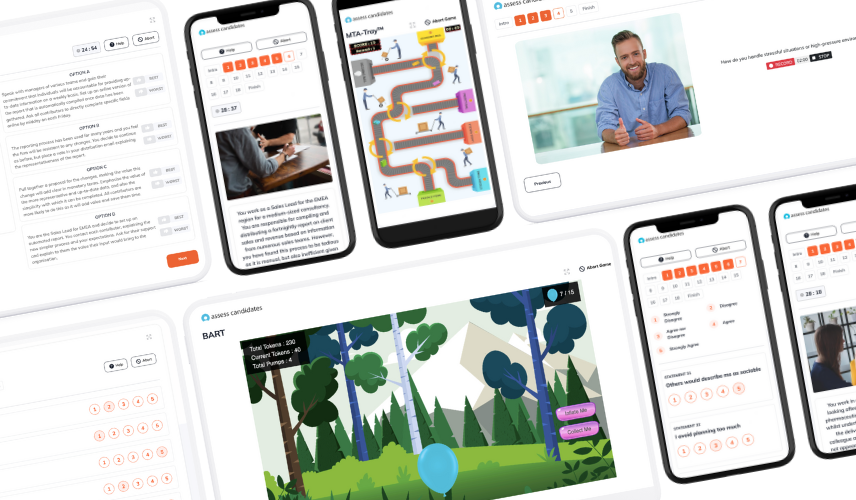
The 3 most common pre-employment assessments in 2025
1. Psychometric Assessments
Employers use AI-enhanced psychometric assessments to gain deeper insights into candidates’ emotional intelligence, adaptability, and collaborative behavior. These tools no longer rely on generic personality quizzes, but instead use science and predictive analytics to predict how individuals will perform on the job to specific workplace dynamics and challenges.
Psychometric tests include:
- Aptitude Tests
Aptitude tests, a form of psychometric assessment, evaluate a candidate’s cognitive abilities and potential in specific areas. Employers use these tests during the pre-employment process to assess technical skills and identify applicants who are best suited for the role, enabling more informed and objective hiring decisions.
Leading platforms offering aptitude tests include Assess Candidates, TestGorilla, and SHL.
- Behavioral Assessments
Organizations use advanced behavioral assessments that incorporate video and VR technology to simulate realistic workplace scenarios. Situational judgment tests (SJTs) present candidates with realistic workplace challenges via interactive media, while AI analyzes speech, facial cues, and problem-solving behaviors.
These behavioral assessment tools assess emotional intelligence, communication style, and decision-making under pressure, especially key for customer-facing roles. Some employers use VR to test candidates in high-stress environments, measuring their ability to remain composed and act effectively under time constraints.
Leading platforms offering behavioral assessments include Assess Candidates, HireVue, and Cangrade.
- Game-based Assessments
Hiring teams increasingly are turning to game-based assessments to evaluate cognitive skills and personality traits. These interactive games eliminate background-related biases by focusing solely on how candidates think and solve problems.
The games measure competencies like memory, risk-taking, attention, and emotional control using interactive, game-like elements. As a result, candidates are more engaged to complete these tests, enhancing the candidate experience, and thus are one of the most common pre-hire assessments in 2025.
Top platforms that offer game-based assessments include Assess Candidates, HireVue, and Cangrade.
2. Skills-based Assessments
Employers embrace skills-based assessments to measure candidates’ demonstrated abilities and job-relevant skills. You can test technical applicants with coding exercises and real-time debugging tasks, while creative candidates complete design challenges or portfolio reviews.
Even for general roles, employers use practical work simulations to evaluate performance. Many of these tools integrate directly with ATS platforms, enabling hiring teams to filter candidates based on actual performance.
Leading platforms providing skills-based assessments include Assess Candidates, HireVue, and Cangrade.
3. AI-driven Video Interview Tool
Employers use AI-powered video interview tools to streamline early-stage screening. These analyze candidates’ verbal responses, tone, facial expressions, and body language to assess communication skills, confidence, and cultural fit.
By automating interviews, hiring teams save time, minimize bias, and create a more standardized interview process. Many platforms integrate directly with ATS systems, allowing recruiters to shortlist candidates based on AI-generated insights and human judgement, thus setting the employment trends in 2025.
Leading platforms providing AI-driven video interview tools include Assess Candidates, HireVue, and MyInterview.
Uncover our expert range of psychometric tests, game-based assessments, and video interviews. LEARN MORE
Now, let’s look into the top candidate assessment software trending in 2025.
How can you choose the best candidate assessment software in 2025?
When choosing a talent assessment platform, employers must assess both the quality of the tools and the platform’s overall functionality. Consider these key questions:
- Does the platform streamline the evaluation process efficiently?
- Can I assess multiple candidates’ skills and behaviors at the same time?
- Are results and insights easily accessible, ideally with a single click?
- Does the platform support unbiased and objective evaluations?
- Can I customize assessments to fit the specific needs of my role and organization?
- Is the platform user-friendly and seamless for candidates throughout the assessment process?
By addressing these considerations, you can choose a candidate assessment platform that enhances your recruitment process while ensuring accuracy and efficiency.
Here are the top 10 pre-employment talent assessment providers trending in 2025:
- Assess Candidates
- SHL
- Criteria Corp
- Thomas International
- Aon Assessment
- Saville Assessment
- Talent Q
- TestGorilla
- Cubiks
- Test Partnership
Now, let’s explore how predictive analytics is redefining hiring in 2025.
6. How do predictive analytics improve hiring?
Organizations are transforming their hiring processes in 2025 by using predictive analytics – leveraging AI, machine learning, predictive assessments, and historical data to forecast outcomes with precision.

Rather than relying on resumes alone, recruiters analyze large datasets, including assessment results, past hiring patterns, performance metrics, and external labor trends to identify top candidates.
Using AI-Driven Assessments to Detect Attrition Risk Early
Predictive analytics, a hiring trend in 2025, are used by businesses to flag candidates likely to leave early, addressing turnover risks before hiring. AI algorithms evaluate factors such as job change frequency, behavioral traits, and responses to assessments to detect signs of low resilience or high risk-taking.
An example could be a candidate completing a situational judgment test during the recruitment process. Use your AI system to analyze their responses and evaluate their long-term suitability for the role.
Enhancing Culture Fit with Data-Backed Insights
Organizations now use AI to evaluate culture fit through objective, data-driven methods. These systems analyze assessment responses, language patterns, and even social media behavior to assess alignment with company values.
To select candidates who not only meet skill requirements but also thrive in the company’s environment, apply NLP and sentiment analysis to interview transcripts and written interactions. This helps gauge traits like collaboration, adaptability, and emotional intelligence.
Predicting Job Performance with Advanced Simulations
A rising hiring trend in 2025 is the use of job simulations and AI-powered assessments to predict how well candidates will perform in specific roles. Game-based tasks, cognitive tests, and problem-solving challenges help evaluate key skills, while tools like in-tray exercises and job simulations provide deeper insights. AI models then compare candidates’ responses to historical data from top performers to forecast on-the-job success.
By integrating real-time feedback from current employees, these systems continually refine their predictions, helping employers identify high performers from the start.
Reducing Bias and Promoting Diversity in Hiring
Employers reduce unconscious bias by using AI-driven assessments that focus on skill and performance data rather than personal identifiers. These tools anonymize resumes, flag biased language in job postings, and highlight patterns that may disadvantage diverse applicants.
Adopt fairness-aware algorithms that promote equitable hiring without compromising on quality. The result is a more diverse workforce that fosters innovation, stronger decision-making, and improved business outcomes.
Optimizing Talent Pipelines with Predictive Sourcing
Rather than reacting to hiring needs, recruiters now use predictive analytics, one of the leading job trends in 2025, to build talent pipelines in advance. AI analyzes market data, competitor activity, and internal workforce movement to forecast future roles and skill demands.
Armed with these insights, hiring teams engage passive candidates early, building relationships and reducing time-to-hire when openings arise. This strategic sourcing model gives organizations a competitive edge in a fast-moving talent market.
Personalizing the Candidate Experience with AI Insights
A hiring trend in 2025 is the use of AI to enhance the hiring journey for candidates by delivering personalized support throughout the process. Predictive systems analyze candidate behavior and preferences to suggest relevant job opportunities, provide preparation tips, and even tailor communication.
AI chatbots and assistants adjust messaging based on each candidate’s priorities, such as remote work options or growth potential, boosting engagement and improving offer acceptance rates.
In the following section, we will take a look at the recruitment tools that are still emerging as a new recruiting trend in 2025.
7. What new recruitment tools are emerging in 2025?
In 2025, a new wave of recruitment tools is transforming how companies identify, assess, and engage talent. While many innovations have already gained traction, we are now seeing the rise of next-gen technologies like immersive VR simulations, voice analysis, AI-powered chatbots, and blockchain-based credential verification. These tools are not just enhancing efficiency, but reshaping hiring strategies from the ground up.
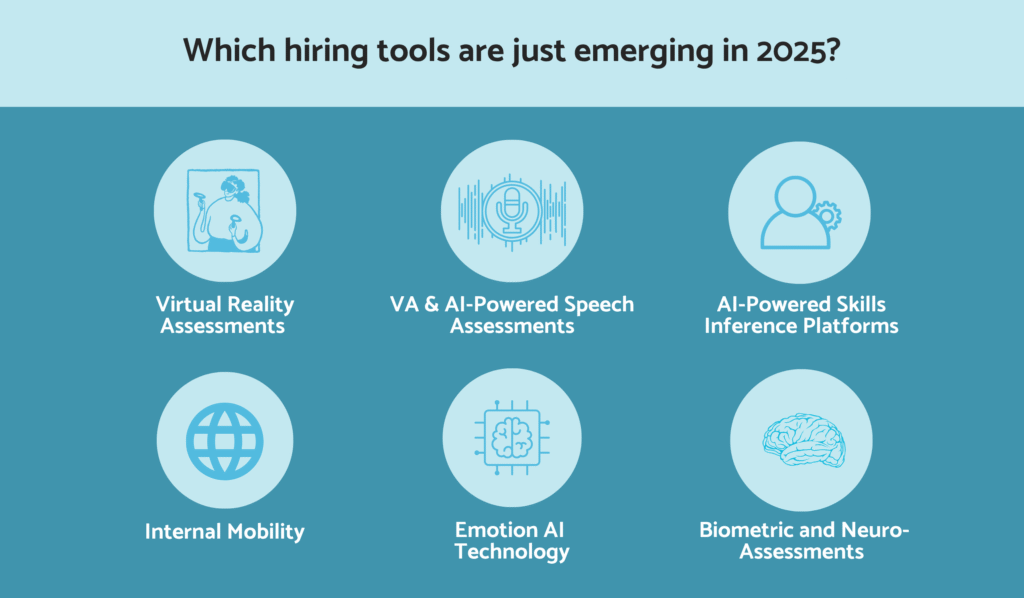
Recruitment tools that are still emerging as a hiring trend in 2025
- Virtual Reality (VR) Assessments
Companies use Virtual Reality (VR) assessments to evaluate candidates in realistic job scenarios. Unlike traditional methods, VR fully immerses applicants in simulated environments, such as resolving customer conflicts, leading virtual teams, or handling technical breakdowns, to assess critical skills like adaptability, problem-solving, and emotional intelligence. These tools not only improve hiring accuracy but also offer candidates an engaging, next-generation evaluation experience.
Leading providers of VR assessments: HireVue and Pymetrics.
- Voice Analysis (VA) and AI-powered Speech Assessments
Recruiters are increasingly using AI-powered voice analysis to evaluate candidate potential beyond written responses. These tools assess tone, speech patterns, and word choice to gauge confidence, communication abilities, and personality traits.
Top providers of AI-powered voice analysis: Cangrade and Sapia.ai.
- AI-powered Skills Inference Platforms
Employers now use AI to infer candidate skills from non-traditional data sources instead of relying solely on resumes. These tools help companies uncover untapped talent, reduce bias, and match individuals to roles based on real-world competencies.
Top AI-powered skills interference platforms: Eightfold.ai and TalentWall.
- Internal Mobility Tools
Modern organizations are actively focusing on internal mobility tools, establishing it as an emerging hiring trend in 2025. These tools dynamically match employees with internal opportunities, recommend personalized upskilling paths, and enable gig-style project staffing. They identify transferable skills across departments, predict future competency gaps, and suggest targeted training programs.
By fostering agile talent ecosystems, these intelligent platforms help organizations boost retention, lower hiring costs, and future-proof their workforce through continuous reskilling.
Leading internal mobility platforms: Gloat and Fuel50.
- Emotion AI Technology
Emotion AI technology is yet another recruiting trend that has been gaining momentum in 2025. These tools provide insights into a candidate’s emotional engagement and transform interview assessments. They actively analyze micro-expressions, vocal tones, and engagement levels during video interviews, going beyond content alone.
Emotion AI technology gives recruiters deeper insights into candidate suitability and provides applicants with real-time feedback on communication effectiveness and emotional intelligence.
Significant Emotion AI technology platforms: Affectiva and IMentiv AI.
- Biometric and Neuro-assessments
Employers are turning to biometric and neuro-based tools to gain deeper insights into candidates’ cognitive and emotional capacities. These tools assess stress resilience through facial recognition and reaction-time testing, track micro-expressions to evaluate emotional intelligence, and use EEG headsets to measure focus and problem-solving skills in real time.
Leading biometric and neuro-based platforms: Pymetrics and Cognisess.
Explore our cutting-edge video interview tool using emotion AI technology. LEARN MORE
8. Why top companies choose Assess Candidates for pre-employment testing
At Assess Candidates, we provide a comprehensive suite of pre-employment assessments to align with the unique hiring requirements of any organization and help you stay ahead of the hiring trends.
Here is an example of the campaign reporting dashboard that you will come across on the Assess Candidates platform. This intuitive tool equips hiring managers and HR professionals with actionable insights and advanced sorting capabilities, simplifying candidate assessment and streamlining the selection process.
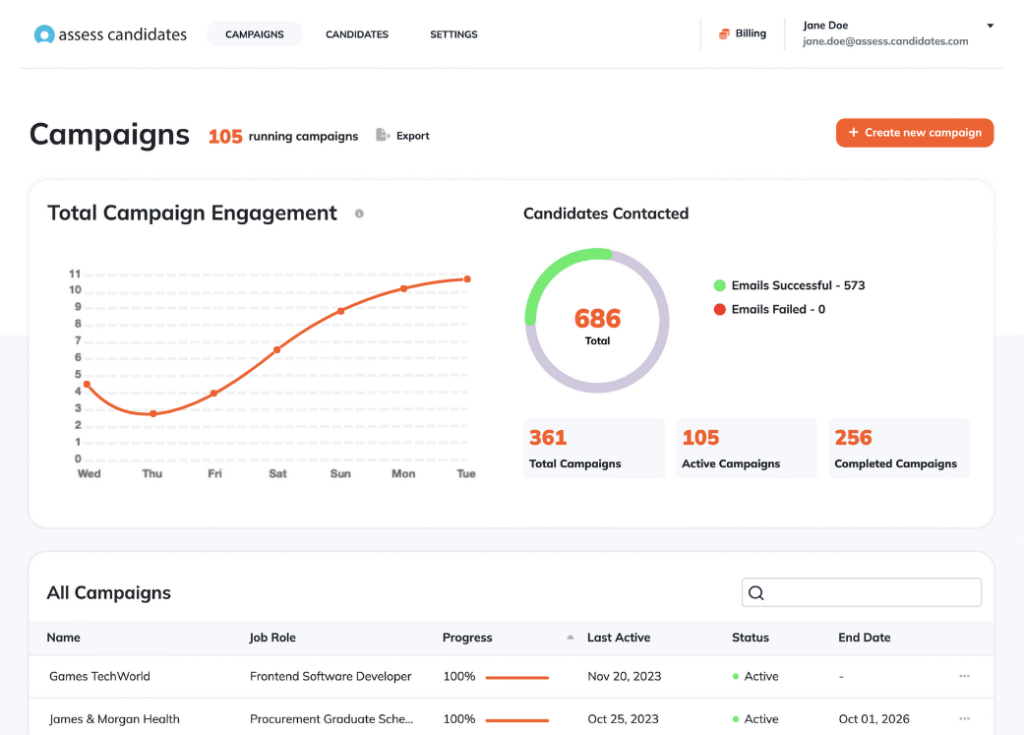
Here are the top 4 reasons why you should use Assess Candidates’ pre-employment hiring tests to keep up with hiring trends:
- Designed and Scientifically Validated by Expert Psychologists: Assess Candidates’ assessments are crafted by Chartered Scientists, Psychologists, and Psychometricians with decades of experience, including designing assessment solutions for companies like SHL and IBM Kenexa. Our assessments have undergone rigorous testing and validation to measure candidates’ skills across diverse dimensions. These tests have consistently selected and hired top talent across various organizations and industries.
- Expert Reporting: Assess Candidates’ intuitive and easy-to-navigate assessment platform enables employers to assess candidate reports in detail and make data-driven hiring decisions based on customizable criteria. Recruiters can efficiently review the performance of the candidates individually on multiple assessments and then filter, rank, compare, and shortlist them. Additionally, our talent assessment platform offers the option to integrate seamlessly with your existing ATS for a smooth and efficient recruitment process.
- Positive Candidate Experience: Assess Candidates’ hiring assessments are designed to be easily accessible from any device. They also feature an aesthetic and user-friendly interface for candidates. The assessment instructions are displayed distinctly and can be fully customized to match your organization. With minimal clicks required to complete, the assessment automatically progresses to the next question once answered. This ensures an effortless and optimistic candidate experience, enabling a positive perception of your brand.
- Candidate Accessibility Support: Assess Candidates provide support for individuals with disabilities and visual impairments. All our hiring assessments present options to add extra time, zoom functionalities, and accessible color schemes and images in compliance with Web Content Accessibility Guidelines (WCAG), guaranteeing compatibility with screen readers.
Assess Candidates is a leading pre-employment hiring test provider that is proven to provide end-to-end assessment solutions for small, medium, and large employers. Our user-friendly platform will empower you to confidently and successfully recruit top talent.
Explore our comprehensive range of top hiring tests and make the right hiring decisions today!
Unlock smarter hiring decisions with advice from our organisational psychologists. CONTACT US
Interested in learning more about effective candidate assessment? Continue reading for frequently asked questions, and sign up with your email to get started.
Frequently Asked Questions
Are AI-powered hiring tools affordable for small and mid-sized businesses (SMBs)?
Yes, small and mid-sized businesses (SMBs) can now access affordable AI hiring tools through pay-per-use and subscription models. These tools, such as resume screeners, chatbots, and skill assessments, streamline recruitment and reduce bias with minimal investment. Cloud-based platforms offer flexible plans, helping smaller teams compete effectively for top talent while staying within budget.
Is skill-based hiring a recruiting trend in 2025?
Yes, skills-based hiring is a recruiting trend in 2025, moving away from traditional qualification-based practices. Employers now prioritize hands-on expertise and skills-first assessments, ensuring better alignment with role requirements and enabling the development of more skilled, adaptable teams.
How does employer branding influence the candidate selection process?
Employer branding influences the candidate selection process by attracting top talent and building trust. Candidates are more likely to apply to companies that keep up with key hiring trends and have a strong employer brand based on diversity, sustainability, and social responsibility, enhancing both recruitment and employee retention.
Are job trends impacted by objectivity in the recruitment process in 2025?
Job trends in 2025 are influenced by increased objectivity in recruitment, driven by diversity, equity, and inclusion (DE&I) efforts. Companies now focus more on diverse perspectives to enhance innovation, creativity, and workplace culture, aided by tools like online psychometric tests.
What role do candidates play in shaping hiring trends?
Gen Z candidates actively shape hiring trends by demanding transparency, flexibility, and values-driven workplaces. Their expectations drive employers to adopt inclusive, tech-enabled, and skills-based recruitment practices, transforming the hiring process into a more candidate-centric and future-ready approach.


 English
  Arabic