
How To Successfully Combine Personality Assessments With Interviews For Recruitment?



Hiring the right talent requires more than reviewing resumes or conducting interviews alone. While interviews reveal communication skills and situational judgment, they often miss deeper insights into personality, motivation, and cultural fit.
Work personality assessments fill that gap by providing objective data on how candidates are likely to think, behave, and collaborate within the organization.
By combining personality tests with interviews, employers gain an even more comprehensive view of each candidate. Assessment results can guide interview questions, allowing recruiters to further explore specific behaviors, validate findings, and evaluate how candidates apply their strengths in real-world scenarios. This approach ensures more accurate and informed hiring decisions.
Integrating both methods also improves the efficiency and fairness of your recruitment process. Employers can streamline shortlisting, reduce bias, and maintain consistency across evaluations – resulting in high-performing teams, stronger employee retention, and a workplace culture aligned with organizational goals.
Whether you’re a hiring manager or HR professional, you might find yourself asking questions, including:
- Why are personality assessments important in recruitment?
- Why should interviews be used for recruitment?
- How to align personality assessments with interviews for better accuracy and fairness?
- How can I use personality test insights to tailor interview questions effectively?
In this comprehensive guide, we explore how personality assessments complement interviews to improve candidate evaluation and hiring outcomes.
Contents
- What are personality assessments for recruitment?
- What are the different types of interviews used during recruitment?
- How to successfully integrate workplace personality tests with interviews in the recruitment process?
- How does combining personality testing with interviews help in recruitment?
- How to combine personality assessments and interviews: Client Success story
- Why do top companies choose Assess Candidates for personality testing and video interviews?
Now that we’ve summarized what this article covers, let’s find out what personality assessments are in recruitment.
1. What are personality assessments for recruitment?
Personality tests for recruitment are psychometric tests used to identify a candidate’s personality traits, behavior, and workplace preferences. They help employers understand how well a candidate’s personality aligns with company culture, goals, and work style, ultimately supporting stronger team and organizational cohesion.
Strengthen your hiring strategy with our scientifically validated personality assessments. HIRE FOR FREE
Why are personality assessments used for candidate evaluation?
Work personality assessments provide valuable insights into traits that influence job performance, team dynamics, and overall organizational fit. They go beyond technical skills, revealing how individuals think, interact, and respond to workplace challenges.
When used effectively, these assessments build stronger, more productive teams and promote fair, data-driven decisions.
Here are 8 major reasons why employers use personality testing for hiring:
1. Cultural Fit Assessment
Personality assessments evaluate how well a candidate’s personality aligns with your company culture and values. Identifying candidates who are likely to thrive within the existing environment and norms contributes to building a cohesive, harmonious workplace.
2. Predicting Job Performance
Personality tests can predict success in specific roles by highlighting traits that correlate with high performance and job satisfaction. Employers can then place individuals where they are most likely to excel.
Did you know? According to a Myers-Briggs report, 88% of Fortune 100 companies use personality assessments.
3. Tailoring Roles to Individual Strengths
Personality testing matchs candidates to roles that align with their natural strengths and preferences, enhancing team dynamics. By placing individuals in positions that complement their personality traits, employers help create well-balanced, high-performing teams.
4. Identifying Leadership Potential
As a recruiter, assessing leadership qualities and potential in candidates is integral. Identifying individuals with traits such as decisiveness, emotional intelligence, and strategic thinking helps in cultivating effective leadership within the organization.
5. Screening for Specific Traits
With personality assessments, employers can target traits crucial for success in particular roles. Focusing on job-relevant characteristics streamlines the hiring process and ensures a more efficient and effective candidate evaluation.
6. Enhancing Team Dynamics
Recruiters analyze how a candidate’s personality contributes to overall team dynamics. Building diverse yet complementary teams helps create an environment where collaboration and productivity thrive.
Did you know? According to a LinkedIn report, about 80 million individuals worldwide complete a pre-hire personality test each year.
7. Reduction of Unconscious Bias
Standardized personality assessments minimize unconscious bias during hiring. By focusing on measurable personality traits rather than subjective impressions, organizations promote fairness and equity in recruitment decisions.
Did you know? According to a LinkedIn report, 77% of recruiters expect diversity to be crucial in future recruitment.
8. Alignment with Organizational Values
Recruiters assess whether a candidate’s personal values align with the organization’s mission and vision. Personality assessments provide valuable insights into how closely a candidate’s beliefs and behaviors reflect the company’s core values.
Now, you have an understanding of what personality tests are, In the following section, we will take a look at what the different types of interviews are.

2. What are the different types of interviews used during recruitment?
Personality assessments play an important role in candidate evaluation, but they are rarely the only pre-employment assessment tool used in the process. Interviews remain a key part of recruitment, yet not all interviews follow the same approach.
While interview styles vary widely, a few main types dominate. Each focuses on assessing a candidate’s skills, personality, and cultural fit.
Employers often combine different interview formats to match job requirements and organizational values. Understanding these variations helps create a more strategic and effective hiring process.
Did you know? According to Zippia, recruiters use structured interview techniques 74% of the time, followed by behavioral interviews 73% of the time, and panel interviews 48% of the time.
The common types of interviews used in recruitment
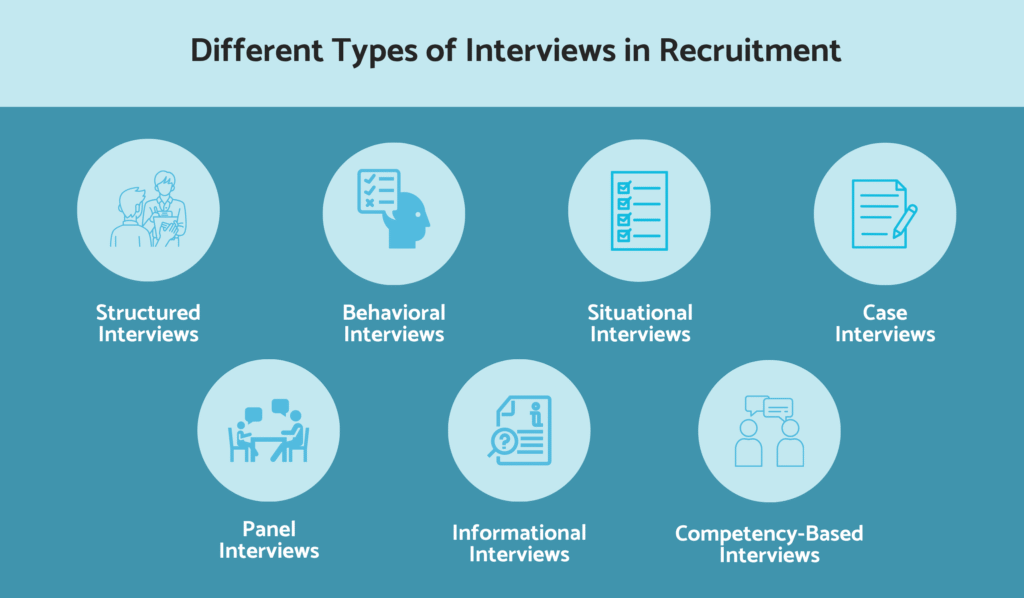
Structured Interviews
Structured interviews follow a predetermined set of questions, ensuring consistency across all candidates. They are designed to assess a candidate’s skills, competencies, and knowledge relevant to the job. By maintaining a standardized format, structured interviews provide a fair basis for comparison among candidates.
Structured interviews are best for:
- Ensuring fairness and consistency in candidate evaluation.
- Comparing applicants objectively using standardized questions.
- Roles that require a balanced assessment of both technical and behavioral competencies.
Did you know? According to a report by Indeed, 82% of hiring managers employ virtual interviews.
Behavioral Interviews
Behavioral interviews explore a candidate’s past experiences and actions to predict how they might behave in future scenarios. Using the premise that past behavior is indicative of future performance, these interviews assess qualities like problem-solving, communication, and interpersonal skills.
Behavioral interviews are best for:
- Assessing soft skills and interpersonal competencies.
- Predicting how candidates might handle specific job-related situations.
- Roles where interpersonal relationships and teamwork are critical.
Did you know? According to legaljobs, the number of managerial and teaching jobs that require both analytical and social skills has increased by 94% since 1980.
Situational Interviews
Situational interviews present candidates with hypothetical job-related scenarios and evaluate their problem-solving and decision-making abilities. This type of interview aims to understand how candidates would approach challenges and make choices in real-world situations.
Situational interviews are best for:
- Roles that demand quick and effective decision-making.
- Positions with high-pressure or unpredictable work environments.
- Assessing adaptability and critical thinking.
Case Interviews
Common in fields like consulting and finance, case interviews present candidates with real or hypothetical business problems. Candidates are expected to analyze the situation, propose solutions, and articulate their thought processes. These interviews assess analytical skills, creativity, and strategic thinking.
Case interviews are best for:
- Roles requiring analytical reasoning.
- Evaluating problem-solving abilities in real-world contexts.
- Assessing how candidates approach complex challenges.
Did you know? According to Yello, recruiters spend an average of two-thirds of their hiring time on the interview process.
Panel Interviews
Panel interviews involve multiple interviewers questioning a single candidate simultaneously. This format enables a comprehensive evaluation from multiple perspectives, including technical expertise, cultural fit, and team compatibility. Panel interviews are valuable for obtaining diverse insights in a single session.
Panel interviews are best for:
- High-level positions where decisions involve multiple stakeholders.
- Comprehensive evaluation of a candidate’s compatibility with various team members.
- Streamlining the interview process for efficiency.
Informational Interviews
Informational interviews are more conversational and focus on the candidate’s interest in the company, role, and industry. While less formal, they provide valuable insights into a candidate’s cultural fit, enthusiasm, and commitment.
Informational interviews are best for:
- Assessing a candidate’s alignment with organizational values.
- Gauging a candidate’s understanding of the company’s mission and goals.
- Roles where cultural fit is crucial for success.
Did you know? According to SRHM’s report, 74% of recruiters have found that video interviews have made their job of interviewing and shortlisting candidates easier.
Competency-Based Interviews
Competency-based interviews target specific skills and competencies required for the job. Candidates are asked to provide examples from their past experiences that demonstrate their proficiency in these core areas.
Competency-based interviews are best for:
- Roles with well-defined competency requirements.
- Evaluating practical skills and experiences.
- Ensuring alignment with the organization’s core competencies.
Create job-relevant questions with our custom AI-powered video interviews. LEARN MORE
Let’s now take a look at how personality assessments can be successfully integrated with interviews for holistic hiring.
3. How to successfully integrate workplace personality tests with interviews in the recruitment process?
Combining personality assessments with interviews gives employers a deeper, more accurate view of candidates. Assessments reveal behavioral patterns and work preferences, while interviews highlight communication skills and practical judgment. When used together, these tools strengthen hiring decisions by validating insights and ensuring a fair, well-rounded evaluation process.
Here are 9 strategic steps to use personality assessments and interviews together in recruitment:

1. Define Job Requirements
Begin by outlining both the technical skills and critical personality traits required for success in the specific role. For instance, if effective collaboration is key, consider traits like teamwork, adaptability, and communication skills.
Did you know? According to OnVideoChat, video interviews are 6 times faster than phone interviews.
2. Choose the Right Assessment
Select a personality assessment tool that aligns with your job’s demands. For example, if the role requires a balance between independence and teamwork, look for pre-employment personality questionnaires that measure traits such as independence, cooperation, and openness to collaboration.
At Assess Candidates, we offer the following types of personality tests: Big 5 Work Personality Test, SHL Occupational Personality Questionnaire, and the Hogan Personality Inventory.
3. Transparent Communication
Clearly communicate to candidates that the assessment aims to understand their natural tendencies. Assure them that there are no right or wrong answers and that the goal is to ensure a harmonious fit within the organizational culture.
Did you know? According to a LinkedIn report, 94% of job seekers want to receive interview feedback.
4. Tailor Interview Questions
Leverage personality assessment results to identify potential “Danger Zones,” such as extreme introversion or overemphasis on independence. Tailor interview questions to explore how candidates manage these traits in professional settings. For instance, ask about experiences working in both collaborative and independent projects.
5. Diverse Question Types
Incorporate a variety of question types. For technical roles, include problem-solving scenarios. For interpersonal skills, ask about past experiences in conflict resolution or successful team collaborations.
6. Explore Verbal Nuances
Encourage candidates to elaborate on their communication preferences and work style. For example, inquire about their approach to giving and receiving feedback or how they handle disagreements within a team.
Did you know? According to Workonic, high-quality candidates only have to wait 10 days to find a new job.
7. Observe Non-Verbal Cues
Pay close attention to non-verbal cues. Observe body language, facial expressions, and tone of voice. For instance, a candidate may express introverted tendencies verbally but demonstrate extroverted energy through gestures and expressions.
8. Verify Consistency
Cross-verify interview responses with the traits identified in the personality assessment. If the assessment suggests a high level of detail-orientedness, delve into specific examples during the interview to ensure consistency in their narrative.
9. Address Inconsistencies
Promptly address any inconsistencies between assessment results and interview responses. For example, if the assessment indicates high adaptability but the candidate struggles to provide relevant examples, explore these gaps to gain a deeper understanding.
Unlock comprehensive insights into your candidate’s personality for better hiring decisions. HIRE FOR FREE
Next up, we will take a look at the benefits of combining personality assessments with interviews for recruitment.
4. How does combining personality testing with interviews help in recruitment?
Integrating personality assessments with interviews enables recruiters to make more informed and balanced hiring decisions. While assessments uncover key traits such as motivation, teamwork, and adaptability, interviews highlight a candidate’s communication, problem–solving, and behavioral responses in real situations.
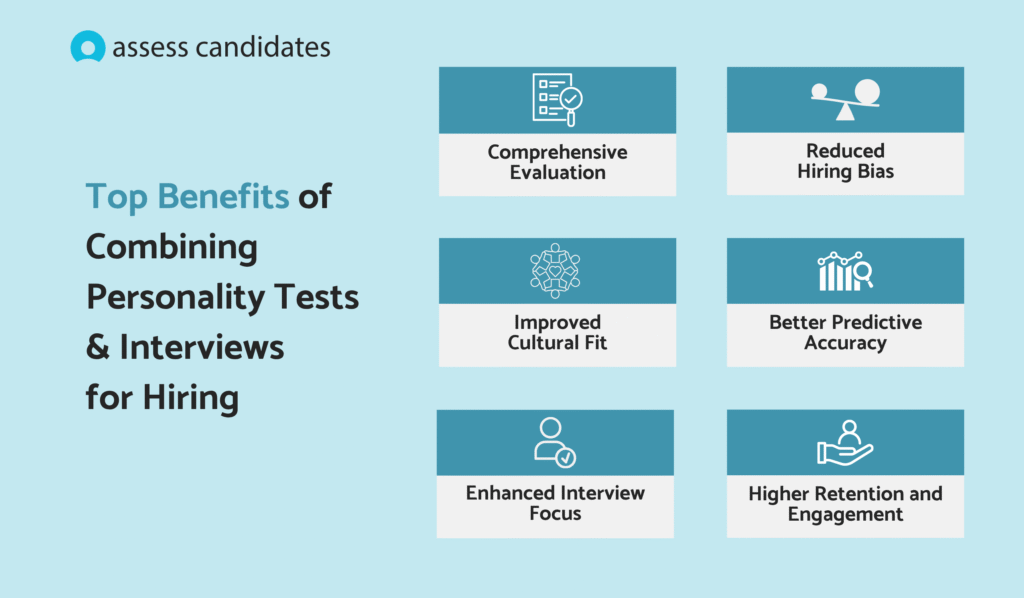
Here are the benefits of combining personality assessments and interviews for hiring
Comprehensive Evaluation
Employers gain a complete view of each candidate by integrating personality assessments with interviews. Assessments reveal behavioral patterns, motivation, and work preferences, while interviews uncover interpersonal skills, problem-solving ability, and real-world judgment. Together, these methods give recruiters a clear picture of the candidate’s potential and role compatibility.
Improved Cultural Fit
Recruiters use personality assessments to identify candidates whose values and work styles align with company culture. During interviews, they confirm this alignment through conversation and real-life examples. This combined approach helps ensure new hires thrive in the organization’s existing environment, boosting engagement and long–term job satisfaction.
Enhanced Interview Focus
Recruiters use personality assessment insights to craft interview questions that match each candidate’s personality traits. For instance, if a candidate shows strong independence but weaker collaboration, interviewers can ask targeted questions about teamwork experiences. This approach keeps interviews focused, consistent, and aligned with role requirements.
Reduced Hiring Bias
Recruiters reduce unconscious bias by combining standardized personality assessments with structured interviews. Assessment data provides objective insights, ensuring hiring decisions rely on measurable traits instead of personal impressions. This method promotes fair evaluation and supports diversity and inclusion in recruitment.
Better Predictive Accuracy
By combining assessment results with interview performance, recruiters strengthen their ability to predict job success. Personality data reveals behavioral tendencies, while interviews confirm how those traits appear in practice. This integration improves hiring accuracy and reduces costly mismatches.
Higher Retention and Engagement
Recruiters who use both methods hire candidates who fit well within teams and the organizational culture. Aligning personality traits with job demands and validating fit through interviews helps employers select capable, motivated individuals. As a result, employees show higher engagement, stronger collaboration, and better retention rates.
However, with every assessment method, you may be faced with some challenges and obstacles to overcome.
Challenges faced when combining personality assessments with interviews
- Bias in Interpretation: Interviewers unconsciously interpret assessment results to match their personal impressions of candidates.
Solution: Train interviewers to interpret data objectively using structured scoring rubrics and calibration sessions to minimize bias.
- Inconsistent Application: Recruiters may apply assessment data unevenly when they lack standardized procedures.
Solution: Implement clear evaluation frameworks and standardized interview guides to ensure consistent use across all candidates.
- Overreliance on Test Results: Recruiters place too much emphasis on personality scores and overlook practical skills or experience.
Solution: Balance assessment data with structured interviews, skill-based tasks, and real-world performance evaluations.
- Candidate Faking or Impression Management: Candidates may tailor their responses in tests and interviews to appear more favorable.
Solution: Use validated personality assessments with response consistency checks and verify results through behavioral interview questions.
- Test Anxiety or Cheating: Some candidates feel anxious or may attempt to manipulate results to perform better.
Solution: Create a comfortable testing environment and choose providers with strong security measures such as remote proctoring, ID verification, randomized question banks, and cheat detection systems. Providers like Assess Candidates implement these safeguards to maintain test integrity.
- Accessibility Issues: Candidates with disabilities may face barriers in completing the assessments if the platform is not fully accessible.
Solution: Choose assessment providers that comply with accessibility standards (WCAG) and offer accommodations such as screen readers, larger text, or extended time where needed. Providers like Assess Candidates prioritize inclusivity by providing WCAG-compliant features.
Discover top talent with our end-to-end talent assessment platform. LEARN MORE
5. How to combine personality assessments and interviews: Client Success story
Client Problem
Imagine a global retail company experiencing high employee turnover despite hiring candidates with strong technical skills. While interviews help assess experience and communication, they fail to capture deeper insights into personality traits, motivation, and cultural fit.
As a result, new hires often struggle to adapt to the organization’s collaborative environment, leading to reduced engagement, performance gaps, and increased hiring costs. The company needs a more holistic approach that evaluates both personality and interview performance to ensure long-term employee success.
Assess Candidates’ Proposal
At Assess Candidates, we recommend integrating personality assessments with video interviews to create a balanced and data-driven recruitment process. Personality assessments help measure key traits such as adaptability, teamwork, emotional intelligence, and leadership potential, offering objective insights into a candidate’s suitability for the role and the organizational culture.
Once these results are available, interviewers can use them to tailor interview questions, explore behavioral patterns in depth, and validate assessment findings through real-world examples. For instance, if a candidate’s results highlight strong conscientiousness but lower openness, the interviewer can probe how they handle change or ambiguity in work situations.
Recruiters can also use assessment data to guide interview panel decisions, ensuring alignment between the candidate’s personality profile and team dynamics. This combination of objective testing and interactive evaluation results in more consistent, informed, and equitable hiring decisions.
Result
By integrating personality assessments with interviews, the company can identify candidates who not only have the required skills but also align with its culture and values. This structured approach enhances hiring accuracy, strengthens team cohesion, and reduces turnover rates. Over time, the organization builds a more engaged, resilient, and high-performing workforce.
Partner with Assess Candidates to leverage scientifically validated personality assessments and interviews. VIEW PLANS
So, why choose us?
6. Why do top companies choose Assess Candidates for personality testing and video interviews?
At Assess Candidates, we offer a comprehensive suite of personality assessments and video interviews and create recruitment campaigns tailored to each organization’s unique hiring needs.
Here is an example of our campaign reporting dashboard available on Assess Candidates.
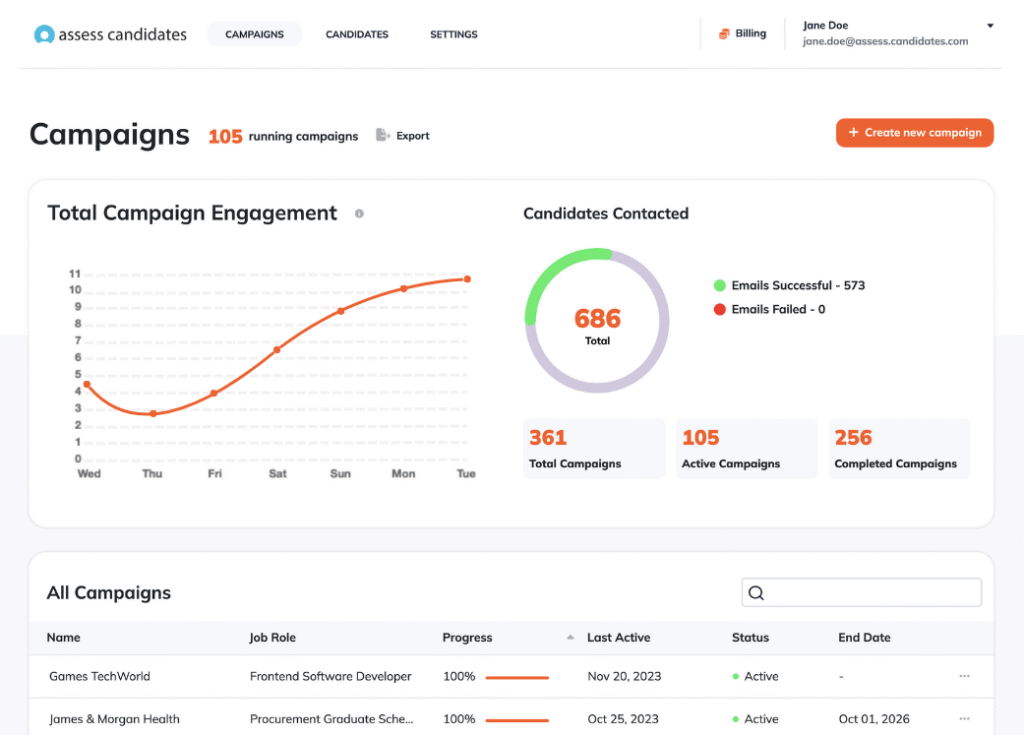
Here are the top 4 reasons why you should use Assess Candidates’ personality assessments and interviews for your pre-employment selection process:
- Scientifically Designed and Validated by Expert Psychologists: Assess Candidates’ personality assessments and video interview solutions are developed by Chartered Psychologists and Psychometricians with decades of experience designing tools for global leaders like SHL and IBM Kenexa.
Each assessment is scientifically validated to accurately measure behavioral traits, communication style, and job fit, helping employers identify candidates who align with both role requirements and company culture. - Expert Reporting: Our intuitive talent assessment platform enables recruiters to evaluate personality insights alongside video interview performance for a complete candidate profile. Employers can review behavioral data, compare responses, filter, rank, and shortlist candidates with ease. The talent assessment platform integrates seamlessly with any ATS, streamlining the entire hiring workflow and supporting data-driven decisions.
- Positive Candidate Experience: All personality assessments and video interviews feature a clear, mobile-friendly interface that ensures a smooth and engaging candidate experience. With intuitive navigation, branded designs, and automated progress tracking, candidates can complete their assessments and interviews effortlessly, reflecting positively on the employer brand.
- Candidate Accessibility Support: Inclusivity remains central to our design. We provide accessibility options such as extra time, zoom features, screen reader compatibility, and color adjustments, all compliant with WCAG standards. This ensures that every candidate, including those with disabilities or visual impairments, can participate equitably.
Assess Candidates delivers end-to-end, science-backed recruitment solutions that combine personality insights and video interviews for smarter, fairer hiring. Explore our assessment tools today and start building teams that perform and thrive.
Not sure if personality assessments and video interviews fit your hiring needs? Contact us for a free consultation and discover the best solution for your recruitment process.
Interested in learning more about effective candidate assessment? Continue reading for frequently asked questions, and sign up with your email to get started.
Frequently Asked Questions
How do personality assessments contribute to candidate evaluation?
Personality assessments provide in-depth insights into an individual’s traits, influencing job performance, team dynamics, and organizational fit. Their multifaceted role extends from predicting success in specific roles to enhancing communication and reducing biases in the hiring process.
What tools help integrate assessments and interviews effectively?
Recruiters can leverage talent assessment platforms like Assess Candidates that integrate psychometric insights with interview management tools. These systems store personality profiles, create customized interview guides, and display side-by-side candidate comparisons. When connected with Applicant Tracking Systems (ATS), they centralize all candidate data, from assessment results to interview feedback, supporting faster, smarter, and more consistent hiring decisions.
How to use verbal and non-verbal cues in interviews to complement personality assessments?
Encourage candidates to elaborate on communication preferences and work styles. Observe non-verbal cues, especially when discussing potential “Danger Zones”. Assess adaptability through questions challenging identified traits. Verify the consistency of interview responses with personality assessment traits.
How does combining both methods improve hiring outcomes?
Combining personality assessments with interviews makes hiring more accurate and consistent. Recruiters can assess both the “can do”, a candidate’s skills and potential, and the “will do”, their motivation and cultural fit. This well-rounded approach enhances job alignment, increases retention, and fosters a more engaged, high-performing workforce.
How can organizations ensure fairness when combining personality assessments with interviews?
Organizations can ensure fairness by using validated personality assessments and structured, competency-based interviews. Applying consistent questions, objective scoring, and clear evaluation criteria reduces bias and promotes equal treatment. This integrated, data-driven approach supports transparency, ethical hiring practices, and alignment with diversity and inclusion objectives.


 English
  Arabic