
How to Measure Problem-Solving Skills in Candidates During the Hiring Process



Ever wondered why some hires excel under pressure and find solutions quickly, while others struggle with change? This contrast often comes down to their ability to solve problems.
In today’s ever-changing work environment, you need employees who can quickly analyze information, adapt to changing situations, and solve problems through logic.
However, it’s hard to assess problem-solving skills through resumes and traditional interviews alone. These methods highlight experience, not thinking processes or real capability, increasing the risk of misaligned hires.
To avoid this issue, employers use structured, data-based assessment methods that demonstrate exactly how candidates approach problems, prioritize information, and make decisions. By combining reasoning tests, situational judgment assessments, job simulations, and behaviour-based interviews, organizations can gain deeper insight into a candidate’s problem-solving abilities.
In this guide, we will explore the proven pre-employment assessment tools to measure problem-solving skills, helping you recruit top talent faster and more fairly.
Contents
- What are problem-solving skills?
- Why do problem-solving skills matter in the workplace?
- How to measure problem-solving skills in candidates
- How to score and interpret problem-solving skills
- What to avoid when assessing problem-solving skills in candidates?
- Measuring problem-solving skills: Client Success Story
- Why top companies choose Assess Candidates to evaluate problem-solving skills
Now that we’ve summarized what this article covers, let’s start with the basics: what problem-solving skills are.
1. What are problem-solving skills?
Problem-solving skills are a person’s ability to identify problems and their root causes, evaluate potential solutions, and choose the most effective one to solve the issue.

In the workplace, problem-solving goes beyond simply fixing immediate issues. It reflects an employee’s critical thinking, communication skills, adaptability, and technical expertise.
Employees with strong problem-solving skills proactively anticipate problems. They are able to break down complex challenges, collaborate effectively to consider multiple perspectives, communicate their reasoning, and act decisively using logic and evidence.
Did you know? According to the World Economic Forum, analytical thinking remains the most in-demand skill for employers, with 7 out of 10 companies considering it essential.
Measure real problem-solving skills using our science-backed pre-employment assessments. HIRE FOR FREE
Now you understand what problem-solving skills are, let’s take a look at why measuring them is important for the workplace.

2. Why do problem-solving skills matter in the workplace?
Problem-solving skills are essential throughout the employee lifecycle, but especially during the pre-employment hiring process as problem-solving is a strong predictor of performance across industries and seniority levels. Employees with strong problem-solving ability can successfully identify and resolve the daily challenges your organization faces.
Here are 5 key reasons why problem-solving skills matter in the workplace:

1. Enhanced Operational Efficiency
Employees with strong problem-solving skills in the workplace can easily help you identify workflow gaps and eliminate obstacles. They will also help implement strategies that improve operations, saving time and resources in the long run.
2. Stronger Decision-Making
Employees with good problem-solving skills quickly gather relevant information, weigh the possible solutions, and choose the most effective option. This structured thinking helps the team develop with confidence.
3. Drives Innovation and Improvement
Problem solvers question outdated practices and propose more effective and smarter alternatives. Their ability to think creatively helps your organization stay competitive in an ever-changing market.
4. Strengthened Teamwork and Communication
Problem solvers also help strengthen teamwork and communication in a workplace. They collaborate easily, share insights, and consider various viewpoints when solving complex issues.
5. Improved Customer Satisfaction
When customers face problems, employees with strong problem-solving skills respond quickly, identify, and understand the root cause of the issue. This helps resolve issues more clearly and effectively.
Discover our scientifically validated logical reasoning assessments for measuring problem-solving skills. LEARN MORE
In the following section, we will delve into the different ways to measure problem-solving skills.
3. How to measure problem-solving skills in candidates
Measuring problem-solving skills in candidates requires assessing how they think, make decisions in realistic scenarios, and analyze information. The following are some of the assessment tests that help measure a candidate’s problem-solving skills:

- Logical Reasoning Tests
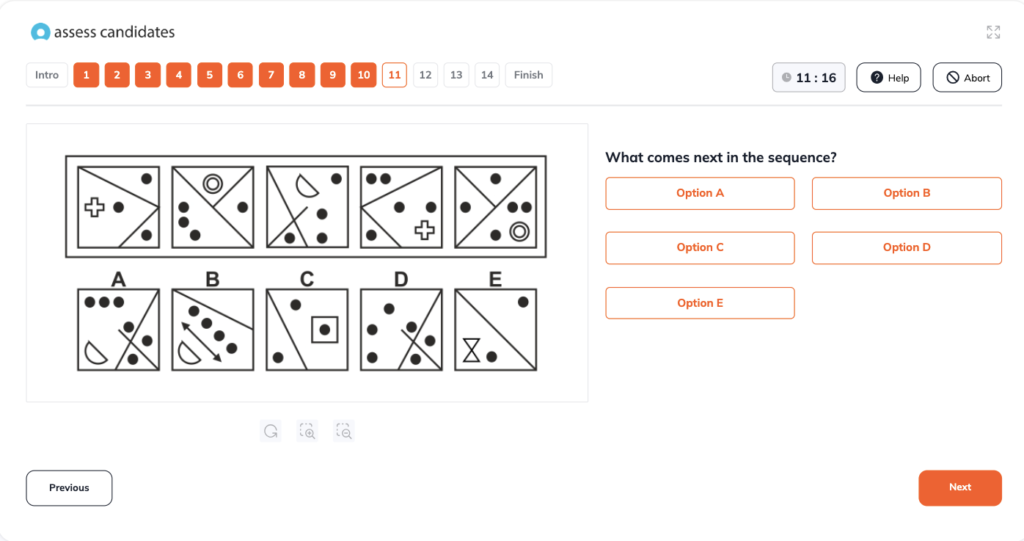
Logical reasoning tests measure how effectively candidates analyze information, recognize patterns, and draw sound conclusions from them. Through these tests, you will also get a clear picture of a candidate’s ability to handle complex tasks, prioritize reasoning over guesswork, and approach obstacles with clarity and structure.
Assess Candidates Logical Reasoning Example Question
- Game-Based Assessments
Game-based assessments will help you evaluate cognitive, problem–solving, and decision–making skills through interactive tasks presented as games. These tests show how candidates respond to dynamic rules, manage competing priorities, and make quick decisions while tracking metrics like adaptability, accuracy, and strategy.
These tests will further help you reduce a candidate’s test anxiety, generate behavioral data, and offer an interactive, engaging alternative to traditional aptitude tests.
- Situational Judgment Tests
Situational judgment tests (SJTs) help you understand how candidates evaluate workplace scenarios and select the most appropriate response. These tests present realistic challenges that assess competencies like communication, conflict resolution, leadership potential, time management, and ethical decisions.
These tests also help you gain insights into a candidate’s problem-solving abilities, emotional intelligence, and judgment in real-world scenarios.
Example: A key client contacts you to complain about a delayed delivery that is now affecting their deadlines. How would you respond to resolve this issue? Please rate the effectiveness of each option:
A) Acknowledge the issues and their frustration, apologize for the delay, and explain you will look into the issue but don’t provide a clear solution.
B) Shift blame to another team and suggest the issue is outside your control.
C) Clearly explain the reason for the delay, propose a revised delivery timeline, and confirm next steps to resolve the issue or minimize further impact.
D) Ignore the complaint, do not respond immediately, and instead wait for the situation to resolve itself.
- Abstract Reasoning Tests
Abstract reasoning tests will help you understand how well candidates identify patterns, interpret relationships, and draw logical conclusions from unfamiliar information. These tests will also allow you to navigate how well a candidate thinks conceptually, processes complex information, and solves problems without any prior knowledge.
Example: “Which of the following options comes next in the sequence?”
- Diagrammatic Reasoning Tests
Diagrammatic reasoning tests assess how candidates interpret diagrams, flowcharts, and rule-based visual systems. These tests will help you evaluate a candidate’s ability to analyze inputs, apply logical rules, and determine the accurate output.
Example: “Which diagram in the image displayed matches the missing part of the sequence?”
- Spatial Reasoning Tests
Spatial reasoning tests evaluate how candidates visualize objects, understand their positions, and mentally manipulate 2D or 3D shapes. They give you a clear picture of a candidate’s ability to understand spatial relationships, process visual information, and think three-dimensionally.
Example: “How many cubes does this 3D shape consist of? ”
- Job Simulation Exercises
Job simulation exercises place candidates in realistic scenarios so you can measure how they would solve problems in real-world job responsibilities. These exercises provide a highly accurate prediction of on-the-job performance and reveal a candidate’s technical and problem–solving skills.
Example: “You receive five tasks at once: a customer complaint, a report due in two hours, a team query, a system error alert, and an urgent email. Which task should you address first?
A) Respond to the urgent email to clear your inbox.
B) Work on the report due in two hours to meet the deadline.
C) Answer the team query so they can continue their work.
D) Address the system error alert to prevent wider disruption.
E) Resolve the customer complaint immediately to maintain satisfaction.
- Behavioral Interviews
Behavioral interviews help you understand a candidate’s problem-solving skills by asking them about their past experiences and how they handled challenges in their previous roles. These interviews will help you understand how candidates think, collaborate, and learn from experiences.
Example: “Can you provide an example of how you managed tight deadlines in your previous role?”
- Assessment Centers
Assessment centers measure problem-solving skills through a combination of activities, including group exercises, case studies, and in-tray tasks. Through assessment centers, you can evaluate a candidate’s analytical skills, teamwork, leadership qualities, and ability to stay calm under pressure.
Example: “You are the CEO of a company considering a merger. What key factors would you evaluate before deciding whether to proceed?”
Uncover the potential of problem-solving assessments and boost your hiring accuracy. HIRE FOR FREE
To get answers to all the questions mentioned above, head down to the end of the article.
Next, let’s take a look at various proven ways to score problem-solving skills.
4. How to score and interpret problem-solving skills?
Scoring and interpreting problem-solving skills requires an evidence-based and structured approach.
5 ways to score problem-solving skills effectively

1. Define the Competencies to be Measured
Based on our experience from helping hundreds of international organizations hire the right candidates, we recommend starting with a clear list of problem-solving behaviors you would want to assess in a candidate. These could include analytical thinking, innovation, logical thinking, prioritization, decision-making, adaptability, and collaboration.
These behaviors help anchor the scoring system and ensure the measurement of skills that directly impact performance.
2. Use Standardized Scoring Rubrics
From our observations, employers who use standardized scoring rubrics usually get the best results. Hence, apply clear scoring criteria for logical, spatial, diagrammatic, and abstract reasoning tests to evaluate candidates based on accuracy, consistency, and completion time. This ensures fairness and reduces bias or subjectivity.
3. Apply Behavioral Rating Scales for Interviews and SJTs
From our experience in evaluating hundreds of behavioral interviews, we are aware that rating scales, like 1 to 5, allow interviewers to assess how closely a candidate’s behavioral responses align with the ideal response. Hence, we suggest focusing on clarity of thought, decision–making, and structured reasoning.
4. Compare Scores Against Benchmarks
Benchmarking is an essential step towards interpreting scores accurately. Use internal performance benchmarks or industry percentiles to analyze if a candidate meets or exceeds expectations.
5. Document Scoring Decisions Clearly
At Assess Candidates, we always recommend thorough documentation during scoring. Start by recording how each rating was assigned and linking your comments to certain behaviors. This further promotes transparency, ensures fairness, and strengthens your organization’s auditability and compliance.
Explore our candidate assessment platform to easily and quickly identify top problem-solvers. LEARN MORE
But what are the common mistakes recruiters face when measuring problem-solving skills in candidates?
5. What to avoid when assessing problem-solving skills in candidates?
Measuring problem-solving skills requires precision, structure, and fairness, and even well-designed assessments can produce unreliable results when employers overlook common pitfalls. Therefore, it is necessary to look out for the red flags in candidates when evaluating their problem-solving skills.
5 red flags to avoid while measuring problem-solving skills in candidates:
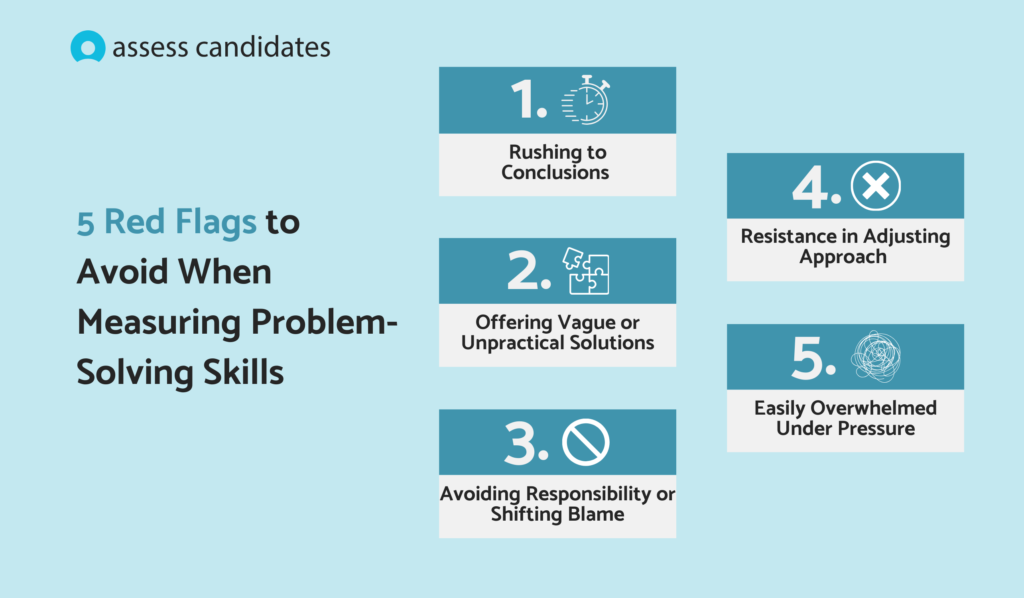
- Rushing to Conclusions Without Analyzing the Problem: Candidates who jump to conclusions without analyzing the problem, or even clarifying the issue, reveal a reactive rather than a thoughtful approach. This is a red flag that showcases how these candidates may misinterpret data, overlook the root cause of each issue, and make decisions based on assumptions, leading to errors in the workplace.
- Offering Vague or Impractical Solutions: Candidates demonstrate poor planning and weak execution skills when they propose solutions without outlining steps, anticipating challenges, or grounding their ideas in reality.
- Avoiding Responsibility or Shifting Blame During Past Examples: Avoid candidates who lack accountability. Candidates who blame colleagues and customers signal low ownership and struggle with improving their problem-solving skills over time.
- Resistance in Adjusting Approach With New Information: Candidates who avoid responsibility and refuse to stay flexible and adapt their new strategies to evolving situations demonstrate rigid thinking. This inability slows down progress, creates conflict within the teams, and leads to poor outcomes.
- Easily Overwhelmed Under Pressure: Candidates who get easily overwhelmed under pressure and display signs of panic, confusion, or disengagement during timed exercises indicate short-term thinking. This completely contradicts strong problem-solvers who stay calm even under pressure.
Identify candidates with strong problem-solving skills with our science-backed assessments. HIRE FOR FREE
6. Measuring problem-solving skills: Client Success Story
Client Problem Statement
Imagine a fast-growing SaaS company struggling to hire competent product managers who can identify technical issues, prioritise conflicting tasks, and make customer-focused decisions in real time. Despite receiving strong resumes, conversational interviews fail to reveal how candidates analyze problems or handle real product challenges.
As a result, their development slows down, product quality becomes inconsistent, and customer satisfaction drops. The organization, hence, requires a reliable way to evaluate candidates’ analytical reasoning, situational judgment, and ability to solve problems under pressure.
Assess Candidates’ Proposal
At Assess Candidates, we recommend incorporating logical reasoning tests, situational judgment tests, and job simulation exercises early in the recruitment process. These assessments measure how candidates interpret information, evaluate trade-offs, and choose the most effective course of action during real-world product challenges.
When combined with structured behavioral interviews, they will help recruiters gain deeper insights into how candidates think, prioritize, and communicate. These reveal candidates’ decision-making approach and overall problem-solving capability.
Result
By integrating these problem-solving assessments into the hiring process, the SaaS company can confidently identify candidates who showcase strong analytical skills, sound judgment, and consistent decision-making skills. This would result in better product releases and an elevated customer experience.
Ultimately, the company will build a more capable product team, speed up innovation, and strengthen its ability to handle complex challenges.
Partner with Assess Candidates to integrate a range of psychometric tests into your hiring process. VIEW PLANS
7. Why top companies choose Assess Candidates to evaluate problem-solving skills
At Assess Candidates, we offer a wide range of pre-employment aptitude tests and create recruitment campaigns customized to each organization’s unique hiring needs.
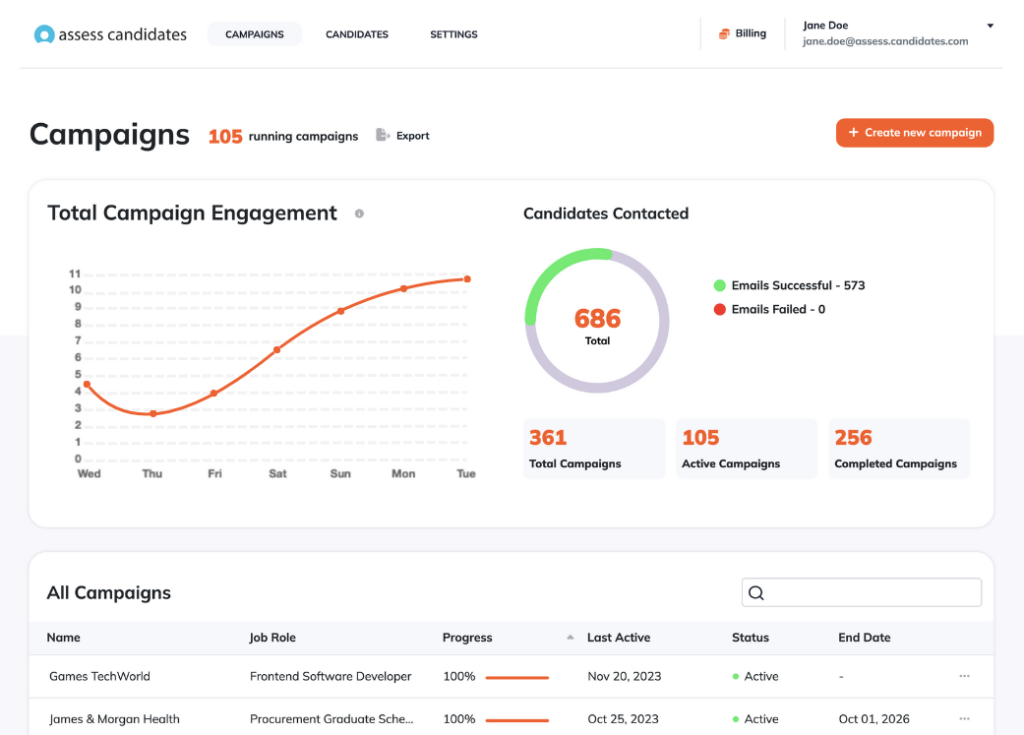
Here is an example of our campaign reporting dashboard available on Assess Candidates.
Here are 4 reasons why you should use Assess Candidates for measuring problem-solving skills in candidates:
- Scientifically Designed by Expert Psychologists: Assess Candidates’ problem-solving tests are developed by expert Psychologists and Psychometricians with extensive experience designing assessments for organizations like SHL and IBM Kenexa.
Each assessment goes through rigorous validation to ensure it accurately measures analytical reasoning, decision-making ability, pattern recognition, and solution-generation skills. This scientific approach enables organizations to confidently identify candidates who can analyze issues effectively and make sound decisions.
- Advanced Reporting: Our intuitive platform delivers detailed, easy-to-understand reports that highlight each candidate’s problem-solving strengths, reasoning accuracy, speed, and approach to complex tasks. Recruiters can quickly compare results, rank candidates, and make informed hiring decisions based on objective evidence. With full ATS integration, the scoring and shortlisting process becomes efficient and seamless.
- Positive Candidate Experience: We design our problem-solving assessments to be intuitive, accessible, and device-friendly. Candidates receive clear instructions and experience smooth navigation, allowing them to concentrate fully on demonstrating their logical reasoning and analytical abilities. Custom branding options also help companies reinforce their employer identity throughout the assessment journey.
- Candidate Accessibility Support: We prioritize inclusivity in problem-solving assessments by offering features such as extended time, Zoom functionality, accessible color contrasts, and screen-reader compatibility. All tools comply with WCAG accessibility standards, ensuring every candidate has a fair and equal opportunity to perform at their best.
Assess Candidates offers reliable, science-backed tools that help organizations measure problem-solving skills accurately and hire smarter, faster, and more fairly. Explore our full range of assessments to start identifying candidates with strong analytical and decision-making abilities.
Not sure which problem-solving assessments to choose? Contact us for a free analysis of your hiring needs.
Answers to the above example questions
- Logical Reasoning Test: Option A.
- The lines on Figures 1 and 4 are symmetrical, as are the lines on Figures 2 and 5. Thus, the lines in the correct answer must be symmetrical to the lines in Figure 3, leaving options A and D.
- The shapes are repeated after every 3 figures, so in the correct answer the shape must be the same as the shape on Figure 3, leaving options A and B.
- The number of black circles has a sequence of increasing by one, staying the same, and then increasing by one again. In the correct answer there must be 6 black circles, therefore leaving options A and D.
- Situational Judgment Tests (SJTs):
- Best option: C. This response balances transparency with action, helping the client understand what went wrong and how you are going to resolve the issue.
- Worst option: D. This approach avoids confrontation, but it risks damaging the client relationship and escalating dissatisfaction and frustration. It also does not resolve the issue.
- Job Simulation Exercises: Option D
Conclusion: Key Takeaway
- Problem-solving skills help candidates identify the root causes of issues, evaluate solutions, and implement effective actions.
- Strong problem-solving skills reflect a combination of adaptability, critical thinking, and communication.
- Employers value problem-solving because it drives efficiency, innovation, teamwork, and customer satisfaction.
- Job simulations provide the most accurate prediction of real-world performance and problem-solving capability.
- Scoring problem-solving skills requires defined competencies, standardized rubrics, benchmarks, and clear documentation.
- Red flags, like rushing to conclusions, vague solutions, rigidity, and pressure-induced errors, signal weak problem-solving skills.
Interested in learning more about effective candidate assessment? Continue reading for frequently asked questions, and sign up with your email to get started.
Frequently Asked Questions
How to assess a candidate’s problem-solving skills effectively?
One of the easiest ways to assess problem-solving skills is through certain pre-employment assessments, including logical, spatial , diagrammatic, and abstract reasoning tests . These psychometric assessments show you how candidates identify patterns, interpret information, and apply logic under pressure.
When should problem-solving skills be assessed?
It is best to check problem-solving skills early in the hiring process. Doing this will help you filter ineligible candidates before interviews. By measuring these skills through assessments or screening tasks, you can identify candidates who meet the basic analytical requirements of the role. This will further help you reduce interview time, lower the cost of hiring, and ensure only strong problem-solvers progress in the hiring process.
How to make problem-solving assessments fair?
You can maintain fairness in measuring problem-solving skills by using standardized tests, consistent scoring rubrics, and validated assessment tools. By eliminating cultural, language, and unnecessary technical bias, all candidates can have an equal opportunity to perform.
Do problem-solving assessments work for every role?
While problem-solving assessments benefit most roles, they are especially effective for roles requiring analytical thinking, decision-making, and autonomous work. By evaluating a candidate’s reasoning skills, you can quickly see how well they interpret information, adapt to challenges, and make sound decisions.
How do interviews help measure problem-solving skills?
Structured and behavioral interviews give you insights into how a candidate has handled various situations within previous work. By explaining the thought process and action they chose, you can get a clear picture of their reasoning, adaptability, and judgment.


 English
  Arabic