
How To Design And Deliver A Successful Virtual Assessment Center



Virtual assessment centers have become a core part of modern recrutiment processes, allowing employers to evaluate candidates’ skills, behaviors, and potential online.
In today’s fast-paced and digitally connected world, organizations must hire efficiently without compromising quality. By simulating real-world job tasks, assessment centers provide quick, comprehensive insights into a candidate’s ability to perform in the specific role.
Beyond accuracy, online assessment centers offer unmatched scalability and flexibility. Recruiters can evaluate large candidate pools across multiple locations simultaneously, saving time and cutting recruitment costs. Remote participation also broadens access to diverse talent worldwide, helping companies attract and identify top performers without logistical challenges.
These online platforms also enhance both the candidate and employer experience. Candidates complete engaging, interactive assessments from any device, while employers gain real-time insights, analytics, automated scoring, and standardized data-driven reports. By leveraging virtual assessment centers, organizations can make more informed hiring decisions, strengthen workforce quality, and build a forward-thinking employer brand in a competitive talent market.
In this comprehensive guide for recruiters and HR professionals, we explore how to design, deliver, and optimize virtual assessment centers for recruitment.
Contents
- What is a virtual assessment center?
- How to design a virtual assessment center: Key steps and best practices
- How to deliver and conduct a virtual assessment center successfully
- Why do employers use virtual assessment centers for recruitment?
- Client Success Story: A high-performing online assessment center
Let’s now dive into what virtual assessment centers are in recruitment.
1. WHAT IS A VIRTUAL ASSESSMENT CENTER?
A virtual assessment center is a digital hiring solution that enables recruiters to comprehensively evaluate candidates through a range of structured online exercises, interviews, and psychometric tests. It mimics the format of a traditional, in-person assessment center but operates entirely online, assessing candidates’ skills, behaviors, and cultural fit from anywhere in the world.
Through tools such as video interviews, group tasks, role-plays, and psychometric assessments, virtual assessment centers provide a fair, consistent, and scalable way to identify top talent. They eliminate the need for travel while offering greater flexibility, accessibility, and cost-efficiency, making them ideal for global and hybrid recruitment strategies.
What is the difference between a virtual and an in-person assessment center?
Both virtual and in-person assessment centers share the same goal – to evaluate candidates’ skills, behavior, and personality to gauge on-the-job performance – but differ in their format and delivery.
Virtual assessment centers take place online using video conferencing tools and digital platforms, offering enhanced flexibility, cost savings, and global accessibility. In contrast, in-person assessment centers require physical attendance, allowing for direct observation, face-to-face interaction, and a more immersive experience.
Below is a table showcasing the differences between an in-person and virtual assessment centre:
Boost your hiring strategy with science-backed virtual assessments before your assessment center. HIRE FOR FREE
In the following section, we will take a look at best practices and steps for designing a virtual assessment center.

2. HOW TO DESIGN A VIRTUAL ASSESSMENT CENTER: KEY STEPS AND BEST PRACTICES
Organizations design virtual assessment centers by meticulously planning, creating clear structures, and aligning with organizational goals to evaluate candidates effectively. By designing well-defined exercises and frameworks, you ensure candidate assessment remains fair, consistent, and reliable.
Did you know? According to SHRM, organizations that utilize modern structured assessment methods report a 25% improvement in hiring accuracy compared to traditional approaches.
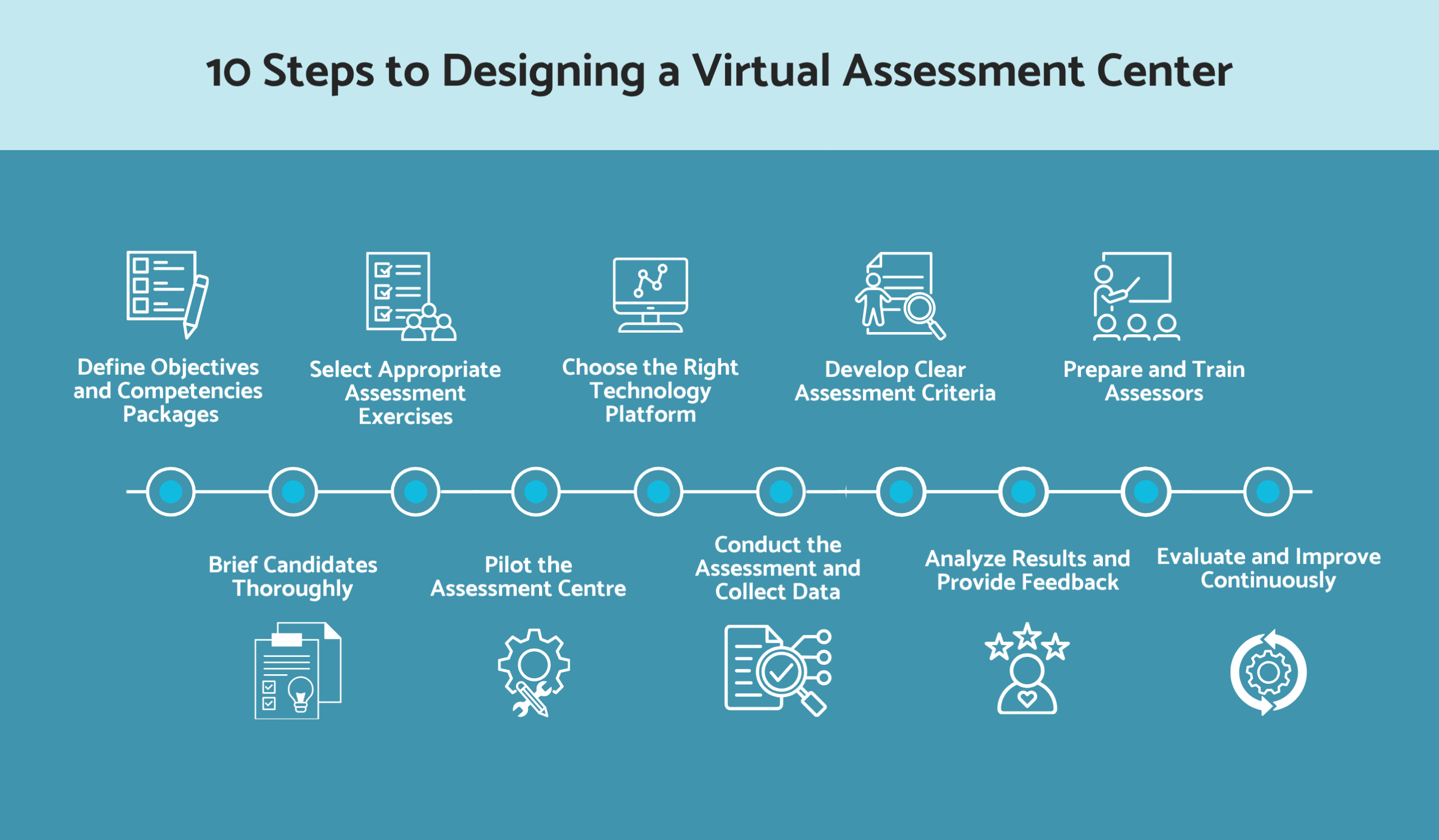
10 STEPS TO DESIGNING A VIRTUAL ASSESSMENT CENTER
1. Define Objective and Competencies
Start by identifying the purpose of the assessment center and the key competencies you want to measure. These may include leadership potential, teamwork, decision-making, adaptability, and communication.
Each competency should align with organizational goals and specific role requirements. A clear framework ensures that every exercise in the virtual assessment directly contributes to evaluating job-relevant skills and behaviors.
2. Select Appropriate Assessment Exercises
Choose exercises that effectively measure the target competencies. Common virtual assessment exercises include case studies, situational judgment tests, role plays, group discussions, in-tray exercises, and presentations.
Each activity should simulate realistic workplace challenges, allowing assessors to observe candidates’ problem-solving approaches and interpersonal effectiveness.
3. Choose the Right Technology Platform
Select a digital platform that supports all aspects of the virtual assessment process. Essential features include video conferencing, breakout rooms for group tasks, document sharing, and integrated scoring systems.
Prioritize a platform that ensures stable connectivity, data security, and accessibility for all participants.
4. Develop Clear Assessment Criteria
Establish well-defined scoring rubrics that link directly to the competencies being assessed. Create behaviorally anchored rating scales (BARS) to guide assessors in objectively evaluating performance.
Each criterion should describe observable behaviors, making it easier to differentiate between performance levels. This structure ensures fairness, consistency, and transparency across all candidates and assessors.
5. Prepare and Train Assessors
Assessor training is critical for the reliability of a virtual assessment center. Conduct calibration sessions to align assessors’ understanding of competencies, rating scales, and behavioral indicators.
Train them to use the technology platform efficiently and to manage technical issues that may arise. Well-prepared assessors can conduct smoother sessions, make unbiased evaluations, and maintain consistency across assessments.
6. Brief Candidates Thoroughly
Provide candidates with clear instructions and expectations before the assessment day. Include details about technology requirements, platform navigation, dress code, time limits, and assessment format.
Offering a short orientation session or mock exercise helps candidates familiarize themselves with the process and reduces anxiety. A well-informed candidate performs more confidently and authentically during the assessment.
7. Pilot the Assessment Centre
Before launching the main session, conduct a pilot run with a small group. This helps identify potential technical glitches, unclear instructions, or timing issues. Use feedback from participants and assessors to refine materials, improve the user experience, and ensure the platform runs smoothly.
8. Conduct the Assessment and Collect Data
On the day of the virtual assessment, ensure all participants have a stable internet connection and access to the required materials. Assign facilitators to manage breakout rooms, monitor time, and handle queries.
Assessors should record observations in real-time using digital scorecards. Automated systems can compile data and generate initial reports, helping recruiters make faster and more informed decisions.
9. Analyze Results and Provide Feedback
After the assessment, compile results into detailed candidate reports that summarize performance across all exercises. Highlight strengths, areas for improvement, and overall suitability for the role.
Share constructive feedback with candidates promptly. Providing feedback enhances employer branding and demonstrates organizational transparency, even for candidates who are not selected.
10. Evaluate and Improve Continuously
Post-assessment evaluation is vital for continuous improvement. Gather feedback from assessors, candidates, and administrators to understand what worked well and what can be enhanced.
Analyze metrics such as completion rates, assessor agreement, and candidate satisfaction. Use these insights to refine exercises, improve platform usability, and strengthen assessment reliability in future sessions.
Let’s now take a look at the best practices for designing a virtual assessment center.
7 BEST PRACTICES FOR DESIGNING VIRTUAL ASSESSMENT CENTERS
1. Ensure Fairness and Accessibility
Design assessments that accommodate all candidates. Include accessibility options such as screen readers, extra time, and multilingual instructions. Comply with data protection and accessibility standards, such as WCAG. Inclusive design supports diversity and enhances your employer reputation.
2. Maintain Consistent Communication
Communicate clearly and regularly with candidates and assessors at every stage, from pre-assessment briefings to post-assessment updates. Clear communication builds trust, reduces anxiety, and ensures everyone understands expectations.
3. Leverage Technology Effectively
Use advanced digital tools to enhance engagement and efficiency. Features like breakout rooms, screen sharing, and automated scoring streamline coordination and minimize disruptions.
4. Prioritize Candidate Experience
Create an intuitive, user-friendly virtual environment. Ensure smooth navigation, technical support, and engaging content throughout the session. A positive candidate experience strengthens your employer brand and helps attract top talent.
5. Use Multiple Assessors
Include several trained assessors to observe and evaluate candidates. Multiple perspectives reduce personal bias, improve scoring accuracy, and ensure a more balanced and objective assessment process.
6. Record Sessions with Consent
Record sessions with candidate consent to allow assessors to review performance, ensure fairness, and provide evidence-based feedback. Recording also supports continuous improvement and helps maintain assessment integrity.
7. Balance Automation with Human Judgment
Use AI-driven analytics to efficiently handle scoring and data analysis, but rely on human assessors for contextual understanding. Combining automation with expert judgment ensures fair, accurate, and well-rounded evaluations.
Utilize our accurate virtual assessment center exercises to identify top talent. LEARN MORE
Next up, we will delve into the steps and best practices for actually delivering and conducting a successful virtual assessment centre.
3. HOW TO DELIVER AND CONDUCT A VIRTUAL ASSESSMENT CENTER SUCCESSFULLY
Organizations deliver and conduct virtual assessment centers by carefully planning, executing seamlessly, and evaluating candidates systematically to make accurate and fair hiring decisions.
By following clear steps and applying best practices, they assess candidates’ skills, behaviors, and potential effectively, while delivering a smooth, engaging, and inclusive experience entirely online.
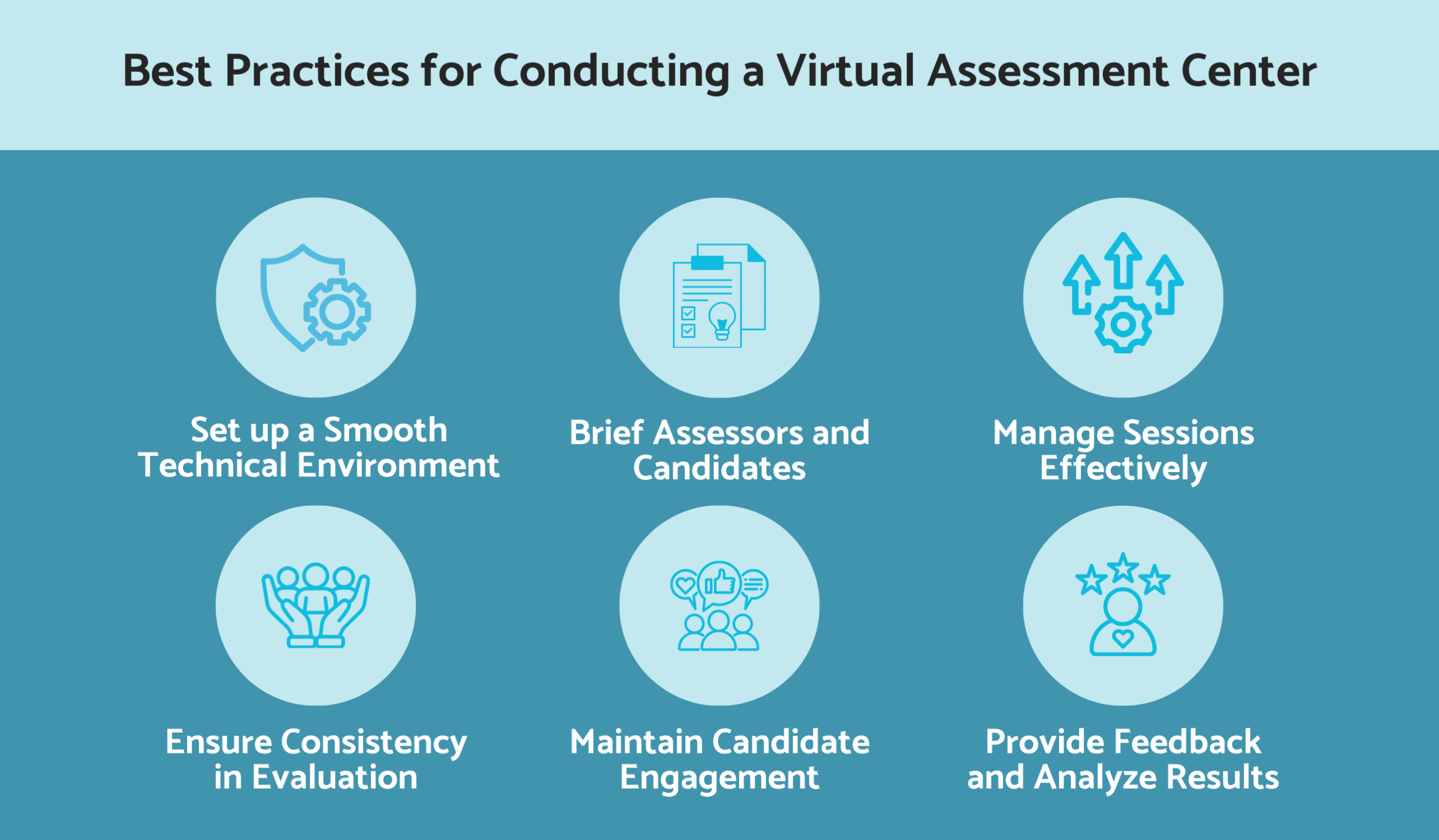
Steps and best practices to conduct a virtual assessment center for recruitment
- Set Up a Smooth Technical Environment
Run a complete technical check before starting the assessment to ensure all tools, video conferencing platforms, breakout rooms, document-sharing apps, and online testing software work properly.
Secure stable internet connections, good lighting, and clear audio. Keep IT support ready to resolve any issues immediately. A smooth technical setup keeps the session professional and uninterrupted.
- Brief Assessors and Candidates
Begin the session by clearly briefing both assessors and candidates. Explain the schedule, assessment format, evaluation process, and behavioral expectations.
Instruct candidates on how to interact, complete tasks, and request assistance. When everyone understands their responsibilities, the session runs smoothly and transparently.
- Manage Sessions Effectively
Follow the schedule closely and transition efficiently between exercises. Use breakout rooms, shared files, and timers to keep activities organized and fair. Monitor candidate participation and guide discussions to stay on track. By managing sessions effectively, you create structure, fairness, and consistency throughout the assessment.
- Ensure Consistency In Evaluation
Ask assessors to document observations objectively and use standardized rating scales to maintain fairness. Conduct quick calibration meetings when multiple assessors evaluate the same candidates to align scoring standards. Consistent evaluation strengthens reliability and ensures unbiased hiring decisions.
- Maintain Candidate Engagement
Keep candidates engaged by promoting interaction and participation. Use chat tools, polls, and prompts to sustain attention, and include short breaks to prevent fatigue.
Encourage a supportive atmosphere where candidates feel confident to perform. Engagement drives better results and improves the overall candidate experience.
- Provide Feedback and Analyze Results
Share constructive feedback with candidates once the assessment concludes. Gather insights from assessors and review data to identify strengths, development areas, and process improvements.
Use these findings to refine future sessions. Providing feedback reinforces transparency and strengthens your employer brand.
Gain comprehensive insights into your candidate’s skills and potential with our virtual assessments. HIRE FOR FREE
Next up, we will take a look at the reasons why employers use virtual assessment centers for hiring.
4. WHY DO EMPLOYERS USE VIRTUAL ASSESSMENT CENTERS FOR RECRUITMENT?
Employers adopt virtual assessment centers to streamline recruitment and make data-driven hiring decisions. By replicating real-world job tasks online, they can evaluate candidates’ skills, behaviors, and potential efficiently, while saving time and costs, ensuring fairness, and expanding access to a broader, more diverse talent pool.
6 BENEFITS OF USING VIRTUAL ASSESSMENT CENTERS FOR HIRING
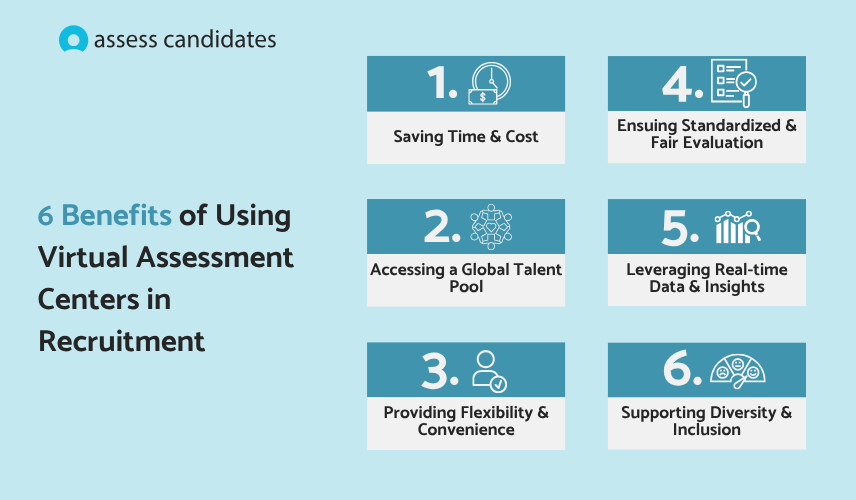
1. Saving Time and Costs
Virtual assessment centres eliminate the need for physical venues, travel, and other logistical expenses. Recruiters can evaluate multiple candidates simultaneously without scheduling conflicts or geographic limitations.
This streamlined approach reduces administrative overhead, accelerates the hiring cycle, and allows hiring teams to focus on strategic decision-making.
2. Accessing a Global Talent Pool
By conducting assessments online, companies can reach candidates anywhere in the world. This removes geographic barriers, enabling organizations to attract diverse and highly skilled talent.
Recruiters can tap into international markets, compare candidates from different regions, and identify the best fit for roles without being limited by location.
3. Providing Flexibility and Convenience
Candidates can complete assessments on their preferred device, such as laptops, tablets, or smartphones, and choose a time that suits their schedule. This flexibility increases participation rates and reduces no-shows.
It also allows candidates to perform in a comfortable environment, often resulting in more authentic and accurate evaluations of their skills and abilities.
4. Ensuring Standardized and Fair Evaluation
Virtual assessment centres use structured exercises, scoring rubrics, and standardized tasks to evaluate candidates. This consistent approach ensures that all participants are measured against the same criteria, reducing bias and providing an objective basis for comparison.
Standardization enhances reliability, making it easier to make fair and data-driven hiring decisions.
5. Leveraging Real-time Data and Insights
Digital platforms capture assessment results in real time and provide detailed analytics on candidate performance. Recruiters can track competencies, strengths, weaknesses, and behavioral trends in real time.
These insights enable faster shortlisting, more informed selection decisions, and a clear understanding of how each candidate aligns with the role and the company culture.
6. Supporting Diversity and Inclusion
Virtual assessment centre platforms can include accessibility features such as screen readers, adjustable fonts, color contrast options, and extra time for candidates with disabilities. These features allow all candidates to participate fairly, supporting inclusive hiring practices and helping organizations build diverse, equitable, and high-performing teams.
6 CHALLENGES FACED WHEN USING VIRTUAL ASSESSMENT CENTERS FOR HIRING
- Technical Issues: Candidates or assessors may experience connectivity problems, software glitches, or device incompatibility, disrupting the assessment process.
Solution: Conduct pre-assessment tech checks, provide clear instructions on platform requirements, and have IT support available during the session to resolve issues immediately.
- Reduced Personal Interaction: Virtual environments can limit non-verbal cues and informal interactions, making it harder to evaluate soft skills and cultural fit.
Solution: Incorporate video-based role plays, interactive group discussions, and behavioral interviews to observe communication, collaboration, and interpersonal skills effectively.
- Maintaining Candidate Engagement: Candidates may feel disengaged or distracted during online sessions, which can affect performance and the accuracy of results.
Solution: Use interactive exercises, polls, multimedia content, and short breaks to maintain energy and attention. Encourage active participation throughout the assessment.
- Security and Cheating Concerns: Online assessments are vulnerable to fraud, impersonation, or unauthorized assistance.
Solution: Implement secure login, multi-factor authentication, browser lockdowns, remote proctoring and cheat detection systems to protect test integrity and verify candidate identities. Providers like Assess Candidates implement these safeguards to maintain test integrity.
- Accessibility and Inclusivity Issues: Candidates with disabilities or limited access to technology may face difficulties completing virtual assessments.
Solution: Choose assessment providers that comply with accessibility standards (WCAG) and offer accommodations such as screen readers, larger text, or extended time where needed. Providers like Assess Candidates prioritize inclusivity by providing WCAG-compliant features.
Uncover top talent with our talent assessment platform and join us. LEARN MORE
5. HOW TO DESIGN AND DELIVER A SUCCESSFUL VIRTUAL ASSESSMENT CENTER: CLIENT SUCCESS STORY
CLIENT PROBLEM
Imagine a fast-growing tech startup struggling to fill leadership positions for its remote engineering teams. While candidates demonstrate excellent technical expertise in interviews, the company struggles to assess collaboration, problem-solving under pressure, and leadership potential in a distributed work environment.
As a result, new hires occasionally fail to thrive in remote team dynamics, leading to project delays, disengagement, and higher recruitment costs. The startup needs a comprehensive, virtual approach that evaluates both skills and behavioral competencies to ensure long-term success.
ASSESS CANDIDATES’ PROPOSAL
At Assess Candidates, we recommend using a virtual assessment center that combines cognitive tests, situational judgment exercises, and video-based simulations to evaluate candidates’ skills, decision-making, and leadership potential. These assessments provide objective insights into critical traits such as adaptability, teamwork, problem–solving, and remote collaboration effectiveness.
Once the assessment results are available, hiring managers can tailor interviews to explore behavioral patterns in depth and validate findings through real-world examples. Recruiters can also use the assessment data to guide panel decisions, ensuring alignment between candidates’ profiles and team dynamics. This combination of objective testing and interactive evaluation leads to more consistent, informed, and equitable hiring decisions.
RESULT
By integrating virtual assessment centers with targeted interviews, the company identifies candidates who not only have the required technical skills but also thrive in remote, collaborative environments. This structured approach improves hiring accuracy, strengthens team cohesion, and reduces turnover rates. Over time, the startup builds a resilient, high-performing workforce capable of scaling effectively across distributed teams.
Partner with Assess Candidates for engaging, science-backed virtual assessments and structured interviews. VIEW PLANS
Interested in learning more about effective candidate assessment? Continue reading for frequently asked questions, and sign up with your email to get started.
Frequently Asked Questions
How do virtual assessment centers improve candidate evaluation?
Virtual assessment centers combine cognitive tests, situational judgment tasks, group exercises, and video simulations to evaluate candidates effectively. Employers can measure technical skills, problem-solving, teamwork, and leadership potential. By pairing data-driven insights with real-time observations, recruiters make consistent, fair, and accurate evaluations.
Can virtual assessment centers reduce hiring bias?
Yes, virtual assessment centers standardize exercises, scoring, and observation methods, helping employers minimize subjective judgments. Recruiters focus on candidates’ performance and potential rather than personal impressions. Using structured tasks and multiple assessors ensures fair, unbiased evaluations and supports inclusive hiring practices.
How do virtual assessment centers enhance the candidate experience?
Virtual assessment centers provide convenient, flexible, and engaging assessments accessible on any device. Candidates navigate exercises easily with automated progress tracking and interactive features. Employers deliver a positive experience, strengthen their brand, and attract top talent by demonstrating innovation, accessibility, and respect for candidates’ time.
How secure are virtual assessment centers?
Virtual assessment platforms integrate strong security measures, including secure logins, multi-factor authentication, browser lockdowns, and remote proctoring. Employers protect test integrity, prevent cheating, and verify candidate identities. Companies can rely on virtual assessments to maintain fairness, accuracy, and compliance with data protection standards.
How can virtual assessment centers help make better hiring decisions?
Virtual assessment centers combine objective assessment data with interactive exercises to give employers a complete view of candidates’ skills, behaviors, and potential. Recruiters can rank, filter, and compare candidates in real time, shortlist top performers, and make evidence-based hiring decisions that reduce turnover and improve workforce performance.


 English
  Arabic