
How To Measure Teamwork And Collaboration In Candidates During Hiring



When hiring for roles that involve teamwork and collaboration, you’ve likely experienced how hard it is to tell who is actually a great team player.
Teamwork is easy to talk about during interviews. Most candidates know the right phrases: “collaborative”, “good communicator”, “happy to support others”. But when it comes to real team settings, many struggle to communicate, share responsibilities, or handle conflict and disagreement.
As a result, many employers still rely on gut feeling, surface-level impressions, or inconsistent criteria when judging how well someone will work with others.
If that sounds familiar, you’re not alone. Teamwork is one of the most important workplace skills, yet it’s also one of the hardest to measure objectively. That’s why you need a structured, reliable way to assess how candidates actually behave in team-based situations, not just how confidently they can talk about it.
Research consistently shows that strong collaboration improves productivity, engagement, and retention across teams.
By the end of this article, you’ll have a clear understanding of how to measure teamwork and collaboration in candidates, so you can make confident hiring decisions without guesswork or unnecessary complexity.
Contents
- What do teamwork and collaboration really mean?
- Why teamwork and collaboration matter in the workplace
- How to measure teamwork and collaboration in candidates
- How to effectively score teamwork and collaboration
- Common red flags to look out for
- Why choose Assess Candidates?
1. What Do Teamwork and Collaboration Really Mean?
Teamwork and collaboration are often used interchangeably, but they are not the same thing. Understanding the difference helps you measure them more accurately during hiring to identify candidates who will perform well in a team environment.
Teamwork
Teamwork is about how effectively someone functions within a defined group structure. This includes how well they support shared goals, follow responsibilities, communicate progress, and put team success ahead of individual credit.
Strong teamwork shows up in everyday behaviors like reliability, cooperation, and accountability.
Google’s Project Aristotle found that effective teamwork is a key driver of high-performing teams.
Collaboration
Collaboration focuses on how people actually work together to think, solve problems, make decisions, and achieve shared goals. It goes beyond assigned roles or job titles.
Here, you’re assessing how candidates share ideas, listen to others, handle disagreement, and build on others’ input to reach better outcomes. Strong collaborators contribute while improving the quality of work through how they interact with others.
Harvard Business Review reports that collaborative teams are more likely to solve complex problems effectively and sustain performance over time.
Why the distinction matters
In practice, you need both. Teamwork keeps work moving smoothly. Collaboration improves the quality of decisions and solutions. Measuring them separately during hiring helps you avoid vague judgments and gives you clearer signals about how a candidate will actually perform on a team.
What Makes Up Strong Teamwork and Collaboration?
These soft skills are not vague personality traits. They show up through specific, observable behaviors you can assess consistently.
1. Clear Communication
Candidates with strong teamwork skills express ideas clearly, share updates proactively, and adjust their message based on who they’re working with.
2. Active Listening
Effective collaborators don’t just wait to speak. They listen, ask clarifying questions, and respond thoughtfully to others’ input.
3. Shared Ownership
Strong team players take responsibility for outcomes, not just tasks. They support teammates, follow through on commitments, and step in when others need help.
4. Respectful Problem-Solving
Collaboration shows up when candidates can disagree without becoming defensive. They stay focused on solutions rather than egos and work toward consensus when possible.
5. Adaptability in Group Settings
Team-oriented candidates adjust their approach based on team dynamics, feedback, and changing priorities instead of rigidly sticking to one way of working.
Assess candidates’ teamwork and collaboration more accurately with validated hiring tools. HIRE FOR FREE
Now that you understand what teamwork and collaboration truly mean, the next step is to see why they matter in the workplace. In the next section, you’ll see how strong teamwork and collaboration directly impact performance, engagement, and business results.

2. Why Teamwork and Collaboration Matter in the Workplace
When teamwork breaks down, you notice it quickly. Projects stall, misunderstandings increase, and even individual performers struggle to deliver results together.
The reality is that no matter the role, employees rarely work in isolation. Most work depends on handovers, shared decisions, and cooperation across teams. That means how well people collaborate directly affects how efficiently and effectively work gets done.
Below are 4 reasons why teamwork and collaboration are essential in the workplace:
1. They Drive Day-to-Day Performance
Teamwork and collaboration determine how smoothly tasks move from one person to the next. When employees communicate clearly, share responsibility, and support each other, work gets done faster and with fewer errors. When collaboration is weak, even simple tasks create unnecessary friction and delays.
2. They Reduce Conflict and Rework
Poor collaboration often shows up as duplicated effort, missed details, or unresolved tension between team members. Over time, this leads to rework, frustration, and avoidable setbacks.
Strong collaborative skills help employees clarify expectations early, address issues constructively, and keep small problems from turning into costly setbacks.
Studies from the Project Management Institute link poor teamwork to higher error rates, rework, and interpersonal conflict within teams.
3. They Support Engagement and Retention
People stay longer in environments where they feel heard, supported, and included. Team-oriented workplaces build trust and psychological safety, which leads to higher engagement and lower turnover.
This is especially important in roles that rely on cross-functional or project-based teamwork.
4. They Matter Even More as Roles Get Complex
As roles become more interdependent, collaboration stops being a “nice to have.” Effective teamwork and collaboration are essential for better problem-solving, decision-making, and faster adaptation to change, particularly in fast-moving, hybrid, or remote work environments.
Research done by Harvard Business Review shows that effective collaboration improves productivity, work quality, and speed of execution.
Explore assessments that evaluate teamwork and collaboration objectively. LEARN MORE
When collaboration fails, performance usually follows. That’s why you can’t afford to guess who will work well in a team; you need to measure it. In the next section, we will show you exactly how to measure teamwork and collaboration using structured and reliable pre-employment tools.
3. How to Measure Teamwork and Collaboration in Candidates
Measuring teamwork and collaboration isn’t about asking candidates if they’re “good team players.” Most people will say yes.
What actually works is structured methods that show you how candidates actually behave when working with others, especially under pressure, with disagreements, or shared responsibility.
Below are the most reliable, recruiter-approved ways to assess teamwork and collaboration objectively.
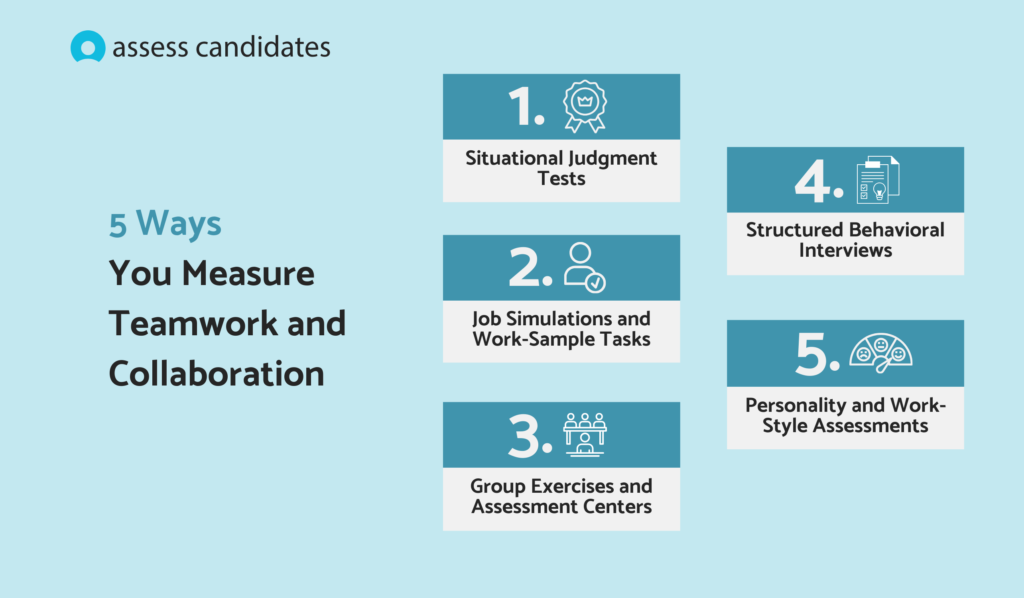
Situational Judgment Tests (SJTs)
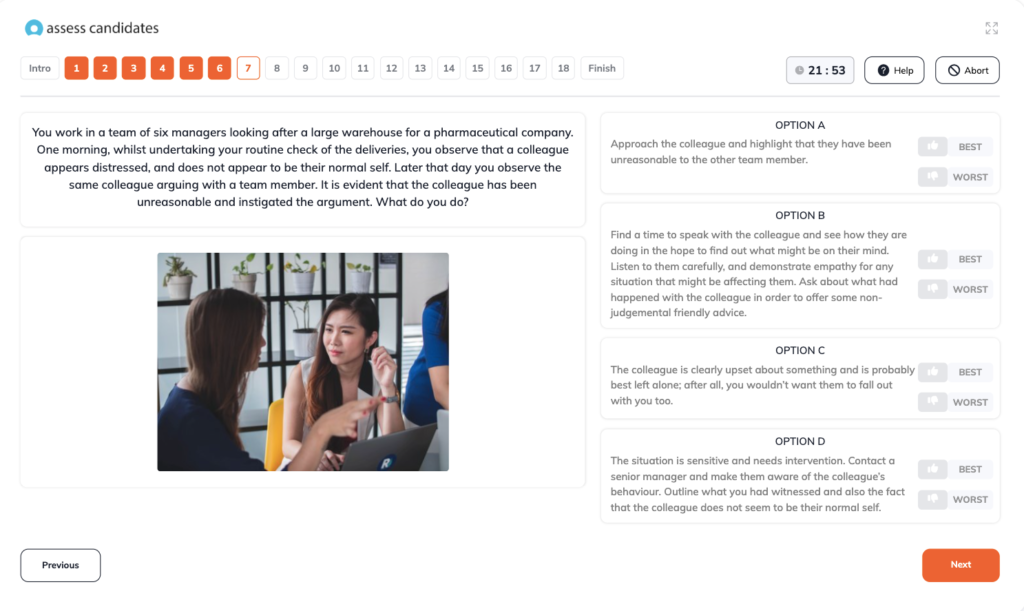
Situational judgment tests place candidates in realistic workplace scenarios and ask them to choose how they would respond. This helps you see how they prioritize collaboration, handle conflict, and balance personal goals with team outcomes.
SJTs are especially useful because they reveal decision-making under pressure, not rehearsed answers.
Situational judgement example question
Research shows SJTs effectively predict teamwork and interpersonal performance in work settings (SHRM).
Job Simulations and Work-Sample Tasks
Job simulations show how candidates collaborate while doing the actual work. This might include co-authoring a document, solving a shared problem, or completing a task with limited information.
Because candidates must interact, communicate, clarify roles, and adapt in real time, you get clear evidence of cooperation, communication, and accountability.
Group Exercises and Assessment Centers
Group exercises in assessment centers allow you to observe teamwork directly. You can see who listens, who dominates, who builds on others’ ideas, and who helps move the group forward.
These exercises are particularly effective for roles that depend on collaboration, leadership potential, or cross-functional teamwork.
Structured Behavioral Interviews
Structured behavioral interviews focus on past team experiences, using the same questions and scoring criteria for every candidate. This keeps evaluations fair and comparable.
Instead of vague questions, you ask candidates to describe specific situations where they worked through conflict, shared responsibility, or supported teammates.
Behavioral interview example question:
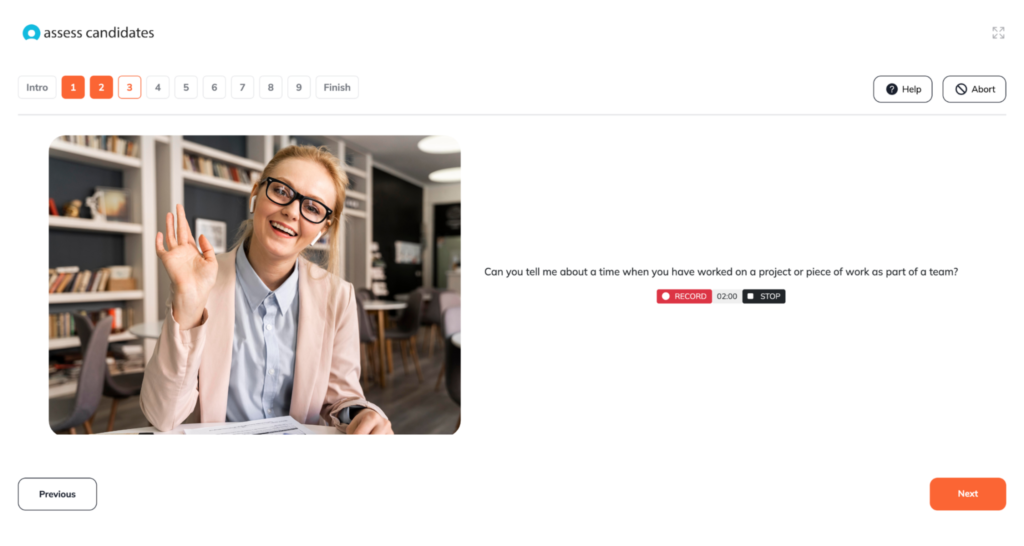
Structured interviews are significantly more reliable than unstructured interviews for assessing teamwork behaviors (Society for Industrial and Organizational Psychology).
Personality and Work-Style Assessments
Personality and work-style assessments help you understand how candidates naturally collaborate, communicate, and respond to group dynamics.
Used alongside other methods, they add context to observed behaviors and highlight potential team fit without relying on intuition alone.
Work personality questionnaire example:
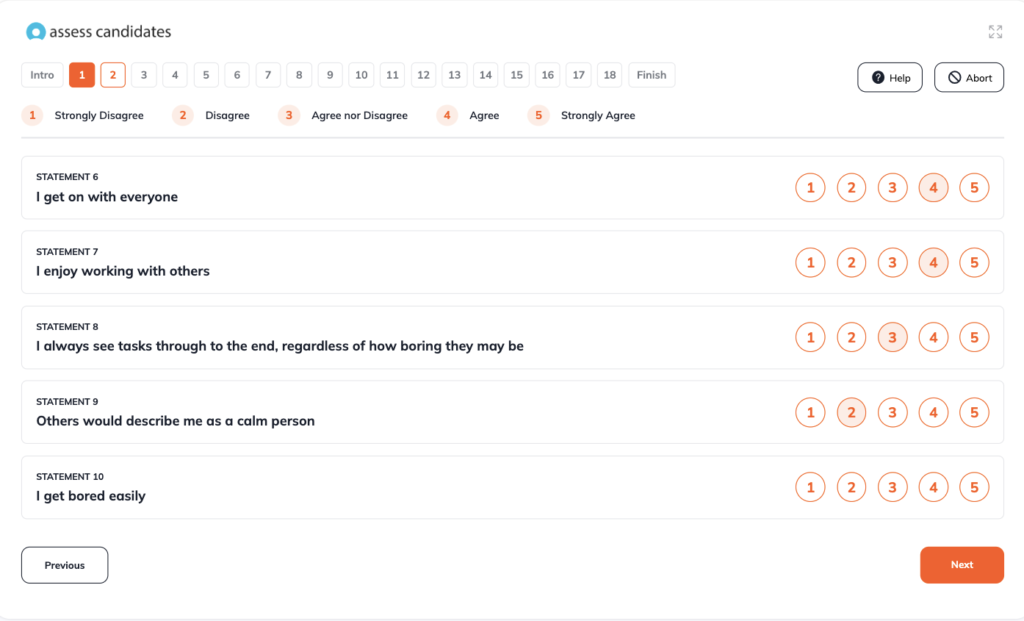
No single method gives you the full picture. The strongest teamwork assessments combine simulations, structured interviews, and scenario-based tools so you can see both how candidates think and how they act in team settings.
Measure teamwork and collaboration skills with our science-backed assessments. LEARN MORE
Once you’ve seen how candidates collaborate in assessments and real tasks, the next step is making sense of what you observed. To hire fairly and consistently, you need a clear way to score teamwork and collaboration without relying on gut feel.
4. How to Effectively Score Teamwork and Collaboration
Once you’ve measured teamwork and collaboration through assessments and exercises, the next step is scoring them in a way that’s fair, consistent, and useful for hiring decisions. This is where many teams slip back into gut feeling.
A simple, structured scoring approach keeps you objective.
Research from the Society for Human Resource Management (SHRM) shows that structured scoring rubrics significantly improve consistency and reduce bias when evaluating soft skills like teamwork and collaboration.
- Use a Clear, Behavior-Based Scoring Rubric
Instead of scoring based on “likability” or confidence, score observable behaviors you actually see during tasks, assessments, interviews, or group exercises. This makes your decisions easier to explain and defend.
Focus on a small set of core dimensions:
- Collaboration & Contribution
Look at how the candidate works with others. Do they contribute ideas, support teammates, and stay engaged without dominating the group?
- Communication & Clarity
Assess how clearly they explain ideas, listen to others, and respond constructively to feedback or disagreement.
- Adaptability & Openness
Score how well they adjust their approach when situations change or when others challenge their ideas.
- Respect & Professional Behavior
Observe whether they show respect for different viewpoints, manage conflict calmly, and maintain a professional tone.
According to Harvard Business Review, teams assessed using behavior-based criteria produce more reliable hiring outcomes than those evaluated using unstructured judgment.
- Apply a Simple Rating Scale
Use a consistent scale across all candidates, for example:
- 1 – Below expectations
- 2 – Developing
- 3 – Meets expectations
- 4 – Strong
- 5 – Exceptional
This keeps scoring aligned across assessors and prevents over- or under-rating based on personal bias.
- Score Independently, Then Compare
If more than one assessor is involved, score candidates independently first, then compare notes with the hiring team. This reduces group bias and helps you focus on evidence rather than opinions.
- Weight Scores Based on Role Needs
Not every role needs the same level of collaboration. For team-heavy roles, weight teamwork scores more heavily. For individual roles, keep them important but balanced with other soft skills and behaviors.
Research from McKinsey & Company highlights that organizations using standardized scoring frameworks for collaboration skills see better team effectiveness and long-term retention.
You get the most reliable hiring outcomes when teamwork and collaboration are scored using clear behaviors, consistent scales, and role-relevant weighting, not intuition.
Even strong assessment scores can hide collaboration issues. In the next section, you’ll learn the key teamwork and collaboration red flags to watch for.
5. Common Red Flags to Look Out For
Strong teamwork and collaboration skills don’t just show up in what candidates say; they show up in how they behave. During assessments, interviews, and group exercises, certain patterns can signal deeper collaboration issues. Spotting these early helps you avoid hires that disrupt team dynamics later.
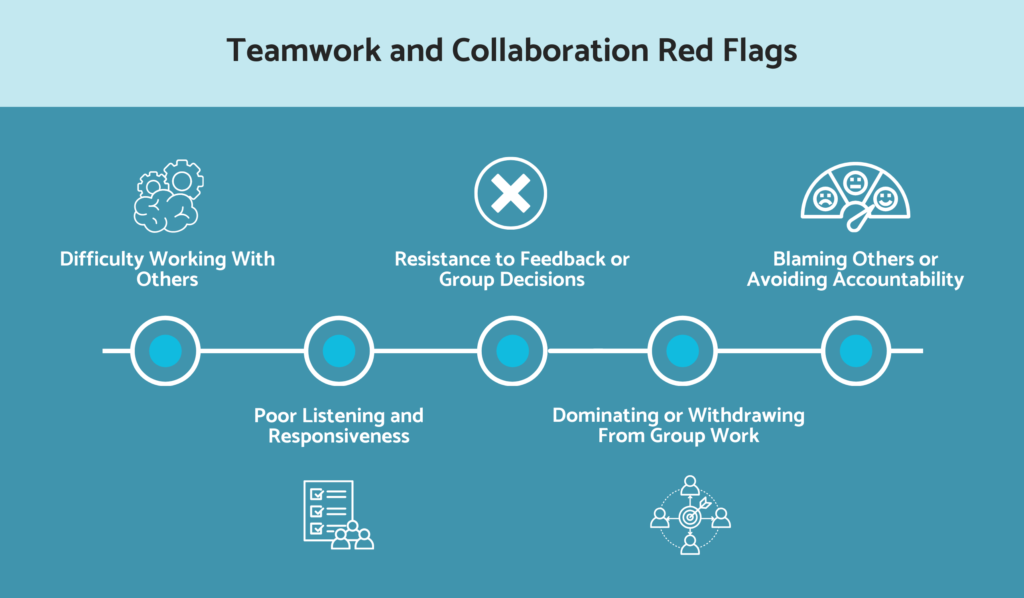
Difficulty Working With Others
Candidates who consistently focus on individual achievement may struggle in team environments.
When this matters:
Roles that rely on shared ownership, cross-functional work, or group problem-solving.
What it looks like during assessment:
- Ignoring others’ input
- Pushing their own ideas without discussion
- Showing little interest in group outcomes
Research from the Journal of Applied Psychology shows that low cooperation during group tasks predicts poor team performance after hire.
Poor Listening and Responsiveness
Teamwork breaks down quickly when people don’t listen or adapt to what others are saying.
When this matters:
Customer-facing roles, agile teams, project-based work, and leadership tracks.
What it looks like in interviews or exercises:
- Talking over others
- Repeating points already addressed
- Failing to respond to feedback or direction
According to Harvard Business Review, active listening is one of the strongest predictors of effective collaboration and trust within teams.
Resistance to Feedback or Group Decisions
Collaboration requires flexibility, not control. A significant degree of resistance to group decisions or feedback may indicate a potential red flag.
When this matters:
Environments where priorities shift or decisions are shared.
What it looks like:
- Defensiveness when challenged
- Dismissing group consensus
- Refusing to adjust the approach
Studies cited by SHRM link feedback resistance to lower team cohesion and reduced long-term performance.
Dominating or Withdrawing From Group Work
Both extremes – dominating or withdrawing from group discussions and work – can signal collaboration risk.
When this matters:
Balanced teams where participation and shared responsibility are essential.
What it looks like in group exercises:
- One candidate is controlling the discussion
- Another staying silent throughout
- Lack of shared problem-solving
Research from Google’s Project Aristotle found that psychological safety, not dominance, drives high-performing teams.
Blaming Others or Avoiding Accountability
Strong collaborators own outcomes, good or bad. They don’t blame others or avoid accountability.
When this matters:
Team-based roles with shared targets and deadlines.
What it looks like:
- Shifting blame during scenarios
- Avoiding responsibility for group failures
- Taking credit only for success
The CIPD reports that accountability is a core behavioral marker of effective teamwork and collaboration.
Explore science-backed assessment tools to evaluate teamwork and collaboration with confidence. VIEW PLANS
Once you know the red flags to watch for, the final step is choosing the right tools to assess collaboration reliably. In the next section, you’ll see why many employers choose the Assess Candidates hiring platform.
6. Why Choose Assess Candidates?
When you’re hiring for teamwork and collaboration, intuition isn’t enough. You need tools that show how candidates actually work with others, not just how well they talk about it.
Assess Candidates helps you evaluate collaboration and teamwork skills using structured, science-backed assessments designed to reduce bias and improve decision-making.
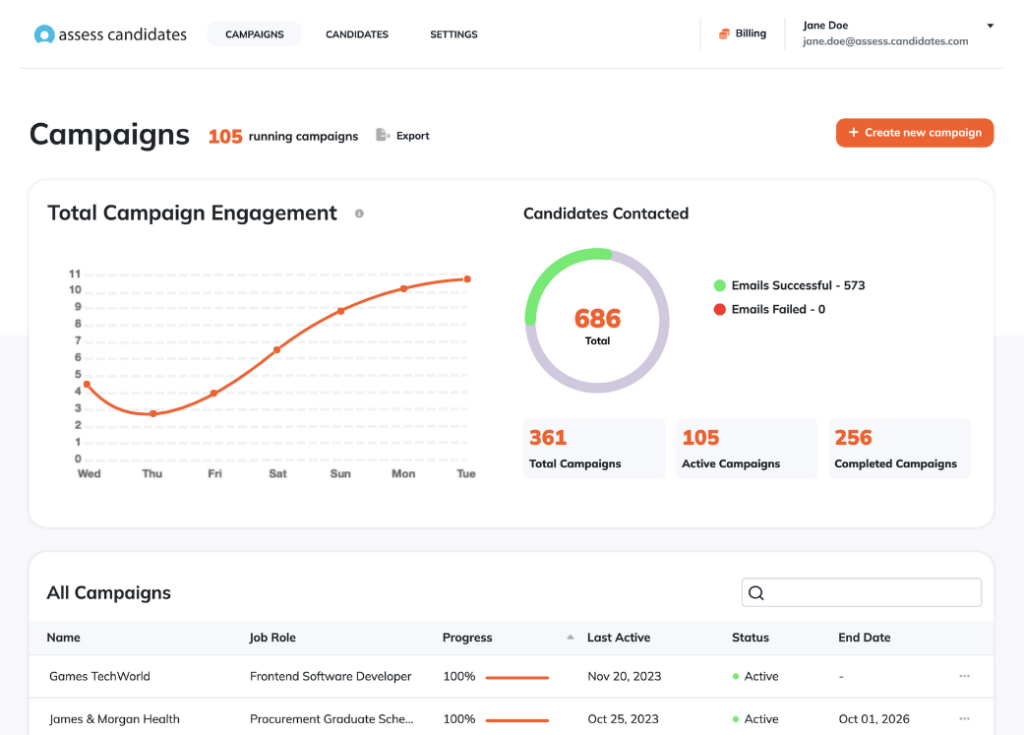
1. Built for Real Teamwork Evaluation
Assess Candidates focuses on how candidates behave in realistic workplace situations, giving you insight into how they collaborate, communicate, and contribute within a team.
See Collaboration in Action
Through situational judgment tests, job simulations, and group-based tasks, you can observe how candidates work with others in real time.
You can assess whether candidates:
- Listen and respond to teammates
- Contribute ideas constructively
- Handle disagreement professionally
- Work toward shared goals
2. Fair, Consistent, and Scalable
To make reliable hiring decisions, teamwork and collaboration must be evaluated using the same standards for every candidate.
Score Every Candidate Against Clear Criteria
Assess Candidates applies structured scoring frameworks that remove guesswork and reduce subjectivity.
This allows you to:
- Compare candidates fairly
- Maintain consistency across assessors
- Defend hiring decisions with evidence
- Scale assessments across roles and teams
3. Designed for Hiring Teams
Hiring teams need tools that fit naturally into their workflows, not systems that slow them down.
Make Confident Decisions Without Added Complexity
Assess Candidates delivers clear, actionable insights that are easy to interpret and apply.
This helps you:
- Save time during screening
- Focus discussions on evidence
- Reduce back-and-forth between stakeholders
- Hire with confidence
Want expert guidance on assessing teamwork and collaboration effectively? CONTACT US
Key Takeaway
Teamwork and collaboration aren’t abstract traits; they show up in how people communicate, listen, adapt, and work toward shared goals. To hire strong team players and collaborators, you need structured ways to measure and score these behaviors consistently. Objective, evidence-based assessments help you move beyond gut instinct and make fair, confident hiring decisions.
When you use tools like simulations, structured interviews, and clear scoring frameworks, you gain a clearer picture of how candidates will actually perform in team environments. This approach reduces bias, improves hiring accuracy, and helps you build teams that work together effectively from day one.
Google’s Project Aristotle found that effective collaboration and psychological safety are key predictors of high-performing teams.
Want to learn more about assessing teamwork and collaboration effectively? Continue reading for frequently asked questions, and sign up with your email to get started with Assess Candidates.
Frequently Asked Questions
What are teamwork and collaboration?
Teamwork and collaboration describe how well individuals work together toward shared goals. You’re looking at how people communicate, contribute ideas, listen to others, resolve conflicts, and support group outcomes. Strong collaboration isn’t about personality alone, but about behaviors that help teams function effectively.
Why do teamwork and collaboration matter in the workplace?
Teamwork and collaboration directly affect productivity, decision-making, and employee engagement. When people work well together, tasks move faster, mistakes are reduced, and morale improves. Poor collaboration, on the other hand, often leads to misalignment, conflict, and performance issues that slow teams down.
How do you measure teamwork and collaboration?
You measure teamwork and collaboration using structured methods like situational judgment tests, job simulations, group exercises, and behavior-based interviews. These approaches show how candidates interact, respond to others, and handle shared tasks, giving you a more accurate picture than resumes or unstructured interviews.
How do you score teamwork and collaboration?
To score teamwork and collaboration fairly, you need clear criteria and consistent rubrics. Focus on behaviors such as communication, cooperation, adaptability, and conflict handling. Using standardized scoring ensures candidates are evaluated objectively, even when multiple assessors or hiring teams are involved.
What red flags should you look out for when assessing teamwork?
Common red flags include poor listening, dominating group discussions, difficulty adapting to others, or avoiding responsibility in team tasks. These behaviors often surface during simulations or interviews and may signal future collaboration challenges if not explored further during the hiring process.
Why should you choose Assess Candidates for teamwork assessments?
Assess Candidates helps you evaluate teamwork and collaboration using science-backed, structured assessments designed to reduce bias. You get consistent scoring, realistic simulations, and clear insights that make it easier to compare candidates and confidently select people who truly work well with others.


 English
  Arabic