
Talent Sourcing vs. Recruiting: What is the Difference and Why It Matters



As a recruiter, you’re likely under constant pressure at work: tight deadlines, talent shortages, demanding stakeholders, and unpredictable applicant flow. You know better than anyone that simply posting vacancies and waiting for applications is not enough. To consistently deliver high-quality candidates, you need to successfully combine two core approaches: talent sourcing and recruiting.
While these terms are often confused as the same, they play very different roles. Talent sourcing focuses on proactively finding and engaging potential candidates, while recruiting involves assessing, interviewing, and selecting the right people for the job. Understanding how these functions differ and work together will help organizations build stronger pipelines, and hire faster and more efficiently.
Global hiring is evolving fast and nearly 76% of employers now face talent shortages. While 82% of recruiters use social media for sourcing, only 27% actively turn sourcing efforts into successful hires. With the average cost per hire at US$4,683, companies are moving toward recruitment is becoming increasingly AI-driven, data-backed, and strategic.
Hiring today is more than just filling a position. Recruiters must find the right people who align with their organization’s goals, culture, and long-term vision. That is why understanding the difference between talent sourcing and recruiting is more important than ever.
This guide breaks it down step-by-step. You will learn the key differences, how they complement each other, and how Assess Candidates can help you strengthen both processes to build a future-ready workforce. Let’s dive in!
Contents
- What is talent sourcing?
- What is recruiting?
- Key differences between talent sourcing and recruiting
- How do talent sourcing and recruiting work together?
- Effective strategies for modern sourcing and recruiting
- The future of talent sourcing and recruiting
- Talent sourcing vs. recruiting: Client success story
- How does Assess Candidates support both talent sourcing and recruiting?
Let’s start by understanding what talent sourcing and recruiting really mean!
1. What is talent sourcing?
Talent sourcing is the process of proactively researching, finding, and engaging potential candidates, especially those who may not be actively seeking jobs. Sourcers use a mix of technology, data, and networking to identify and connect with top talent before a position opens.
The main objective of talent sourcing is to build a strong talent pipeline that recruiters can tap into when new opportunities arise. This reduces hiring time, lowers costs, and ensures that businesses always have access to qualified candidates.
Discover data-driven hiring made simple with our pre-employment assessments. HIRE FOR FREE
Why is effective talent sourcing important?
Effective talent sourcing is about strategically engaging the right talent before roles even open up. By focusing on proactive search and relationship-building, companies create a steady pipeline of quality hires.
What recruiters use to talent source:
- Boolean and keyword searches: Sourcers use advanced Boolean logic and keyword filters on platforms like LinkedIn or job boards to find candidates with the required skills, experience, and qualifications. This refines searches and uncovers high-quality talent that generic queries might miss.
- Identifying and engaging passive candidates: Passive candidates are professionals who are not necessarily actively job-hunting but may be open to opportunities. Sourcing teams reach out through personalized messages, social media engagement, and strong employer branding to initiate conversations and attract candidates.
- Building and maintaining talent pools: Sourcers continuously collect, categorize, and nurture profiles of potential candidates for future roles. Talent pools ensure a steady pipeline, reduce hiring time, and support long-term workforce planning.
- Engagement metrics: Sourcing performance is tracked through data metrics such as response rates, candidate engagement, conversion rates, and time-to-fill. These insights help refine sourcing strategies and improve overall hiring efficiency.
Overall, talent sourcing helps companies find the best people faster, even before they start looking for a job. It builds a steady pool of qualified candidates and reduces hiring time and cost. By focusing on long-term relationships and proactive search, you can stay ahead in a competitive job market.

2. What is recruiting?
Recruiting is the process of assessing and selecting qualified candidates to fill vacancies within an organization. It involves both strategic and operational activities aimed at ensuring the right person with the right skills and cultural fit is hired for the right role.

Recruiting begins the moment there is an open role that needs to be filled. Recruiters write job descriptions, review applications, screen candidates, coordinate interviews, and manage communication throughout the hiring process. They are also responsible for ensuring each candidate has a positive experience and a clear representation of company culture and values.
In summary, while sourcers find potential talent, recruiters hire the right people for the role.
Key modern recruitment methods
Modern recruitment blends traditional evaluation with data-driven insights to make hiring more efficient and objective. Beyond resume reviews and interviews, organizations increasingly leverage pre-employment assessments to accurately and quickly evaluate candidates’ skills, personality, and behaviors.
There are a wide range of scientifically designed assessments on the market including:
- Cognitive ability tests
- Personality tests
- Situational judgment tests
- Video Interviews
- Coding tests
- Job simulation tasks
- Job-specific skills tests
Using a combination of these pre-employment tests helps recruiters predict performance, cultural fit, and long-term potential, ensuring that each hire contributes meaningfully to organizational success. By integrating such tools, companies make smarter, fairer, and faster hiring decisions.
What are the key responsibilities of recruiters?
Recruiters play a crucial role in turning sourced talent into successful hires. They manage the end-to-end hiring process, from screening and interviewing to offer negotiation, ensuring the right candidates move seamlessly from interest to onboarding.
A Recruiter’s Responsibilities:
- Reviewing applications and shortlisting candidates: Recruiters screen resumes and applications to match candidates with job requirements, focusing on skills, experience, and cultural fit. They create shortlists of qualified candidates to move them forward in the hiring process efficiently.
- Conducting interviews and assessments: Recruiters organize and lead interviews, ranging from phone screenings to video interviews, to evaluate a candidate’s technical abilities, soft skills, and role alignment. This step ensures only the most suitable candidates advance.
- Managing offers, negotiations, and onboarding: Once a candidate is selected, recruiters handle job offers, salary discussions, and onboarding formalities. They coordinate onboarding to ensure a smooth transition and positive experience.
- Collaborating with hiring managers for final decisions: Recruiters work closely with hiring managers to align on candidate profiles, discuss interview feedback, and make final hiring decisions. This collaboration ensures hiring choices meet both team needs and organizational goals.
Recruiters ensure that candidates are the right fit for both the role and the company. Their decisions directly strengthen team performance and support business growth through strategic, people-focused hiring.
Strengthen your recruitment strategy with data-driven assessments that deliver quality hires. Learn More
Moving on, let’s now explore the difference between talent sourcing and recruiting!
3. Key differences between talent sourcing and recruiting
While both talent sourcing and recruiting are essential parts of an organization’s hiring strategy, they serve distinct purposes and require different skill sets. Together, they create a seamless hiring process: sourcing brings the right people in, and recruiting ensures the best fit is selected out of the sourced talent pool.
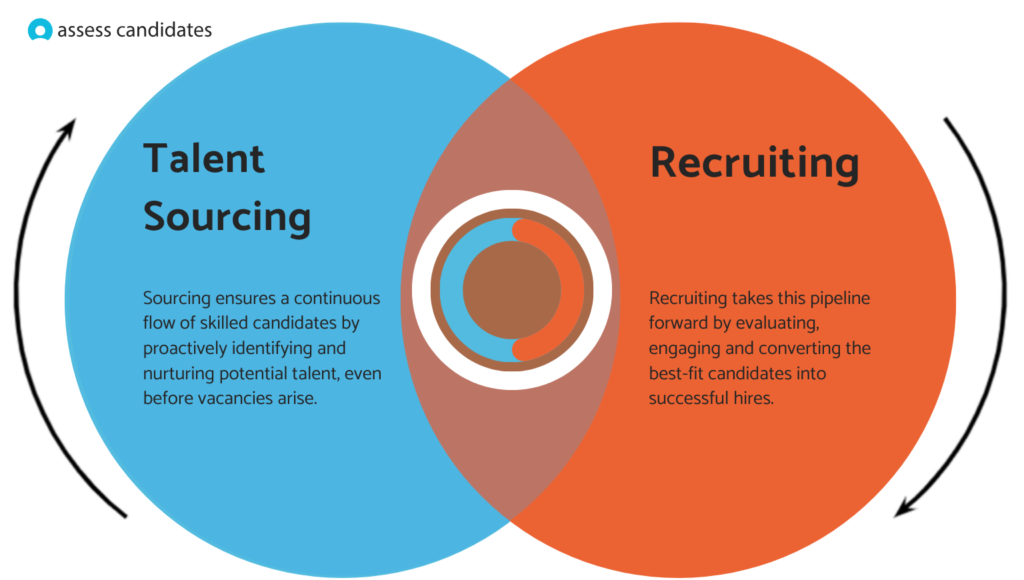
The table below highlights the key differences between talent sourcing and recruiting, showing how each supports distinct stages of the hiring journey and strengthens workforce readiness.
While there are key differences between talent sourcing and recruiting, they work side by side, helping organizations achieve a more strategic and efficient hiring process. Sourcing ensures a continuous flow of skilled candidates by proactively identifying and nurturing potential talent, even before vacancies arise, and recruitment narrows down this potential talent pool to select the best-quality hires.
Although 77% of talent leaders view active sourcing as essential to their talent acquisition approach, merely 27% of companies actually implement it for over half of their hires.
In the next section, we will explore how talent sourcing and recruiting collaborate together for an effective hiring strategy.
4. How talent sourcing and recruiting work together
Sourcing and recruiting thrive when they operate as partners rather than in isolation. Sourcers identify and engage with potential candidates early, creating a ready pool of qualified talent. This early groundwork gives recruiters a significant advantage, allowing them to nurture relationships, assess candidates, and convert high-potential individuals into employees more quickly and effectively.
When both teams align their goals and collaborate seamlessly, organizations experience multiple benefits.
What are the top benefits of using talent sourcing with recruiting?
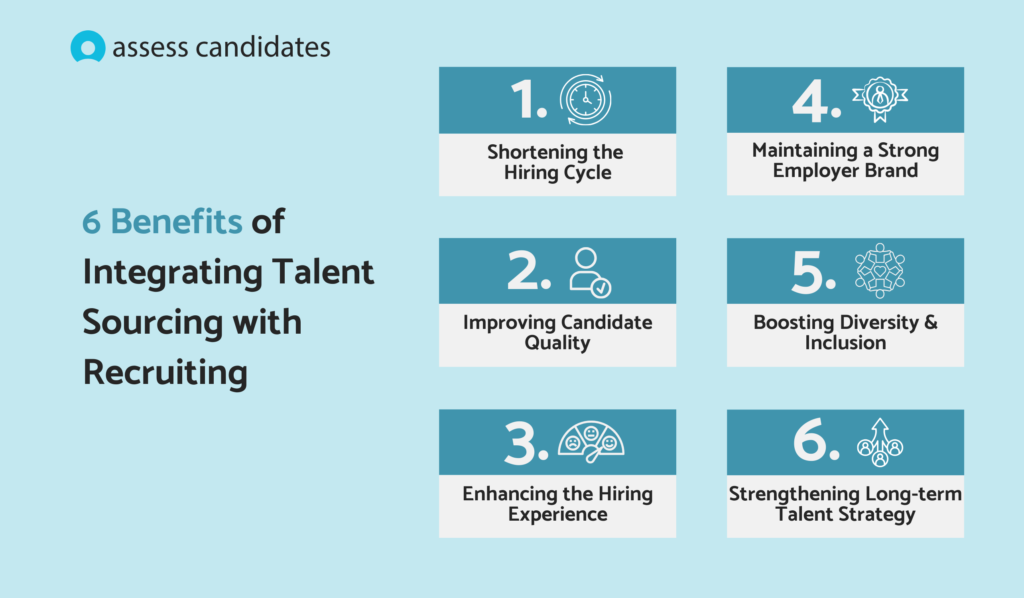
Integrating talent sourcing with modern recruitment methods creates a seamless and efficient hiring process. It helps organizations attract better candidates, fill roles faster, and plan for future talent needs. Let’s take a look at a few of them!
- Shortening the hiring cycle: With pre-qualified candidates already in the pipeline, recruiters can move quickly from screening to selection, reducing the overall time-to-hire and ensuring critical positions are filled without delay. This efficiency helps organizations stay agile and responsive to business needs.
- Improving candidate quality: Close collaboration allows sourcers to target candidates who meet both technical and cultural requirements, while recruiters can focus on deeper evaluation and engagement. As a result, the final hires are better aligned with the company’s goals and values.
- Enhancing the overall hiring experience: When sourcing and recruiting work hand-in-hand, communication with candidates becomes smoother and more consistent. This creates a positive and transparent experience from the first interaction to the final offer, increasing candidate satisfaction and trust.
- Maintaining a strong employer brand: A unified sourcing and recruiting strategy ensures that every candidate touchpoint reflects professionalism and care. Over time, this builds a reputation for the organization as a desirable and trustworthy employer, attracting top talent organically.
- Boosting diversity and inclusion: By widening the search to multiple platforms and networks, sourcing teams help uncover diverse talent pools that might otherwise be overlooked. Combined with fair and structured recruitment practices, this leads to a more inclusive and balanced workforce.
- Strengthening long-term talent strategy: Continuous collaboration between sourcing and recruiting helps organizations forecast future hiring needs and build talent pipelines accordingly. This proactive approach reduces hiring gaps and supports sustainable workforce growth.
This collaboration ensures that hiring isn’t reactive but proactive, allowing companies to engage with the best talent before competitors do.
When talent sourcing and recruiting work in sync, organizations achieve faster, smarter, and more efficient hiring outcomes. Studies show that companies aligning both functions can reduce time-to-hire by up to 30% and cut cost-per-hire by nearly 25% through better use of pre-qualified talent pipelines.
Make hiring smarter and simpler! Try our science-backed pre-employment assessments today. HIRE FOR FREE
By now, it’s clear that modern hiring success depends not just on individual tools or tactics, but on building a seamless, data-driven ecosystem where sourcing and recruiting reinforce each other. To make that shift, organizations must adopt strategies that are both innovative and practical.
5. Effective strategies for modern sourcing and recruiting
The future of hiring is data-driven, tech-enabled, and human-centred. To stay ahead in the battle for skilled talent, organizations must integrate innovative strategies into both sourcing and recruiting.
Practical strategies for effective talent sourcing and recruiting:
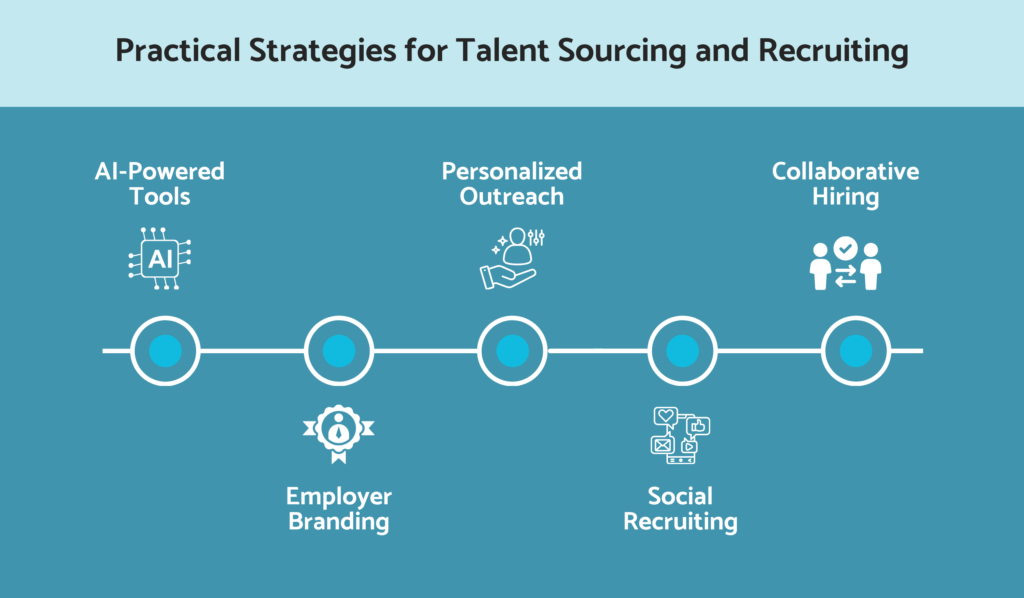
AI-powered Tools:
Automating repetitive sourcing tasks is now a must-have. Science–backed assessments, game–based testing, and AI–powered dashboards will help you shortlist faster and more accurately.
Employer branding:
In a crowded market, building a compelling image means more than flashy job ads; it means creating consistent and positive experiences from first contact to onboarding. Strive to use accessible, inclusive assessments and transparent candidate journeys, helping strengthen your reputation as a professional, fair, and attractive employer.
Personalized outreach:
Customizing communication to each candidate, referencing their background, ambitions, and skills, dramatically improves candidate engagement. When sourcing teams collaborate with recruiting to understand role needs and culture fit, outreach becomes more genuine and candidate-centred rather than transactional.
Social recruiting:
Use LinkedIn, X (formerly Twitter), GitHub, and industry forums to not only post jobs but actively engage with talent. Sourcing teams monitor discussions, join relevant groups, and share insights while recruiters use assessment tools to finalize their hiring decisions.
Collaborative hiring:
Bringing hiring managers and teams into the process early during sourcing as well as recruiting. When roles are defined jointly, recruiter and sourcer together, decision-making becomes faster, understanding of culture deepens, and alignment increases.
By combining these approaches, that is, AI-enabled assessment, strong employer brand, personalised outreach, social recruiting, and cross-functional collaboration, companies can create an efficient, scalable, and candidate-friendly hiring process. This creates a modern talent acquisition engine that not only fills roles quickly but also builds a future-ready workforce aligned with culture, skills, and strategy.
So, what can employers look forward to in talent sourcing and recruitment? Let’s find out below.
6. The future of talent sourcing and recruiting
Technology is reshaping the future of talent acquisition. Artificial intelligence (AI), automation, and predictive analytics now enable organizations to anticipate hiring needs and identify top talent before they even start active job hunting. These tools are revolutionizing efficiency, accuracy, and reducing human bias.
Leading companies across industries are already leveraging this blend of innovation and empathy to transform the way they hire. As AI manages data-heavy tasks such as candidate sourcing, resume screening, and interview scheduling, the role of recruiters and sourcers is evolving. They now focus on relationship-building, empathy, and cultural alignment aspects that technology cannot replicate.
For example, Walmart’s Chief People Officer noted that while AI accelerates candidate identification, human interaction remains central to assessing fit, guiding applicants, and creating a genuine connection.
This shift toward “high-tech meets high-touch” hiring is visible across many organizations:
- Unilever: Implemented AI-driven assessments to handle high applicant volumes and reduce bias. As a result, this consumer goods company saved 50,000 hours in interview time, achieved £1 million in annual cost savings, reduced time-to-hire by up to 90%, and improved diversity hires by 16%. While AI handled screening, recruiters focused on cultural-fit interviews and delivering a strong candidate experience.
- Reed Recruitment (UK): A recruitment agency automated job posting, cutting time per post from 90 to 5 minutes. This generated a 600% ROI, saved 4,000 hours annually, and for one client, reduced time-to-hire from 25 to 18 days while increasing applications by 68%. Recruiters could then dedicate more time to personalized candidate engagement.
- Monster: This online Job Portal company used machine learning for job matching and resume feedback, increasing global applications by around 20%. The platform’s technology manages volume efficiently, while human recruiters focus on storytelling and maintaining the employer brand.
- Synsel: A staffing agency developed an AI system to automate sourcing for engineers and technicians, freeing recruiters from repetitive tasks so they could focus on relationship management, interview coaching, and nurturing candidates.
These success stories highlight a clear trend: organizations that integrate intelligent automation with genuine human connection are redefining recruitment success. This synergy not only streamlines hiring but also enhances candidate experience and decision-making, revealing the many benefits of blending technology with the human touch. Moving next, let’s take a look at some of these benefits.
What are the benefits of automation in ethical recruitment?
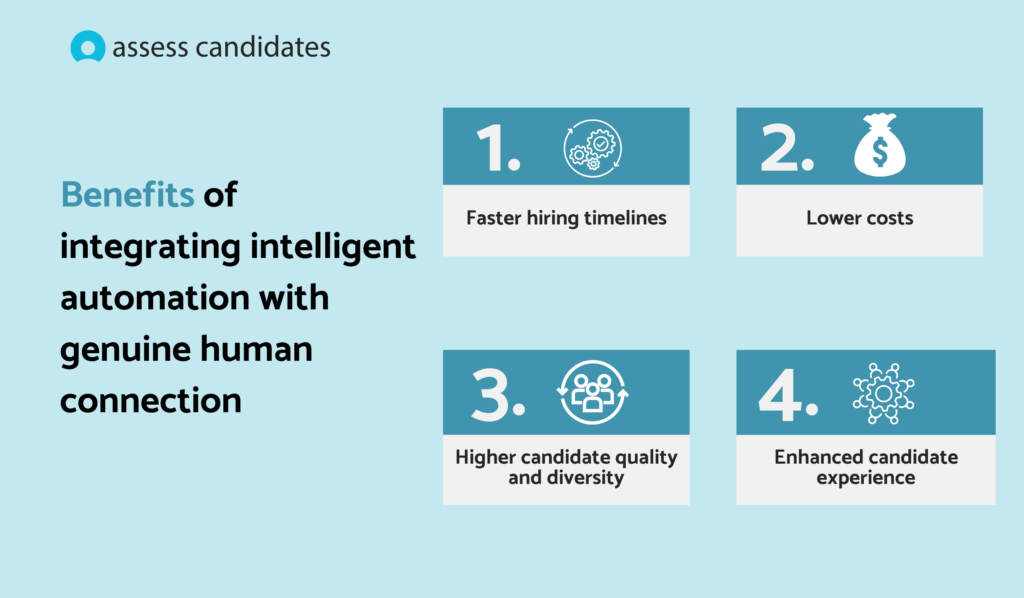
The benefits of integrating intelligent automation with human connection include:
- Faster hiring timelines: Predictive analytics and automation speed up candidate sourcing and screening, helping companies fill critical roles swiftly.
- Lower costs: Streamlined processes and AI tools reduce administrative work and operational expenses.
- Higher candidate quality and diversity: Data-driven sourcing broadens reach, while human insight ensures alignment with company culture.
- Enhanced candidate experience: Personalized communication and empathy-driven engagement improve how candidates perceive the hiring journey.
Ultimately, the future of talent sourcing and recruiting belongs to organizations that strike the right balance using AI for speed and scale but relying on humans for authenticity and connection. Those who master this blend will not just fill roles faster but will also build lasting relationships and stronger employer brands.
Boost your hiring quality with Assess Candidates’ reliable pre-employment solutions. View Plans
7. Talent sourcing vs. recruiting: Client Success Story
Client Problem Statement:
A mid-sized fintech company was scaling rapidly but struggling to bridge the gap between talent sourcing and recruiting. Their sourcing team generated a large pool of applicants through job boards and social media, but recruiters found it difficult to filter candidates who truly matched the job requirements and company culture. Despite investing in outreach, the company faced high screening times, poor candidate fit, and increasing turnover in customer support and product roles. The absence of standardized skill assessments led to inconsistent evaluations and wasted efforts on unqualified candidates. They needed a data-driven, automated solution to align sourcing with recruitment and make better hiring decisions faster.
Assess Candidates Proposal:
Assess Candidates introduced an integrated suite of pre-employment assessments to bring structure, accuracy, and objectivity to the company’s hiring pipeline. For sourced candidates, quick screening assessments (like cognitive ability and situational judgment tests) were implemented to qualify talent early. For shortlisted candidates, role-specific skill tests and personality questionnaires were used to evaluate job-fit and team compatibility. Recruiters could now rely on real-time analytics, standardized reports, and AI-backed scoring to identify top performers efficiently.
With Assess Candidates’ seamless integration into the company’s applicant tracking workflow, sourcing and recruiting teams began working in sync. Sourcers could focus on outreach and lead generation, while recruiters leveraged assessment data to prioritize high-potential candidates without bias or guesswork.
Result:
Within three months, the company reduced screening time by over 50% and increased quality hires by 30%. The standardized assessments helped eliminate subjective bias and ensured only the most capable and aligned candidates reached the final interview stage. By using Assess Candidates, the organization created a smoother collaboration between sourcing and recruiting teams, built a stronger talent pipeline, and established a scalable, data-driven hiring process that continues to support its long-term growth.
So, why choose us?
8. How does Assess Candidates support both talent sourcing and recruiting?
Assess Candidates bridges the gap between talent sourcing and recruiting by empowering organizations to identify, evaluate, and select high-quality talent with speed and precision. While it does not directly perform AI-driven candidate sourcing or talent discovery, it plays a crucial role in transforming how sourced candidates are assessed, shortlisted, and hired.
For talent sourcers, Assess Candidates helps maintain a high-quality talent pipeline by offering objective data on each candidate’s cognitive abilities, technical proficiency, and personality traits. This ensures that even before the recruiting stage begins, talent pipelines are filled with verified, capable individuals who match the organization’s skill and culture requirements.
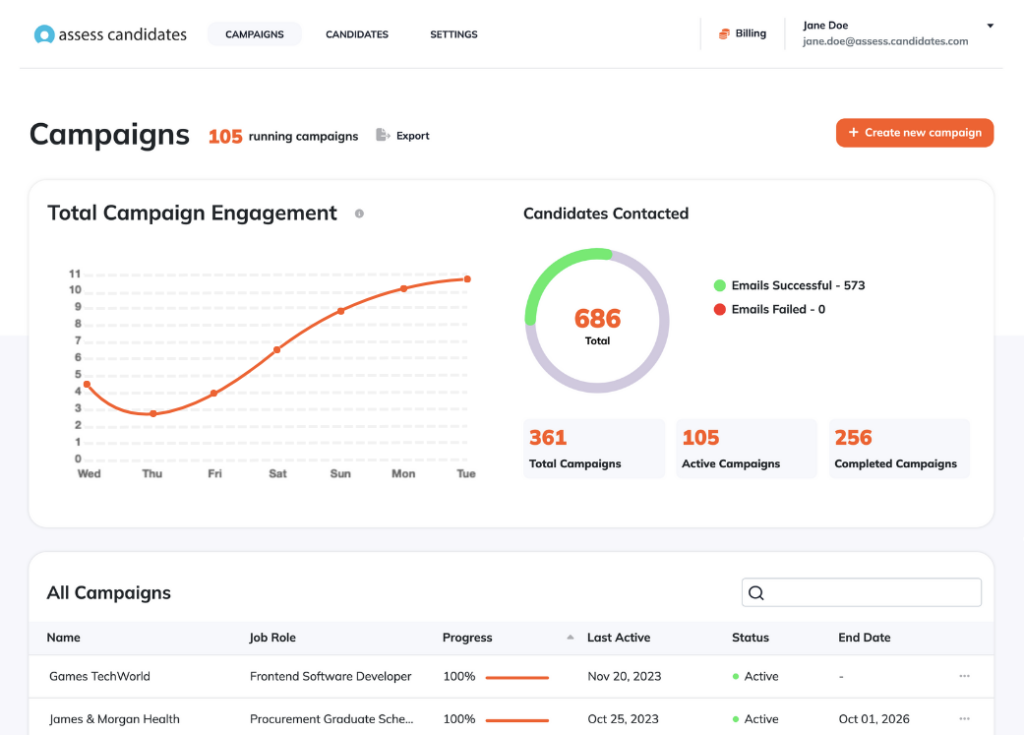
For recruiters, the platform streamlines decision-making through automated assessments, psychometric testing, and job-fit evaluations. These tools help recruiters move beyond resumes and gut instincts, relying instead on evidence-based insights to identify the most suitable candidates. Recruiters can thus focus more on relationship building, communication, and onboarding, rather than manual screening.
By integrating Assess Candidates into both sourcing and recruiting workflows, organizations can reduce bias, accelerate time-to-hire, and improve the overall quality of hires. It creates a unified, data-backed hiring ecosystem where technology enhances human judgment, allowing HR teams to make smarter, fairer, and faster hiring decisions while providing a better candidate experience from start to finish. Here’s how:
- Evidence-based screening, not just gut instinct
Instead of relying solely on resumes or first impressions, recruiters gain access to objective assessments of cognitive ability, technical proficiency, situational judgement, and personality traits, all validated and reliable.
This means recruiters can surface high-potential candidates earlier, reduce the risk of bias or missing hidden talent, and feel confident in their shortlists.
- Streamlined workflows for high-volume or niche roles
With the platform, recruiters can quickly launch an assessment campaign (in just a few clicks) and process large candidate pools with consistent criteria.
That allows recruiters to shift effort away from manual screening and toward candidate engagement, interviews, and onboarding, the human side of recruitment.
- Better alignment of role fit & culture fit
Technical and cognitive scores give a clear picture of “can this person perform the job?”, while personality and situational judgement assessments provide insight into “will they thrive in this role and environment?” Recruiters can therefore present hiring managers with candidates who are not only capable but also more likely to integrate well with the team and organisation. - Transparent, fair, and inclusive candidate experience
Because the assessments are scientifically validated, accessible (including for candidates with disabilities), and designed for fairness, recruiters can uphold stronger employer–brand standards and reduce legal or reputational risk.
This, in turn, encourages higher completion rates, a better candidate journey, and stronger candidate-employer relationships.
Empower your hiring decisions with our proven, science-based assessment platform. LEARN MORE
Want to learn more about effective candidate assessment? Explore the FAQs below and subscribe with your email to get started.
Frequently Asked Questions
What is the main difference between talent sourcing and recruiting?
Talent sourcing is about identifying and engaging potential candidates even before a position opens. It focuses on building relationships and a steady talent pipeline. Recruiting, on the other hand, manages applicants through screening, interviews, and final selection, turning that pipeline into successful hires.
Why do organizations need both sourcing and recruiting teams?
Having both ensures a proactive and efficient hiring strategy. Sourcers create a steady pool of qualified candidates, reducing time-to-hire when new positions open. Recruiters then focus on screening, assessment, and ensuring a good cultural and role fit. Together, they improve the quality of hire and overall candidate experience.
How has technology changed talent sourcing and recruiting?
Modern technology, including AI, predictive analytics, and automation, has revolutionized both. Sourcing tools can now identify passive candidates using social data, while recruiting platforms can screen applicants, schedule interviews, and assess skills with minimal manual effort. This makes the entire process faster, data-driven, and more inclusive.
Can one person handle both sourcing and recruiting?
In smaller organizations, yes, one HR professional may manage both functions. However, in larger companies or high-volume hiring situations, separating the two roles improves efficiency and depth of focus. Sourcers specialize in market mapping and outreach, while recruiters handle engagement, interviews, and final selection.
How does Assess Candidates help in both talent sourcing and recruiting?
Assess Candidates bridges the gap between sourcing and recruiting by offering AI-powered pre-employment assessments, cognitive tests, psychometric evaluations, data insights, and automation tools. Sourcers can identify high-potential talent early, and recruiters can evaluate candidates objectively, ensuring faster, smarter, and bias-free hiring decisions.


 English
  Arabic