
A Practical Guide To Hiring Talent From Around The World



Global recruitment has quickly shifted from a niche practice into a powerful driver of modern business growth, innovation, and competitiveness.
As teams expand across borders and remote work becomes standard, more organizations are actively seeking talent beyond their local markets to find the right people. By recruiting globally, employers can access a broader pool of skilled professionals, enhance workforce diversity, and build teams that innovate and adapt in a fast-changing business environment.
Did you know? According to LinkedIn’s Global Talent Trends Report 2024, 70% of business leaders say that hiring internationally has helped them close critical skill gaps and improve team performance, especially in technology, data analytics, and digital marketing.
But global recruitment isn’t just about broadening your search. It integrates strategic workforce planning, cross-cultural understanding, and technology-driven hiring practices to help you attract, evaluate, and support talent worldwide. It allows companies to overcome local skill shortages, maintain round-the-clock operations across time zones, and build culturally aware teams that navigate diverse markets effectively.
Organizations that invest in global recruitment future-proof their workforce and gain a competitive edge in innovation, efficiency, and employer reputation. It is a long-term strategy that supports growth, inclusivity, and the ability to thrive in a connected global economy.
Whether you are a recruiter, hiring manager, or talent acquisition expert, you may find yourself asking:
- How does hiring globally help employers stay competitive and relevant?
- What limitations come with global recruitment?
- What does an effective international recruitment strategy look like?
- Which tools support hiring globally?
- Which industries benefit most from a global hiring model?
This guide explores the importance of global recruitment in 2026, highlights its business benefits, and explains how organizations can effectively hire, assess, and retain top talent worldwide.
Contents
- What is global recruitment?
- Why are companies hiring globally today?
- What are the benefits of hiring internationally?
- How to build an effective global recruitment strategy?
- What are the best tools or platforms for global hiring?
- Which roles and industries benefit most from global recruitment?
- How global recruitment shapes the future workforce
- Global Recruitment: A Success Story
- Why top companies choose Assess Candidates to hire internationally
Now that we’ve outlined what this article covers, let’s find out what global recruitment is.
1. What is global recruitment?
Global recruitment is the process of sourcing, attracting, and hiring candidates from around the world. Instead of limiting roles to local applicants, companies instead gain access to a broader global group with diverse skills, experiences, and perspectives they might not find locally.
What does global recruitment involve?
Global recruitment typically involves hiring using international job boards, global recruitment agencies, and digital assessment tools to identify and assess candidates effectively. Employers use an understanding of international hiring practices, visa and immigration requirements, cultural differences, and relocation processes to ensure a smooth hiring and onboarding process for candidates.
Improve your global recruitment strategy with our virtual, science-backed pre-employment assessments. HIRE FOR FREE
How does the global recruitment process work?
The global recruitment process involves a series of important steps that help organizations attract, evaluate, and hire talent across the world. It combines strategic planning, international outreach, and compliance with global employment regulations.
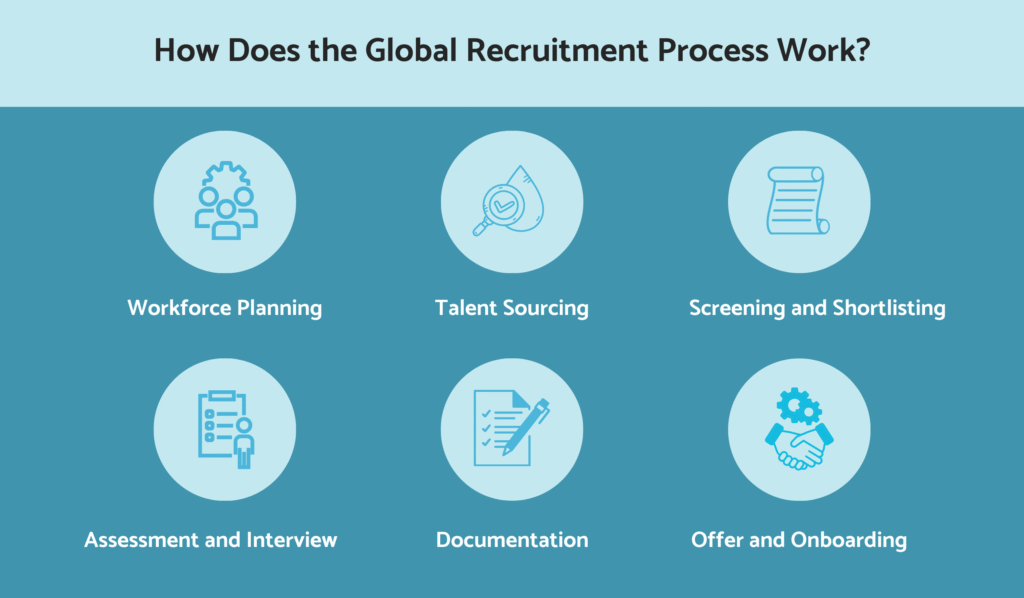
Here are the 6 main steps in a typical global recruitment process:
1. Workforce Planning
Recruiters begin by identifying skill gaps and providing details for the roles they need to fill globally. Workforce planning includes outlining job descriptions, qualifications, and talent markets.
2. Talent Sourcing
Next, employers use multiple channels, including online job boards, LinkedIn, social media platforms, and international recruitment agencies, to reach out to global talent. The goal is to attract qualified candidates from diverse regions.
3. Screening and Shortlisting
Recruiters screen and shortlist potential candidates using an Applicant Tracking System (ATS) or AI-driven tools that assess their qualifications, skills, experience, and cultural fit.
4. Assessment and Interview
The shortlisted candidates undergo skills assessments, aptitude tests, and video interviews. This further helps recruiters fairly evaluate the candidates’ technical and soft skills in a standardized manner.
5. Documentation
At this stage, organizations verify documents, manage work permits or visa applications, and ensure compliance with labor laws in both home and host countries of the selected candidates.
6. Offer and Onboarding
Once a candidate accepts a formal offer, the onboarding process, which typically includes relocation support, orientation, and integration into the company culture, begins.
Now that you understand the basics, in the following section, we will look into why companies are hiring globally in 2026.

2. Why are companies hiring globally today?
In 2026, companies are actively hiring globally to adapt to new hiring trends, diversify their talent pool, bridge skill gaps, and stay relevant in a competitive, fast-changing business landscape.
Top reasons why companies hire globally
- Strengthening Diversity and Inclusivity
Hiring internationally enhances an organization’s diversity and inclusion by enabling employers to tap into diverse talent globally. It brings together individuals from varied cultural, linguistic and educational backgrounds.
Organizations can identify the best talent by searching beyond local borders and broadening their hiring pool to include international candidates, regardless of their location. A diverse and inclusive workforce encourages broader perspectives, innovative thinking, and stronger collaboration.
- Bridging Skill Gaps in the Local Market
As industries like technology, finance, and healthcare continue to evolve over time, the demand for highly skilled professionals continues to increase. Organizations that limit their hiring efforts domestically often struggle to find candidates with the right expertise.
By hiring globally, organizations can gain exposure to the international market, where skilled professionals are more readily available. This approach supports business continuity and innovation and helps companies stay competitive by overcoming local workforce limitations and securing top-tier global talent.
- Adapting to Remote and Hybrid Work Trends
Since the onset of the pandemic, remote and hybrid working are now standard practice. In 2026, organizations continue to leverage these flexible hiring models to source employees from any part of the world.
Moreover, remote hiring can also lead to increased cost savings, since companies tap into more cost-effective labor markets while reducing the need for physical infrastructure.
- Leveraging Technology for Smarter Hiring
Advanced hiring strategies and HR technologies, including AI-driven assessments, automated screening tools, and digital recruitment platforms, have significantly simplified the global recruitment process.
These tools further help recruiters hire faster and more efficiently, identifying top performers while also saving costs and time and maintaining compliance with international labor laws.
- Enhancing Global Presence
Organizations enhance their global presence and cultural compatibility through greater cultural awareness and collaboration across borders.
By building diverse teams with global perspectives, companies operate seamlessly in multiple markets, adapt to varied business environments, and build stronger connections with international clients.
Find the right global talent faster with our automated, online assessments. LEARN MORE
In the following section, we will dive into the benefits of hiring globally.
3. What are the benefits of hiring internationally?
Organizations build a strong global workforce to open their doors to diverse skills, perspectives, and expertise from around the world. A well-designed global recruitment approach allows companies to grow and improve operational efficiency as well as stay competitive in rapidly changing markets.
Top 5 benefits of a global recruitment strategy
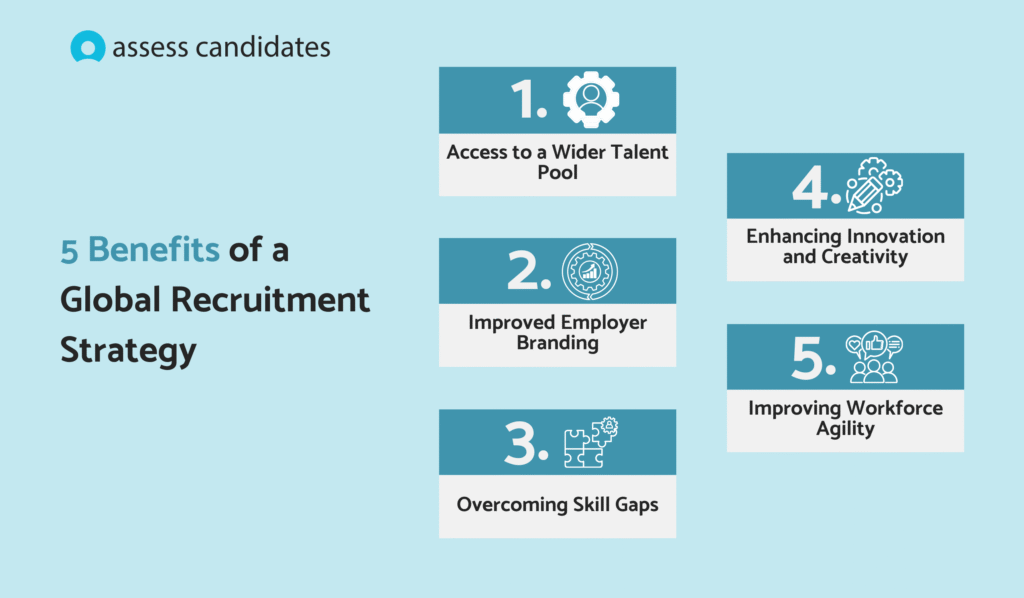
1. Access to a Wider Talent Pool
Organizations can access a broader talent pool, enabling them to tap into skilled professionals worldwide. This further diversifies the workforce by bringing together employees from different backgrounds and cultures.
2. Improved Employer Branding
A successful global recruitment strategy enhances employer branding by positioning the company as a diverse, inclusive, and forward-thinking organization. This reputation further helps the company attract highly skilled professionals, strengthening its position in the global market.
3. Overcoming Skill Gaps
Global recruitment helps efficiently bridge skills gaps by providing easier access to qualified candidates worldwide. Moreover, several industries, particularly technology, finance, and healthcare, frequently face skill shortages. A global recruitment strategy helps overcome this skill gap by sourcing talent from international markets where the skills are readily available.
4. Enhancing Innovation and Creativity
A diverse workforce brings different perspectives, problem–solving ideas, and approaches. This blend of experiences fosters organizations to build a more forward-thinking and adaptable business strategy.
5. Improving Workforce Agility
By accessing talent worldwide, organizations quickly scale their teams, adapt to new market demands, and maintain operational flexibility. This agility plays a vital role during business expansions, product launches, and shifts in strategic priorities.
But what challenges do organizations face when hiring internationally?
What challenges do organizations face with global recruitment?
The majority of the challenges that you might face are related to compliance, communication, and coordination across borders.
Common challenges and considerations, and how to overcome them
- Legal and Compliance Barriers: Different countries enforce varying labor laws, tax policies, and visa requirements, making it difficult for organizations to maintain compliance during international hiring.
Solution: Partner with local legal experts or global recruitment agencies that specialize in compliance. Use HR management tools that automate documentation and ensure adherence to regional employment and data protection laws.
- Cultural and Communication Differences: Language barriers and contrasting workplace norms can lead to misunderstandings, misalignment, and reduced collaboration among international teams.
Solution: Offer cross-cultural training programs to recruiters and managers. Encourage open communication, and use multilingual collaboration tools to ensure inclusivity and clarity across regions.
- Time Zone Coordination: Scheduling interviews and managing operations across multiple time zones can create communication delays and workflow disruptions.
Solution: Implement flexible working hours and rely on scheduling tools that automatically calculate overlapping time zones. Encourage asynchronous communication methods to keep teams connected and productive.
- Inconsistent Recruitment Standards: Variations in education systems, skill certifications, and job expectations can result in uneven candidate evaluations across countries.
Solution: Use structured interviews, standardized assessments, and global applicant tracking systems (ATS) to ensure fair and consistent candidate evaluation worldwide.
- Relocation and Immigration Delays: Visa approvals, relocation logistics, and international paperwork often cause hiring delays and added costs.
Solution: Partner with immigration consultants and relocation service providers to streamline the process. Offer remote or hybrid work options when relocation is not immediately feasible.
- High Recruitment and Operational Costs: Expanding recruitment globally demands investments in marketing, technology, and compliance, making ROI harder to track.
Solution: Establish clear performance metrics such as cost-per-hire, time-to-fill, and retention rate. Use data analytics to monitor ROI and focus hiring on regions with quality, cost-efficient talent pools.
Now, let’s look into the different ways employers use to develop a global recruitment strategy.
4. How to build an effective global recruitment strategy?
Building a global recruitment strategy means creating a clear, structured plan to attract, evaluate, and hire talent from around the world while ensuring alignment with your company’s goals, culture, and compliance standards.
5 effective strategies employers use for building a successful global recruitment process:
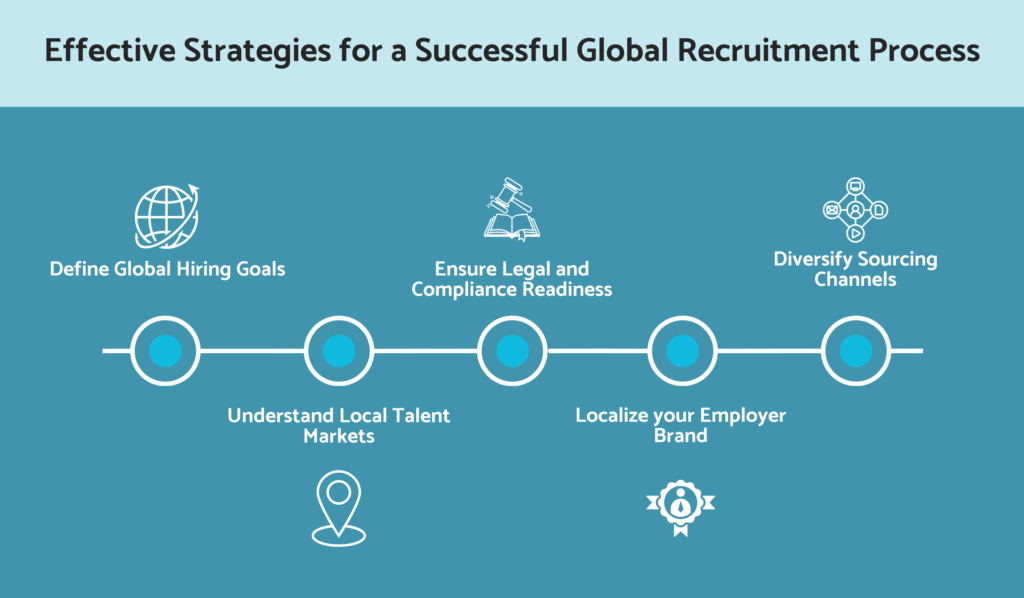
1. Define Global Hiring Goals
From our work supporting employers around the world through assessment-led recruitment, we have found that successful international hiring begins with clearly defining why your organization wants to hire globally.
Identify whether your goal is to close skill gaps, access specialized expertise, diversify your workforce, or expand into new markets. Establishing these objectives helps you target the right roles for international hiring and ensures your recruitment efforts support your overall business strategy.
2. Understand Local Talent Markets
Research each target region to understand its talent availability, salary expectations, and employment trends. Analyze where your required skills are concentrated and what motivates professionals in those areas.
From our work with global organizations, we recommend using global platforms like LinkedIn and Glassdoor alongside regional job boards. By studying regional labor patterns, you can focus your efforts on areas known for specific strengths.
3. Ensure Legal and Compliance Readiness
As a test provider working with several international organizations, Assess Candidates regularly helps teams navigate the compliance considerations linked to global hiring and assessment deployment. Hence, before expanding into new regions, prepare your organization to meet all legal and regulatory requirements in each country where you plan to hire. Review employment laws, tax regulations, and data protection rules to avoid compliance risks.
Collaborate with an Employer of Record (EOR) or Professional Employer Organization (PEO) to manage contracts, payroll, and benefits. Stay compliant with global privacy standards such as the GDPR and confirm visa or work permit requirements for international hires.
4. Localize Your Employer Brand
Adapt your employer brand to connect with candidates across different cultures and regions. Translate job postings, use inclusive language, and emphasize benefits that matter locally, such as healthcare, flexible work options, or career growth opportunities.
Share testimonials and success stories from global employees to highlight your commitment to diversity and inclusion.
5. Diversify Sourcing Channels
We recommend using a multi-channel sourcing approach supported by objective assessment data. Post jobs on international sites like Indeed, Glassdoor, and LinkedIn, while also leveraging regional job boards.
Partner with local recruiters, universities, and professional networks to tap into regional talent pools. Explore remote hiring platforms like We Work Remotely and Deel to find qualified professionals open to international work opportunities.
Next up, we will take a look at the best platforms used for global recruitment.
Discover our expert-backed psychometric tests to support your global recruitment hiring strategy. HIRE FOR FREE
5. What are the best tools or platforms for global hiring?
Employers use global recruitment platforms to source, evaluate, and hire candidates across diverse regions. The best tools and platforms provide strong international reach, multilingual support, robust applicant tracking, compliance features, and advanced search or AI-driven matching capabilities.
The following are the top 5 tools and platforms used for global recruitment:
1. LinkedIn Recruiter
LinkedIn Recruiter is one of the largest professional networks globally, which is open to candidates all over the world. Employers use this hiring platform to quickly source, connect with, and manage qualified candidates.
Some of its features include:
- Advanced search filters and intelligent matching
- Personalized messaging to form candidate connections
- Analytics tools and collaboration to manage the candidate pipeline.
2. SmartRecruiters
SmartRecruiters is a global talent acquisition suite that employers can use to attract, select, and hire candidates across multiple regions. It supports AI-powered sourcing, multilingual job postings, and seamless collaboration to attract and manage international candidates.
Some of its features include:
- Personalized recruiting workflows that align with operational requirements.
- Customization of user roles and access levels in seconds.
- Multi-language customer support.
Assess Candidates has officially partnered with SmartRecruiters, allowing our systems to integrate and work effortlessly together.
3. Gem
Gem is an AI-first, all-in-one recruitment platform that combines CRM, ATS, sourcing, scheduling, analytics, and over 800 million candidate profiles to source from. This hiring platform has AI built into every workflow.
Some of its features include:
- AI sourcing agents to find matches faster, flag candidates already in the existing ATS, and craft personalized messages.
- AI application review agents to review applications faster.
- End-to-end analytics, where ATS integrations and a no-code interface allow recruiters and TA leaders to self-serve full-funnel reports.
4. Indeed
Indeed is a widely used global recruitment platform that helps employers connect with thousands of candidates all across the globe. This platform supports high-volume sourcing and provides insights to improve recruitment outcomes.
Some of its features include:
- Indeed Smart Sourcing to quickly identify candidates who fit your job description.
- Employer branding and analytics tools.
- Sponsored Job to receive higher visibility for relevant search results longer.
5. Workable
Workable is a future-ready HR platform that features intelligent tools to streamline hiring, manage employee data, and track time and payroll.
Some of its features include:
- Extensive job ad syndication network to reach millions of candidates with one click.
- Passive candidate sourcing tools.
- Employee referral program.
In the following section, we will take a look at the roles and industries that benefit from global recruitment.
6. Which roles and industries benefit most from global recruitment ?
Global recruitment supports a diverse range of roles and industries, particularly those that depend on specialized expertise, digital collaboration, and skills that are limited or hard to find in local markets.
Top 5 industries that benefit from a global recruitment strategy
- Technology and IT
Tech companies actively use global recruitment to fill critical skill gaps in software development, data science, cloud engineering, and cybersecurity. Hiring internationally allows them to access specialized talent and stay ahead of rapid technological changes.
Major companies like Google, Microsoft, and Infosys recruit professionals worldwide to strengthen their teams and drive innovation.
- Finance and Fintech
Financial organizations expand their hiring globally to find experts in data analytics, risk management, compliance, and blockchain technology. By reaching beyond local markets, they access professionals who understand international financial systems and regulatory frameworks.
Significant firms such as J.P. Morgan, Revolut, and HSBC recruit globally to support their digital banking operations and fintech innovations.
- Healthcare and Life Sciences
Healthcare providers and life sciences companies hire internationally to address shortages in clinical, pharmaceutical, and research roles. Global recruitment helps them bring in specialized knowledge and improve patient care outcomes.
Organizations like Pfizer, the Cleveland Clinic, and Johnson & Johnson actively source talent from different countries.
- Engineering and Manufacturing
Engineering and manufacturing firms recruit globally to find skilled professionals in fields such as civil, mechanical, and electrical engineering. They rely on international hiring to manage complex infrastructure projects, renewable energy initiatives, and advanced production systems.
Leading companies like Siemens and General Electric (GE) hire globally.
- Education and Research
Universities and research institutions attract international talent to promote knowledge sharing and academic excellence. They hire globally to build diverse faculties, strengthen research programs, and foster cross-cultural collaboration.
Top institutions such as Oxford University, MIT, and the University of Melbourne recruit researchers and educators worldwide to enhance their academic reputation and global impact.
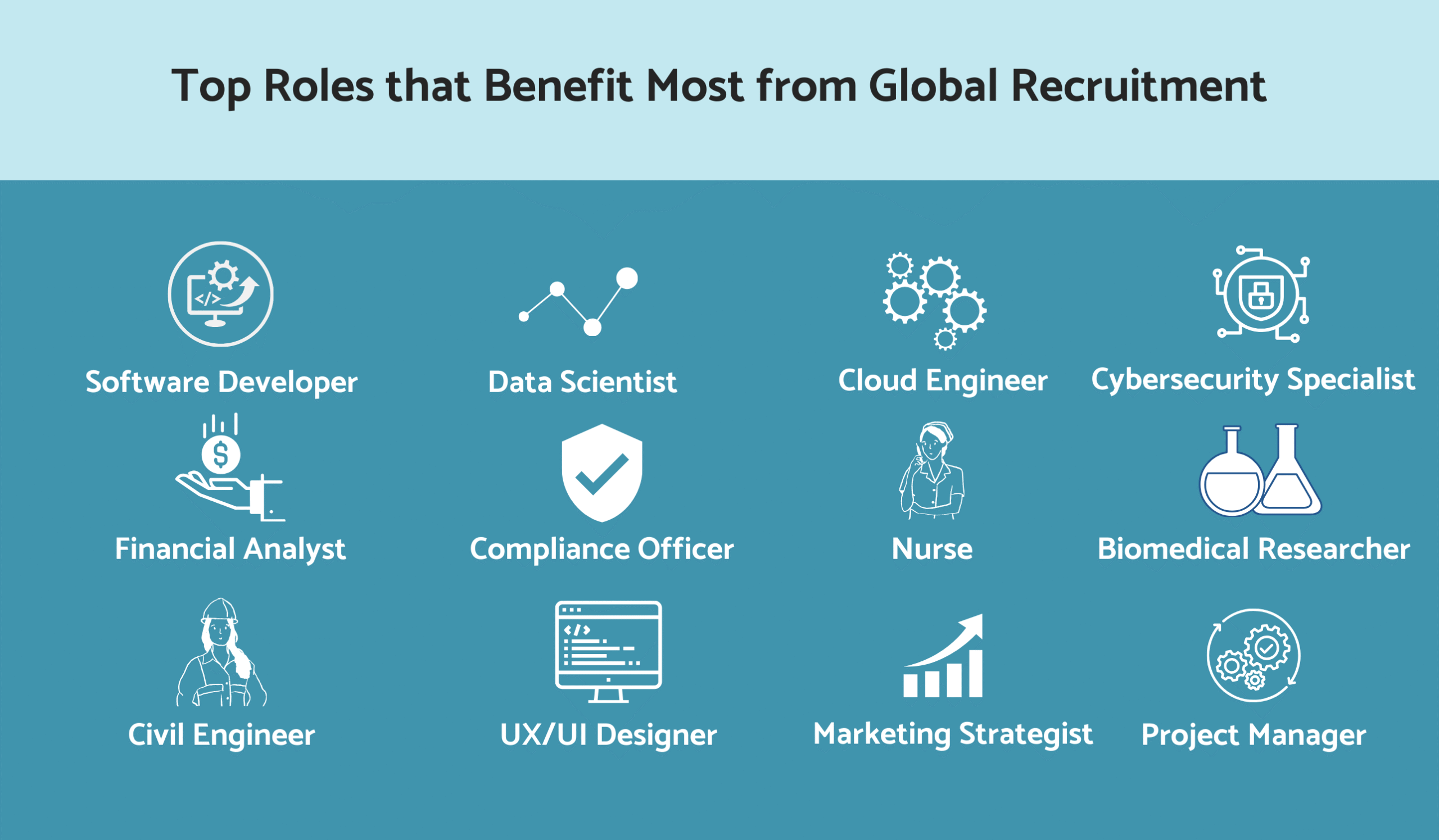
Roles that benefit the most from global recruitment
- Software Developer
- Data Scientist
- Cloud Engineer
- Cybersecurity Specialist
- Financial Analyst
- Compliance Officer
- Registered Nurse
- Biomedical Researcher
- Civil Engineer
- UX/UI Designer
- Marketing Strategist
- Project Manager
Explore our talent assessment platform to assess and hire top global talent with us. LEARN MORE
Now, let’s explore the importance of global recruitment for the future workforce.
7. How global recruitment shapes the future workforce
Global recruitment is a core driver of productivity, competitiveness, and innovation that is reshaping the future workforce.
1. Bridging Global Skill Gaps
Industries worldwide face growing skill shortages, especially in technology, healthcare, and engineering. Global recruitment allows organizations to close these gaps by accessing international talent with the right expertise.
By hiring from different countries, companies secure specialized professionals who bring unique technical knowledge and fresh perspectives, ensuring innovation and steady growth.
2. Fostering Diversity and Inclusion
Global hiring actively builds diverse teams that combine different cultures, experiences, and viewpoints. This diversity fuels creativity, enhances collaboration, and leads to better decision–making.
When organizations recruit inclusively across borders, they strengthen their culture, promote equity, and attract top candidates who value representation and belonging in the workplace.
3. Driving Innovation and Agility
Global recruitment empowers teams to think differently and innovate faster. Professionals from varied backgrounds challenge conventional ideas and introduce new approaches to problem-solving.
By bringing together talent from multiple regions, companies create agile teams that adapt quickly to technological change, evolving markets, and shifting customer needs.
4. Building Business Resilience
Organizations that hire globally increase their ability to operate seamlessly across time zones and markets. A distributed workforce helps maintain productivity even when one region faces disruptions, whether economic, political, or environmental.
This global structure strengthens business continuity and ensures companies remain resilient in uncertain conditions.
5. Expanding Market Reach and Cultural Insight
Hiring globally gives companies direct access to local expertise and cultural understanding. Employees with regional experience help businesses navigate market-specific challenges, regulations, and customer behaviors.
This cultural insight allows brands to design better products, create authentic marketing strategies, and connect meaningfully with diverse audiences worldwide.
Strengthen your global recruitment process with our scientifically validated pre-employment assessments. LEARN MORE
8. Global Recruitment: A Success Story
Client Problem Statement:
Imagine a fast-growing technology company expanding across multiple regions but struggling to source skilled professionals locally. Despite significant investment in recruitment, the company continued to face talent shortages in software engineering, cybersecurity, and data analytics. Local hiring processes led to extended time-to-fill rates, inconsistent candidate quality, and a lack of diversity within teams.
Without a broader talent network, the company found it increasingly difficult to sustain innovation, meet global client expectations, and stay competitive. Realizing the limitations of its traditional hiring model, leadership decided to adopt a global recruitment strategy aimed at attracting top talent worldwide while ensuring consistency, efficiency, and compliance across all regions.
Assess Candidates’ Proposal:
At Assess Candidates, we recommended implementing a structured global recruitment strategy supported by data-driven talent assessments. Our approach helps the organization identify, evaluate, and onboard skilled professionals from multiple regions through a unified recruitment framework.
Additionally, we proposed integrating mobile–friendly cognitive, personality, and technical skill assessments to ensure fair and efficient evaluations across diverse candidate pools. By using analytics to compare regional talent availability, the company could strategically expand its sourcing network and focus on high–potential markets.
This method ensures a standardized yet flexible hiring process that aligns with the company’s culture and performance goals.
Result:
By adopting a global recruitment framework, the company can access a wider range of qualified candidates, reduce hiring timelines, and strengthen team diversity. Managers gain deeper insights into candidates’ skills, cultural adaptability, and long-term potential, enabling smarter hiring decisions.
As a result, the organization will be able to build agile, high-performing global teams capable of driving innovation and operational excellence. Over time, the strategy will enhance global presence, improve workforce resilience, and position the company as an employer of choice in the international talent market.
Partner with us to advance your global recruitment using our psychometric tests. VIEW PLANS
So, why choose us?
9. Why top companies choose Assess Candidates to hire internationally
At Assess Candidates, we offer a comprehensive suite of scientifically validated assessments and create recruitment campaigns tailored to each organization’s unique hiring needs.
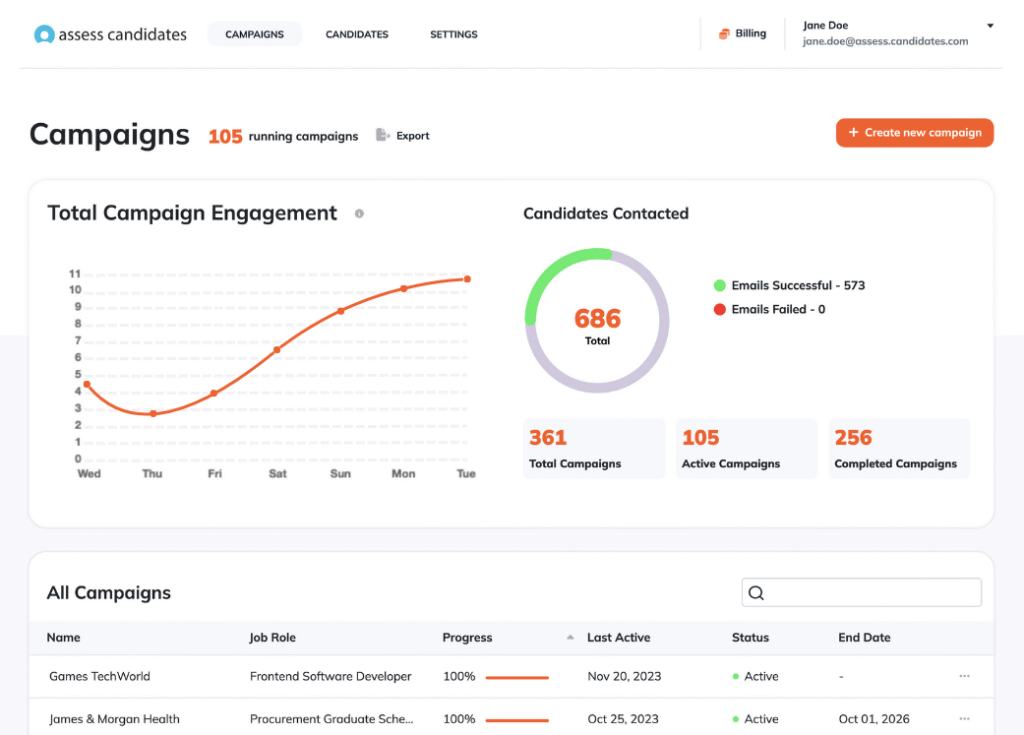
Here is an example of our campaign reporting dashboard available on Assess Candidates.
The top 4 reasons why you should use Assess Candidates for your global recruitment selection process:
- Scientifically Designed and Validated by Expert Psychologists: Leading organizations trust Assess Candidates to support their global recruitment process because our solutions are developed by Chartered Psychologists and Psychometricians with decades of experience designing assessments for renowned industry leaders such as SHL and IBM Kenexa.
Each tool undergoes rigorous validation to ensure it measures skills, cultural alignment, and job fit across diverse markets with scientific precision. Our globally adaptable platform ensures consistent, reliable results, whether candidates complete assessments on a phone, tablet, or desktop, anywhere in the world.
- Expert Reporting: Our intuitive talent assessment platform helps hiring teams to evaluate candidates from multiple regions using behavioral analytics, performance comparisons, and role-specific benchmarks. Real-time scoring and integrated reporting empower recruiters to make data-driven hiring decisions quickly and confidently.
With seamless ATS integration and centralized dashboards, global hiring managers can coordinate international recruitment campaigns without switching between systems, ensuring faster, smarter, and more consistent results across borders.
- Positive Candidate Experience: Every mobile-friendly assessment is designed to deliver an engaging, device-friendly, and culturally adaptive experience for candidates worldwide. The interface supports multilingual options, branded visuals, and real-time progress tracking, allowing candidates to complete assessments conveniently from any location. This inclusive, user-centered approach enhances your employer brand, improves engagement, and increases completion rates across global talent pools.
- Candidate Accessibility Support: Inclusivity lies at the heart of our design. Our platform adheres to global WCAG accessibility standards, offering features such as adjustable color contrast, screen reader support, zoom functions, and extended time allowances. These accessibility measures ensure that every candidate, regardless of geography, language, or ability, can participate confidently and fairly in your recruitment process.
Assess Candidates empowers organizations to build high-performing, globally diverse teams through scientifically validated assessments, advanced analytics, and a seamless user experience. Explore our global recruitment solutions today to discover how we can help you attract, assess, and hire top talent worldwide.
Not sure where to start? Contact us for a free consultation and discover the best-fit solution for your hiring needs.
Key Takeaways
- Global recruitment provides access to a wider talent pool and fills skill gaps that can’t be met locally.
- A structured global recruitment process includes sourcing, screening, assessing, interviewing, verifying documents, and onboarding.
- Employers can reduce hiring delays and improve fairness by using standardized assessments, ATS tools, and AI-driven screening.
- Understanding local regulations, cultural differences, and market trends is essential for building an effective global recruitment strategy.
Interested in learning more about effective candidate assessment? Continue reading for frequently asked questions, and sign up with your email to get started.
Frequently Asked Questions
How can global recruitment improve workforce diversity and innovation?
Global recruitment enhances diversity by bringing together professionals from varied backgrounds, cultures, and perspectives. Hiring globally allows teams to approach challenges creatively, drive innovation, and better understand international markets. This diversity strengthens product and service development, boosts adaptability, and reinforces the company’s reputation as an inclusive, forward-thinking global employer.
How can employers maintain consistency and fairness in global hiring practices?
Employers ensure fairness by applying standardized assessments, structured interviews, and data-driven evaluation methods across all regions. These practices measure every candidate objectively, regardless of location or background. By leveraging validated psychometric tools and centralized hiring platforms, employers actively minimize bias, promote transparency, and uphold fairness throughout the global recruitment process.
How can employers ensure compliance when hiring internationally?
Employers maintain compliance by staying updated on local employment laws, visa requirements, and data protection regulations in each region. They partner with global recruitment platforms or Employer of Record (EOR) services to simplify legal and administrative processes. By standardizing contracts and policies, companies ensure consistent, compliant, and risk-free hiring across all international markets.
How can companies maintain a strong employer brand in global recruitment?
Companies strengthen their employer brand by delivering inclusive and transparent hiring experiences and showcasing global career growth opportunities. By emphasizing diversity, flexibility, and professional development, they attract top talent worldwide. Consistent brand messaging across all digital platforms builds trust and positions the organization as a reputable, attractive global employer.
What technologies can help employers manage global recruitment effectively?
Employers streamline global recruitment by leveraging advanced technologies such as Applicant Tracking Systems (ATS), AI-driven assessment tools, and integrated HR platforms with multilingual and compliance capabilities. These solutions simplify candidate evaluation, documentation, and communication, allowing recruiters to manage large-scale international hiring efficiently and maintain a consistent, data-driven approach across regions.


 English
  Arabic