
How To Effectively Measure Communication Skills in Hiring



Hiring managers often say that communication is one of the most challenging skills to evaluate. Candidates may speak confidently during interviews yet struggle to write a simple email. Others communicate well in writing but fall short in real-time discussions. With tight deadlines, high applicant volumes, and pressure to make the right hire quickly, it’s easy to rely on gut feelings, and that often leads to inconsistent decisions.
In today’s workplace, where remote teams, client-facing roles, and cross-functional collaboration are the norm, misjudging a candidate’s communication ability can create costly problems. So, how to reliably measure communication skills without bias? This guide will show you practical, evidence-based methods to assess candidates more accurately.
A study among office workers showed a significant correlation between communication skills, including verbal, listening, and decisiveness, with overall job performance.
By the end, you’ll have a clear, practical framework for assessing communication skills without adding complexity or slowing down your hiring process.
Contents
- What are communication skills?
- Why do communication skills matter in the workplace?
- How to effectively measure communication skills?
- How to score communication skills?
- What are the red flags you should look out for?
- Why choose Assess Candidates’ assessments for hiring?
1. What Are Communication Skills?
Communication skills describe a candidate’s ability to exchange information clearly, confidently, and appropriately in a professional setting. In hiring, this matters because communication impacts collaboration, customer interactions, productivity, and how quickly new hires adapt to their roles.
Enhance your recruitment process with our scientifically validated hiring tools. HIRE FOR FREE
What Makes Up Strong Communication Skills?
- Verbal Communication
Assessing verbal communication helps you gauge how well a candidate expresses ideas during conversations, presentations, or meetings. Strong verbal communicators speak clearly, stay concise, and tailor their message to their audience.
In healthcare teams, effective communication was strongly associated with improved teamwork, collaboration, and conflict resolution, demonstrating that communication ability directly supports team performance.
- Written Communication
Written communication includes emails, reports, documentation, chat messages, and task updates. Recruiters often see gaps here; candidates may speak confidently but write poorly. This is why objective assessment tools are essential when you want to measure communication skills fairly.
- Active Listening
Listening is a critical but often overlooked part of assessing communication skills. Good listeners ask clarifying questions, avoid interrupting, and respond based on what was actually said, not what they assumed.
- Non-Verbal Communication
Body language, eye contact, facial expressions, and tone all influence how messages are received. While subtle, these nonverbal cues can reveal whether a candidate communicates effectively in team settings or client-facing roles.
Why These Communication Skills Matter in Hiring
These skills matter in hiring because you want to ensure the person you choose can communicate clearly and handle real-world workplace interactions. When you focus on these key components of interpersonal skills, you reduce bias and make fairer, more confident decisions.
Research in a public-service organization found that effective communication skills strongly influence employee performance across administrative, support, and management roles.
Let’s now discuss why communication skills are important for you to assess while hiring.

2. Why do Communication Skills Matter in the Workplace
Strong communication skills are one of the most important predictors of workplace performance. Employers consistently rank them among the top skills required for effective teamwork, problem-solving, and customer interaction. Ruling out candidates with poor communication skills helps you avoid confusion, delays, avoidable conflict, and reduced team cohesion in the long term; issues that directly affect productivity and business outcomes.
According to Market.biz, companies with strong communication practices report higher employee productivity and fewer workplace misunderstandings.
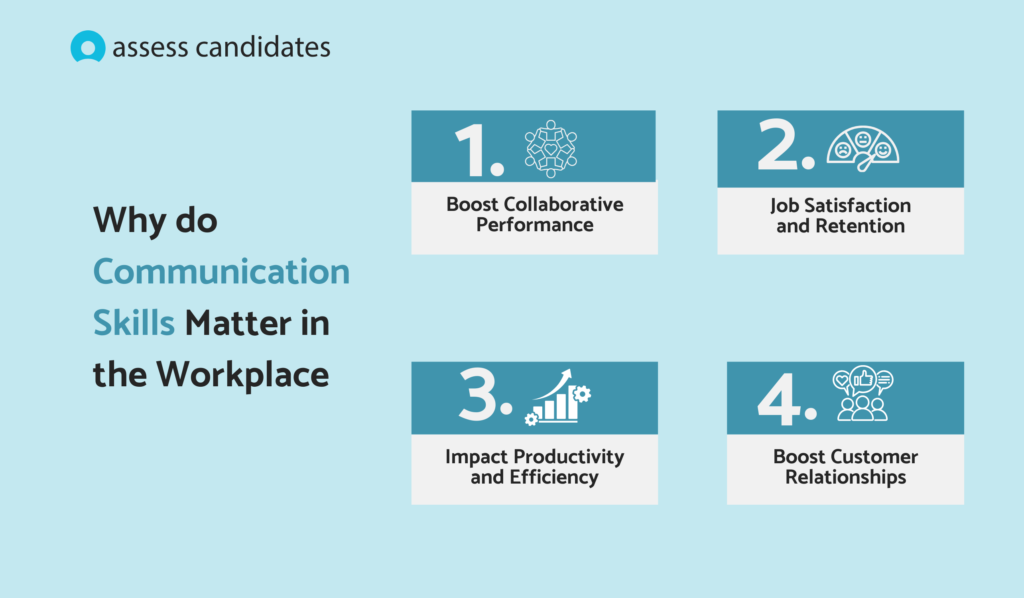
1. Boost Collaborative Performance
Effective communication helps your teams align expectations, share information clearly, and collaborate without friction. When your employees communicate well, tasks move faster, roles get clearer, and mistakes are significantly reduced.
2. Job Satisfaction and Retention
Employees who feel heard and understood are more satisfied, engaged, and loyal to their organizations. Strong communication supports trust, psychological safety, and a more positive work culture; all major contributors to retention.
A report from OrangeHRM highlights that open communication channels are directly linked to higher employee morale and lower turnover rates.
3. Impact Productivity and Efficiency
Clear communication minimizes confusion and helps teams make faster, more informed decisions. It reduces duplicated work, lowers error rates, and increases overall operational efficiency.
4. Boost Customer Relationships
Strong communicators represent the organization better, whether speaking with clients, customers, or external partners. They manage expectations clearly, resolve issues faster, and build stronger relationships.
The Illinois State Board of Education notes that effective communication enhances professionalism and builds trust in customer-facing interactions.
Improve how you assess communication skills with our candidate assessment platform. LEARN MORE
You now understand the importance of communication, but assessing it fairly is another challenge as interviews alone often miss key behaviors. In the next section, you’ll find research-backed methods that help you measure communication skills accurately.
3. How to Effectively Measure Communication Skills
Measuring communication skills requires more than observing how confidently a candidate speaks. Employers need structured, objective tools that reveal a candidate’s clarity, comprehension, reasoning, and ability to respond under pressure. The methods below provide reliable, evidence-based ways you can assess communication fairly and consistently.

1. Verbal Reasoning Tests
Verbal reasoning tests evaluate how well a candidate interprets written information, draws logical conclusions, and communicates their understanding clearly. These tests reveal whether candidates can process information accurately, a critical part of effective communication.
A study by AssessmentDay shows that verbal reasoning tests predict a candidate’s ability to understand written instructions and communicate decisions clearly in real workplace scenarios.
2. Situational Judgement Tests
Situational Judgement Tests (SJTs) evaluate how candidates respond to realistic workplace scenarios. They measure clarity, tone, empathy, and decision-making, all essential parts of communication.
Research published by the British Psychological Society reports that SJTs are strong predictors of communication-related competencies such as conflict resolution, clarity under pressure, and interpersonal effectiveness.
3. Job Simulation Tasks
Job simulations place candidates in real job situations, such as responding to an email, presenting findings, or handling a customer query. They reveal communication style, clarity, structure, and accuracy.
According to the Chartered Institute of Personnel and Development (CIPD), job simulations significantly improve assessment accuracy by showing how candidates communicate in practical, role-specific contexts.
4. Assessment Centers
Assessment centers combine group exercises, presentations, and problem-solving tasks, providing a multidimensional view of communication. Recruiters can observe tone, listening skills, articulation, and how candidates handle group dynamics.
Research from the International Journal of Selection and Assessment confirms that assessment centers are among the most effective tools for evaluating interpersonal and communication competencies.
5. Structured or Competency-Based Interviews
Structured interviews assess communication through targeted questions about past behavior. They allow interviewers to evaluate clarity, coherence, listening ability, and how well a candidate organizes their thoughts.
The Society for Human Resource Management (SHRM) notes that structured interviews increase reliability and reduce communication-skill misjudgments by focusing on behavioral evidence rather than subjective impressions.
6. Personality Assessments
While not direct communication tests, personality assessments provide insight into communication-related traits, such as assertiveness, empathy, and sociability.
The American Psychological Association highlights that personality traits such as extraversion, openness, and agreeableness are strong predictors of communication behaviors in workplace settings.
You’ve measured how well a candidate communicates, but the real clarity comes from how you score what you’ve seen. In the next section, you’ll learn how to turn those observations into a simple, fair scoring system your whole team can use consistently.
4. How to Score Communication Skills?
After you measure communication skills through assessments or interviews, the next step is scoring the results. This ensures your evaluations stay fair, consistent, and predictive of job performance. Most hiring issues happen here, not because candidates lack communication skills, but because employers score them inconsistently.
This section shows you how to score communication objectively so every candidate is evaluated on the same standard.
How to develop a good scoring system for communication skills?
When scoring varies across interviewers, the results become unreliable. A candidate may be rated “excellent” by one reviewer and “average” by another simply because expectations weren’t aligned.
Hiring research consistently shows that structured scoring with defined criteria is up to 40% more reliable than unstructured judgment.
A clear scoring system keeps your process fair, reduces bias, and gives every candidate an equal chance.
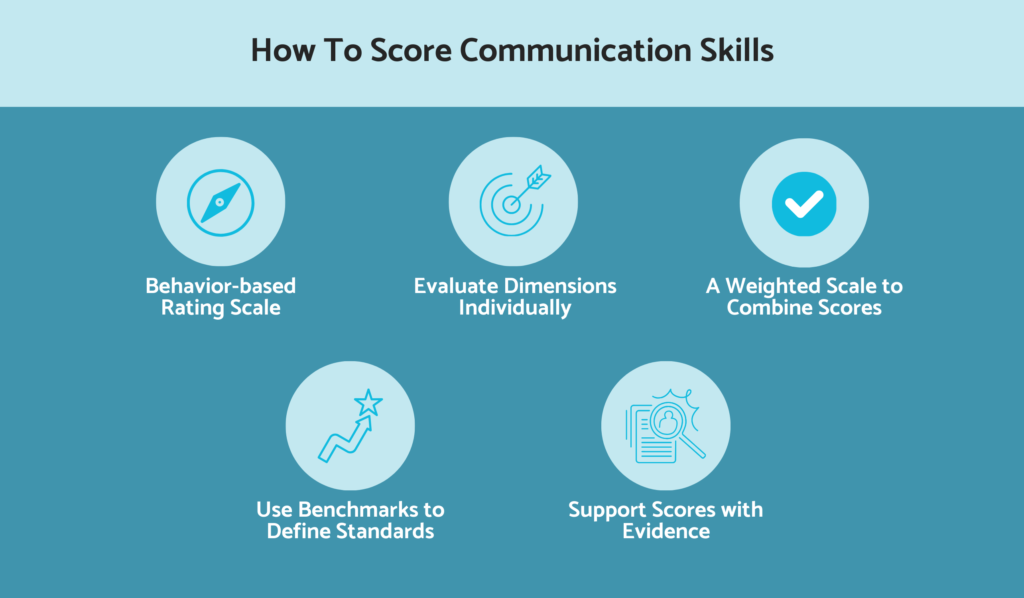
Steps to score communication skills include:
1. Behavior-based Rating Scale
A 1-5 or 1-4 scale works best because it is easy for reviewers to apply.
Each score should represent a concrete behavior, not a feeling.
Example (5-point scale):
1 = Poor: Unclear, disorganised, frequent misunderstanding
2 = Below Average: Partly clear but inconsistent, limited detail
3 = Competent: Clear, structured, and understandable
4 = Strong: Clear, confident, responsive, well-reasoned
5 = Excellent: Highly articulate, concise, empathetic, and audience-aware
behaviorally anchored rating scales (BARS) have been shown in multiple workplace studies to improve scoring accuracy and reduce subjective bias.
2. Evaluate Dimensions Individually
Communication is not one skill; it’s a combination of four core behaviors. Score each one individually before calculating an overall score:
- Clarity: This looks at how easily the candidate expresses their ideas. You’re checking whether they get to the point, stay coherent, and explain things in a way others can understand without confusion.
- Structure: This focuses on how well they organise their thoughts. You want to see whether their message has a logical flow, with ideas arranged in a way that makes it easy for the listener or reader to follow.
- Listening and Responsiveness: This helps you evaluate how well they take in information and respond. You’re paying attention to whether they ask thoughtful questions, adapt based on what you’ve said, and show that they truly understand the conversation.
- Professional Tone: This measures how appropriately they communicate in a workplace setting. You’re looking for a tone that is respectful and suitable for professional interactions, rather than overly casual or too formal.
When you separate dimensions, you avoid vague comments like “They communicate well” and instead get actionable scoring.
Multi-dimensional scoring systems are significantly more predictive of future job performance than single-score assessments.
3. A Weighted Scale to Combine Scores
Not all communication behaviors matter equally for every role. For example:
- A customer-facing role may prioritize tone and active listening.
- A technical role may prioritize clarity and structure.
- A leadership role may prioritize persuasion and message framing.
You can apply weights like:
Weighted scoring prevents overrating a candidate who is articulate but disorganised, or one who is structured but cannot listen.
4. Use Benchmarks to Define Standards
Scores only have meaning when compared to something. This could be:
- Average scores from previous applicants
- Scores of your top performers
- A minimum passing threshold (e.g., 70%)
Benchmarks keep the final decision consistent and predictable.
Benchmarking is widely used in assessment science because it increases fairness and reduces random variation between assessors.
5. Support Scores with Evidence
For every score, document:
- What the candidate said
- The behavior you observed
- Why it aligns with the rating
This protects your process legally and supports better hiring decisions.
Assessment audits show that organizations with documentation-based scoring make significantly fewer mis-hire decisions.
Strengthen your hiring decisions with scientifically validated pre-employment assessments. LEARN MORE
Even with a clear scoring system, you still need to watch for behaviors that signal deeper communication challenges. In the next section, you’ll see the key red flags that often show a candidate may struggle in real workplace interactions.
5. What Are the Red Flags You Should Look Out For?
Even when a candidate performs reasonably well in tests, certain behaviors can signal deeper communication challenges. These red flags often appear during interviews, written tasks, simulations, or even casual conversations with the hiring team. Spotting them early helps you prevent mis-hires and protects your team’s performance.
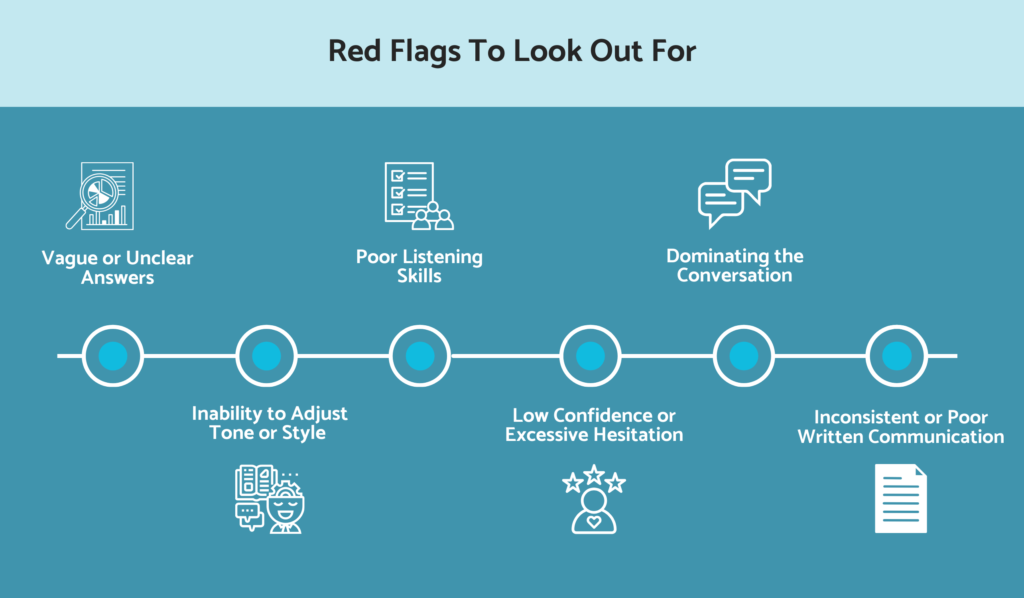
Hiring for communication skills means paying attention not just to what candidates say, but how they say it. Below are the most common red flags you’ll want to watch for; each one can quietly signal deeper communication challenges that affect teamwork and overall performance.
1. Vague or Unclear Answers
Sometimes you’ll ask a simple question and get an answer that feels scattered or unfinished. When a candidate struggles to explain their thinking clearly, it often shows up later as misalignment, confusion, or repeated clarifications on the job.
What It Looks Like in an Interview
- Jumping between unrelated points
- Not addressing the core of your question
- Talking for long stretches without delivering a clear message
Clarity, conciseness, and logical flow are recognized as essential workplace communication indicators. Indeed Career Guide
If you spot this, you must treat it immediately because unclear communicators slow teams down and increase the chances of misunderstandings.
2. Inability to Adjust Tone or Style
Good communicators shift their tone depending on who they’re speaking to. If a candidate uses the same tone in every situation, overly casual, overly formal, or just mismatched, it’s a sign they may struggle with audience awareness.
What It Looks Like in an Interview
- Being too casual when discussing professional matters
- Sounding stiff or robotic
- Struggling to simplify technical explanations
If they can’t adjust their communication to fit the audience, they may struggle with customers, peers, or leadership.
3. Poor Listening Skills
Communication isn’t just about expressing yourself; it’s also about being able to take information in. Candidates who don’t listen well often reveal themselves quickly.
What It Looks Like in an Interview
- Cutting you off mid-question
- Repeating details incorrectly
- Asking about information you already explained
Employers consistently rank listening as a top communication skill for workplace success.
You must treat this as urgent because poor listeners miss deadlines, misunderstand instructions, and create avoidable rework.
4. Low Confidence or Excessive Hesitation
A bit of nerves is normal. But if a candidate can barely get through a sentence or struggles to voice basic ideas, it may indicate deeper communication barriers.
Communication confidence is associated with clearer messaging and higher perceived competence. APA Journal of Personality and Social Psychology
What It Looks Like in an Interview
- Long pauses before responding
- Struggling to start or finish sentences
- Speaking too softly to follow
Low confidence can limit clarity and affect credibility.
5. Overconfidence or Dominating the Conversation
On the opposite side, you may meet candidates who take over the entire conversation. They talk too long, interrupt, and rarely check in to see if their message is landing.
What It Looks Like in an Interview
- Talking over you
- Giving no space for back-and-forth
- Overselling achievements
These behaviors can weaken team culture and discourage open dialogue.
6. Inconsistent or Poor Written Communication
If a written task is full of grammar issues, unclear sentences, or disorganised thoughts, that’s a strong communication red flag, especially in hybrid or remote teams.
Grammarly’s 2024 Workplace Communication Report links poor writing with lower productivity and increased misunderstandings.
What It Looks Like in an Assessment
- Disorganised or unclear emails
- Rambling or poorly structured responses
- Frequent grammar mistakes
Weak writing leads to misalignment and poor execution, especially when teams rely heavily on written communication.
Key Takeaway
At the end of the day, strong communication isn’t just about speaking or writing well, it’s about clarity, listening, professionalism, and how effectively someone works with others. The most reliable way you can evaluate this is with structured, evidence-based tools that help you score candidates consistently and spot red flags early, instead of relying on gut instinct. When you assess communication this way, you make fairer, more confident hiring decisions every time.
Looking for expert guidance from our organizational psychologists to assess candidates? HIRE FOR FREE
Spotting communication red flags helps, but the real value comes from using tools that let you measure and compare candidates with confidence. In the next section, you’ll see why Assess Candidates is a trusted choice for evaluating communication skills.
6. Why Choose Assess Candidates’ Assessments for Hiring?
Hiring teams need more than intuition to evaluate communication skills accurately. You need assessments that are scientifically validated, easy to deploy, and built to reduce bias while giving reliable insights into how a candidate will perform on the job.
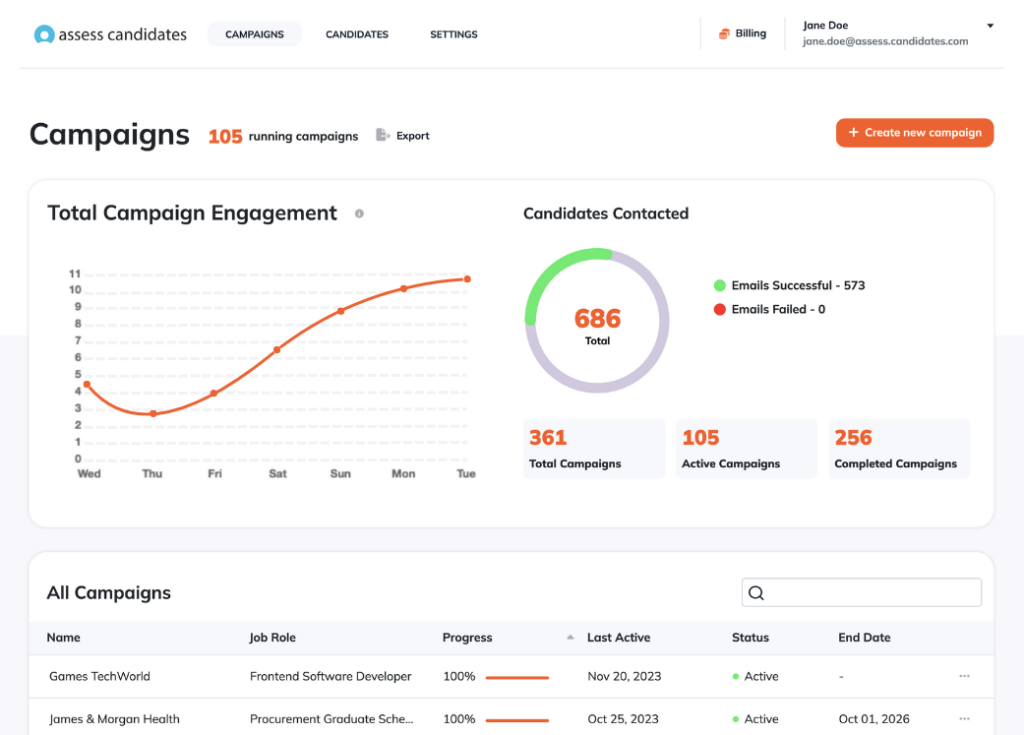
Assess Candidates provides a research-backed, end-to-end solution that helps recruiters measure communication skills with precision, without slowing down the hiring process.
Science-Backed Tools Built by Chartered Psychologists
Our assessments are developed using globally recognized psychometric standards, ensuring every score is valid, fair, and predictive of job performance.
Reliable Tests for Measuring Communication Skills
We offer a suite of assessments designed specifically to measure communication competence, including:
- Verbal reasoning tests to assess clarity and comprehension
- Situational judgment tests to evaluate judgment and tone
- Job simulations to capture real-world communication behavior
- Interview frameworks for consistent scoring
- Personality assessments that highlight communication tendencies
Designed for Busy Hiring Teams
Whether you’re hiring early-career candidates or senior professionals, Assess Candidates candidate assessment platform provides:
- Clear, easy-to-understand score reports
- Benchmarks that show how candidates compare to norms
- Automated shortlisting recommendations
- Scalable testing for small and large hiring teams
Proven Impact Across Industries
Organizations use Assess Candidates to reduce mis-hires, strengthen internal mobility, and improve hiring speed, all while maintaining fairness and scientific rigour.
Conclusion
Communication is one of the strongest predictors of workplace success, yet it’s also one of the hardest skills to evaluate without structure. By combining clear definitions, science-backed assessments, and consistent scoring criteria, hiring teams can move beyond guesswork and make decisions with confidence.
Whether you’re assessing graduates, experienced professionals, or internal candidates, the goal remains the same: identify people who can communicate clearly, listen actively, and collaborate without friction. With the right tools, this becomes not just possible, but scalable.
Assess Candidates gives you a reliable, validated way to measure communication skills at every stage of the hiring process, helping you reduce mis-hires, protect team performance, and select candidates who thrive in real workplace conditions.
Explore reliable assessments developed by Chartered Scientists to evaluate candidates’ key skills. VIEW PLANS
Curious about how to measure and compare communication skills effectively? Explore the key frequently asked questions below, and sign up with your email to begin using Assess Candidates.
Frequently Asked Questions
How do you measure communication skills during hiring?
You can measure communication skills using structured tools like verbal reasoning tests, situational judgment tests, job simulations, structured interviews, and written exercises. These methods reveal how clearly a candidate expresses ideas, listens, adapts their tone, and communicates under pressure, giving you a reliable, consistent way to evaluate performance.
What are the most important communication skills employers should look for?
Key communication skills include clarity, active listening, tone adjustment, concise writing, and the ability to explain ideas logically. Employers should look for candidates who communicate confidently, understand their audience, and respond thoughtfully. These behaviors consistently correlate with teamwork, customer satisfaction, and overall job performance across different industries and roles.
Why is communication skill one of the top predictors of job success?
Strong communicators reduce misunderstandings, improve teamwork, and help projects move faster. Research shows communication influences decision-making, collaboration, client interactions, and leadership effectiveness. When employees communicate clearly, they make fewer errors and contribute to a more efficient, aligned workplace, making communication a key predictor of long-term performance.
What are the signs that a candidate has poor communication skills?
Warning signs include vague answers, disorganised explanations, excessive hesitations, interrupting others, inconsistent written communication, or failing to adjust tone. These behaviors often lead to misunderstandings and collaboration issues. Identifying them early helps prevent mis-hires and gives you a chance to explore whether training or role fit might be a concern.
Can communication skills be improved over time?
Yes. Communication is a developable skill. Candidates can improve through feedback, coaching, writing practice, presentation training, and real-world experience. Many employees significantly strengthen their communication once they receive structure and guidance. Assessing communication early simply helps you understand their starting point and whether they’re ready for the demands of the role.
What’s the best test for evaluating communication skills?
There’s no single “best” test. The most reliable approach combines several methods. Verbal reasoning tests assess comprehension and clarity, while situational judgement tests evaluate how candidates communicate decisions. Job simulations show real behavior, and structured interviews ensure fairness. A blended approach gives the most accurate picture of communication ability.
Do communication assessments reduce bias in hiring?
Yes. Structured assessments reduce subjectivity by scoring all candidates with the same criteria. Tools like verbal reasoning tests, situational judgment tests (SJTs), and structured interviews focus on observable behaviors instead of impressions. This creates a fairer process, improves diversity outcomes, and helps hiring teams make decisions based on evidence rather than intuition.


 English
  Arabic