
12 Effective Strategies to Boost Diversity in Recruitment



As competition for the best talent continues to grow, implementing proven strategies to boost diversity in recruitment becomes a necessity.
Companies that prioritize diversity benefit from greater creativity, broader perspectives, and stronger innovation. With the right approach, your organization stands a better chance of attracting and hiring a more diverse talent pool than competitors.
According to Harvard Business School, companies are 31% more likely to attract job seekers to choose when they highlight their diversity efforts over focusing on salary alone.
Yet many organizations struggle to build diverse workforces. Challenges such as poorly defined diversity goals, limited outreach, and unconscious bias in hiring can easily stump efforts. However, with clear diversity recruitment strategies, organizations can eliminate unconscious bias, strengthen their employer brand, and improve overall workforce performance.
So, if you are a hiring manager with questions such as the following:
- What are the top strategies for building a diverse and inclusive workforce?
- How can we attract more diverse talent?
- What practices ensure fairness in recruitment?
- How do we reach a more culturally diverse application pool?
This article will provide the answers to these questions and more.
By the end of this article, you will understand what diversity in recruitment is, its importance, and the most effective strategies for recruiting a diverse workforce.
Contents
- What is diversity in recruitment?
- What is a diversity recruitment strategy?
- Why is diversity important in recruitment?
- Top strategies to boost diversity in recruitment
- How do pre-employment assessments support diversity?
- Why organizations choose Assess Candidates to boost diversity in recruitment
1. What is diversity in recruitment?
Diversity in recruitment is the practice of intentionally attracting, evaluating, and hiring individuals from different backgrounds, identities, and experiences. It encourages companies and hiring managers to focus more on candidates’ skills, abilities, and potential rather than on subjective, irrelevant factors, such as race, age, gender, or education.
When applied well, this naturally reduces both conscious and unconscious bias in the hiring process.
Effectively boost diversity in your hiring with our bias-free pre-employment assessments. HIRE FOR FREE
Why do we need diversity in recruitment?
Introducing diversity into recruitment has become essential for addressing bias in the hiring process, widening access to talent, and building stronger, more representative teams. Instead of selecting candidates with similar educational and professional experiences, diversity hiring enables organizations to choose people with the right job skills, regardless of their background.
The main factors that drive the need for diversity in recruitment are the following:
Educational Background Bias
There was a time when the primary reason why an applicant succeeded was because they had a formal degree or training from a reputable institution. This often disadvantaged equally capable talent who didn’t have access to an elite school nor education.
Today, learning is no longer restricted to a formal setting; it is widely accessible through online courses, alternative training routes, and practical experience. Relying too heavily on educational prestige causes organizations to miss out on top performers.
Introducing diversity through skills-based hiring helps eliminate educational background bias by giving every qualified candidate a fair chance, regardless of where they studied.
Ethnicity and Race Bias
One of the most common biases in hiring is regarding ethnicity and race. The idea of disqualifying a candidate for a job based on their skin colour, accent, or cultural background without assessing their skills, is archaic and damaging to your business growth. The world has become a global village, with people of different races and cultures living together, so customers expect businesses to value and reflect their diversity.
Companies that hire employees from different races and cultures connect better with their audience globally, expand their customer base, and attract more global talent. Local businesses benefit in the same way by better serving diverse communities and strengthening their employer brand.
Sexual Orientation Bias
An individual’s sexual orientation has no connection to their skill and competence in a role. However, sexual orientation bias exists. Without diversity-focused recruitment practices to curb bias, a hiring manager may unintentionally filter out candidates based on stereotypes or assumptions.
Removing this bias increases the number of quality applicants you can choose from. A fair, inclusive hiring process ensures the best candidates remain in the recruitment pipeline, giving you a better chance at hiring quality talent.
A fair, inclusive approach not only improves representation but also increases your chances of hiring top-quality talent.
Gender Bias
Some jobs have traditionally been associated with a specific gender due to societal standards, for example, nurses. Today, research consistently shows that individuals succeed in their roles regardless of gender.
Since gender identities have gone beyond the binary, it is even more important for hiring decisions to be based on actual skill and job fit. Diversity hiring helps eliminate outdated assumptions and ensures opportunities are open to everyone.
Age Bias
While some specific jobs genuinely have certain physical and cognitive demands, most do not. Therefore, insisting on hiring young candidates for tech-savvy roles or overlooking younger candidates despite valuable experience is biased.
Focusing on younger candidates can cause you to overlook the soft skills that older workers possess such as empathy, communication, and wisdom. While restricting a role to older generations instead of leveraging Gen Z’s tech knowledge, creativity, and adaptability can also have detrimental effects on your business. Diversity recruitment ensures the best candidate, regardless of age, gets the job.
While diversity hiring is effective, you can’t leverage it effectively without a carefully thought-through strategy. Let us see what a diversity strategy is.

2. What is a diversity recruitment strategy?
A diversity recruitment strategy is an organization’s approach to attracting and hiring diverse candidates for a role. It is a carefully structured plan that usually starts with training employees and recruiters to recognize and mitigate unconscious bias. However, a strong strategy goes far beyond that – its effectiveness depends on how well all its components work together.
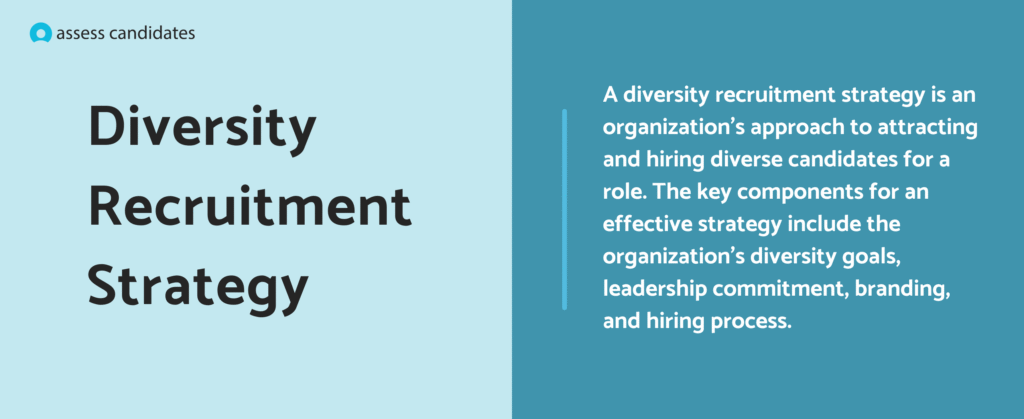
Key components of an effective diversity recruitment strategy:
- Clear diversity goals and metrics: You must understand what diversity means for your organization. Are you aiming to improve gender balance? Increase racial or ethnic representation? Or is your focus on boosting socio-economic diversity in your workforce? Once your goals are clear, set measurable metrics, such as the percentage of women in leadership, to track the real progress of your diversity efforts.
- Leadership commitment: Ensure that the organization’s leadership publicly supports diversity recruitment, shares initiatives on social media, and avoids “diversity washing”. This can influence the company’s credibility and appeal to attract diverse talent.
- Diversity- and inclusivity-focused employer branding: Your brand should consistently and publicly support diversity and demonstrate its commitment across your website, job posts, and media channels. A common way to achieve this is to celebrate your diverse employees and relevant cultural dates.
- Bias-free and inclusive hiring process: Avoid bias at every stage of recruitment. Use diversity sourcing, be inclusive in your job descriptions, and train hiring managers to recognize and mitigate bias.
While a diverse workforce is valuable, well-designed diversity recruitment strategies are what make diversity hiring truly effective. Therefore, choose the approach that best suits your workplace diversity goals.
For example: An employee referral program is ideal for an organization seeking to add only two diverse individuals to its workforce. But if you need to hire ten or more, posting on diversity-focused job boards may be a better strategy.
Explore how our accurate, bias-free pre-hire assessments can support your diversity hiring. LEARN MORE
So, why is diversity hiring so important? Keep reading!
3. Why is diversity important in recruitment?
Diversity directly impacts how well an organization performs. Every organization has its mission and long-term vision, which rely on the quality of their hires and employees to work toward these goals.
Although a workforce made up of people with similar backgrounds and experiences might work in the short term, it often limits innovation and creativity. In contrast, a diverse team with the same strong skill set will bring more ideas to the table and produce stronger business decisions and outcomes.
In short: bringing in employees who think differently, problem-solve differently, and come from a wide range of backgrounds strengthens your team to reach your shared goals.
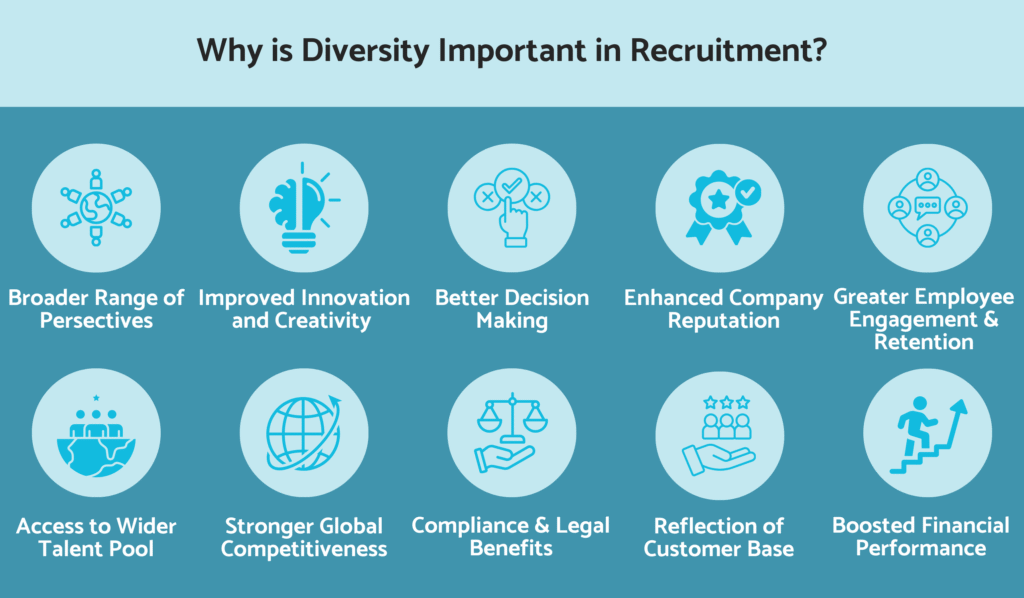
Reasons why diversity is important for hiring
- Broader Range of Perspectives
A diverse workforce comprises employees from different cultural backgrounds. They bring diverse life experiences and unique perspectives to your organization’s problem-solving. Their different perspectives on tackling challenges offer numerous and unique ways to solve your problems.
For example: Employee A from a well-to-do background understands how to communicate with potential clients from the same background. However, Employee B, from a modest background, relates better with potential clients from the same background. Both employees offer the same value, but from different perspectives shaped by their backgrounds.
With a diverse workforce, every challenge in your organization will be solved by exploring different ideas from different people. This allows you to get effective solutions that you thought were not possible due to the broader range of perspectives your employees provide.
- Improved Innovation and Creativity
One of the reasons many businesses fail is a lack of creativity. Employees from similar backgrounds usually have the same experiences. They attend schools that use the same curriculum and teaching styles, and their extracurricular activities are the same. Therefore, their level of creativity is similar. Given the task of brainstorming new ideas to improve a product, their ideas will be identical.
However, if you introduce employees with diverse experiences and backgrounds, you will generate more creative ideas that drive innovation and help the company progress.
For example: Candidate A and Candidate B, from different backgrounds, must meet a similar sales target. Candidate A uses word of mouth among his ethnic community to meet his target, while Candidate B leverages social media to meet his target. They solve the same problem but in different ways.
- Better Decision Making
Before you can make any business decision, you must have options. The better the quality of the options you have, the better the quality of the decision you will make.
Usually, you generate options from ideas that your partners or employees suggest. A diverse workforce will offer diverse perspectives, providing high-quality ideas to choose from. The more diverse your workforce is, the more uniqueness you’ll find in your employees’ ideas.
After considering all the quality ideas, you are more likely to choose one or more to benefit your business. Not only will your decision-making be better, but it will also become easier, as you don’t have to repurpose ideas from your competitors, and you can trust the creativity of your diverse employees.
- Enhanced Company Reputation
What do your competitors think about your company? What do your customers feel about your product or service? Do your company’s hiring policies encourage diversity?
Although you have a loyal customer base and a fantastic product, you must constantly work to maintain these, as your competitors are not resting until they get your customers. One way to ensure you are ahead, or not far behind, is to attract and retaindiverse talent.
What a company is known for determines if it attracts quality employees and new customers. A company with a good, diverse workforce reputation attracts more global talent into its application pool, thereby improving the quality of its employees, overall creativity, and productivity.
The diversity of your workforce depends on your company’s reputation. No employee wants to be the odd one out. They will instead join a company, probably a competitor, that has a diverse workforce, including people they can relate to. With such diverse experiences and backgrounds in your workforce, you can tap into more creativity and innovation to enhance your company’s products or services.
- Greater Employee Engagement and Retention
To get the best from your employees, ensure they work in a diverse workplace environment. Employees who are surrounded by people from different backgrounds and can see representation of their background to varying levels of the organization’s hierarchy tend to be more invested in the organization’s success. They are more involved, committed, and motivated to help the company progress.
Also, a company with a workforce emotionally invested in its success will experience lower turnover. When employees realize they are valued for their skills, they strive to deliver more value to earn promotions and are less likely to leave the company. The organization, in turn, benefits from this by limiting the cost of hiring new talent.
- Access to a Wider Talent Pool
Your quality of hire depends on the overall quality of your talent pool at any given time. Restricting your recruitment to a hiring channel or network limits the volume of talent you attract. However, employing a heterogeneous recruitment channel opens your job vacancy to appropriately skilled, diverse candidates.
In the competitive labour market, you stand a better chance of hiring the best talent by embracing diversity hiring best practices, such as diversity sourcing, to allow you access to individuals with different educational backgrounds, life experiences, and career paths that you’ll otherwise overlook.
- Stronger Global Competitiveness
The world becomes smaller with each technological innovation that makes communication across continents easier and faster. For this reason, many companies now design their products with a global customer base in mind.
Now that there are fewer restrictions on accessing customers worldwide, it is only logical to have employees worldwide. The level of competition among companies in different sectors for capturing new customers from unfamiliar backgrounds requires that they have employees who can relate to these new targets.
An established company in a new location must familiarize itself with its target audience in the new environment. The fastest way to do so is to hire competent hands from that locality to foster communication and speed up product or service adoption.
Therefore, to remain competitive in your niche, a diverse workforce that can relate to your global audience is a must.
- Compliance and Legal Benefits
Some jurisdictions have regulations and laws that guide diversity hiring to prevent discrimination and bias in recruitment. Proactive diversity recruitment ensures that organizations comply with these regulations and avoid discrimination lawsuits and their associated penalties.
Also, organizations stand to benefit from complying with diversity recruitment laws and regulations. Commitment to diversity hiring improves your company’s relationship withregula tory bodies, positioning you favourably if recruitment issues arise. Your company can gain favour with the government through collaborations or contracts that require meeting specific diversity hiring benchmarks.
- Reflection of Customer Base
Your workforce should reflect your customers. A diverse workforce is the perfect fit for a diverse customer base, as it ensures you can accommodate their different ethnicities, experiences, expectations, ages, and genders in your offerings. Your employees can connect with your wider audience because they have working relationships with colleagues from similar backgrounds. Your customers then feel valued and seen in your company because they are represented in your workforce.
Additionally, diverse employees can help you easily identify product and service gaps, ensuring that customer satisfaction remains a priority. The diversity of your workforce helps you notice any marketing mistakes that disregard or offend a group of customers and their values.
- Boosted Financial Performance
Your company’s goal is to make a profit while delivering the best service or product to your customers. Although a good financial year is attainable with your homogeneous employees, you can have a better one with a diverse workforce. Research consistently shows that organizations with diverse talent outperform those with a homogeneous workforce financially.
Key factors, including higher hiring quality, the creativity of diverse employees, enhanced employee engagement and retention, and better decision-making, drive the improved financial performance of a diverse organization. At every level of management, you will find a diverse representation that drives creativity and the quality of decisions, translating into better financial performance.
Ensure diverse candidates have the skills to drive business growth with our reliable assessments. HIRE FOR FREE
To unlock these benefits that diversity brings, you must plan. Let us now explore practical strategies and best practices to boost diversity in your recruitment.
4. Top strategies to boost diversity in recruitment
Despite its benefits, you must implement diversity in hiring strategically throughout the different stages of the hiring process.
Top 12 strategies to drive diversity in hiring
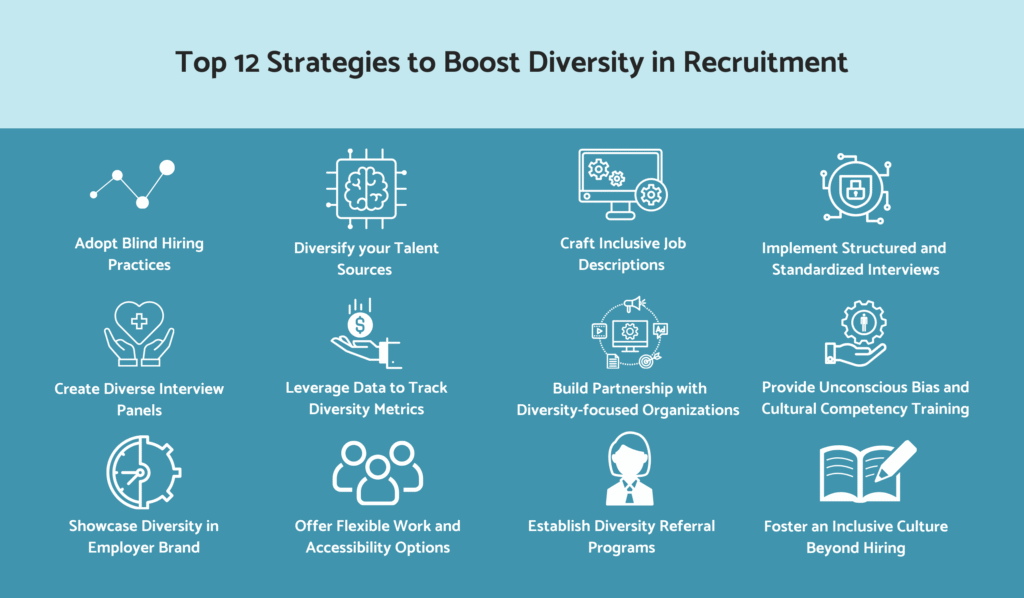
1. Adopt Blind Hiring Practices
Blind hiring redacts candidates’ information, such as name, age, gender, school, graduation year, and others, which introduces unconscious bias into the hiring process. It aims to create equal employment opportunities for all candidates who apply for a role.
Many companies automate the anonymization of applicants’ information, while others have dedicated team members who remove the identifying elements from candidates’ applications before sending them to reviewers. Regardless of the category you fall into, you can fill the vacant role without considering applicants’ identities, focusing instead on their skills, qualifications, and experience. With blind hiring, you have more qualified individuals in the interview stage, giving you a better chance to hire the best of the lot.
Company A receives 1000 job applications and resumes from diverse candidates. It uses its blind hiring tool to remove candidates’ names, gender, age, and addresses, inviting those with the required skills for a pre-screening interview. It hires only 10 of the diverse candidates after successful pre-employment assessments and interviews.
2. Diversify Your Talent Sources
Where do you get employees from?
If your talent sources are the same for every hiring cycle, that means you hire your employees from the same job boards, universities, and professional networks. Your workforce will comprise individuals with similar experiences and qualifications who offer the same ideas, leading to groupthink.
Use a diversity sourcing strategy to eliminate groupthink and improve your workforce’s diversity. To achieve this, explore the following:
- Partner with diverse institutions: They admit students from diverse backgrounds and help you tap into a diverse talent pool, making your diversity hiring process smoother.
- Use niche job boards: Ideal for finding professionals in specific fields. They accommodate professionals who can prove their skills from different backgrounds.
- Consider hiring from freelance platforms: They offer a shared space where remote, skilled, diverse candidates are available to help your business grow.
- Collaborate with governments and NGOs: They maintain records of diverse professionals and will help give you a head start with your diversity recruitment goals.
- Optimize employee referral programs: Your employees have other professionals as friends and acquaintances. Explore their networks for diverse candidates.
For example: Organization H wants to improve its workforce diversity. Its recruiter advertises the job vacancies on niche job boards, extends interview invitations to freelancers, encourages the company to collaborate with NGOs and the government, and optimizes employee referral programs for diversity hiring. At the end of the hiring process, the organization has 7 new diverse employees.
3. Craft Inclusive Job Descriptions
Your job descriptions determine the quality of the talent you attract. An inclusive job description ensures that individuals from diverse backgrounds feel confident they will have a fair chance of landing the job. In many cases, applicants can predict that they will not get as far as the interview stage, even though they have the qualifications and skills needed for the job.
To ensure you attract diverse talent, word your job applications to show that you embrace diversity and inclusion. Remove gendered language. Emphasize your openness to candidates seeking growth opportunities and support. Also, clearly distinguish between candidates’ required and preferred qualifications, skills, and job experiences.
For example: Company A’s hiring team discusses their ineffective diverse hiring strategies and decides to make their job descriptions inclusive and diversity-focused. They recorded a 700% increase in job applications from diverse candidates and a 400% increase in their diverse workforce in a year.
4. Implement Structured and Standardized Interviews
An unstructured interview uses random questions to assess a candidate’s suitability for a job. It makes your company and the interview panel appear unprofessional and exposes the hiring process to unconscious bias. Asking candidates for the same role different questions will cause you to omit necessary details that can influence your decision about the right candidate.
Conversely, structured, standardized interviews with pre-employment tests use the same set of questions for all candidates vying for a role. These questions are designed to assess the skills, experience, and qualifications of these candidates to ensure their success in that role. It also eliminates the influence of any rapport between the interview panel and the candidates.
Also, interviewers must score each question appropriately to improve the efficacy of the structured interview.
A 2-person interview panel has standardized interview questions for 50 job candidates and grades each candidate based on their answers. At the end of the exercise, they compare their results and choose the top 5 for the next stage of the recruitment process.
5. Create Diverse Interview Panels
In an interview, the interviewees must be comfortable with the environment and the personnel conducting it. One way to ensure this is to have a diverse interview panel. A candidate may feel uncomfortable answering interview questions if they don’t see anyone on the panel with a similar background. Furthermore, a candidate can interpret a non-diverse interview panel as meaning that your company does not embrace diversity.
Therefore, ensure that your interview panel comprises individuals from different backgrounds, departments, and experiences. A diverse interview team introduces multiple perspectives into the evaluation process and reduces individual bias. If your organization does not have enough diversity to showcase at the interview stage, use external advisors or partners to introduce diversity. Train your interview and candidate assessment panel on mitigating bias.
For example: The 4-person interview panel for Company A has 3 of them present. 4 diverse candidates walk into the room to start their interview. Candidate 3 is nervous as she sees that no panel member is Asian like her. She struggles to answer the interview questions but gains more confidence after the 4th interviewer, an Asian, joins the panel.
6. Leverage Data to Track Diversity Metrics
Whether you’re new to data-driven hiring or you’re looking to improve on it, establish diversity metrics and track them. Start by noting applicants’ demographic breakdown, then move on to the number of diverse candidates who advance to the interview stage. Note the percentage of diverse applicants that reach the assessment stage, the number of candidates you made a job offer to, and how many of them accepted or rejected the offer. These will help you understand where diverse candidates drop out of your hiring funnel.
Also, analyzing these metrics helps you improve your diversity recruitment strategy as needed. It compels you to be accountable for your diversity hiring efforts and enables you to identify what needs to be fixed in your future hiring efforts.
For example: If you have 200 diverse applicants for a role and your company is looking to increase its varied workforce by 5. If 100 pass the assessment stage, 25 of them make it past all interview stages, and you hire 2 of them. Tracking diversity metrics throughout the hiring process helps you understand why you were able to hire only 2.
7. Build Partnerships with Diversity-Focused Organizations
Research under-represented people in your industry and the organizations that represent them. They can range from associations that cater to gender-based job needs to age-related professional networks and ethnic-focused support groups. Reach out to these associations and collaborate with them. Sponsor their events, participate in panel discussions, host industry-relevant workshops, or provide mentorship to their target audience to build authentic relationships.
In your partnership with these associations, you can combine the first three phases of the recruitment funnel. This approach helps you directly source talent from diverse groups, eliminating the need to hope your job descriptions appeal to them. It shows your commitment to diversity and improves your company’s reputation.
For example: Organization H, based on its employment data, recognizes the need to improve employee diversity. They pinpoint the underrepresented groups in their workforce and collaborate with institutions and associations as their talent sources for these groups. They equalize the diverse workforce population in two hiring cycles.
8. Provide Unconscious Bias and Cultural Competency Training
Well-meaning hiring managers and recruiters are prone to unconscious bias due to their personal experiences and society. However, regular training to show where and when these biases can appear during recruitment is necessary if you are to comply with diversity and inclusion regulations. These trainings should teach recruiters how to avoid bias, from resume screening through the interview to the final selection stages.
Also, all team members should undergo cultural competency training to educate them on different communication styles, work approaches, and perspectives and ideas. Training recruiters and team members to address bias and build cultural competency ensures you can successfully hire a diverse workforce, retain them, and ensure they are a good cultural fit.
For example: Company V records high employee turnover yearly due to cultural clashes among its diverse workforce. To tackle that, management ensures all employees undergo cultural competency training at the end of the year. Since then, communication and collaboration among all employees have improved, and employee turnover is at an all-time low.
9. Showcase Diversity in Employer Branding
Your brand tells potential employees how they should perceive you. If you aim to improve your company’s diversity, you must show that you appreciate and embrace different perspectives, backgrounds, and experiences. As an employer, your company’s social and physical presence must announce your attitude toward diversity. A positive employer branding in diversity attracts more diverse talent.
To achieve a good employer brand in diversity, engage and celebrate your diverse workforce. Note important dates and events for each employee group, and celebrate them on those dates. Potential candidates see how you value and interact with your diverse employees, leading them to want to work in your company. Display your positive attitude toward diversity on your company’s website, social media pages, and at your offices.
This strategy only works if you genuinely promote diversity in your company’s recruitment and employee relationships.
For example: Companies K and R are in the financial services sector and are seeking to hire new employees. Company R brands itself as a global financial service provider, while Company K claims to serve a select group of people. Based on their branding, which will attract a more diverse set of candidates? Company R!
10. Offer Flexible Work and Accessibility Options
Flexible work hours and accessible facilities are two factors that can determine how diverse your workforce can be. Generally, employees find it hard to request flexibility in their working hours or ask that reaching certain areas in your offices be made easier. However, having the foresight to address these issues keeps you ahead of many other companies in attracting diverse talent.
Allow remote and hybrid work as options for candidates to improve your company’s diversity. Although many remote applicants will not be physically present at your company, they can contribute to your mission and vision from their abode. Remote work encourages your employees to deliver their best work at their peak performance hours.
Physically challenged individuals in your workforce require special accessibility facilities. Ensure they are comfortable reaching all parts of your office with the appropriate facilities, and communicate their presence to attract diverse talent who belong to this group.
For example: Organization P has all the necessary facilities to attract diverse candidates, including remote and hybrid work options. How will Organization B, in the same sector, compete with Organization P to attract diverse talent? Organization B must have all the facilities that Organization P has.
11. Establish Diversity Referral Programs
Many companies save recruitment costs by encouraging employee referrals. However, it can lead to a homogeneous workforce, as employees will refer candidates similar to themselves. Despite this, you can manipulate employee referral programs to focus on diversity hiring.
Some ways to establish diversity referral programs in your company include:
- Introduce bonuses for every successful referral from an underrepresented group in the company.
- Host events where employees invite diverse professionals in their network.
Ensure you educate your employees about the importance of diversity in recruitment and structure referral programs to discourage tokenization.
For example: The hiring team at Organization B announces that employees can refer diverse professionals in their networks for employment and receive a bonus on their wages. Employees expand their diversity network, learn to communicate with their diverse professional acquaintances, and receive promised bonuses for every successful diverse candidate hired through employee referrals.
12. Foster an Inclusive Culture Beyond Hiring
One of the best strategies for diversity hiring is diversity retention and inclusive hiring. Fostering an inclusive culture in your company entails creating an environment where every employee, regardless of their background or perspective, contributes value to the company.
You will attract more diverse talent when you can retain your varied workforce in a thriving, inclusive work environment. Your employees, based on their experience at your company, will announce the positivity of diversity to others, improving your employer brand. Also, in an inclusive environment, your workers are motivated to perform at their best capacities.
For example: 5 diverse candidates notice that there is a balanced mix of employees from different backgrounds in Company K. They get hired and tell other diverse candidates in their network about the company. Company K receives more applications from diverse professionals.
Discover top diverse talent with our candidate assessments. VIEW PLANS
5. How do pre-employment assessments support diversity?
In efforts to boost diversity in your workforce, focusing on candidates’ skills is central to whichever strategy you choose. An effective way to determine applicants’ actual skill levels and suitability for your company’s needs is through pre-employment assessments.
What are pre-employment assessments?
Pre-employment assessments help you assess the quality of talent applying for vacant roles through structured tests that focus on the different aspects they need to succeed in those roles. Verbal reasoning tests, for instance, assess candidates’ ability to comprehend written text, while situational judgement tests check their strengths, behavioural competence, and their ability to apply to different roles.
Regardless of your diversity hiring strategy choice, you should support them with pre-employment assessments, using any candidate assessment platform of your choice, for these reasons:
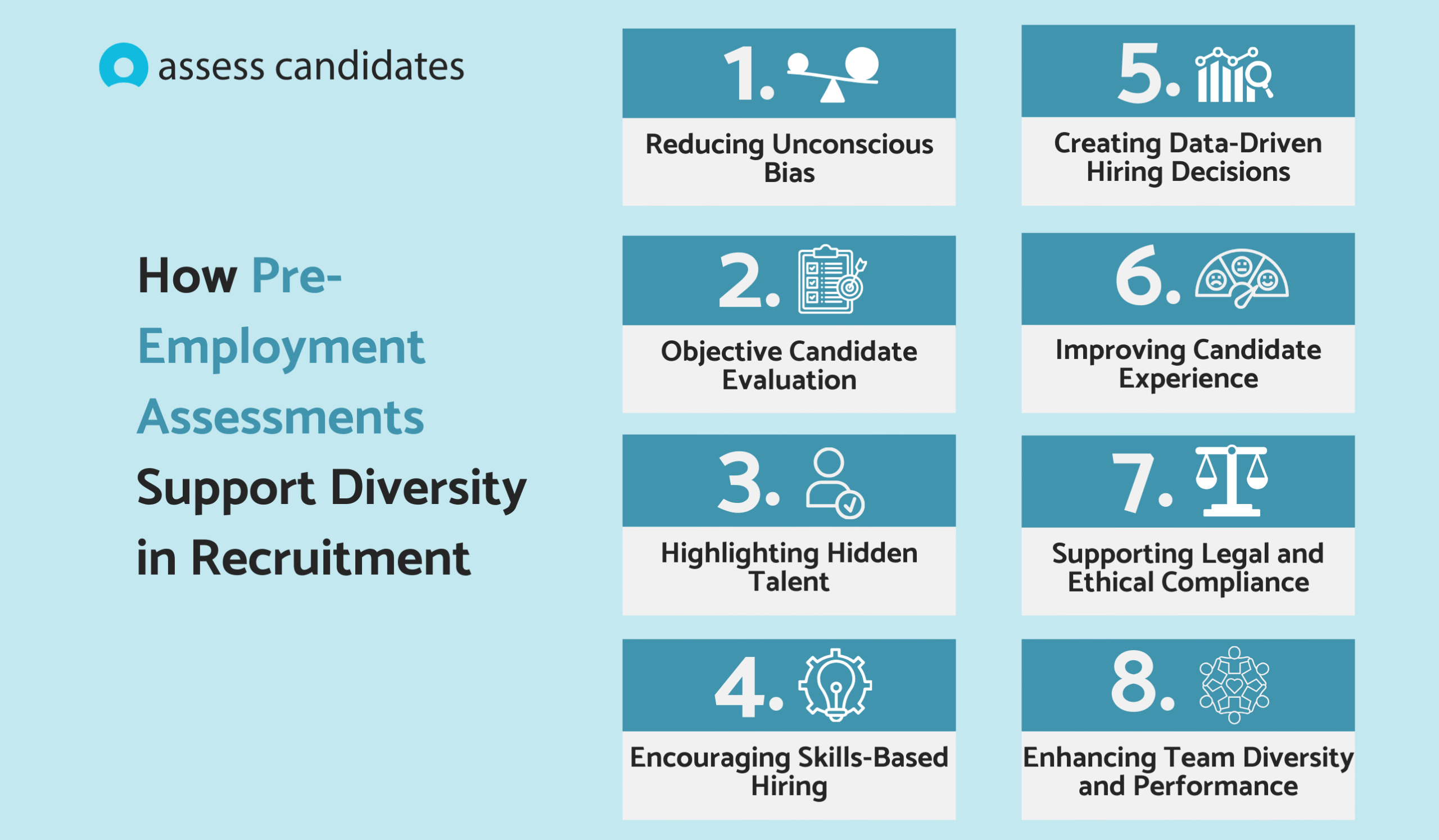
1. Reducing Unconscious Bias
As professional as hiring managers are, their personal experiences often lead them to favor particular groups unconsciously. Although you can reduce such biases through strategies such as blind hiring or anonymized interviews, you may still subconsciously eliminate certain individuals as potential employees.
An effective way to further reduce unconscious bias is through pre-employment assessments. After you have shortlisted candidates who have made it through the CV screening exercise, they should go through pre-employment testing. At this stage, they usually maintain anonymity, helping the hiring team focus on their performance in psychometric tests such as logical reasoning, numerical reasoning, and error-checking.
2. Objective Candidate Evaluation
Recruiters should be as objective as possible when evaluating candidates for a role. However, they can’t help noticing specific pointers to who a candidate is. Their objectivity becomes questionable when these identifying elements influence their fairness toward evaluating such candidates. This necessitates focusing on candidates’ skills rather than their personality.
In pre-employment assessments, objectivity becomes the norm, with candidates’ scores used to determine their suitability for roles. Instead of guessing which candidates have the personality suitable for a role, the Hogan Personality Inventory, SHL Personality OPQ, and other personality questionnaires can help.
For roles that require number crunching and mental arithmetic, MathBubbles game-based assessment and numerical reasoning tests objectively assess these skills better than a human can. If the role requires extensive interaction with people, such as in customer-focused roles, the I-EQ game-based assessment is the most objective way to evaluate these skills.
For example: An applicant whose CV shows that they have the skills and experience to fill a role does not get that role because of the school they attended. However, pre-employment assessments ascertain their skill level and prioritize it over the school.
3. Highlighting Hidden Talent
A candidate’s actual competence level is not often adequately represented on a resume. While they did not attend the best school for that skill compared to other candidates, and they do not have as much work experience, they can still have the necessary skills and personality for that role. How do you know which candidates have hidden talents? Through pre-employment assessments.
Pre-employment assessments are the most effective tool for identifying candidates with hidden talents. As you put applicants through exercises that assess the skills needed for their roles, you’ll find that some candidates with less glamorous CVs, usually due to employment gaps, non-traditional backgrounds, or career changes, have the talent you need for that role. These candidates are proof that you can determine the best choice for effective hiring with pre-employment tests and interviews.
4. Encouraging Skills-Based Hiring
A common problem with resume-based hiring is credential inflation. Candidates fill their CVs with false information to meet the standard the recruiter wants. When they are hired, they are unable to defend their resumes. Skill-based hiring, on the other hand, aims to expose the candidates’ strengths and weaknesses through pre-employment assessments.
Focusing on skills rather than educational qualifications and years of experience reduces the gap between under-represented groups and traditional job candidates. It supports diversity hiring by offering an equitable chance to all candidates without prioritizing other criteria. Pre-employment assessments test candidates’ skills and use their results as the most crucial basis for hiring decisions.
5. Creating Data-Driven Hiring Decisions
Often the best candidate isn’t the one with the best CV, nor is it the one with the best interview result. Research has shown that the best-performing employees are those who demonstrate the most relevant skills during the pre-employment assessment phase of recruitment. Therefore, as a hiring manager, your selection criteria should be based on data, not intuition, as intuition can be influenced by bias.
One of the most reliable sources of data for hiring capable hands is pre-employment test data. It ranks candidates by performance, making it easier for you to select suitable candidates without second-guessing your choice.
For example: Employer Q put 10 candidates to the verbal reasoning test, the Cognition-A game-based test, the MTA-TRAY game-based assessment, and the I-EQ game-based assessment. The system ranks the candidates 096, 021, 062, 006, 151, 099, 195, 044, 125, and 144 in their order of performance. The hiring manager selects the top 3 candidates quickly based on their performance.
6. Improving Candidate Experience
Candidates’ experiences during the recruitment phase shape their expectations for what it’s like on the job. Some factors that influence these experiences include the ease of communication with the interview panel, access to recruitment facilities, and equitable employment opportunities.
Candidates want to be able to communicate effectively with the interview panel to ascertain the intricacies of the role. They also want to go through the recruitment phase with as little hassle as possible. Ensuring candidates have the best recruitment experience is essential to employer branding, and pairing interviews with pre-employment assessments contributes to this.
Pre-employment assessments ensure that candidates have the best experience with equitable employment opportunities. It assures all candidates that their chances of getting the job are based solely on their skills, not on factors such as cultural background, age, or group affiliation. It makes it easier for them to take rejections.
7. Supporting Legal and Ethical Compliance
Pre-employment assessments, when appropriately designed and administered, are practical tools for ensuring compliance with diversity, equity, and inclusion policies, laws, and regulations. They remove barriers such as location disadvantage, communication difficulties, and unconscious bias that restrict under-represented groups’ access to employment.
With pre-employment assessments, organizations can worry less about legal issues arising from compliance with diversity and equity regulations.
8. Enhancing Team Diversity and Performance
Pre-employment assessments aim to ensure you hire talent based on their skills. By nature, only the most skilled candidates will join your team, thereby improving overall performance. Your organization will experience enhanced human and financial performance due to the quality of talent you will be adding to the team.
A contributing factor to the improved performance will be the team’s diversity. Since your only concern is the candidates’ skills, you can hire talent from diverse backgrounds, increasing your team’s diversity, creativity, and innovative potential.
Make trusting diversity hiring decisions with our science-backed assessments. HIRE FOR FREE
6. Why organizations choose Assess Candidates to boost diversity in recruitment
Implementing strategies to boost diversity in recruitment requires a strong commitment to seeing diversity work in your workforce. Many diversity hiring strategies fail because hiring teams make half-hearted efforts when designing their recruitment strategies. Assess Candidates ensures you have one less step in your hiring process to worry about.
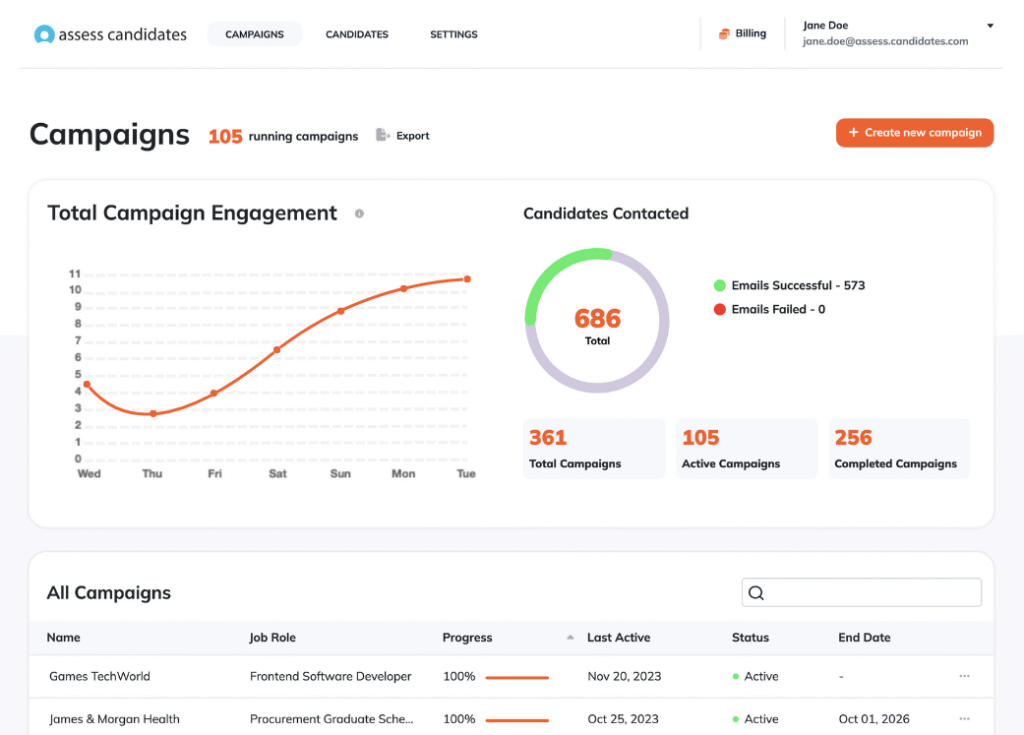
Many influential organizations choose Assess Candidates to assess applicants’ skills and personalities and determine their suitability for roles because it is reliable and makes candidate skills evaluation easier. Other reasons they choose Assess Candidates to boost diversity in recruitment include:
- Accurate and Efficient Candidate Assessment
Although your aim is to increase workforce diversity, you must do so without sacrificing the quality of the talent you hire. An effective way to ensure you’re hiring the best talent is to screen applicants with pre-employment assessments. However, these tests must be relevant to the roles they are looking to fill.
Assess Candidates provides relevant, efficient, and accurate pre-employment assessments that allow the hiring team to discover applicants’ strengths and weaknesses. These psychometric tests expose candidates’ sensitivity, memory, intelligence, personality, and aptitude. Also, it features cheater-detection technology to increase its accuracy and reliability.
- Simplified Assessment Reporting
After testing candidates’ skills and personalities, hiring teams get the results and use them to make hiring decisions. However, unclear reports on candidates’ assessment cause unprecedented difficulties and delays in making accurate hiring decisions.
A simple, clear assessment report features candidate rankings based on their scores. On the Assess Candidates’ platform, recruiters can see applicants’ ranks based on their performance. In some cases, candidate assessment results are colour-matched to show which candidates have passed the assessment. We aim to assist recruiters in making their final selection without any errors.
- Compatible with all Diversity Hiring Strategies
Pre-employment assessments are not restricted to any diversity recruitment strategy. Whether you are exploring blind hiring, referral programs, or diverse talent sourcing, you must assess your candidates’ skills to determine their suitability for the role they have applied for.
Assess Candidates naturally supports your diversity hiring strategy by focusing on skills and personality evaluation without considering your candidates’ educational, cultural, and experiential backgrounds. We use the same structured assessment for all candidates vying for the same roles.
- Facilitates Quick and Accurate Data-driven Hiring Decisions
A common challenge in some organizations is the long wait candidates endure before receiving feedback from the hiring team. Usually, the hiring team has to decide which candidates best fit their needs, and that can take time. However, with accurate candidate assessment data, that waiting period can be significantly shortened.
With simple, accurate, and transparent reporting, Assess Candidates helps recruiters make informed, data-driven, and confident recruitment decisions quickly, cutting waiting time and reducing hiring costs.
- Periodic Expert and Data-backed Assessment Adjustment
As the world advances in technology, more skills are required to remain relevant in a role. That means, to ascertain a candidate’s suitability for a role, assessments must reflect current skill requirements, necessitating that organizations update their candidate pre-employment assessments.
3 years ago, to hire a digital marketer who majors in content writing, they must possess SEO skills. However, they must now possess GEO skills to be considered adequately skilled for such roles.
Assess Candidates periodically updates its assessments to reflect the current skill requirements for the role. Its recruitment and scientific experts use data and experience to ensure each assessment adequately tests the necessary skills for each role as the times dictate.
Hire top diverse talent with our talent assessment platform. LEARN MORE
Want to know more about strategies to boost diversity hiring and how to leverage candidate assessment in the process? Continue reading for frequently asked questions, and sign up below with your email address to get started.
Frequently Asked Questions
What is the meaning of diversity recruiting?
Diversity recruiting refers to the active sourcing, attracting, and hiring of candidates of various backgrounds, experiences, and identities. It aims to create equal employment opportunities for people regardless of gender, sexual orientation, age, or ethnicity, but focuses on their skills.
How to make recruitment more diverse?
To make an already diverse workplace environment more diverse, start by focusing on diversity retention. Afterward, expand your talent pool, employ diversity hiring strategies such as blind hiring, and focus more on skill-based hiring. However, for a better result, ensure your diverse candidates undergo pre-hire assessments.
How to source diverse candidates?
To source diverse candidates, collaborate with minority professional associations, advertise job openings on diversity-focused job boards, leverage social media, and use employee referral programs. Use these methods together for better results, as they diversify your talent sourcing and broaden your talent pipeline.
What are three ways to promote diversity?
Three ways to promote diversity are through diversity hiring, equitable workplace policies, and continuous education against bias. Diversity hiring ensures that talent from diverse backgrounds with relevant skills join your workforce. Equitable workplace policies seek to give every employee an equal chance at career advancement. Continuous education teaches your workforce to relate to other employees without bias.
What are the three pillars of diversity?
The three pillars of diversity, often referred to as DEI, are diversity, equity, and inclusion. Diversity represents employees with different backgrounds and identities. Equity ensures equal access to opportunities, fair treatment of all employees, and removal of systemic barriers to career development . Inclusion creates an environment where all employees are valued, respected, and empowered to contribute to the organization’s progress fully.


 English
  Arabic