
Why Choose Psychometric Testing for Recruitment: 11 Key Pros and Cons



Today, psychometric testing has become an irreplaceable part of modern hiring, used by major global organizations to make accurate recruitment decisions.
A recent study by the Society for Industrial and Organizational Psychology found that 85% of employers now use psychometric testing as part of their recruitment process, showing an increase from 70% in just five years.
Scientifically validated psychometric assessments provide objective, data-driven insights into candidates’ skills, behaviors, and cultural fit. When combined with other skills-based candidate evaluations, psychometric testing boosts overall quality of hire, lowers the risk of costly mis-hires, and strengthens employer branding.
However, while the benefits of psychometric assessments are clear, important questions remain:
- How can I use psychometric tests effectively in my recruitment process?
- What are pre-employment critical thinking tests?
- How can I detect cheating during online psychometric testing?
- Are psychometric assessments affordable for small and mid-sized businesses?
This article answers these questions and more! Keep reading to explore the top 11 pros and cons of implementing psychometric tests for candidate assessment, and discover whether it’s the right fit for your company. But first, let’s define what psychometric testing is.
Contents
- What is psychometric testing?
- Types of psychometric tests for recruitment
- What are the top 11 pros and cons of psychometric testing?
- How to use psychometric testing effectively to maximize ROI
- Why choose psychometric testing: Client Success story
1. What is psychometric testing?
Psychometric testing is a standardized, scientific method of evaluating candidates during hiring and upskilling and reskilling initiatives. Unlike traditional CV screening, HR teams and recruiters typically combine multiple psychometric assessments to gain objective insights into a candidate’s:
- Aptitude and Cognitive Skills: Problem-solving, numerical reasoning, verbal reasoning.
- Personality Traits: How candidates behave and interact in workplace settings.
- Work Behaviors: Adaptability, leadership potential, communication.
- Job-Specific Skills: Technical, critical thinking, or role-based capabilities.

Hire top talent for your organization with our science-backed, reliable psychometric assessments. HIRE FOR FREE
So, what types of pre-employment psychometric tests do organizations use? Let’s find out below.

2. Types of psychometric tests for recruitment
Employers globally use a variety of different pre-employment psychometric tests to quickly and accurately assess candidates. Depending on skills or abilities you want to measure, these assessments typically fall into the following 4 main categories:
1. Cognitive Aptitude Tests
Cognitive ability tests assess candidates on a variety of cognitive skills to determine whether they have the required abilities for the role. Recruiters such as Tesla and PwC use these tests to hire for roles requiring strong analytical thinking, problem-solving, and reasoning skills.
Renowned providers that offer these standardized cognitive assessments are Assess Candidates, SHL, and TestGorilla.
Here are the most common aptitude test types:
- Numerical Reasoning Tests: Evaluate candidates on their ability to understand and interpret numerical data to solve problems accurately. Numerical assessments are useful when recruiting for data-oriented roles like data analysts, investment bankers, and statisticians.
- Verbal Reasoning Tests: Measure a candidate’s ability to comprehend, analyze, and interpret written information. Employers use verbal ability tests to hire for roles that require a strong command of language and communication skills, such as customer service representatives, digital marketers, and lawyers.
- Logical Reasoning Tests: Assess candidates on their ability to solve complex abstract problems and draw conclusions based on logic. Employers use logical reasoning tests to hire for roles like designers, engineers, and data analysts.
- Critical Reasoning Tests: Evaluate a candidate’s ability to analyze arguments and information to make logical decisions under pressure. Recruiters use critical thinking tests to hire for positions that require strong judgment and decision-making, such as consultants and lawyers.
- Abstract Reasoning Tests: Measure a candidate’s skills in pattern recognition and abstract problem-solving without relying on prior knowledge. Employers use these tests for roles that require strong critical and analytical thinking, such as AI specialists and strategists.
- Diagrammatic Reasoning Tests: Assess candidates’ visual logic and reasoning skills when working with patterns, systems, and diagrams. Employers use these tests to hire for roles like architects, risk analysts, and system engineers.
- Spatial Reasoning Tests: Measure a candidate’s ability to comprehend and manipulate spatial objects, visualize 3D shapes, and identify patterns. Recruiters use these assessments to hire for roles such as air traffic controllers, game designers, and VFX testers.
- Error Checking Tests: Assess attention to detail and accuracy. Employers use these checking assessments to hire proofreaders, data entry clerks, and policy analysts.
Check out our whole range of pre-employment psychometric assessments below:
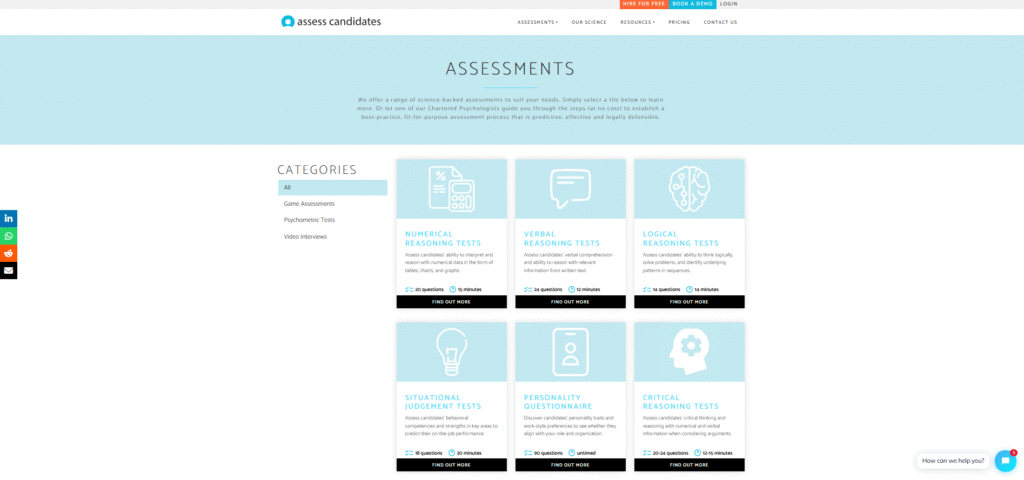
Let’s now move on to our next set of psychometric assessments: Game-based assessments.
2. Game-based Assessments
Game-based assessments are an interactive method of evaluating candidates on their cognitive, personality traits, and soft skills using game-like elements. These games offer high predictive accuracy, reduce candidate stress, and boost candidate engagement and experience.
Renowned employers such as Unilever and Morgan Stanley use these tests to hire for roles in industries such as consulting, engineering, and finance.
Employers prefer to hire with reliable game assessment providers such as Assess Candidates, Pymetrics, and Arctic Shores.
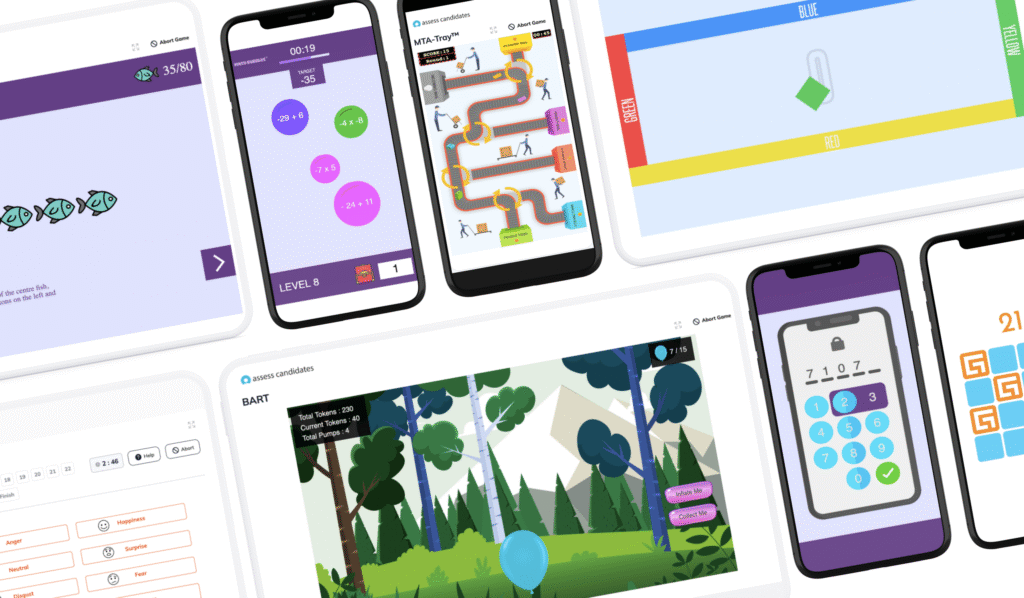
Let’s check out the different Assess Candidates game-based assessments that you can use for your assessment process:
After gamified tests, let’s introduce personality tests.
1. Personality Assessments
Personality assessments evaluate candidates’ personality traits, work preferences, and behavioral tendencies to predict their alignment with the role and company culture. Depending on their type and format, workplace personality tests help recruiters match candidates for roles during recruitment, career transition, and team-building opportunities.
Leading employers such as Goldman Sachs and Unilever use these tests for roles such as risk analysts, customer service representatives, and managers.
Popular personality questionnaires include Assess Candidates’ Big 5 personality questionnaire, the MBTI (Myers-Briggs Type Indicator), and the DISC personality test as part of their assessment processes.
Here’s what a typical personality assessment question looks like using an example from our Work Personality Questionnaire:

2. Situational Judgment Tests (SJTs)
Situational judgment tests are workplace behavioral assessments that evaluate candidates on their strengths, competencies, and behaviors by presenting realistic work scenarios and challenges. SJTs and job simulation tests are a popular choice for assessing candidates on their decision-making, leadership potential, and interpersonal judgment, for roles in marketing, sales, finance, and consulting.
Top companies such as the NHS and Deloitte use behavioral tests such as the Assess Candidates’ situational judgment test, Talent SJT, and SHL situational judgment test as part of their psychometric testing.
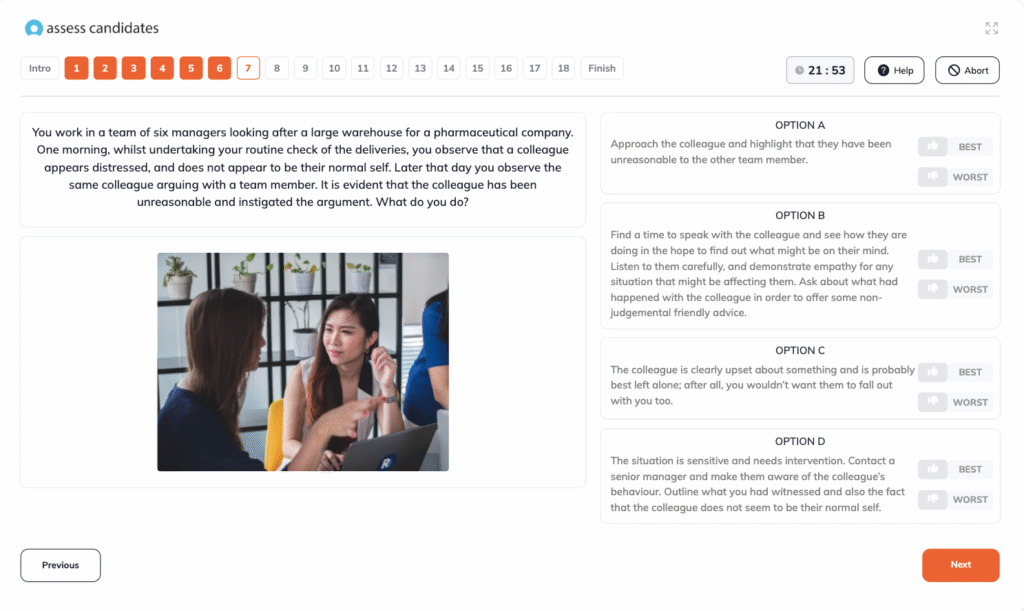
Here’s a situational judgment test example question from the Assess Candidates assessment library:
Explore our end-to-end assessment library of standardized psychometric tests to hire best-fit candidates. LEARN MORE
So, now you understand what psychometric testing is and the different types of assessment available, let’s now discuss the top 11 benefits and challenges of psychometric assessments for recruitment.
3. What are the top 11 pros and cons of psychometric testing?
Psychometric testing has become one of the most sought-after techniques for evaluating candidates. According to TestGorilla, in the last 12 months, 76% of companies utilized skills tests with psychometric assessments, marking a significant increase from 55% in 2022.

While the benefits of psychometric assessments are substantial, there are also some challenges to using this modern testing methodology. Below we outline the top 11 pros and cons along with the practical solutions for balancing them effectively..
Top 11 Pros and Cons of Psychometric Tests
1. Objective Candidate Evaluation, But Risk of Being Lengthy
Pro: Psychometric testing allows employers to conduct a fair and standardized assessment of a candidate’s abilities and skills that traditional interviews fail to do. This approach helps reduce unconscious bias and discrimination, giving the same opportunity to all candidates.
Con: If not carefully designed with expert advice, psychometric assessments can easily become lengthy or vague, risking candidate fatigue.
SOLUTION: Keep tests short between 10 and 15 minutes, role-specific, and offer personalized feedback. This boosts predictive validity while also improving candidate experience.
2. Reduced Mis-Hire Costs But Risks Rejecting Good Candidates
Pro: Psychometric tests, such as situational judgment tests and personality tests, reduce the risk of costly mis-hires as they identify red flags in candidates early on. This saves time and costs by reducing wasted onboarding/training investments and morale drops due to cultural misalignment.
Con: Behavioral assessments without a proper hiring strategy or careful cutoffs risk rejecting good candidates, including neurodivergent and those from diverse backgrounds.
SOLUTION: Choose psychometric test providers such as Assess Candidates who offer culturally neutral assessments with accessibility features for neurodivergent candidates. Encourage candidates to practice psychometric tests beforehand to ease their test anxiety.
3. Enables Cultural Fit Assessment, But May Hurt Diversity
Pro: Cultural-fit hiring is key to ensuring long-term success and growth of your organization. Culture-fit assessments like personality tests ensure that candidates align with your company values, mission, and vision. This helps boost employee retention, team harmony, and organizational belonging.
Con: Over-reliance on culture-fit assessments risks over-increasing homogeneity and discouraging different perspectives and innovation, sidelining candidates with good role-specific skills but different work preferences.
SOLUTION: Assess for “cultural add” as well as “culture fit” to ensure you hire personalities suited to your work style while also paving the way for a diverse, innovative work environment. Combine assessment results with structured interviews for fair and holistic candidate evaluation.
4. Identifying Leadership Potential, But May Overlook Ground Reality
Pro: Emotional intelligence tests and personality questionnaires are scientifically proven to identify candidates with leadership potential, empathy, and resilience. Use these tests to objectively nominate employees for promotions instead of subjective leadership nominations that run the risk of unconscious bias.
Con: Over-reliance on psychometric tests can unnecessarily put too much weight on abstract personality traits or cognitive profiles without context. This can lead to overlooking high performers in their current roles who score poorly on certain traits, despite their practical experience and expertise.
SOLUTION: At Assess Candidates, we always suggest using a blended assessment approach for more valid data interpretation. Use tools like 360-degree feedback, past performance reviews, and leadership simulation tasks to promote inclusive leadership pipelines, reduce attrition of high performers, and increase trust in talent evaluations.
5. Faster Screening of Large Applicant Pools, But Risks Digital Divide
Pro: Unlike time and resource-intensive resume screening, psychometric profiling automates shortlisting candidates efficiently. A combination of aptitude and gamified assessments is particularly beneficial for speeding up large-scale graduate recruitment.
Con: Relying solely on psychometric profiling can risk rejecting strong candidates from diverse backgrounds who aren’t familiar with digital tests.
SOLUTION: Combine automation with human oversight through manual screening of AI-rejected resumes. Organize test-prep webinars and encourage candidates to practice psychometric assessments to familiarize themselves with psychometric tests.
6. Identifies Hidden Talent, But Not Suitable for All Roles
Pro: Psychometric testing evaluates candidates beyond their resumes, i.e., degrees and experiences. This helps identify skilled candidates from non-traditional educational or career backgrounds.
Con: Generic psychometric tests can be culturally biased, unknowingly favoring one cultural group over another. Additionally, some roles like in healthcare, traditional assessments cannot be replaced. This can compromise the overall process’s legal defensibility, erode candidate trust, and negatively impact the employer brand.
SOLUTION: Use tailored role-specific assessments over generic psychometric tests to assess for only relevant skills for the role. Additionally, combine these candidate assessments with other recruitment methods, such as interviews and assessment centers, for a holistic evaluation.
7. Boosts Internal Mobility, But Risks Employee Satisfaction
Pro: Psychometric testing allows employers to comprehensively determine a candidate’s overall job potential. You can identify employees ready for upskilling or promotion to senior-level roles, such as from bank tellers to analysts.
Con: Over-reliance can make the process dependent on scores. This risks employees feeling pigeonholed as it doesn’t give them enough space to showcase their skills in real-time or prove their calibre.
SOLUTION: Use psychometric testing as one data point to assess candidates. Combine the results with other candidate assessment methods such as job simulations, peer reviews, and manager inputs for a balanced, holistic approach, boosting employees’ satisfaction with the assessment process.
8. Supports Reskilling Initiatives, But Often Faces Resistance
Pro: Psychometric profiling identifies employee learning styles and training needs to develop personalized training programs. This approach helps boost training return-on-investment and reduce long-term candidate attrition. Assessments like situational judgment tests and emotional intelligence objectively evaluate candidates on key learning abilities and adaptability.
Con: Psychometric testing can be met with resistance from both employees and recruiters. While employees may find it unfair to be tested mid-career; HR professionals, unfamiliar with online pre-employment assessments, may question their validity, complexity, and cost compared to interviews.
SOLUTION: Utilize a structured dashboard, such as Assess Candidates, to auto-collate and simplify data. A trained HR partner then facilitates a decision matrix for reskilling initiatives. Train them on one unit before scaling to save costs.
9. Contributes to Team Dynamics, But Risks Privacy Concerns
Pro: Personality and emotional intelligence assessments help hire future employees who complement each other, leading to harmonious team dynamics, strong collaboration, empathy, and resilience necessary for long-term organizational success. Furthermore, this helps manage workplace conflicts by understanding the behavioral styles of employees.
Con: There are privacy concerns with generic personality assessments that are poorly explained. It may feel impersonal and forced, risking candidate trust in their validity.
SOLUTION: Ensure your pre-employment assessments evaluate candidates in line with organizational values. Seek input from the team post-assessment to keep the process updated and flexible. To rule out privacy concerns, share only role-relevant summaries, explain test purpose clearly, and keep feedback transparent.
10. Reduces Turnover, But Poses Technical Challenges
Pro: Job-fit assessments align candidates with the right roles and companies, ruling out misfit candidates and reducing employee attrition due to mismatched expectations and skills.
Con: Psychometric testing may require integration with ATS or HRIS systems, which can pose technical challenges. Additionally, validated assessments can costly investments upfront, but necessary to prevent discrimination claims later on.
SOLUTION: Partner with reliable psychometric test providers like Assess Candidates that offer scientifically validated, industry-standard tests at low cost. Pair your testing platform results with job simulation tasks so candidates can get a glimpse of the daily demands of the role and manage their expectations beforehand.
11. Increases Employee Engagement, But Risks Losing Out On Top Talent
Pro: Psychometric tests, especially personality questionnaires and motivation inventories, align roles with candidates’ natural personality traits, motivations, career goals, and strengths. This helps boost engagement and their sense of belonging, while also preventing higher turnover risk and reduced creativity in problem-solving.
Con: Some managers fear losing their top performers to other teams if internal mobility is encouraged, creating skill gaps in their current projects.
SOLUTION: Use internal gig systems where employees can work part-time on cross-departmental projects while keeping their main role. This offers them a variety and growth opportunities without causing managers to lose high-value team members permanently.
The best approach to using psychometric tests lies in balancing their pros and cons with the right advice. Contact us, and our expert chartered psychologists will be happy to guide you!
Hire with ease with Assess Candidates’ expert-backed psychometric testing tools. VIEW PLANS
So, how to best prepare an effective hiring strategy with psychometric assessment tests? Let’s find out below.
4. How to use psychometric testing effectively to maximize ROI
Psychometric testing in recruitment works best, especially in large-volume graduate hiring. However, it also helps shortlist candidates for medium and low-volume candidate assessment for technical roles such as a financial analyst and a mechanical engineer.
Here is a 3-step guide to prepare an effective psychometric testing process using our talent assessment platform.
How to effectively design and implement psychometric tests in hiring?
1. Create your psychometric test campaign:
- Clearly define the specific skills, behaviors, and personality traits necessary for the role. Then, depending on your recruitment campaign, choose a combination of psychometric assessments for a holistic candidate evaluation. E.g., for a finance assessment process, a multi-assessment approach with a numerical reasoning test, a situational judgement test and our MathBubbles™ game assessment will be effective.
- Combine these standardized tests with other assessment tools, such as video interviews and assessment centers.
- Choose a test provider like Assess Candidates, which provides scientifically validated assessments to predict job performance. Avoid the use of generic assessment tests that fall short of validity.
- Establish a clear deadline and make sure to provide sufficient time for candidates to complete their psychometric assessments. Ensure that all candidates have a consistent time limit, with the option to offer accessibility features for neurodivergent candidates. This standardization guarantees that applicants are evaluated under equitable conditions, promoting fairness and objectivity in the hiring process.
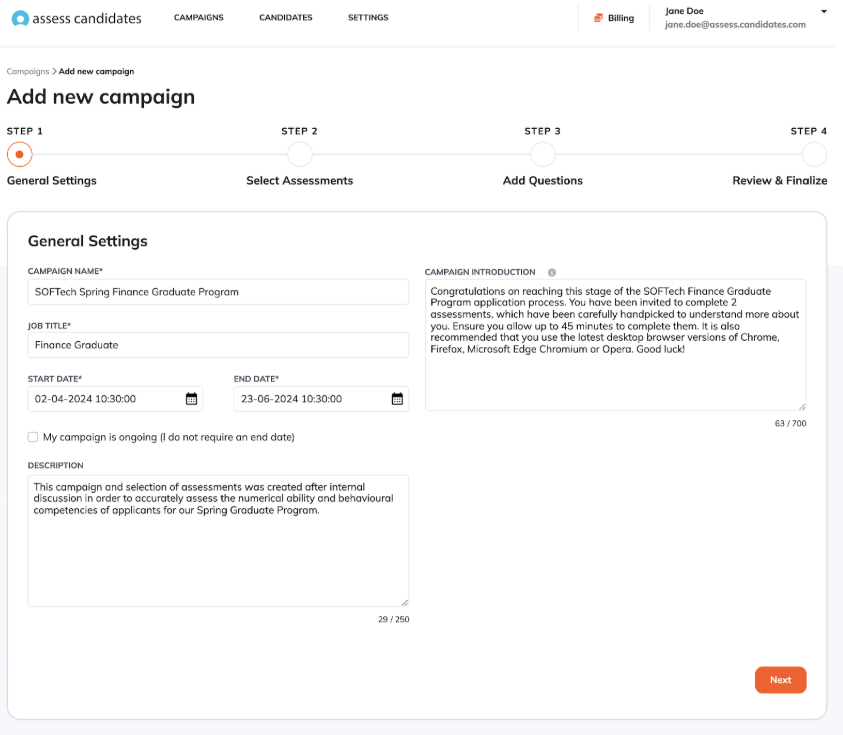
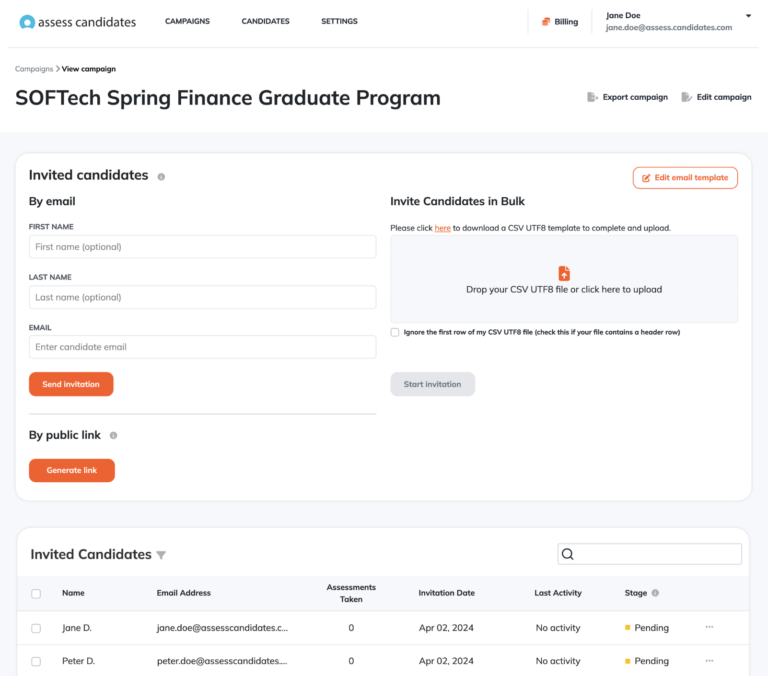
2. Invite candidates to your psychometric test:
Invite candidates in a single click to complete your psychometric tests by individual email, CSV file upload, or public link.
3. Analyze candidate results and shortlist candidates:
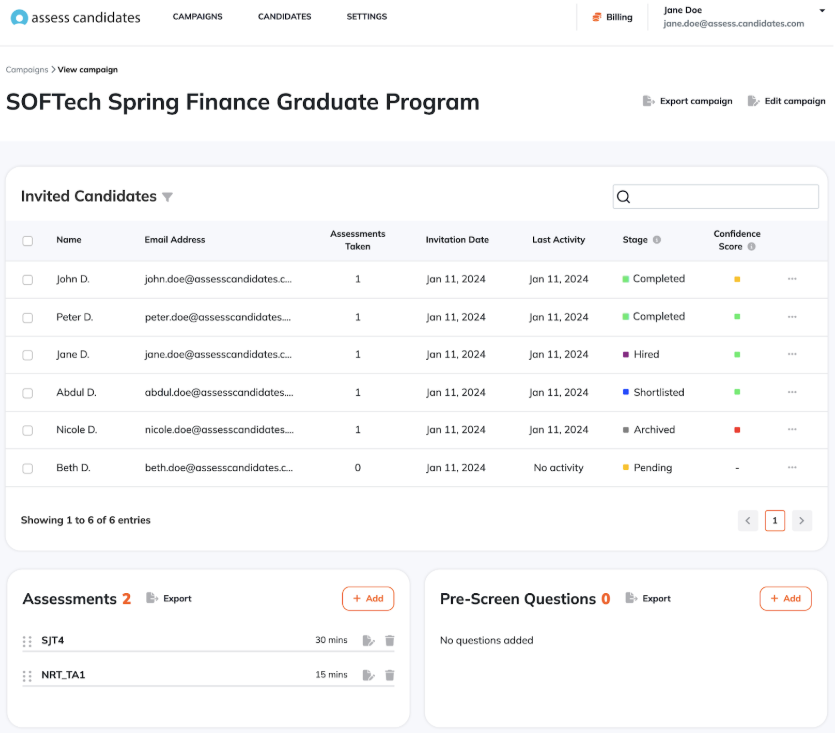
- Monitor candidates’ progress in real-time as they complete the psychometric tests. You can access automatically graded results and detailed reports immediately after test completion.
- You can use advanced tools to rank, filter, and sort candidates based on criteria such as performance score, number of assessments completed, hiring status, confidence score, and more. This feature allows you to quickly and effortlessly view, compare, and select top talent for your role and organization to progress to the next assessment stage.
- Ensure the training of hiring managers and recruiters to interpret psychometric tests accurately and avoid misinterpretation.
Before moving on to the FAQs, let’s discuss a client success story on how they finally used psychometric testing for success.
5. Why choose psychometric testing: Client success story
Client Problem Statement
A mid-sized marketing firm was struggling with a sharp decline in campaign effectiveness and client satisfaction. Despite hiring candidates with strong resumes and prior agency experience, the firm found that many lacked the creativity, adaptability, and collaboration skills needed to thrive in a fast-paced, digital-first marketing environment. This mismatch led to frequent miscommunication within teams, missed deadlines, and declining innovation in client campaigns.
Over time, employee morale dipped as frustration grew over poor team dynamics and unbalanced workloads. Additionally, the firm noticed higher turnover, rising recruitment costs, and difficulties in maintaining a strong employer brand.
Assess Candidates’ Proposal
To tackle these issues, the firm was recommended to include psychometric testing as part of its pre-screening process. These assessments focused on personality fit, creativity, critical thinking, collaboration style, and motivation. By incorporating psychometric insights, the company aimed to ensure cultural alignment, improve teamwork, and hire a resilient workforce with strong soft skills complementing the technical marketing knowledge.
Problems Resurfaced with Psychometric Testing
However, psychometric profiling surfaced new challenges as some applicants reported the tests to be invasive and too time-consuming. Others argued that the assessments did not always reflect real-world job performance and could unfairly filter out strong candidates. Hiring managers worried about over-reliance on test scores rather than holistic judgment. In some cases, biases crept in during interpretation, leading to confusion and pushback from both recruiters and candidates. The firm also faced logistical issues in integrating testing into its existing recruitment pipeline, adding delays to an already time-sensitive hiring process.
Assess Candidates’ Renewed Proposal
So, to balance out these challenges, Assess Candidates suggested that the organization combine psychometric assessments with structured interviews and job simulations, ensuring that no single tool dictated outcomes. Recruiters were asked to be trained on how to interpret results without stereotyping or misusing scores. Candidate feedback was actively collected to refine the process and keep it transparent. Finally, the firm invested in technology that streamlined testing and reduced delays, making assessments a seamless part of hiring.
Result
As a result of Assess Candidates psychometric assessments, the company achieved stronger cultural alignment, higher creativity in campaigns, and smoother collaboration across teams. Client satisfaction scores improved, employee turnover decreased, and the company was able to position itself as a progressive employer that balances science and human judgment in hiring, minimizing disadvantages while maximizing long-term workforce potential.
Interested in learning more about effective candidate assessment? Continue reading for frequently asked questions, and sign up with your email to get started.
Frequently Asked Questions
Which industries commonly use psychometric assessments?
Almost all major industries today use psychometric assessments as part of their recruitment and developmental initiatives. Some of the common sectors with a high preference for psychometric tests are sales, IT, marketing, consulting, banking, data analysis, finance, HR, retail, and engineers.
Which industries don’t commonly use psychometric assessments?
Industries with more orientation towards manual work, creativity, and low time-to-hire prefer not to use psychometric tests in hiring. These include hospitality, agriculture, factory floor jobs, and gig economy jobs such as delivery riders and seasonal workers. Additionally, many recruiters for highly technical roles with licensing requirements to practice, such as physicians and lawyers, choose traditional testing over psychometric assessments.
How to select the best psychometric assessment platform for my hiring process?
You can select the best psychometric assessment platform for hiring by asking these questions: Can I evaluate the aptitude, behaviors, and personalities of multiple candidates simultaneously? Can I view candidate results and insights with just a single click? Can I tailor the psychometric tests for specific roles and organization? Is the talent assessment platform user-friendly, objective and efficient?
How to prevent cheating during psychometric testing?
You can effectively prevent attempts to cheat by using advanced anti-cheat technology to avoid compromising test integrity. Top providers like Assess Candidates offer anti-cheating features such as web proctoring for remote tests, screen-sharing monitoring, and facial recognition to ensure the assessment process remains fair and objective.
Do psychometric tests work for small and medium-sized enterprises (SMEs)?
Yes, psychometric assessments have made candidate profiling easy, efficient and affordable for all employers, including SMEs. Popular providers such as Assess Candidates offer Saas (Software-as-a-Service). These include fully automated, cloud-based tests that can seamlessly integrate into existing recruitment campaigns for a smooth and efficient assessment process.


 English
  Arabic