
What are the Biggest Hiring Challenges for Large Businesses?



Many recruiters ask for the secret to avoiding and solving the common hiring challenges large businesses face during mass recruiting. Hiring for a large organization is no easy feat when there are multiple roles to fill, and you want to beat the competitors to recruit the top candidates in the industry.
As a recruiter or talent acquisition expert, knowing the right strategies to help you select quality hires for your company will help you achieve your KPIs and ensure that the business continues to run on skilled talent.
According to Flair HR, large organizations spend about 47.5 days to fill their vacant positions. This is due to many issues, but 89% of employers have reported that candidate ghosting increases time-to-hire and is a problem.
In this guide, we will focus on the top challenges to work on and best strategies to use as a large business for high-volume recruitment.
Contents
- What is large-scale hiring?
- What are the skills to look out for when recruiting for large businesses?
- What popular tools do top large businesses use while hiring?
- What top strategies are used by large-scale organizations in hiring?
- How to avoid the challenges of hiring for a large business?
- Client success stories of large business recruitments
- What is the future of recruitment for large businesses?
- Why do large companies use Assess Candidates when recruiting?
Are you interested in learning the secrets behind effective hiring for large businesses? Keep reading to find out.
1. What is large-scale hiring?
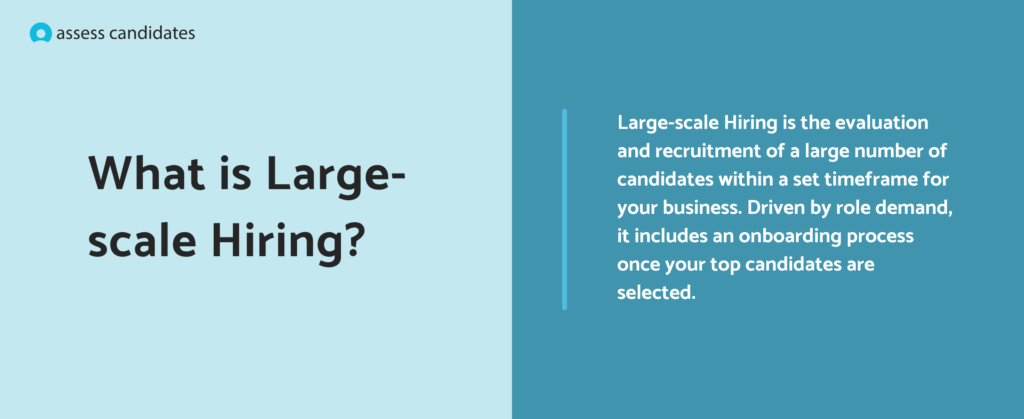
Large–scale Hiring, also known as high–volume recruitment, is the process of evaluating and recruiting a large number of candidates within a set timeframe for your business. It is driven by role demand and includes an onboarding process once your top candidates are selected.
Start your large-scale hiring process with our psychometric assessments. HIRE FOR FREE
Want to know what skills you can assess when recruiting for a large business? We have some answers right here!

2. What are the skills to look out for when recruiting for large businesses?
According to Prospects, about 77% of employers worldwide face recruitment challenges, including difficulty in identifying top candidates with in-demand skills.
Top in-demand skills when recruiting for a large business
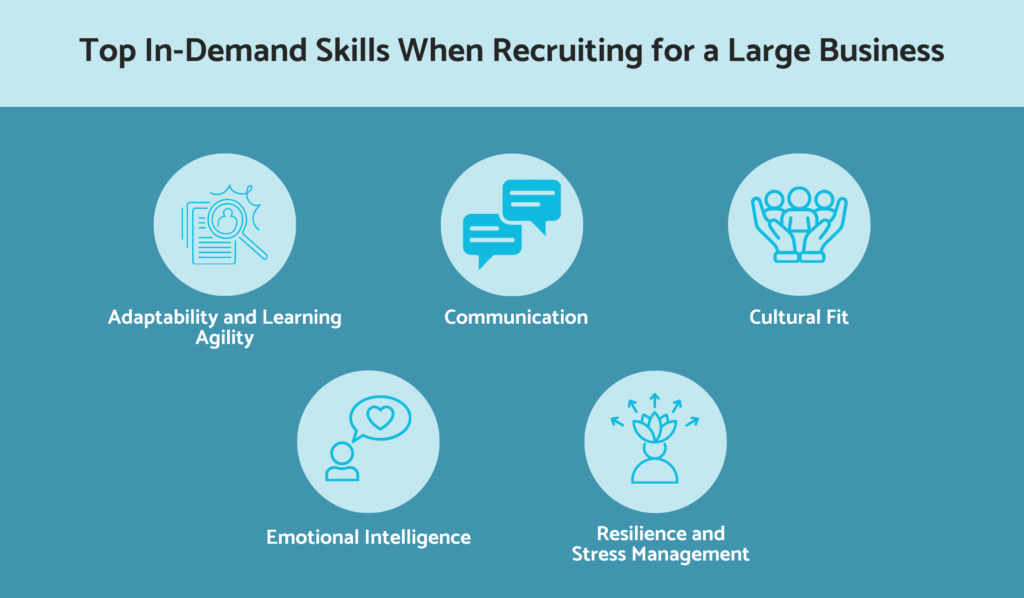
- Adaptability and Learning Agility: Large businesses often evolve as markets change, and to keep up with technological updates and strategic shifts, you need to hire candidates who can adapt. Assess your candidates’ track record of learning skills and adjusting to new priorities.
- Communication: Effective communication across departments and hierarchies is important in large organizations. Evaluating candidates’ written and spoken communication skills is necessary to ascertain their ability to perceive and communicate across all boards and departments.
- Cultural Fit: Cultural misalignment among candidates can lead to costly early turnover and friction within teams in large organizations. To avoid this, assess whether your candidates’ work styles, expectations, and values align with your company’s culture.
- Emotional Intelligence: Understanding and managing one’s emotions is a difficult skill to find in your candidates, especially when hiring for large businesses. To make the perfect hire for the role, assess your candidates’ self–awareness, empathy, and relationship–management skills, as these skills regulate interactions between candidates and other staff, creating a respectful workplace.
- Resilience and Stress Management: Hiring for a large organization means candidates will likely face challenging scenarios. Examine how candidates have handled rejection, failure, and criticism, and identify healthy coping mechanisms through these challenges to filter out the mis-fits.
Wondering what tools are used in the recruitment process for a large business? Let’s get right into it!
3. What popular tools do top large businesses use while hiring?
Recruitment processes for large businesses are often expensive, time–consuming, and an administrative burden. When hiring to recruit the perfect candidates, you will need to use certain tools to expedite the recruitment process.
7 Key tools used for hiring in large businesses
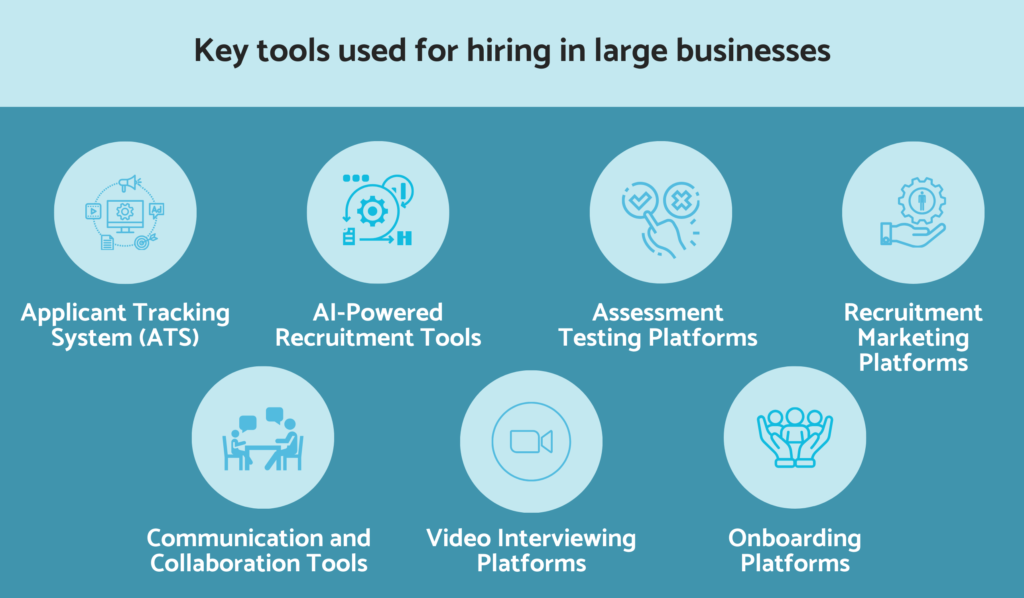
1. Applicant Tracking System (ATS)
Large companies use ATS platforms such as Taleo, Workday, and Smart Recruiters to assess and hire large numbers of candidates for a single role or multiple roles within the company. ATS software monitors candidates throughout the recruitment process. These systems also support templated communications and workflow approvals, leaving final decisions to your hiring staff so candidates do not feel like they are recruited by AI.
2. AI-Powered Recruitment Tools
Many organizations use HireVue, Pymetrics, and Modern Hire because they help screen candidate resumes, analyze video interviews, and evaluate the candidate’s culture fit at a large scale when recruiting. Hiring tools such as these review thousands of CVs in minutes and select the most qualified candidates based on skills and experience.
3. Assessment Testing Platforms
Platforms like Assess Candidates, Codility, and Criteria Corp help you test the aptitude and psychometric skills of large numbers of candidates. The assessment platforms are administered remotely and provide candidates with automatic scoring, making it easier for you to identify top talent during the hiring process.
4. Recruitment Marketing Platforms
Recruitment marketing platforms such as Beamery, Phenom, and Zoho Recruit market job listings for large organizations and employers. They help develop personalized candidate experience, build communities of interested and qualified prospective candidates, and monitor engagement to inform you when passive candidates are likely to apply.
5. Communication and Collaboration Tools
Software such as Google Workspace, Microsoft Teams, and Slack is an important tool for sharing information effectively between recruiting teams and candidates. These tools enable quick communication about your candidates and collaboration with other recruiters on hiring decisions.
6. Video Interviewing Platforms
Video interviewing platforms such as Assess Candidates, Pymetrics, and HireVue enable you to conduct remote interviews at a large scale. Some of these platforms even offer asynchronous video interviewing, which allows candidates to respond to your preset questions at their convenience.
7. Onboarding Platforms
Software tools such as Workday Onboarding, Enboarder, and BambooHR help large businesses automate the onboarding experience with digital paperwork, training assignments, and engagement activities. These tools help reduce administrative burden on your HR teams when recruiting a large number of candidates.
Assess thousands candidates at once for your large business with our scalable assessment platform. LEARN MORE
Now that you know what to look for, check out these tips for hiring for large businesses!
4. What top strategies are used by large-scale organizations in hiring?
According to LinkedIn, the best talent will hardly settle for anything less than the perfect organization. Therefore, your recruitment strategies must be encouraging and engaging to attract top talent and outperform large competitors.
Best strategies to hire for large businesses
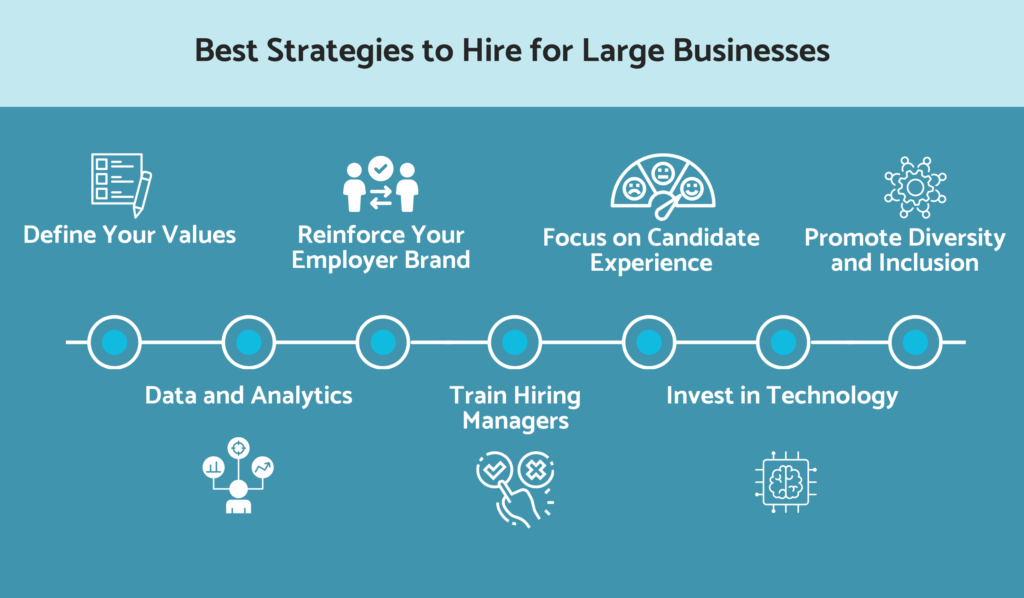
- Define Your Values
Defining your values is the best way to start your recruitment for your large business. Develop a recruitment strategy that clearly articulates your value proposition so candidates can assess whether they align with your company and can grow with the organization. This will help in reducing the bad hires, as every recruited candidate will be aligned with your culture and values beforehand.
- Reinforce Your Employer Brand
Large businesses need a functional career site, an active social media presence, and employee testimonials to build a strong employer brand. We suggest you display your culture, growth opportunities, and values to attract, hire, and retain top talent, and beat competitors to it by filling your organization with the best hires in the industry.
- Focus on Candidate Experience
Applying to a large organization can be daunting for prospective candidates due to the high volume of candidates applying for the same positions. Offering these candidates regular updates, a streamlined application process, and feedback will boost their confidence in your recruitment process because a poor candidate experience damages your employer brand.
- Promote Diversity and Inclusion
When recruiting, be sure to implement structured interviews, a diverse hiring panel, and bias-reduction measures to help reduce the risk of bias affecting your candidates. Collaborate with organizations that protect and serve underrepresented groups, and post your job descriptions with inclusive language. This proves that you encourage candidates from diverse backgrounds to apply for a role in your company.
- Data and Analytics
We recommend tracking metrics such as time–to–fill, quality–of–hire, and cost–of–hire to gain insight into how large-scale hiring affects everyone involved. Having this data will help you identify bottlenecks and optimize your recruiting channels.
- Train Hiring Managers
Train your hiring managers and recruiters on interviewing methods, unconscious bias, and your recruitment process. Clearly communicate the guidelines and ensure that they make better hiring decisions while maintaining consistency across the company. This not only helps you promote your employer brand but also offers your candidate some comfort in your interview process.
- Invest in Technology
We recommend using an enterprise-grade applicant tracking system (ATS) to manage high-volume applications, automate screening, and track candidate status. Integration with your HRMS and other hiring tools, such as a video interviewing tool, will reduce administrative burden on your hiring staff.
Up next, let us take a look at some of the challenges that you could face when hiring for a large business!
5. How to avoid the challenges of hiring for a large business?
Many employers have shared their challenges with large-scale recruitment. Our researchers have compiled some of these challenges, along with solutions, to help you avoid them if you ever come across them.
Top 6 challenges of hiring for a large business
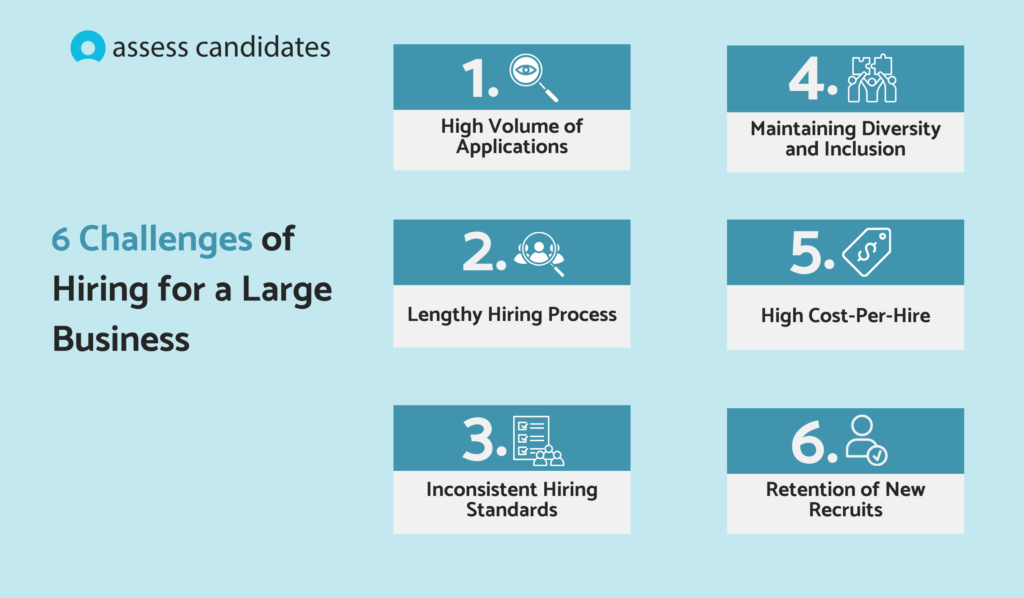
1. High Volume of Applications
Large organizations often receive thousands of applications during their recruitment process, making it impossible to manually review each one. As a result, high-quality candidates may be overlooked amid the chaos, and response times will be unnecessarily long.
Solution: We recommend implementing an AI-powered resume screening tool and pre-screening assessments to filter the candidates based on their qualifications and keywords.
2. Lengthy Hiring Process
As a large business, you may have to go through numerous interview rounds with candidates and bureaucratic procedures that will delay the recruitment process. As a result, your top candidates may have accepted other offers while waiting for your employment letter.
Solution: Start by mapping your current process and removing any unnecessary steps that will delay you. Give your hiring managers delegated authority for specific roles, and implement mobile-friendly scheduling tools that automatically sync calendars.
3. Inconsistent Hiring Standards
There may be an issue with the collective agreement on recruitment requirements, as different departments and managers may each have specific criteria.
Solution: Create standardized interview guides and train all hiring managers on the structured interviewing methods, using scorecards, such as for your candidates’ assessments.
4. Maintaining Diversity and Inclusion
Recruiting for a large business means that some of your candidates are likely to experience unconscious bias in the CV screening and interview stage. Many employers share concerns about how their workforce does not reflect their diversity.
Solution: Removing the pictures, names and other identifying information from the initial resume reviews of your candidates will help your recruiters focus solely on qualifications and experience with no bias.
5. High Cost-Per-Hire
Recruitment processes often cost a lot for all large organizations, as you will have to budget for agency fees, recruiter salaries, assessment tools, and candidates’ interview travel costs. These costs begin to pile up when you have to recruit hundreds of applicants annually.
Solution: Build a robust internal recruiting team to reduce your dependency on external recruiting agencies, and invest in your employer brand that promotes your organic applications. This significantly reduces your recruitment expenses and budget.
6. Retention of New Recruits
High turnover in the first year of recruitment is expensive, as you have already invested in the recruitment process. The turnovers can be traced to your hiring process, onboarding, or a gap between your candidates’ reality and expectations.
Solution: Enhance your quality-of-hire through a thorough assessment of skills, cultural fit, and realistic job previews. This helps familiarize your candidates with the realities of the role they are applying for during the hiring process, allowing you to select top talent that can thrive in your organization.
Design the perfect assessment process for your candidates with our end-to-end assessment library. HIRE FOR FREE
Interested in hearing what some clients have to say about recruitment for a large business? Keep reading!
Are you looking to attract and hire tech talent in your large company, but are not sure what pre-employment psychometric assessment tests to look for in 2026? Reach out to us for a complete analysis of your recruitment assessment design.
Want to know more about the real-world large business companies that shared their stories about their recruitment process?
6. Client success stories of large business recruitments
Several large companies have shared their recruitment processes, and below we will review some real-world examples.
1. Forever 21
Challenge:
A multinational fashion retail store needed to hire 3,000 seasonal workers across 600 store locations within six weeks for the holiday season, but it was experiencing 60% time–to–fill delays. This decentralized recruitment process led to inconsistent candidate quality and poor new recruit retention rates.
Solution:
The fashion company implemented an enterprise ATS with AI-powered screening, standardized interview processes across all store locations, and enforced hiring events with same-day offer capabilities.
Results:
- Reduced the time-to-hire from 28 days to 12 days
- Increased seasonal employee retention by 35%
- Minimized cost-per-hire by 42%
2. Atlassian
Challenge:
Atlassian, a fast-growing tech company, needed 300 software engineers across various specializations within a year to support product development, but was losing 40% of its candidates to competitors due to lengthy interview processes.
Solution:
Atlassian launched a coding assessment platform for objective candidate skill evaluation, reduced its interview rounds from 6 to 3 to through panel interviews, and established a skilled and dedicated technical sourcing team.
Results:
- Reduced offer acceptance rate losses from 40% to 18%
- Achieved 285 engineering recruits, which was about 95% of the goal
- Improved quality-of-hire ranks by 27%
7. What is the future of recruitment for large businesses?
The future of recruitment for large businesses is being shaped by various factors. Such factors include constant technological growth and development, dynamic workforce expectations, and business models. These will ultimately change how organizations attract, hire, and retain top talent.
What is the future of recruitment for large businesses?
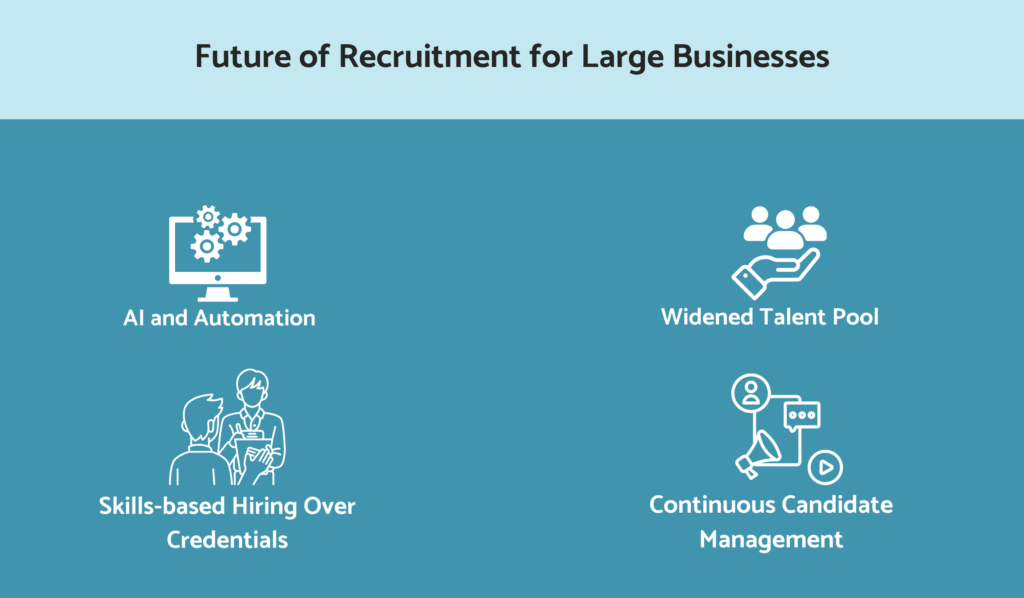
- AI and Automation
AI will expand beyond resume screening to handle more complex tasks, such as conducting initial candidate conversations, predicting candidate success, and making hiring recommendations based on the analyzed data. Meanwhile, automation will help you handle the entire administrative recruiting workflow, from interview scheduling and background checks to generating employment letters.
- Skills-based Hiring Over Credentials
Large organizations will increasingly prioritize candidates’ skills and competencies over traditional credentials such as degrees and years of experience. The future of recruitment will now focus on recruiting both soft and hard skills rather than traditional requirements, while also prioritizing diversity and inclusion.
- Widened Talent Pool
Large companies will no longer face geographic recruitment constraints, as they adopt remote and hybrid work models. This allows them to attract, hire, and retain top talent worldwide without worry of losing these candidates to competitors or due to geographical limitations.
- Continuous Candidate Management
Recruitment will shift from candidates applying and hoping for feedback to relationship management, which includes communicating with potential candidates before roles are vacant for the talent pipeline. Large businesses will nurture these relationships through appropriate content and networking opportunities, helping them reduce time–to–hire when roles open.
Explore our assessments created by Chartered Scientists to hire the top talent. VIEW PLANS
So, why choose Assess Candidates when recruiting for a large business?
8. Why do large companies use Assess Candidates when recruiting?
Large organizations often seek assessment platforms that fully align with their hiring goals and help devise a recruitment strategy that attracts top talent and positions them ahead of competitors in the hiring process.
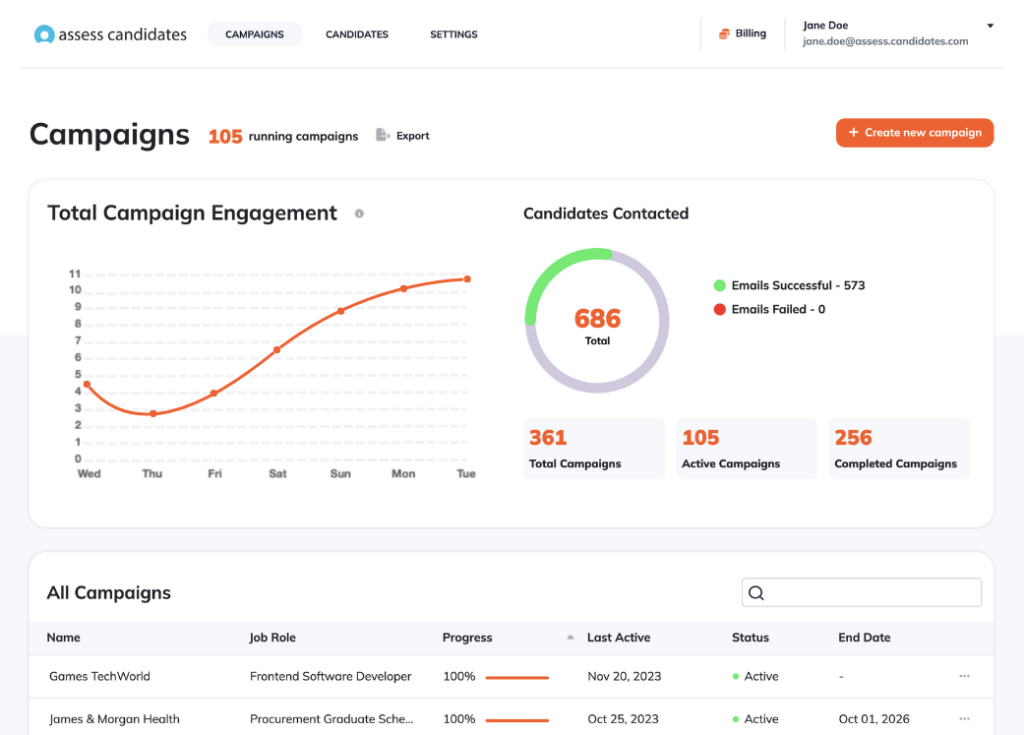
- End–to–End Assessment Solution: Large businesses use Assess Candidates because it is a centralized platform that provides them with all assessment types and selection tools. Instead of managing multiple vendors and systems, these companies can access cognitive ability tests, behavioral competencies, video interviews, situational judgment tests, game-based assessments, and personality questionnaires.
- Bias Reduction and Diversity Support: Our assessment platform promotes fairness by minimizing unconscious bias in your recruitment process. With the help of our standardized evaluations based on subjective impressions from resumes or interviews, promoting diversity and inclusion for large companies.
- High–Volume Hiring Efficiency: The Assess Candidates’ automated screening features are useful during high-volume recruitment. The feature enables large organizations to evaluate candidates in one place, focus on the most promising talent, and reduce screening time and time-to-hire.
- Reduces Cost: Using the Assess Candidates assessment tools will reduce recruitment costs by minimizing the risk of bad hires and employee turnover. When large companies choose us, they get an investment that delivers an assessment platform that guarantees better hiring outcomes.
- Enterprise Customization: Our platform offers semi–bespoke and fully bespoke solutions for assessments, enabling large businesses to customize existing assessments or build new tests tailored to specific roles and organizations.
Hire the right candidates with our assessment tool platform. LEARN MORE
Conclusion: Key Takeaway
In this text, we uncovered how to attract, hire, and retain top talent for a large business. We also made sure to inform you of situations that many large companies have faced, along with solutions on how to avoid these scenarios, should you begin high-volume hiring. You discovered strategies to help you hire for the organization without the obstacles that may slow down your recruitment process.
Curious to know more about using the assessment process to hire the top talent for a large business? Keep scrolling to explore our frequently asked questions, and enter your email to get started today.
Frequently Asked Questions
How long does a hiring process usually take for a large business?
Large-scale business hiring processes often take between 4 weeks, depending on the role level, number of candidates, and organizational complexity. Organizations like Meta and Apple often go through the following application process:
- Application Submission
- Psychometric Assessment Tests
- Video Interview
- Assessment Centre
- Final Interview
What is the difference between centralized and decentralized recruiting in large companies?
Centralized hiring means that all candidate acquisition is managed by a single, dedicated recruiting team that handles the hiring process across the organization. Meanwhile, decentralized hiring is handled by individual recruiters in each department. Large businesses often use hybrid models for high-volume hiring or entry-level recruiting.
How should large businesses approach remote and hybrid hiring?
Large organizations approach remote and hybrid hiring by first clarifying which roles can be performed remotely, which require office presence, and which offer flexibility. They then discuss these arrangements in job postings, so candidates have a clear understanding of what they are applying for before recruitment.
How do large companies manage high-volume seasonal recruitment?
Large businesses manage high-volume seasonal recruitment by analyzing data to accurately predict how many people they will need and when. The companies often set up temporary hiring centers in their target markets and host hiring events where candidates can apply, interview, and receive job offers.
How can large businesses reduce time-to-hire without reducing the quality?
Large organizations reduce their time-to-hire by mapping their entire recruitment process to identify and eliminate unnecessary steps that will not improve decision quality. They set clear agreements for each stage and give the hiring managers the authority to make offers without seeking multiple approvals.


 English
  Arabic