
How to Measure Conflict Resolution Skills During Hiring



A key factor limiting productivity in many workplaces is the prevalence of conflict. When employees with different personalities and emotional control work together, disagreements are inevitable.
However, this can quickly lead to increased work-related stress, fractured relationships with colleagues, and reduced productivity, which negatively affects overall business performance.
As impossible as it is to eliminate conflict completely from work environments, you can mitigate the negatives by hiring and developing people with strong conflict resolution skills. Understanding how to assess these skills accurately and fairly is key.
This article will help you understand what conflict resolution is in the workplace, its importance to your organization, and how to measure and score it using structured, data-driven methods among candidates and existing employees.
Contents
- What is conflict resolution?
- Why does conflict resolution matter in the workplace?
- How to measure and score conflict resolution skills
- Conflict resolution red flags to watch out for
- Why companies trust Assess Candidates to measure conflict resolution skills
1. What is Conflict Resolution?
Conflict resolution is the process of addressing a disagreement between two parties and restoring trust, interpersonal relationships, and productivity. It involves identifying the root cause of the disagreement, communicating openly, negotiating a solution, and reaching an agreement.
In an organization, conflict resolution is more than simply ending a dispute. It aims to repair relationships between individuals or teams, reduce tension, and produce a peaceful and constructive outcome that is acceptable to both parties. Resolving conflict effectively can actually strengthen rapport and productivity.
Conflict resolution can be formal, such as HR mediating peace between two conflicting parties in an organization, or informal, as where the disagreeing parties hash out their differences through honest, respectful discussions. Whichever one is in play, it requires a healthy level of emotional intelligence – the ability to understand emotions and respond thoughtfully under pressure.
Hire candidates who strengthen your company culture with our conflict resolution assessments. HIRE FOR FREE
What are the key conflict resolution skills?
Conflict resolution needs 3 things:
- A subject of disagreement
- Disagreeing parties with differing perspectives
- Resolution skills
Before you can resolve a conflict, there are specific skills you must possess. These skills are essential indicators of emotional intelligence and determine how smoothly conflicts can be handled and resolved.
The top 5 conflict resolution skills include:
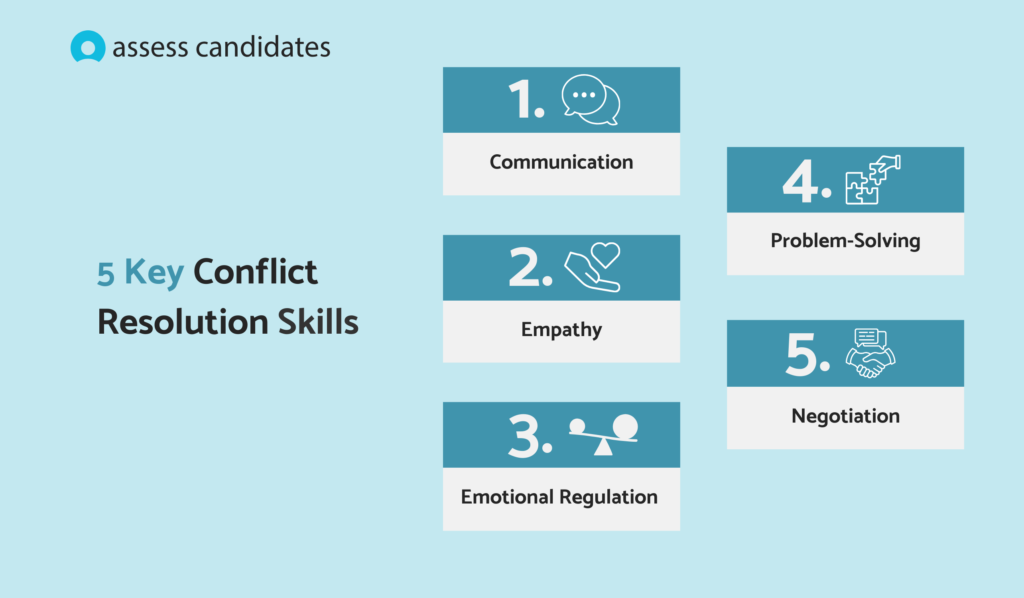
1. Communication
Open and effective communication is essential for exposing the cause of a conflict. The aggrieved party must use clear communication skills to explain how they feel, while the other party actively listens and without interruption. Strong communication ensures both sides feel heard and understood.
2. Empathy
Empathy allows for a good understanding of the situation from each other’s perspectives. By recognizing why someone reacted the way they did, both parties can move away from blame and towards understanding.
3. Emotional regulation
With every disagreement comes an emotional response. Emotional regulation is the ability to realize the need to regulate their reaction, stay calm, and respond constructively and peacefully. In many cases, a mediator helps others regulate their emotions.
4. Problem-solving
The ability to seek a practical way to eliminate or circumvent the problem is essential to resolving a conflict. Problem-solving skills help conflicting parties focus on the resolution rather than the disagreement itself. The effectiveness of this skill depends on good communication and understanding of each other’s perspectives.
5. Negotiation
As important as solving the problem is, it must be mutually acceptable and feel fair to everyone involved. Negotiation skills help balance different needs and find common ground. The mediator or problem solver must make the conflicting parties see the solution as an ideal way to meet their mutual goals rather than as a compromise.
With conflict resolution being the means for restoring healthy interpersonal relations using specific skills, the next question is clear: so why does it matter in the workplace?

2. Why Does Conflict Resolution Matter in the Workplace?
An organization is deemed successful when it consistently meets its growth and productivity targets. Behind that success is a workforce that must work well together. When teams can address problems early and resolve disagreements constructively, work moves faster, relationships stay healthy, and productivity improves. That’s why conflict resolution is a core part of a high-performing workplace.
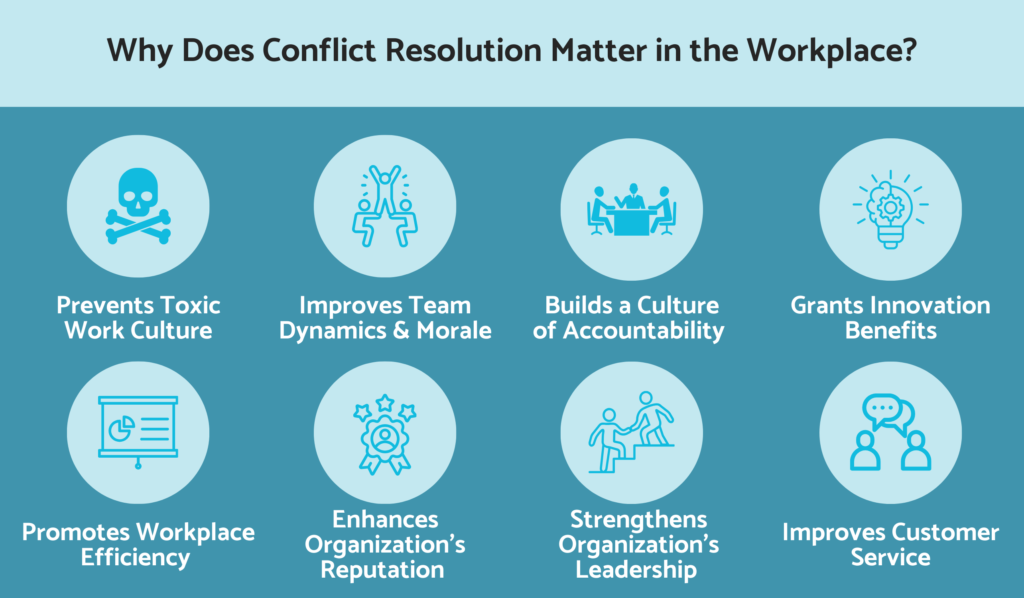
While the primary benefit of conflict resolution in the workplace is higher profit for the organization, its real value shows up in day-to-day ways across your organization. They include:
- Prevents toxic work culture
Unresolved conflict, resulting from poor communication, bullying, or leadership abuse, always leads to a toxic work culture where small disagreements turn into bigger issues.
Hiring people with strong conflict resolution skills and having a clear conflict resolution strategy helps prevent and settle these disputes early. When employees feel safe raising concerns and confident they’ll be handled fairly, trust and collaboration follow.
- Improves team dynamics and morale
In most companies, different departments and teams cross-collaborate to meet objectives. The higher the team morale, the better the quality of their work and the faster they reach their goals. When conflict lingers, morale drops and performance suffers.
Team members must understand team dynamics and learn to work with them. Every team should have at least one person, usually a manager, with high emotional intelligence who can recognize issues early, communicate effectively, and guide teams to workable compromises that suit all parties.
- Builds a culture of accountability
In the event of conflict, a workplace with a strong accountability culture and conflict resolution practices have employees who are more likely to take responsibility for their actions. They acknowledge mistakes and work towards solving them.
You can build a culture of accountability in your workplace by hiring employees with conflict resolution skills. This strengthens team cohesion, boosts employee engagement, and consequently, creates a more professional, respectful working environment.
- Grants innovation benefits
Innovation drives productivity. However, it also involves challenging ideas, testing boundaries, and questioning existing ways of working, which can naturally lead to disagreement. An organization that encourages innovation must also prioritize conflict resolution.
When innovative ideas flow freely within a team, it challenges other team members to develop unique solutions to organizational problems, increasing employee engagement and motivation. In the long run, this leads to increased productivity, better problem-solving, and profits for the organization.
- Promotes workplace efficiency
The speed and accuracy with which tasks are completed affects companies’ productivity. Conflict slows teams down. Time wasted on strained interpersonal relationships, miscommunication, and tension is time poorly spent.
Conflict resolution ensures that disagreements are quickly resolved, restoring or improving team synergy and helping the team meet its goals. It also saves time and money that might otherwise be lost.
- Enhances your employer brand and reputation
Your employer brand is an essential tool in attracting the right candidates to your company. Candidates expect conflict to arise among teams; what they are more interested in is how those conflicts are handled so they don’t affect the work environment and productivity.
An effective conflict-resolution strategy, backed by employees with conflict resolution skills, strengthens your employer brand and makes you stand out in competitive markets.
- Strengthens organizational leadership
Great teams reflect great leadership. Leaders who listen to varying views, reconcile differences, and evaluate competing needs demonstrate competence, fairness, and approachability.
Through enhanced team cohesion and improved emotional intelligence, and the demonstration of accountability and professionalism, your organization’s leadership will encourage a healthy work culture and employee motivation.
- Improves customer service
When you leave internal conflicts unaddressed, it leads to unhealthy employee relationships that spill over to customers, resulting in unsatisfactory customer service. One way to improve your customer service is by quickly resolving internal conflicts.
With effective conflict resolution, employees develop transferable skills such as active listening, empathy, and negotiation. These skills directly improve customer interactions, satisfaction, and long-term loyalty.
Assess and measure conflict resolution skills with our science-backed pre-employment assessments. LEARN MORE
Considering the benefits conflict resolution offers teams, leadership, and customer experience, the next step is knowing how to measure conflict resolution skills in your candidates.
3. How to Measure and Score Conflict Resolution Skills
Before you can unlock the benefits of strong conflict resolution in the workplace, you must hire people who can actually handle disagreements. But how do you actually measure and score conflict resolution skills properly, rather than relying on gut feeling?
Below are the most effective and reliable tools to use to assess conflict resolution skills in candidates.
1. Situational Judgment Tests (SJTs)
A situational judgment test places candidates in realistic workplace situations in which they must choose the most appropriate course of action. SJTs measuring conflict resolution skills typically involve scenarios of team disagreements, communication breakdowns, clashes of priorities, and customer complaints, depending on the role.
A situational judgment test measuring conflict resolution requires that you compare candidates’ answers with benchmarked answers under the same conditions to reach a percentile score. Usually, you will assign marks to each SJT question option, depending on its effectiveness at resolving the posed situation. In other words, you can have more than one option that resolves the conflict, but their effectiveness will differ.
For example, Company Q tests Candidates 098, 765, 103, 008, and 555 for their conflict resolution competencies using a Situational Judgement Test. In one question, options B, A, D, and C are the correct answers in order of effectiveness, attracting 3, 2, 1, and 0 marks respectively. Candidates 008 and 555 choose option B; 098 chooses option A; 103 picks option D; while 765 chooses option C. Scoring them, candidates 008 and 555 get the highest score, while 098 comes next in ranking, and 103 and 765 follow in that order.
2. Job Simulation Test
Job simulation tests are role-specific, realistic assessments, like virtual reality assessments. They present candidates with job-specific situations mimicking a situation involving conflict to assess how well they handle disagreements and deal with team behavior.
Job simulation assessments use behavioral anchor rating scales to evaluate candidates’ workplace conflict resolution skills. You will rate candidates against a list of behaviors and skills, such as empathy, active listening, calmness under pressure, and emotional regulation. Then, you calculate the total score and find an average score for each candidate.
For example, an assessor uses a 5-point behavioral scale to rate 5 candidates, A65, A02, C77, G18, and H39 on active listening, empathy, emotional regulation, problem-solving, and negotiation skills. With 1 denoting poor, 2 representing below average, 3 being competent, 4 showing strong, and 5 marking excellent, the assessors score each competency and calculate the average score for each candidate.
3. Behavior-based Interviews
You can use interviews to test many skills, including conflict resolution. Their question-and-answer format can help you ascertain candidates’ experiences about how they have resolved conflicts in the past. However, behavior-based interviews can be less reliable because they depend on the candidate’s self-report. Your first-hand account of candidates’ reaction to conflict is not considered with this method.
Behavior-based interviews use the Likert scale to score conflict resolution skills. You ask questions that require the candidate to follow the STAR format when answering. Each aspect of the model influences a candidate’s final score. If a candidate answers poorly, you score them 1 or 2 (weak). If their answer is moderately clear, score 3 or 4 (moderate). However, if they answer excellently, score them 5 (strong). Then, you calculate the average score from their total score to arrive at the final score.
For example, an interviewer scores 3 candidates’ conflict resolution skills. Candidate 1 receives the weak remark because his answers are vague, avoid responsibility, and don’t resolve the conflict. Candidate 2 receives a moderate remark for demonstrating adequate actions and impactful results in her answers. Candidate 3 receives a strong remark for her clear answers, which demonstrate proactive conflict resolution and positive outcomes.
4. Assessment Centers
Assessment centers are designed to test a wide range of skills, including conflict resolution. They are one of the best avenues for measuring conflict resolution skills. They subject candidates to numerous exercises, using different environments and stimuli to ascertain the suitability of their skills for conflict resolution. You can test your candidates on specific workplace dispute-resolution skills, such as collaboration, emotional regulation, and negotiation, using various assessments.
Assessment centers are unique in scoring conflict resolution due to their multi-assessment and multi-assessor approach that significantly reduces bias. Combine the behavioral anchor and Likert scale range (1 to 5 or 7) to score candidates’ conflict resolution skills. Score each competency, then determine the average score across all assessments before you obtain the final score.
For example, assessors rate 20 candidates’ conflict resolution via 3 assessment methods. They collate the scores from each assessor, calculate the total score for each candidate, and then determine the average score for each candidate to form their final score on a scale of 1 to 5.
5. Personality Assessments
A personality test evaluates a candidate’s conflict resolution skills by examining authentic traits such as agreeableness, openness, assertiveness, and emotional stability. It evaluates and shows you candidates’ conflict-handling styles, including avoidance, compromise, accommodation, competition, and collaboration. This method is prevalent in many personality assessment tools, such as the Big 5 Personality Model, Hogan Inventory, and DISC.
Scoring conflict resolution from a personality assessment requires that you attach numerical values to candidates’ dispute-solving traits. You will rate each trait on a Likert scale; the higher a candidate’s score, the more proficient they are at using that trait to resolve disputes.
For example, a candidate’s collaborating, competing, avoidance, accommodating, and compromising traits are tested via a work personality test. They score 5, 2, 4, 4, and 5 for each trait, respectively. The average score is 4, making her a strong candidate for a conflict resolution role.
Boost your quality of hire with skills assessments that evaluate the competencies you need. VIEW PLANS
Although all these methods for assessing conflict resolution are effective individually, a multi-method approach will yield the most accurate results. Continue reading to see conflict resolution red flags you must watch out for in candidates.
4. Conflict Resolution Red Flags to Watch Out For
As a recruiter, there are specific things you must watch out for when assessing candidates for conflict resolution. Although candidates may practice and train themselves to give interviewers the correct answers, you can still deduce their actual skill level via careful observations.
Some of the conflict resolution red flags to watch out for in candidates include the following:
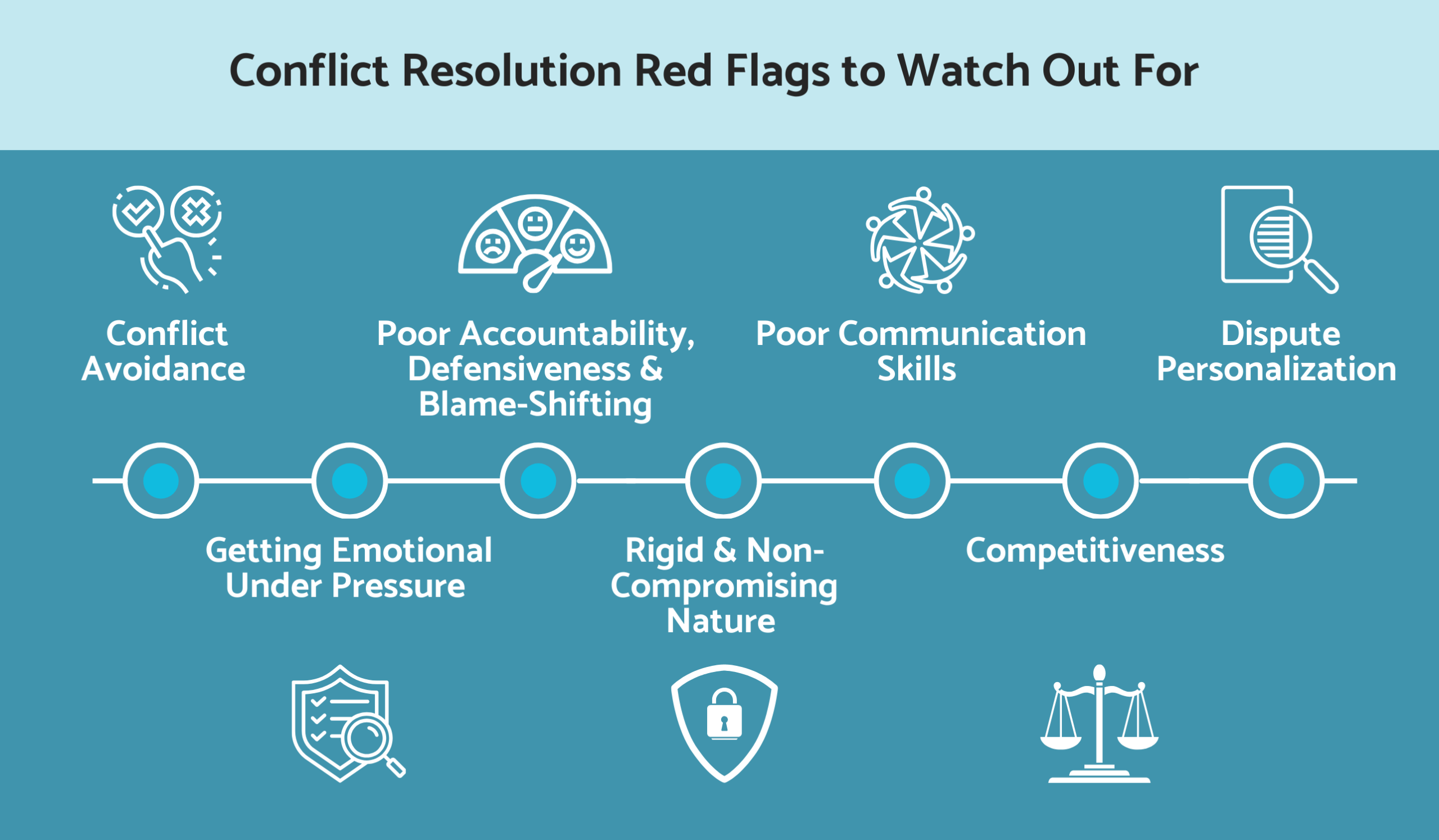
- Conflict avoidance
One of the red flags in conflict resolution is avoiding conflict. Many individuals take avoiding conflict and difficult discussions to mean maintaining peace. The existence of conflict in the workplace is inevitable. And the ability to confront it, discuss it, and reach an agreeable resolution is what determines a candidate’s proficiency at resolving disagreements.
Therefore, consider signs of avoidance in candidates’ assessments as red flags. Such signs can include postponing difficult discussions, shutting down when issues arise, or staying silent instead of communicating effectively. You can find these signs during their job simulation tasks and behavioral interviews.
- Poor accountability, defensiveness, and blame-shifting
Resolving any conflict involves communication, taking responsibility, understanding others’ perspectives, and compromising. In contrast, poor accountability, blame-shifting, and defensiveness do not help to resolve disagreements. They intensify negative emotions, creating a toxic work environment, making it a red flag.
Candidates that display an iota of blame-shifting in a workplace conflict situation show that they avoid responsibility and lack accountability. A lack of accountability can lead to rapid deterioration in your workplace culture. It can cause other employees to excuse their non-diligence on various grounds. Note that defensiveness and blame-shifting work together to show poor accountability.
- Poor communication skills
For two disagreeing parties to understand each other’s perspectives, they must communicate clearly. When an individual finds it hard to communicate their emotional expressions and triggers, it becomes impossible to resolve the conflict. Therefore, poor communication skills in candidates are red flags you must be wary of.
You can observe your candidates’ communication skills in how they frame their interview answers. When they have to answer the common “how have you resolved a conflict in the past” question, pay attention to how they structure their answers. Does their answers how the situation, their task to assuage the problem, their actions, and the result of their actions? If not, they possess poor communication skills.
- Dispute personalization
Another conflict resolution red flag is dispute personalization. Some colleagues do not get along because they have neglected their disagreements and attacked the person behind the issues. It entails making accusations against an individual, usually blaming them for the dispute, instead of addressing that issue.
Personalizing a dispute creates hostility and reduces trust in the workplace, and that makes the team’s progress significantly slow. Candidates with the potential to personalize disputes show it through their lack of accountability and blame-shifting. They usually use phrases like “You are the problem,” shifting all the blame to the other party.
- Getting emotional under pressure
A high-performance role attracts pressure. Therefore, candidates for these roles must be able to regulate their emotions. Emotions get high when deadlines are close, and teams are doing all they can to meet them. The ability to regulate high emotions at these critical times determines the success of these teams and the organization.
Hire candidates who can avoid raising voices, visible anger, irritability, sarcasm, and emotional outbursts when under pressure. You can observe their emotional control via situational judgment tests and job simulation tasks. Candidates who get emotional under pressure are red flags that can jeopardize teams’ progress.
- Rigid and non-compromising nature
Being set in your principles is an admirable quality; however, it is undesirable in conflict resolution. Before a disagreement reaches a point of resolution, at least one of the disagreeing parties must be willing to compromise to restore normalcy to the strained interpersonal relationship. A rigid, non-compromising employee makes negotiation and conflict resolution difficult, while two employees with the same nature make reconciliation impossible, creating a visibly toxic work environment.
Hire candidates with an agreeable nature to maintain a healthy work environment. Furthermore, observe their responses to work conflict situations during their assessment and deduce their reactions toward compromising and negotiating to settle a conflict.
- Competitiveness
Like other workplace personality traits, a competitive nature can help a team achieve results faster; however, it can also negatively affect interpersonal relationships, as individuals seek to outdo others and get recognized for their success. When conflicts are to be resolved between employees with a competitive nature, they are usually unwilling to budge, as the disagreement is more of a contest that they must win.
Candidates with a competitive nature focus on being right. Consequently, they shut others down and refuse to acknowledge their mistakes. This damages long-term relationships, leading to poor employee engagement, high turnover, and increased hiring costs.
Detect conflict resolution red flags with our pre-employment assessments. LEARN MORE
5. Why Companies Trust Assess Candidates’ Assessments for Hiring?
In-house conflict resolution skills assessment can be challenging, as it requires expertise, time, and money that can go to waste without the necessary experience. Many organizations avoid the challenges of conducting skill assessment tests by outsourcing to established candidate assessment organizations, while they focus their time on other beneficial activities.
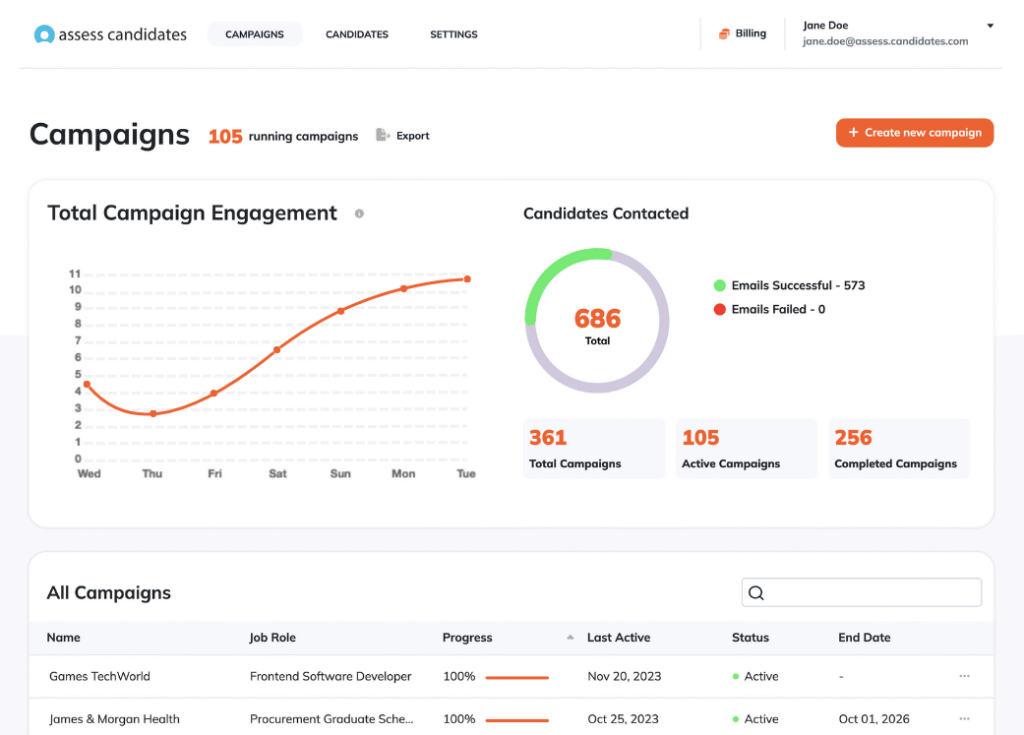
Assess Candidates is one of the topmost, reliable candidate assessment administrators that many organizations trust to test their candidates and employees for conflict resolution skills, among others. They have secured the trust of big institutions because they do the following:
1. Use scientifically validated tools
Accuracy is an essential determinant of a candidate assessment’s effectiveness. The accuracy of any appraisal ensures fairness to all candidates and influences the correctness of hiring decisions. To ensure assessment accuracy, Assess Candidates uses scientifically validated tools to help your candidate assessment exercises run more easily and faster.
From its psychometric tests to its behavioral assessments, it uses cutting-edge AI technology built on proven neuroscience methodologies to enhance immersion and deliver reliable, accurate, and predictive results that enable faster, better hiring decisions.
2. Offer objective, data-driven decisions
The best candidates are hired via data-driven decisions, as they eliminate bias and focus on candidates’ abilities to fill that role. Assessing candidates’ skills ensures that you align their competencies with your requirements for the role, and that’s where Assess Candidates have been helpful to many organizations.
With Assess Candidates’ clear results, you can objectively make your hiring choices with more confidence. Additionally, data-driven hiring decisions help your organization avoid potential fairness and equality concerns.
3. Offer industry benchmarking
Hiring the best candidates involves comparing their skills to current industry averages. However, such data is available via candidate assessment administrators like Assess Candidates. They test a vast number of candidates across different organizations and sectors. Therefore, they have accurate insight into the skills that top performers in each industry possess.
You can leverage this advantage by outsourcing your candidates’ conflict-resolution skills assessment to Assess Candidates. They will provide you with a comparison of your candidates against role-specific success profiles, leadership benchmarks, and industry competency averages.
4. Reduce costly hiring mistakes
Hiring mistakes are avoidable; however, doing so requires your organization to leverage its capital and human resources. You can avoid mistakes such as prioritizing technical prowess over soft skills or depending solely on candidates’ CVs for hiring. But you must let an experienced and competent organization handle your candidate assessments.
Assess Candidates, with their vast experience in candidate assessment, will help you avoid bias in hiring. They will ensure you balance candidates’ hard and soft skills assessments for their roles. And also advise you on the best assessments for testing candidates’ conflict resolution skills.
5. Save time and stress
Every hiring cycle comes with its stress. The common ones include scheduling pre-screening interviews, maintaining communication, ensuring positive motivation and experience, and assessing candidates’ skills. While AI can easily handle these activities, they require human supervision.
Assess Candidates takes the stress out of many organizations’ hiring by handling candidates’ skill assessments. They help these companies make the best hiring decisions and save on time-to-hire by reaching their hiring goals faster.
6. Eliminate bias and improve fairness
Bias in hiring has been a concern in recruitment for some time now. Candidates with the necessary skills are overlooked in favor of those with the educational qualifications companies consider attractive. The lack of fairness affects both candidates and companies: organizations hire subpar candidates, while the best candidates remain unemployed.
Access Candidates, through candidate skill assessment, ensures that all applicants demonstrate their competence and ensures fairness in hiring. This helps companies hire the best talent, maximizing their investment in hiring. You can do the same.
7. Enhance employer brand and candidate experience
One of the challenges of recruitment is keeping candidates motivated throughout the recruitment process. Organizations achieve this by ensuring candidates have the best hiring experience, thereby strengthening their employer brands. However, enhancing employer brand and candidate experience requires some expertise in candidate assessment.
Many organizations have improved their employer brand through Assess Candidates’ expert handling of their candidate assessments. Applicants have remained motivated throughout the recruitment process and have lauded these organizations’ hiring procedures, thereby improving their employer brand.
Explore our candidate assessment platform to easily and quickly identify top problem-solvers. LEARN MORE
Conclusion: Key Takeaways
- Conflict resolution is the process of identifying the causes of a disagreement, communicating them effectively, negotiating a solution, and reaching an agreement that suits the disagreeing parties, preserving or improving the relationship. It addresses a dispute between two parties such that the outcome is acceptable to them. The skills to achieve conflict resolution include communication, empathy, emotional regulation, problem-solving, and negotiation.
- Conflict resolution is vital in the workplace as it prevents a toxic work culture, improves team dynamics and morale, builds a culture of accountability, enhances organizational reputation, and improves customer service.
- You can measure conflict resolution skills using assessment methods such as situational judgment tests, job simulation tasks, behavior-based interviews, and personality assessments. You can also use assessment centers for multi-assessment. They score conflict resolution skills through option effectiveness, behavioral anchor rating scale, Likert scale, and multi-assessment averaging, respectively.
- Many companies outsource their candidates’ conflict resolution skills assessment to Assess Candidates because it uses scientifically validated tools, provides objective, data-driven decisions, reduces costly hiring mistakes, offers industry benchmarking, and eliminates bias and improves fairness in hiring.
- When assessing candidates for conflict resolution skills, watch out for these red flags: conflict avoidance, poor accountability, poor communication skills, rigid and non-compromising nature, and dispute personalization.
Want to know more about how to measure conflict resolution? Keep reading for frequently asked questions and sign up below with your email to get started.
Frequently Asked Questions
What questions measure conflict resolution?
Many questions measure conflict resolution but they depend on the assessment method. For behavior-based interviews, “Share a time when conflict affected your productivity. How did you handle it?” For a personality assessment, “How do you balance assertiveness with empathy during conflict?”
How do you know if an employee handles conflict well?
To determine if an employee handles conflict well, observe their calmness under pressure and their understanding of situations. Watch their focus on the issue and collaboration even when they disagree. Use job simulation tasks and situational judgment tests to test them.
What is the most effective tool in conflict resolution?
The most effective tool in conflict resolution is communication (active listening). It is impossible to resolve conflict without objectively listening to either party. Furthermore, active listening is considered the most crucial conflict resolution tool because it reduces defensiveness and clarifies misunderstandings.
What is the difference between conflict management and conflict resolution?
Conflict management reduces the negative impact of a dispute. Its goal is to manage emotions, prevent escalation, and ensure work continues smoothly. Conflict resolution ends disputes, identifies and fixes the problem, restores relationships, and ensures permanent solutions.
What is transformative conflict resolution?
Transformative conflict resolution is a method of ending recurring conflict between two individuals by ensuring they undergo personal behavioral changes. Unlike traditional conflict resolution, it achieves its aim by changing people rather than settling the issue.


 English
  Arabic