
How to Measure Adaptability and Learning Agility in Candidates During the Hiring Process



Have you ever observed how to get the true picture of a candidate’s performance once you measure their adaptability and learning agility? While candidates often claim to efficiently handle change and learn quickly in interviews, only observing how they respond to new information, shifting priorities, and unfamiliar tasks reveals their true potential.
However, adaptability and learning agility cannot solely be identified through resumes and traditional interviews, as this may lead to mis-hires. To steer clear of this mishap, use structured assessment tools like cognitive ability tests, game-based assessments, situational judgment tests, job simulation exercises, and more.
In this guide, we will explore how you can effectively assess adaptability and learning agility in candidates through structured assessment methods.
Contents
- What are adaptability and learning agility in the workplace?
- Why do we need adaptability and learning agility skills in the workplace?
- How to measure adaptability and learning agility in candidates?
- How to score adaptability and learning agility skills?
- What to avoid when measuring adaptability and learning agility in candidates?
- How to measure adaptability and learning agility: Client Success Story
- Why do top companies choose Assess Candidates’ assessments for measuring adaptability and learning agility in candidates?
Let’s first explore what adaptability and learning agility are.
1. What are adaptability and learning agility in the workplace?
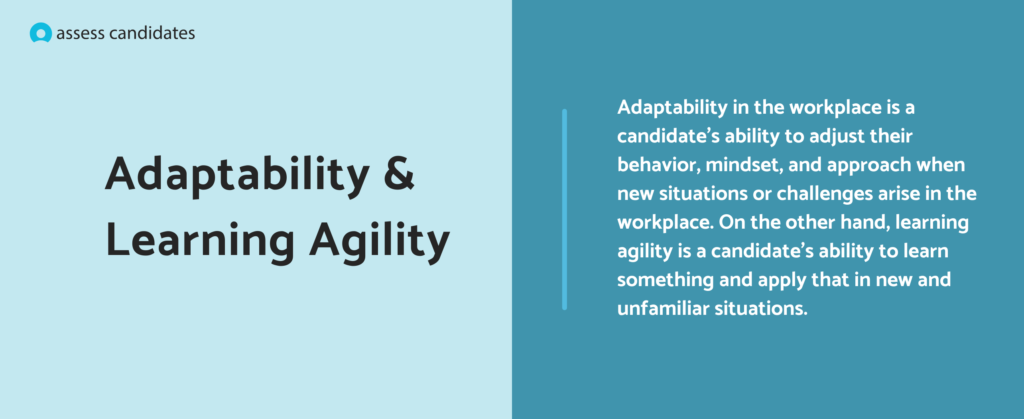
Adaptability in the workplace is a candidate’s ability to adjust their behavior, mindset, and approach when new situations or challenges arise in the workplace. On the other hand, learning agility is a candidate’s ability to learn something and apply that in new and unfamiliar situations.
Candidates with strong adaptability skills possess traits such as resilience, emotional intelligence, agility, and critical thinking. On the other hand, candidates with strong learning agility skills possess traits like mental agility, change agility, people agility, and self-awareness.
Improve your recruitment strategy with our science-backed assessments that evaluate learning agility. HIRE FOR FREE
Now, let’s take a look at why measuring adaptability and learning agility is necessary in the workplace.

2. Why do we need adaptability and learning agility in the workplace?
Adaptability and learning agility skills are necessary in a workplace since they help organizations stay effective in an ever-changing work environment.
5 major reasons why adaptability and learning agility skills matter in the workplace
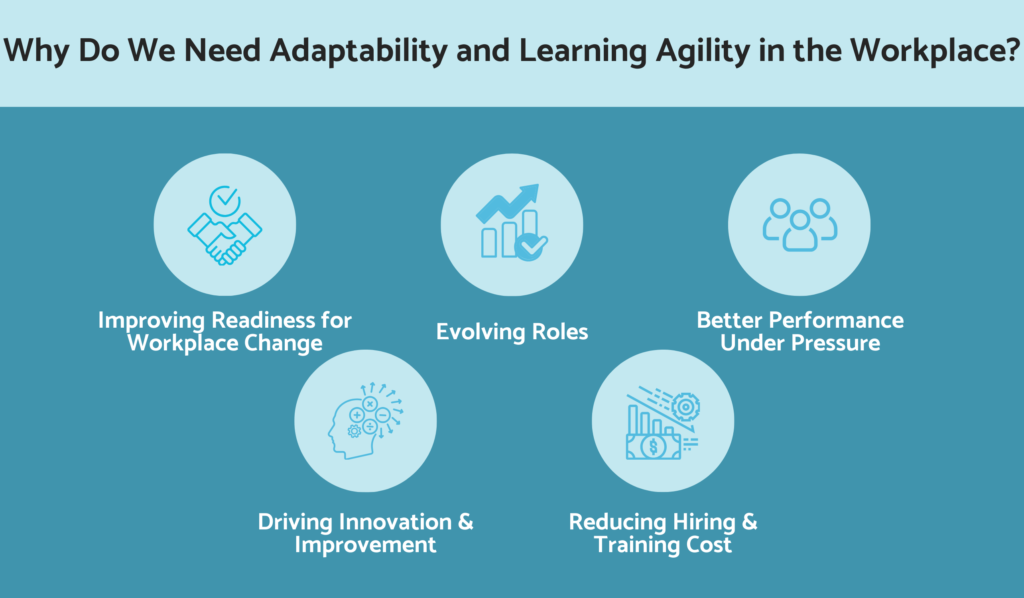
1. Improving Readiness for Workplace Change
Employees with great adaptability skills adjust quickly to constant work environment changes, including new technologies, tools, and business models. Similarly, employees with great learning agility skills acquire new skills without long ramp-up periods. This helps maintain productivity during transitions.
2. Evolving Roles
Employees with good adaptability and learning agility skills handle role changes seamlessly. They also take on new responsibilities and handle cross-functional work. This helps reduce skill gaps and limits the need for frequent hiring.
3. Better Performance Under Pressure
Employees with strong adaptability and learning agility skills perform better under pressure. Adaptable employees stay focused even when priorities shift or deadlines tighten. Employees with strong learning agility skills learn from challenges and apply those lessons immediately. This helps them maintain consistency even in uncertain times.
4. Driving Innovation & Improvement
Employees with robust adaptability skills are always open to new ideas, while employees with strong learning agility skills support experimentation and continuous growth. These skills together improve processes and help you make better decisions.
5. Reducing Hiring & Training Cost
When employees with strong adaptability and learning agility skills adapt easily and learn quickly despite changing workplace conditions and setbacks, you spend less time and money on retraining, rehiring, and reskilling them.
Uncover our scientifically validated assessments for measuring adaptability and learning agility. LEARN MORE
Next up, we will explore various methods for measuring adaptability and learning agility skills.
3. How to measure adaptability and learning agility in candidates?
Measuring adaptability and learning agility skills in candidates requires structured assessment methods that would help you understand how candidates think, learn, and respond when faced with unfamiliar situations.
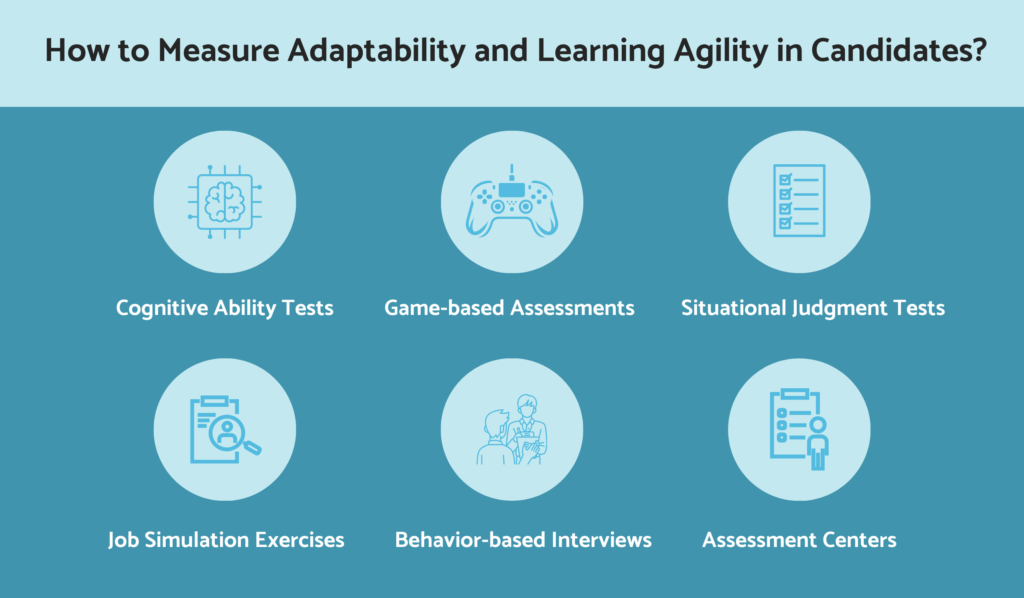
- Cognitive Ability Tests
Cognitive ability tests will help you measure how quickly candidates process information, recognize patterns, and apply logic in unfamiliar situations. These tests will further help you evaluate a candidate’s mental flexibility, learning speed, and problem-solving ability.
Example 1: “What is the percentage difference between the number of contactless transactions for Fast Money and Credit Union?”
- Game-based Assessments
Game-based assessments will help you assess how candidates adapt, learn from feedback, and adjust strategies in real-time through interactive and time-bound tasks. These tests will further reveal a candidate’s curiosity, resilience, and attitude toward changing rules without prior knowledge.
Example 2: “Recognize the emotional expressions of different people from the pictures.”
- Situational Judgment Tests
Situational judgment tests (SJTs) help you measure a candidate’s decision-making skills, emotional control, and adaptability when they face unfamiliar or changing situations.
Example 3: “You are assigned a task that requires using a new software tool you have never worked with before. The deadline is tight, and no formal training is scheduled yet. What should you do?”
- Start learning the tool immediately using available resources, ask focused questions if needed, and begin the task while adapting as you learn.
- Wait until formal training is provided to ensure you use the tool correctly before starting the task.
- Continue using a familiar tool to complete the task quickly, even if it does not fully meet the requirements.
- Escalate the issue to your manager and pause the task until clear instructions or training are provided.
- Job Simulation Exercises
Job simulation exercises replicate real job challenges and intentionally introduce uncertainty or change. These tasks will help you observe how candidates learn while working, respond to feedback, and adjust their approach without losing momentum.
Example 4: “You receive a project brief asking you to create a short proposal based on provided data and guidelines. Midway through the task, the client updates the requirements and changes the project goals:
- Revise your proposal based on the new requirements.
- Explain the changes you made and why you adjusted your approach.
- Describe how you prioritized tasks after the update.
- Behavior-based Interviews
Behavioral interviews or behavior-based interviews help you understand how candidates have handled change and learning in real-world situations. This further helps you evaluate a candidate’s reflection, learnings from past mistakes, and application of lessons across roles.
Example 5: “Tell me about a time you had to learn a new skill quickly to succeed at work.”
- Assessment Centers
Assessment centers measure adaptability and learning agility skills across various scenarios through a combination of methods, including group discussions, role-plays, simulations, and presentations. Through assessment centers, you can evaluate how candidates collaborate, learn from others, and adjust strategies over time.
Example 6: “Develop a marketing campaign for a product launch. You must deliver a 20-minute presentation covering objectives, messaging, channels, content strategy, engagement tactics, and success metrics to senior management.”
Explore how adaptability and learning agility assessments can boost your hiring accuracy. HIRE FOR FREE
Next, let’s take a look at various proven ways to score adaptability and learning agility skills.
4. How to score adaptability and learning agility skills?
Scoring adaptability and learning agility requires using clear, behavior-based criteria that evaluate how candidates react to change, learn from experience, and apply feedback.
Here are the 5 ways to score adaptability and learning agility skills effectively:
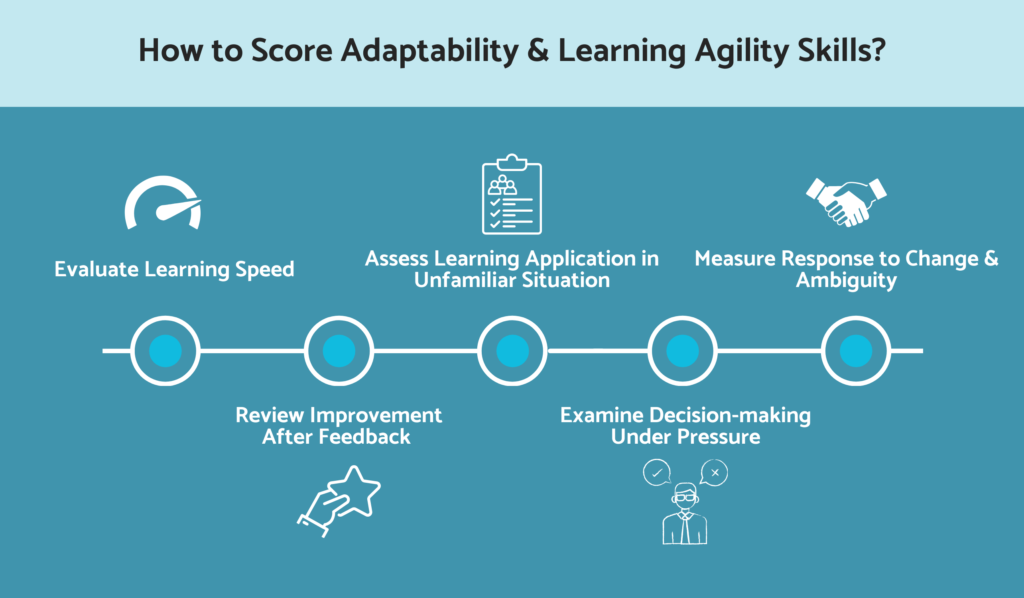
1. Evaluate Learning Speed
Based on our experience designing assessments that focus on adaptability and learning agility, we have observed that how quickly candidates learn new information strongly predicts job performance. Hence, begin by understanding how fast candidates understand new or unfamiliar tools, processes, and rules, and how efficiently they respond to changes.
2. Assess Learning Application in Unfamiliar Situations
After candidates grasp new information, measure how fast they apply it. You should focus on observing whether they adapt and adjust to changes when requirements shift to improve outcomes or if they stick to the outdated methods.
3. Measure Response to Change & Ambiguity
Observe how candidates react when they face unexpected changes. This will help you identify candidates with strong adaptability and learning agility skills, as adaptable candidates will stay composed, reprioritize effectively, and modify strategies without sacrificing quality or progress.
4. Review Improvement After Feedback
A candidate’s learning agility skills become more evident after feedback or setbacks. Evaluate whether candidates accept feedback openly, reflect on mistakes, and modify strategies without losing momentum or quality.
5. Examine Decision-making Under Pressure
Examine how candidates make decisions when timelines tighten or priorities shift. Candidates with strong adaptability skills balance speed, accuracy, and judgment, especially when operating under pressure.
Leverage our candidate assessment platform to identify candidates with strong adaptability. LEARN MORE
However, when assessing a candidate’s adaptability and learning agility, it’s important to avoid these following areas.
5. What to avoid when measuring adaptability and learning agility in candidates?
While measuring adaptability and learning agility skills, it is necessary for you to avoid candidates who are uncomfortable with fast-paced or changing environments. Therefore, given below are some of the most common pitfalls you should steer clear of.
5 red flags to avoid while measuring adaptability and learning agility skills in candidates:
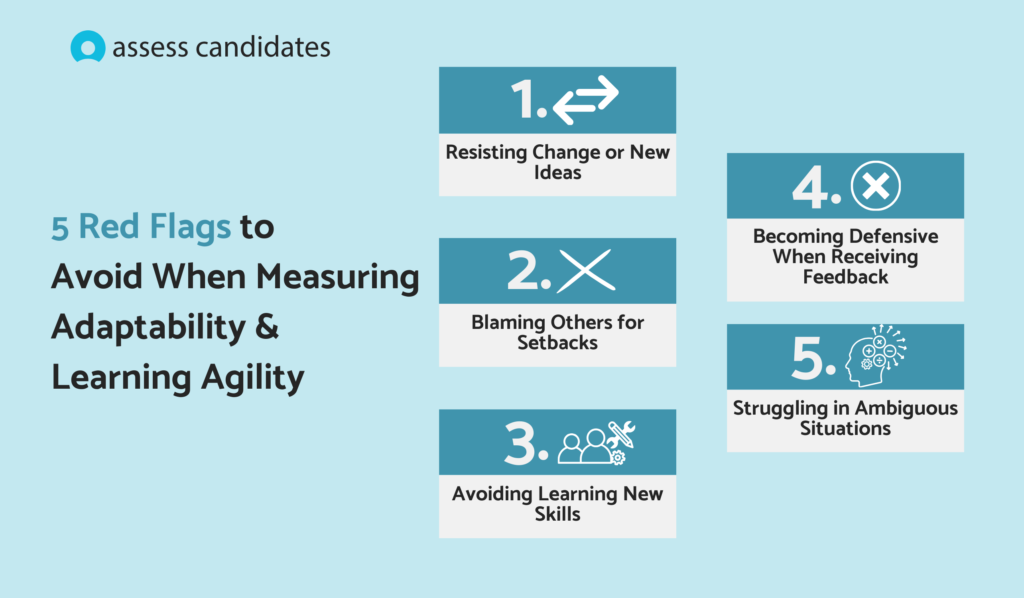
- Resisting Change or New Ideas: Candidates who resist learning new tools, processes, or ways of working often struggle to adapt. This is a red flag as it showcases rigidity rather than openness to learning new things.
- Blaming Others for Setbacks: Candidates who consistently blame their managers, teams, or systems for setbacks show signs of low self-esteem. Hence, steering clear of such candidates during the hiring process is necessary.
- Avoiding Learning New Skills: Avoid hiring candidates who still believe in past experiences and use outdated methods, while refusing to learn new skills. They generally struggle in evolving roles.
- Becoming Defensive When Receiving Feedback: Candidates who become defensive when receiving constructive criticism or feedback show signs of difficulty learning from experience. This is a red flag that must be avoided during the hiring process.
- Struggling in Ambiguous Situations: Avoid candidates who need constant directions or clear instructions. This is a red flag, as such candidates might often find uncertainty or changes uncomfortable.
Optimize your hiring strategy with adaptability and learning agility assessments. HIRE FOR FREE
6. How to measure adaptability and learning agility: Client Success Story
Client Problem Statement
Imagine a fast-scaling technology company struggling to hire professionals who can adapt quickly to changing tools, shifting priorities, and evolving team structures. These candidates, when onboarded, may take longer to learn new systems, resist change, and need constant guidance.
As a result, their productivity drops, teams slow down, and managers work overtime on retraining. The organization now needs a reliable way to measure candidates’ adaptability, learning speed, and ability to perform effectively in unfamiliar situations.
Assess Candidates’ Proposal
At Assess Candidates, we recommend measuring adaptability and learning agility early in the hiring process using cognitive ability tests, game-based assessments, and situational judgment tests. These tools evaluate how quickly candidates learn new information, adjust to changing workplace conditions, and respond to uncertainty.
When paired with job simulation tasks and structured behavior-based interviews, they provide deeper insight into how candidates learn from feedback, apply new skills, and adapt their approach under pressure.
Result
By implementing assessments that focus on adaptability and learning agility, the company can confidently identify candidates who learn fast, adjust quickly, and stay effective in dynamic environments. This leads to shorter onboarding time, improved performance, and reduced dependency on constant training.
Ultimately, the organization builds a future-ready workforce that can grow with changing business needs, reduce hiring risk, and maintain high performance as the company scales.
Partner with Assess Candidates to integrate psychometric tests that focus on adaptability and learning agility. VIEW PLANS
7. Why do top companies choose Assess Candidates’ assessments for measuring adaptability and learning agility?
At Assess Candidates, we offer a wide range of pre-employment assessments that focus on adaptability and learning agility and create recruitment campaigns customized to each organization’s unique hiring needs, all in one easy-to-use platform.
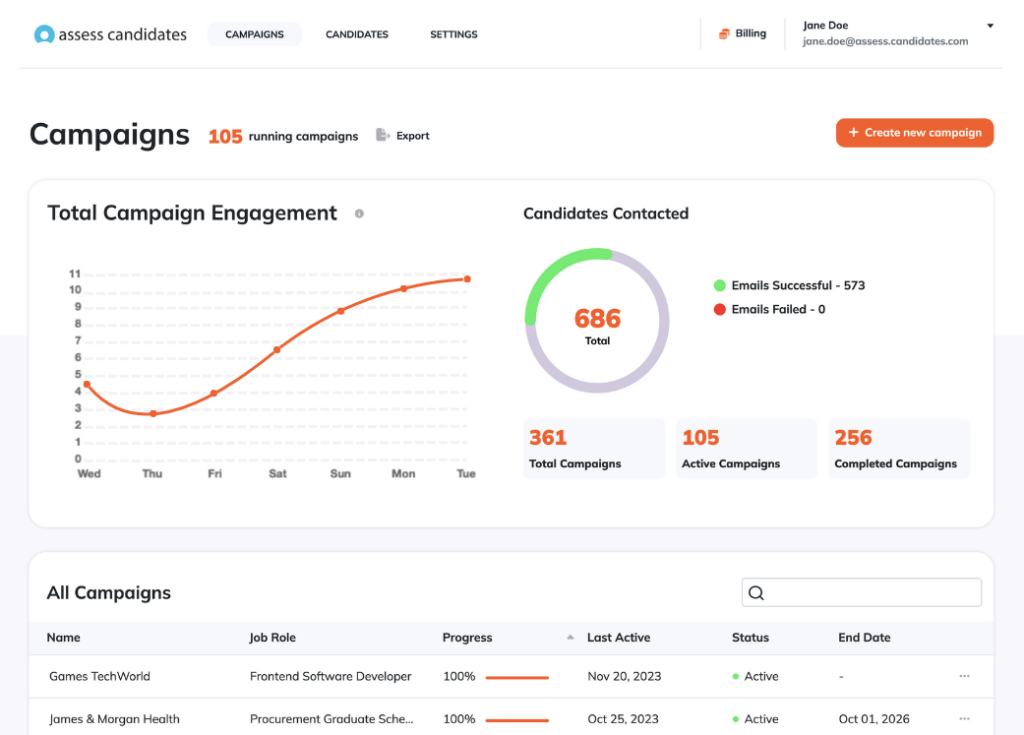
Here are 4 reasons why you should use Assess Candidates for measuring adaptability and learning agility skills in candidates:
- Scientifically Designed by Expert Psychologists: Assess Candidates’ adaptability and learning agility assessments are developed by experienced Psychologists and Psychometricians who have previously designed assessments for global leaders such as SHL and IBM Kenexa.
Each assessment undergoes rigorous validation to ensure it accurately measures learning speed, cognitive flexibility, response to change, and ability to apply new information in unfamiliar situations. This scientific approach gives you confidence that you are hiring candidates who learn quickly, adapt effectively, and perform well in evolving roles.
- Advanced Reporting: Our intuitive platform delivers clear, comprehensive reports that highlight each candidate’s learning rate, adaptability score, response to feedback, decision-making under change, and performance improvement over time.
You can easily compare candidates, identify high-potential talent, and shortlist applicants using objective, data-driven insights. With seamless ATS integration, your scoring and hiring decisions become faster, more consistent, and fully automated.
- Positive Candidate Experience: We design our adaptability and learning agility assessments to be engaging, intuitive, and accessible across all devices. Candidates receive clear instructions and experience smooth task progression, allowing them to focus on learning, adjusting strategies, and responding to change rather than navigating complex interfaces. Organizations can also apply custom branding to maintain a consistent employer experience throughout the assessment journey.
- Candidate Accessibility Support: We prioritize inclusivity by ensuring candidates can demonstrate adaptability and learning agility fairly through robust accessibility features. These include extended time options, screen-reader compatibility, adjustable color contrast, and Zoom functionality. All assessments comply with WCAG accessibility standards, ensuring an equitable and inclusive evaluation experience for every applicant.
Assess Candidates offers reliable, science-backed tools that help organisations measure attention to detail skills accurately and hire smarter, faster, and more fairly. Explore our complete range of assessments to start identifying candidates with strong error-spotting skills today.
Not sure which problem-solving assessments to choose? Contact us for a free analysis of your hiring needs.
Conclusion: Key Takeaway
- Adaptability reflects how well candidates adjust to change, while learning agility shows how quickly they learn and apply new skills.
- Employees with strong adaptability and learning agility help organizations stay productive in changing environments.
- Adaptability and learning agility enable employees to handle evolving roles, cross-functional work, and new responsibilities with ease.
- Adaptable and learning-agile employees perform consistently well under pressure and uncertainty.
- Measuring these skills supports innovation, continuous improvement, and better decision-making.
- Structured assessments provide the most reliable way to measure adaptability and learning agility.
Interested in learning more about effective candidate assessment? Continue reading for frequently asked questions, and sign up with your email to get started.
Frequently Asked Questions
How to objectively measure adaptability during hiring?
One of the most reliable ways to objectively measure adaptability and learning agility is by using structured assessments that simulate change. These assessments include a combination of cognitive ability tests, game-based assessments, situational judgment tests, job simulation exercises, and behavior-based interviews.
Can interviews alone accurately measure adaptability and learning agility?
No. Interviews alone cannot measure adaptability and learning agility. This is because, during interviews, candidates mostly talk about what they would do rather than demonstrating it. You can pair structured behavioral interviews with job simulation exercises or situational judgment tests to observe how candidates actually learn, adapt, and perform under pressure.
How to distinguish adaptability from compliance?
You can distinguish adaptability from compliance by observing how a candidate behaves when rules change. Candidates with strong adaptability adjust strategies independently, while compliant candidates wait for direction.
When to assess adaptability and learning agility in the hiring process?
You should assess adaptability and learning agility early in the hiring process. This is because pre-employment assessments identify high-potential candidates before interviews and reduce reliance on resumes. This will further help you select candidates who learn quickly and adapt to changing workplace demands.
How can you reduce bias when measuring adaptability and learning agility?
You can reduce bias when assessing adaptability and learning agility in candidates by using standardized assessments, consistent scoring criteria, and multiple evaluation methods. This further ensures that decisions rely on observable learning behavior of candidates rather than solely on confidence, communication style, or background.


 English
  Arabic