
How to Reduce Bias in the Interview Process and Make Your Hiring Process Fairer



As a recruiter, you know interviews are one of the most important stages in hiring but also one of the easiest places for bias to slip in.
You’ve probably experienced situations where even well-intentioned interviewers judge candidates based on “gut feeling”, first impressions, or personal preferences rather than real evidence without realizing.
A fair and consistent interview process is central to building diverse, high-performing teams. Interview bias isn’t usually intentional. Instead, it shows up subtly, through assumptions, unstructured conversations, or over-focusing on similarities. This can make hiring decisions less reliable, reduce diversity, and overlook highly qualified talent before they ever get a fair chance.
With the increasing shift toward skills-based hiring and data-driven decision-making, understanding what interview bias is and how to reduce it has become essential. This article provides a clear, practical breakdown of why it occurs and the main forms it takes. You will also learn how to interview candidates fairly, how structured interviews create consistency, and what combination of modern tools and scoring methods support more objective hiring.
According to research by Harvard Business Review (2016), structured, standardized interviews significantly improve fairness and predictive accuracy compared to unstructured, conversational formats.
By the end of this guide, you’ll have a practical understanding of how to build a more objective, defensible, and consistent interview process.
Contents
- What Is Interview Bias?
- Why Does Interview Bias Occur?
- What are the Main Types of Interview Bias?
- How to Interview and Assess Candidates Fairly
- Practical Strategies to Reduce Interview Bias
- Why Choose Assess Candidates for Bias-Free Interviews?
1. What Is Interview Bias?
Interview bias is when an interviewer’s judgment is influenced by subjective factors like personal opinions, assumptions, or irrelevant details, rather than evaluating candidates based on their actual skills and job-related abilities.
This bias may occur consciously, but in most cases, it is unconscious. Despite good intentions, even experienced hiring managers can fall into biased patterns without realizing if the interview process isn’t structured, standardized, and backed by data.
As a result, organizations end up making hiring decisions based on “gut feeling”, familiarity or subtle preferences instead of measurable indicators of performance. This leads to inconsistencies, poorer predictive accuracy, and reduced workplace diversity.
Reduce bias in your interview process with structured video interviews designed for fair hiring. HIRE FOR FREE
How Biased and Structured Interviews Differ
Here’s a breakdown of how traditional interviewing differs from more structured, objective interviews:
Even though these biases are subtle, they have powerful effects on how interviewers interpret behaviour, answer quality, and perceived cultural fit.
Why Interview Bias Is a Problem
Interview bias damages the hiring process in several ways because it:
- Reduces predictive accuracy, meaning the organization struggles to identify candidates who will perform well in the role.
- Creates inconsistent hiring outcomes across different roles and teams.
- Disadvantages qualified candidates who do not match the interviewer’s personal expectations.
- Weakens diversity, inclusion, and overall team performance.
- Increases turnover when hires don’t align with job demands.
A landmark study published in the Journal of Applied Psychology found that unstructured interviews, where bias is most prevalent, have extremely low predictive validity, sometimes as low as 0.20, making them one of the weakest and least reliable methods for forecasting job performance.
This is why leading companies are replacing intuition-driven interviews with structured, skills-based, and evidence-rich interview frameworks.
A Real-World Example of Interview Bias
Imagine 2 candidates applying for a business analyst role:
- Candidate A attended the same university as the interviewer and has a similar communication style.
- Candidate B speaks more slowly and has an unfamiliar accent but demonstrates stronger analytical skills and more relevant experience.
Without structure, the interviewer may unconsciously favour Candidate A, even though Candidate B is objectively a better fit. This is how bias silently influences hiring outcomes.
Research shows that as many as 96% of recruiters believe unconscious bias is a problem in recruitment, making it a critical issue to address.
Understanding what interview bias is is a start, but to reduce it effectively, you also need to understand why it happens in the first place. Bias doesn’t appear randomly; it follows patterns rooted in psychology, perception, and the way traditional interviews are structured. In the next section, we explore the key reasons why interview bias occurs.

2. Why Does Interview Bias Occur?
Interview bias emerges from a mix of cognitive, social, and organizational factors – how humans think, the social pressures interviewers face, and how organizations hire. Understanding these root causes is essential for designing a fair and consistent recruitment processes.
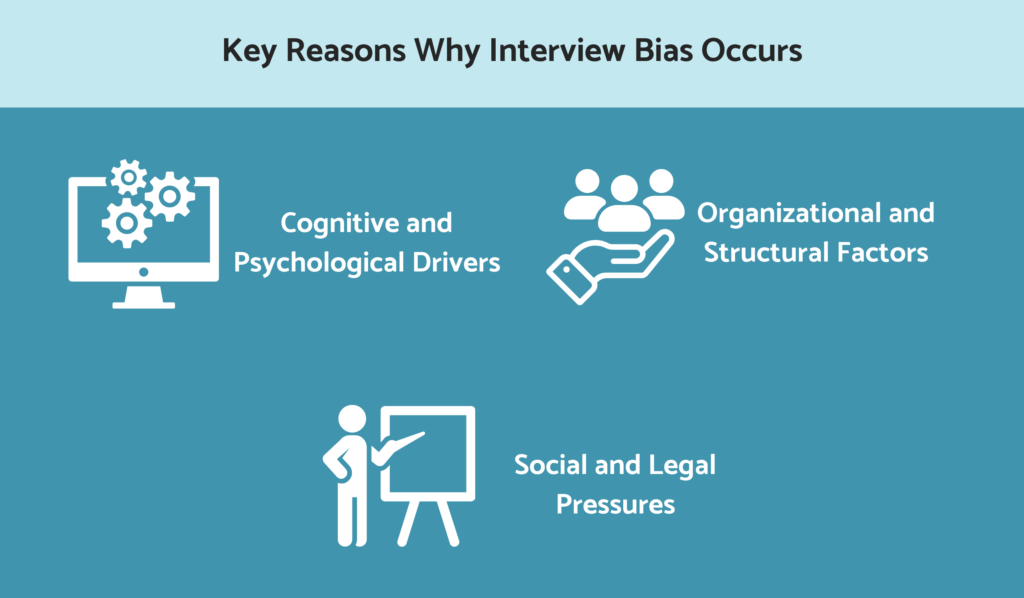
1. Cognitive and Psychological Drivers
Human psychology plays a major role in how interviewers assess candidates. Even trained professionals can be influenced by instinct, emotion, or mental shortcuts.
- Unconscious (Implicit) Bias
Unconscious biases are automatic mental shortcuts shaped by experience, culture, and social norms. Affinity bias may lead interviewers to favor candidates who feel familiar – those who look, speak, or behave like them with shared backgrounds or interests – even if these traits are irrelevant to job performance.
- First impressions
Candidates are often judged within the first 5-10 seconds of walking into the room. Everything from appearance to voice tone can subconsciously influence the interviewer and the entire evalutation.
“First impressions formed within seconds tend to steer the rest of the evaluation, even when irrelevant.” CIPD (2015)
- Stereotyping
Stereotyping occurs when interviewers make generalized assumptions – positive or negative – about a candidate based on characteristics like age, gender, race, or education. These distort candidate assesment and overshadow real skills.
For example, an interviewer might unconsciously assume that older candidates are less tech-savvy or that certain ethnic groups have particular personality traits.
- Similarity Bias / “Like Me” Bias
Similarity bias (also called in-group bias) refers to the tendency to favor people who resemble oneself, whether in background, education, or style, as they “seem like a good fit”.
Studies show that when interviews lack structure, similarity bias is stronger and can skew hiring decisions.
“Gender-based expectations often drive unconscious judgments in hiring.” HBR (2019)
2. Organizational and Structural Factors
Bias isn’t only about individuals, it is also shaped by the hiring process and workplace culture.
- Lack of Standardization
When interviews are unstructured, interviewers ask different questions for different candidates and use different criteria to score. Without a predefined rubric, decisions are more likely to be based on subjective impressions.
- According to SHRM, standardized interviewing processes (with defined competencies, consistent questions, and structured evaluation criteria) can significantly reduce bias.
- Without this structure, interview panels may rely too heavily on “gut feeling” or personal chemistry, which can skew outcomes.
- Cultural and Organizational Norms
An organization’s existing culture influences hiring bias. If a company lacks diversity and inclusion, interviewers may inadvertently prefer candidates who fit the dominant group’s profile.
- This perpetuates a cycle: hiring similar candidates reinforces the existing culture, making it harder to introduce diverse perspectives.
- Moreover, interviewers may feel pressure to conform to organizational stereotypes about what a “good fit” looks like.
- Interviewer Effect / Interviewer Variance
Individual differences among interviewers, such as personality, communication style, or even mood, can influence candidate evaluations.
- For example, a more charismatic or confident interviewer may unconsciously favor certain traits in a candidate, skewing the assessment.
- Variations in how different interviewers weigh candidate responses (or how they interpret answers) introduce inconsistency and potential bias.
According to SHRM (2022), “Unstructured interviews consistently show higher levels of inconsistent and biased judgments.”
3. Social and Legal Pressures
Interviewers are influenced by social expectations and the environment in which decisions are made.
- Social Expectations and Conformity
Interviewers may be influenced by social norms or peer pressure, especially in panel interviews. Conformity bias can occur when interviewers align their opinions with dominant voices in the room, even if they personally disagree.
This can lead to consensus-driven hiring, where dissenting views are suppressed and critical evaluation of candidates is weakened.
- Legal and Ethical Anxiety
Interviewers may avoid probing certain topics (unintentionally) because of fear of discriminatory behavior or legal repercussions. This defensive posture can result in a safe, surface-level evaluation rather than a thorough assessment of competencies.
- The risk of discriminatory hiring is real: unchecked biases may violate equal employment opportunity regulations.
- As a result, interviewers might default to non-challenging questions that don’t truly test a candidate’s potential, which undermines objectivity.
“Research shows that when interviewers face time pressure or high decision volume, reliance on intuitive judgments increases.” McKinsey (2020)
Want to eliminate interviewer bias? Learn how our assessment platform ensures structured, fair interviews. LEARN MORE
Now that you understand the underlying causes of interview bias, the next step is to examine the specific forms these biases take during interviews. Each one affects decision-making differently, and recognizing them early is critical. In the next section, we break down the most common types of interview bias and how they influence hiring outcomes.
3. What are the Main Types of Interview Bias?
Interview bias appears in multiple subtle ways that influence how interviewers interpret behavior, evaluate fit, and make hiring decisions. Understanding the types of bias is essential if organizations want to build fair, objective, and evidence-based hiring processes.
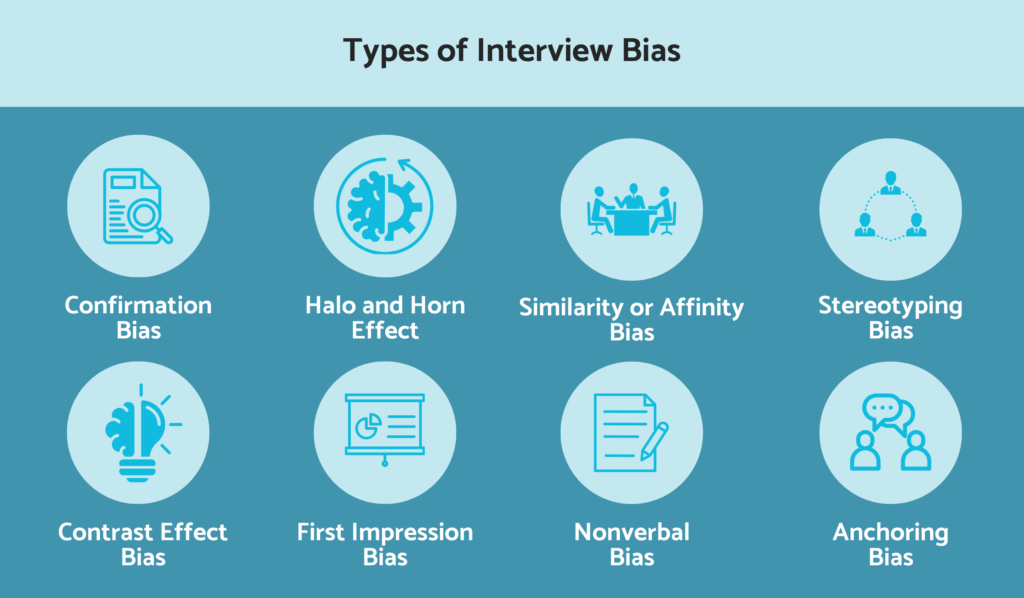
Each bias below affects recruiter’s judgment differently, but they all overall reduce hiring accuracy, weaken diversity, and undermine the reliability of interviews.
- Confirmation Bias
Confirmation bias happens when interviewers form an early opinion, often in the first few seconds, and spend the rest of the interview looking for evidence that supports their initial judgment.
How Does Confirmation Bias Affect Hiring?
- Interviewers ask easier questions to candidates they already “like”.
- Weak candidates may appear stronger simply because they confirm an early assumption.
- Red flags are overlooked if the interviewer already believes the candidate is competent.
Did you know? Research shows hiring managers frequently give disproportionate weight to information that supports their first impression. CIPD (2015)
- Halo and Horn Effect
The halo effect occurs when one positive trait (e.g., confidence or communication) influences the entire evaluation. The horn effect is the opposite; one negative trait overshadows everything else.
How Does the Halo and Horn Effect Lead to Poor Hiring Outcomes?
- A well-spoken candidate may be rated highly even if their technical skills are weak.
- A nervous candidate may be undervalued even if highly competent.
- These biases lead to inconsistent and inaccurate scoring.
- Similarity (Affinity) Bias
Affinity bias makes interviewers prefer candidates who share similar backgrounds, language, schools, personality traits, or interests.
How Does Similarity Bias Show Up in Hiring?
- Saying “I just have a good feeling about them” because they remind you of yourself.
- Preferring candidates with similar communication styles.
- Hiring based on comfort, not competence.
Did you know? McKinsey (2020). Affinity bias is one of the strongest drivers of discriminatory outcomes in interviews.
- Stereotyping Bias
This occurs when interviewers rely on assumptions, social categories, or group generalizations to form judgments about a candidate’s skills or behavior.
Examples of Stereotyping Bias
- Assuming younger candidates lack leadership ability.
- Assuming older candidates can’t adapt to technology.
- Judging competence based on accent, gender, or physical appearance.
Harvard Business Review (2019) states that stereotypes continue to influence hiring decisions, even when hiring managers believe they are being objective.
- Contrast Effect Bias
Contrast bias occurs when interviewers evaluate a candidate relative to the previous candidate, not based on objective criteria.
Why Contrast Effect Is a Problem
- A strong candidate may look average if interviewed after a superstar.
- A mediocre candidate may appear stronger when following a weak performer.
- It disrupts consistent scoring and fairness.
- First Impression Bias
This involves placing too much importance on the first 5–10 seconds of interaction.
What Behaviors Can Trigger First Impression Bias?
- Handshake style
- Eye contact
- Clothing or grooming
- Initial greeting confidence
Interviews can become emotionally driven rather than competency-based.
Studies show that first impressions formed within seconds significantly alter later judgements.
- Nonverbal Bias
Here, interviewers rely excessively on body language, tone, or appearance, even when these cues have a weak correlation with job performance.
Examples of Nonverbal Bias
- Assuming confidence equals competence.
- Assuming introversion equals a lack of leadership.
- Judging a candidate based on facial expressions, posture, or voice tone.
- Anchoring Bias
Anchoring bias happens when interviewers rely too heavily on the first piece of information they see, such as CV design, GPA, or company names.
How Does Anchoring Bias Lead to Poor Hiring Outcomes?
- A candidate from a prestigious company may be overrated.
- A candidate with a gap year may be underrated.
- Small, unrelated details anchor the entire decision.
Build a bias-free hiring process powered by science-driven assessments. VIEW PLANS
Now that you’ve seen how different forms of interview bias affect decisions, the next question is simple: how do you ensure fairness when assessing and interviewing candidates?
Understanding the problem is important, but applying structured, evidence-based methods is what truly transforms your hiring process. In the next section, we break down practical, science-backed ways to evaluate candidates objectively and consistently.
4. How to Interview and Assess Candidates Fairly
Creating a fair and objective assessment and interview process is critical for reducing interview bias and improving hiring accuracy. Fair assessment means evaluating candidates based on evidence, job-related behaviors, and standardized criteria, rather than subjective impressions.
Below is a full breakdown of what a fair assessment looks like, how to evaluate consistently, and the tools that make it possible.
What Does a Fair Interview Look Like?
A fair interview and assessment process is structured, predictable, and tied directly to the requirements of the role.
Key characteristics include:
- Clear, measurable criteria linked to job competencies
- The same questions asked to all candidates
- Consistent evaluation tools and scoring guides
- Decisions based on evidence, not intuition
According to the Chartered Institute of Personnel and Development (CIPD), structured and competency-based interviews significantly improve fairness and reduce bias in candidate evaluation (cipd.org).
Practical Steps to Ensure A Fair Interview Process
- Ensure Evidence-Based Evaluation
Evidence-based interviewing and hiring means your decision is backed by observable behaviours and data, not assumptions.
Examples of strong evidence that can inform your hiring decision include:
- Real examples of past performance
- Work samples or task simulations
- Quantifiable achievements relevant to the role
Examples of weak evidence that show some level of bias include:
- “I have a good feeling about this candidate.”
- “They seem confident.”
- “They remind me of someone who performed well.”
Why this matters: Evidence-based evaluation reduces the influence of affinity bias, the halo effect, and other subjective distortions.
Research from Harvard Business Review shows that evidence-driven evaluation increases hiring accuracy and reduces early turnover (hbr.org).
- Focus on Behavioral and Competency Indicators
Using behavioral questions and competency frameworks creates objective evaluations.
Examples:
- Behavioral Question: “Tell me about a time you managed a challenging stakeholder.”
- Competency Indicator: Ability to influence, communicate clearly, and stay calm under pressure
Benefits:
- Promotes consistency
- Focuses on real-world performance
- Reduces halo, horn, and stereotype biases
Studies from the Society for Human Resource Management (SHRM) show that competency-based assessments are among the most reliable predictors of job performance (shrm.org).
- Avoid Over-Reliance on Intuition
Intuition may feel advantageous, but it is not predictive of job performance. Problems with intuition include:
- Highly inconsistent
- Influenced by stereotypes and personal preferences
- Leads to decisions that can’t be justified
Fair hiring requires relying on data, structured methods, and documented evidence, not gut feelings.
Use Assess Candidates’ structured video interview tool for bias-free hiring decisions. LEARN MORE
Now that you understand how to assess and interview candidates fairly, the next step is turning these principles into practical, everyday hiring strategies. Fair assessments alone aren’t enough; your interview process must be intentionally structured to minimize bias at every stage.
In the next section, we break down actionable, research-backed techniques you can apply immediately to create a more consistent, objective, and bias-resistant interview process.
5. Practical Strategies to Reduce Interview Bias
Reducing interview bias requires more than awareness; it demands structured, repeatable systems that intentionally remove subjectivity from hiring. This section breaks down practical, science-backed strategies organizations can use to make their interviews more fair, consistent, and predictive of real job performance.
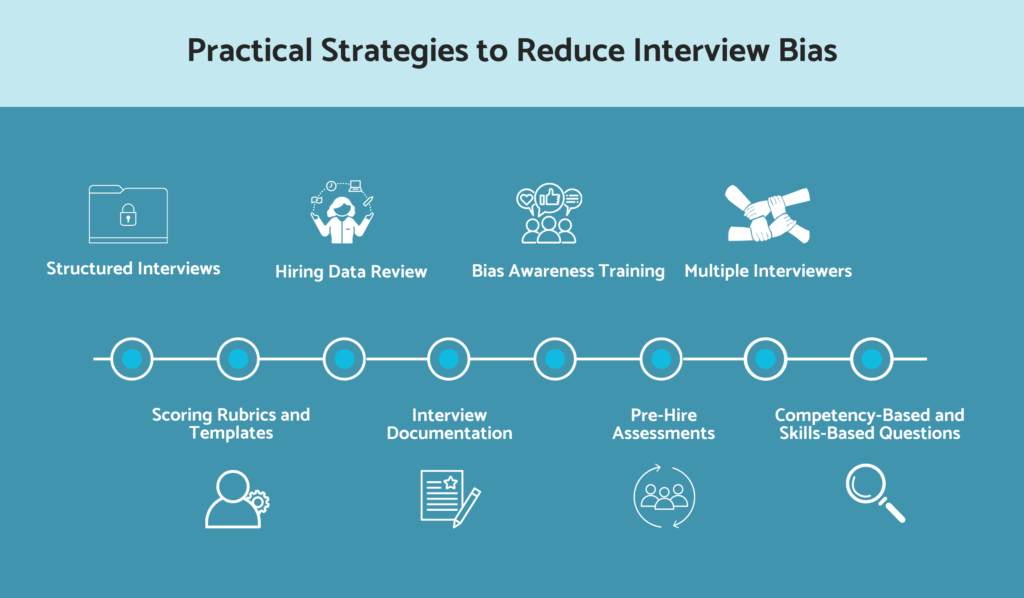
1. Structured Interviews
Structured interviews are one of the most effective ways to combat interview bias. Every candidate receives:
- The same questions
- In the same order
- Evaluated using standardized scoring rubrics
Why it works: Structure prevents interviewers from drifting into intuition-led assessments or unequal questioning.
According to the Society for Industrial and Organizational Psychology (SIOP), structured interviews are nearly twice as predictive of job success compared to unstructured methods.
2. Competency-Based and Skills-Based Questions
Traditional interviews often focus on CV reviews or “tell me about yourself” prompts, both of which are highly vulnerable to bias. Competency-based questions shift the focus to behavior, problem-solving, and skills that matter.
Examples of Competency-Based and Skills-Based Questions:
- “Tell me about a time you resolved a conflict within your team.”
- “Walk me through a project where you had to learn a new skill quickly.”
- “How would you troubleshoot a data integrity issue under pressure?”
Benefits of Competency-Based and Skills-Based Questions:
- Keeps interviews role-relevant
- Forces evidence-based answers
- Provides comparable performance insights across all candidates
Research from Harvard Business Review shows that competency-based interviews significantly reduce inconsistency and increase hiring accuracy.
3. Bias Awareness Training
Interviewers often underestimate how deeply implicit bias influences decision-making.
Bias awareness training helps teams to:
- Recognize cognitive shortcuts
- Identify when personal preferences influence evaluation
- Separate facts from feelings
- Use structured methods consistently
Training is especially critical for hiring managers involved in high-stakes or high-volume recruitment.
The World Economic Forum reports that companies implementing bias-reduction programs experience measurable improvements in hiring fairness and diversity outcomes.
4. Multiple Interviewers
Using more than one interviewer dilutes individual bias and increases decision accuracy.
Advantages of using multiple interviewers:
- Diverse viewpoints balance one-sided judgments
- Reduces personal bias from dominating outcomes
- Strengthens decision confidence
- Makes scoring more reliable
Best practice: Combine HR, technical, and functional perspectives for a well-rounded evaluation.
5. Scoring Rubrics and Templates
A standardized scoring rubric is a non-negotiable tool for bias-free interviews. A good scoring rubric includes:
- Defined competencies
- Behavioral indicators at each level
- A numerical scoring system (e.g., 1–5)
- Evidence notes
Here’s a sample scoring rubric you can adopt:
Sample Interview Scoring Rubric
| Score | Description | Behavioral Evidence Example |
| 1 – Poor | Unclear or irrelevant example | Provides no demonstration of skill |
| 3 – Good | Clear example with moderate impact | Demonstrates skill with measurable output |
| 5 – Exceptional | Strong, complex example with high impact | Shows advanced skill and above-average results |
This eliminates guesswork and ensures interviewers justify every score with objective evidence.
6. Interview Documentation
Documenting interviews reduces the risk of:
- Memory-based decisions
- Recency bias
- Emotional influence
- Lost or incomplete information
Best practices for effective interview documentation:
- Write evidence-based notes during the interview
- Capture exact examples shared by the candidate
- Avoid summarizing based on impressions
- Store documentation securely for compliance
Documentation also supports fair audit trails and compliance with employment regulations.
7. Pre-Hire Assessments
Pre-hire assessments help validate whether a candidate truly possesses the skills demonstrated during interviews. Examples include:
- Cognitive ability test
- Job simulations
- Personality assessments
- Work samples
- Situational judgment tests (SJTs)
These tools provide data-driven proof of ability, not just spoken claims.
Why it works: Assessments decrease the influence of interviewer intuition and increase accuracy in evaluating actual job performance.
According to the American Psychological Association, validated ability tests are among the strongest predictors of future job success.
8. Hiring Data Review
Organizations committed to bias-free hiring must regularly analyze interview and selection data. Key areas to include for your regular hiring data review are:
- Pass/fail rates across demographics
- Interviewer scoring patterns
- Rubric consistency
- Average performance by stage
- Drop-off points in the funnel
If one interviewer consistently scores lower than others, or a demographic experiences unusual drop-off rates, this may indicate hidden bias.
Data review ensures your process remains fair, compliant, and equitable over time.
Build a more consistent and bias-free hiring process with Assess Candidates’ structured evaluation tools. HIRE FOR FREE
Now that you’ve explored the most effective, research-backed strategies for reducing interview bias, the final step is understanding how to put these practices into action seamlessly. This is where the right tools, technology, and expert support make all the difference. In the next section, you’ll see how Assess Candidates helps organizations run bias-free, data-driven, and consistent interviews at scale.
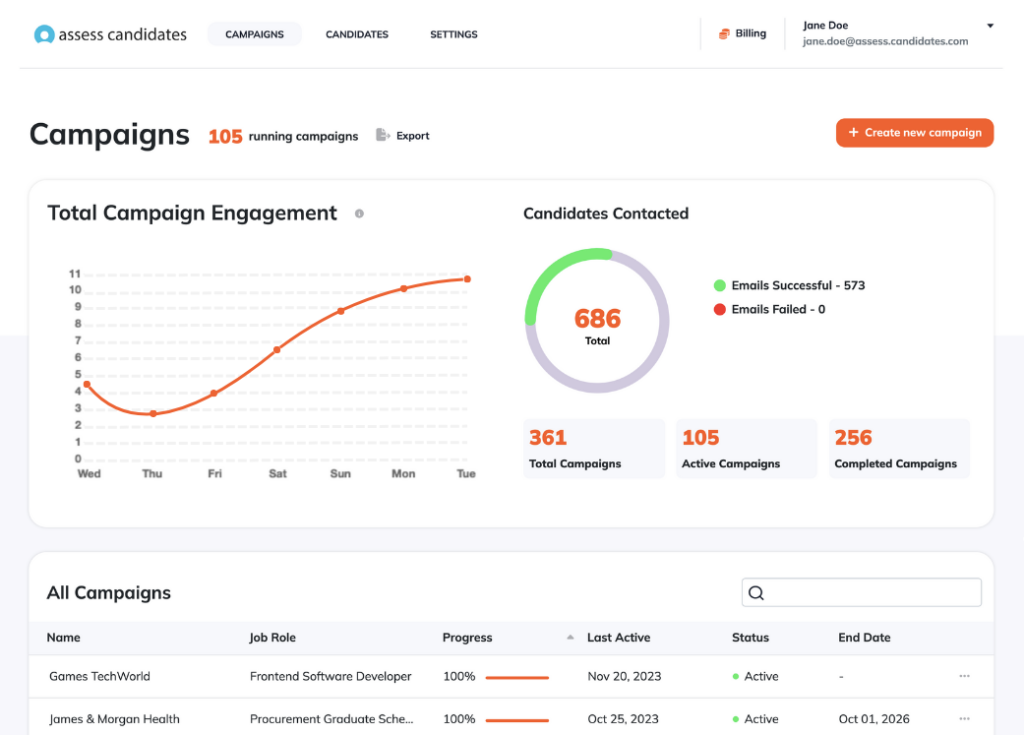
6. Why Choose Assess Candidates for Bias-Free Interviews?
Choosing the right assessment tool is a strategic decision. Assess Candidates is designed to help organizations eliminate guesswork, reduce unconscious bias, and make hiring decisions rooted in evidence, not opinion. This section explains why the platform stands out and how it supports fair, consistent, and defensible hiring.
A Science-Backed Approach to Fair Hiring
- Built on Proven Recruitment Research
Assess Candidates uses the principles of structured interviews, competency-based evaluation, and standardized scoring, all of which have been repeatedly shown to reduce bias and improve prediction accuracy. Research from the American Psychological Association confirms that structured interviews significantly increase fairness and reliability in hiring decisions.
- Consistent Candidate Evaluation
The platform ensures every candidate is measured using the same criteria, same questions, and same scoring standards, reducing the risk of personal preference influencing outcomes. This aligns closely with global HR best practices, recommending competency-driven scoring to prevent subjectivity.
Designed to Support DEI and Ethical Hiring
- Promotes Equal Opportunity
Assess Candidates helps hiring teams focus on skills, behaviors, and role fit, rather than irrelevant personal characteristics. This supports organizational commitments to equity, inclusion, and transparent talent evaluation.
- Meets Modern DEI Expectations
With global organisations under increasing pressure to provide fair hiring environments, platforms that minimize bias are now a necessity. A McKinsey study highlights that companies prioritizing DEI outperform competitors and build more equitable recruitment pipelines.
Evidence-Based Scoring for Stronger Hiring Decisions
- Reduces Reliance on Gut Feelings
Unstructured interviews often lead interviewers to rely on instinct, which is highly vulnerable to bias.
Assess Candidates replaces this with quantitative scoring, ensuring each decision is backed by measurable evidence.
- Improves Predictive Accuracy
Assess Candidates increases the likelihood of selecting candidates who will succeed in the role by enabling:
- Behavioral competency scoring
- Skills-based assessment
- Comparative evaluation across candidates
This leads to more objective, defensible, and data-driven hiring decisions.
Streamlined Hiring Experience for Busy Teams
- Simplifies Interview Preparation
Assess Candidates provides ready-made, research-based interview frameworks that reduce preparation time while increasing consistency.
- Supports Collaboration Across Hiring Teams
All interviewers can work from the same structured rubric, reducing misalignment and ensuring every candidate receives a fair evaluation.
Builds Trust With Candidates and Stakeholders
- Enhances Candidate Experience
Candidates feel respected when interviews are structured, transparent, and fair. The platform helps organizations present themselves as professional and credible.
- Strengthens Employer Brand
A fair hiring process signals to the market that the organization values merit, objectivity, and equal opportunity, making it easier to attract top talent.
Key Takeaways
Interview bias is rarely the result of intentional unfairness; it emerges when subjective impressions, unstructured conversations, and unconscious assumptions override objective evaluation. Left unchecked, it quietly shapes decisions by favouring familiarity, confidence, or similarity over genuine capability. The less structured the interview, the more these invisible influences creep in, reducing fairness, accuracy, and the overall quality of hire.
Building a fair hiring process requires more than awareness. Organizations must combine psychological insight with structured systems: competency-based questions, predefined scoring rubrics, multiple evaluators, and evidence-backed frameworks. These practices remove guesswork and ensure every candidate is assessed using the same criteria, under the same conditions, with the same evidence. When applied consistently, they create a scalable, data-informed approach that identifies true potential, not subjective impressions.
Assess Candidates supports this shift by offering a research-driven, DEI-aligned, and highly structured interview framework that reduces bias at every stage. With standardized scoring, structured interviews, and tools designed for fair decision-making, hiring teams gain a repeatable way to evaluate talent confidently and responsibly, leading to more equitable outcomes and stronger long-term hires.
Get personalized guidance from our expert psychologists on building a fair, evidence-based interview process. CONTACT US
Interested in learning more about building fair, data-driven interviews and reducing bias across your hiring process? Continue reading for our Frequently Asked Questions, and sign up with your email to get started.
Frequently Asked Questions
What is interview bias in recruitment?
Interview bias occurs when a recruiter’s perceptions, assumptions, or preferences influence how a candidate is evaluated. These biases may be unconscious, yet they can shape judgments about competence, personality, or fit. Reducing bias requires structure, consistent criteria, and objective evaluation tools across all candidate assessments.
How can interview bias affect hiring decisions?
Bias can lead to overlooking highly qualified candidates, favoring those who appear similar to current team members, or misjudging talent based on irrelevant impressions. This reduces diversity, weakens hiring accuracy, and increases turnover. Organizations that actively minimise bias generally see stronger performance and more inclusive workplace cultures.
What tools help reduce interview bias?
Structured interviews, standardized scoring rubrics, job-specific assessments, and AI-enabled evaluation tools help reduce bias. These tools provide consistent criteria for every candidate and minimize reliance on subjective impressions. When combined with trained recruiters, they significantly improve fairness, accuracy, and predictive validity in hiring decisions.
Can AI eliminate interview bias completely?
No. AI cannot eliminate bias, but it can significantly reduce it when built and audited properly. AI removes inconsistent human judgments and applies the same evaluation rules to all applicants. However, it must be monitored routinely to avoid unintended patterns that may introduce new forms of bias.
What are the best ways to train recruiters against bias?
Effective bias training includes awareness workshops, scenario-based learning, behavioural interview training, and practice with structured assessments. Recruiters should also learn how to score responses consistently and recognize triggers for common biases. When supported with the right tools and processes, trained recruiters make much fairer decisions.
How does Assess Candidates help reduce interview bias?
Assess Candidates uses validated assessments, structured scoring systems, and AI-driven insights to minimise subjective judgment in hiring. Recruiters get clear, data-backed evaluation criteria aligned with role requirements. This approach improves fairness, helps compare candidates consistently, and strengthens confidence in every hiring decision.


 English
  Arabic