
Finding the Balance Between Standardized and Customized Assessments



Hiring and assessment decisions are rarely straightforward. On one hand, standardized assessments promise fairness, consistency, and efficiency. On the other hand, customized assessments feel more relevant, role-specific and human. Caught between the two, many organizations struggle with a familiar question: Which approach actually leads to better hiring decisions?
This tension often shows up in practice. Standardized tests can feel too rigid or impersonal, while customized assessments can feel subjective or hard to scale. Hiring teams worry about being fair, candidates worry about being understood, and decision-makers worry about getting it wrong.
Research shows that standardized cognitive assessments provide one of the most reliable baselines for predicting job performance. When combined with role–specific, customized assessments, organizations can improve hiring accuracy and significantly reduce early attrition.
The reality is that this isn’t a question of choosing one approach over the other. Both standardized and customized assessments solve different problems and create different risks when used in isolation.
In this article, we’ll break down what each approach does well, where it falls short and why the most effective assessment strategies don’t treat this as an either-or decision. Instead, they focus on building a balanced process that is fair, relevant and genuinely predictive of performance.
Contents
- What are standardized tests?
- In which situations does standardization work best for fair and efficient assessment?
- What are customized assessments?
- Where does customization add real value, and where can it create challenges?
- Why is treating standardized and customized assessments as an either-or choice a flawed approach?
- What best practices help organizations balance consistency with personalization in assessments?
So, what do standardized tests actually bring to the table?
1. What are standardized tests?
Standardized tests are assessments designed to measure candidates against the same criteria, using consistent formats, scoring methods, and benchmarks. Their biggest strength lies in fairness and comparability; every candidate is evaluated under identical conditions, which helps reduce bias and enables objective decision–making at scale.
Where do their strengths become limitations?
However, these strengths can also become limitations. Standardized tests often measure a narrow range of skills or how well a candidate takes tests, rather than on how they apply knowledge in real-world situations. They can miss context, creativity, and different learning styles, and may disadvantage candidates who do well in practical settings but struggle with timed or highly structured tests.
56% of employers use standardized pre-employment assessments to evaluate candidates’ skills and abilities as part of their hiring process, highlighting how widespread they are.
When used in isolation, standardized tests risk flattening human potential into scores and rankings. They are most useful as a starting point, offering consistency and efficiency, but not as the sole measure of a candidate’s capability, values or future growth.
Discover the best pre-employment assessments you can tailor to your hiring needs. HIRE FOR FREE
Next, let’s see where standardization actually works best.

2. In which situations does standardization work best for fair and efficient assessment?
Standardization works best when hiring needs are consistent, scalable, and comparable. It creates a shared baseline that helps organizations evaluate candidates efficiently and objectively. However, when relied on too heavily, it can miss important human and contextual nuances.
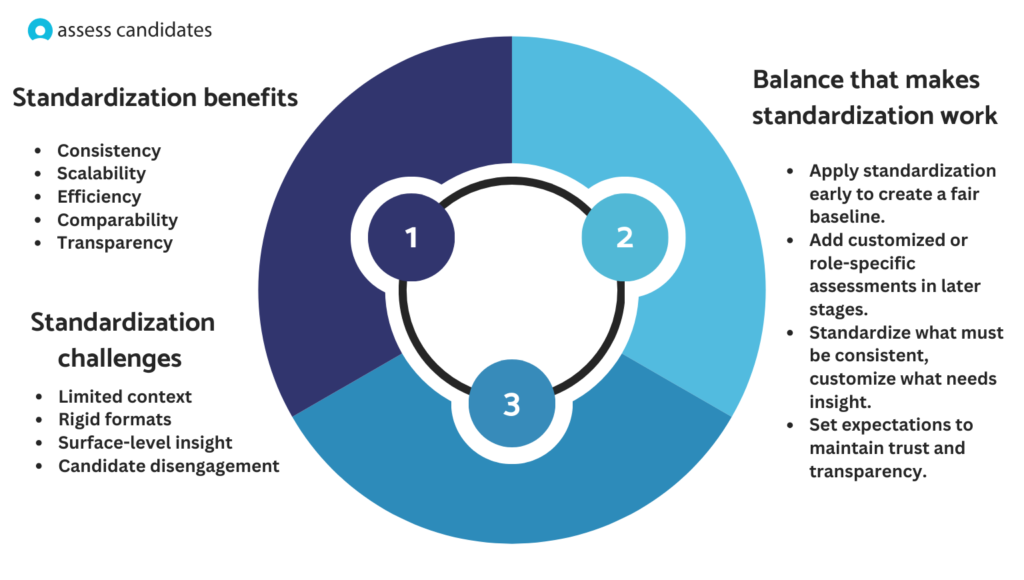
Benefits of Standardization:
- Consistency: Applies the same criteria and scoring to every candidate and reduces variability in decision-making.
- Scalability: Handles large applicant volumes with minimal effort and is suitable for high-volume or time-sensitive hiring.
- Efficiency: Speeds up early-stage screening and saves time for hiring teams and candidates.
- Comparability: Enables clear benchmarking across applicants and supports data-driven shortlisting.
- Transparency: Makes evaluation criteria clear and defensible.
Challenges of standardization:
- Limited context: May not reflect real job tasks or environments and can overlook role-specific nuances that may occur in the workplace.
- Rigid formats: Standard assessments often do not suit creative, leadership, or evolving roles and may disadvantage strong performers who don’t do well in timed tests.
- Surface-level insight: Focuses on what candidates know, not how they apply it. It also misses out on assessing their behavioral skills and situational awareness.
- Candidate disengagement: Can feel impersonal or overly generic.
The balance that makes standardization work
- Apply standardization early to create a fair baseline.
- Add customized or role-specific assessments in later stages.
- Standardize what must be consistent; customize what needs insight.
- Set expectations to maintain trust and transparency.
When used thoughtfully, standardization provides structure without rigidity. It creates a reliable starting point for assessment, helping organizations make fair and efficient comparisons while keeping bias in check. Its real strength lies in what it enables next, not in replacing deeper evaluation, but in setting the stage for it.
That’s where customization comes in. To see how assessments can go beyond consistency and better reflect real-world situations, it’s important to look at customized assessments and the advantages they have compared to fixed formats.
3. What are customized assessments?
Customized assessments are tailored evaluation tools designed around a specific role, team, or organizational context rather than using a one-size-fits-all format. They are built to reflect the actual skills, behaviors and challenges a candidate is likely to face on the job, making the assessment more relevant and meaningful.
What advantages does customization have over standard assessment formats?
Their biggest advantage over fixed assessment formats is contextual accuracy. Customized assessments can mirror real work scenarios, incorporate role–specific tasks, and evaluate behaviors aligned with organizational values. This helps hiring teams move beyond generic scores and gain deeper insight into how a candidate thinks, solves problems and applies their skills in practice.
Research suggests that 87% of employers find that customized assessments lead to better hiring outcomes, aligning candidates more closely with role requirements and company culture.
They also offer a more engaging and candidate experience. Candidates are assessed on what truly matters for the role, rather than being filtered out by unrelated or overly rigid tests. As a result, customized assessments often provide stronger signals of job performance, potential, and cultural alignment, especially for specialized, senior, or rapidly evolving roles.
When used thoughtfully, customized assessments complement standardized tools by adding depth, relevance, and nuance to hiring decisions.
Strengthen your recruitment strategy with well-crafted customized assessments. LEARN MORE
Next, let’s look at where customization delivers the most value.
4. Where does customization add real value, and where can it create challenges?
Customization adds the most value when assessments need to reflect real work, real decisions, and real context. For complex or specialised roles, tailored assessments can reveal how candidates think, collaborate and adapt, insights that fixed formats often miss.
However, without structure, customization can quickly introduce inconsistency and bias. The impact depends less on whether assessments are customized and more on how they are designed and used.
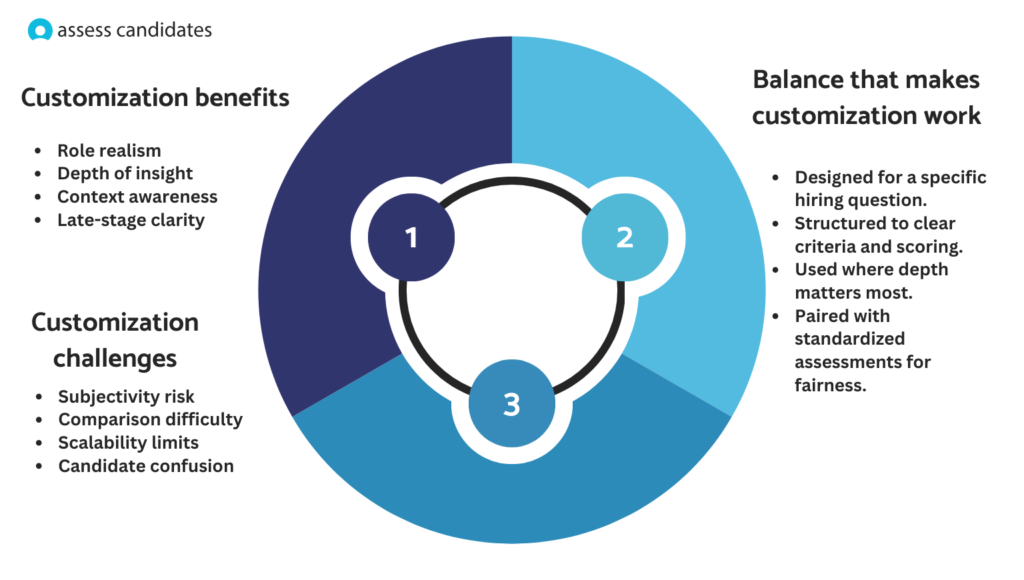
Benefits of customization:
- Role realism: Mirrors real job tasks and decision-making scenarios and assesses how candidates apply skills in practice, not just in theory.
- Depth of insight: Reveals problem-solving, judgment, and leadership behavior and helps differentiate candidates who look similar on paper.
- Context awareness: Accounts for team dynamics, industry challenges, and role complexity and evaluates how candidates handle ambiguity and trade-offs.
- Late-stage clarity: Most effective when the candidate pool is smaller and supports confident final decisions with richer evidence.
Challenges of customization:
- Subjectivity risk: Lack of clear criteria can lead to inconsistent evaluation, and decisions may rely too heavily on personal judgement.
- Comparison difficulty: Tailored assessments can make it harder to compare candidates fairly, and results may not be benchmarked consistently.
- Scalability limits: Time- and resource-intensive to design and administer, and less suitable for high-volume hiring.
- Candidate confusion: Unclear expectations can affect performance and experience, and inconsistent formats may feel unfair or unpredictable.
The balance that makes customization work
- Designed for a specific hiring question.
- Structured with clear criteria and scoring.
- Used where depth matters most.
- Paired with standardized assessments for fairness.
Boost your hiring quality with Assess Candidates’ reliable pre-employment solutions. VIEW PLANS
When designed with intent and structure, customization brings assessments closer to the realities of the role. It helps hiring teams move beyond surface-level signals and understand how candidates think, decide, and perform in context. But without guardrails, the same flexibility that adds depth can also introduce inconsistency.
This is why framing assessment design as a choice between standardization and customization misses the point. To build hiring processes that are both fair and meaningful, it’s essential to understand why treating these approaches as an either-or decision is a flawed way to think about assessment.
5. Why is treating standardized and customized assessments as an either-or choice a flawed approach?
Customization adds real value when roles are complex, specialised, or context-dependent. For positions that require critical thinking, creativity, leadership or role-specific expertise, tailored assessments can reflect real work scenarios and decision-making environments. This makes it easier to evaluate how candidates apply their skills in practice, collaborate with others, and navigate ambiguity, areas where fixed formats often fall short.
Customization is especially useful in the later stages of hiring, when the candidate pool is smaller and deeper insights are needed. Role-specific tasks, work simulations, or case studies help distinguish between candidates who may look similar on paper but differ significantly in approach, judgement, and potential.
However, challenges arise when customization is overused or poorly structured. Without consistent criteria, tailored assessments can introduce subjectivity and bias, making fair comparisons difficult. They can also be time-intensive, harder to scale, and confusing for candidates if expectations are unclear.
Research shows that traditional, unstructured interviews predict job performance only about 30–40% of the time, while structured assessments and tests improve accuracy to roughly 55–65%.
This is why treating standardized and customized assessments as an either-or choice is flawed. Each approach solves a different problem. The most effective assessment strategies use standardization for fairness and consistency, and customization for relevance and depth.
Standardized vs. customized assessments: where each works best
Now that we’ve seen why standardized and customized assessments work best together, it helps to look at how each approach shows up in real hiring processes. The examples below illustrate where standardization provides consistency and where customization adds the context that fixed formats often miss.
Examples of assessments in each approach
The key is balance. Standardized assessments create a fair and efficient foundation. Customized assessments add nuance and insight where it matters most. When used together, intentionally and thoughtfully, they deliver a more accurate, inclusive and human-centred view of candidate potential.
Measure the right traits and behaviors for your role with our flexible, end-to-end assessments. Learn More
So how can organizations apply this balance in practice? The next section explores the best practices that help hiring teams maintain consistency while still personalizing assessments in ways that truly predict performance.
6. What best practices help organizations balance consistency with personalization in assessments?
Balancing consistency with personalization starts by recognising that no single assessment can capture the full picture of a candidate. The most effective organizations design assessment journeys that are structured at the core, but flexible at the edges.
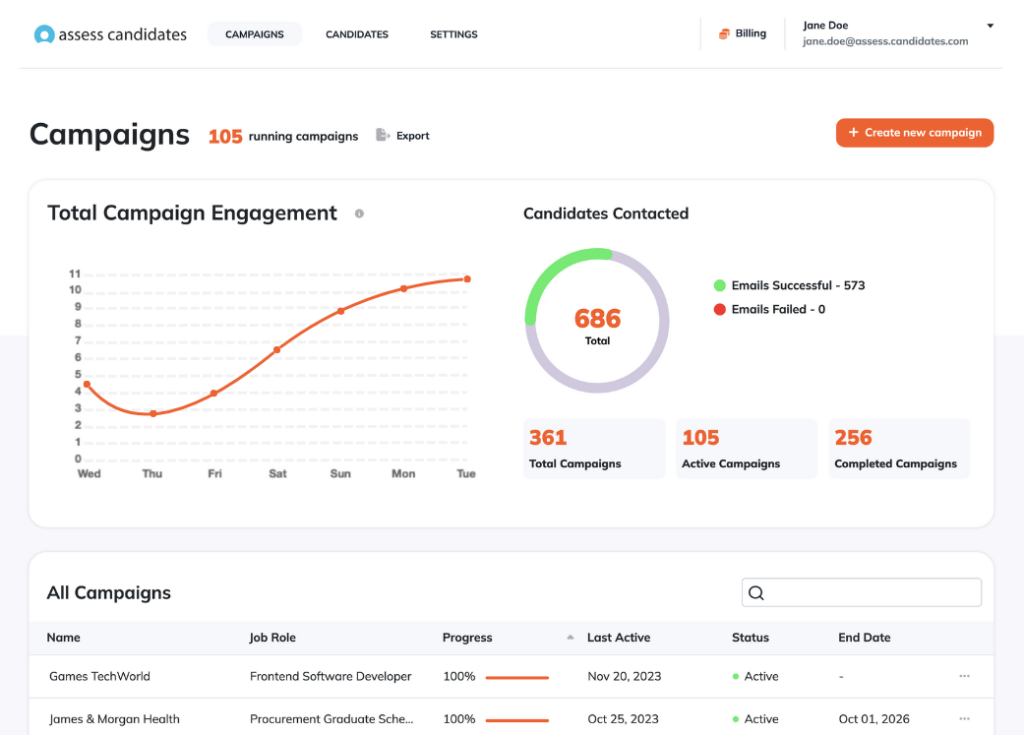
The first best practice is to establish a standardized foundation. This typically includes cognitive ability tests, behavioral assessments, or situational judgement tests that are applied consistently to all candidates. Tools like numerical, verbal, logical reasoning, and situational judgement tests from Assess Candidates help create a fair baseline by evaluating candidates against the same criteria, using objective data rather than subjective impressions.
Personalization is then layered on thoughtfully. As candidates move forward, assessments become more role-specific, such as tailored situational judgement tests, personality questionnaires or job-relevant simulations. These customized elements help hiring teams understand how a candidate applies skills, makes decisions, and aligns with organizational values in real work contexts.
Another key practice is using multiple data points rather than single scores. Platforms like Assess Candidates allow hiring teams to combine insights from cognitive tests, personality questionnaires, behavioral assessments, and video interviews. This reduces overreliance on any one metric and leads to more balanced, defensible decisions.
The US Department of Labor found that companies using pre-employment testing reported a 27% reduction in attrition and a 20% increase in productivity.
Consistency is further strengthened through the structured interpretation of results. Clear scoring frameworks, benchmarking and reporting dashboards ensure that personalization doesn’t slip into subjectivity. Hiring managers evaluate candidates against predefined success criteria, not personal preference.
Finally, strong assessment strategies keep the candidate experience in mind. Clear communication, relevant assessments and engaging formats, such as game-based assessments or structured video interviews, help candidates feel evaluated on what truly matters, not filtered out by generic or irrelevant tests.
Identify and develop best-fit candidates with our expert range of assessments. HIRE FOR FREE
How consistency and personalization work together in practice
When organizations combine standardized assessments with targeted customization, they don’t have to choose between fairness and relevance. They create an assessment process that is consistent, inclusive, and genuinely predictive of performance and potential.
Conclusion: Key Takeaway
Standardized and customized assessments are not competing approaches, they are complementary tools that serve different purposes at different stages of the hiring journey. Standardization provides the fairness, consistency and scalability needed to make objective decisions, especially early in the process. Customization brings relevance, depth and real–world context, helping organizations understand how candidates will actually perform on the job.
The most effective hiring strategies don’t rely on a single test or format. Instead, they are intentionally designed to combine a strong standardized foundation with thoughtfully applied customization. This balance reduces bias, improves prediction accuracy, enhances candidate experience and supports better long-term outcomes for both employers and employees.
By moving beyond the either-or mindset and focusing on purpose-driven assessment design, organizations can build hiring processes that are not only efficient, but also inclusive, human–centred and aligned with real performance and potential.
Looking for better ways to assess and onboard interns? Explore the FAQs below and subscribe to get started.
Frequently Asked Questions
Are standardized assessments fair for all candidates?
Standardized assessments are fair when used as a baseline because every candidate is evaluated using the same criteria. However, fairness improves further when they’re combined with role-specific or behavioral assessments later in the process.
When should organizations use customized assessments instead of standardized ones?
Customized assessments are most effective for roles that involve complex decision-making, leadership, creativity or specialised expertise. These roles often require candidates to navigate ambiguity, collaborate across teams, or apply judgement in real-world scenarios that generic tests may not fully capture. Customization is especially valuable in later hiring stages, when deeper insight is needed to differentiate between strong candidates.
Can customized assessments introduce bias?
Yes, they can, especially if they are loosely designed or evaluated without clear criteria. When expectations, scoring, or success measures are unclear, personal judgement can overshadow objective evaluation. To reduce bias, customized assessments should be tied to defined behaviors, structured scoring rubrics and consistent evaluation standards across candidates.
Is it better to standardize early and customize later in the hiring process?
In most cases, yes. Standardized assessments work well at the start of the process by creating a fair and efficient baseline for screening large applicant pools. As the candidate pool narrows, customized assessments can then be introduced to explore role-specific skills, behaviors and potential in greater depth, without sacrificing fairness.
Do candidates prefer standardized or customized assessments?
Candidates generally respond best to assessments that feel both transparent and relevant. Clear, standardized steps help them understand how they are being evaluated, while role-relevant tasks and simulations make the process feel meaningful and fair. A balanced approach improves engagement and leaves candidates with a more positive experience, even if they are not selected.


 English
  Arabic