
Best Practices to Attract and Hire in the Tech Industry in 2026



Recruiting tech talent in 2026 requires the knowledge and practices for combining the search for hard and soft skills, rather than prioritizing one over the other.
Employers looking to hire tech talent have asked several questions about best practices for recruiting, the skills to measure, and the best tools and assessments to use in the recruitment process. These employers seek tech talent in 2026 to gain a competitive advantage and drive digital transformation. As companies report productivity gains of 20%-40% through the automation of routine tasks and more.
In this text, we will answer all your questions and provide you with the information and tools you need to stay ahead of tech hiring trends in 2026.
Contents
- What is the tech industry?
- Skills to measure when hiring in the tech industry
- Tools to use when attracting tech talent
- Challenges of hiring in the tech industry
- Best strategies to hire in the tech industry
- Roles of tech talent in the industry
- Client success stories in hiring in the tech industry
- Future of recruitment in the tech industry
- Why do employers use Assess Candidates when recruiting tech talent?
Prepared to uncover all that you need to know to begin your tech talent recruitment in 2026? Keep reading as we have the answers for you!
1. What is the tech industry?
The tech industry comprises companies and organizations that design, develop, manufacture, and sell technology products and services to the public. These products can either be for the general public or be created and sold to a specific clientele.
Start your tech recruitment process with our psychometric assessments. HIRE FOR FREE
Curious about what skills to measure when hiring in the tech industry? We have highlighted them below.

2. Skills to measure when hiring in the tech industry
According to a McKinsey report, many employers are increasingly looking to hire tech talent with specific skills. It is necessary to formulate a talent hiring strategy if you want to stay ahead of the competition.
Aside from the necessary hard skills that your tech candidates are expected to have. Recruiting tech candidates who possess soft skills encourages the communal growth of your staff and improves the company culture.
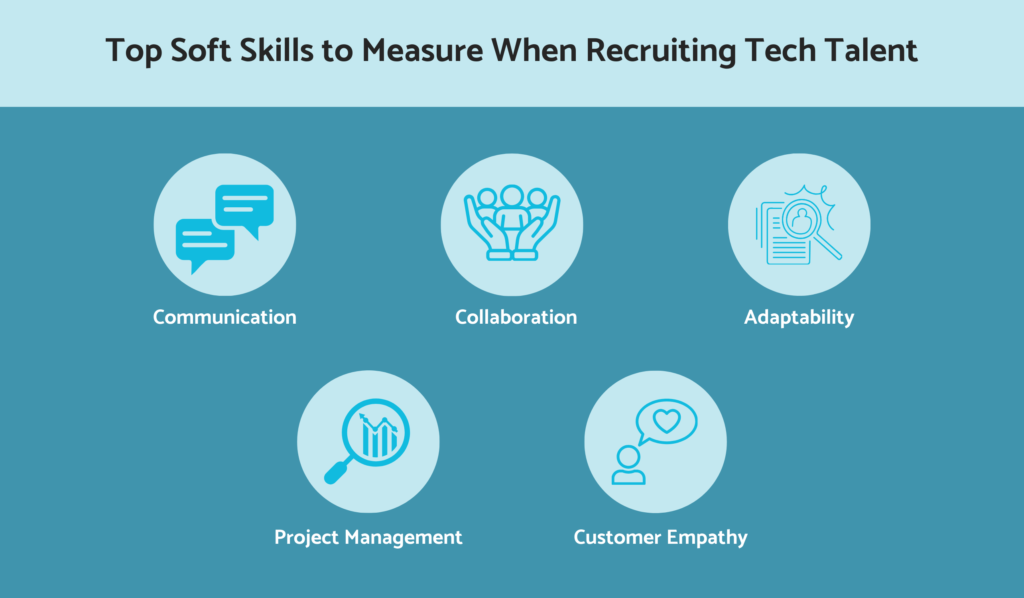
Top soft skills to measure when recruiting tech talent
- Communication
Look for tech talent who can explain technical concepts to non-technical stakeholders and demonstrate active listening and documentation skills. This is important in recruiting top tech talent, as they will need to interact with cross–functional teams.
- Collaboration
The tech applicants must demonstrate their abilities in cross-team coordination, working in agile/scrum environments, pair programming, and code collaboration. You should also assess whether they are skilled at giving and receiving constructive feedback.
- Adaptability
When recruiting, ensure candidates possess adaptability, a continuous-learning mindset, and can improve productivity and creativity by quickly adapting to new technologies.
- Project Management
Possessing project management skills, which include prioritization, time management, meeting task deadlines, and having a firm grasp on agile methodologies, is heavily required for any tech talent. We recommend testing for this skill in the recruitment process.
- Customer Empathy
A tech talent must always have the end-product users in mind when developing any product. If you are recruiting for your company, you can measure if your candidates understand ROI and business impact, principles of user experience, and customer empathy.
What is the way you can test if your candidates possess these skills? Let’s find out below.
3. Tools to use when attracting tech talent
Employers like you often feel confused about which tools to use when hiring talent in the tech industry. This often results in recruiting the wrong candidates who are either not qualified for the role or have difficulty with the culture fit.
To attract, hire, and retain your top tech talents in your organization, we have listed a few tools that will guide you through your recruitment process without wasting your efforts, time, and resources.
6 Top tools to use when hiring tech talent
1. Specialized Sourcing Platforms
To attract the perfect candidates for your company, start by looking at platforms where they already build and share their work. You can go on platforms like GitHub, LinkedIn, and Upwork.
2. Applicant Tracking System (ATS)
An Applicant Tracking System (ATS) helps your tech talent recruitment process by automating your job postings, CV screenings, and tracking your candidates’ progress. ATS tools like Workable, BambooHR, and Clear Company are great to use.
3. Coding Assessment Platforms
When recruiting for technical roles, use coding assessment platforms such as SHL, HackerRank, and Codility to evaluate candidates’ technical skills. Doing this will help you make informed hiring decisions and ensure you hire the right candidates.
4. Video Interviewing Platforms
Conduct video interviews with your candidates on platforms like Assess Candidates, HireVue, and Spark Hire. They are affordable and let you recruit beyond your region, widening your search for top tech talent and strengthening diversity and your employer brand.
Types of Technical Interview Questions to Ask a Tech Candidate
There are various types of technical questions that you can ask a tech candidate during the interview stage. These include the following:
- How do you keep your technology skills up-to-date with the current trends?
- Tell me about the time you had to explain a technical report to a non-technical stakeholder?
- Describe a scenario where you had to quickly learn a new technology to complete a new project.
- How do you improve your skill set?
5. Skills Assessment Tools
Skills assessment platforms such as Assess Candidates, TestGorilla, and Triplebyte examine and monitor your tech candidates’ skills. They ensure you hire the right fit for your organization who will easily align with your company culture and staff.
6. Psychometric Assessment Tests
When recruiting top talent in the tech industry, we recommend designing an assessment process that effectively evaluates their skills, cognitive abilities, personality traits, and behavioral tendencies.
- Verbal Reasoning Test: The test examines your candidates’ ability to interpret and understand comprehensive documents. This is done by presenting candidates with passages that require them to think logically and provide accurate answers to the questions.
- Numerical Reasoning Test: This test helps you assess candidates’ mathematical and analytical skills by presenting numerical questions that require critical thinking to pass.
- Logical Reasoning Test: This assessment helps you assess the candidate’s deductive and critical thinking skills. The test questions can come in sequences or shapes and require your candidates to determine the next sequence.
- Situational Judgment Test: This test assesses candidates’ behavioral skills and workplace preferences through scenario–based questions.
- Personality Questionnaire: This assessment assesses candidates on their personality traits and behavior, as well as how well they can fit the organization’s culture.
- Game–based Assessment: It helps you evaluate candidates on their cognitive skills and traits through interactive and engaging assessments.
Well-strategized selection of psychometric assessments will not only provide you with a thorough performance index for all your applicants, but also boost your confidence in hiring decisions.
Hire the right candidates for your tech roles with our flexible assessment platform and solutions. LEARN MORE
You may be worried about the challenges that you might face when hiring in the tech industry. We have offered solutions for you. Keep reading!
4. Challenges of hiring in the tech industry
Today, many companies have been vocal about the challenges of recruiting top candidates in the tech industry. If you have such concerns, in this section, we will provide you with solutions on how to avoid these challenges.
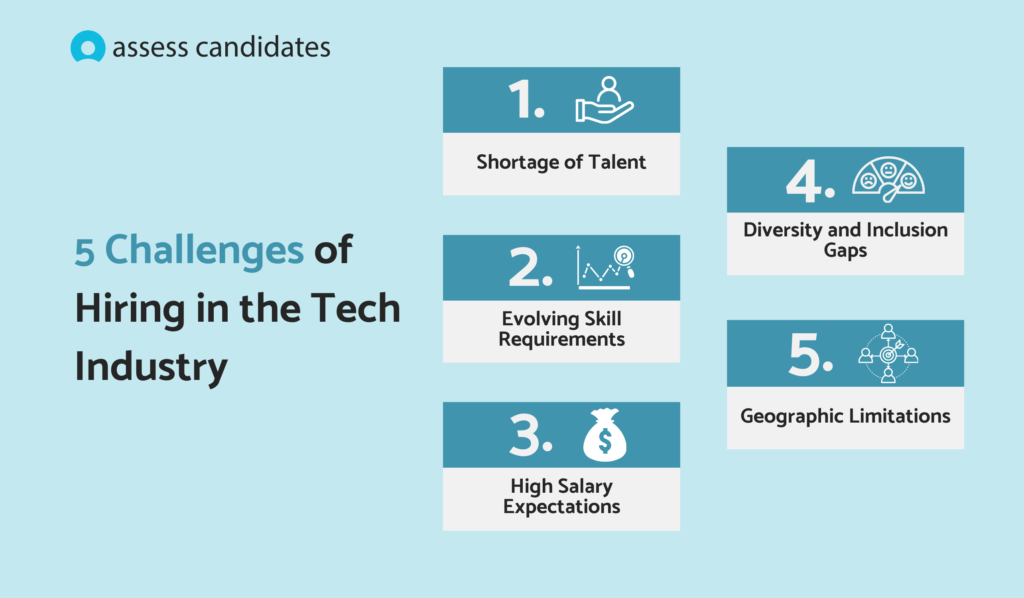
Top 5 challenges of hiring in the tech industry
1. Shortage of Talent
Many employers have reported facing a shortage of tech talent in the industry. This reduces the productivity of their companies, especially for niche roles such as AI engineers, data scientists, and cybersecurity experts.
Solution: We recommend that you hire for potential and invest in upskilling programs for candidates. Partner with coding bootcamps and encourage internal training sessions to develop talent in your company.
2. Evolving Skill Requirements
The fast-paced evolution of technology makes it difficult to hire tech applicants. This is because the skills required today may not be needed in the next six months, and hiring for current skills may alter the company’s response to the latest trends.
Solution: Focus on foundational skills and learning ability instead of certain technologies. When you do this, recruit candidates who demonstrate adaptability and are provided access to training courses will keep you current with trends and policies.
3. High Salary Expectations
Top tech talent often demands high salaries and compensation that keep rising, making it challenging to hire and retain them. This is an issue, especially when hiring for startups and non-tech companies.
Solution: To hire the perfect and professional candidates, offer total compensation, including equity, bonuses, and other benefits, as it helps attract candidates. Be transparent about salary ranges and consider remote hiring in lower-cost-of-living areas to help reduce your costs.
4. Diversity and Inclusion Gaps
Historically, the tech environment has lacked diversity, and building an inclusive team requires intentional effort on your part as a recruiter to avoid unconscious bias in recruitment.
Solution: To combat this challenge, use structured interviews with standardized questions, remove bias from job descriptions, and create an inclusive onboarding process for new candidates. This will promote a positive candidate experience and enhance the employer brand.
5. Geographic Limitations
Despite the growth of remote work since the COVID–19 pandemic, some roles still require an on-site presence. This limits your recruitment pool to certain locations where tech skills may be scarce or very expensive.
Solution: Provide your candidates with hybrid arrangements with partial remote work options. Open satellite offices in tech talent hubs and evaluate the job role to determine whether on-site requirements are necessary. Doing this will reduce your expenses and improve tech candidate retention.
Having seen the challenges of hiring in the tech industry, check out the best strategies to hire in the tech industry.
5. Best strategies to hire in the tech industry
According to a National Institute of Standards and Technology (NIST) report, there is a shortage of 4.7 million workers in some tech fields. This includes cybersecurity roles, with more than 457,398 cybersecurity job openings.
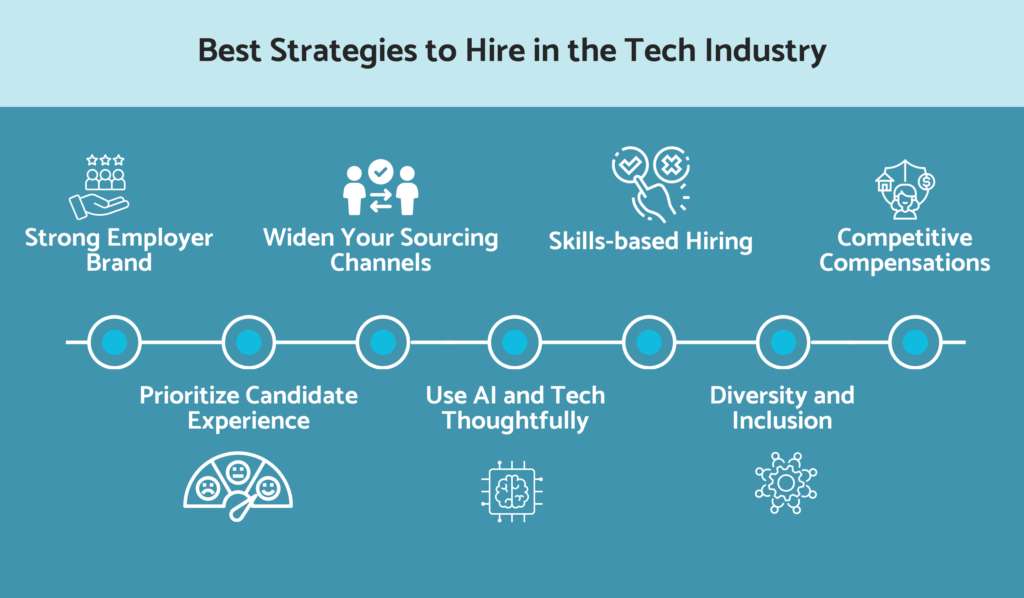
Best strategies to hire in the tech industry
- Strong Employer Brand
Demonstrate what makes your company unique. Do so by showcasing your GitHub projects, attending tech conferences, and featuring employee testimonials. Also, highlight growth opportunities to attract tech candidates to work with your organization.
- Widen Your Sourcing Channels
When recruiting top tech talent, we recommend that you widen your sourcing channels. Start by finding them in spaces where they are most likely to be, such as tech communities, conferences, and hackathons.
- Skills-Based Hiring
Focus on assessing what skills your candidates actually have, depending on the role you are recruiting for. For example, testing them on coding tests or with real–world scenarios that require on-desk solutions.
- Competitive Compensations
Before you post your job vacancies, we suggest researching market rates. Remain transparent about your salary ranges, and offer candidates equity plus benefits that tech talent values, such as flexible roles and learning budgets.
- Prioritize Candidate Experience
You can encourage a positive candidate experience by respecting candidates’ time, communicating regularly, and addressing any questions about the recruitment process. We also suggest providing feedback to rejected applicants.
- Use AI and Tech Thoughtfully
When assessing a large number of candidates interested in a role in your company, employ the use of technology and AI by automating repetitive tasks like screening resumes. Also, use up-to-date recruiting and skills assessment platforms to make data-driven hiring decisions.
- Diversity and Inclusion
Remove bias from your job descriptions by using structured interviews with consistent questions, and collaborate with organizations that align with your support for underrepresented groups.
Explore reliable assessments created by Chartered Scientists to hire high-quality tech candidates. VIEW PLANS
Want to know about the roles that you can employ candidates in the tech industry? We have a few mentioned below.
6. Roles of tech talent in the industry
According to Upwork, the demand for tech skills that are related to Artificial Intelligence (AI) grew by 220% year over year.
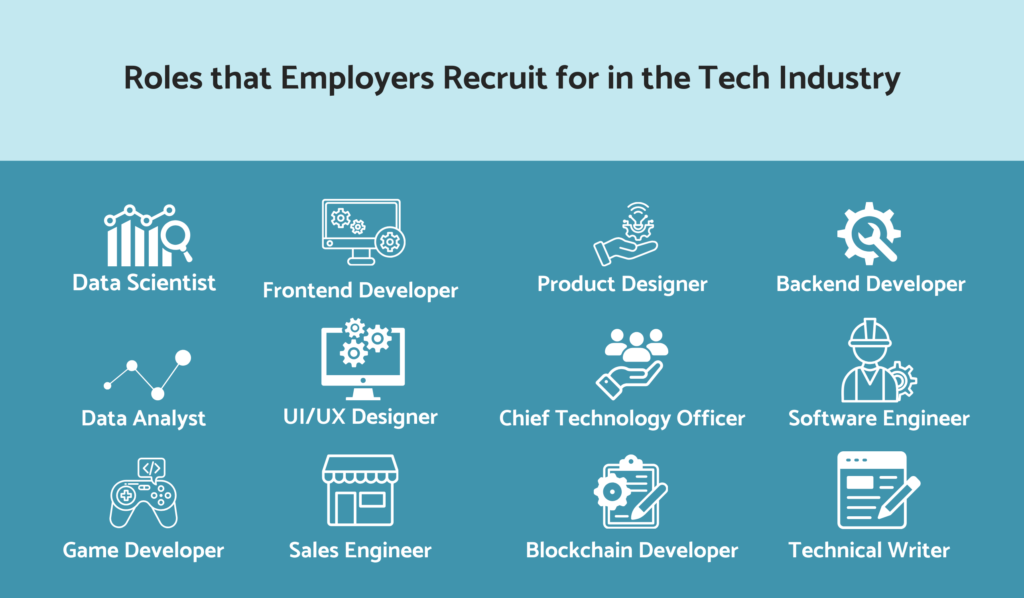
Roles that Employers Recruit for in the Tech Industry
- UI/UX Designer
- Software Engineer
- Frontend Developer
- Backend Developer
- Data Scientist
- Data Analyst
- Product Designer
- Game Developer
- Blockchain Developer
- Sales Engineer
- Technical Writer
- Chief Technology Officer (CTO)
Are you looking to attract and hire tech talent in your company? Unsure about what pre-employment psychometric assessment tests you should use to evaluate your candidates to ensure you hire the perfect talent? You can reach out to us for a thorough evaluation of your recruitment assessment design, and we will ensure you hire the right candidates.
There are lots of companies worldwide that have successfully attracted, hired, and retained top tech talent. Let us take a look at some of these companies.
Employers that hire tech talent
- Apple
- Meta
- Amazon
- Microsoft
- Bank of America
- Andela
- Netflix
- New York Times
- Deloitte
- Notion
Want real–world examples of employers who hired top tech talent in their organizations and boosted their productivity?
7. Client success stories in hiring in the tech industry
Recruiters and organizations have shared their experiences with the adaptation of strategies that have helped them in hiring their tech talents, without losing time or money to hiring processes.
1. Netflix
Challenges:
Netflix was competing for talent against some cash-rich startups and big tech companies. As a result, the company often lost promising candidates in the final negotiation round due to compensation uncertainty.
Solution:
They decided to implement radical pay transparency and began offering top-of-market salaries and compensation to their candidates, removing lengthy negotiation rounds.
Results:
- Minimized negotiation period from 2 weeks to 2 days
- Increased its offer acceptance rate to 90% by eliminating compensation surprises
- Reduced time spent on salary negotiations by 70% and instead focused on candidate experience.
2. Zoom
Challenge:
Zoom was looking to scale its engineering teams by 300% within six months during the pandemic while maintaining hiring quality under pressure.
Solution:
Zoom launched a virtual onboarding program along with automated technical screening and developed dedicated recruiting pods that are focused on specific engineering skills.
Results:
- Recruited 1,200 engineers within six months without compromising its quality standards
- Maintained 95% new recruit retention rate despite the rapid scaling
- Decreased recruit burnout by 35%
This is where Assess Candidates comes in: we help ensure that your candidates are well qualified, as our pre-employment psychometric assessments measure skills and provide data-driven analytics to inform your hiring decisions.
8. Future of recruitment in the tech industry
How much do you know about the future of recruitment in the tech industry? Why don’t we take a look at some of the possibilities that could happen if more employers implemented our strategies in hiring in the tech industry?
What is the future of recruitment in the tech industry?
- AI-Powered Recruitment
The future of recruitment will see AI handling initial screening, candidate matching, and administrative tasks, while human staff focus on building relationships and final hiring decisions. Expect AI chatbots to conduct first-round interviews and identify the perfect candidates for your company.
Focus on training AI on how to detect and mitigate bias while training your employees to crucially identify talent in the candidates. Starting these programs early will prepare your organization for the eventual change in recruitment.
- Remote and Global Talent Hiring
Companies will no longer be restricted by geography, as there will be more opportunities to hire talented tech candidates worldwide. Additionally, remote work will become a permanent feature of the tech industry.
Since the 2020 COVID-19 pandemic, more organizations worldwide, particularly the tech industry, have focused on remote work. Embracing this reality now will prepare you for a more informed recruitment structure that suits your organization’s policies.
- Diversity, Equity, and Inclusion
Diversity, equity, and inclusion (DEI) will become a primary focus for all recruiters. It will be embedded in every recruitment technology and process from the beginning to avoid bias that could corrupt the candidate experience.
Hiring for skills and not being restricted by geography or favoring a certain demographic will enhance your employer brand. This will also encourage more competent candidates from diverse backgrounds to apply to your organization.
- Integration of Recruitment Marketing
Recruitment marketing strategies, such as employer branding, content marketing, and recruitment, will be used to attract, engage, and convert prospective talent like customers. Organizations will also invest heavily in career sites and employee testimonials to build tech talent pipelines.
Making due and early research on hiring trends and job marketing will have you learn the best methods to attract and hire your preferred tech candidates.
So, why use Assess Candidates to hire your tech talent in 2026?
9. Why do employers use Assess Candidates when recruiting tech talent?
Organizations and recruiters like yourself often look for platforms like Assess Candidates that align with your recruitment goals and help ensure that your hiring decisions are not influenced by bias or unfairness that can occur when recruitment is left entirely to your human staff.
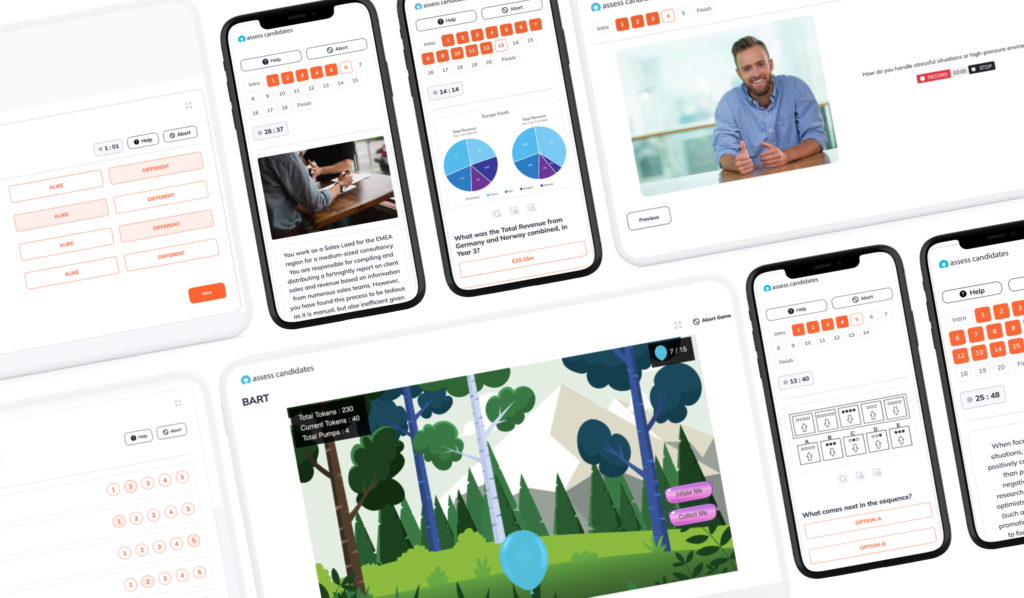
Why employers prefer using Assess Candidates for hiring in the tech industry
- Tech Hiring Tools: Assess Candidates offers logical-reasoning problem-solving tests and critical thinking tests significant for measuring your tech candidates’ deductive and analytical skills.
- AI–Powered Video Interviews: You can assess your tech candidates’ communication skills and genuine experiences through AI-powered video interviews that allow you to examine both verbal and non-verbal communication without dealing with scheduling conflicts.
- Extensive Assessment Library: Assess Candidates offers a range of psychometric tests, AI video interviews, and gamified assessments created by Chartered Psychologists. These assessment tests will provide you with an opportunity to test your candidates’ hard and soft skills.
- Mitigates Bias and Supports Diversity: Our platform reduces bias and gives every tech candidate an equal chance to succeed in the recruitment process, regardless of their background. We also offer additional time and screen reader compatibility for accessibility.
- Cost–Effective Provisions: Assess Candidates offers very flexible pricing for employers looking to begin their recruitment process in the tech industry without incurring heavy expenses or making the wrong hiring decisions.
Hire the right tech candidates with our well-equipped assessment tool platform. LEARN MORE
Conclusion: Key Takeaway
Recruiting the right talent is an ongoing challenge in the ever-changing world of tech. In this article, we have explored the key skills to look out for when hiring, and provided guidance and recommendations to avoid making the same mistakes that many employers have made when hiring. Our strategies will help you with your hiring process as you attract and retain top tech talent for your organization into the future.
Curious to know more about using assessment tests to hire the perfect candidates in the tech industry? Keep scrolling to explore our frequently asked questions, and enter your email to get started today.
Frequently Asked Questions
How long will it take to hire a tech professional?
On average, it will take you 3-4 weeks to attract and recruit a tech professional. Although there have been scenarios where urgent roles have required 2 weeks and 8 weeks for some specialized positions, respectively.
What is the difference between junior and senior tech talent?
Junior tech talent often requires less compensation but needs more hands-on training and supervision, while senior talent demands higher salaries and performs their tasks with little to no supervision. Some of them even mentor junior tech talents.
How important are soft skills in tech hiring?
Soft skills are extremely important when recruiting tech talent, as recruiters value skills like communication, collaboration, problem-solving, and adaptability, which often determine success more than pure technical ability.
How can I improve diversity in tech recruitment?
Improve DEI by removing biased language from your job descriptions. This should be done through structured interviews, outreach to diverse communities, and the creation of a space for an inclusive company culture.
How long do tech employees usually stay in a company?
Most tech employees usually remain with a company for an average tenure of 2-3 years, which is shorter than in other industries. To improve retention, you should focus on retaining them by providing engagement, growth opportunities, and competitive compensation.


 English
  Arabic