
AI vs Human Recruiters: Finding the right balance in modern hiring process



AI tools and automation in recruitment are transforming how companies source and assess candidates, schedule interviews, and analyze hiring data.
For many recruiters, this shift raises concerns about whether AI could eventually replace human roles.
However, in reality, assessing and hiring the right candidates with the necessary skills requires a combination of AI-driven efficiency and human judgment. While AI can process large volumes of data, recruiters remain essential for evaluating context, motivation, and cultural fit.
This guide breaks down the role of AI and human recruiters in modern hiring processes. You will learn the differences, how they complement each other, and how Assess Candidates can help you combine both approaches to build a high-quality workforce.
Contents
- Why is AI growing in recruitment?
- Is there a danger of AI replacing humans in hiring?
- What are the key differences between AI and human recruiters?
- What should recruiters automate with AI?
- What should recruiters NOT automate with AI?
- Finding a balance with a human-AI hybrid hiring model
- AI hiring tools and technologies that support recruiters
- 5 best practices for introducing AI into recruitment without replacing humans
- The risks of over-automation in recruitment
Now that we have outlined what this article will cover, let’s discuss why AI is growing in recruitment.
1. Why Is AI Growing in Recruitment?
AI in recruitment refers to the use of artificial intelligence tools to automate or support tasks such as candidate sourcing, resume screening, interview scheduling, and hiring analytics.
The use of AI in recruitment is gaining popularity among recruiters because of its ability to help speed up the hiring process. Hiring teams often receive high volumes of applications and tight deadlines to fill roles, on top of the need to ensure hiring decisions are accurate and fair.
How AI helps optimize hiring:
AI speeds up and improves the recruitment process by:
- Processing large volumes of applications quickly: AI can sort through thousands of job applications in significantly less time than it would take humans. A trained AI model can make use of specific keywords to filter through job applications.
- Reducing repetitive administrative work: Most initial stages of job applications are always repetitive and boring, but AI can reduce the bulk of it.
- Identifying patterns humans may overlook: AI can track similarities and differences much better than humans can, especially when sorting through high volumes of applications.
- Improving time-to-hire and operational efficiency: The use of AI in hiring leads to a faster recruitment process, as it saves time and energy required to shortlist candidates.
A 2024 study revealed that while AI offers significant benefits in recruitment, a balance between technological efficiency and human judgment remains crucial for fair and effective hiring practices.
Streamline your hiring and make confident decisions with our automated, science-backed assessments. HIRE FOR FREE
Recruiters are increasingly using AI to support them by handling repetitive and data-heavy tasks that would otherwise consume significant time. However, AI is also causing fear about job security and concerns that it will completely replace humans.

2. Is there a danger of AI replacing humans in hiring?
The advancement of AI and its capabilities within recruitment has caused concern among hiring managers and talent acquisition professionals. But the reality is that AI has several key limitations, which will prevent its full takeover.
Top 5 limitations of AI in recruitment
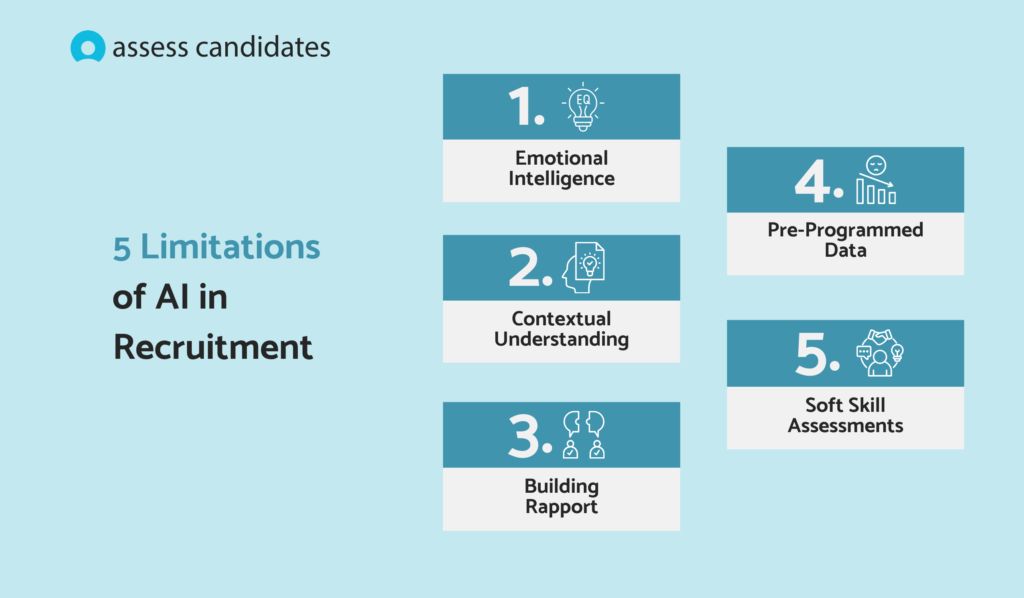
- AI lacks emotional intelligence
Artificial intelligence is built using models that thrive on logic and calculations. For this reason, AI finds it difficult to comprehend the subtlety of human behavior and emotions. Seeing as job roles require specific behavioral competencies, AI will not be able to accurately evaluate these skills.
- AI cannot process data based on context
A certain level of contextual understanding is required during candidate screening, as each job applicant has a unique background, skills, and experience. Based on its design, AI cannot easily detect nuances as humans do in order to better understand each candidate.
- AI cannot build true rapport with candidates
AI interacts with candidates based on preset instructions; therefore, it will only ask and respond to pre-programmed questions. Such lack of originality can place candidates in a state of distrust of such generalized rather than individualized interview processes.
- AI depends heavily on the pre-programmed data
AI works based on the data that it has been trained on. So, if the data is outdated, incomplete, inaccurate or accidentally biased, this can lead to incorrect judgment, poor hiring recommendation or talent loss.
- AI cannot accurately assess soft skills
Soft skills like emotional intelligence, communication, leadership, collaboration and situational judgment can be difficult for AI to correctly evaluate because of the differences and nuances involved in the expression of these skills.
Instead of rejecting AI because of its limitations, organizations should focus on using it strategically alongside human expertise.
AI and human recruiters have some noticeable differences; continue reading to explore these in detail.
3. What are the Key Differences between AI and Human Recruiters?
As we are in the age of Artificial Intelligence (AI) and tech advancement makes it possible for AI to perform tasks that were once delegated to humans. However, it is important to note that there are differences between AI and human recruiters.
The differences between AI and human recruiters and their limitations and strengths
Understanding the strengths and limitations of both AI and human recruiters allows organizations to design a hiring process that uses each where it performs best.
So, what should recruiters actually automate with AI tools?
4. What should Recruiters Automate with AI?
AI has several benefits that make recruiters’ work easier and increase overall team productivity. We’ve already discussed that AI performs best with structured, repetitive, and data-rich tasks. Below are some of the processes that you can confidently assign to AI to optimize your recruitment:
5 Hiring Processes that can be Automated with AI
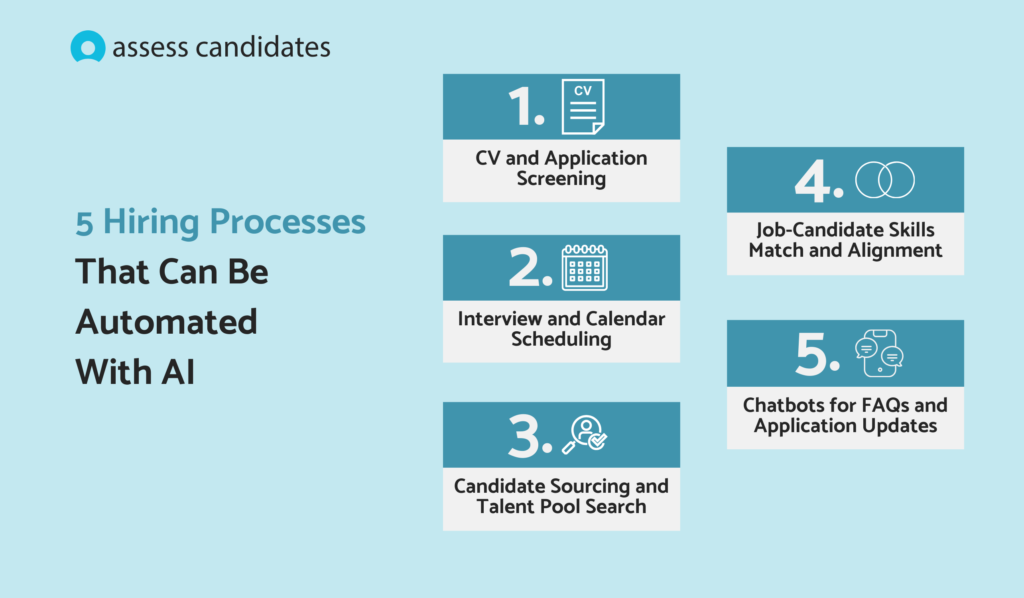
- CV and application screening based on predefined criteria
AI can assist in screening CVs and applications submitted through the job application portals using a set of predetermined criteria. This way, you can quickly process thousands of applications to see if they fit the role you want to fill.
- AI can schedule interviews and coordinate calendars
Present AI models facilitate the scheduling of interviews for candidates, minimising the risk of conflicting time slots. This can help recruiters manage the time required to interview all potential candidates.
- AI can be used for candidate sourcing and talent pool searches
Recruiters can use AI to access talent pools across the world. With a well-optimized AI tool, you can source candidates with specific skills and experience to fill certain roles even if these candidates are not actively seeking jobs.
- Basic skills matching and job–candidate alignment
AI can help match candidates and the skills required for the role you have opened based on the candidates’ CVs and applications. This functionality makes it easier for you as the recruiter to assess the relevant applications.
- The use of Chatbots for FAQs and application status updates
An AI model can be built to respond to candidates’ questions, especially frequently asked ones. If candidates receive prompt answers to their questions, even from a chatbot, it enhances their confidence in the application process. AI could also be assigned to provide application updates by email.
Automating these tasks discussed above will give recruiters the time to focus on strategy, relationship-building and other areas of the recruitment process not outsourced to AI.
Empower your hiring decisions with our automated pre-employment assessments. LEARN MORE
The following section explains which parts of recruitment should remain human-led.
5. What should Recruiters NOT Automate with AI?
Now that we understand which hiring processes AI can automate, let’s explore what AI cannot handle. Instead, human insight should continue to dominate these stages of recruitment.
Hiring processes that should not be Automated with AI
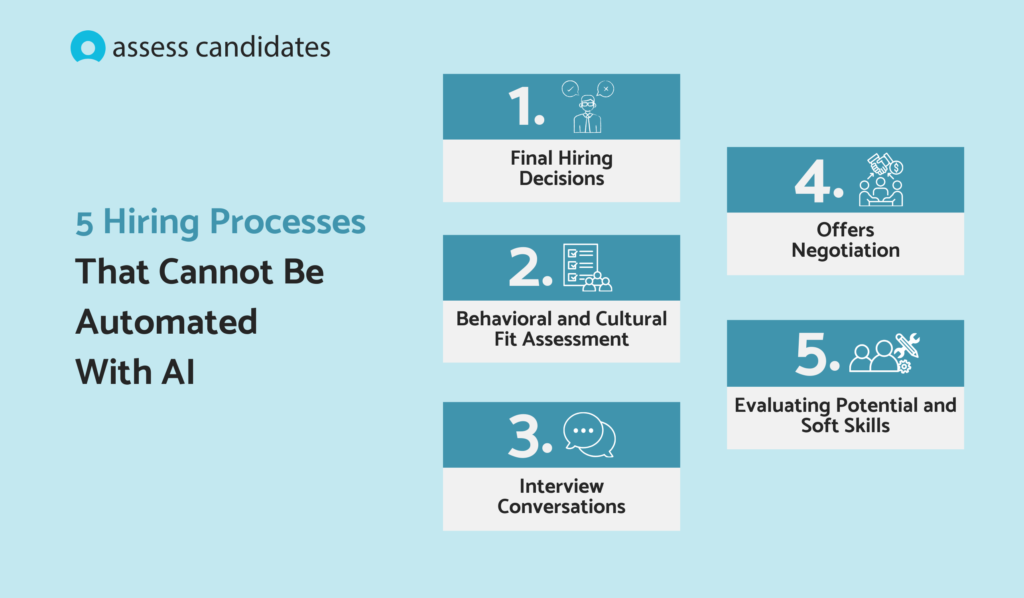
- Final hiring decisions
AI should not make the final hiring decisions for job roles because it does not possess the ability to critically assess human competencies and personality required to perform excellently in job roles.
- Behavioral and cultural fit assessments
Human interactions better assess a candidate’s behavioral and cultural fit. Human recruiters need to have conversations with candidates to get a better understanding of their workplace behaviors and ideology to work.
- Sensitive interviews and feedback conversations
During interviews, candidates can ask questions that require responses that draw from different sources, and for you to provide a suitable response, you will need to be able to process these questions deeply and provide direct answers.
- Negotiation of offers and compensation discussions
AI cannot function in the role of compensation negotiation because this stage of the recruitment process can be complex and needs you to critically assess what the particular candidate brings to the organization and how much the organization is willing to offer.
- Evaluating potential, motivation, and soft skills
AI is mostly equipped to assess data that is presented to it; however, for you to know the motivation and soft skills of a candidate, there needs to be in-depth questioning coupled with intuition and ethical judgment which a preprogrammed tool might not be able to perform.
Now that you have learned the aspects of recruitment that should not be automated, it’s important to learn how to balance the human-AI hybrid model for your organization’s recruitment exercise.
6. Finding a Balance with a Human-AI Hybrid Hiring Model
For an effective hiring process, it is important to design a balanced human-AI hybrid hiring model which combines AI efficiency with human expertise. This will maximize the recruitment system’s efficiency by assigning roles to humans and AI.
What should be the roles of AI and humans in recruitment?
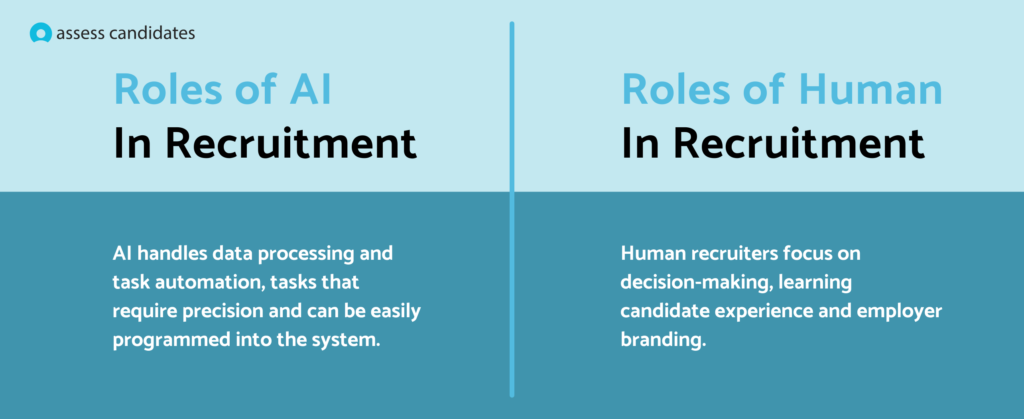
- AI handles data processing and task automation, tasks that require precision and can be easily programmed into the system.
- Recruiters should focus on decision-making, conversations, candidate experience, and employer branding.
Implement a human-AI hybrid hiring model using the Assess Candidates platform. LEARN MORE
This balance improves hiring quality while preserving the human connection that candidates value. There are some AI hiring tools and technologies that can help recruiters create the best human-AI model.
7. AI Hiring Tools and Technologies that Support Recruiters
There are several AI-powered tools that enhance recruitment processes without seeking to replace humans. Here are 4 of them:
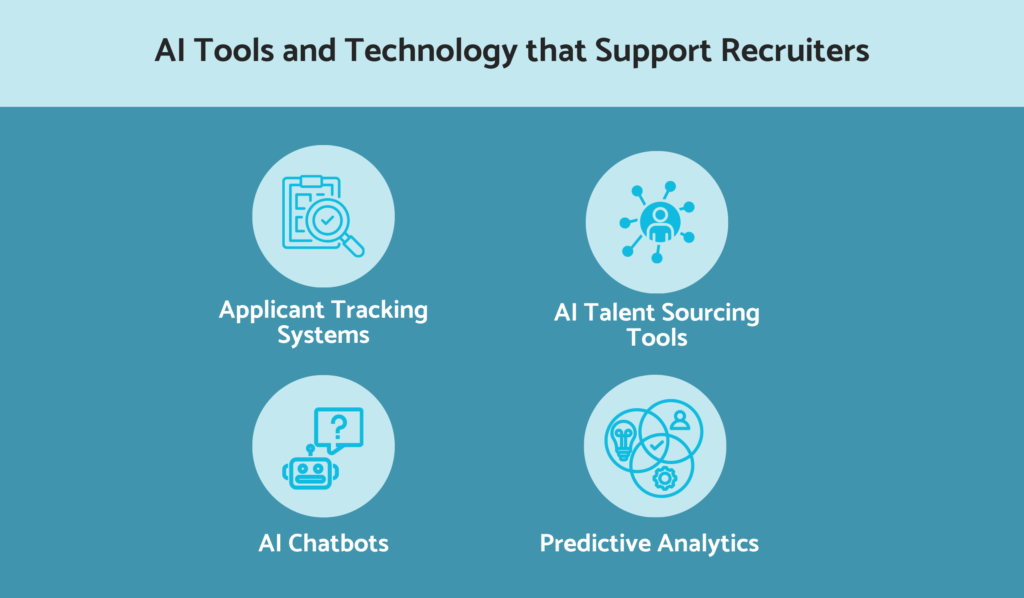
1. Applicant Tracking Systems (ATS) with AI screening features
Recruiters can use the Applicant Tracking System (ATS) software to manage job applications. When enhanced with AI screening features, an ATS can do more than screen and store CVs, as it can also assist in sorting, ranking, and managing candidates more efficiently.
Examples of ATS software include Greenhouse and SmartRecruiters.
2. AI sourcing tools for talent discovery
There are AI sourcing tools that use artificial intelligence to identify potential candidates across social media platforms, such as LinkedIn and other talent databases, after which such candidates are recommended to recruiters even before they apply.
Examples of AI sourcing tools include hireEZ, Hiretual, Fetcher and Entelo.
3. Chatbots for candidate communication
Recruitment chatbots act as the line of communication between candidates and recruiters. These AI-powered tools automate and support communication to boost candidates’ experience throughout the hiring process. Chatbots handle high-volume repetitive interactions within career or social media pages.
Examples of recruitment chatbots are JobPal, Talla, and Mya.
4. Predictive analytics for hiring trends and workforce planning
AI hiring tools can analyze performance trends in the industry and plan the strategies needed for a productive workforce. However, these technologies are not designed to make final hiring decisions.
Examples of predictive analytics platforms include HireVue, Pymetrics, and LinkedIn Talent Insights.
Make hiring smarter and simpler! Try our science-backed pre-employment assessments today. HIRE FOR FREE
With your knowledge of AI tools and technologies, you also need to know the best practices for introducing AI to your recruitment process without replacing humans.
8. 5 Best Practices for Introducing AI into Recruitment without Replacing Humans
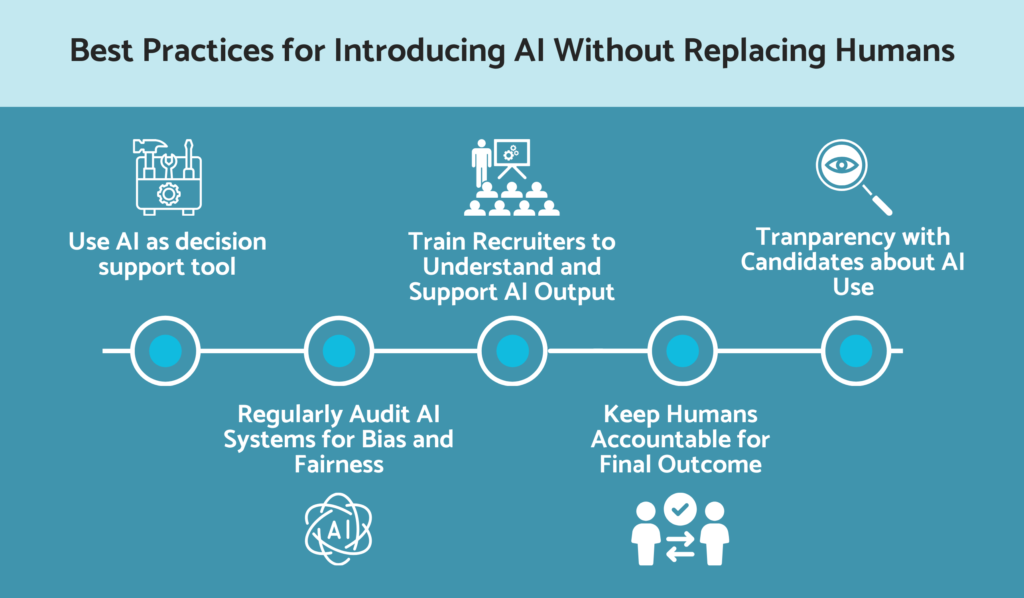
How to implement AI responsibly in your recruitment process
- Use AI as a decision-support tool, not a decision-maker
It is important to know that AI is not equipped to make final hiring decisions due to its fixed and structured programming. Final hiring decisions require behavioral, motivation and competency-based assessments that AI cannot perfectly evaluate.
- Train recruiters to understand and supervise AI outputs
Train your recruiters to understand how to use AI for recruitment, the limitations and the areas in which they can leverage the abilities of AI for an easier and more productive hiring process.
- Be transparent with candidates about AI use
Make candidates aware of the extent of AI’s involvement in your recruitment process. This will help build trust and let them know that both humans and AI adequately assessed them to ensure the best candidates are shortlisted.
- Regularly audit AI systems for bias and fairness
When using AI, it is important that the systems are audited regularly to ensure they remain fair in their assessment of candidates during recruitment and that necessary adjustments are made to the programming as needed.
- Keep humans accountable for final outcomes
The final decision should rest solely with human recruiters to reduce the risk of losing talent due to AI omissions.
Using AI in recruitment, over time, you might run the risk of over-automating the recruitment process. Find out about these risks in the section below.
9. The Risks of Over-Automation in Recruitment
There are several risks that come with the use of AI in an organization’s recruitment process. One of the risks is the excessive reliance on AI, which can create serious challenges for the organization. These challenges include the following:
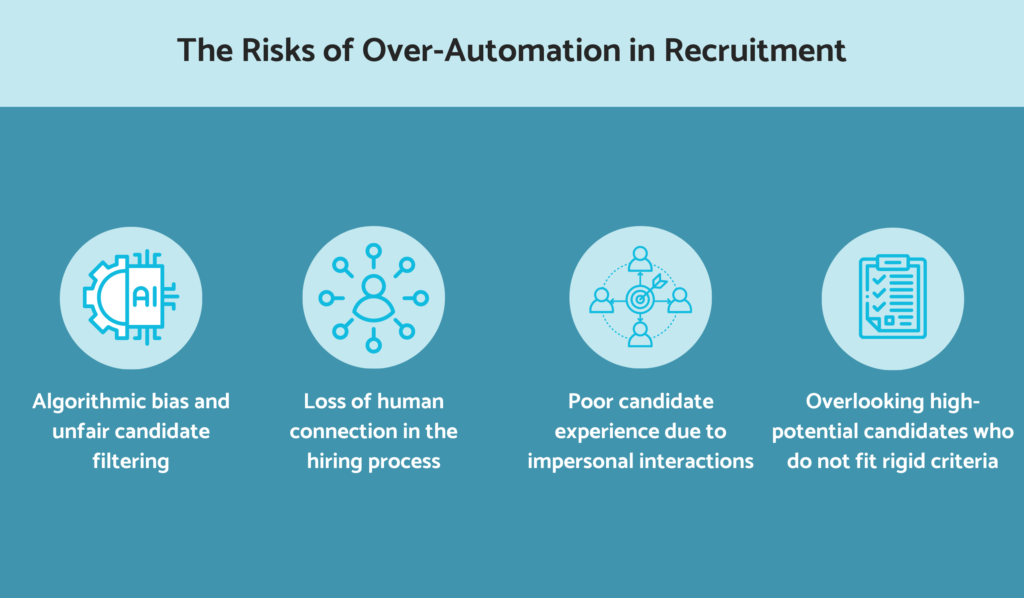
Algorithmic bias and unfair candidate filtering
The AI has the tendency to strike out candidates based on non-alignment with some fixed guidelines, which might not be suitable to assess all candidates equally and objectively.
Loss of human connection in the hiring process
When AI solely manages recruitment, it prevents candidates from developing rapport with the recruitment officers. This could affect the level of motivation and interest in potential recruits.
Poor candidate experience due to impersonal interactions
When AI is overused in the recruitment process, candidates are not able to get the best experience that comes with communication with humans since interactions between the organization and candidates are mostly going to be automated.
Overlooking high-potential candidates who do not fit rigid criteria
AI can easily overlook candidates with high potential to succeed in their roles because they do not align with the rigid criteria programmed into the system.
These risks highlight why human oversight remains essential when organizations introduce AI into hiring workflows.
Want to learn more about effective recruitment procedures? Explore the FAQs below and subscribe with your email to get started.
Frequently Asked Questions
Will AI replace human recruiters?
No, AI augments recruiters by automating repetitive tasks (screening, scheduling), while humans retain judgment, empathy, relationship-building, ethics, and final decision-making.
What are the major benefits of using AI in hiring?
AI improves speed, efficiency, scalability, cost reduction, data-driven decisions and candidate sourcing, especially for high-volume roles.
Is AI only suitable for large organizations or can small teams use it too?
AI is accessible to small and mid-sized teams through cloud-based subscription tools that scale with hiring needs.
How expensive is AI recruitment software compared to traditional hiring methods?
AI hiring tools often reduce overall hiring costs by lowering manual labor, agency fees and time-to-hire, despite upfront software costs.
What new skills do recruiters need to stay relevant in an AI-driven market?
Recruiters need AI literacy, data interpretation, ethical oversight, strategic thinking, employer branding, and relationship management skills.


 English
  Arabic