
How To Customize Pre-Employment Assessments To Match Your Role?



Have you ever hired a candidate who aced his/her interview but struggled once the role began? Or used a pre-employment test that seemed very professional yet told you very little about how a candidate would actually perform on the job?
These issues usually come down to one thing: misaligned pre-employment assessments.
In the current hiring environment, generic testing is not sufficient. An efficient recruitment requires customized pre-employment assessments that reflect real job tasks, team dynamics, and performance expectations. When assessments align with the role, they enhance the accuracy of hiring, lessen risk, and help achieve better long-term results.
Organizations that use structured, role-related pre-employment assessments report up to a 74% increase in hiring efficiency. This is because customized tests allow employers to assess job-relevant skills quickly and make more effective hiring decisions.
This guide walks you through how to design job-specific assessments that enable you to fairly evaluate candidates and make better hiring decisions with confidence.
Contents
- What are pre-employment assessments?
- Why do employers need customized pre-employment assessments?
- What are the benefits of customizing pre-employment assessments?
- Step-by-step guide to customizing pre-employment assessments
- How does Assess Candidates support customized pre-employment assessments?
Let’s start by understanding what pre-employment assessments are!
1. What Are Pre-Employment Assessments?
Pre-employment assessments are standardized tests and evaluations that help you assess a candidate’s abilities, skills, and personality traits. By using them, you can make hiring decisions that are more objective and backed by data.
Top common assessment types include:
- Cognitive Ability Tests
- Personality Tests
- Situational Judgment Tests
- Video Interviews
- Coding Tests
- Job Simulation Tasks
- Job-Specific Skills Tests
Research shows that properly designed pre‑employment tests such as work sample tests, can be up to 54% predictive of future job performance.
Discover data-driven hiring made simple with our pre-employment tests. HIRE FOR FREE
At this point, we know what pre-employment assessments are, let’s now discuss the reasons why you need customized pre-employment assessments.

2. Why Do Employers Need Customized Pre-Employment Assessments?
You need customized pre-employment assessments because they ensure candidates are evaluated on the abilities, behaviors, and skills that actually matter for the role, which improves hiring decisions.
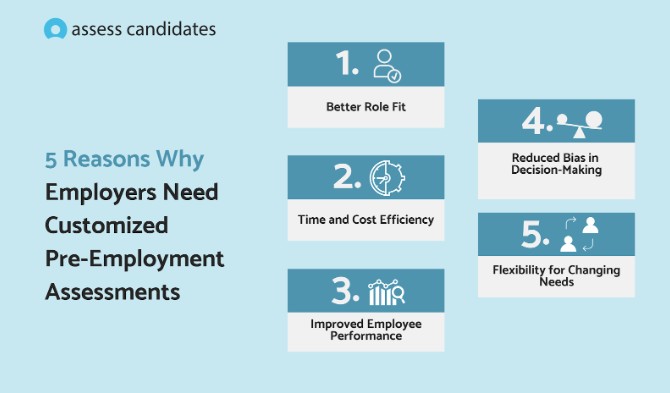
Top 5 reasons why employers need customized pre-employment assessments:
- Better role fit: Assessments designed for the job help identify candidates whose skills, personality, and work style match the position.
- Time and cost efficiency: Screening candidates more effectively means fewer interviews with candidates to go through and faster hiring, saving you and your company resources.
- Improved employee performance: Selecting candidates based on relevant skills and traits leads to stronger on-the-job performance.
- Reduced bias in decision-making: Customized tests keep the focus on job-related skills and experience, helping you avoid subjective decisions that can cost you high quality employees.
- Flexibility for changing needs: As your business evolves, customized assessments can adapt to new responsibilities, team dynamics, and goals.
Organizations that use structured pre-employment tests have a 90% higher probability of successful hiring.
Develop role-specific pre-employment tests that help you hire with confidence. Learn More
Understanding why generic assessments fall short leads naturally to the next question: What are the advantages of customizing pre-employment assessments in your hiring process?
3. What Are the Benefits of Customizing Pre-Employment Assessments?
Customized pre-employment tests go beyond one-size-fits-all approaches, and provide better, more precise and actionable information to inform hiring decisions. Matching tests to the job requirements enable you to assess candidates on those skills and behaviors that are really crucial.
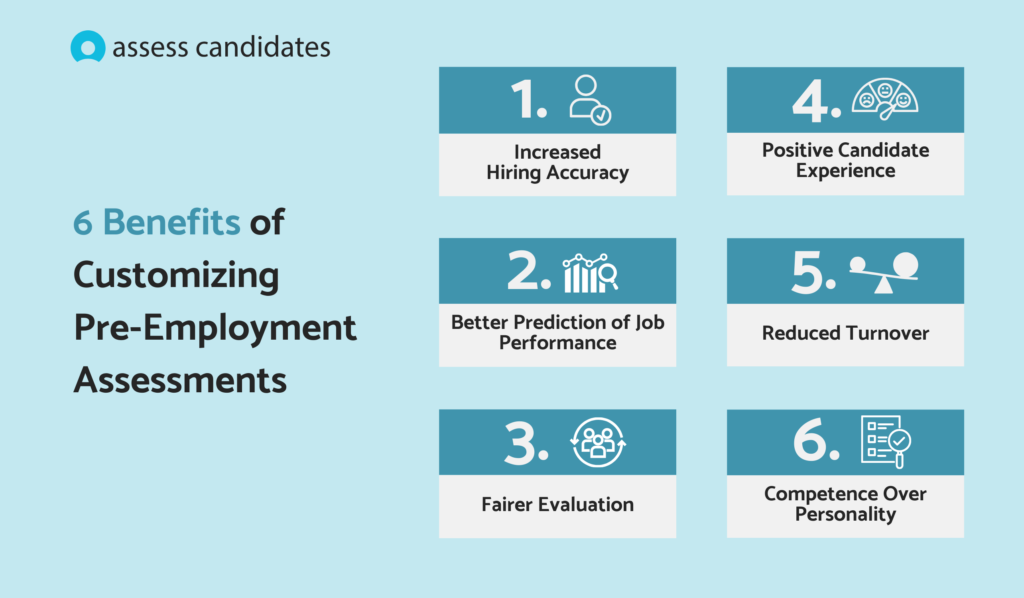
Top 6 benefits of using customized assessments in hiring:
- Increased hiring accuracy: Job-specific tests assess actual performance pointers as opposed to general characteristics. This ensures that hiring decisions are based on what predicts success in the actual role.
- Better prediction of job performance: Candidates demonstrate how they would perform on the job, not just how well they answer abstract questions.
- Fairer evaluation: Tailored hiring assessments use the same standards for everyone. This is more bias-free and ensures consistency in the decision-making process.
- Positive candidate experience: Role-specific assessment items are meaningful and engaging, which provide the candidates with a positive experience during the hiring process.
- Reduced turnover: Organizations can improve retention by identifying candidates who are a strong fit for both the role and the team. This also helps enhance long-term performance and overall team success.
- Competence over personality: Generic tests tend to place an excessive focus on likability or first impression rather than on job-specific critical abilities. Custom pre-employment assessments emphasize competence, hence the chances of choosing high performers are high.
These advantages indicate why role-specific, fair, and data-driven custom pre-employment evaluations are always effective in hiring quality employees.
According to reports by the Talent Board, the first-year turnover rate in organizations that have pre-employment assessments is reduced by 25%.
Create role-based pre-employment assessments today to improve hiring accuracy. Learn More
Having discussed the merits of customized pre-employment tests, the next step is to know how to customize pre-employment assessments to specific roles.
4. Step-by-Step Guide to Customizing Pre-Employment Assessments
You can’t build effective pre-employment assessments by relying on off-the-shelf tests alone. When you customize assessments, you align the evaluation with the required skills, behaviors, and decision-making needed in the position. This enhances hiring accuracy, fairness, and candidate experience.
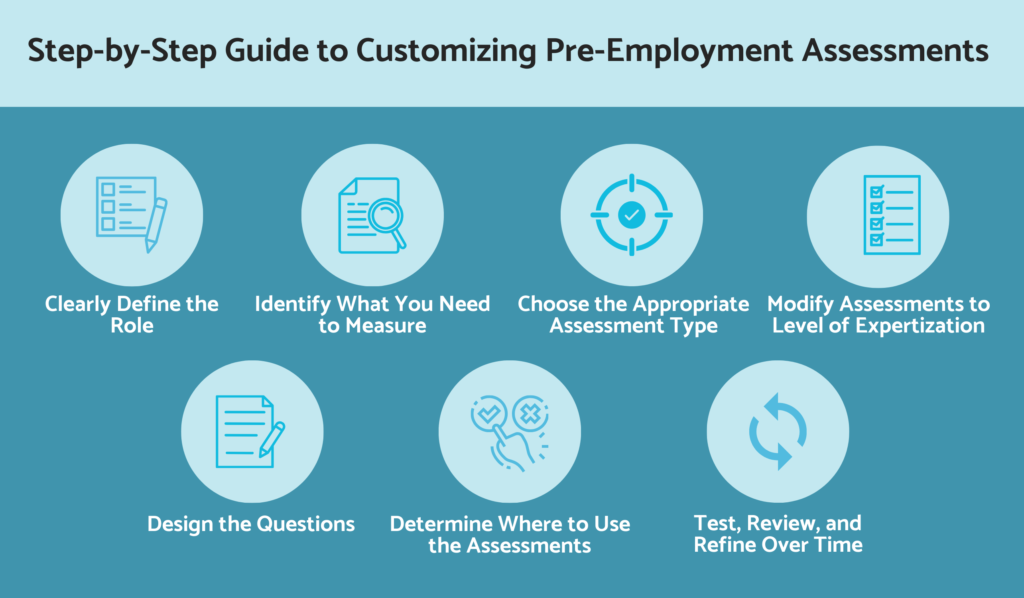
1. Clearly define the role:
Start with clarity. Identify key responsibilities, daily tasks, and success outcomes. Determine priority responsibilities, day-to-day activities, and expected success outcomes. Identify skills that are must-haves as opposed to those that can be trained. Include technical skills, soft skills, and behavioral characteristics vital to performance.
2. Identify what you need to measure:
Focus on job-related competencies. These include core technical or functional competencies, cognitive ability and problem-solving, personality and behavioral patterns, and situational judgment and team fit. This ensures your assessments support effective candidate evaluation rather than more generic metrics.
3. Choose the appropriate assessment type:
Match tools to the skills and behaviors you want to assess. For example, execution-based jobs involve skills and technical assessments, situational judgment tests are required in decision-making roles, while cultural fit requires personality tests.
4. Modify assessments to the level of expertization:
At the entry level, judgment, leadership, and strategic thinking are not as heavily evaluated as at higher levels, as the focus is on the ability to learn and the basic skills required for the job. It is relevant, fair, and actionable to alter the assessments according to the job level.
5. Design the questions:
The assessment questions must be realistic and should have occupational scenarios. The difficulty level should also be at the same level as the job requirement. Irrelevant and misleading questions that hinder accuracy should not be used. Designed questions do not only assess theoretical knowledge; they also forecast actual performance at work.
6. Determine where to use the assessments:
While late-stage testing verifies hiring, early-stage testing increases the effectiveness of the screening process. Strategic placement of the tests boosts their value and enhances the candidate experience.
7. Test and refine over time:
Tests should be continuously improved based on input from hiring managers and candidates, performance of newly hired staff, and modifications to business needs.
Role-specific skills measured with pre-employment structured tests have a validity coefficient of 0.54-0.65. This is more predictive of job performance compared to unstructured interviews.
Use our customized pre-employment tests to improve your hiring procedure. View Plans
Having an established process, it is important to make use of the appropriate tools to maximize the effectiveness of your designed pre-employment tests.
5. How Does Assess Candidates Support Customized Pre-Employment Assessments?
Assess Candidates helps organizations in implementing tailored pre-employment tests, which are more efficient than generic tests. With Assess Candidates, you can tailor assessments to specific roles. You can measure the necessary skills using tools such as situational judgement tests (SJTs) and a range of cognitive and personality tests.
By emphasizing practical behaviors and role-based competencies, Assess Candidates improves hiring accuracy and better predicts job performance.
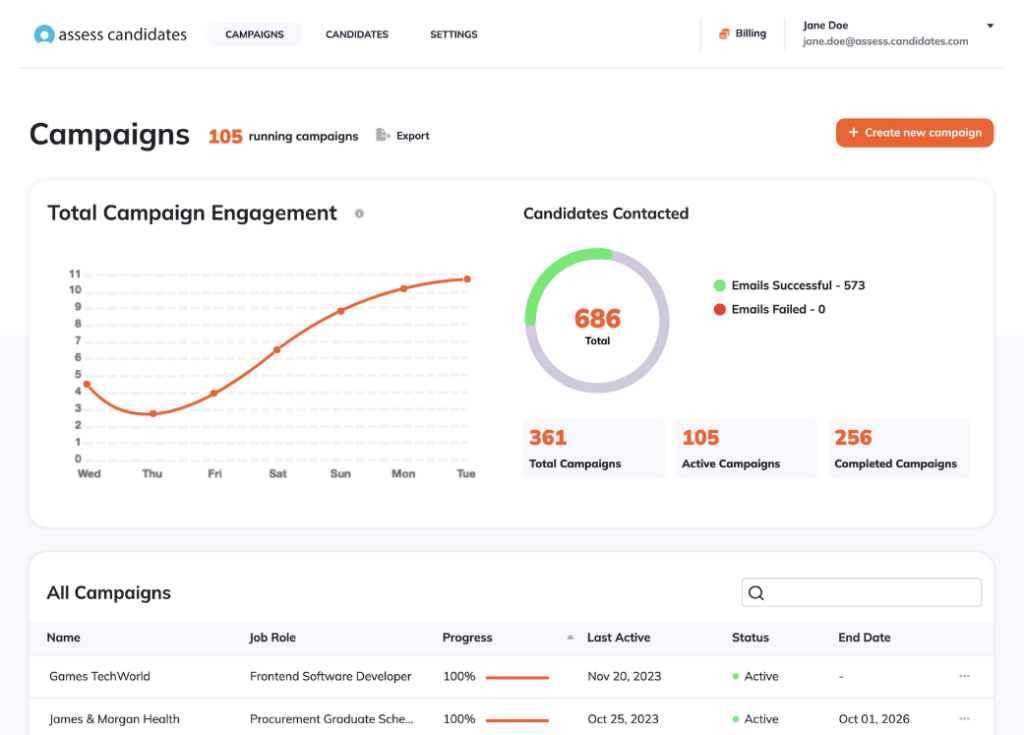
Companies can use customizable candidate assessment tools to:
- Design job-related tests as per the job requirements
- Modify job-specific tests to be relevant and fair
- Integrate skills testing and behavioral testing
- Use grading and analytics in a structured way to create objective hiring
This ensures a uniform, branded candidate experience, offers actionable feedback in business, and enables effective recruiting in the long-term.
Conclusion: Key Takeaway
Customization transforms pre-employment tests from one-size-fits-all filters to specific hiring tools. Role-based assessments improve fairness, validity, and long-term performance.
When hiring teams match assessments to real job demands, they decrease risk, reinforce decision-making, and create better teams.
Better assessments lead to better hires. And recruitment of better hires makes a stronger business.
Strengthen your hiring quality using our reliable pre-employment assessments. View Plans
Would you like to know more about customized pre-employment tests? Explore the FAQs below and sign up with your email to get started!
Frequently Asked Questions
Why are customized pre-employment assessments better than generic tests?
Customized pre-employment assessments specifically focus on abilities, skills, and personality traits that matter for the role you’re hiring for. This not only improves the accuracy of your hiring decisions but also helps predict long-term success.
What forms of pre-employment assessments can be customized?
Almost any pre-employment assessment can be tailored to suit your hiring needs. This includes skills tests, cognitive ability tests, situational judgment tests, and role-play simulations. By customizing assessments, you ensure candidates are evaluated on what truly matters for their specific role.
Are customized pre-employment assessments more effective in hiring?
Yes, job-specific assessments give you structured, objective information that allows you to compare candidates fairly. They reduce bias by focusing on role-relevant competencies rather than subjective impressions. This increases the likelihood of hiring candidates who are capable of succeeding in the position.
Can customized pre-employment assessments improve retention?
Yes. When you hire candidates who fit the role and team well, they are more likely to feel confident and engaged in their work. This alignment reduces turnover, boosts productivity, and improves overall team performance over time.
How does Assess Candidates support customized pre-employment assessments?
Assess Candidates offers customized assessments tailored to each job description and level. They also include built-in anti-cheating measures to ensure test integrity and accessibility features to support fair and inclusive hiring.


 English
  Arabic