
How to Measure Attention to Detail in Candidates During the Hiring Process



Attention to detail is one of those skills many candidates say they have, but few can apply it under real working conditions.
While anyone can easily claim to be “detail-oriented” on CVs or during interviews, the real challenge is evaluating if they can actually spot errors, manage information accurately, and follow instructions under pressure. Measuring attention to detail during the hiring process gives you a much clearer picture of how candidates may perform in many detail-focused roles, such as administration, finance, engineering, healthcare, and customer support.
Resumes and traditional interviews don’t do a great job at identifying attention to detail. Relying solely on these methods may lead to costly mis-hires. That’s why assessment tools like checking tests, game-based assessments, situational judgment tests, and job simulations are far more reliable.
In this guide, we will explore the practical, structured ways you can effectively assess attention to detail in candidates and reduce hiring errors.
Contents
- What is attention to detail?
- Why does attention to detail matter in the workplace?
- How to measure attention to detail skills in candidates
- How to score attention to detail accurately
- What to avoid when assessing attention to detail
- Client success story: Measuring attention to detail
- Why do top companies choose Assess Candidates to assess attention to detail?
Now that we’ve summarized what this article will cover, let’s explore what attention to detail skills are.
1. What is attention to detail?
Attention to detail is the ability to notice, process, and work with the small but important details of a task that might otherwise be overlooked. It is what helps someone follow instructions accurately, spot mistakes before they cause problems, and deliver projects thoroughly and to a high standard.
Attention to detail assessments help you evaluate a candidate’s ability to identify errors, spot inconsistencies, and work carefully with inaccuracies in various forms of critical information like numerical data, written documents, instructions, records, and more. Rather than relying on self-reported claims, these tests show how candidates actually perform.
Did you know? According to CareerBuilder, 58% of employers say poor attention to detail is a top reason why candidates are rejected.
Enhance your hiring strategy with our science-backed attention to detail assessments. HIRE FOR FREE
Now, let’s take a look at why attention to detail is so important in the workplace.

2. Why does attention to detail matter in the workplace?
Attention to detail is an essential skill in a workplace. It shows up in various ways: when checking numbers for accuracy, proofreading documents, following multi-step processes, and ensuring no important details are missed out.
This skill directly impacts accuracy, quality, and trust in roles where even minor oversights or inaccuracies can lead to costly errors.
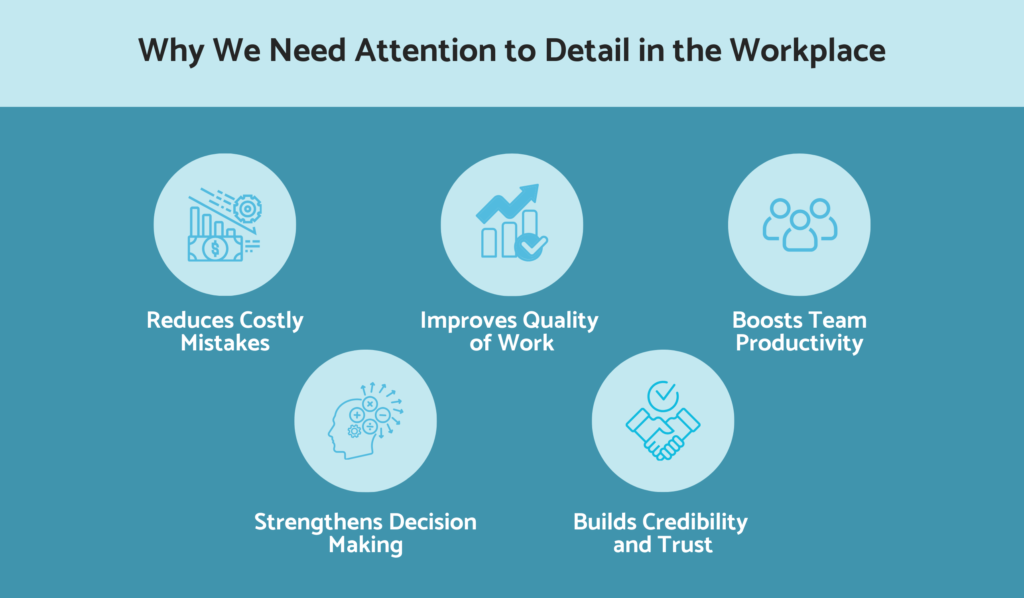
5 reasons why attention to detail matters in the workplace
1. Reduces Costly Mistakes
Employees with great attention to detail skills lead to the reduction of costly operational mistakes, including errors in data, communication, reporting, and processes. A lack of attention to detail in your team may instead lead to customer dissatisfaction or heavy financial loss.
2. Improves Quality of Work
Employees with strong attention to detail ensure that their work is polished, consistent, and professional in every aspect. This increases the quality and standard of work throughout the business.
3. Boosts Team Productivity
Detail-oriented hires do not waste time fixing errors and mostly submit error-free work. This further helps in speeding up the workflow, productivity, and output.
4. Strengthens Decision Making
Detail-focused employees notice patterns, discrepancies, or small changes in information. This leads to smarter, more accurate, and more reliable business decisions.
5. Builds Credibility and Trust
When employees with strong attention to detail consistently deliver thorough, error-free work, they increase the reliability and trustworthiness of the team. This leads to stronger team dynamics and reduces micromanagement.
Our pre-employment checking error tests accurately assess attention to detail in candidates. LEARN MORE
Next up, we will explore the various methods for measuring attention to detail skills.
3. How to measure attention to detail skills in candidates
Assessing attention to detail in candidates requires structured, evidence-based assessment methods that help you understand how accurately candidates process information, identify errors, and follow instructions, especially when time or pressure is involved.
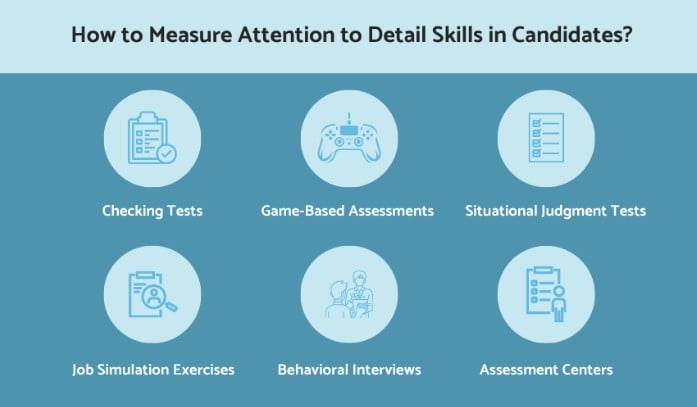
Below are some of the most reliable ways to assess attention to detail during the hiring process:
- Checking Tests
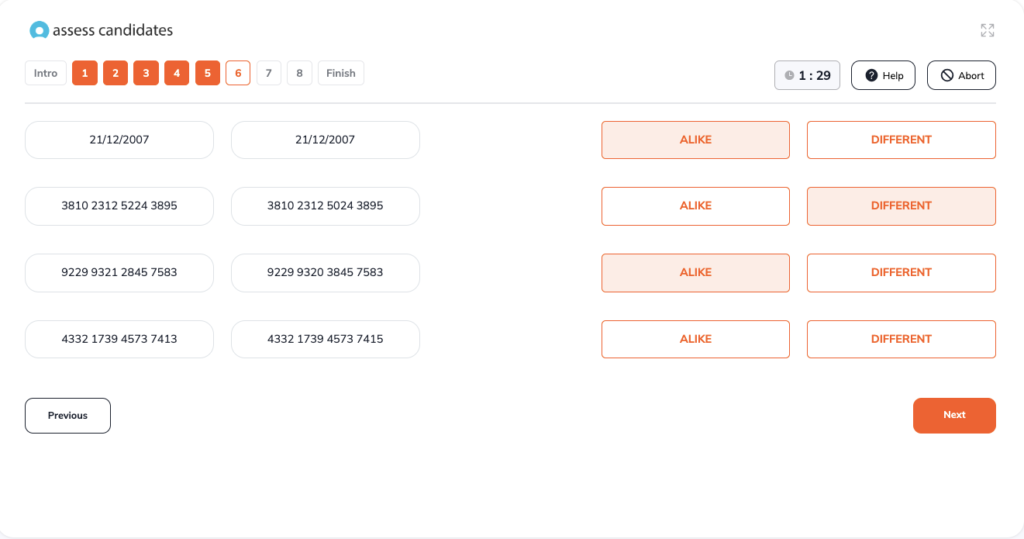
Checking tests are one of the most accurate ways to measure a candidate’s attention to detail, precision, and focus since they directly evaluate error-spotting skills and pattern recognition under strict time constraints. These tests will help you identify candidates who can process information quickly while maintaining accuracy.
Example question: “State whether the two sets of numbers 127849027463 and 127849028463 are ‘Alike’ or ‘Different’.”
- Game-Based Assessments
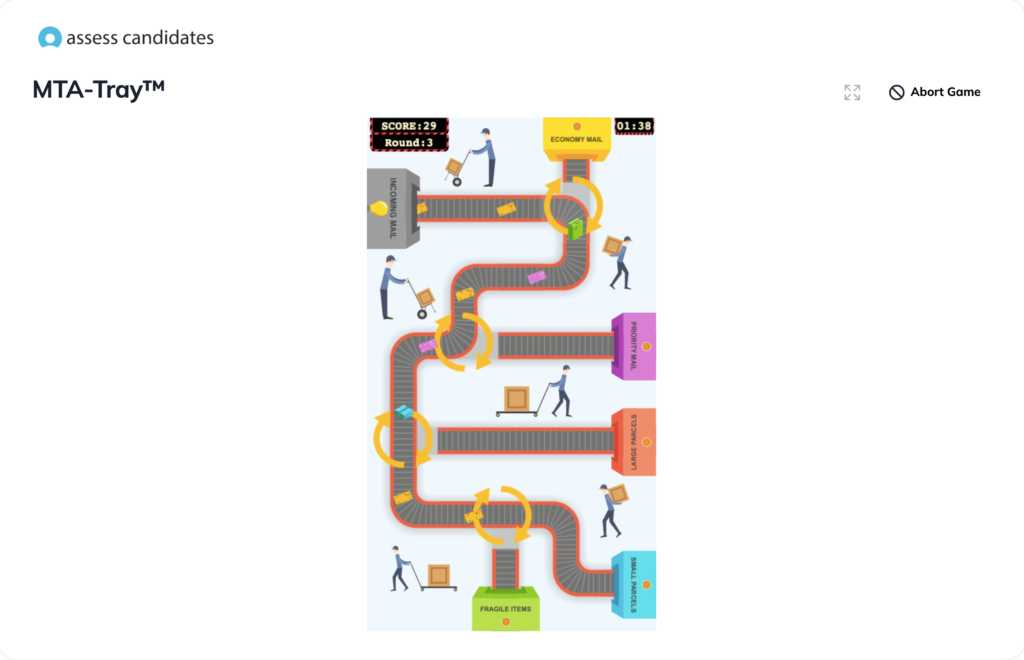
Game-based assessments will help you measure micro-level attention skills in an interactive and engaging format. These tests will further help you get deeper insights while hiring, as they track speed, accuracy, memory, and selective focus together.
Example: Candidates are required to play a game-like task to manually sort parcels into the correct mailbox.
- Situational Judgment Tests
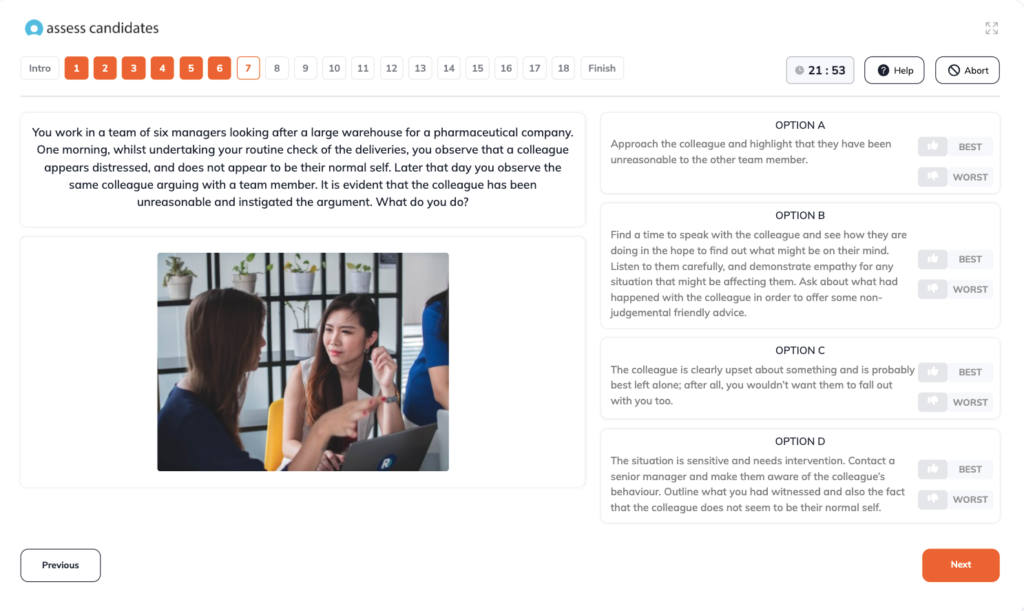
Situational judgment tests (SJTs) help you understand how candidates apply attention to detail skills in realistic workplace scenarios. Their chosen answers reveal how carefully they consider details and how they prevent errors from occurring in real-world workplace scenarios.
Example: The report is due in 10 minutes. What should you do?
- Submit the report as it is and correct the discrepancy after the meeting.
- Quickly check the source again, correct the discrepancy, and notify your manager if it affects the outcome.
- Ignore the mismatch because it is small and unlikely to be noticed.
- Delay the report submission to redo the entire summary table from scratch.
- Job Simulation Exercises
Job simulation exercises measure attention to detail through hands-on activities that closely mirror real-life responsibilities. These tasks will help you observe candidates’ accuracy, consistency, and ability to follow instructions properly in real-world workplace scenarios.
Example: “You are reviewing an invoice that lists three items. The subtotal displayed is $150USD, but when you calculate the individual item totals, you get $130USD. The customer has already been sent a draft copy of this invoice. What should you do?”
- Keep the subtotal as it is since it’s only a small difference.
- Correct the subtotal to $130USD and send the updated invoice immediately.
- Verify each item again, correct the subtotal, and inform your manager before sending the final version.
- Wait for the customer to notice the error, then fix it later.
- Behavioral Interviews
Behavioral interviews help you understand how candidates have used their attention to detail skills in their previous roles. Their responses to your questions highlight whether they naturally approach tasks with precision and thoughtfulness.
Example: “How do you check your work for accuracy?”
- Assessment Centers
Assessment centers measure attention to detail skills through a combination of methods, including group exercises, tests, simulations, and structured interviews. Through assessment centers, you can evaluate how consistently and accurately each candidate performs across various settings.
Example: “Collaborate to review, correct, and finalize the four-page operations document within 20–30 minutes.”
Discover the potential of attention to detail assessments and boost your hiring accuracy. HIRE FOR FREE
To get answers to all the questions mentioned above, head down to the end of the article.
Next, let’s take a look at various proven ways to score attention to detail skills.
4. How to score attention to detail accurately
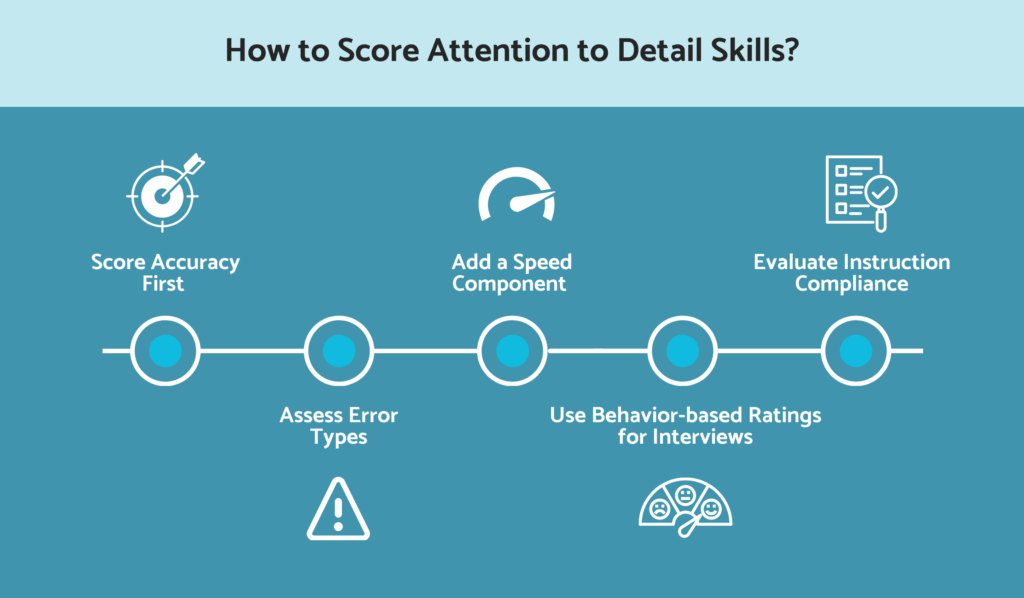
Scoring attention to detail skills requires a standard scoring rubric that evaluates how well candidates spot errors, follow instructions, and maintain precision under time constraints.
5 ways to score attention to detail skills effectively
1. Score Accuracy First
We have learnt from designing attention-to-detail assessments that accuracy remains the strongest indicator of performance. Hence, start your evaluation process by scoring how accurately candidates complete each task. This includes measuring their ability to correctly spot errors, identify missing information, and provide error–free outputs.
2. Add a Speed Component
Include speed as a secondary scoring component to understand how well candidates maintain precision when under strict time pressure. This further helps you identify candidates who can work efficiently, paying attention to detail without sacrificing the quality of work.
3. Evaluate Instruction Compliance
Attention to detail often complements how well candidates adhere to the given instructions. Score how candidates adhered to each step, followed the instructions properly, and used the correct format. This metric showcases a candidate’s ability to read carefully and execute tasks as instructed.
4. Use Negative Marking
From our experience helping thousands of recruiters hire better, we have observed that not all errors carry the same risk. Hence, you should focus on building a system that negatively marks mistakes but also scores them based on their impact, that is, critical, moderate, or minor.
This approach will further help you identify errors that might impact your business or ones that are simply harmless typos.
5. Use Behavior-Based Ratings for Interviews
Behavior-based interviews are the strongest indicator of how candidates have previously applied their attention to detail skills in real-life jobs. Score each answer based on a standardized rubric that measures clarity, structure, and real-world impact.
Leverage our candidate assessment platform to identify candidates with strong attention to detail skills. LEARN MORE
But it is also important to consider avoiding the following when measuring attention to detail in candidates:
5. What to avoid when assessing attention to detail
While measuring attention to detail, you must avoid unreliable or misleading practices. This section walks through some of the most common pitfalls you should steer clear of.
5 red flags to avoid while measuring attention to detail in candidates
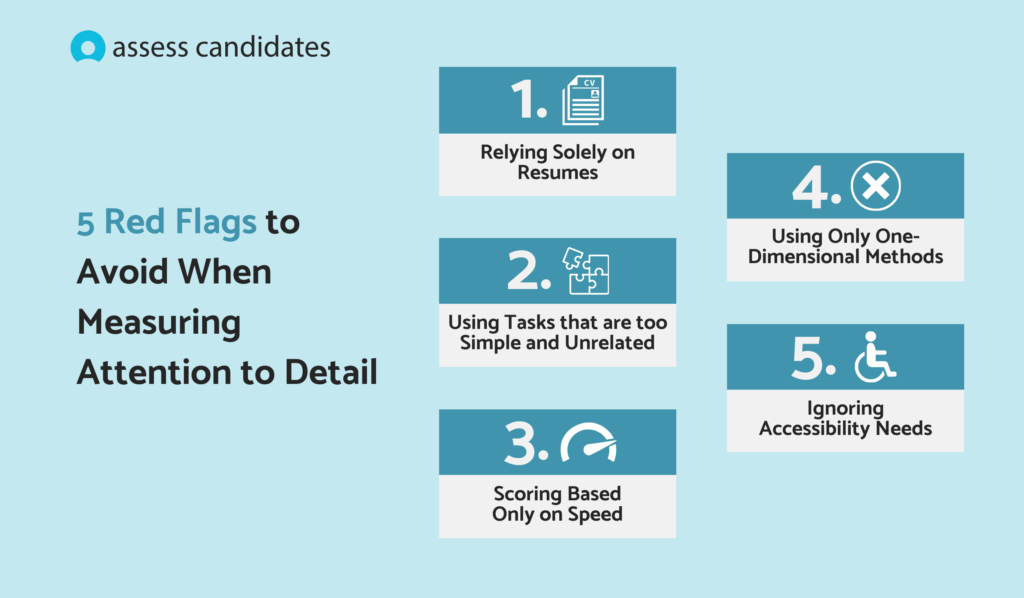
- Relying Solely on Resumes or Self-Reported Strengths: On their CVs or during interviews, candidates can self-report that they are “detail-oriented”. However, this rarely reflects their actual accuracy and attention to detail. Hence, you should never replace structured testing with self-reports but draw from both insights.
- Using Tasks that are Too Simple and Unrelated: Using overly simple tests like spotting an easy typo will not clearly reveal a candidate’s true precision levels or attention to detail skills.
- Scoring Based Only on Speed: Candidates who rush to solve tests may score higher on time but will perform poorly on accuracy. Hence, measuring speed alone can be misleading.
- Using Only One-Dimensional Methods: Using only one method, like just interviews or proofreading tasks, can limit your understanding of a candidate’s abilities. Hence, a combination of tests, simulations, and interviews is necessary for painting a well-rounded picture of candidates’ attention to detail skills.
- Ignoring Accessibility Needs: Many qualified candidates may not be able to proceed with the selection if inclusivity is not offered. Adjustments like extended time, clarity, screen-reader compatibility, and adjustable color contrasts are necessary for a fair hiring process.
6. Client Success Story: Measuring Attention to Detail
Client Problem Statement
Imagine a growing e-commerce company struggling to hire operations associates who can identify data inconsistencies, follow complex order-processing steps, and maintain accuracy while handling high volumes of information.
As a result, their order mistakes will increase, shipment delays will become more frequent, and customer complaints will also rise significantly. Hence, the organization now requires a reliable way to evaluate candidates’ accuracy, instruction-following ability, and consistency under pressure.
Assess Candidates’ Proposal
At Assess Candidates, we recommend integrating checking tests, game-based assessments, and job simulation tasks early in the hiring process. These tools measure how effectively candidates spot errors, follow multi-step instructions, and process information with precision in realistic operational scenarios.
When paired with structured behavior-based interviews and situational judgement tests, recruiters can gain deeper insights into how candidates maintain accuracy, handle repetitive tasks, and avoid costly mistakes. Together, these methods reveal a candidate’s true attention to detail and reliability.
Result
By adopting these attention-to-detail assessments, the e-commerce company can confidently identify candidates who demonstrate high accuracy, strong instruction-following skills, and consistent performance. This leads to fewer order errors, smoother operations, and significantly improved customer satisfaction.
Ultimately, the company strengthens its workforce, reduces operational risk, and builds a more dependable team capable of maintaining quality at scale.
Partner with Assess Candidates to integrate a range of psychometric tests into your hiring process. VIEW PLANS
7. Why do top companies choose Assess Candidates to assess attention to detail?
At Assess Candidates, we offer a wide range of pre-employment recruitment tests that measure attention to detail in candidates. You can also create recruitment campaigns customized to your organization’s unique hiring needs.
Here is an example of our campaign reporting dashboard available on Assess Candidates.
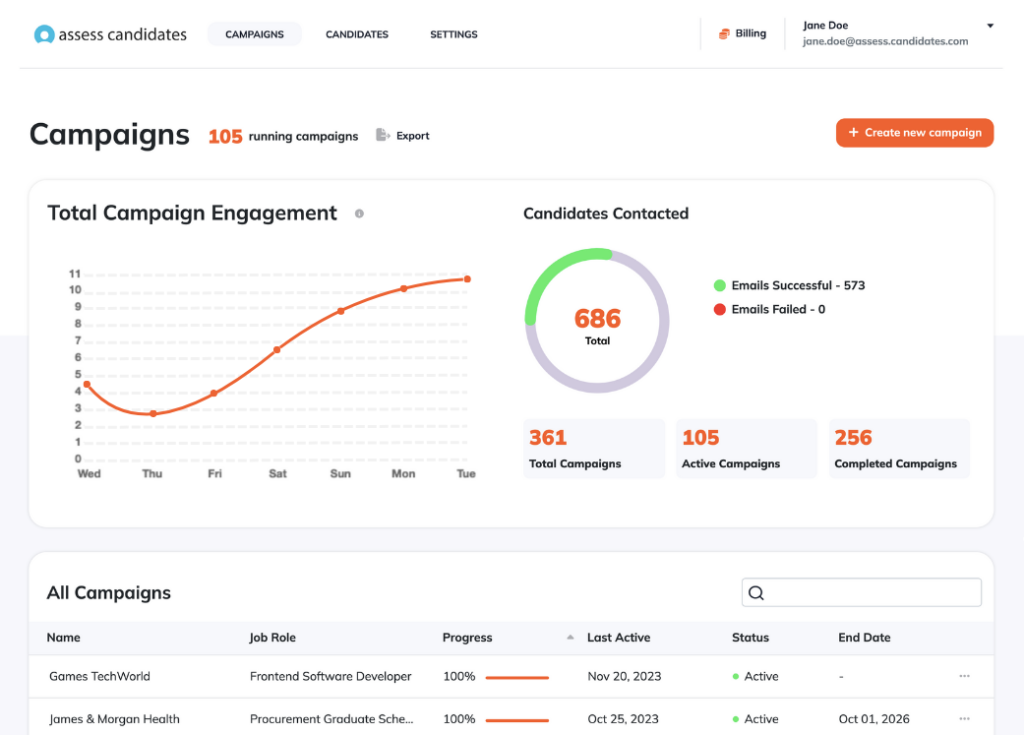
Here are 4 reasons why you should use Assess Candidates for measuring attention to detail in candidates:
- Scientifically Designed by Expert Psychologists: Assess Candidates’ attention-to-detail assessments are developed by experienced Psychologists and Psychometricians who have previously designed assessments for global leaders such as SHL and IBM Kenexa.
Each assessment undergoes rigorous validation to ensure it accurately measures error-detection ability, pattern recognition, instruction-following accuracy, and consistency under time pressure. This scientific approach gives you confidence that you are hiring candidates who maintain precision, minimize costly mistakes, and work with exceptional accuracy.
- Advanced Reporting: Our intuitive platform provides clear, comprehensive reports that highlight each candidate’s accuracy rate, error types, speed, consistency, and ability to follow detailed instructions. Recruiters can quickly compare results, identify high performers, and shortlist applicants based on objective, data-driven evidence. With seamless ATS integration, your scoring and decision-making process becomes faster, more reliable, and fully automated.
- Positive Candidate Experience: We design our attention-to-detail assessments to be intuitive, user-friendly, and accessible across all devices. Candidates receive clear instructions and experience smooth navigation, allowing them to focus entirely on spotting errors, following steps correctly, and completing tasks accurately. Companies can also apply custom branding to maintain a consistent employer identity throughout the assessment journey.
- Candidate Accessibility Support: We prioritize inclusivity and ensure candidates can demonstrate their attention-to-detail skills fairly through robust accessibility features such as extended time options, screen-reader compatibility, adjustable color contrasts, and Zoom functionality. All tools comply with WCAG accessibility standards, ensuring an inclusive and equitable assessment experience for all applicants.
Assess Candidates offers reliable, science-backed tools that help organizations measure attention to detail accurately and hire smarter, faster, and more fairly. Explore our complete range of assessments to start identifying candidates with strong error-spotting skills today.
Not sure which problem-solving assessments to choose? Contact us for a free analysis of your hiring needs.
Answers to the above example questions
- Checking Test: Different
- Situational Judgment Tests (SJTs):
- Best option: B
- Worst option: D
- Job Simulation Exercises: Option C
Conclusion: Key Takeaway
- Attention to detail ensures accuracy, quality, and error-free task completion.
- Strong attention to detail reduces costly mistakes and improves overall work quality.
- High-detail performers boost productivity by minimizing rework and errors.
- Attention-focused employees make more accurate, informed decisions.
- Consistent accuracy builds trust, reliability, and stronger team dynamics.
- Accuracy should be the primary scoring factor when assessing attention to detail.
Interested in learning more about effective candidate assessment? Continue reading for frequently asked questions, and sign up with your email to get started.
Frequently Asked Questions
What is the most reliable method to measure attention to detail in candidates?
One of the most reliable ways to measure attention to detail skills in candidates is by combining multiple assessment methods, including checking tests, game-based assessments, job simulations, and situational judgment tests. This helps you gain a complete picture of the candidate’s real-world abilities.
How can you measure attention to detail for remote/hybrid roles?
You can measure attention to detail skills in remote or hybrid roles by using assessment methods like online checking tests, job simulations, and task-based exercises. These tools assess accuracy, focus, and a candidate’s ability to follow instructions in a virtual environment.
Can interviews effectively measure attention to detail in candidates?
Yes. Although interviews alone are not a strong indicator, structured behavior-based interviews assess real-world thoughtfulness and accuracy in candidates. When you ask candidates how they identify errors or handle detailed tasks, you will get deeper insights into their habits and processes.
Should speed be considered when evaluating attention to detail?
Yes, speed is necessary for measuring attention to detail skills in candidates. However, they are secondary to accuracy. You can include time limits to assess efficiency, but avoid candidates who rush through assessments and make mistakes.
How can you prevent bias when assessing attention to detail?
You can prevent bias when assessing attention to detail skills in candidates by using standardized assessments with clear scoring rubrics, timed tasks, and objective outputs. Moreover, automated scoring tools also reduce subjectivity by measuring accuracy, error types, and instruction-following without human interpretation.


 English
  Arabic