
How to Measure Decision-making in Candidates During the Hiring Process



Did you know that you could get a clear picture of how candidates think and perform by assessing their decision-making skills during the hiring process? While interviews reveal confidence, only real-time analyzation skills, prioritization, and acting under pressure will give you an accurate view of their real capabilities.
Decision-making skills may not be readily apparent on resumes and in traditional interviews, which can lead to mis-hires. To avoid this issue, use assessment tools like situational judgment tests, game-based assessments, job simulations, and role-specific scenarios that reveal how candidates make decisions in real-world situations.
In this guide, we will explore how you can effectively use decision-making skills in candidates through structured, assessment-based methods.
Contents
- What is decision-making?
- Why do we need decision-making skills in the workplace?
- How to measure decision-making skills in candidates?
- How to score decision-making skills?
- What to avoid when measuring decision-making skills in candidates?
- How to measure decision-making skills: Client Success Story
- Why do top companies choose Assess Candidates’ assessments for measuring decision-making skills?
Now that we’ve summarized what this article covers, let’s explore what decision–making skills are.
1. What is decision-making?
Decision-making in hiring is a soft-skill that is used to assess which candidates can effectively choose between possible solutions to a problem after weighing pros and cons, collecting information, and analyzing alternative solutions.
Candidates with strong decision-making skills are highly valued in an organization. Organizations evaluate candidates and choose the top candidate for a particular role. This evaluation is based on evidence, role requirements, and organizational goals.
Did you know? According to CareerBuilder, 58% of employers cite poor attention to detail as a top reason for job rejection.
Improve your hiring strategy with our science-backed assessments that measure decision-making. HIRE FOR FREE
Now, let’s take a look at why measuring decision-making skills is necessary in the workplace.

2. Why do we need decision-making skills in the workplace?
Decision-making skills are important in a workplace as they help choose the best course of action in everyday situations.
5 major reasons why decision-making skills matter in the workplace
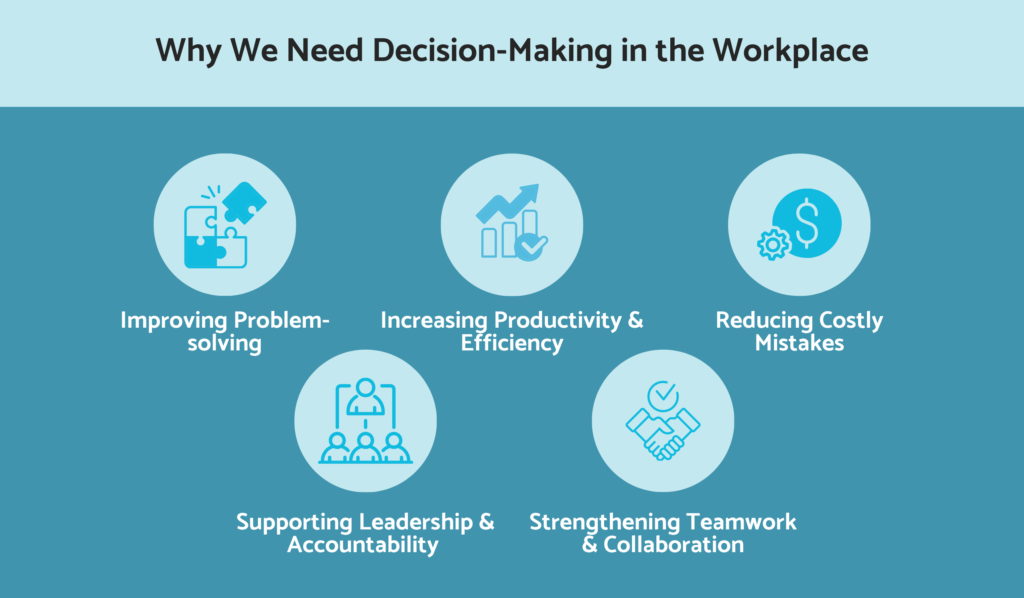
1. Improving Problem-solving
Employees with strong decision-making skills can easily analyze a situation, quickly understand and identify the root cause, and choose a solution that will actually work and help solve the problem.
2. Increasing Productivity & Efficiency
Employees with good decision-making skills prioritize their work, make clear decisions without overthinking, reduce delays, keep projects on track, and make decisions without second-guessing themselves.
3. Reducing Costly Mistakes
Employees with strong decision-making skills weigh options and risks, check assumptions, and consider the consequences before making a decision. This will further help your organization avoid costly errors and rework.
4. Supporting Leadership & Accountability
Employees with robust decision-making skills display leadership qualities and rely on their decision-making skills to guide teams, set priorities, and take responsibility for outcomes, especially in high-pressure situations.
5. Strengthening Teamwork & Collaboration
Employees with clear decision-making skills consistently communicate choices confidently, resolve conflicts faster, and also support teams in aligning around communicated goals.
Discover our scientifically validated assessments for assessing decision-making skills. LEARN MORE
Next up, we will explore various methods for measuring decision-making skills.
3. How to measure decision-making skills in candidates?
Measuring decision-making skills in candidates requires structured, evidence-based assessment methods that would help you understand how accurately candidates process information, identify errors, and follow instructions:
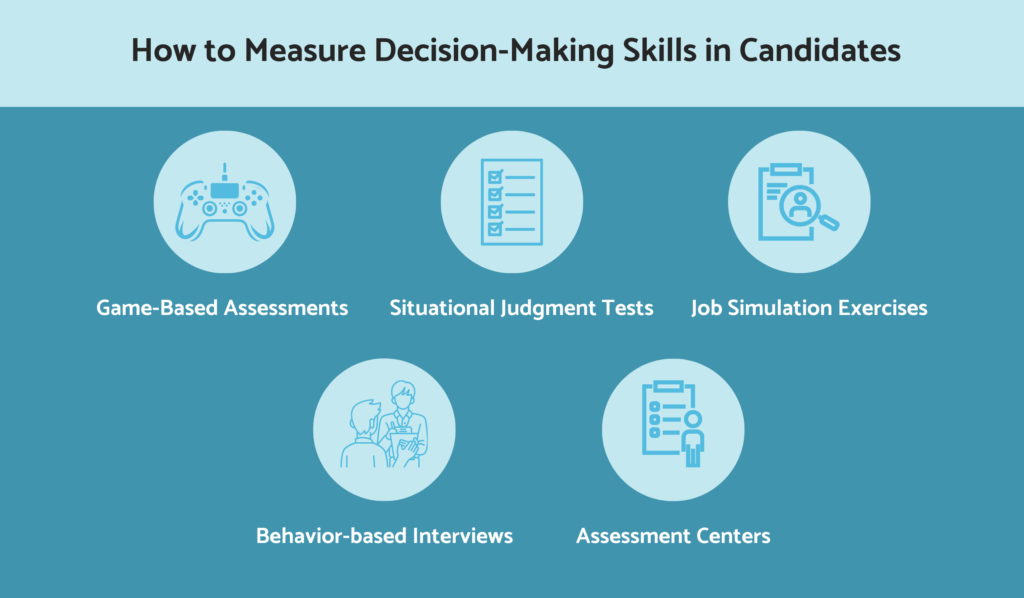
- Game-Based Assessments
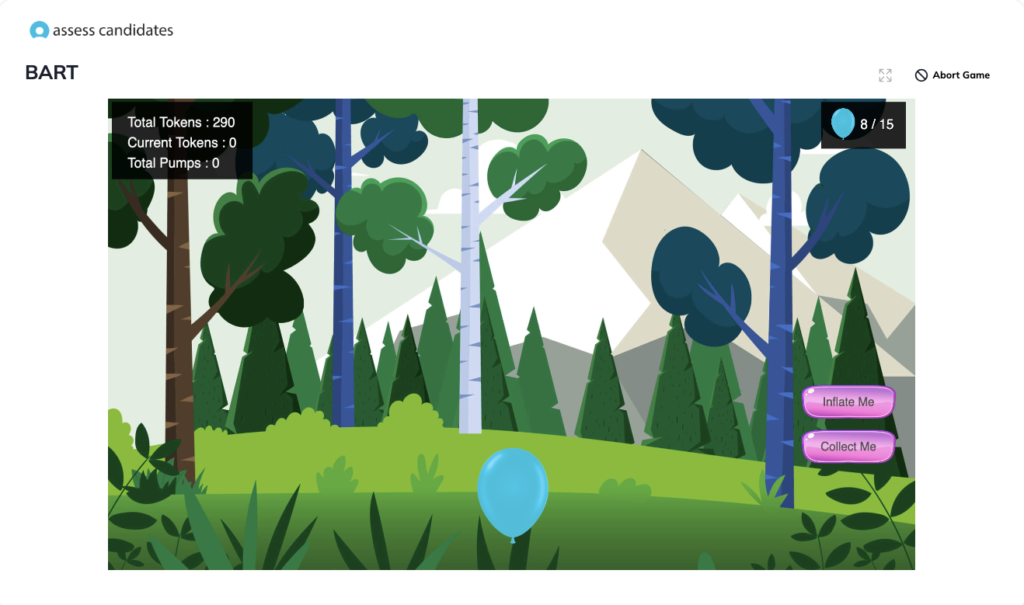
Game-based assessments will help you measure decision-making skills in candidates by placing them in interactive, time-bound scenarios where they will be required to make quick and strategic choices. These assessments help you understand a candidate’s ability to handle risks, uncertainties, and competing priorities.
Example 1: Assess a candidate’s propensity to take risks through the balloon-popping game based on the Balloon Analogue Risk Task (BART).
- Situational Judgment Tests
Situational judgment tests (SJTs) help you understand how candidates apply their decision-making skills in realistic job-related scenarios. Their chosen answers will help you measure their practical judgment, ethical decision-making, emotional control, prioritization, and problem-solving skills.
Example 2: “You are working on a vital project when a client requests an urgent change that could delay delivery. Your manager is unavailable. What should you do?”
- Proceed with the change immediately to satisfy the client
- Assess the impact, communicate possible delays to the client, and document your decision
- Ignore the request and stick to the original plan
- Wait for your manager’s approval before taking any action
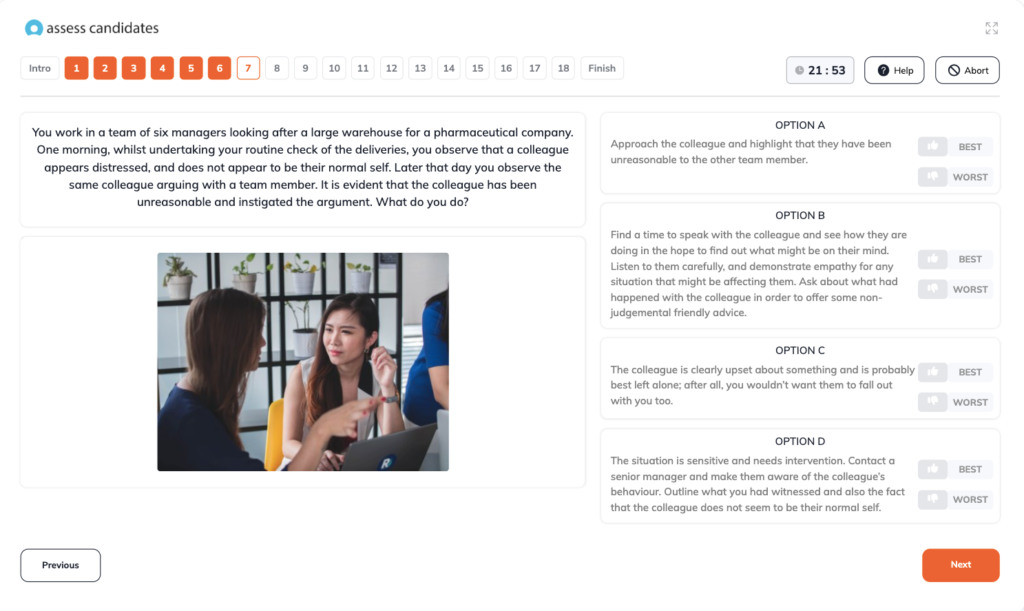
To get answers to all the questions mentioned above, head down to the end of the article.
- Job Simulation Exercises
Job simulation exercises measure decision-making skills by replicating actual job responsibilities and asking candidates to make decisions as if they were already on the job. Their answers will help you measure their decision-making skills under real constraints, their ability to prioritize tasks, their problem-solving skills, and their business awareness.
Example 3: “You are working as a project coordinator. At 9 AM, you log in and see the following tasks in your inbox. You have 60 minutes before a scheduled client review meeting.”
- Immediately investigate the system alert to prevent any possible future delays.
- Approve your teammate’s task so work can continue, then respond to the client with a clear explanation.
- Prepare the status update for leadership before addressing any other tasks.
- Respond to the client first and wait to handle the remaining tasks after the meeting.
- Behavioral Interviews
Behavioral interviews help you understand how candidates have used their decision-making skills in their previous roles. Their responses will help you predict their future job behavior, reasoning behind decisions, accountability, and learning and handling of pressure and consequences.
Example 4: “Can you describe a situation where you had to adapt quickly to a change?”
- Assessment Centers
Assessment centers measure decision-making skills through multiple evaluation methods, including group exercises, presentations, simulations, and structured interviews. Through assessment centers, you can evaluate candidates’ decision-making skills in group settings, influence and collaboration, strategic thinking, and leadership judgment.
Example 5: “You are the CEO of a company considering a merger. What key factors would you evaluate before deciding whether to proceed?”
Uncover the potential of decision-making assessments and boost your hiring accuracy. HIRE FOR FREE
Next, let’s take a look at various proven ways to score decision-making skills.
4. How to score decision-making skills?
Scoring decision-making skills requires using a standard scoring rubric that evaluates how well candidates analyze situations, prioritize actions, and choose effective solutions under real-world constraints.
Here are the 5 ways to score decision-making skills effectively:
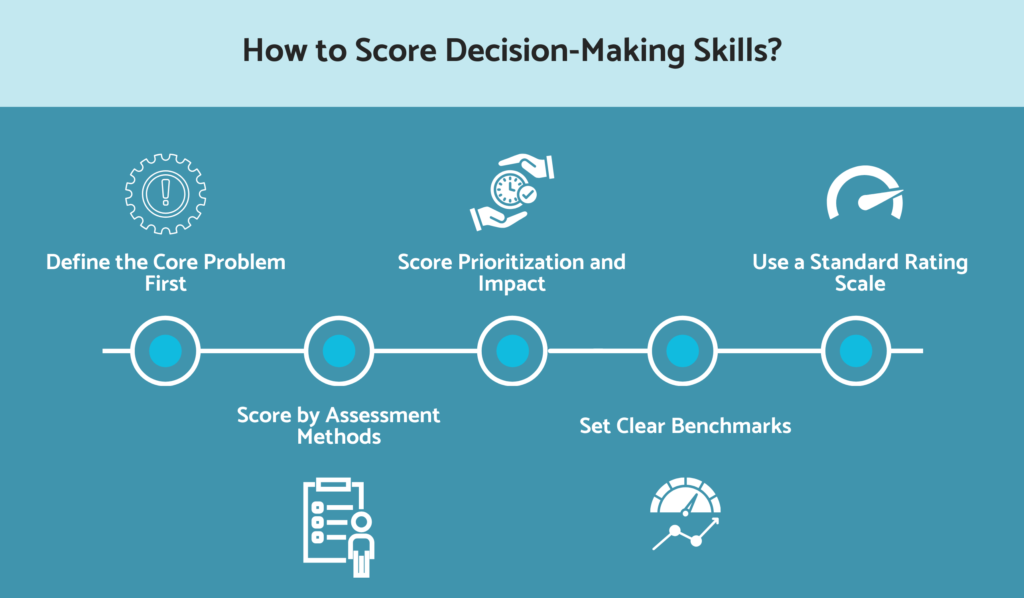
1. Define the Core Problem First
Based on our work designing assessments that measure decision-making skills, we have noticed that correctly identifying the core problem is the strongest indicator of decision-making skills. Start by assessing how well candidates understand the situation before making a decision.
This further helps you identify candidates who can easily separate symptoms from root causes, recognize constraints, and avoid reacting to irrelevant or misleading information.
2. Score Prioritization and Impact
Evaluate how candidates prioritize actions under pressure. This further helps you identify candidates with strong decision-making skills who focus on high-priority tasks that unblock progress and protect outcomes.
3. Use a Standard Rating Scale
Using a standard rating scale will help you reduce bias and compare candidates fairly. Candidates with a low rating score reflect poor decision-making skills, hesitation, and poor prioritization. On the other hand, candidates with a high rating score indicate clear analytical skills, strong risk evaluation, and make well-reasoned decisions aligned with business goals.
4. Score by Assessment Methods
From our experience designing assessments that assess decision-making skills, different assessment methods reveal different aspects of decision–making. This structured scoring method will help you identify candidates with strong decision-making skills who make sound decisions under real workplace constraints and deliver reliable outcomes.
5. Set Clear Benchmarks
Set clear benchmarks when hiring candidates with strong decision-making skills. Candidates who score high are likely to display strong independent judgment skills and can handle tasks with minimal supervision. This further helps keep your hiring decisions consistent and defensible across candidates.
Utilize our candidate assessment platform to identify candidates with strong decision-making skills. LEARN MORE
But what to avoid when measuring decision-making skills in candidates?
5. What to avoid when measuring decision-making skills in candidates?
While measuring decision-making skills, it is necessary for you to avoid practices that can distort results or weaken accuracy. Given below are some common mistakes you should avoid.
5 red flags to avoid while measuring decision-making skills in candidates:
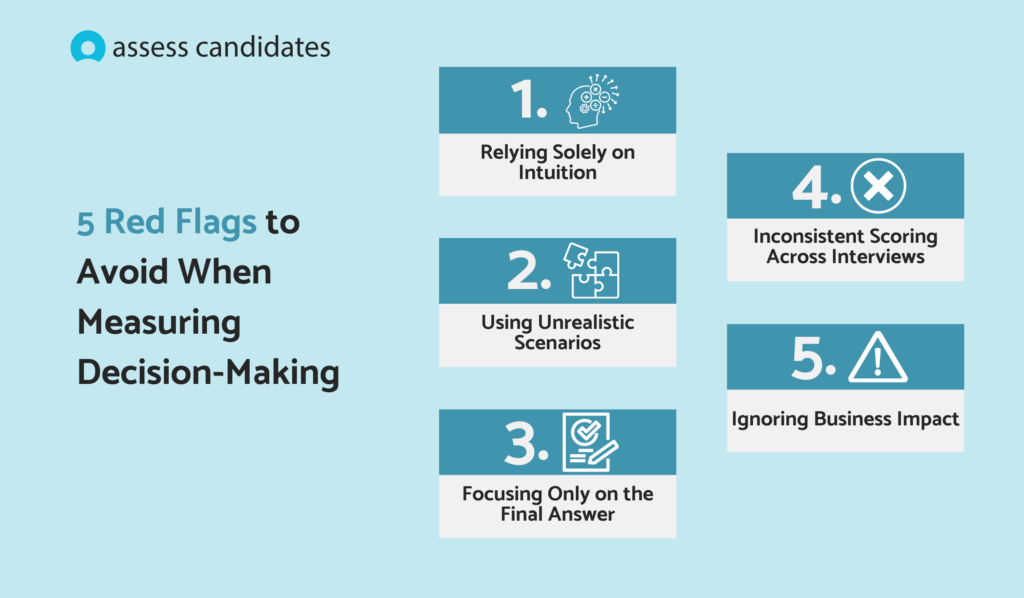
- Relying Solely on Gut Feeling or Intuition: When you judge candidates solely based on gut feeling or intuition instead of relying on a structured method, it induces bias and inconsistency.
- Using Unrealistic Scenarios: Providing vague or unrealistic questions to candidates will fail to reflect their real workplace decision-making skills.
- Focusing Only on the Final Answer: Candidates who rush to solve hiring tests may score higher on time but will perform poorly on accuracy. Hence, speed alone can be misleading.
- Inconsistent Scoring Across Interviews: Using inconsistent scoring across interviews will result in the scores losing reliability. This further leads to unfair comparisons and weakens the overall quality of the hiring decisions.
- Ignoring Business Impact: Ignoring role context or business impact and applying generic criteria across all roles can result in the overlooking of candidates suitable for the specific role.
Choose candidates with strong decision-making skills with our structured assessments. HIRE FOR FREE
6. How to measure decision-making skills: Client Success Story
Client Problem Statement
Picture this: a mid-sized technology company struggling to hire project coordinators who can make useful decisions when priorities shift, deadlines overlap, and information is incomplete. As a result, project timelines slip, team productivity drops, and stakeholders lose confidence.
The organization now needs a reliable way to evaluate how candidates prioritize tasks, assess risks, and make practical decisions in real–world situations.
This is more common than you might think.
Assess Candidates’ Proposal
At Assess Candidates, to hire the right project coordinator, we recommend including situational judgment tests, game-based assessments, and job simulation tasks early in the hiring process. These tools evaluate how candidates respond to competing priorities, manage uncertainty, and choose effective actions within realistic constraints.
When combined with structured behavior-based interviews and role-specific decision scenarios, the company gains a deeper insight into how candidates think through problems, justify their choices, and balance speed with accuracy.
Result
By adopting these decision-making assessments, the technology company can confidently identify candidates who demonstrate strong prioritization, clear reasoning, and practical judgment. This leads to faster issue resolution, smoother project execution, and improved team collaboration.
In the end, this helps organizations improve hiring results, avoid costly delays, and build a workforce that can make confident, effective decisions in changing environments.
Partner with Assess Candidates to incorporate a range of psychometric tests into your hiring process. VIEW PLANS
7. Why do top companies choose Assess Candidates’ assessments for measuring decision-making skills?
At Assess Candidates, we offer a wide range of pre-employment assessments and create recruitment campaigns customized to each organization’s unique hiring needs.
Here is an example of our campaign reporting dashboard available on Assess Candidates.
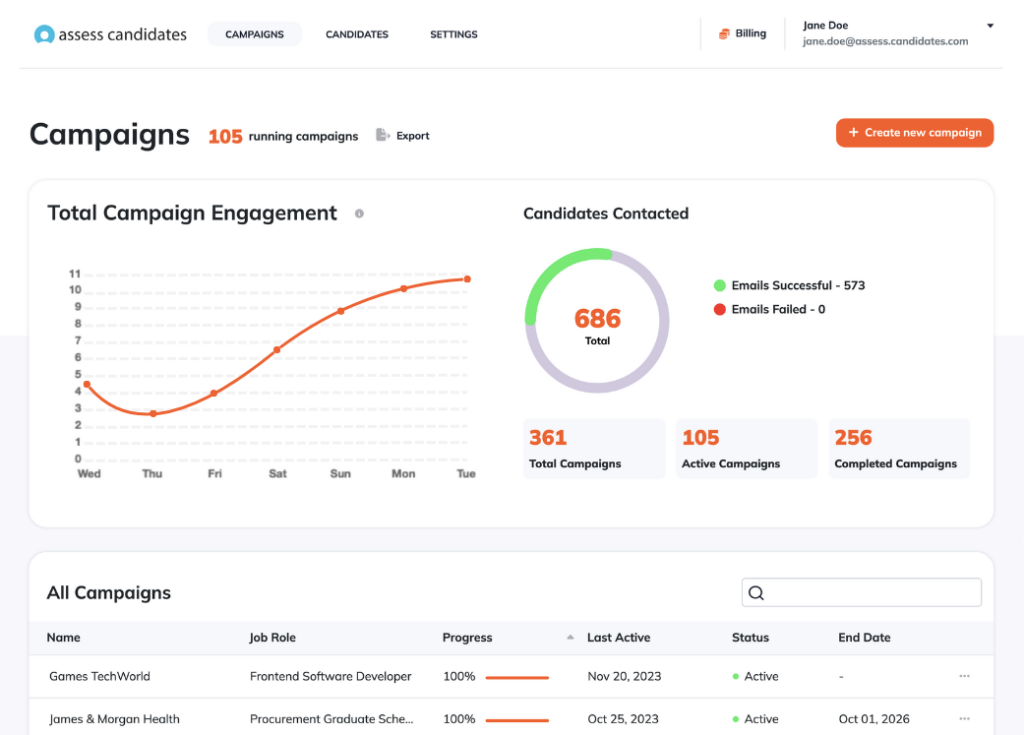
Here are 4 reasons why you should use Assess Candidates for measuring decision-making skills in candidates:
- Scientifically Designed by Expert Psychologists: Assess Candidates’ decision-making assessments are developed by experienced psychologists and psychometricians with a proven track record of building tools for global assessment leaders such as SHL and IBM Kenexa.
Each assessment undergoes rigorous scientific validation to ensure it accurately measures judgment quality, prioritization, risk evaluation, and decision consistency under pressure. This evidence-based approach gives you confidence that you are hiring candidates who make sound, practical decisions that align with business goals.
- Advanced Reporting: Our intuitive platform delivers clear, in-depth reports that highlight how candidates analyze situations, evaluate options, prioritize tasks, and select effective actions. You can quickly compare decision patterns, identify high-potential candidates, and shortlist applicants using objective, data-driven insights. Moreover, with seamless ATS integration, your evaluation and hiring decisions become faster, more consistent, and fully streamlined.
- Positive Candidate Experience: Our decision-making assessments are designed to be engaging, easy to use, and accessible across devices. Each assessment provides candidates with clear instructions and realistic scenarios, so they can focus on evaluating options and making informed choices without unnecessary obstacles. Custom branding can also be applied to create a consistent and professional experience throughout the assessment process.
- Candidate Accessibility Support: We prioritize inclusivity by offering robust accessibility features that allow candidates to demonstrate decision-making skills fairly. These include extended time options, screen-reader compatibility, adjustable visual settings, and zoom functionality. All assessments comply with WCAG accessibility standards, ensuring an equitable experience for all applicants.
Assess Candidates provides reliable, science-based tools that help organizations measure decision-making skills accurately and make hiring decisions that are smarter, faster, and fairer. Explore our full range of assessments to identify candidates with strong judgment and prioritization skills.
Not sure which decision-making or problem-solving assessments fit your role? Contact us for a free analysis of your hiring needs.
Answer to the above example Situational Judgment Test question
- Best option: B
- Worst option: C
Conclusion: Key Takeaway
- Decision-making in hiring focuses on evaluating how candidates analyze information and choose effective actions aligned with the role and business goals.
- Strong decision-making skills directly improve problem-solving, productivity, leadership, and team collaboration in the workplace.
- Structured methods like game-based assessments, SJTs, job simulations, and behavioral interviews provide reliable insights into real-world decision-making.
- Decision-making skills reveal how candidates balance speed, accuracy, risk, and business impact under pressure.
- Avoiding gut-based judgments, unrealistic scenarios, and inconsistent scoring is critical for accurate decision-making assessment.
Interested in learning more about effective candidate assessment? Continue reading for frequently asked questions, and sign up with your email to get started.
Frequently Asked Questions
How to assess decision-making under pressure?
One of the most reliable ways to measure decision-making skills under pressure is by introducing time limits, incomplete information, and competing priorities within assessments. This will help you identify candidates who stay focused, make timely decisions, and adjust when conditions change.
How to avoid bias when measuring decision-making skills?
You can reduce bias by relying on standardized assessments and multiple data points. Using structured scoring, setting clear benchmarks, and relying on multiple assessments for evaluation help measure candidates’ observable decision-making behavior.
How can decision-making assessments improve the quality of hire?
When you measure decision-making skills in candidates effectively, you can hire candidates who think clearly, act confidently, and handle real-world job challenges well. This further helps in reducing costly mistakes and improving overall team performance.
How early should you assess decision-making skills in the hiring process?
You should assess decision-making skills early in the hiring process to avoid candidates who struggle with judgment. By introducing scenario-based assessments at the screening stage, you can identify candidates who prioritize, evaluate risks, and act decisively before moving to interviews or final rounds.
Can decision-making skills be measured for entry-level roles?
Yes, you can measure decision-making skills for entry-level roles. This can be done by using simplified scenarios and job simulations. As these assessments mainly focus on prioritization, judgment, and logic, they help identify candidates with strong potential and learning agility.


 English
  Arabic