
How To Use Situational Judgment Tests For Entry Level Hiring



During entry level hiring, many recruiters struggle with a high volume of applications, limited time, and the risks of hiring entry level candidates who look great on paper but would lack real workplace judgment. This is harder because traditional screening methods often fail to reveal how an entry level candidate would actually behave on the job.
Situational judgment tests solve this by assessing whether a candidate is suitable for a role based on how they would respond to real work scenarios. By integrating situational judgment assessments in your hiring process, you create a more streamlined process that helps you to filter unsuitable candidates early on.
Did you know? Situational judgment tests are so effective that they can eliminate up to 80% of applicants before the interview stage. This leaves you with those candidates who are the best fit for the role.
In this guide, you will discover what situational judgment tests are, how to use them for entry-level hiring, and the key tool we offer to help you set them up effectively. Let’s dive in.
Contents
- What is a situational judgment test?
- What are the benefits of using situational judgment tests for entry level hiring?
- How to use situational judgment tests for entry level hiring?
- What roles and industries benefit most from situational judgment tests in entry level hiring?
- How are situational judgment tests changing the future of entry level hiring?
- Who are the top situational judgment test providers?
- How Assess Candidates helps you hire entry level talent with SJTs
Let’s start by understanding what situational judgment tests are and how they work.
1. What Is A Situational Judgment Test?
A situational judgment test is an assessment used by recruiters to measure a candidate’s suitability for a role, based on how they would approach workplace challenges. Situational judgment tests present candidates with different scenarios that could occur on the job and ask them to select the most appropriate response.
How Do Situational Judgment Tests Work And What Do They Measure?
Situational judgment tests are based on competencies for the specific role and industry. This could involve skills such as communication, decision-making or teamwork. The SJT builds scenarios around these competencies and tests your candidates on these scenarios.
Situational judgment tests can either be written or multimedia-based.
During entry level hiring, situational judgment tests help you to assess your candidates’ performance since they rarely have a professional background. This allows you to identify candidates with the strongest potential to succeed.
Improve your entry-level hiring with our virtual, scientifically validated situational judgment assessments. HIRE FOR FREE
Situational Judgment Tests Vs Traditional Interviewing Techniques
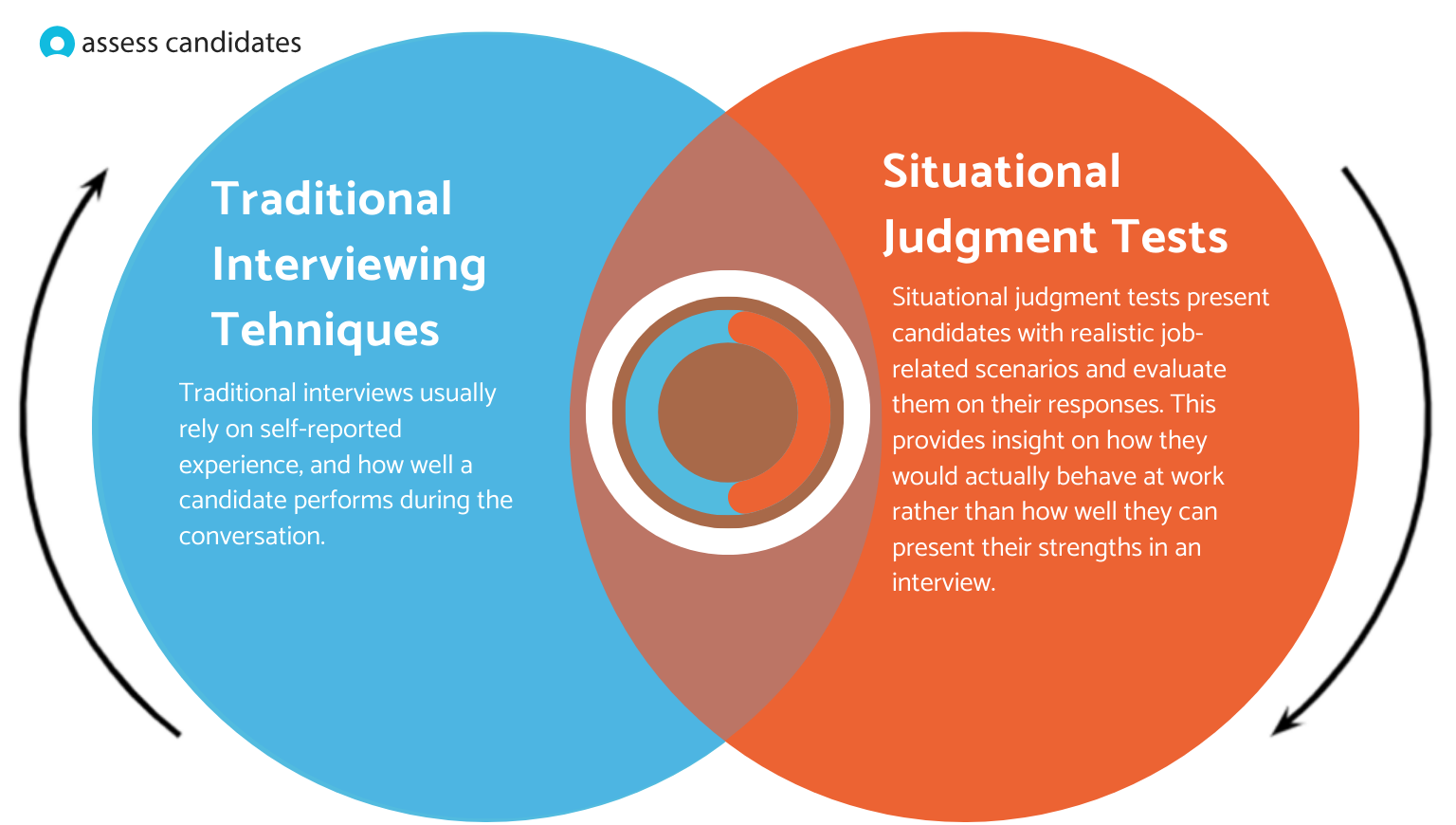
Traditional interviews usually rely on self-reported experience and on how well a candidate performs during the conversation. However, during entry level hiring, this can be limiting, as many entry-level candidates possess academic backgrounds but lack real-world experience.
Situational judgment tests fill this gap by presenting candidates with realistic, job-related scenarios and evaluating their responses. This enables recruiters and employers to assess entry-level talent based on how they would actually behave at work rather than how well they can present their hypothetical strengths in an interview.
While traditional interviews can also vary depending on the interviewer, SJTs are structured, consistent, and based on the real challenges of the job. This makes them more reliable and scalable, especially during high-volume entry-level hiring.
According to a study by Ghent University, situational judgment test results are less biased against candidates from minority backgrounds compared to traditional aptitude methods.
Now that you understand what situational judgment tests are, let’s look into why organizations use them for entry level hiring.

2. What Are The Benefits Of Using Situational Judgment Tests For Entry Level Hiring?
Situational judgment tests give employers an objective way to assess how entry level candidates would respond to real workplace problems. This enables recruiters to easily identify the candidates before the interviewing process begins.
Let’s look at the top benefits of using situational judgment tests for entry level hiring.
Top 5 Benefits of Using Situational Judgment Tests In Entry Level Hiring
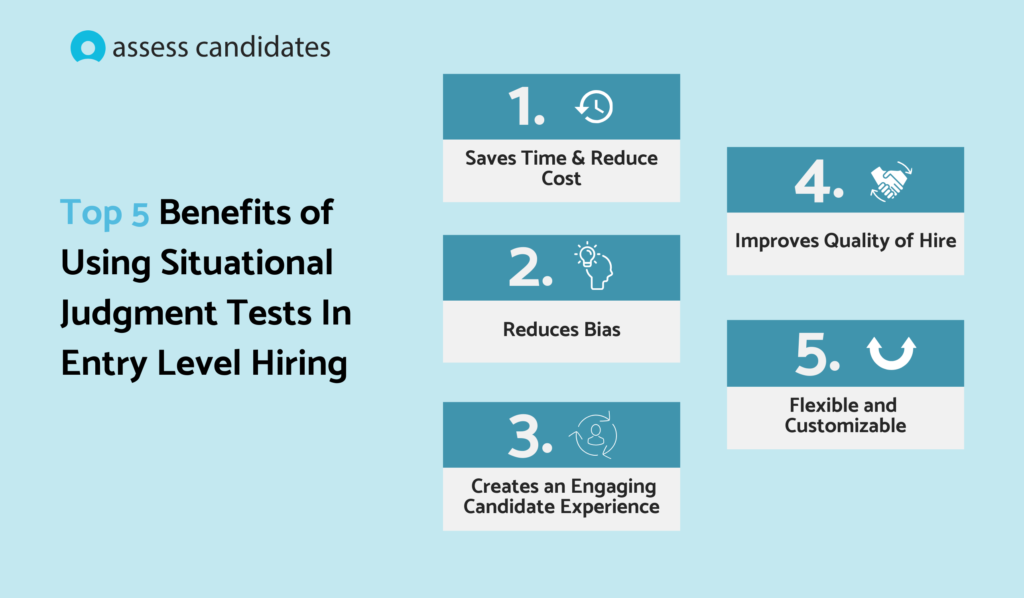
1. Saves Time and Reduces Hiring Cost
Situational judgment tests save time by screening large volumes of applicants quickly and efficiently. Traditionally, recruiters would have to manually review hundreds of CVs, which don’t always reveal the true competencies of a candidate for a given role.
By using situational judgment assessments early on, they’re able to filter candidates and reduce the number of candidates moving to costly stages such as the interview stage or the assessment centre stage.
2. Reduces Bias
Situational judgment tests assess candidates purely based on their performance and not on other metrics such as background or gender. This helps to reduce both conscious and unconscious biases.
Most entry level candidates usually lack other credentials, such as work experience. However, situational judgment assessments enable you to create a fairer selection process based on their performance and potential.
3. Create an Engaging Candidate Experience
Online situational judgment tests use workplace scenarios that give candidates a realistic preview of the role. This is beneficial for entry-level candidates, who are often entering the professional world for the first time, as it helps them understand the expectations of the job.
Interactive SJTs with pictures and videos also help to increase candidate trust and engagement.
4. Improves Quality of Hire
Situational judgment tests provide recruiters with a more accurate picture of a candidate’s potential than CVs and resumes. Situational judgment test questions are scientifically validated, and candidates whose behaviors and strengths align with the role requirements and your company culture will perform well. This provides you with better quality hires and reduces turnover within your organization.
5. Flexible and Customizable
Situational judgment tests are flexible and can be customized to your specific role, requirements and work culture. This allows you to design scenarios that are unique and tailored to your organization and the role itself. This is important for entry-level hiring as it helps you not only measure the candidate’s performance but also how well they would fit into your company.
But how do you use situational judgment tests in hiring? Let’s look at the different strategies below.
3. How To Use Situational Judgment Tests For Entry Level Hiring
Situational judgment tests help create a faster, fairer, and scalable entry level hiring process. Here are some strategies to help you use situational judgment tests effectively for entry level hiring.
6 Effective Strategies For Using Situational Judgment Tests In Entry Level Hiring:
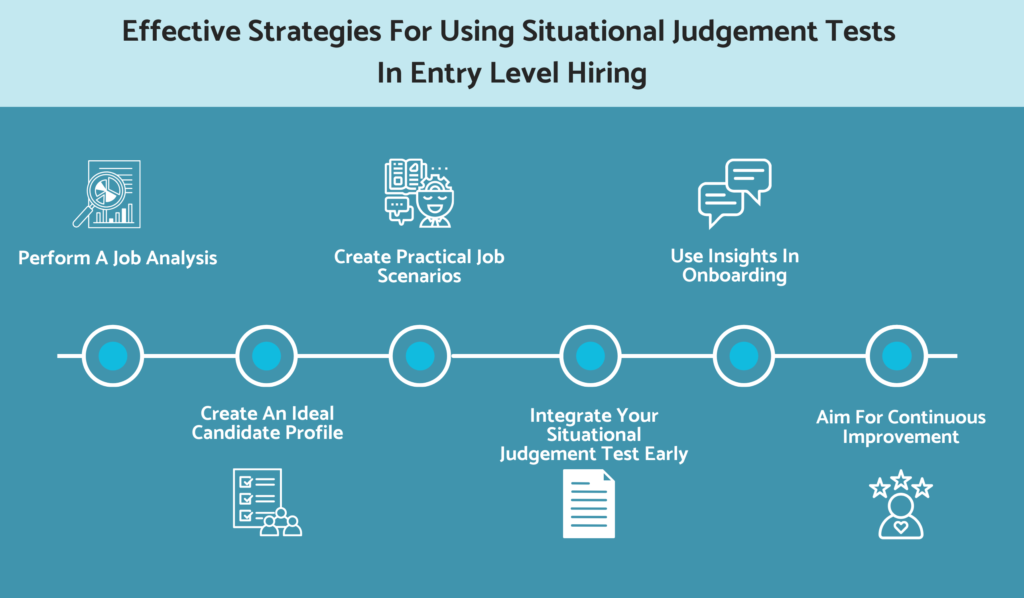
1. Perform A Job Analysis
Before creating your situational judgment assessment test, perform a job analysis of the role. Measure the requirements, responsibilities, key performance indicators, and challenges of the role. Staff who currently function in that role or have been promoted from the role can also give insight into the day-to-day requirements of the role. This will help you ensure that your SJT measures the right metrics and requirements.
2. Create An Ideal Candidate Profile
Based on the job analysis, create an ideal candidate profile. List out the competencies and skills the ideal candidate must have, and include the traits they must have to thrive in your organization and fit into your culture.
For example, if you’re hiring an entry-level data analyst, you may require them to have critical thinking as a skill. Your ideal candidate profile helps you build the right scenarios for your situational judgment test.
3. Create Practical Job Scenarios
Once you’ve done your analysis and created your ideal candidate profile, either you or your SJT provider then creates realistic job scenarios. These scenarios should reflect situations candidates are likely to experience on the job.
When creating your answers, you might discover that there is no universally correct answer. However, based on the job role and your organization’s values and standards, there should be a clear most effective response for each scenario.
4. Integrate Your Situational Judgment Test Early
Situational judgment tests are most effective when you use them early in the hiring process, such as immediately after sending applications. This helps you quickly filter your application pool and identify candidates that are the right fit. It also helps candidates self-assess and decide whether the role is the best fit for them professionally.
5. Use Insights In Onboarding
Recruiters and hiring professionals can use results from the SJTs to ask follow-up questions during interviews. Candidate responses can also be used to customize onboarding for each candidate after the offer stage and help you spot areas where your new hires need more support and training.
6. Aim For Continuous Improvement
Periodically review your situational judgment test to ensure it still fits the requirements of the role and the values at your company. This ensures that your test is always relevant and accurate.
It is important to note that there are some challenges organizations face when they try to introduce SJTs in their hiring process. Let’s look at them in the next section.
What Challenges Do Organizations Face With Situational Judgment Tests In Entry Level Hiring?
Situational judgment tests are great tools for assessing entry level talent. However, they also come with challenges. Below are the most common challenges organizations face when using SJTs for entry level hiring.
Common Challenges and Considerations, and How to Overcome Them
- Test Integrity Risks: Like most online tests, online situational judgment tests can also be susceptible to cheating. Candidates can search for answers or have someone else complete the test on their behalf. This leads to wrong results and hires.
Solution: Use assessment providers that offer cheating prevention methods. Situational judgment test providers such as Assess Candidates use advanced detection tools that help to maintain test integrity.
- Unaligned Assessments: Employers sometimes use generic situational judgment tests, which do not reveal the realities of their specific role or the organization. This reduces the accuracy of the test results.
Solution: Opt for semi-bespoke or fully customisable situational judgment assessments. This helps you tailor the test to your role and organization and ensures candidates are measured on what actually matters for success.
- Time Pressure Leading To Skewed Results: Entry level applicants are often nervous, and strict time limits can place excessive pressure on them. This leads to underperformance and results that do not accurately reflect their real-world behavior.
Solution: Ensure that the completion time for your situational judgment test is reasonable, or use an untimed SJT. This reduces the pressure and helps your candidates produce better results that reflect their true workplace performance and abilities.
- Customisation Costs: Creating a custom situational judgment assessment test can seem expensive, especially for small and medium organizations. This usually forces organizations to go for generic SJTs that affect results.
Solution: A custom SJT will help you reduce turnover and cut training costs by hiring the right candidates the first time. So, consider situational judgment tests as a long-term investment for your organization. You can also work with cost-effective providers on a tailored solution.
- Wrong Interpretations: Recruiters and hiring teams sometimes struggle to correctly interpret situational judgment test results. This often leads to poor hiring decisions.
Solution: Train your recruiters and hiring team on interpreting situational judgment test results and what they measure. This helps them correctly interpret results, leading to better hiring decisions.
- Poor Measurement Criteria: Poorly defined criteria and competencies make it difficult to correctly assess applicants. You could end up measuring the wrong metrics, and this makes results harder to interpret, leading to poor hires.
Solution: Conduct a job analysis and define the competencies required for each role. Ensure each scenario is connected to these competencies.
Next up, let’s look at the industries and entry level roles that benefit most from situational judgment tests.
Discover our expert-backed situational judgment tests to support your entry level hiring process. HIRE FOR FREE
4. Which Roles And Industries Benefit Most From Situational Judgment Tests In Entry Level Hiring?
Situational judgment tests can be used for hiring entry level talents across virtually every sector. They help employers and recruiters identify candidates who can perform appropriately and align with the organization’s culture from day one.
Nonetheless, here are some industries that benefit from using situational judgment tests for entry level talent.
Top 5 Industries That Benefit From Using Situational Judgment Tests For Entry Level Talent
- Finance
In finance, situational judgment tests are used to assess how well entry level talents can prioritise tasks, risk management, and maintain accuracy under pressure.
Major organizations like Barclays, Morgan Stanley, and JP Morgan use SJTs to identify entry-level candidates who can apply sound judgment and don’t solely rely on their educational background or technical knowledge.
- Healthcare
In healthcare, situational judgment tests help organizations to assess a candidate’s empathy, crisis response, and ethical decision-making. Organizations such as the NHS use SJTs based on real-life scenarios to measure how candidates would respond to issues involving patient care, teamwork, and professionalism.
- Retail
As a fast-paced and customer-facing industry, retail organizations benefit from using situational judgment tests to assess entry level talents. They can assess how candidates would handle complaints, solve issues and maintain company policy while balancing customer satisfaction.
Organizations such as Boots, Aldi, and Morrisons use SJTs to help them identify candidates who can stay calm and professional under pressure.
- Consulting
In consulting, situational judgment tests help recruiters assess how well entry level talent can think critically, solve problems, and recommend solutions. Organizations such as PwC and KPMG use situational judgment assessments to test a candidate’s decision-making skills beyond their academic background.
- Public Sector
Public sector roles usually require facing the public and making complex decisions. Situational judgment tests help recruiters to assess entry level candidates for fairness, resilience, and their ability to stick to policy despite challenging situations. Organizations such as the Civil Service use SJTs in their entry-level hiring process to ensure that applicants can handle pressure and maintain professional and ethical standards.
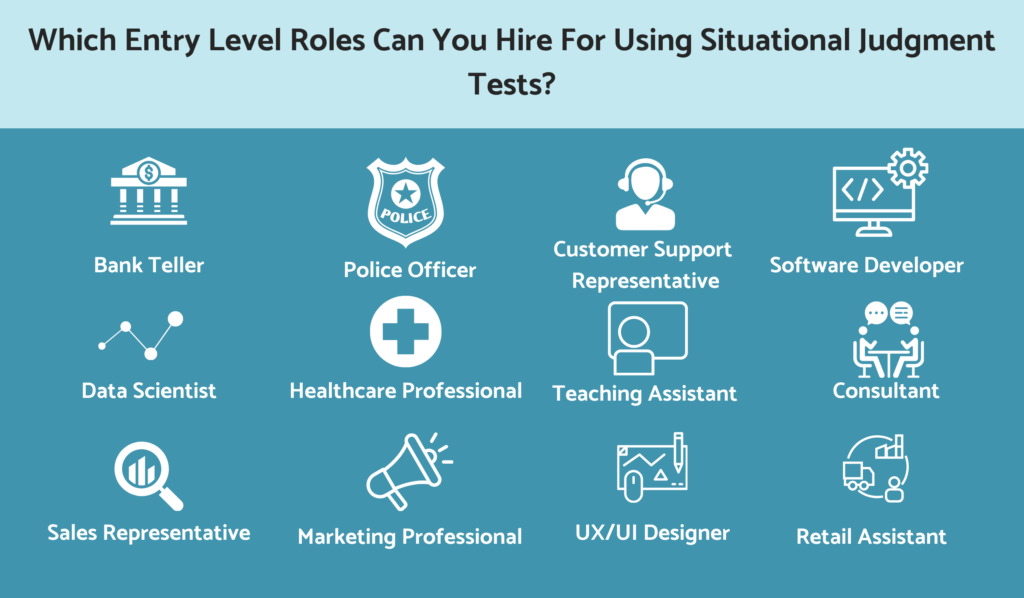
Which Entry Level Roles Can You Hire For Using Situational Judgment Tests?
Situational judgment assessments are beneficial for virtually all roles, but here are some entry level roles that benefit from SJTs.
- Bank Teller
- Data Scientist
- Police Officer
- Healthcare Professional
- Sales Representative
- Retail Assistant
- Marketing Professional
- Teaching Assistant
- UX/UI Designer
- Customer Service Representative
- Consultant
- Software Developer
Explore our talent assessment platform to assess and hire high-quality entry-level talent. LEARN MORE
Now, let’s look at how situational judgment tests are changing the future of entry level hiring.
5. How Are Situational Judgment Tests Changing the Future of Entry Level Hiring?
Situational judgment tests are changing how organizations identify, assess and hire entry level talent. With technological advancements, situational judgment tests have become easier to deploy, helping to analyze and scale high-volume entry-level hiring processes.
Here’s how SJTs are changing the future of entry level hiring.
1. Reducing Staff Turnover
One of the most costly challenges with hiring entry level talent is high staff turnover. Situational judgment tests help recruiters and employers place the right person in the right role based on how well they align with the requirements of the role and the company culture. This reduces the chance of mishiring.
Entry-level talents who perform well in custom situational judgment assessments are more likely to do well on the job and stay longer with the organization.
2. Improving Expectation Management
Several entry-level applicants do not know what to expect in their first role or fully understand what’s expected of them. Situational judgment tests help remove this uncertainty by providing these candidates with a real-life preview of the role before they even get interviewed.
This provides transparency and helps to set their expectations early in the hiring process. Exposing candidates to the realities of the job using SJTs helps to reduce the chances of surprise and disappointment after onboarding.
3. Enabling Fairer Hiring Decisions
Traditional hiring methods sometimes involve bias in hiring decisions, both consciously and unconsciously. Situational judgment tests typically remove all background factors and focus solely on how well a candidate responds to a work-related problem.
This helps organizations create a level playing field and build a diverse entry-level workforce by selecting candidates based solely on their performance without bias.
4. Helping Employers Stand Out
Today’s talent market is competitive. This means that organizations must differentiate themselves to attract the right candidates. Situational judgment tests help employers to showcase their workplace culture, values, and expectations during the hiring process. This gives candidates an idea of what it would be like to work for the organization and gives the organization a competitive advantage.
Did you know? Research shows that 96% of candidates prefer job assessments that give insight into what the job and workplace culture look like. (ThriveMap)
Strengthen your entry-level recruitment process with our scientifically validated assessments. LEARN MORE
But who provides situational judgment tests? Let’s look at some top providers below.
6. Who Are The Top Situational Judgment Test Providers?
If you’re looking to improve the quality and fairness of your entry level hiring with situational judgment tests, it’s important to choose the right provider. Before selecting a provider, there are certain criteria you must look at. Let’s look at some of these criteria below.
Key Criteria To Look For When Choosing Situational Judgment Tests Providers
When trying to choose an SJT provider for your entry level hiring, ensure you check for the following criteria.
1. High Volume Support
Before choosing a situational judgment test provider, ensure that their platform can effectively assess a large number of entry level talent. Your chosen platform should be able to manage a high volume of candidates and maintain consistent scoring across all candidates.
2. Objective Evaluation
The situational judgment assessment provider must provide tests based on work behaviors and not on their background and credentials. This eliminates bias and helps you assess candidates objectively.
3. Scientifically Validated Assessment Tests
A good situational judgment test provider should have their tests backed and validated with scientific research. This ensures that the test is accurate and will provide your hiring team with reliable data.
4. Customizable Tests
Before choosing a provider, ensure that they offer situational judgment assessments that can be tailored to your organization and work culture. This will help you capture the actual demands of the job and create relevant and realistic scenarios.
5. Automation Options
Ensure your SJT provider provides automations and helps you automate repetitive tasks like screening, scoring, and shortlisting. This helps you to handle high-volume hiring without slowing down the process.
6. Easy Access to Results
You should be able to easily view candidates’ results, rankings, and reports. Ensure that the platform offers clear dashboards that make it easy to identify high performers.
7. Positive Candidate Experience
The SJT must be mobile-friendly, clearly explained, and easy to access. This leaves your candidates with a positive candidate experience and helps them perform their best.
Before choosing a provider, ensure that they meet these criteria. This will help you choose an assessment provider that improves your hiring process and reduces the risk of poor hires.
Now, let’s look at some of the top situational judgment test providers.
Top Situational Judgment Tests Providers
Here are some of the most popular situational judgment test providers today
- Assess Candidates
- SHL
- Kenexa (IBM)
- Cubiks
- Aon/Cut-e
- Cappfinity
- Test Gorilla
- Harver
- Korn Ferry
- Saville Assessments
Partner with us to advance your entry level hiring using our situational judgment tests. VIEW PLANS
So, why choose Assess Candidates?
7. How Assess Candidates Helps You Hire Entry Level Talent With Situational Judgment Tests
At Assess Candidates, we offer a comprehensive suite of scientifically validated situational judgment assessments and create campaigns tailored to your organization’s unique hiring needs.
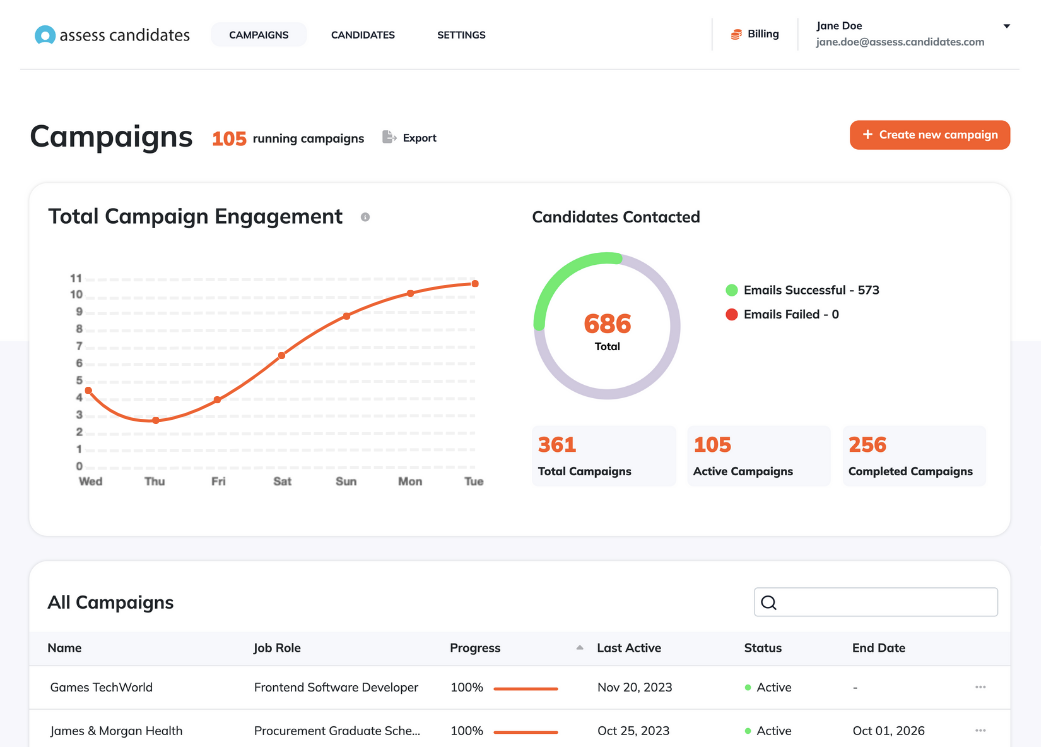
Here is an example of our campaign reporting dashboard available on Assess Candidates.
The Top 4 Reasons Why You Should Use Assess Candidates For Your Entry Level Hiring Process:
- Scientifically Designed and Validated by Expert Psychologists: Leading organizations trust Assess Candidates to provide situational judgment tests for entry level talent because our solutions are developed by Chartered Psychologists and Psychometricians with decades of experience designing assessments for renowned industry leaders such as SHL and IBM Kenexa.
Each test undergoes rigorous validation to ensure it measures skills, cultural alignment, and job fit across diverse markets with scientific precision. Our globally adaptable platform ensures consistent, reliable results, whether candidates complete assessments on a phone, tablet, or desktop, anywhere in the world.
- Expert Reporting: Our intuitive talent assessment platform helps hiring teams to evaluate candidates from multiple regions using behavioral analytics, performance comparisons, and role-specific benchmarks. Real-time scoring and integrated reporting empower recruiters to make data-driven hiring decisions quickly and confidently.
With seamless ATS integration and centralized dashboards, entry-level hiring managers can coordinate international recruitment campaigns without switching between systems, ensuring faster, smarter, and more consistent results across borders.
- Positive Candidate Experience: Every mobile-friendly assessment is designed to deliver an engaging, device-friendly, and culturally adaptive experience for candidates worldwide. The interface supports multilingual options, branded visuals, and real-time progress tracking, allowing candidates to complete assessments conveniently from any location. This inclusive, user-centred approach enhances your employer brand, improves engagement, and increases completion rates across global talent pools.
- Candidate Accessibility Support: Inclusivity lies at the heart of our design. Our platform adheres to global WCAG accessibility standards, offering features such as adjustable color contrast, screen reader support, zoom functions, and extended time allowances. These accessibility measures ensure that every candidate, regardless of geography, language, or ability, can participate confidently and fairly in your recruitment process.
Assess Candidates empowers organizations to build high-performing, entry level teams through scientifically validated situational judgment assessments, advanced analytics, and a seamless user experience. Explore our situational judgment assessment solutions today to discover how we can help you attract, assess, and hire entry level talent worldwide.
Not sure where to start? Contact us for a free consultation and discover the best-fit solution for your hiring needs.
Key Takeaways
- Situational judgment tests are used to predict how candidates will perform in real workplace situations, which makes them very effective for hiring entry level talent.
- One of the major benefits of situational judgment tests is that they help to reduce staff turnover. Using SJTs, employers and recruiters can hire the right candidates who are fit for their workplace culture. This helps to improve staff retention.
- Situational judgment tests use a standard scoring system and help to reduce unconscious bias in hiring decisions.
- Situational judgment tests should be placed early in the hiring process. This helps to save time and filter candidates before they get to costlier stages like the interview stage.
- It’s important to choose the right situational judgment test provider. Ensure your provider offers scientifically validated tests, customization, and clear reporting tools.
Interested in learning more about effective candidate assessment? Continue reading for frequently asked questions, and sign up with your email to get started.
Frequently Asked Questions
Can I also use situational judgment tests for senior-level roles?
Yes, you can. Situational judgment tests are very adaptable, and you can simply tweak the scenarios to be more complex and fit into the requirements for senior roles.
Can candidates fail situational judgment tests even when they have strong skills?
Yes, situational judgment tests require candidates to read carefully and reflect on the scenarios. If candidates rush through the scenarios or ignore instructions, they might do poorly on the tests.
Are situational judgment assessment scenarios realistic or hypothetical?
While the scenarios in situational judgment assessments are hypothetical, they should be based on real workplace challenges that your applicants will likely face on the job.
Do situational judgment tests remain consistent when hiring for multiple roles and levels?
Yes, they do. You can tweak the test based on the complexity of the role without redesigning the test from scratch.
Can candidates “game” an SJT?
SJTs are context-specific, and the answers are based on good judgment and company values rather than the usual, typical right answers. This makes it difficult for candidates to use coaching, AI answers, or gaming the system.


 English
  Arabic