
Why Your Company Should Introduce Mobile-Friendly Candidate Assessments For Recruitment



In today’s fast-paced digital world, candidates expect recruitment processes to match their mobile-first lifestyles.
Traditional, desktop-based assessments often restrict accessibility and engagement, causing lower completion rates and missed opportunities to attract top talent. By implementing mobile-friendly candidate assessments, companies meet candidates where they are, delivering a seamless, convenient experience that fits into their daily routines.
Beyond accessibility, mobile-friendly assessments improve the candidate experience and hiring team efficiency. Recruiters access real-time results, automated scoring, and data-driven insights, enabling faster shortlisting and more informed decisions. This technology makes it possible to evaluate large volumes of applicants efficiently without sacrificing quality, accuracy, or fairness.
Moreover, mobile assessments promote inclusivity and diversity in hiring. Candidates across different regions, time zones, and accessibility needs can participate equally, expanding the talent pool and ensuring fairer evaluation. This approach positions employers as innovative, tech-savvy, and candidate-centric, which is key to attracting, engaging, and hiring top talent in a competitive talent market.
Whether you’re a hiring manager or HR professional, you might find yourself asking questions, including:
- How do mobile-friendly assessments impact hiring efficiency and decision-making?
- How do mobile assessments support diversity and inclusion?
- Do mobile assessments actually improve candidate engagement? And enhance the candidate experience?
- Are there any limitations faced when using mobile-friendly candidate assessments?
In this comprehensive guide, we explore why it is crucial for modern organizations to ensure their candidate assessments are mobile-friendly as a step toward faster and fairer recruitment.
Contents
- What are mobile-friendly candidate assessments?
- How have employers switched to mobile and online assessment tests?
- What are the benefits of providing mobile-friendly pre-employment assessments?
- Which industries and roles benefit most from mobile-friendly assessments?
- Which employers use mobile-friendly candidate assessments for recruitment?
- How to choose the best mobile-friendly assessment platform for recruitment?
- Client success story: Mobile-friendly assessments
- Why top companies choose Assess Candidates for mobile-friendly recruitment
- The future of mobile-friendly candidate assessments
Now that we’ve summarized what this article covers, let’s find out what mobile-friendly candidate assessments are and why they matter.
1. What are mobile-friendly candidate assessments?
Mobile-friendly candidate assessments are pre-employment hiring tests designed to run seamlessly on smartphones (Android and iOS) and tablets. These assessments allow candidates to complete cognitive, personality, or situational judgment tests anytime and from anywhere in the world.
Using intuitive, responsive user interfaces, mobile-friendly candidate assessments enhance accessibility, speed up hiring, and improve the overall candidate experience.
Enhance your hiring strategy with our mobile-friendly candidate assessments. HIRE FOR FREE
What is the history behind pre-employment assessment tests?
Pre-employment assessments trace back to the early 20th century, rooted in classical test theory. Developed by psychologists and statisticians, this theory laid the groundwork for standardized testing and measurement of individual differences in aptitude, knowledge, and performance.
These standardized assessments aimed to ensure fairness, consistency, and accuracy in identifying the most suitable candidates for each role.
By the mid-20th century, organizations began using these standardized tests to identify talent objectively and consistently. This shift led to the rise of psychometric testing, which measured not just ability but also personality, motivation, and potential.
Pioneering companies like SHL (Saville and Holdsworth Ltd), founded in the 1970s, and Kenexa, launched in 1987, revolutionized the space with innovative, data-driven assessment tools to measure cognitive abilities, personality, and job skills. Both emphasized the importance of scientific rigor, standardization, and structured methods in modern recruitment.
As technology advanced, assessments transitioned from pen-and-paper tests to computerized and mobile formats, mirroring the broader shift toward digitalization in the workplace.
Did you know? According to Statista, in 2025, the number of mobile users worldwide is projected to reach 7.49 billion.
Has the classical test theory changed since its introduction?
Classical test theory, with its emphasis on reliability and validity, remains central to creating pre-employment assessments that can withstand scientific scrutiny. However, over the decades, advancements in psychometrics and statistical analysis have signficantly refined how assessments are designed and interpreted.
Modern tests leverage Item Response Theory (IRT), AI-driven scoring, and adaptive testing to create more accurate, fair, and bias-resistant assessments that can predict real-world job performance with higher precision.
The different types of mobile-friendly pre-employment assessments
Recruiters today use a variety of mobile-optimized pre-employment assessments to evaluate candidates’ specific skills, traits, and potential for the role efficiently on any device. These tests fall into 5 main categories:
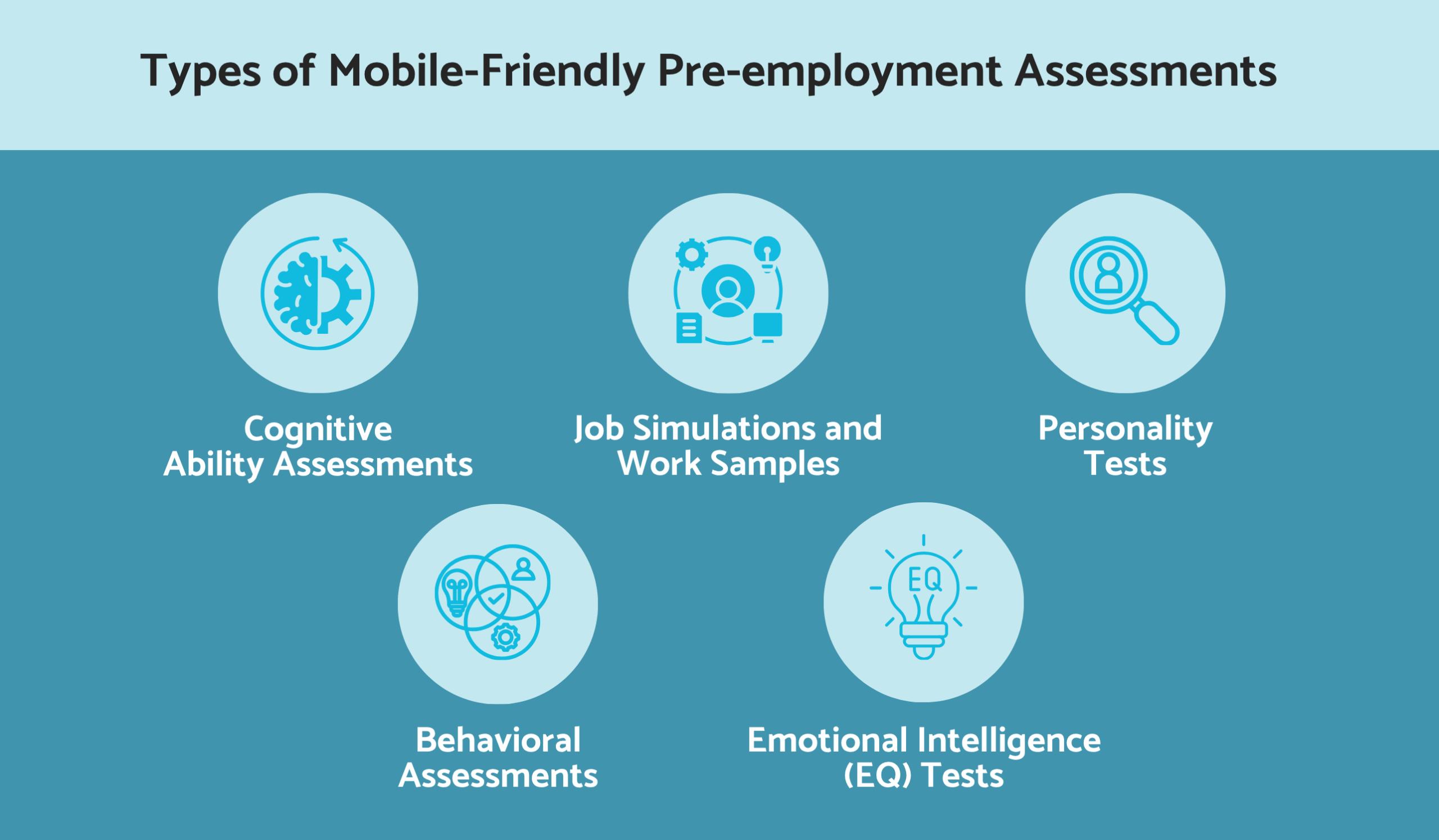
1. Cognitive Ability Assessments
Cognitive aptitude tests measure a candidate’s reasoning, problem-solving, and learning potential. Some of the common cognitive assessments include:
- Numerical Reasoning Tests: Evaluate a candidate’s ability to interpret, analyze, and draw conclusions from numerical data.
- Verbal Reasoning Tests: Assess a candidate’s comprehension, logic, and communication skills via written passages.
- Logical Reasoning Tests: Measure pattern recognition, analytical thinking, and problem-solving skills.
- Spatial Reasoning Tests: Examine a candidate’s ability to visualize and manipulate shapes and objects mentally.
2. Job Simulations and Work Samples
Job simulations and work samples require candidates to perform tasks that closely replicate actual job responsibilities. Examples include coding exercises for software developers or mock sales presentations for account executives.
3. Personality Tests
Personality tests, or personality questionnaires, evaluate an individual’s traits, motivations, and work-style preferences. They help predict how well a candidate will align with a role, team dynamics, and organizational culture.
4. Behavioral Assessments
Behavioral assessments, such as situational judgment tests (SJTs), measure how candidates respond to real-world workplace scenarios. They examine traits like leadership, conflict resolution, and adaptability through structured questions or scenario-based tasks.
5. Emotional Intelligence (EQ) Tests
Emotional intelligence (EQ) tests assess a candidate’s ability to perceive, understand, manage, and influence emotions of their own and others. EQ tests are particularly valuable for roles requiring strong interpersonal skills, leadership, and teamwork.
In the following section, we will take a look at the process employers use to implement online, mobile assessment tests.

2. How have employers switched to mobile and online assessment tests?
The transition from traditional, paper-based tests to online mobile-friendly assessments was a strategic response to employers’ evolving needs in the digital age. This shift not only streamlined the hiring process but also empowered employers with the right tools to make data-driven decisions. This helped foster a more efficient, fair, scalable, and dynamic approach to talent acquisition.
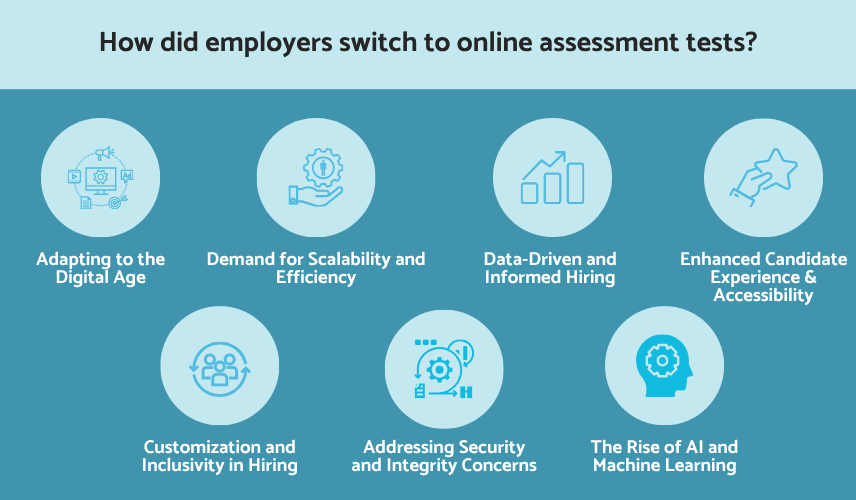
- Adapting to the Digital Age
With the rise of the internet and widespread use of personal computing devices, employers began exploring online platforms to streamline recruitment. Online candidate testing offered practical, scalable solutions that improved reach, efficiency, and accuracy, transforming hiring from a manual process into a streamlined, technology-enabled experience.
- Demand for Scalability and Efficiency
Traditional paper-based assessments were time-consuming, resource-heavy, and difficult to manage at scale. Manual grading, distribution, and storage often slowed down hiring processes, particularly for organizations handling large applicant volumes. Online assessments addressed these issues by introducing automation, instant scoring, faster evaluation, and real-time candidate comparisons for more efficient recruitment.
- Data-Driven and Informed Hiring
Digital assessments offered recruiters detailed analytics and performance metrics. These tools provided real-time insights into candidates’ abilities and suitability for specific roles, enabling more objective and data-driven hiring decisions. As a result, employers could identify top talent more accurately and reduce the risk of bias in the selection process.
Did you know? According to LinkedIn, up to 98% of Fortune 500 companies use online hiring software.
- Enhanced Candidate Experience and Accessibility
Online, mobile-friendly testing improved the overall candidate experience by introducing flexibility and accessibility. Applicants could now complete assessments remotely, without the need to travel or be present at a physical testing site. This flexibility allowed organizations to reach a global talent pool and promote inclusivity by removing geographical barriers.
Did you know? According to Ofcom, four-fifths of the time spent online in the UK is on mobile devices.
- Customization and Inclusivity in Hiring
Online assessments move employers away from a one-size-fits-all model by allowing them to tailor tests to specific roles, skills, and industries. This customization improved the predictive accuracy of assessments and ensured alignment with organizational goals. Furthermore, online candidate testing platforms introduced accessibility features to support candidates with disabilities, reinforcing diversity and inclusion in hiring practices.
- Addressing Security and Integrity Concerns
The transition to digital assessments is not without challenges. Employers initially faced concerns about test security, cheating, and data protection. To address these, modern platforms introduced advanced proctoring technologies, secure browsers, and verification protocols that maintained the integrity of the testing process while ensuring candidate authenticity.
- The Rise of AI and Machine Learning
The integration of artificial intelligence (AI) and machine learning further enhanced the sophistication of online assessments. Adaptive testing models began adjusting question difficulty based on candidate responses, offering a more personalized and accurate measure of ability. This innovation provided deeper insights into candidate potential, helping employers make smarter, evidence-based hiring decisions.
Discover our science-backed, mobile-friendly assessments and hire top-performing talent. LEARN MORE
Next up, we will take a look at the benefits of optimizing your pre-employment assessments for mobile.
3. What are the benefits of providing mobile-friendly pre-employment assessments?
Delivering pre-employment assessments on mobile devices gives employers and candidates a faster, more accessible, and engaging hiring experience. As smartphones dominate daily life, candidates can take tests anytime, anywhere, increasing flexibility and inclusivity. Employers streamline recruitment, reach more candidates, and make data-driven decisions in real time.
Did you know? According to LinkedIn, 89% of applicants believe mobile devices are necessary for job searching.
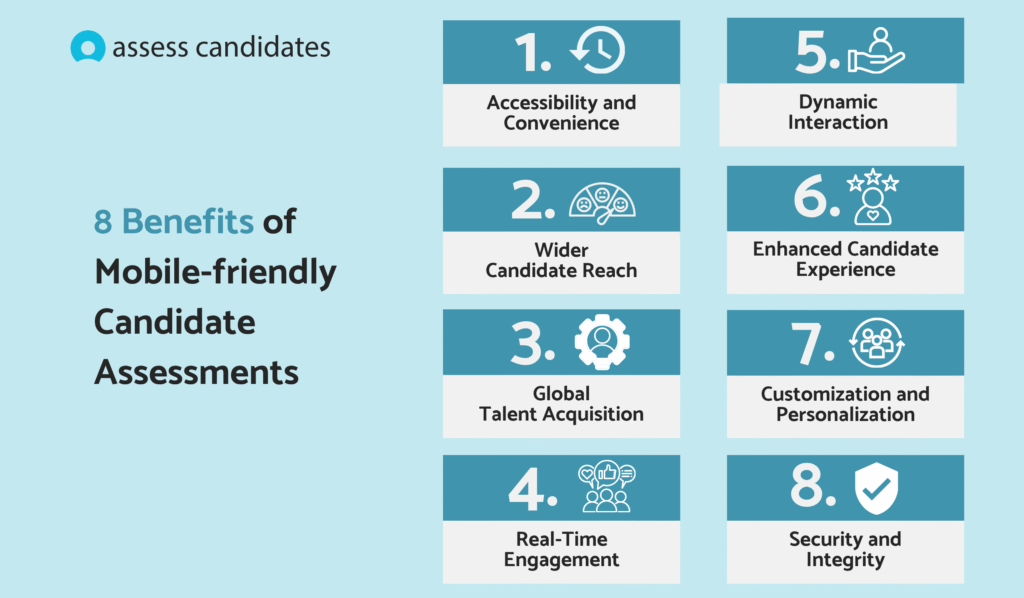
8 benefits of using mobile-friendly candidate assessments
1. Accessibility and Convenience
Mobile assessments remove geographical and logistical barriers, allowing candidates to take tests from anywhere in the world. Candidates can access assessments at home, while traveling, or across time zones, ensuring location never limits participation. This accessibility promotes inclusivity and enables organizations to connect with a broader, more diverse talent pool.
2. Wider Candidate Reach
As smartphones dominate daily life, mobile assessments align perfectly with how today’s workforce interacts with technology. Employers who offer mobile-optimized tests attract tech-savvy candidates and reach a wider audience. This approach especially appeals to younger generations who rely heavily on mobile devices.
Did you know? According to Hire Quotient, Gen Z spends approximately 4 hours and 15 minutes per day on mobile.
3. Global Talent Acquisition
Mobile-friendly assessments enable organizations to recruit globally. They allow employers to include candidates from diverse regions and cultural backgrounds without logistical barriers. By expanding access, companies strengthen diversity and inclusion efforts and build richer, more dynamic talent pipelines.
4. Real-Time Engagement
Mobile-friendly candidate assessments deliver instant feedback and real-time results. Candidates immediately see their performance, and recruiters can access data for faster decision-making. This instant engagement speeds up the hiring process and keeps candidates motivated.
Did you know? According to Statista, in the second quarter of 2025, mobile devices (excluding tablets) accounted for 62.54% of global website traffic.
5. Dynamic Interaction
Employers use mobile assessments with videos, animations, and simulations to create engaging and interactive experiences. These tools replicate real-world scenarios, allowing recruiters to observe how candidates apply skills and make decisions. Interactive assessments hold attention and provide deeper insights into candidates’ behavioral and cognitive strengths.
6. Enhanced Candidate Experience
User-friendly mobile interfaces simplify navigation and make assessments easy for candidates with varying technical skills. A smooth experience leaves a positive impression and strengthens the employer brand. Candidates who enjoy the process are more likely to complete assessments and engage further in the hiring journey.
Did you know? According to a LinkedIn report, strong brands attract 50% more qualified applicants.
7. Customization and Personalization
Employers design mobile candidate assessments that match specific job roles, skill requirements, and industries. They personalize content, question types, and difficulty levels to measure relevant competencies. This customization improves accuracy and ensures every hiring decision reflects real job performance, not just general aptitude.
8. Security and Integrity
Mobile assessment platforms protect test integrity with advanced security features. Employers use secure browsers, biometric verification, and multi-factor authentication to prevent cheating and identity fraud. These technologies maintain fairness and safeguard both employer and candidate data.
Common challenges faced when using mobile-friendly candidate assessments
- Device Compatibility Issues: Different mobile devices and operating systems may not display assessments correctly, causing layout or functionality problems.
Solution: Design assessments using responsive, cross-platform frameworks that automatically adjust to various screen sizes. Test them across multiple devices and browsers to ensure smooth performance on both Android and iOS.
- Connectivity Problems: Candidates with unstable or slow internet connections often face interruptions or incomplete submissions.
Solution: Develop assessments with auto-save and offline capabilities so candidates can continue despite weak connections. Keep assessments light and optimized to load quickly on any network.
- Limited Screen Size: Small mobile screens can make it hard for candidates to read long text, view detailed visuals, or input responses easily.
Solution: Optimize layouts for mobile by using concise questions, clean visuals, and scroll-friendly designs. Incorporate touch-friendly navigation and break complex information into smaller, digestible sections.
- Distractions and Environmental Noise: Candidates may take assessments in noisy or distracting environments, affecting concentration and performance.
Solution: Encourage candidates to complete assessments in quiet, distraction-free spaces. Allow pause or retake options when appropriate, and set reasonable time limits to balance focus with fairness.
- Difficulty in Usage: Candidates with disabilities may struggle with mobile navigation or touch-based interfaces.
Solution: Select assessment providers that comply with accessibility standards (WCAG) and offer accommodations such as screen readers, larger text, or extended time where needed. Providers like Assess Candidates prioritize inclusivity by providing WCAG-compliant features.
Empower your recruitment strategy with mobile-friendly hiring. HIRE FOR FREE
Now that you understand the basics of mobile-friendly recruitment and its benefits and challenges, let’s now discuss which industries and roles use mobile tests in their hiring processes.
4. Which industries and roles benefit most from mobile-friendly assessments?
Mobile-friendly candidate assessments transform how companies identify and evaluate talent. Employers can reach candidates anytime, anywhere, making recruitment faster, more accessible, and data-driven.
Organizations across finance, healthcare, retail, and technology use mobile-based testing to ensure fair, efficient, and engaging evaluations for diverse roles and business needs.
Industries that use mobile-friendly candidate assessments for recruitment
The following are the top 5 industries that use mobile candidate assessments for hiring:
- Technology and IT
Tech companies use mobile-friendly tests to assess candidates’ logical reasoning, coding aptitude, and problem-solving abilities. These assessments help them identify analytical and adaptable professionals ready for dynamic digital environments.
Major employers such as Google, IBM, and Infosys actively use mobile assessments for tech recruitment.
- Finance and Banking
Banks and financial institutions use mobile aptitude tests to measure candidates’ numerical reasoning, analytical thinking, and decision–making skills. These tests help ensure accuracy in financial data handling and minimize operational risks.
Top employers, including HSBC, Goldman Sachs, and Morgan Stanley, rely on mobile testing in recruitment.
- Retail and Customer Service
Retailers and service organizations use behavioral and situational judgment tests to evaluate customer service aptitude, communication, and teamwork. These assessments help them hire individuals who deliver exceptional customer experiences.
Significant employers, including Amazon, Walmart, and Marks & Spencer, use mobile assessments for high-volume hiring.
- Healthcare and Life Sciences
Healthcare organizations use mobile-friendly situational and compliance tests to assess empathy, ethical decision-making, and technical accuracy. These evaluations help them maintain quality care and operational integrity.
Major employers such as Mayo Clinic, Johnson & Johnson, and Pfizer use mobile assessments across clinical and support roles.
- Hospitality and Tourism
Hotels and travel companies use mobile behavioral and situational tests to measure interpersonal skills, problem–solving, and adaptability. These assessments help them build teams that deliver outstanding guest service.
Prominent employers such as Marriott International, Hilton, and the Emirates Group rely on mobile testing for hospitality recruitment.
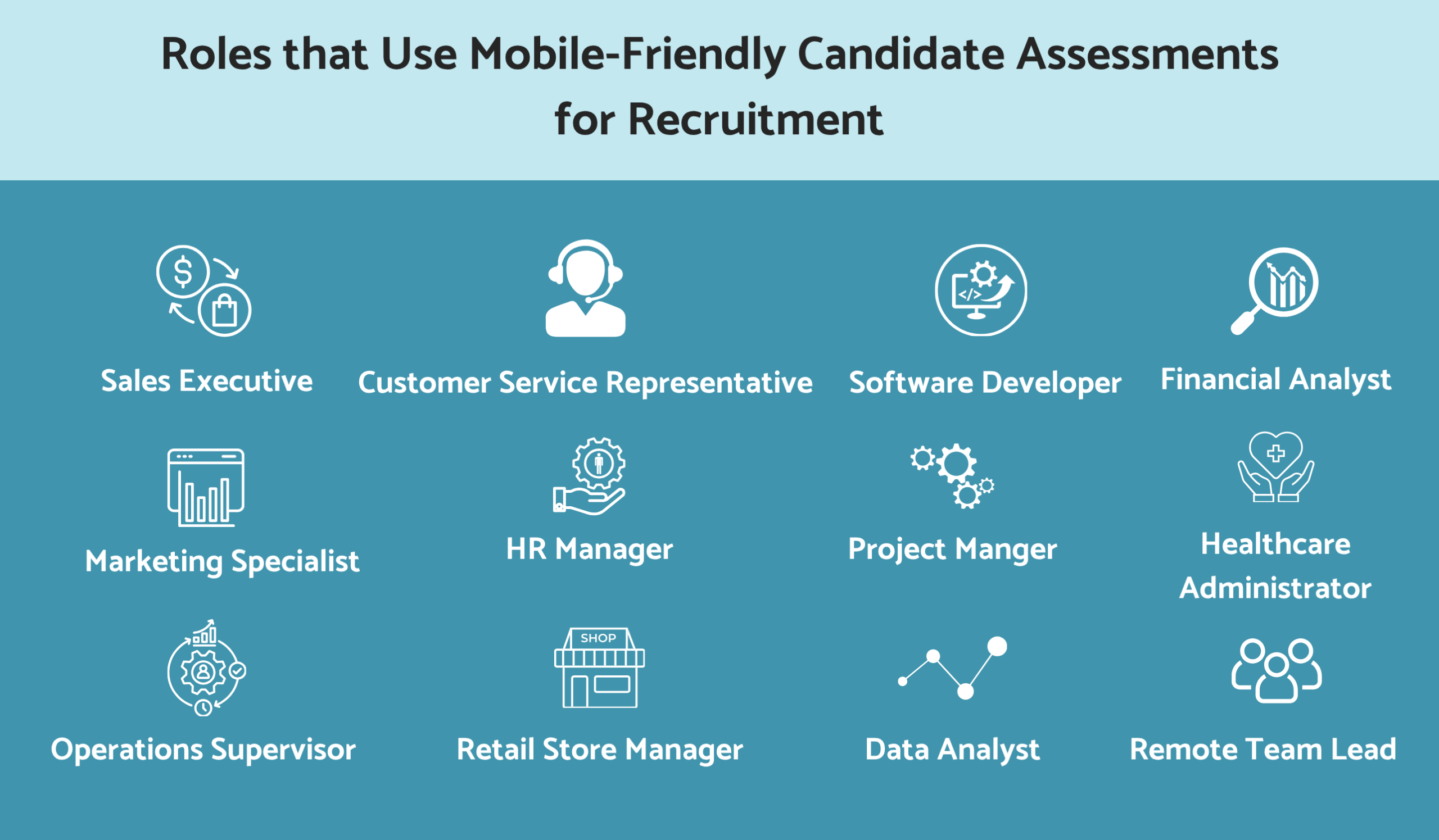
Roles that use mobile-friendly candidate assessments for recruitment
- Sales Executive
- Customer Service Representative
- Software Developer
- Financial Analyst
- Marketing Specialist
- Human Resources Manager
- Project Manager
- Healthcare Administrator
- Operations Supervisor
- Retail Store Manager
- Data Analyst
- Remote Team Lead
In the following section, we will explore the employers that utilize mobile-friendly candidate assessments in their pre-employment recruitment process.
5. Which employers use mobile-friendly candidate assessments for recruitment?
Leading employers now use mobile-friendly candidate assessments to streamline recruitment and evaluate talent effectively. These tools let organizations identify top performers, predict on-the-job success, and provide candidates with a convenient, anytime-anywhere testing experience.
Some well-known companies that use mobile-friendly candidate assessments in their recruitment process:
- JP Morgan
- Siemens
- EY
- Lloyds Banking Group
- KPMG
- Accenture
- HP
- PwC
- Unilever
- Deloitte
- Goldman Sachs
- Amazon
Explore our science-backed, mobile-friendly talent assessment platform. LEARN MORE
Let’s delve into the ways you can choose the best mobile-friendly candidate assessment provider for hiring.
6. How to choose the best mobile-friendly assessment platform for recruitment?
Selecting the right mobile-friendly candidate assessment software is crucial in modern recruitment. The best platforms let recruiters accurately evaluate skills, personality, and potential. They provide easy-to-use, device-accessible tools, and deliver actionable insights to help hiring teams identify top talent efficiently.
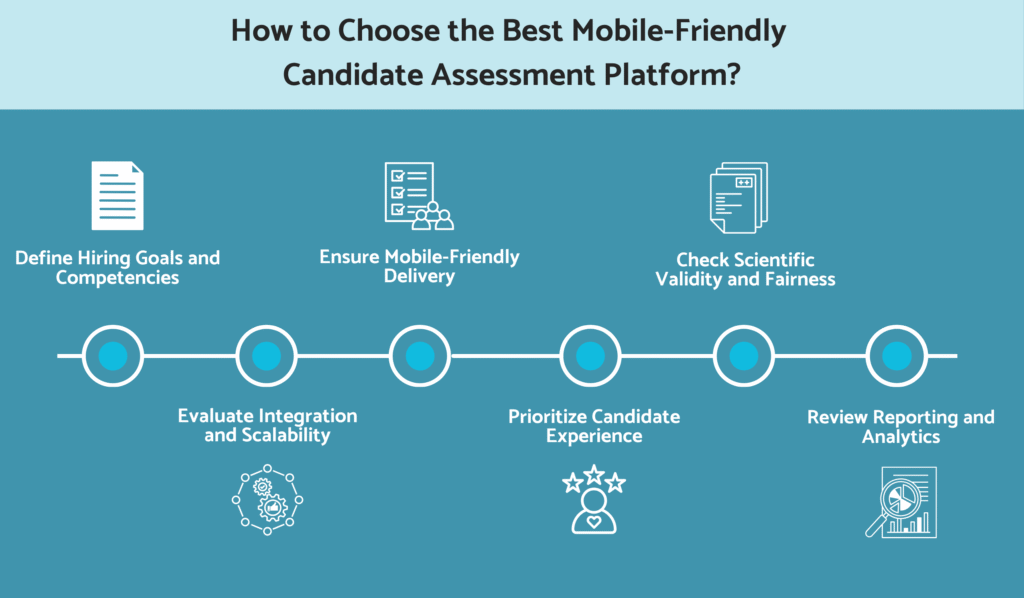
Define Hiring Goals and Competencies
Start by identifying what you want to measure and why. Decide which roles require assessments and which key skills or traits, such as problem-solving, teamwork, or leadership, are essential for success. When you define your goals clearly, you can choose assessments that match your hiring needs and get more relevant, accurate results.
Ensure Mobile-friendly Delivery
Choose a candidate assessment platform that works smoothly on smartphones, tablets, and desktops. Make sure it has a responsive design, loads quickly, and offers easy navigation so candidates can take tests anytime and anywhere.
The layout should automatically adjust to smaller screens while keeping the same level of quality and fairness across devices.
Check Scientific Validity and Fairness
Select assessments that are built on strong psychometric research and validated through data. Reliable providers follow international testing standards, such as those set by the EEOC or ISO.
The tests should be fair, unbiased, and inclusive so that every candidate has an equal chance to perform well, no matter their background or the device they use.
Evaluate Integration and Scalability
Choose a software solution that integrates easily with your existing hiring tools, such as your ATS or HR systems. This helps you manage candidate data efficiently and avoid manual errors.
The platform should also be scalable to support different roles, departments, and global hiring needs as your company grows.
Prioritize Candidate Experience
A mobile-friendly assessment should be simple, engaging, and easy to complete. Look for features like clear instructions, a clean layout, and quick transitions between questions. Avoid long or confusing tests that can frustrate candidates. When candidates have a positive experience, they are more likely to complete the assessment and think highly of your brand.
Review Reporting and Analytics
Pick a platform that provides detailed reports and easy-to-read analytics. Real-time dashboards, automated scoring, and performance comparisons help recruiters make faster and more informed decisions. You can also track patterns over time, identify high performers, and continuously improve your recruitment strategy.
What are the top candidate assessment test software providers?
Here are the top pre-employment talent assessment providers:
- Assess Candidates
- SHL
- Talent Q
- TestGorilla
- Cubiks
- Test Partnership
- Criteria Corp
- Thomas International
- Aon Assessment
- Saville Assessment
7. Client success story: Mobile-friendly assessments
Client Problem
Suppose a multinational logistics company struggles to attract and retain frontline and remote workers across different regions. While its recruitment process is effective at identifying skilled candidates, the company relies on desktop-based assessments, limiting accessibility for many applicants who primarily use smartphones.
As a result, candidates often drop out mid-assessment due to device incompatibility or poor user experience, resulting in hiring delays and a shrinking talent pool. The company needs a faster, more accessible, and candidate-friendly assessment solution that fits the modern mobile workforce.
Assess Candidates’ Proposal
At Assess Candidates, we recommend introducing mobile-friendly pre-employment assessments to make the hiring process seamless, inclusive, and efficient. These assessments are designed to run smoothly on smartphones and tablets, allowing candidates to complete them anytime, anywhere.
The mobile format not only improves accessibility but also boosts completion rates by reducing friction and enhancing user experience. Recruiters can track real-time progress, automate scoring, and make quicker hiring decisions without compromising accuracy or security.
Additionally, mobile-friendly platforms support adaptive testing, multimedia questions, and remote proctoring features, ensuring that assessments remain engaging, reliable, and compliant across all devices.
Result
By implementing mobile-friendly candidate assessments, the company can expand its talent reach, speed up hiring, and deliver a more convenient candidate experience. The process becomes more inclusive, attracting tech-savvy and geographically diverse applicants. Over time, the organization benefits from improved candidate engagement, faster time-to-hire, and a stronger, future-ready workforce.
Partner with Assess Candidates for science-backed mobile-friendly assessments. VIEW PLANS
So, why choose us?
8. Why top companies choose Assess Candidates for mobile-friendly recruitment
At Assess Candidates, we offer a comprehensive suite of personality assessments and video interviews and create recruitment campaigns tailored to each organization’s unique hiring needs.
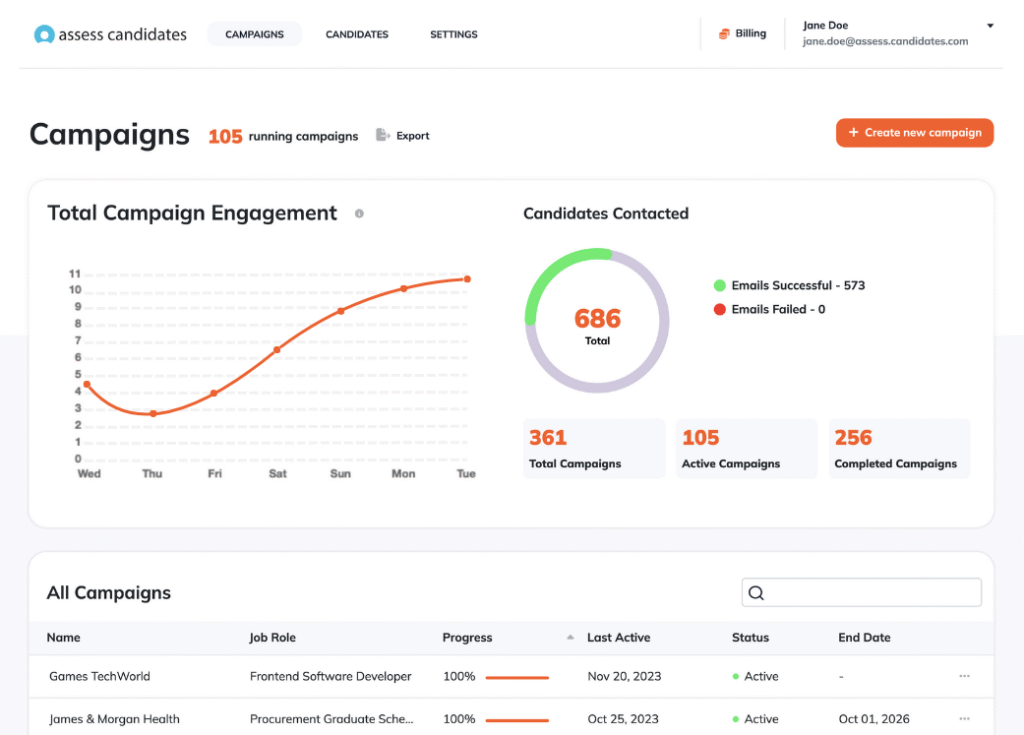
Here is an example of our campaign reporting dashboard available on Assess Candidates.
Here are the top 4 reasons why you should use Assess Candidates’ mobile-friendly assessments for your pre-employment selection process:
- Scientifically Designed and Validated by Expert Psychologists: Top companies trust Assess Candidates because our mobile-friendly assessments are developed by Chartered Psychologists and Psychometricians with decades of experience designing tools for industry leaders like SHL and IBM Kenexa. Each assessment undergoes rigorous validation to ensure it measures behavioral traits, problem-solving ability, and job fit with scientific accuracy. Our mobile-first design ensures that every assessment delivers reliable results, whether completed on a phone, tablet, or desktop.
- Expert Reporting: Our intuitive talent assessment platform enables recruiters to analyze behavioral data, compare candidate performance, and efficiently shortlist top talent. With real-time scoring, integrated reporting, and seamless ATS compatibility, recruiters can make faster, data-backed hiring decisions without switching between systems. The result is a smarter, streamlined workflow that enhances both hiring speed and quality.
- Positive Candidate Experience: Every mobile-friendly assessment is designed to provide a smooth, intuitive, and engaging experience for candidates. The interface adapts to any device, supports branded visuals, and offers automated progress tracking, allowing candidates to complete assessments at their convenience. This frictionless process enhances the employer brand while improving assessment completion rates.
- Candidate Accessibility Support: Inclusivity lies at the heart of our design. Our platform complies with WCAG standards, offering accessibility options such as adjustable colors, zoom features, screen reader support, and additional time allowances. These features ensure that every candidate, including those with disabilities, can participate fairly and confidently.
Assess Candidates delivers end-to-end mobile-friendly assessment solutions that combine psychological expertise, advanced analytics, and user-friendly technology. Explore our mobile-friendly assessment tools today to build high-performing, future-ready teams.
Not sure where to start? Contact us for a free consultation and discover the best-fit solution for your hiring needs.
Now we’ll take a closer look at what the future holds for mobile-friendly candidate assessments in recruitment.
9. The future of mobile-friendly candidate assessments
Mobile-friendly candidate assessments are transforming recruitment. They help organizations evaluate talent quickly, make informed hiring decisions, and give candidates a smooth, accessible testing experience on any device.
1. Adaptive and AI-driven Testing
Mobile assessments use artificial intelligence to adjust question difficulty based on each candidate’s responses. Adaptive testing provides recruiters with accurate insights into skills and potential while reducing test fatigue. This approach personalizes the assessment experience and ensures fair evaluation for every candidate.
2. Integration with Emerging Technologies
Organizations integrate gamification, virtual reality (VR), and augmented reality (AR) to make assessments more interactive. Candidates complete simulations, role-plays, or real-world tasks that reveal problem-solving, decision-making, and behavioral skills more effectively than traditional methods.
3. Enhanced Candidate Engagement
Mobile platforms provide intuitive navigation, multimedia content, and interactive elements to keep candidates motivated. Features like instant feedback, progress tracking, and engaging visuals improve completion rates and create a positive candidate experience that strengthens the employer brand.
4. Global and Inclusive Hiring
Recruiters reach candidates across geographies, time zones, and backgrounds with mobile-friendly assessments. Multi-language support, accessibility options for disabilities, and flexible timing ensure fair evaluation and allow companies to build diverse, inclusive, and talented workforces.
5. Building Future-ready Teams
By combining cognitive, behavioral, and potential assessments, mobile platforms help companies select candidates who meet current role requirements and grow with the organization. This approach ensures a resilient, adaptable workforce prepared for evolving business challenges.
Interested in learning more about effective candidate assessment? Continue reading for frequently asked questions, and sign up with your email to get started.
Frequently Asked Questions
How do mobile-friendly candidate assessments improve our hiring efficiency?
Mobile-friendly assessments allow candidates to complete tests anytime, anywhere, increasing participation and reducing dropouts. The platform automatically scores and analyzes results in real time, enabling recruiters to shortlist and hire qualified candidates faster. This streamlined process accelerates recruitment while ensuring only the most suitable applicants advance.
Are mobile-friendly assessments secure enough for large-scale recruitment?
Yes, mobile candidate assessment platforms encrypt data, use remote proctoring, and apply biometric or multi-factor authentication to protect test integrity. These security measures prevent cheating, verify candidate identities, and ensure that mobile-based hiring remains reliable, fair, and compliant with organizational and legal standards.
How do mobile assessments enhance the candidate experience?
Mobile-friendly assessments provide intuitive interfaces, flexible scheduling, and device compatibility, making the process smooth and stress-free. Candidates can complete tests at their convenience, which improves completion rates, boosts engagement, and strengthens your company’s reputation as a tech-forward and candidate-focused employer.
Will mobile assessments integrate with our existing recruitment tools?
Yes, mobile-friendly assessment platforms integrate seamlessly with Applicant Tracking Systems (ATS) and HR software. They centralize candidate data, simplify workflow management, and allow recruiters to track progress, analyze results, and generate reports without switching between multiple systems.
How do mobile-friendly assessments prepare employers for the future of recruitment?
Mobile assessments align with evolving workforce trends and digital hiring practices. By offering mobile-optimized assessments, your company positions itself as innovative and adaptable, attracting tech-savvy candidates and preparing for a future where mobile-first recruitment dominates the talent acquisition landscape.


 English
  Arabic