
How AI Chatbots Are Transforming Recruitment in 2026



Recruiters today are feeling the pressure: high application volumes, long screening cycles, constant follow-ups, and increasing expectations for faster hiring. These often lead to delays, bottlenecks, and inconsistent communication that frustrate both candidates and hiring managers.
As Artificial Intelligence (AI) becomes more widespread, many recruiters are asking whether it can genuinely make hiring easier, and the short answer is yes. One of the most transformative tools leading this transformation is the AI recruitment chatbot. These intelligent assistants can answer candidate questions, screen applicants, schedule interviews, and guide individuals through every stage of the hiring process in real time.
Instead of waiting days for updates, candidates receive instant responses and clear guidance about job requirements and essential steps such as assessments or interviews. For recruiters, AI chatbots reduce repetitive administrative tasks, freeing up time to focus on meaningful work, like evaluating talent, improving processes, and connecting with top candidates.
According to a 2025 HR technology report, recruitment chatbots now handle up to 90% of candidate enquiries during early screening stages.
But beyond convenience, AI recruitment chatbots bring structure, consistency, and speed to hiring operations. They help create a fairer process, reduce hiring delays, and ensure that every candidate receives timely communication, regardless of application volume or peak periods.
In this guide, we will break down what AI chatbots really do, how they work, and where they add the most value. By the end, you will understand exactly how AI-powered chatbots can strengthen your recruitment process, improve the candidate experience, and support smarter, faster, and more efficient hiring.
Contents
- What are AI chatbots for recruitment?
- How do AI recruitment chatbots work?
- The benefits of using AI chatbots in recruitment
- The limitations of AI recruitment chatbots you should be aware of
- Best practices and strategies to use AI chatbots effectively
- Real-world success stories of AI hiring chatbots in practice
- What is the future of AI chatbots in talent acquisition?
1. What Are AI Chatbots for Recruitment?
AI chatbots for recruitment are automated conversational tools and intelligent digital assistants that interact with candidates throughout the hiring journey.
They use AI and natural language processing (NLP) to understand queries, provide instant answers, guide applicants through next steps, and support recruiters with routine tasks such as screening questions, scheduling interviews, and sharing status updates.
These chatbots act as virtual recruitment assistants that operate 24/7, ensuring candidates always receive timely communication. They can answer FAQs, collect candidate information, recommend suitable roles, and even direct applicants to relevant assessments, all without requiring a recruiter to be actively available.
Airbus reported that its recruitment chatbot handled over 12,000 candidate interactions per month, with 60% of these interactions occurring after office hours.
Streamline your recruitment process with our scientifically validated hiring tools. HIRE FOR FREE
Why AI Chatbots Matter in Modern Hiring
The modern recruitment landscape is fast-paced, competitive, and often high-volume. Candidates expect quick responses and clear communication, while recruiters need tools that reduce repetitive work and maintain a consistent process. AI chatbots help bridge this gap by offering:
- Fast response times
- Reliable, consistent communication
- Clear candidate guidance
- Reduced administrative pressure on hiring teams
They enhance the entire end-to-end experience, from initial job discovery to application support and interview preparation.
Where Recruitment Chatbots Fit in the Hiring Funnel
AI chatbots are flexible and can support candidates at multiple touchpoints, such as:
- Pre-application: Answering questions about roles, culture, eligibility, and requirements.
- Application: Guiding candidates through forms or directing them to assessments.
- Screening: Asking structured questions and ranking applicants based on predefined criteria.
- Scheduling: Coordinating interview times and sending reminders.
- Follow-up: Giving updates on next steps or providing preparation resources.
This makes chatbots valuable for both high-volume recruitment (e.g., graduate hiring) and more specialized roles requiring consistent communication.
Studies consistently show that AI chatbots enhance early-stage communication quality, especially in high-volume or time-sensitive hiring environments.
Example of a Recruitment Chatbot in Action
A candidate visits an employer’s careers page and is unsure which role suits their background. An AI chatbot instantly:
- Asks about their skills and interests.
- Recommends relevant roles.
- Explains the application process.
- Directs them to complete a skills assessment.
- Books an interview slot if they meet the criteria.
Traditional Recruitment vs. AI Recruitment Chatbots
Did you know? Companies that combine human recruiters with AI chatbots see 30–50% faster screening cycles, according to recruitment automation benchmarks.
Now that we’ve clarified what AI chatbots are and how they reshape the recruiter–candidate interaction, the next step is to understand the technology behind them. Let’s break down how AI recruitment chatbots actually work.

2. How Do AI Recruitment Chatbots Work?
Understanding how AI recruitment chatbots operate is essential for any organization looking to streamline early-stage hiring, improve efficiency, and deliver faster, more consistent candidate communication. These chatbots don’t replace recruiters; they automate repetitive tasks so talent teams can focus on meaningful human decisions.
Here’s a clear breakdown of the technology powering them.
Natural Language Processing (NLP): Understanding Candidate Queries
NLP is the core engine behind chatbot conversations. It enables the system to interpret candidate questions, identify intent, and deliver accurate, context-aware responses. For example, a candidate types, “Do you offer remote roles?” The chatbot identifies the keyword remote, understands the intent, and instantly provides the company’s remote-work policy or links to relevant job postings.
Research by HR.com shows that 20% of talent acquisition leaders now use conversational AI tools to support mobile recruiting, underscoring the growing reliance on NLP-powered interactions.
Machine Learning (ML): Improving With Every Interaction
Machine learning helps the chatbot learn from past conversations so it can continually refine its accuracy and tone.
Over time, the system recognizes patterns, such as frequently asked questions, common screening responses, or candidate misconceptions, and adjusts to deliver faster, more personalized communication without human intervention.
This makes the chatbot more consistent each week, even as recruitment volumes rise.
Automated Workflows: Screening, Routing & Scheduling
AI chatbots connect with your recruitment workflow to automate tasks that traditionally consume a recruiter’s time, such as:
- Prescreening based on eligibility criteria, including pre-employment assessments.
- Routing candidates to the right job pipeline.
- Booking interviews through calendar integrations.
- Sending reminders to reduce no-shows.
- Answering FAQs instantly.
For example, instead of waiting for a recruiter to reply the next day, a candidate can complete initial screening and schedule an interview within minutes.
Studies show that AI-powered automation can reduce time-to-hire by up to 30%, significantly accelerating high-volume recruitment.
Integration With ATS & HRIS Systems
Modern recruitment chatbots integrate directly with Applicant Tracking Systems (ATS) and HRIS platforms. This ensures that all candidate data, CVs, screening answers, conversation logs, and assessments flow into a central dashboard.
This integration prevents data silos and allows recruiters to:
- Track a candidate’s progress in real time
- Ensure consistent communication
- Trigger automated next steps
- Reduce administrative errors
This unified workflow leads to more predictable hiring outcomes.
Data Capture & Insights
Every interaction generates valuable recruitment insights: peak engagement periods, drop-off points, recurring questions, or the quality of candidate responses.
Talent teams rely on this data to improve the hiring funnel, personalize communication, and identify inefficiencies.
According to recruitment-industry data, 38% of recruitment processes now use AI-powered chatbots, helping to automate candidate communication and screening.
Now that we’ve delved into the inner workings of AI recruitment chatbots, let’s focus on the crucial advantages they offer to hiring teams: speed, efficiency, candidate experience, and decision-making.
3. The Benefits of Using AI Chatbots in Recruitment
AI recruitment chatbots don’t just automate tasks; they fundamentally transform how organizations attract, screen, and engage talent. Below are the key advantages they offer, along with real-world examples that show how they drive better hiring outcomes.
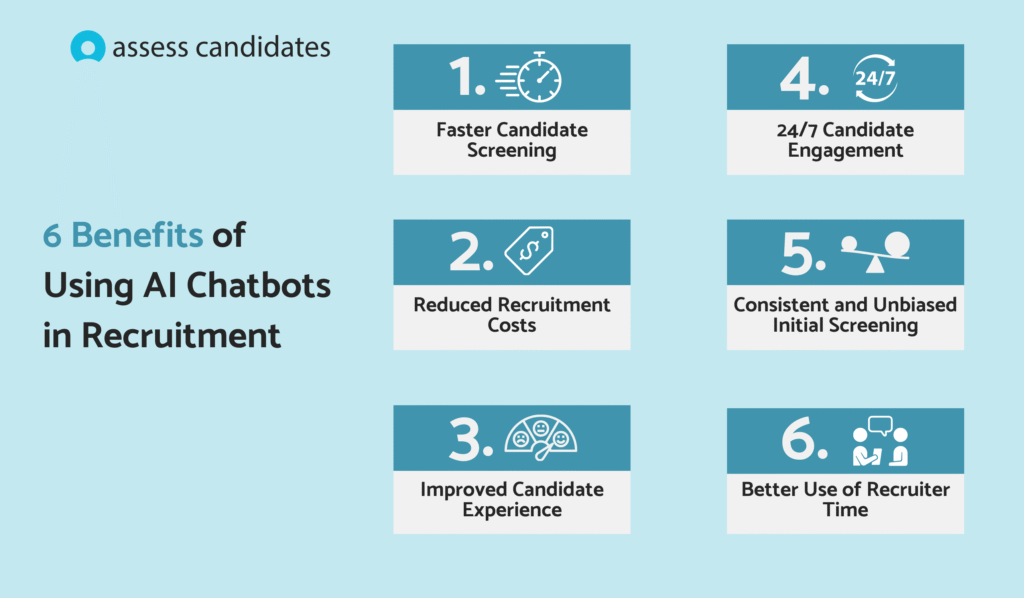
1. Faster Candidate Screening
AI chatbots handle initial screening in minutes instead of days. They collect essential details, ask structured questions, and assess minimum qualifications before the recruiter even steps in. For example, instead of manually reviewing 400 applications for a customer service role, the chatbot screens all candidates overnight and shortlists only those who meet job-specific requirements.
LinkedIn’s 2024 Future of Recruiting report shows that automation tools significantly reduce time-to-hire, with 67% of recruiters saying AI helps them save time on screening tasks.
2. 24/7 Candidate Engagement
Candidates often apply outside business hours. With an AI chatbot available around the clock, no applicant feels ignored or stuck waiting for responses. For example, a candidate applying at 11:30 PM gets instant answers about salary, work hours, and next steps, improving their experience and preventing drop-offs.
3. Reduced Recruitment Costs
By automating repetitive tasks, chatbots significantly cut down on time spent on manual work. This leads to more efficient recruitment cycles and lower operational expenses. Tasks like answering FAQs, scheduling interviews, and collecting documents are handled automatically, saving hundreds of recruiter hours annually.
4. Consistent and Unbiased Initial Screening
Unlike humans, who can be influenced by fatigue, mood, or unconscious bias, chatbots apply the same consistent criteria to every candidate. For example, two applicants with identical qualifications receive the same questions, the same scoring logic, and the same chance to progress from the chatbot, helping companies build fairer hiring processes.
5. Improved Candidate Experience
A well-designed chatbot guides applicants smoothly through the hiring journey, offering clarity and reducing anxiety. Candidates receive instant updates after each step: “Application received”, “Assessment scheduled”, and “Your results are ready”, keeping them engaged and informed.
According to McKinsey, organisations that adopt data-driven talent tools see up to a 40% improvement in hiring accuracy and performance outcomes.
6. Better Use of Recruiter Time
Recruiters can finally focus on strategic activities like interviewing, talent mapping, and culture assessment. For example, instead of responding to repetitive queries like “What are the job requirements?”, recruiters spend time building relationships with top candidates.
But even with these strong advantages, AI chatbots aren’t a perfect solution. To use them strategically, recruiters need to understand the limitations and challenges that come with automation and how to manage them effectively. In the next section, we explore the limitations of AI chatbots.
4. The Limitations of AI Recruitment Chatbots you should be aware of
While AI chatbots have transformed hiring workflows, it’s important to recognize that they are not flawless. Understanding their limitations helps recruiters use them responsibly and avoid costly missteps.
Problem 1: AI Chatbots Can Misinterpret Complex Candidate Queries
Impact:
Chatbots handle straightforward questions well, but they may struggle with nuanced, context-heavy queries, especially those involving compensation exceptions, visa concerns, or unique role-specific details. Misinterpretation at this stage can cause frustration or misinformation, which can weaken the candidate experience.
According to the Society for Human Resource Management (SHRM), 32% of candidates report feeling misunderstood when interacting with automated recruiting tools, particularly on complex or sensitive issues.
Insight:
Chatbots should be trained with high-quality conversation data and linked to human escalation points to prevent breakdowns in communication.
Problem 2: Over-Automation Can Make the Hiring Process Feel Impersonal
Impact:
Candidates may perceive the company as indifferent or overly transactional if every touchpoint is automated. This can hurt employer branding, especially for senior or emotionally sensitive roles.
Insight:
Use AI for efficiency, but keep human-led conversations for high-value touchpoints, such as final interviews or complex negotiations.
Problem 3: Bias Can Still Appear in AI Responses
Impact:
AI systems learn from historical data. If the training data contains biases, gendered terms, cultural assumptions, or skewed performance indicators, the chatbot may unintentionally replicate those patterns. This can expose companies to legal risk or reputational damage.
Insight:
Regular audits, dataset reviews, and fairness checks are essential for maintaining ethical hiring practices.
Problem 4: Chatbots Have Limited Understanding of Human Emotion
Impact :
AI cannot fully interpret tone, frustration, urgency, or subtle emotional cues. For roles requiring empathy or delicate communication, like layoffs, offer withdrawals, or grievance discussions, relying on a chatbot can worsen the situation.
Gartner’s 2024 HR Tech Report states that 58% of organizations still rely on humans for emotionally sensitive communication, despite adopting chatbot technologies.
Insight:
Define clear boundaries around what your chatbot should handle and what must be escalated to a recruiter.
Problem 5: Data Privacy and Security Concerns
Impact :
Chatbots often collect sensitive candidate information. Without strong encryption, compliance processes, and safe API integrations, organizations risk data breaches or regulatory violations.
Insight:
Implement strict access controls, compliance frameworks, and regular system audits to safeguard candidate information.
Problem 6: Chatbots Require Continuous Training and Upkeep
Impact:
AI systems don’t stay accurate on their own. Job descriptions evolve, company policies change, and candidate behavior shifts. Without ongoing maintenance, chatbots become outdated, leading to errors and misinformation.
Insight:
Organizations should treat chatbot training as an ongoing operational process, not a one-time implementation.
Learn how our talent assessment tools can help reduce chatbot-related risks. LEARN MORE
These challenges don’t reduce the value of AI chatbots; they simply show why organizations must be intentional about how they implement them. Strong results come from structure, oversight, and strategy. In the next section, we will explore the best practices and strategies for using AI chatbots effectively so you can maximize their impact while avoiding common pitfalls.
5. Best Practices and Strategies to use AI Chatbots effectively
To get the best out of AI recruitment chatbots, organizations must be intentional about how they deploy, supervise, and refine them. Thegoal isn’t to let automation replace recruiters; it’s to create a smarter, more structured hiring system where AI handles volume and humans handle judgment.
Below is a practical, evidence-aligned playbook for using AI chatbots responsibly and effectively.
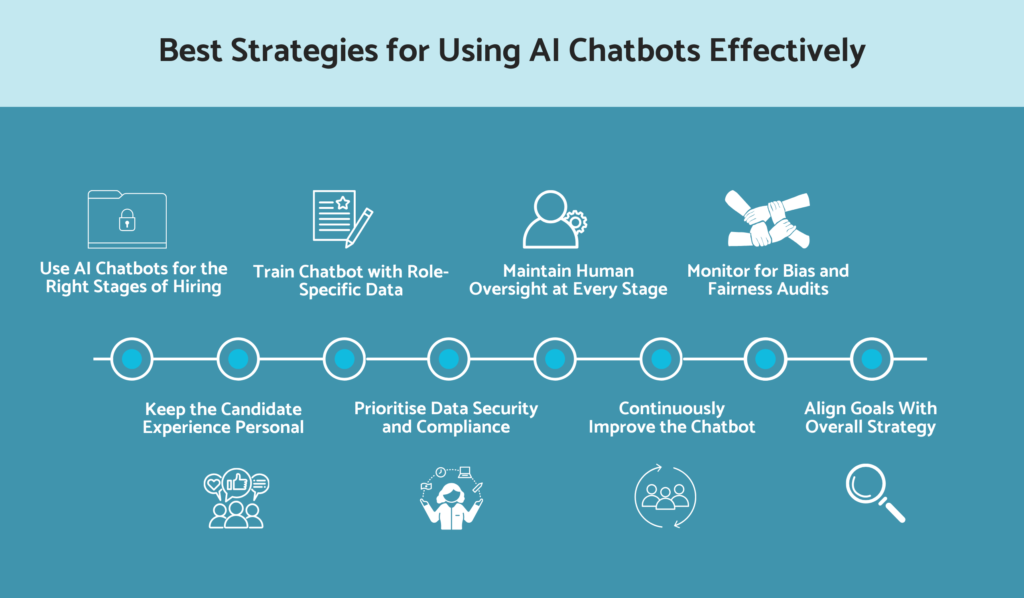
Best Practice 1: Use AI Chatbots for the Right Stages of Hiring
Why It Matters
Overusing automation makes the process feel impersonal, while underusing it leads to inefficiency. The key is placing the chatbot where it genuinely adds value.
What to Do
- Automate early-stage activities. FAQs, application guidance, basic screening, scheduling, and job-fit queries.
- Reserve human-led interactions for high-context stages such as final interviews, negotiations, or sensitive conversations.
Best Practice 2: Train Your Chatbot with High-Quality, Role-Specific Data
Why It Matters
Chatbots are only as good as the information they are trained on. Poor input leads to vague or inaccurate responses.
What to Do
- Feed the chatbot clear job descriptions, updated company policies, and documented recruiter responses.
- Regularly update datasets whenever roles or processes change.
Best Practice 3: Maintain Human Oversight at Every Stage
Why It Matters
AI should support decisions, not make them independently. Human oversight ensures fairness, accuracy, and accountability.
What to Do
- Implement escalation workflows. The chatbot should hand over to a recruiter whenever a query becomes complex, emotional, or unclear.
- Review chatbot conversations monthly to identify response gaps or misinterpretations.
A study on recruitment chatbot design found that both recruiters and candidates value chatbots for efficiency, but they also emphasize the importance of personalization and accurate, human-validated information.
Best Practice 4: Monitor for Bias and Conduct Regular Fairness Audits
Why It Matters
Chatbots can unintentionally replicate biased patterns if their training data contains historical inequities.
What to Do
- Conduct quarterly audits of chatbot interactions for biased language or exclusionary patterns.
- Review training datasets for representation gaps and correct them proactively.
- Align chatbot responses with your organization’s DEI principles.
Earlier work on recruitment chatbots highlighted transparency issues: ML-based agents make mistakes that span user experience and machine learning, and without explicit roles for accountability, it becomes impossible to correct them.
Best Practice 5: Keep the Candidate Experience Personal, Even with Automation
Why It Matters
Candidates still expect empathy, clarity, and human warmth during hiring. Over-automation weakens employer branding.
What to Do
- Personalize chatbot messaging with the candidate’s name, role, and stage of the process.
- Offer hybrid interactions; for example, automated updates paired with periodic human check-ins.
- Ensure the chatbot tone aligns with your organization’s culture.
Best Practice 6: Prioritise Data Security and Compliance
Why It Matters
Chatbots often collect sensitive personal information. Without adequate safeguards, organizations risk data breaches or non-compliance.
What to Do
- Implement encryption, strict access controls, and safe data-storage standards.
- Ensure your chatbot vendor complies with GDPR or relevant regional regulations.
- Clearly inform candidates about how their data will be used.
Emerging research into generative-AI workplace tools emphasizes the need for transparency, security, and AI-awareness training in organizations to manage risks responsibly.
Best Practice 7: Continuously Optimise and Improve the Chatbot
Why It Matters
AI systems need maintenance. If left untouched, they become outdated and produce poor-quality responses.
What to Do
- Analyze chatbot performance metrics, such as completion rates, misunderstood queries, and drop-off points.
- Update training data as new hiring trends emerge.
- Gather recruiter feedback to refine system behavior.
Best Practice 8: Align Chatbot Goals With Overall Recruitment Strategy
Why It Matters
A chatbot should serve specific recruitment objectives, not operate independently of them.
What To Do
- Define clear KPIs such as response time, candidate engagement, screening accuracy, etc.
- Ensure the chatbot’s role aligns with your organization’s hiring philosophy: skills-based hiring, structured interviewing, or competency-based screening.
- Review the impact quarterly and adjust its role based on performance.
Discover how our AI-powered assessments can elevate your recruitment automation strategy. LEARN MORE
With these best practices in mind, it’s time to look at how organizations are putting them into action. In the next section, we will dive into real-world success stories from companies using AI chatbots to streamline hiring, boost engagement, and achieve measurable results.
6. Real-world Success Stories of AI hiring chatbots in practice
1. Airbus: Enhancing Candidate Engagement around the Clock
Airbus built its chatbot, Bessie, to handle FAQs and candidate queries, especially outside standard business hours.
- Volume: Bessie handles more than 12,000 candidate interactions per month, and about 60% of these occur outside normal working hours.
- Efficiency: The bot successfully answers around 74% of candidate questions, freeing up recruiters to focus on higher-value tasks.
Airbus’s chatbot “Bessie” handles more than 12,000 candidate interactions per month, answers 74% of questions automatically, and 60% of candidate queries come outside working hours.
Key insight: A well-designed chatbot can act like a 24/7 assistant, offering immediate support to candidates while taking repetitive queries off recruiters’ plates.
2. Alexander Mann Solutions: Speeding Time-to-Hire with Conversational AI
Alexander Mann Solutions (a global recruitment outsourcing firm) worked with tech partner Objectivity to deploy a conversational chatbot.
- Result: The bot improved responsiveness, making candidate conversations more fluid and user-friendly.
- Improved Workflows: By automating document processing and pre-screening, they sped up their processing times by 20x compared to previous non-bot workflows.
Key insight: When chatbots support both engagement and administrative tasks, they can fundamentally change the scale and speed of recruitment cycles.
Summary of Impact: In this section, we look at real-world examples of how leading organizations have implemented AI chatbots in their hiring processes, not just as experimental tools, but as strategic levers that drive efficiency, improve candidate experience, and scale recruitment.
3. L’Oréal: Scaling High-Volume Hiring with Mya
L’Oréal turned to Mya, an AI recruiting chatbot, to manage its massive annual application volume: over 1 million job seekers each year. The bot engages with candidates, screens for key qualifications, and provides real-time updates on application status.
- Impact: By automating early-stage screening, L’Oréal reduced the average time recruiters spent per applicant by about 40 minutes.
- Cost Savings: The company also saved around US$250,000 in recruiter wages.
- Reduced Hiring Bias: Importantly, they observed a more diverse pool of intern candidates, indicating that the chatbot helped mitigate some hiring bias.
L’Oréal reduced the average time spent per applicant by 40 minutes and saved around US$250,000 in recruiter wages by using Mya’s AI-recruiting chatbot.
Key insight: AI chatbots can help large employers manage scale without sacrificing personalized candidate engagement and even support diversity goals.
4. Unilever: Reducing Hiring Time by 75% with AI-Powered Screening
Unilever is one of the most globally cited examples of successful AI-driven recruitment transformation. The company adopted a multi-layered AI hiring system that includes chatbots, AI assessments, and automated screening, used across more than 50 countries and for early-career roles.
- Impact on Time-to-Hire: Unilever cut its hiring process from 4 months to just 4 weeks.
- Interview Reduction: The company reduced human interviews by 70%, allowing recruiters to focus only on high-potential candidates.
- Efficiency & Cost Savings: The AI system saved the company over 50,000 hours of recruiter time in its first full year of deployment.
- Candidate Experience: More than 80% of candidates reported a positive experience with the AI-driven recruitment process.
Key insight:
Unilever’s success shows that AI chatbots don’t just support efficiency; they can completely redefine high-volume hiring by improving fairness, reducing bias, and dramatically accelerating decision-making without compromising candidate experience.
5. IKEA: Improving Conversion Through Conversational Design
IKEA implemented a recruitment chatbot (via WhatsApp) to enhance user experience for candidates, especially in markets where click-based application funnels were underperforming. The bot asks interactive, quiz-like questions, recommends roles based on responses, and guides job seekers through role descriptions.
- Better Conversion Rate: Candidate conversion rates increased by 10%, and the number of monthly applications doubled.
- Reduced Hiring Bias: IKEA’s approach also reduced bias and made the application process more accessible.
IKEA’s recruitment chatbot, built on WhatsApp, increased candidate conversion rates by 10% and doubled the number of monthly applications.
Key insight: When designed to reflect your employer brand and adapted to how candidates prefer to communicate, chatbots can significantly boost application completion and conversion.
6. The Adecco Group: Automating Outreach and Screening
The Adecco Group partnered with Mya to automate candidate outreach and communication at scale.
- Role: The chatbot integrates with Adecco’s ATS (Applicant Tracking System) and calendar systems.
- Streamline Hiring Process: It helps assess candidate interest, screen via natural-language conversation, and update applicants in real time, particularly in high-volume sectors like light industrial and call-center hiring.
Key insight: For staffing firms and high-volume recruiters, AI chatbots provide a scalable, consistent channel for candidate interaction, improving quality and responsiveness without increasing headcount.
These case studies demonstrate how AI chatbots are not just a novelty; they drive real business value. Across industries and use cases, chatbots have helped organizations:
- Scale candidate engagement
- Reduce recruiter workload
- Improve time-to-hire
- Support diversity and fairness
- Provide 24/7 candidate support
Explore our tailored, scientifically validated assessment bundles. VIEW PLANS
7. What is The Future of AI Chatbots in Talent Acquisition?
AI recruitment chatbots have already transformed high-volume hiring, but their potential is far from fully realized. As technology advances, chatbots will move beyond answering questions and screening applicants; they will become intelligent partners that help organizations build more adaptive, fair, and predictive hiring systems.
This section explores what the next era of AI-powered recruitment is likely to look like, and what HR teams should prepare for.
1. Hyper-Personalized Candidate Interactions
Future chatbots will deliver deeply personalized experiences based on role type, seniority, skills, and candidate behaviour. Instead of generic responses, candidates will receive tailored guidance, feedback, and job recommendations, creating an experience that feels human, even at scale.
2. Deeper Integration with Predictive Analytics
Chatbots will increasingly work alongside predictive hiring models that identify high-potential candidates earlier in the process. They will use behavioural signals, response quality, and historical data to support better decision-making, reducing bias and helping recruiters move faster.
According to McKinsey, organisations that adopt advanced AI and predictive analytics in HR see a 30–40% improvement in recruitment efficiency and faster hiring cycles.
3. Automated Interviewing and Assessment Support
Future recruitment chatbots will go beyond pre-screening. They will:
- Assist during live interviews
- Automate assessment explanations
- Provide structured feedback to candidates
- Help hiring managers evaluate responses more consistently
This evolution will create fairer and more transparent hiring processes.
4. Stronger Compliance and Ethical Safeguards
With global regulations around AI increasing, next-generation chatbots will come equipped with built-in compliance checks, from bias detection to GDPR-aligned data handling. This ensures organizations can scale AI while protecting fairness and privacy.
5. Multi-Channel Engagement and Omnichannel Hiring
Chatbots will operate across multiple platforms simultaneously, like WhatsApp, SMS, LinkedIn, career sites, ATS portals, and even voice assistants. Candidates will engage wherever they feel most comfortable, without losing context or progress.
6. Chatbots as Recruiter Co-Pilots
Rather than replacing recruiters, AI chatbots will increasingly serve as intelligent co-pilots. They will summarize candidate interactions, flag red-flag patterns, recommend next steps, and support hiring teams with data-backed insights. Recruiters will spend less time coordinating tasks and more time making strategic decisions.
7. Continuous Talent Nurturing
Future chatbots will maintain long-term conversations with candidates, even those not selected. They will send updates, job alerts, skill-based recommendations, and personalized hiring resources to nurture passive talent pools.
Key Takeaway
AI recruitment chatbots are no longer just future tools; they are practical, time-saving assistants that help you manage candidate communication, reduce repetitive admin work, and create a hiring experience that feels faster and more transparent for everyone. If you handle high-volume roles or struggle to keep up with candidate inquiries, AI can genuinely lighten the load while improving consistency across your process.
As you’ve seen throughout this guide, the real value of AI chatbots comes from how they support you: structured early screening, 24/7 candidate support, bias-reduction through standardized questions, and instant updates that keep candidates engaged. But it’s equally important to approach this technology responsibly, understanding its limitations, pairing it with human judgment, and ensuring ethical safeguards are in place.
If you’re considering whether AI chatbots fit into your hiring strategy, remember this: they’re not here to replace you; they’re here to help you work smarter. When combined with validated assessments and strong hiring frameworks, AI-powered chatbots can help you build a recruitment process that is not only faster but also fairer, more efficient, and ultimately more candidate-centred.
Interested in learning more about how AI chatbots are reshaping modern recruitment? Continue reading for our Frequently Asked Questions, and sign up with your email to get started.
Frequently Asked Questions
What is an AI recruitment chatbot?
An AI recruitment chatbot is a software tool that uses natural language processing to communicate with candidates, answer questions, screen applicants, schedule interviews, and deliver updates automatically. It helps organizations handle large applicant volumes efficiently while improving speed, accuracy, and overall candidate experience. Recruiters benefit from reduced workload and smoother communication.
How do AI chatbots improve the hiring process?
AI chatbots enhance hiring by automating repetitive tasks such as answering FAQs, pre-screening candidates, and managing scheduling. They operate 24/7, reduce delays in communication, and ensure every candidate receives consistent information. This leads to faster hiring cycles, improved fairness, and better candidate engagement across all stages of recruitment.
Are AI recruitment chatbots accurate and reliable?
Yes. When trained with clear hiring criteria, AI chatbots can consistently evaluate early-stage candidate responses and flag individuals who meet basic requirements. Their reliability increases when combined with structured assessments and human review. While they support decision-making, they should not replace human recruiters during final evaluations or complex judgment calls.
Do AI chatbots replace human recruiters?
No. AI chatbots are meant to support, not replace, recruiters. They take over administrative and repetitive tasks like scheduling, screening, and answering common questions. Recruiters can then focus on building relationships, conducting interviews, evaluating candidate fit, and making final hiring decisions. The result is a more efficient and human-centred hiring process.
Are AI chatbots fair and unbiased?
When designed responsibly, AI chatbots reduce subjective decision-making by relying on standardized questions and structured evaluation. Ethical safeguards help prevent discriminatory patterns, while compliance features ensure adherence to privacy and bias-reduction regulations. Although they promote fairness, continuous monitoring is essential to maintain transparency and avoid unintended bias.
Can AI chatbots integrate with ATS platforms?
Most modern AI chatbots integrate seamlessly with Applicant Tracking Systems (ATS), HRIS tools, and calendar applications. These integrations allow companies to automate candidate sourcing, screening, communication, and interview scheduling in one connected workflow. This creates a smoother hiring pipeline and ensures recruiters always have updated information in their core hiring system.
What types of roles benefit most from AI chatbots?
AI chatbots work best for high-volume hiring needs such as retail, hospitality, customer service, logistics, and entry-level tech roles. These positions often attract large applicant pools, and chatbots help manage screening and communication quickly. They also support early-career roles where candidates need guidance and rapid responses to stay engaged.
How do AI chatbots enhance candidate experience?
They provide instant responses to questions, real-time updates about application progress, and faster screening decisions. Candidates feel guided and informed rather than left waiting. Clear expectations and timely communication reduce frustration, increase trust, and improve the overall impression candidates have of the organization’s hiring process.
Are AI chatbots expensive to implement?
Pricing depends on the provider and the scale of use, but AI chatbots often reduce long-term hiring costs by saving recruiter time and accelerating hiring cycles. Many organizations see strong ROI within a few months due to reduced administrative workload and improved hiring efficiency. Some platforms also offer affordable entry plans or free trial options.
How can Assess Candidates help me get started with AI-powered hiring?
Assess Candidates offers AI-driven recruitment tools, structured assessments, and science-backed hiring solutions created by organizational psychologists. You can start with free tools, explore advanced features for deeper insights, or speak with our team for tailored support. The platform’s design enables you to confidently recruit and enhance hiring outcomes right from the start.


 English
  Arabic