
How to Measure and Score Organizational and Prioritization Skills in Hiring



During interviews, candidates often describe themselves as adaptable and well organized. However, many actually struggle to perform effectively in fast-paced work environments where multiple tasks compete for attention.
To avoid costly mis-hires, employers increasingly assess organizational and prioritization skills during the hiring process. Recruiters now evaluate how candidates manage time, structure tasks, and decide what work should be completed first using structured assessments and job-relevant scenarios.
Organizational skills and prioritization skills are distinct but closely related. Together, they help employees allocate resources efficiently, meet project deadlines, and focus on high-impact work. These translate to a stronger company brand, boosted productivity, and improved business outcomes for your organization.
This article explains what organizational and prioritization skills are, how to measure them during hiring, and the best practices for assessing them accurately.
Contents
- What are organizational and prioritization skills?
- Why do organizational and prioritization skills matter in the workplace?
- How to measure and score organizational and prioritization skills?
- Red flags to look out for when assessing organizational skills and task prioritization
- How Assess Candidates helps organizations evaluate candidates for hiring
1. What are Organizational and Prioritization Skills?
Organizational and prioritization skills are workplace abilities that help employees plan, structure tasks, manage time, allocate resources, and decide which work should be completed first. Each of them exists on its own but yields better outcomes when used together.
What are Organizational Skills?
Organizational skills are a set of abilities that enable your employees to plan, structure, manage, and execute work effectively and with minimal waste of effort. They help your workforce complete tasks quickly by providing a structured approach that simplifies complex tasks.
Employees with strong organizational skills rarely need constant reminders to meet deadlines. They maintain clear task lists, structured schedules, and reliable systems that help them manage work efficiently without becoming overwhelmed.
What organizational skills do employers value most in candidates?
The sets of abilities that ensure work is done effectively via planning and structure are the components of organizational skills. They are the aspects of a candidate that employers value and that determine an individual’s level of organization. They include the following:
- Planning
Planning breaks work into manageable steps and sets timelines that allow your employees to do part of their work at a time. Your employee with excellent planning skills breaks bulky tasks into smaller, manageable ones. This helps them know where to begin and continue their functions until they are finished.
- Task structuring
Your employees will complete their tasks on time when they have a structure that supports their work process from beginning to end. Such structures ensure that they are working logically and not reactively. Task structuring helps an employee stick to a strict task schedule and eliminates procrastination.
- Time management
It is easier to meet deadlines when your employees have a structure that guides their work. However, an essential part of creating a task structure is time management. Candidates with time management skills realistically distribute their time across all tasks at hand. They meet deadlines without sacrificing the quality of their task outcomes.
- Information management
To be organized means to neatly arrange materials such that they are easily accessible, comprehensible, and retrievable. This means an organized employee manages organizational information so well that it does not stall critical decision-making. You can easily read their reports, trace official materials, and retrieve essential documents in their absence.
- Workflow management
A task structure is only as sound as its flexibility. An accommodating task structure allows you to make changes that suit each task and improves your efficiency at completing tasks. Workflow management will enable you to track your progress across tasks and adjust your plans as needed.
- Follow-through
As with any productive effort, the result matters. Having made work plans, you must be deliberate in completing the work by following through on each step in your task structure and workflow. The ability to follow through on your plans and execute tasks is integral to being organized.
What are Prioritization Skills?
Prioritization skills are attributes that enable an individual to identify and rank tasks by importance or necessity. They tell employees which tasks to perform based on prevailing circumstances. Prioritization skills help assign tasks and identify high-value ones.
A candidate with solid prioritization skills can decide which tasks to do first and those that can wait. They also decide on which tasks ought not be done at all.
What prioritization skills do employers value most in candidates?
Every role in your organization requires prioritization skills to meet deadlines and manage tasks. A candidate with good prioritization skills uses the following components to determine which tasks are most important. They rank the tasks in an order that suits the department or organization’s objectives:
- Goal clarity
The effectiveness of your workers’ efforts is determined by their alignment with your organization’s goals. A candidate with solid prioritization skills first understands the goal or outcome of an undertaking. They then tailor tasks to match those goals. This means your candidates do high-impact work rather than busywork.
- Urgency assessment
Each task comes with a deadline; however, you must complete one before starting another. Therefore, you need the ability to judge the time sensitivity that is attached to each task. Urgency assessment also entails distinguishing between real deadlines and perceived urgency to help avoid last-minute decision-making.
- Impact evaluation
Which tasks are the most important of the bunch? Which tasks, when completed, prevent significant problems? These are the questions high-performance employees with prioritization skills ask when determining which tasks to prioritize. An ideal candidate must be able to evaluate and give the most attention to tasks with the most significant impact.
- Stress and attention management
As deadlines draw near, stress levels increase, and attention to tasks becomes haphazard. With strong prioritization skills, your candidates can manage stress and attention to perform tasks accurately and meet deadlines. Although it requires emotional regulation, it also helps to maintain clear judgment under pressure and prevents reactive, panic-driven decision-making.
- Decision-making under constraints
Prioritization skills require that your employees can make significant decisions under limited time, resources, and information. An employee with strong prioritization skills can manage the stress that comes with these constraints. The quality of their choices helps them prioritize the right tasks and move the organization towards its goal.
- Task sequencing
The ability to logically determine which tasks must come first depends on understanding task dependencies and workflow efficiency. Prioritization skills ensure that your candidates understand which tasks are prerequisites for others. They also use their workflows to ensure the tasks are done in the order that the larger task requires them.
- Time estimation
You must estimate time accurately to meet task deadlines. Poor time estimation can lead to missed deadlines and time inefficiency. If your candidate has prioritization skills, they understand the need to set realistic time limits for task accomplishments. This helps them avoid overcommitment to a task at the expense of others.
Hire candidates with strong organization and prioritization skills who improve your workplace’s efficiency. HIRE FOR FREE
Now that you understand what these skills are, why should you have them in your workplace?

2. Why Do Organizational and Prioritization Skills Matter in the Workplace?
Employees can appear busy while still working on tasks that contribute little to organizational goals. Without clear prioritization, time and effort may be spent on low-impact activities rather than meaningful work.
When your employees have strong organizational and prioritization abilities, they set the most critical tasks as urgent and ensure progress is tracked.
Reasons organizational and prioritization skills matter in the workplace
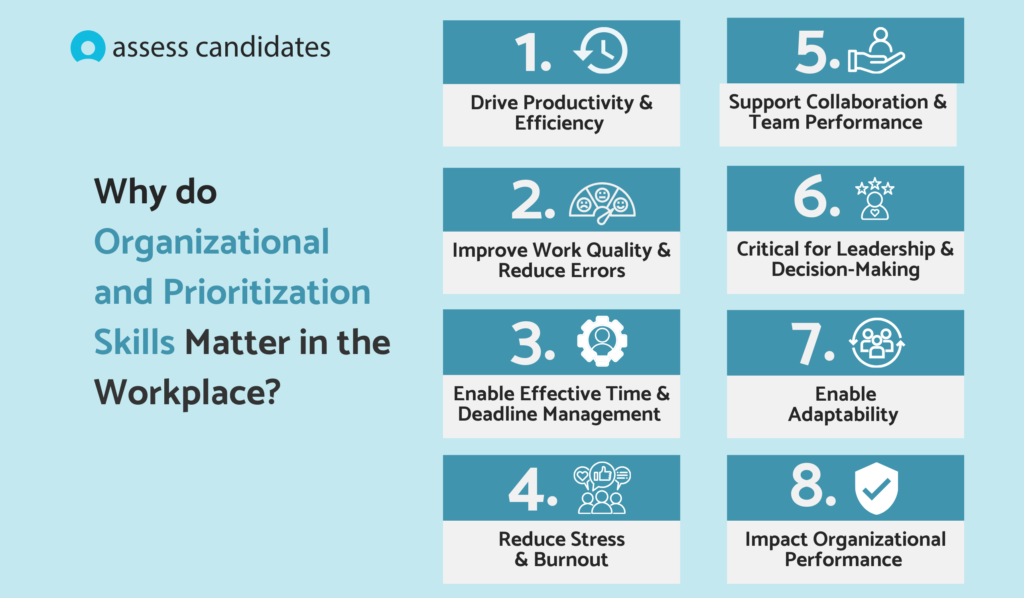
1. Drive productivity and efficiency
Combining these workplace skills drives your workforce’s efficiency and productivity. Your employees with strong prioritization skills, especially in leadership roles, determine which tasks their subordinates should prioritize. Employees with organizational skills follow a systematic workflow to accurately and quickly complete assigned tasks.
2. Improve work quality and reduce errors
Your workforce will record more errors in their tasks as deadlines approach, due to reduced attention. However, prioritization skills help your employees to determine the estimated time and sequencing required to complete tasks. Organizational skills allow them to manage their time by following a task structure and workflow.
3. Enable effective time and deadline management
Time management is an effective tool against factors such as procrastination. Organization and time prioritization influence how your employees allocate and use their time to accomplish tasks, meet deadlines, and juggle multiple tasks. Using task structuring, time and workflow management, your workforce completes essential tasks on time.
4. Reduce stress and burnout
Stress and burnout in your workforce are linked to consistently chasing tight deadlines, which reduces your organization’s productivity. With strong organization and prioritization abilities, your employees can manage time and information to decide which tasks to prioritize. They can also follow through on tasks with task structuring and workflow management.
5. Support collaboration and team performance
Team members depend on one another to complete prerequisite tasks. However, it can either improve collaboration or cause conflict among them. Teams that apply strong organization and task prioritization work more efficiently and complete tasks with fewer delays. They manage stress and attention, improve team collaboration, trust, and overall performance.
6. Critical for leadership and decision-making
As a leader in an organization, you must assign tasks to subordinates and ensure their timely delivery. To do so, you must determine the right tasks to assign to different individuals. Your prioritization skills help you determine high-impact tasks, while your organizational skills aid your subordinates in meeting deadlines.
7. Enable adaptability
Modern work environments are fast-paced, requiring your employees to constantly shift their focus from current tasks to new ones. Furthermore, employees in high-growth environments must respond to urgent issues without losing focus on their previous task goals. With both skills, your employees can maintain progress amid changing priorities.
8. Impact organizational performance
Your workforce’s efficiency determines your organization’s performance. Late task completion, poor customer outcomes, and inconsistencies in work quality all contribute to poor productivity. However, employing candidates with strong organizational and prioritization skills addresses this issue. Your company can improve productivity via high-impact task prioritization and critical decision-making under constraints.
Explore our expertly designed assessments that accurately measure organization and prioritization skills. LEARN MORE
To enjoy the benefits of having these skills in your team, you must know how to measure them in your candidates. Let’s see how it is done.
3. How to Measure and Score Organizational and Prioritization Skills
Given the importance of organizational and prioritization skills in the workplace, you should continually assess these skills in candidates applying for roles at your organization. It helps you avoid mis-hires, improve your organization’s efficiency and productivity, and create a clear path to greater profit.
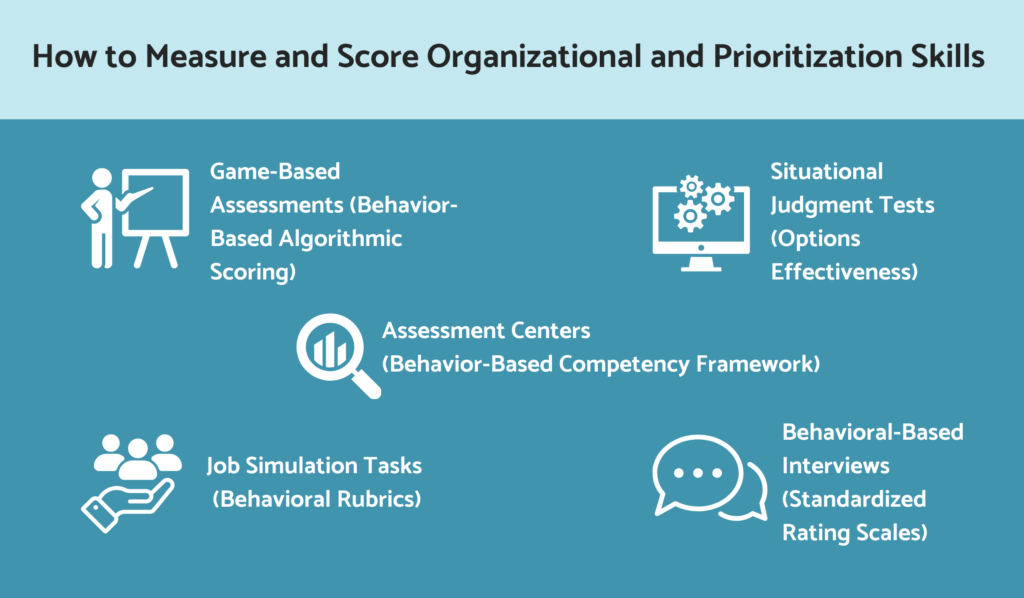
Evaluate candidates for their organization and prioritization skills using the following assessments:
1. Game-based assessments
Game-based assessments can test planning, task organization, time management, and workload management. They also test for adaptability, task sequencing, and the ability to juggle multiple goals under pressure. In the MTA-Tray game-based assessment, candidates organize activities, reorder tasks, or allocate resources while under a time limit.
Game-based assessment scores a candidate’s level of organization and prioritization using a behavior-based algorithmic scoring system. It focuses on time spent per task, the number of tasks completed, the order of task completion, and the response to interruptions. The algorithm benchmarks your candidates’ performance against high-performers’ norms and categorizes them accordingly.
For example, as part of the hiring pre-screening exercise, Candidate G plays the MTA-Tray game, where she sorts moving parcels into the correct mailboxes, and passes, with the result highlighting her multitasking, prioritization, and organizational skills as strong.
2. Situational judgment tests
In order to measure a candidate’s organization and prioritization through situational judgment tests, you can present workplace scenarios that revolve around applying these competencies. Candidates will have to analyze the situation and rank their response in order of priority. Situational tests evaluate candidates’ judgment in prioritizing these tasks and making decisions under pressure.
Answers in situational judgment tests are weighted and ranked according to their effectiveness in addressing situations. Candidates are scored by comparing their responses to subject-matter experts’ in similar situations. An option that balances urgency, impact, and the organization’s goals scores high. However, an option that does not meet these criteria scores low.
For example, in a pre-employment assessment exercise, Candidate E encounters a situational judgment test question that asks, “You have a project deadline at 4 p.m., a team meeting in 30 minutes, and an urgent request from a senior manager. What do you do first?
Option A: Immediately stop working on the project and focus entirely on the senior manager’s request, postponing the meeting and continuing the project later in the day.
Option B: Continue working on the project until the meeting starts, then attend the meeting and handle the senior manager’s request afterward.
Option C: Review all three commitments, identify what can be delegated or rescheduled, inform relevant stakeholders, and create a short plan to ensure the project deadline is met while addressing the urgent request appropriately.”
She chooses Option C, the most effective response.
3. Job simulation tasks
Job simulation tasks that test candidates’ prioritization and organizational skills are role-specific. They help recruiters observe your candidates’ real-world behaviors in role-specific situations through virtual or in-person assessments. An example is a detailed work sample test. This test shows their task management and structuring, time management, and workflow management skills.
During a job simulation assessment, an assessor rates your candidates using behavioral rubrics that use predetermined criteria. Such criteria can include adherence to deadlines, task prioritization logic, quality-versus-speed trade-offs, and scheduling accuracy. Your candidate scores high if their structures work, they meet deadlines, and adjust priorities logically.
For example, Candidate G’s job simulation test question says:
“There are three projects to be delivered in 3 weeks, and they will have three different impacts on the organization. Project 1 will attract more customers to us, project 2 is for a returning high-ticket client, and project 3 will help us reach our annual financial goal faster.
First, rank these projects in order of priority. Then, break each project into tasks and assign them to appropriate personnel to ensure we meet the deadlines.”
4. Behavior-based interviews
Behavioral interview questions assess your candidate’s organizational and prioritization skills by asking them to describe their past behavior in relevant scenarios. These questions measure your candidates’ consistency of behavior, such as time allocation and task sequencing, across situations. Your candidates’ STAR method answers must be clear, as they inform their scoring.
Interviewers use standardized rating scales for scoring candidates in behavior-based interviews. They score the situation, task, action, and result, and aggregate them. A clear example that shows prioritization, explains decisions, and outlines measurable outcomes means your candidate scores high. However, unclear structures and outcomes mean they receive low scores.
For example, Candidate A responds to a behavioral interview question, “How did you, as a team lead, handle multiple urgent deadlines in the past?”
Answer: I analyzed each project’s impact on the organization, broke each project into smaller tasks for my team, and assigned estimated completion times to them. I ensured my team focused on their tasks using a workflow system, and the projects were ready before the deadline.
5. Assessment centers
Measuring organizational and prioritization skills during assessment centers is considered the most effective option as it uses a multi-method, multi-assessor approach. An assessment center tests your candidates over an extended period through role plays, individual in-basket tasks, or group exercises.
Multiple assessors independently rate your candidates across multiple assessments using behavior-based competency frameworks. Your candidates must consistently exhibit high-impact task prioritization, excellent planning, and adaptability to score high. Candidates that are overwhelmed by complexities, inconsistent in their task approaches, and manage time poorly will score low.
For example, in an assessment center test, Candidate E must prepare a presentation in 10 minutes. The assessors watch how she manages stress and attention while under pressure, her time management, and task management skills.
Accurately measure organization and task prioritization with our science-backed assessments. VIEW PLANS
Despite these accurate methods, you must watch out for some red flags in your candidates.
4. Red Flags to Look out For when Assessing Organizational Skills and Task Prioritization
Candidates, through coaching, can get the correct answers during some organizational and prioritization assessments, but lack the skill sufficiently. This is why many assessment organizations use cheater detectors for assessment accuracy. There are many behavioral signs and red flags that show the truth about your candidates’ organizational and prioritization skills.
Some of the red flags to watch out for when assessing your candidates’ organizational and prioritization skills include the following:
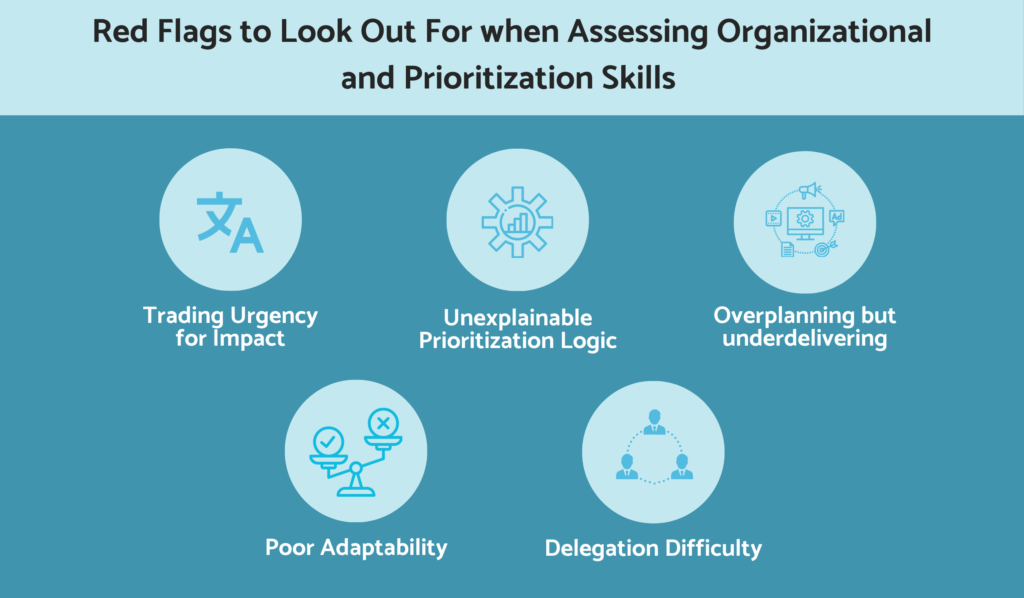
- Trading urgency for impact
The right candidate for your company should be able to relate individual tasks to business impact. If you observe a candidate consistently taking on low-impact tasks instead of high-impact ones, it is a red flag.
Such candidates, when employed, will appear busy but contribute little to the organization’s progress. They will sacrifice high-impact tasks for low-impact ones, making your organization less productive.
- Unexplainable prioritization logic
It is common for employees to decide on a whim, and it turns out to be the right one. However, a lucky guess and an informed decision are two different things, with the latter being preferable for businesses.
Observe your candidates during assessments and note the logic behind their decisions. If they can clearly explain their prioritization decisions, they have the skill. If not, they will pose a challenge to their team and your organization in the future.
- Overplanning but underdelivering
A clear plan that outlines task structuring and time allocation shows that your candidates have good organization and prioritization abilities. However, take note of the time spent on planning and its effect on the project outcome. Does the quality of the work justify the planning?
- Poor adaptability
One of the hallmarks of an organized individual that prioritizes right is the adaptation to changing task goals and urgency. If any of your candidates have this ability, they quickly reprioritize tasks as needed and focus on high-impact ones. Candidates without this quality are organizational and prioritization red flags.
- Delegation difficulty
Candidates that want to handle all tasks by themselves, especially in a group, is a huge red flag. It shows their difficulty in delegating tasks to others to enable quality and timely work delivery. It also portrays them as poor collaborators, a quality that can cause your organization to miss deadlines and deliver subpar work.
Identify organizational and prioritization skills red flags with our end-to-end assessments. LEARN MORE
You can have a more accurate pre-employment assessment for your candidates by outsourcing the exercise. Assess Candidates is one of the best options.
5. How Assess Candidates helps Organizations Evaluate Candidates for Hiring
Conducting the necessary skills assessments for your candidates can be time-consuming. Many organizations opt for outsourcing their candidate assessments to experienced administrators. These candidate assessment organizations have the required technology and systems to evaluate your candidates accurately.
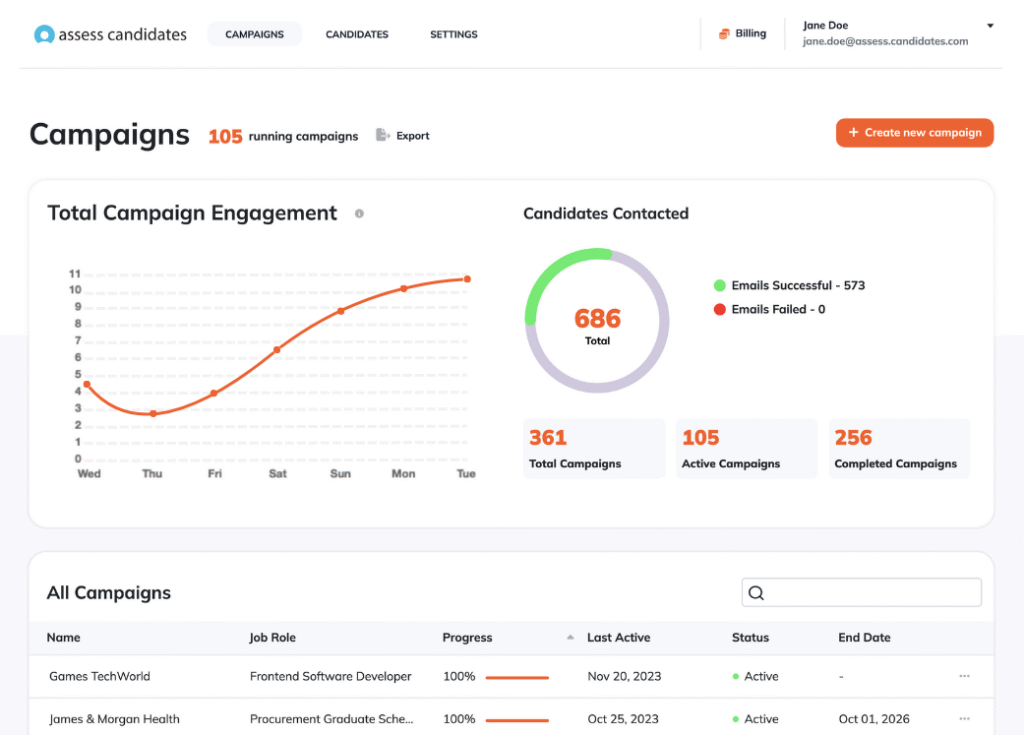
Assess Candidates helps organizations like yours evaluate candidates for hiring through:
- Accurate and reliable assessments
Evaluating your candidates’ skills through various assessments ensures you know their abilities. However, accurately assessing those skills tells you how well they can function in their desired roles. Assess Candidates provides the accuracy and reliability that candidate assessments should have to ensure fairness.
- AI tech assessment systems
To make the experience reliable, predictive, and immersive, Assess Candidates uses state-of-the-art artificial intelligence technology to administer the assessments. Your candidates will find the assessments engaging, and you will receive predictive, reliable results. Due to the AI tech system, you can significantly reduce your time-to-hire.
- Role-tailored assessments
Generic candidate assessments yield poor results because they don’t prioritize candidates’ roles. At Assess Candidates, the system suggests role-specific evaluations. With role-tailored assessments, like hiring retail graduates, you can eliminate false positives and get accurate reviews of candidates’ skills. Also, it improves your company’s quality of hires.
- Clear and simple reporting
After you have tested your candidates’ skills, you should be able to read and understand their assessment results. However, with the technicalities surrounding some tests and their result presentation, that can be a challenge. Assess Candidates provides easy-to-understand reports on your candidates, helping you make hiring decisions faster and confidently.
- Data-driven hiring decisions
For recruitment equity reasons, it is best to hire candidates based on their proficiency in the required skills as presented in their assessment results. Assess Candidates supports your organization’s pursuit of equity and fairness by providing data-driven results that inform your hiring decisions. Anchoring your recruitment decisions on data ensures you remain objective and reduce bias.
Explore our assessment platform to identify high performers. LEARN MORE
Conclusion: Key Takeaways
- Organizational and prioritization skills are soft skills that, when combined, ensure workforce efficiency. Organizational skills enable individuals to plan, structure, manage, and execute work effectively. Prioritization skills help individuals to identify and rank tasks by importance or necessity.
- Organization and prioritization matter in the workplace as they drive productivity and efficiency. They also improve work quality, reduce stress and burnout, and support collaboration and team performance.
- You can measure these skills through game-based assessments, situational judgment tests, job simulation tasks, behavioral interviews, and assessment centers. They score the skills through behavior-based algorithmic scoring, options effectiveness, behavioral rubrics, standardized rating scales, and behavior-based competency framework, respectively.
- Watch out for red flags such as trading urgency for impact, unexplainable prioritization logic, poor adaptability, and overplanning but underdelivering.
- Assess Candidates helps organizations evaluate their candidates for hiring through accurate assessments, AI tech assessment systems, role-tailored assessments, and clear assessment reporting.
Interested in knowing more about how to measure and score organizational and prioritization skills? Continue to the frequently asked questions section and sign up below with your email to get started.
Frequently Asked Questions
What tools help with organization?
Tools that can help you with organization include calendar and scheduling tools (Google Calendar), task management apps (Todoist), and document management systems (Google Drive). Others include note-taking apps (Evernote) and workflow and project management software (Asana).
What are common organizational challenges?
Common organizational challenges that can impede task completion include information overload, unclear goals or objectives, inadequate information, and limited resources. Others include poor time management, frequent interruptions, and a lack of structure. These factors cripple workplace efficiency and productivity.
Which tool is used for prioritization?
Tools that are used for prioritization include digital apps like Trello, Asana, and Jira. These apps use different frameworks for prioritization. The Eisenhower Matrix prioritizes by urgency or importance. RICE stands for Reach, Impact, Confidence, and Effort. MoSCoW prioritizes items as must-haves, should-haves, could-haves, and won’t-haves.
What are the factors affecting organization?
The extent to which a candidate with organizational skills can use them depends on factors such as workload volume. Other such factors include communication quality, leadership and management practices, resource availability, time constraints, and workflow systems.
What are the common prioritization mistakes?
Common prioritization mistakes include elevating urgency over importance, trying to do too many tasks at once, and procrastinating on high-impact tasks. Other mistakes are poor delegation decisions, ignoring deadlines, and failure to reassess priorities when appropriate.


 English
  Arabic