
Why Human Skills Still Outshine AI In The Workplace
AI adoption is accelerating, but people are not becoming obsolete. Technology improves speed and efficiency, while work that relies on human skills such as judgment, creativity, and empathy still depends on humans.
In real workplace scenarios, success goes beyond processing information. Leaders make ethical choices, navigate uncertainty, and build trust to complete tasks that require context, empathy, and critical thinking.
The use of AI is gaining momentum in all industries. Automation now handles data analysis, scheduling, screening, and repetitive tasks at scale. Yet despite this rapid progress, humans are not becoming obsolete. Technology is used to enhance speed and efficiency, yet actual work still requires human judgment, imagination, and emotional intelligence.
In real workplace scenarios, success goes beyond processing information. Leaders have to make ethical choices, handle uncertainty, inspire teams, and develop trust. These tasks need context, empathy and critical thinking, which artificial intelligence tools are unable to achieve.
Workforce data suggests the importance of human skills has grown since 2018, even as AI use has increased (LinkedIn Work Change Report).
In this guide, you’ll learn…
Contents
- What Are Human Skills?
- Strengths of AI in the Modern Workplace
- Limitations of AI in Day-to-Day Work
- Why Human Skills Matter More Than AI at Work
- The Role of Human Skills in Leadership and Management
- How to Integrate Human Skills and AI in the Workplace
- Why Top Employers Use Assess Candidates to Assess Human Skills Accurately
Let’s start by defining what human skills are.
1. What Are Human Skills?
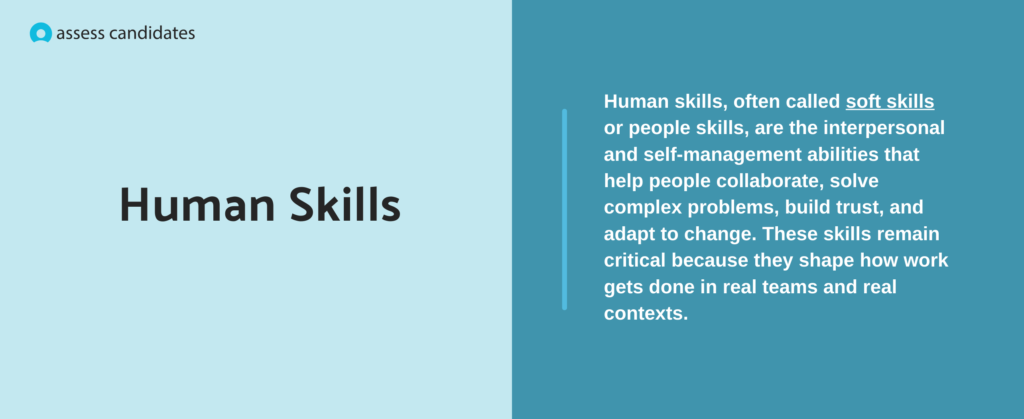
Human skills, often called soft skills or people skills, are the interpersonal and self-management abilities that help people collaborate, solve complex problems, build trust, and adapt to change. These skills remain critical because they shape how work gets done in real teams and real contexts.
Examples of human capabilities include:
- Emotional intelligence
- Creativity
- Communication
- Leadership
- Adaptability
- Time management
- Critical thinking and problem-solving
In a 2024 study, employees and managers indicate that soft skills are an absolute necessity in the recruitment process.
Measure candidates’ soft skills accurately with our research-backed assessment platform. HIRE FOR FREE
It is worthwhile to consider what AI does well before we examine why soft skills are the most important.

2. Strengths of AI in the Modern Workplace
AI now plays a practical role in day-to-day work. Organizations use it to improve speed, accuracy, and efficiency, especially in areas that rely on large volumes of data. When deployed correctly, AI removes friction from routine tasks and gives teams more time to focus on higher-value work.
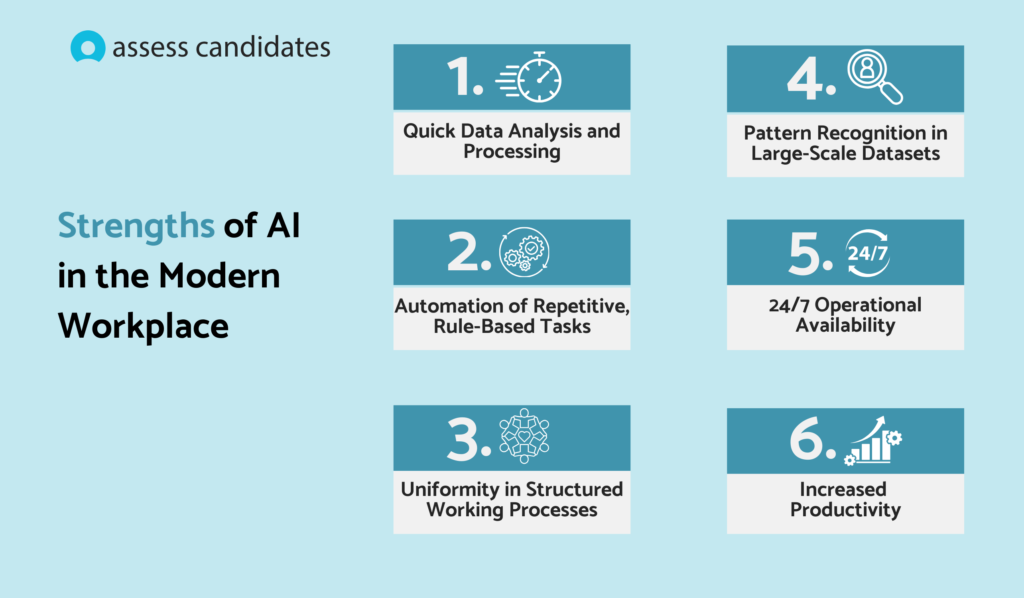
- Quick Data Analysis and Processing: AI processes and analyzes large datasets in seconds, and helps teams get insights more quickly than through manual analysis.
- Automation of Repetitive, Rule-Based Tasks: AI automates scheduling, data input, screening, and reporting processes, relieving the workload of employees.
- Uniformity in Structured Working Processes: AI adheres to established regulations without exceptions, which reduces mistakes in compliance, payroll, and other transactional processes.
- Pattern Recognition in Large-Scale Datasets: AI identifies patterns, anomalies and correlations that humans tend to overlook, particularly in large or complex datasets.
- 24/7 Operational Availability: AI systems work 24/7 and cannot fatigue. They provide services to global teams and clients, and also track the activity of various time zones.
- Increased Productivity: AI enhances productivity when it complements the employees, giving them the opportunity to work on human-focused tasks, and saving resources.
91% of employees say that their organizations utilize one or more AI technology.
Use our AI-driven talent tests to elevate your recruitment process. LEARN MORE
But where it excels reveals where AI falls short, and that’s the primary reason why human-centered skills remain more important.
3. Limitations of AI in Day-to-Day Work
AI is fast and efficient, but it does not interpret people and meaning the way humans do. These gaps show up most clearly in leadership, hiring, ethics, and any role that depends on judgment under uncertainty.
These loopholes can be seen in leadership, recruitment, ethical considerations, and any role that needs the skill of making judgments.
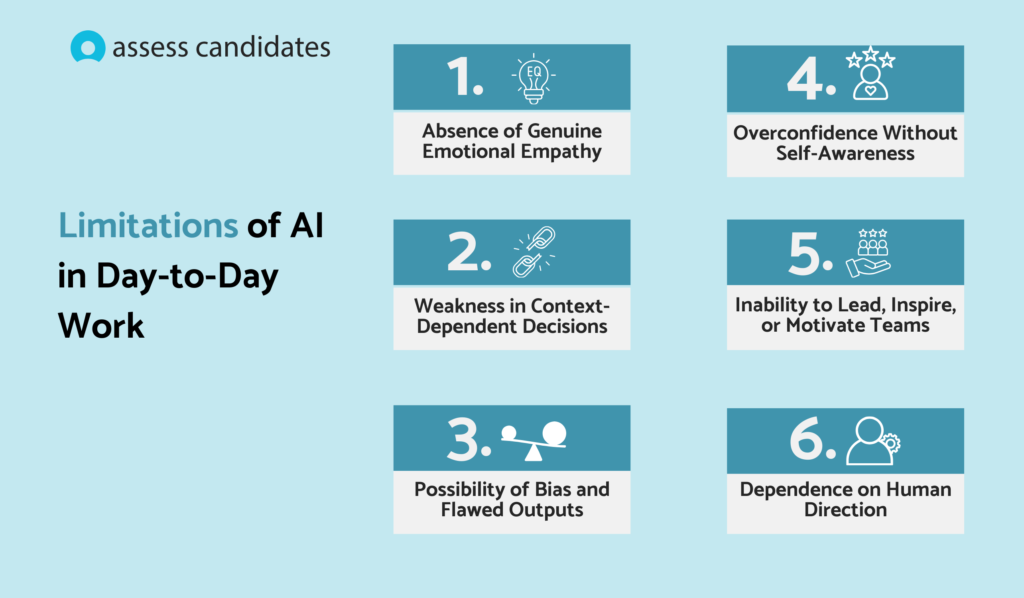
- Absence of Genuine Emotional Empathy: AI can simulate emotional language, but it lacks genuine empathy and emotional intelligence. It often does not understand emotional undertones in complex human relations.
- Weakness in Context-Dependent Decisions: AI struggles in ambiguous situations with conflicting priorities or limited information. It is in such circumstances that human beings assess context, intent, and consequences.
- Possibility of Bias and Flawed Outputs: AI can reproduce historical bias unless humans monitor data, prompts, and outputs to avoid discrimination in hiring, promotion, and evaluation decisions.
- Overconfidence without Self-Awareness: AI provides answers with confidence even in cases of inaccuracy. It is unaware of when it is feeding off misleading information, or when there is a probability of one of its outputs being erroneous. Human beings are aware of uncertainty.
- Inability to Lead, Inspire, or Motivate Teams: Leadership requires vision, emotional intelligence, and influence. AI cannot inspire, motivate, or guide a team in change and uncertainty.
- Dependence on Human Direction: AI is neither a goal-achiever nor a priority decision-maker. Humans must define objectives, validate outputs, and correct errors to ensure AI supports business outcomes.
According to a Workday global survey, 83% of employees believe that AI will make uniquely human skills more critical, not less.
Test candidates confidently with our automated assessments. VIEW PLANS
Therefore, it’s key to use AI for scale and consistency, then rely on human skills for judgment, fairness, and leadership.
With those limitations clear, let’s examine exactly why people skills still matter more.
4. Why Human Skills Matter More Than AI at Work
AI can work with data, automate, and deal with routine tasks, but it cannot substitute the purely human capabilities that result in engagement, innovation, and making better decisions. Companies that make investments in both human capabilities and AI experience improved performance, team performance, and improved ethical and strategic decision-making.
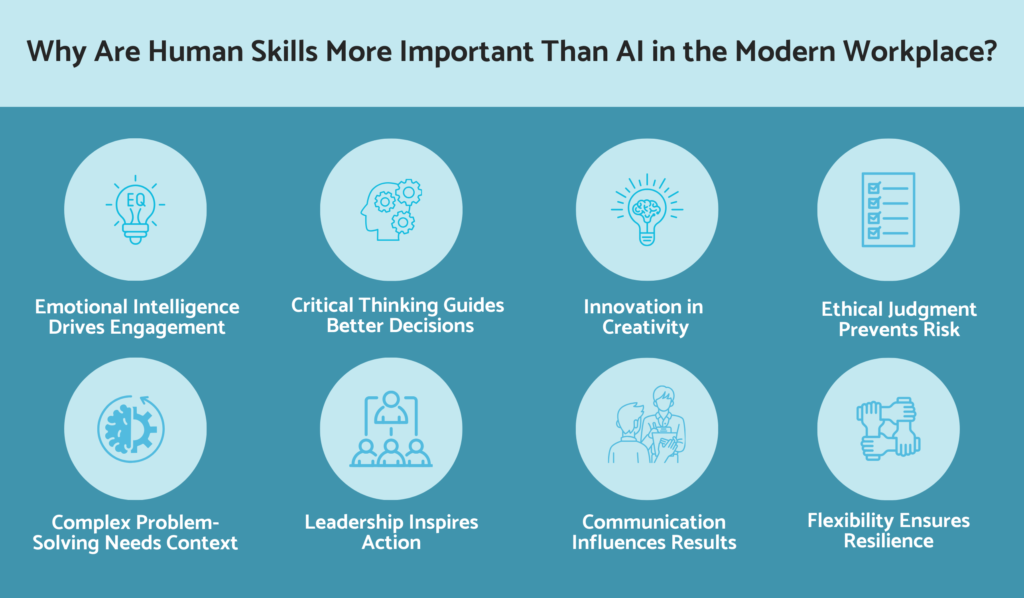
1 . Emotional Intelligence Drives Engagement:
People interpret feelings, adapt communication, and develop trust. AI cannot experience morale or transform leadership style on a whim.
2 . Critical Thinking Guides Better Decisions:
AI offers probabilities in complex scenarios, but humans take nuances, values, and unintended consequences into consideration.
3 . Innovation in Creativity:
Original ideas, strategic vision, and problem-solving with intuition are human-only areas. AI is not able to mimic imaginations and breakthrough thinking.
4 . Ethical Judgment Prevents Risk:
Equity, adherence, and ethics are what human beings consider. When it comes to making a responsible decision, AI is not value-driven and does not possess a means to make such decisions independently.
5 . Complex Problem-Solving Needs Context:
Ambiguous challenges are solved by humans through the combination of experience, context, and social dynamics. AI is not able to see different shades of situations.
6 . Leadership Inspires Action:
AI is unable to inspire, sway, and control teams amid uncertainty. Human leadership promotes culture, accountability, and alignment.
7 . Communication Influences Results:
Individuals speak with tones and persuasion. AI is capable of creating messages but not sensitive dialogues and relationships.
8 . Flexibility Ensures Resilience:
Human beings change strategies as their environment transforms. AI is coded and is not capable of handling any unexpected situations.
Some surveys report that 79% of workers are not confident that AI can understand emotions and human behavior in ways their leaders can, while 71% of workers believe that soft skills will be even more important in the future.
Test soft skills using our extensive range of proven pre-employment tests. HIRE FOR FREE
5. The Role of Human Skills in Leadership and Management
Leadership isn’t only about task management or data analysis. Today’s AI-driven work environment requires you to motivate, mentor, and unite your work teams. Trust comes from emotional intelligence and collaboration relies on human judgment, which AI fails to replicate.
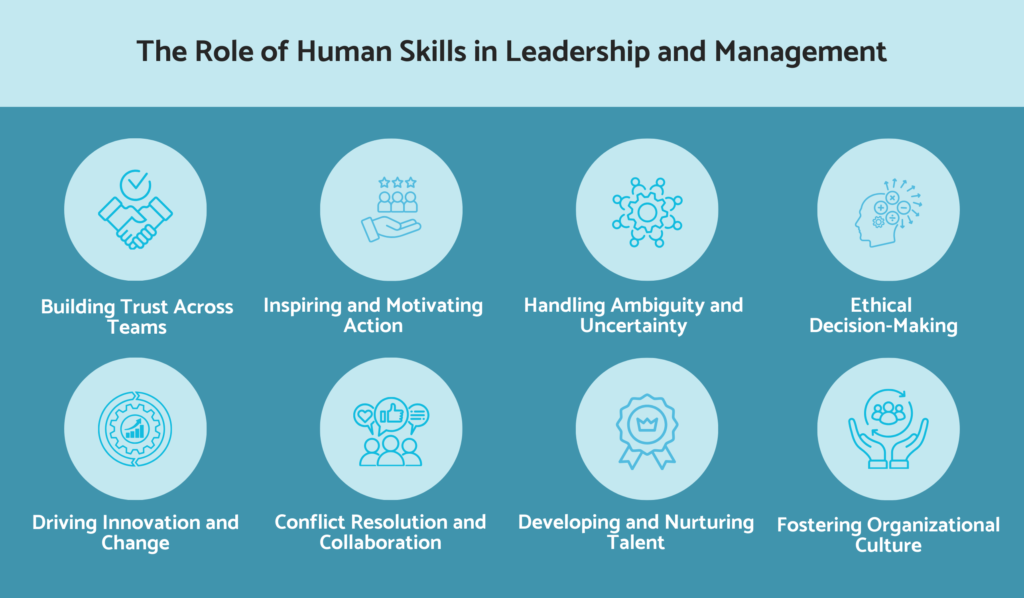
- Building Trust Across Teams: Trust is gained by being transparent, empathetic, and consistent. Leaders who know how to build teams make them loyal and engaged, something AI cannot replicate easily.
- Inspiring and Motivating Action: Human beings can ignite purpose and devotion to help teams perform better than anticipated. AI does not have the power of motivating or aligning people to vision.
- Handling Ambiguity and Uncertainty: Leaders process incomplete information, change strategies, and take high-stakes decisions. AI cannot handle ambiguity and context-based judgment.
- Ethical Decision-Making: Leadership implies finding a balance between values, compliance, and impact. Human judgment prevents reputational and legal risks which AI is not able to manage independently.
- Driving Innovation and Change: Humans anticipate trends, challenge assumptions, and influence cultural or strategic change. AI can be involved in analysis, but does not drive change.
- Conflict Resolution and Collaboration: Leaders intervene in conflicts, address differences in opinions, and foster teamwork. AI cannot grasp social dynamics and interpersonal relationships.
- Developing and Nurturing Talent: Leaders promote development, coach their workers, and provide them feedback. AI cannot build a personal career or motivate people to practice their skills.
- Fostering Organizational Culture: Values, models of behavior and norms are co-created by people to spur performance. AI is able to analyze culture, but cannot mold it.
According to 2025 leadership trends, the vast majority of HR leaders say that emotional intelligence (EQ) is a major factor when recruiting managers, and high-EQ leaders are associated with higher employee retention.
Begin to evaluate crucial human-centered skills today. VIEW PLANS
So how do you integrate human strengths with AI effectively? Let’s explore!
6. How to Integrate Human Skills and AI in the Workplace
AI is able to perform repetitive tasks and respond faster than human beings. However, AI should be used together with human capabilities like emotional intelligence, and adaptability. By using AI alongside people skills, you can increase productivity, make more reliable decisions, and build a more innovative and resilient work environment.
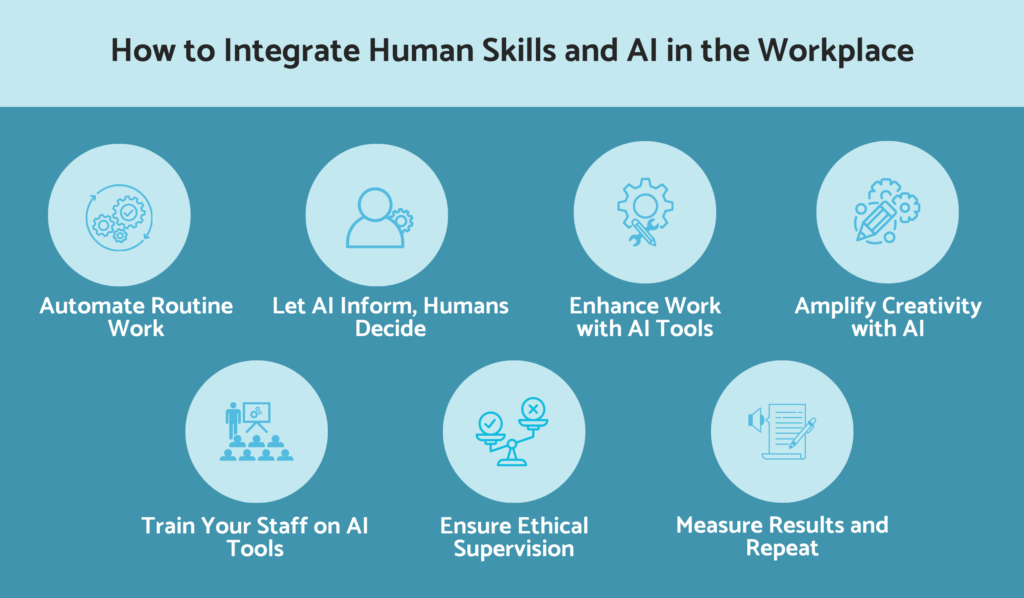
- Automate Routine Work: AI can be used to perform routine and time-intensive tasks, such as data entry, reporting, and scheduling. This allows you and your team more time to do other creative, strategic, or interpersonal work.
- Let AI Inform, Humans Decide: AI can give you summaries or make recommendations, but you should process the information, analyze it, and make a final decision. This will make sure that you make the right decisions that are ethical and against your business goals.
- Enhance Work with AI Tools: Have virtual meetings, create documents, or manage workflow with the help of AI. However, rely on people skills to overcome the disagreements and make collaborations effective.
- Amplify Creativity with AI: AI can assist you in generating ideas, but you will need to refine and transform them into action plans. Real innovation still comes from humans.
- Train Your Staff on AI Tools: Teach your employees artificial intelligence tools, and also train them on the importance of human capabilities like problem-solving, emotional intelligence, and critical thinking. Such combination makes your workforce future-ready.
- Ensure Ethical Supervision: AI adheres to programmed guidelines but cannot assess ethical implications. Supervise adherence, equality, and ethical use of AI in every process.
- Measure Results and Repeat: AI can be applied to analytics and to monitor performance. But result analysis, strategy adjustment, and the continuous process development should be done by humans.
According to a study conducted by Workday in 2025, 93% of active AI users state that AI allows them to concentrate on more advantageous activities such as strategy and problem-solving, and less on routine tasks.
7. Why Top Employers Use Assess Candidates to Assess Human Skills Accurately
Human skills outperform AI in real work because they drive judgment, collaboration, leadership, and adaptability. But these skills are also harder to assess using CVs or gut instinct alone. Assess Candidates helps you measure critical soft skills without removing human decision-making from the hiring process.
How Assess Candidates Helps You Assess Human Skills Accurately
- Scientifically Validated Assessments: Assess Candidates’ assessments are designed by Chartered Scientists, Psychologists, and Psychometricians. Our tests reliably measure cognitive ability, personality traits, judgment, and behavior, people skills that predict performance beyond technical knowledge.
- Evidence-Based Insight: You receive clear, detailed reports that show how candidates think, solve problems, respond under pressure, and interact with others. Recruiters interpret results using flexible criteria, ensuring human judgment stays central to every hiring decision.
- Anti-Cheating: Assess Candidates platform includes cheat-detection technology that monitors specific candidate behaviors during assessments and provides an overall candidate score to help you trust the accuracy and validity of the results.
- Fair and Inclusive Evaluation: Human skills should be assessed equally. Our platform applies the same structured criteria to all candidates, helping reduce bias while maintaining accessibility features for candidates with disabilities or additional needs.
- Human-Centered Candidate Experience: Candidates complete assessments through a simple, branded, and device-friendly interface. Clear instructions and smooth navigation create a professional experience that reflects your employer brand.
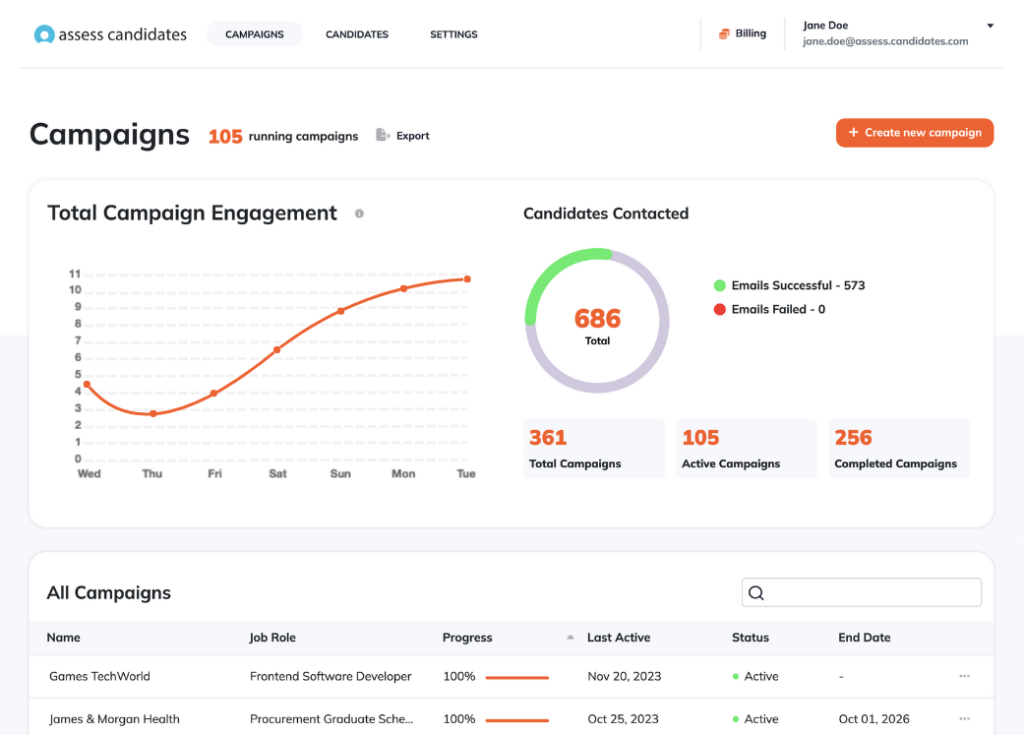
Employers choose Assess Candidates because it enables confident, ethical, and skills-based hiring. You assess emotional intelligence, judgment, problem-solving, and behavior objectively while keeping humans in control of final decisions. The result is better hires, stronger teams, and a hiring process aligned with how work actually happens.
Conclusion: Key Takeaway
Human skills such as emotional intelligence, creativity, judgment, and leadership remain difficult to automate because they depend on context, accountability, and trust. AI can process information and suggest options, but it cannot weigh moral trade-offs or own the consequences of decisions.
The strongest workplaces use AI to enhance human judgment, not replace it, while continuing to invest in the skills that drive collaboration, resilience, and leadership.
Over 70% of employers opine that soft skills will remain essential despite the development of AI. Studies are often-cited as 85% of career success is characterized by the presence of well-developed soft skills.
That’s why human skills still outshine AI in the workplace, especially in leadership and hiring.
Trust our years of experience in assessing soft skills. VIEW PLANS
Want more insights on why soft skills matter more than AI at work? Explore the FAQs below and sign up with your email to get started!
Frequently Asked Questions
Can AI substitute human judgment at work?
No. AI identifies trends, whereas humans understand meaning, risk, values, and long-term implications. Judgment requires accountability and ethical reasoning, especially in hiring, leadership, and strategic decisions.
Why are soft skills more relevant as automation increases?
Other tasks become more complex and people-oriented as AI handles routine tasks. Soft skills make employees able to handle uncertainty, work efficiently, and solve problems which machines fail to comprehend.
What human skills are most valued in the age of AI?
Emotional intelligence, critical thinking, creativity, communication, and ethical judgment are some of the people skills most appreciated by employers. These abilities enable collaboration and multifunctional decision-making where AI lacks context and empathy.
How should employers balance AI and human skills?
Monotonous work should be automated, and employers should invest in leadership, communication, and problem-solving skills. This balance improves productivity without interfering with trust, accountability, and quality of decisions.
What is the best way for recruiters to assess human skills?
Recruiters should use structured interviews, situational judgment tests, behavioral assessments, and work simulations. Such tests measure real-world decision-making, communication, and adaptability better than resume screening.
What are the most human-centred jobs despite AI?
Roles that require empathy, persuasion, ethics, and relationship-building such as leadership, management, HR, customer service, and sales are some of the most human-centred jobs. AI cannot imitate the soft skills required for these roles.


 English
  Arabic