
How to Address Gender Bias in Recruitment
Hiring decisions should be based on skills, potential, and job relevance. Yet gender bias in recruitment continues to influence how candidates are evaluated, often without being visible.
Research shows that many candidates still experience biased questions, unequal treatment, or barriers to entry based on gender rather than ability. This not only affects individuals but also limits access to talent and weakens hiring outcomes.
Addressing gender bias in recruitment means building a process that is structured, consistent, and based on evidence rather than assumptions.
In this guide, you will learn what gender bias in recruitment looks like, what causes it, and how to reduce it using practical, structured hiring strategies.
Contents
- What is gender bias in recruitment?
- What causes gender bias in hiring?
- Risks and consequences of gender bias in recruitment
- Why reducing gender bias improves hiring outcomes?
- Effective strategies to reduce gender bias in hiring
- Tools and assessments that help reduce gender bias in recruitment
- How can Assess Candidates support a bias-free hiring process?
- The future of bias-free recruitment
1. What is Gender Bias in Recruitment?
Gender bias in recruitment is the tendency to favor or disadvantage candidates based on gender rather than job-relevant skills, experience, and potential. It can be conscious or unconscious and may influence decisions at any stage of the hiring process.
Gender bias can limit diversity in the workplace and affect the performance of organizations, as it may prevent them from hiring the most qualified candidates or creating an inclusive work environment.
Through gender bias, women are less favored often due to the preconceived idea about the conflict between progressing their careers or having a family.
A Yale study showed that even with identical applications, candidates perceived as male were rated as more competent and employable than their female counterparts, even when their qualifications were the same.
Use our automated, bias-free assessments to hire diverse talent and avoid damaging gender bias. HIRE FOR FREE
Gender bias does not come from a single decision. It builds across small judgments made during sourcing, screening, and interviews. Let’s explore these causes in the next section.

2. What Causes Gender Bias in Hiring?
Gender bias can appear at multiple points in the hiring process, often through language, assumptions, or inconsistent evaluation criteria. Understanding where it occurs is the first step to reducing it.
Common reasons why gender bias exists in recruitment stages
- Stereotypical Job Perceptions
Longstanding societal beliefs about “male” and “female” roles have influenced hiring decisions, leading employers to associate certain skills or traits with a specific gender.
- Biased Job Descriptions
Gender-coded language, such as overly masculine or feminine terms, can unconsciously attract one gender and discourage the other from applying.
Job advertisements in male-dominated fields are more likely to use masculine-stereotyped language, such as “competitive” and “dominant“, compared to ads for positions in female-dominated fields.
- Unconscious Bias
Recruiters and hiring managers may make snap judgments based on gender without realizing it, affecting candidate evaluation and selection.
- Male-Dominated Leadership
Industries or organizations led predominantly by men may unintentionally perpetuate hiring practices that favor male candidates.
- Cultural and Social Norms
Traditional gender roles and expectations in certain societies shape workplace structures and influence recruitment patterns.
- Informal Hiring Practices
Relying on personal networks and referrals can reinforce existing gender imbalances if those networks lack diversity.
- Historical Underrepresentation
Fields with a long history of gender imbalance may struggle to attract underrepresented genders due to a lack of role models and mentorship opportunities.
- Technology and AI
While technology can help reduce inconsistency, it does not automatically remove bias. AI tools only improve fairness when they are designed, monitored, and used within a structured hiring framework. Otherwise, they can perpetuate existing gender bias.
Gender bias does not just affect candidates. It also undermines hiring quality, team performance, and employer reputation. Next up are some of the most important consequences to watch for.
3. Risks and Consequences of Gender Bias in Recruitment
When gender bias is present in hiring, the impact goes beyond individual candidates. It affects decision quality, team performance, and long-term business outcomes.
What are the negative effects of gender bias in hiring and the workplace?
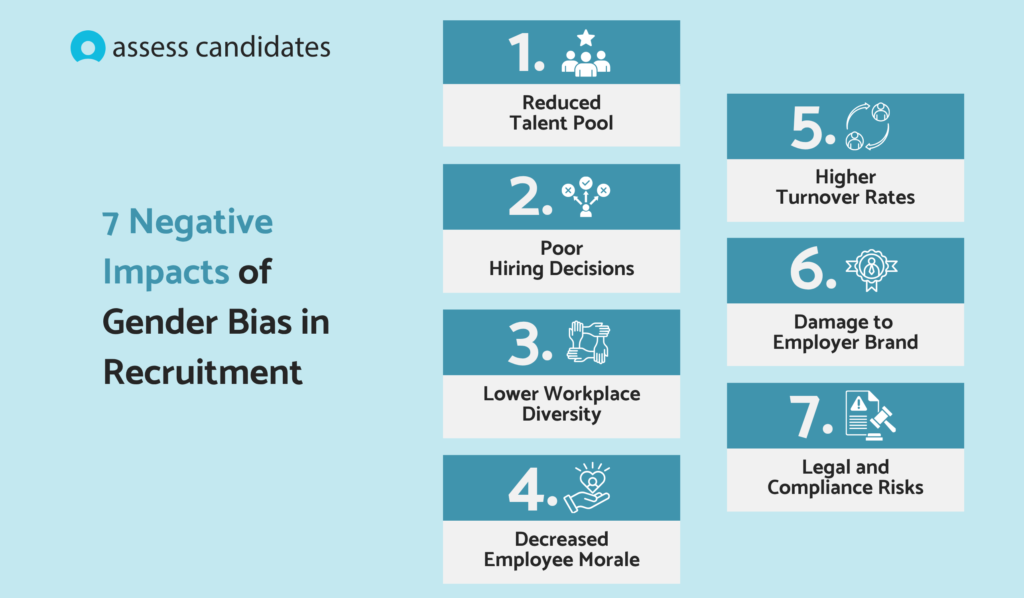
- Reduced Talent Pool: When recruitment is influenced by gender bias, highly qualified candidates may be discouraged from applying or overlooked during the selection process. This narrows the pool of applicants and reduces the chances of finding the best person for the job, limiting the organization’s access to diverse skills and experiences.
- Poor Hiring Decisions: Bias can cause recruiters and managers to prioritize candidates who fit preconceived notions or stereotypes over those with actual merit. This may result in hiring individuals who are less capable or less suited for the role, ultimately affecting performance and productivity.
- Lower Workplace Diversity: Favoring one gender over another in recruitment or promotions reduces diversity within teams. A lack of diverse perspectives can stifle innovation, creativity, and problem-solving, as teams may approach challenges from similar viewpoints instead of benefiting from varied insights.
- Decreased Employee Morale: Employees who perceive gender bias within their workplace often feel undervalued or excluded. This perception can lead to lower engagement, reduced motivation, and a decline in trust toward management, creating a toxic work environment.
- Higher Turnover Rates: Talented employees are likely to leave organizations where they experience or witness gender bias. Losing skilled staff not only disrupts operations but also increases the costs associated with hiring, onboarding, and training new employees.
- Damage to Employer Brand: An organization perceived as biased risks developing a poor reputation among job seekers and the public. This negative image can make it difficult to attract top talent and may even affect customer loyalty, particularly among those who value diversity and inclusion.
- Legal and Compliance Risks: Gender bias can breach equal opportunity laws and anti-discrimination regulations, exposing the organization to legal disputes, fines, and regulatory penalties. Such incidents can also result in lasting reputational damage that is difficult to repair.
Next, we will explore the benefits of reducing gender bias in hiring and how it enhances a company’s cultural impact in society.
4. Why Reducing Gender Bias Improves Hiring Outcomes?
Reducing gender bias in hiring is not only beneficial for increasing fairness in your candidate assessment process. It directly improves hiring quality, consistency, and business performance.
The top 7 benefits of mitigating gender bias in recruitment
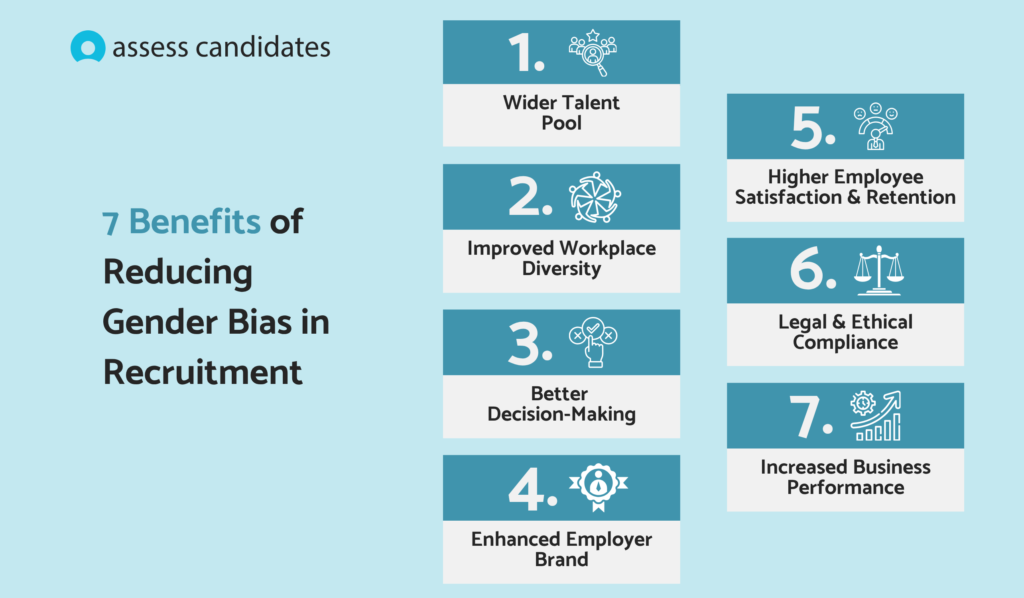
1. Wider Talent Pool
By removing gender bias from your recruitment process, you open the door to candidates of all genders, giving yourself access to a broader range of skills, experiences, and qualifications.
2. Improved Workplace Diversity
You will create a more balanced workforce by ensuring fair hiring practices, which allows you to bring in varied perspectives and experiences that strengthen your team’s capabilities.
3. Better Decision-Making
With a diverse team that is built through unbiased hiring, you benefit from multiple viewpoints and problem-solving approaches, leading to stronger and more effective business decisions.
4. Enhanced Employer Brand
By committing to fair and inclusive recruitment, you position your organization as an employer of choice, attracting top talent who value diversity and equality.
5. Higher Employee Satisfaction and Retention
Providing equal opportunities for everyone allows you to foster a sense of value and belonging among your employees, which encourages them to stay and grow within your company.
6. Legal and Ethical Compliance
By reducing gender bias, you protect your organization from legal risks by complying with equal opportunity laws and demonstrating your commitment to ethical business practices.
7. Increased Business Performance
You set your business up for higher profitability, innovation, and productivity by building a workforce that thrives on diverse perspectives and balanced representation.
Unlock the benefits of our end-to-end range of bias-free assessments developed by Chartered Scientists. LEARN MORE
Discovering the helpful benefits of reducing gender bias in the hiring process has tremendously helped many employers stay ahead of the bias and promote DEI hiring in their organizations.
Next, we will examine the top strategies for addressing gender bias in recruitment.
5. Effective Strategies to Reduce Gender Bias in Hiring
Reducing gender bias requires structure, not intention alone. The following strategies focus on creating consistent, job-relevant evaluations across all candidates:
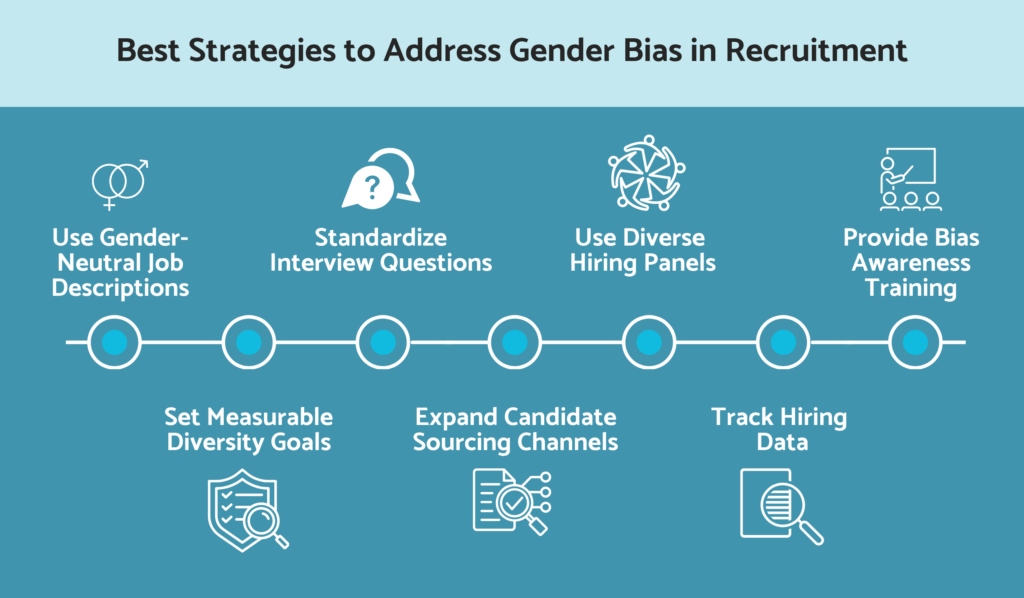
Use Gender-Neutral Job Descriptions based on Skills and Responsibilities
Carefully review job postings to ensure they use inclusive language that appeals to all genders. Avoid gender-coded words such as “dominant” or “nurturing“, which may discourage applicants. Tools like Textio or Gender Decoder can help identify and replace these terms, making your listings more attractive to a broader talent pool.
Standardize Interview Questions
Use a structured interview format in which every candidate is asked the same set of predetermined, job-relevant questions. This approach minimizes subjective comparisons, ensures fair treatment for all applicants, and makes it easier to measure candidates objectively against the role’s requirements.
Use Diverse Hiring Panels to reduce single-viewpoint decisions
Include interviewers from different genders, cultural backgrounds, and departments in your recruitment process. A diverse panel offers multiple perspectives, reduces the likelihood of bias from a single individual, and can help candidates feel more comfortable during the interview.
Provide Bias Awareness Training
Incorporate objective, standardized assessments that measure job-related skills, aptitudes, and cognitive abilities. These tests provide reliable data for comparing candidates, reducing reliance on subjective impressions, and ensuring hiring decisions are based on merit.
Set Measurable Diversity Goals
Define clear diversity and inclusion targets for recruitment and track progress regularly. Setting measurable goals creates accountability, keeps leadership engaged in diversity initiatives, and helps organizations stay focused on continuous improvement.
Expand Candidate Sourcing Channels
Broaden your recruitment reach by posting job ads on platforms that cater to underrepresented groups, partnering with diversity-focused organizations, and participating in events or networks that attract a wider range of talent. This increases your chances of finding top candidates beyond the usual applicant pool.
Track Hiring Data to identify patterns and gaps
Collect and review recruitment metrics such as application rates, interview-to-offer ratios, and acceptance rates by gender. This hiring data can highlight patterns of bias or bottlenecks in your process, enabling you to address disparities before they become entrenched.
When applied thoughtfully and with care, fair recruitment practices help eliminate gender bias, promote equality, and create more inclusive recruitment strategies. Contact us for a complimentary review of your recruitment approach, along with expert guidance on strategies to attract and retain a diverse, high-performing workforce while ensuring gender fairness at every stage.
Reduce gender bias in recruitment with our reliable talent assessment platform. LEARN MORE
These strategies effectively reduce gender bias in hiring and attract underrepresented groups to apply, who might otherwise be discouraged.
6. Tools and Assessments That Help Reduce Gender Bias in Recruitment
Reducing gender bias in recruitment is not just about awareness. It requires the right tools and structured methods to ensure candidates are evaluated consistently and fairly.
The following tools and assessment approaches help minimize bias by focusing on job-relevant criteria rather than subjective judgment.
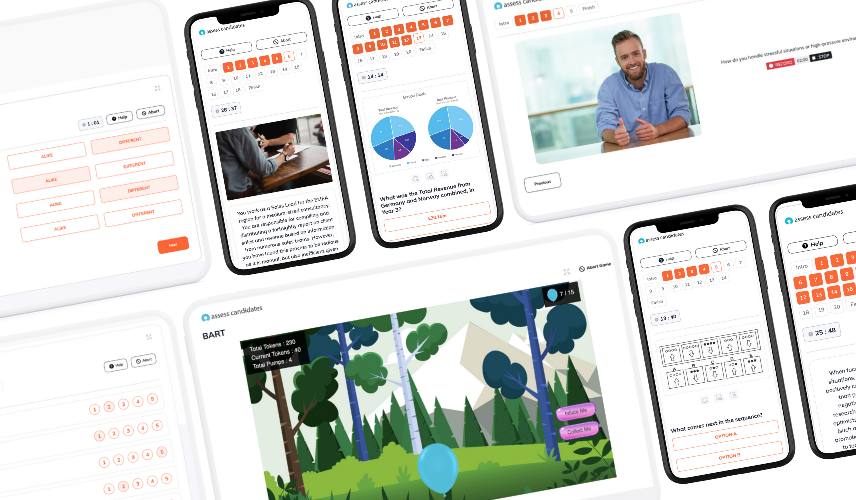
1. Pre-Employment Assessment Tests
Use cognitive, skills-based, and situational judgment tests to evaluate candidates on consistent, job-relevant criteria.
These assessments reduce reliance on subjective impressions and improve comparability across candidates.
Examples include hiring assessment platforms like Assess Candidates and SHL.
2. Gender-Neutral Job Description Tools
Tools such as Textio or Gender Decoder help remove gender-coded language from job ads, increasing application rates from underrepresented groups.
3. Blind Recruitment Platforms
Blind hiring platforms remove identifying details such as name and gender during early screening stages, helping reduce unconscious bias.
4. Structured Interviews and Interview Tools
Standardized interview questions and scoring frameworks ensure all candidates are evaluated consistently, reducing subjective decision-making.
5. Data and Bias Monitoring Tools
Analytics tools track hiring outcomes across stages, helping identify patterns of bias and improve fairness over time.
The most effective approach is combining structured assessments with standardized interviews and consistent evaluation criteria, ensuring hiring decisions are based on evidence, not assumptions.
Use our pre-employment tests to help identify & hire the best-fit candidates for your organization. HIRE FOR FREE
Reducing gender bias in recruitment requires more than isolated changes. It depends on consistent systems that standardize how candidates are assessed and compared.
This is where structured assessment platforms play a critical role. These platforms provide the consistency required to reduce bias at scale. Without this, even well-designed processes can become inconsistent across teams and roles.
7. How Can Assess Candidates Support a Bias-free Hiring Process?
Assess Candidates supports bias-aware hiring by combining structured assessments, consistent scoring, and clear evaluation frameworks. This helps ensure decisions are based on evidence rather than subjective judgment.
Assess Candidates regularly reviews and improves its tests to keep them fair and inclusive. The assessments are designed to be neutral, respectful of different cultures, and easy for everyone to access, so all candidates have the same chance to succeed. This approach helps companies hire more fairly while also protecting them from legal risks and encouraging diversity.
6 key reasons why employers prefer using Assess Candidates to ensure a gender bias-free recruitment:
1. Data-Driven Insights
Assess Candidates provide objective, evidence-based scoring rather than relying on subjective opinions that may be influenced by bias. This helps hiring managers focus on skills and competencies, not gender.
2. Customizable Assessments
Recruiters can tailor assessment tests to match job requirements without introducing gendered assumptions. This flexibility ensures relevance while maintaining fairness across applicant groups.
3. Transparency and Compliance
Assess Candidates promotes legally defensible hiring by offering documented processes and compliance support. This reduces the risk of discrimination claims and reassures organizations about fair practices.
4.Focus on Skills Over Resumes
Pre-employment tests highlight real abilities instead of relying on CVs, which may reflect bias from prior opportunities or networks. This levels the playing field for candidates who might otherwise be overlooked.
5. Promotes Diverse Talent Pipelines
By reducing gender bias in recruitment, companies broaden their candidate pool and increase the chances of hiring diverse perspectives. This directly supports corporate DEI goals and innovation strategies.
6. Improved Candidate Experience
The structured and fair assessment process makes applicants feel evaluated on merit. This builds trust in the employer brand and encourages more diverse candidates to apply.
Prioritize diversity in your hiring process using our carefully crafted pre-hire assessments. VIEW PLANS
Our innovative platform empowers you to attract and hire qualified candidates while ensuring a bias-free recruitment experience. Discover our leading assessment tools and begin making smarter, data-driven hiring choices today.
Having progressed this far in gender bias in hiring, we are left to ponder what the future of bias-free recruitment looks like.
8. The Future of Bias-Free Recruitment
The future of recruitment is moving toward structured, data-driven, and transparent hiring processes where bias is actively monitored and reduced.
Top 8 trends defining the future of gender bias-free recruitment in the workforce
- Blind Recruitment Becomes Standard
Recruitment practices will increasingly involve removing personal identifiers such as names, photos, and gender-related details from CVs and applications. By focusing only on skills, qualifications, and experience, blind recruitment helps ensure candidates are assessed fairly. This levels the playing field for women and underrepresented groups who might otherwise face discrimination in traditional hiring processes.
- Gender-Neutral Job Descriptions
The wording of job advertisements will evolve to use inclusive, neutral language that appeals to a wider talent pool. Research shows that masculine-coded words like “dominant” or “competitive” can discourage female candidates, while feminine-coded words like “supportive” may deter men. Organizations will increasingly adopt gender-neutral phrasing to remove these barriers and attract applicants of all genders.
- Standardized Assessments
To minimize subjective judgments, employers will rely more heavily on standardized pre-employment tests that measure cognitive ability, problem-solving, technical skills, and behavioral fit. These objective assessments help ensure hiring decisions are based on merit rather than unconscious bias, giving candidates equal opportunity to demonstrate their abilities.
- Bias Training for Recruiters
Regular training programs will equip recruiters and hiring managers with the tools to recognize and mitigate unconscious biases. These programs will focus on making individuals aware of their implicit stereotypes, understanding their impact on recruitment, and applying strategies to make decisions more equitable.
- Data-Driven Recruitment Analytics
Employers will increasingly use analytics tools to monitor recruitment outcomes. By tracking metrics such as the gender breakdown of applicants, shortlists, and hires, organizations can identify patterns of bias and intervene where necessary. This data-driven approach ensures accountability and continuous improvement in building diverse, equitable hiring pipelines.
- Regulatory and Compliance Pressure
Governments and regulatory bodies are increasingly pushing for transparency and fairness in hiring practices. Organizations will need to comply with equal opportunity laws and reporting standards, which will encourage the adoption of bias-free hiring practices. Failure to comply may lead not only to legal penalties but also to reputational harm.
- Competitive Advantage Through Diversity
As organizations adopt gender bias-free recruitment practices, they will be better equipped to attract top talent, foster creativity, and encourage innovation. A diverse workforce brings varied perspectives that can improve decision-making and problem-solving, giving companies a competitive edge in global markets. Businesses that prioritize fair hiring practices will ultimately perform better and sustain long-term growth.
- AI and Machine Learning to Remove Bias
Many companies are adopting AI-driven platforms to assist in recruitment, hoping to reduce human bias. AI algorithms are increasingly being adjusted to detect and eliminate biases embedded in hiring processes. However, these systems must be carefully monitored, as algorithms can unintentionally replicate human biases if not properly designed.
Key Takeaway
Addressing gender bias is not a one-time fix. It requires consistent, structured hiring practices that focus on skills, not assumptions.
When applied correctly, these methods improve fairness, decision quality, and long-term hiring outcomes.
Looking to learn more about eliminating gender bias in the hiring process? Check out the FAQs below and sign up with your email to start your journey.
Upon reviewing the page and understanding the importance of addressing gender bias in recruitment, the following section will answer whatever questions you might have regarding reducing gender bias in recruitment in 2026.
Frequently Asked Questions
Why is it important to address gender bias in recruiting?
Addressing gender bias promotes diversity, equity, and inclusion, leading to a more innovative, productive, and fair workplace. It helps companies tap into a wider pool of talent and reduces legal risks associated with discrimination.
What are gender-neutral job descriptions, and how do they help?
Gender-neutral job descriptions are written in a way that avoids using language that might attract only one gender. For example, using terms like “team player” instead of “aggressive” and focusing on skills and competencies rather than gendered expectations. This helps ensure that both men and women feel equally welcome to apply.
How does unconscious bias impact recruitment decisions?
Unconscious bias refers to the automatic judgments we make based on stereotypes or previous experiences. In recruitment, unconscious bias can lead to favoring candidates who are more like the hiring manager (in terms of gender, race, etc.) and overlooking equally qualified candidates who may not fit the stereotypical mold.
How can data analytics help in addressing gender bias?
Data analytics can be used to track hiring patterns and identify disparities in gender representation at various stages of the hiring process. By analyzing data on candidate sources, interview outcomes, and hiring decisions, companies can pinpoint where gender bias is occurring and implement corrective measures.
What role does inclusive language play in reducing gender bias?
Inclusive language in recruitment helps ensure that all genders feel welcome to apply and that no one is excluded or disadvantaged by the way job requirements, descriptions, or communications are framed. This involves avoiding gendered pronouns and using terms like “they” and “everyone” instead.


 English
  Arabic