
How to Maintain a Positive Candidate Experience in High-Volume Hiring



High-volume hiring is becoming the norm for many organizations.
With more applications than ever before and multiple roles to fill, recruiters can quickly become overwhelmed. If the recruitment process is not managed carefully, this easily leads to a negative or poor candidate experience.
Did you know? 72% of candidates share their hiring experience online, and according to Glassdoor, a positive candidate experience can increase candidate offer acceptance rates by 38%.
Maintaining a positive candidate experience during high-volume recruitment helps employers attract stronger candidates and protect their employer brand. Implementing the right strategies ensures that large hiring campaigns remain efficient while still treating applicants fairly and professionally.
In this guide, you will learn what candidate experience means, the strategies you need to maintain it during high-volume hiring, and how Assess Candidates can help enhance your recruitment process. Let’s dive in!
Contents
- What is high-volume hiring?
- What is candidate experience?
- How to measure candidate experience in a high-volume hiring process?
- How to maintain candidate experience during high-volume recruitment?
- Examples of pre-employment assessments designed for a positive candidate experience
- The future of candidate engagement in high-volume recruitment
- How do hiring assessments from Assess Candidates enhance your candidate experience?
1. What is High-Volume Hiring?
High-volume hiring is the process of sourcing, attracting, screening, interviewing, and hiring a large number of candidates for similar job openings.
What does high-volume hiring involve?
High-volume hiring involves screening and assessing a large number of candidates for one or multiple similar roles. To manage this scale effectively, employers rely on structured screening, shortlisting, and digital assessment tools to quickly identify the most suitable applicants and filter out those who are unqualified.
Improve your high-volume recruitment goals with our pre-employment assessments. HIRE FOR FREE
What are the challenges of high-volume recruitment?
High-volume recruitment presents several challenges that make it more difficult for employers and recruiters to assess and hire talent.
Top 3 challenges in high-volume hiring
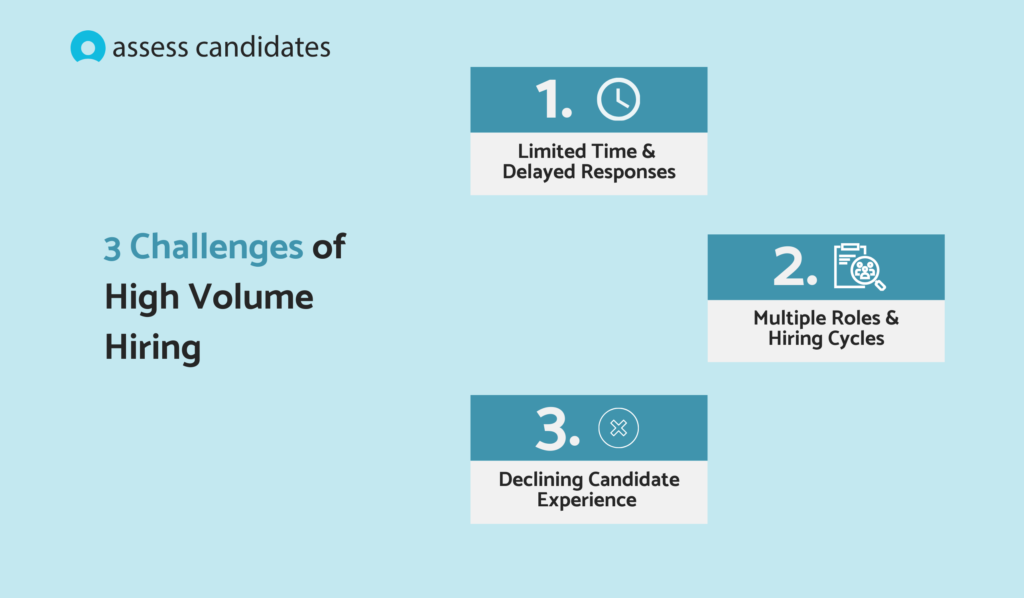
1 . Limited Time and Delayed Responses
Recruiters often balance multiple responsibilities alongside hiring. With a high number of applications, this can delay response times, leading to a backlog of unread applications. Candidates who do not receive timely responses may accept other offers before your hiring process even reaches the interview stage.
2 . Managing Multiple Roles and Hiring Cycles
Employers filling multiple roles simultaneously often deal with overlapping feedback, interviews, communication, and decision-making processes. This complexity increases the risk of errors and inconsistent hiring decisions.
3 . Declining Candidate Experience
High volumes of applications can overwhelm recruitment teams, making it difficult to respond to candidates promptly. Delays or inconsistent communication can make candidates feel ignored or undervalued, potentially leading to a loss of top talent.
Now that you know about high-volume hiring and its challenges, let’s look into candidate experience and why it matters in 2026.

2. What is Candidate Experience?
Candidate experience refers to how job applicants perceive your organization throughout the hiring process, based on interactions from the initial application to the final hiring decision.
Recruitment teams’ main objective is to encourage candidate engagement and satisfaction in a way that treats everyone equally and makes candidates feel informed and valued. This protects employer brand image and attracts qualified candidates.
Why is maintaining a positive candidate experience during high-volume hiring important?
Prioritzing candidate experience makes it easier to attract quality talent and improve the perception of your organization within the job market. Positive candidate experiences encourage and motivate candidates to apply for roles and leave positive reviews of your company, even if they don’t get the job.
Did you know? According to the Monster Work Watch Report, over 40% of applicants abandon the hiring process due to poor communication, negative experiences with the recruiter or interviewer, and a lack of updates on their application status.
What makes a positive candidate experience:
- Clear communication: Ensure that all messages during your hiring process are clear and precise. This reduces hiring time and prevents confusion on the part of your candidates.
- Provision of updates: Candidates expect to receive consistent updates during the hiring process. This includes updates on their application status and interviews.
- Positive recruiter and interviewer experiences: Your recruiters and interviewers are representations of your brand. Interactions with the candidates should be professional and friendly to avoid deterring high-quality talent.
A positive candidate experience occurs when applicants feel informed, respected, and fairly evaluated throughout the hiring process.
You should aim to make every candidate feel seen and acknowledged despite the high volume of applications. This helps you stay ahead in a competitive job market and maintain a positive brand perception among candidates.
Maintain a positive candidate experience with our user-friendly, automated hiring assessments. LEARN MORE
Now, let’s explore the different ways to measure candidate experience in your hiring process.
3. How to measure candidate experience in your high-volume hiring process
To ensure a positive candidate journey when hiring at large volumes, you need to be able to identify what’s working and areas for improvement.
Having worked with several organizations, here are some key metrics to measure candidate engagement and satisfaction in your high-volume recruitment process.
5 key metrics to measure candidate experience in high-volume recruitment
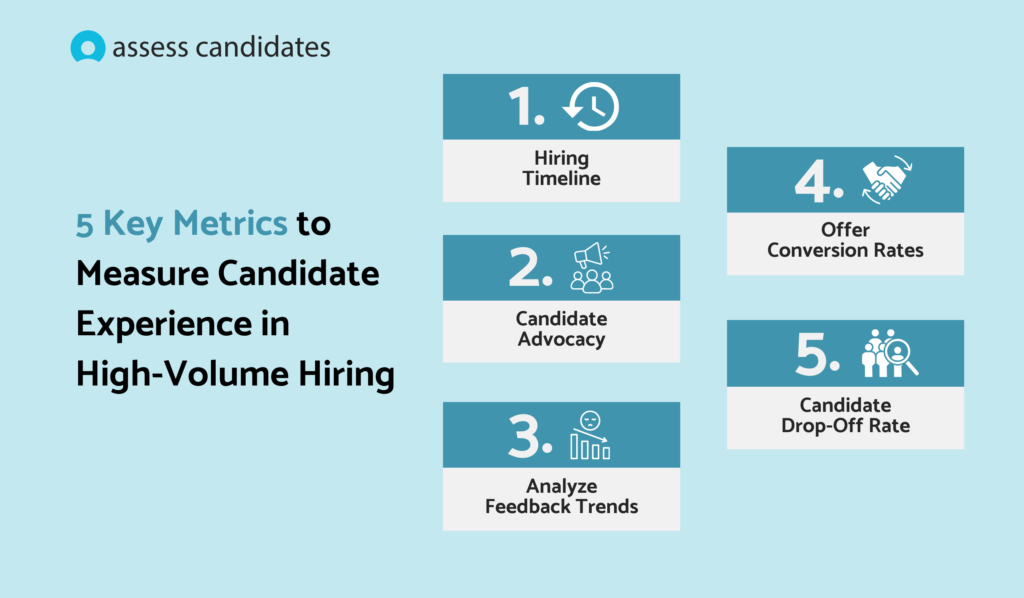
1 . Hiring Timeline
Measure the total duration of your hiring process and the time a candidate spends at each step and between stages of it. Candidates can quickly get frustrated with extended waiting periods between changes, and this would reduce their overall engagement in your hiring process.
2 . Candidate Advocacy
Reviewing candidate feedback on platforms such as Glassdoor and LinkedIn will help you understand how your candidate experience impacts your reputation as an employer.
3 . Analyze Feedback Trends
Collect short feedback forms and surveys after major interviews and milestones. Reviewing this feedback in batches will make it easier for you to identify repeated complaints and prioritize areas for improvement. By identifying trends, you can uncover the aspects of your hiring process that are effective and worthy of preservation.
4 . Offer Conversion Rates
Recruiters can easily measure their candidate experience by tracking how many candidates accept the job offers at the end of the process. Frequently declined offers are usually an indication of misaligned expectations or a negative recruitment experience.
5 . Candidate Drop-Off Rate
Track the stage where most candidates exit the hiring process before completion. If they consistently drop off at a particular stage, it may be an indication of unnecessary complications or delays that ruin your customer experience.
Boost your candidate hiring journey with Assess Candidates’ science-backed assessment tools. HIRE FOR FREE
Tracking metrics such as candidate drop-off rates, hiring timelines, and candidate advocacy helps recruiters identify areas where the hiring process can be improved.
The next section explains how organizations can maintain candidate satisfaction during high-volume recruitment.
4. How to Maintain Candidate Experience During High-Volume Recruitment
To maintain candidate experience during high-volume recruitment, organizations must have an effective and repeatable hiring system that helps them move quickly and efficiently.
Top strategies to ensure a positive candidate journey during high-volume hiring
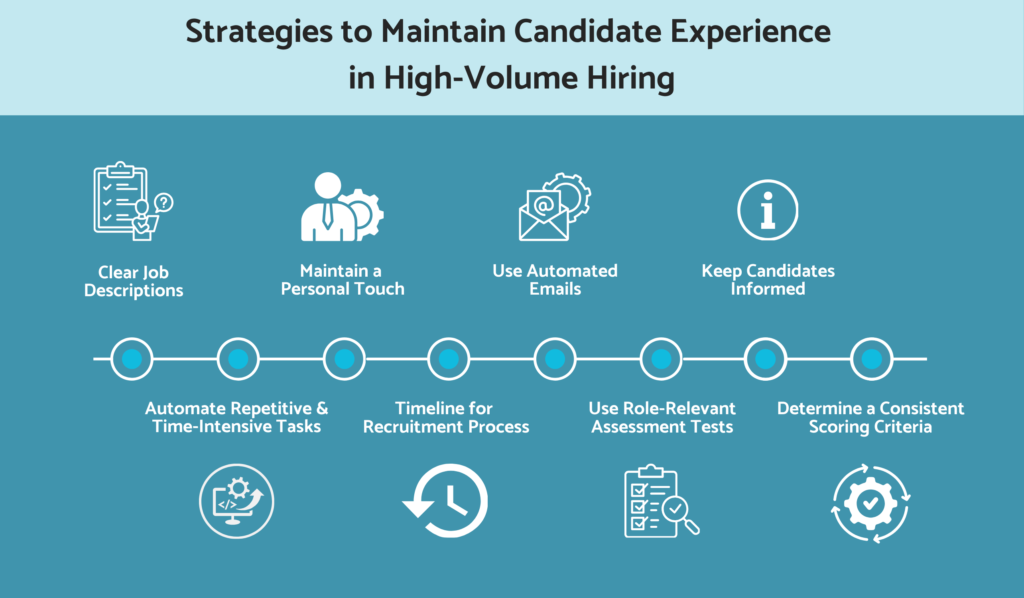
Strategy 1: Create Clear Job Descriptions
A candidate’s journey starts as early as your job posting. If your job description is unclear or exaggerated, it could lead to low responses, wrong expectations, early drop-offs, and poor experiences. A clear and honest job description helps candidates to understand the role from the start and determine if it’s the right fit for them.
What to Do
- Outline the day-to-day responsibilities of the role. State the required skills and expectations. Avoid being vague or using generic terms.
- Be upfront about your expectations and compensation. Share your location, working hours, salary ranges, company culture, and all key requirements to help applicants with their decision.
- Be consistent across all of your platforms and touchpoints. Ensure your job ads, career pages, emails, and offer letters reflect the same details and expectations. This prevents surprises later in the process and maintains engagement.
Strategy 2: Set A Timeline For Your Recruitment Process
Creating a timeline for your high-volume hiring process helps keep it efficient and on schedule. It ensures that everyone on your team knows how long each stage takes and the time between them, making it easier to communicate with candidates.
What to Do
- Determine a deadline for your high-volume hiring. Decide when your new hires are to resume and work backwards from then. This helps you create a schedule that works for your organization and your recruitment team.
- List out all stages of your recruitment process and the duration of each one. Ensure that your timelines are realistic for your team while keeping candidates moving without unnecessary waiting times.
Strategy 3: Keep Candidates Informed Of Your Hiring Timeline
Avoid leaving candidates in a state of uncertainty. Providing them with a clear view of where they are in your hiring process helps you manage their expectations and prevent a buildup of frustration.
What to Do
- Share the timeline at the start of the hiring process. Attach an outline of each step of the hiring process to application acknowledgment emails so candidates know what to expect from the start.
- Make your timeline easily accessible by attaching it to emails or hosting it on your careers page so candidates can see where they are at any time.
- Update your candidates as they move through stages by sending brief status updates via email. If there is a delay, you can also give them an update and assure them that their application hasn’t been forgotten.
Strategy 4: Automate Repetitive and Time-Intensive Tasks
High-volume recruiting often involves a lot of repetitive and time-consuming tasks. To avoid feeling overwhelmed and ruining the candidate experience, automate as many of these tasks as possible.
What to Do
- Utilize resume screening and ATS tools. This helps you to accurately screen through applications and identify the most suitable applicants as soon as possible.
- Use automated feedback to inform applicants about completing a stage, their results, and whether they’ll be moving to the next stage of your hiring process.
- Allow candidates to schedule their interviews with scheduling tools. This eliminates several hours of back and forth and allows the recruiter and applicant to choose a time that’s suitable for both parties.
Strategy 5: Use Automated Emails for the Right Stages of Hiring
Candidates expect feedback at every stage of the hiring process. This informs them of where they are and helps them understand what to expect next. However, avoid overusing automated emails, as this technique might make the process feel impersonal.
What to Do
- Automate emails after every major interaction. Send an email after major events, such as after an application comes in, before and after an interview, or after additional documents have been sent in.
- Ensure that your email includes all the information the candidates need. Thank the candidate for participating in that stage and tell them what the next stage entails and how long it will take to move on.
- Use an If This Then That (IFTTT) function. IFTTT functions and automations allow you to connect actions with emails. This makes it easier to communicate with applicants as soon as they complete any stage of your hiring process.
Strategy 6: Determine a Consistent Scoring Criteria
During high-volume hiring, unclear screening or scoring criteria can create inconsistency and delays. Creating clear and consistent criteria to evaluate all applicants creates a recruitment process that is fast, fair, and transparent.
What to Do
- Determine a clear scoring criterion before creating a job posting. Decide what truly is relevant for the role so all candidates are assessed correctly from the onset.
- Focus on essential skills. Avoid overcomplicating your decisions and focus on core skill sets, experience, and capabilities required for the roles you’re hiring for.
- Ensure everyone on your recruitment team understands your scoring criteria. This reduces back-and-forth communication and prevents candidates from being unfairly delayed.
- Use a simple scoring scale. A simple rating system, like a 1-5 scale, makes it easy for recruiters to quickly and accurately assess candidates, reducing the time spent at each stage of your hiring process.
- Shortlist based on your scoring criteria. Shortlist candidates based on your scores and not on gut feelings. This process ensures fairness and leads to faster and more defensible decisions.
Strategy 7: Maintain A Personal Touch At The Final Stages Of Your High-Volume Hiring
As you get towards the end of your high-volume recruitment process, personalize communication, feedback, and individual interactions with your shortlisted candidates. This improves your candidates’ recruitment experiences, helps them feel valued, and strengthens your offer acceptance rate.
What to Do
- Use human interactions at the final stage of your process. Use live video interviews, panel interviews, and team interviews. This fosters a relationship with your candidates and provides them with an opportunity to interact with potential colleagues if they secure a job.
- Personalize each interaction by using role- and candidate-specific details for each offer letter, invite, or follow-up. Avoid using generic templates at the later stages.
- Tailor your onboarding experience to each person. Even if all new hires start together, ensure that the materials, schedules, and role expectations feel tailored to them individually.
Strategy 8: Use Role-Relevant Assessment Tests To Screen Candidates
In high-volume hiring, manually reviewing applications and screening candidates leads to delays, inconsistencies, and frustrations both on the part of the recruiter and the candidate. Using professionally designed and role-specific assessment tests helps you assess candidates quickly and ensures every applicant gets a fair chance without slowing down your hiring process.
What to Do
- Send assessment tests after the application to reduce long waiting times early in the process. Assessment tests help you evaluate candidates and allow them to progress without wasting days or weeks on a manual screening.
- Use role-specific assessments. Use assessment tests that focus on the skills and capabilities required for the job. This helps you to evaluate candidates beyond what’s written in their application.
- Use assessments to shorten your hiring timeline. Use assessment tests to identify strong candidates early on. This helps to speed up decisions and eliminate unnecessary interview stages.
- Inform applicants of the assessments and how they align with their desired role. This helps the process feel more transparent and builds trust with the candidates.
Discover how our professionally designed, easy-to-use assessments can improve your candidate experience. LEARN MORE
Implementing these strategies becomes significantly easier when supported by structured hiring tools.
5. Examples of Pre-employment Assessments Designed For a Positive Candidate Experience
Recruiters must move past traditional pre-employment assessments and utilize modern pre-employment assessments, which are more engaging with candidate-centric assessment tools.
Below are some examples of pre-employment assessments designed to maintain candidate experience in your high-volume recruitment process.
1 . Immersive Situational Judgement Tests (SJTs)
Immersive situational judgement tests place candidates in realistic work scenarios and are used to evaluate their problem-solving and decision-making skills.
While traditional SJTs do not often give a true preview of the role and its challenges, immersive SJTs give the candidates insight into the role and its daily challenges. This makes it easy to evaluate multiple candidates at scale while maintaining candidate engagement.
2 . Microassessments
To save time during high-volume hiring, several recruiters often use long application forms. However, this can quickly become frustrating for the candidate.
Did you know? 60% of job seekers abandon a long and complex application process. (HireDNA)
Instead, short role-specific assessments, such as writing prompts and coding snippets, help quickly screen candidates early with less friction and filter out unqualified candidates.
Microassessments also keep candidates engaged while saving you money and reducing the time spent on your high-volume hiring process.
3 . Work Style Personality Tests
A work-style personality test not only helps you evaluate candidates but also provides them with personalized insights on their work, preferences, strengths, and weaknesses by providing two-way feedback.
Candidates leave the process feeling more informed about themselves, which enhances their satisfaction. Work-style personality tests also provide standard scoring that allows your hiring team to assess role and cultural fit while providing a personalized experience for each candidate.
4 .Video Interviews
Video interviews are a crucial tool for ensuring a positive candidate experience. They prevent candidates from experiencing the stress of travel and provide flexibility for time and convenience.
Candidates are able to communicate in a familiar environment and at a time that’s best for them. Asynchronous video interviews allow applicants to record their responses at a convenient time, providing even more flexibility. Video interviews enable recruiters to review more candidates in less time and move applicants faster along the hiring process.
98% of candidates consider companies that use video interviews as innovative. (ModernHire)
5 . Game-Based Assessments
Game-based assessments use interactive, fun, and challenge-oriented tasks to evaluate candidates on their skills and cognitive abilities.
These assessments help reduce anxiety in applicants, as they are fun and more relaxing. Game-based assessments also improve your high-volume hiring, as automated scoring enables you to quickly identify top talent without a lengthy manual interview.
According to Criteria, game-based assessments help to predict job performance with 29% more accuracy than traditional assessments.
Leverage our 8 unique engaging game-based assessments to accurately shortlist your large candidate pool. LEARN MORE
6. The Future of Candidate Engagement in High-Volume Recruitment
Prioritizing the candidate experience is essential to protect your organization’s image in the professional space and attract top talent. As candidate expectations continue to evolve with technology advancements, employers and recruiters must also redesign their hiring processes to be faster and more transparent, even when at large volumes.
The following trends show how candidate experience is evolving in high-volume hiring
1 . Mobile-Optimized Hiring Processes
Today’s candidates expect that your hiring processes are more in line with modern digital experiences. They want to apply from their phones and receive acknowledgement of their applications within hours. High-volume hiring is moving to a mobile-first future with seamless applications and immediate confirmation of applications.
According to Recruiter, 70% of job seekers use their mobile phones to search for jobs. Additionally, according to the Daxtra market research report, more than 30% of applicants expect to hear back from a recruiter 24 hours after their application.
2 . Automation and AI-Driven Communication
Candidates increasingly expect quicker confirmations and regular updates throughout the hiring process. Recruitment teams will have to rely on automation and AI-driven communication such as AI chatbots, during high-volume recruitment to maintain consistent communication and build a positive candidate experience.
3 . Technology-Backed High-Volume Hiring
The future of a positive candidate experience depends on using technology for screening, interviewing, communication, and recording candidate data. Using a high-volume recruitment system that lacks automation, analytics, or proper tracking will become a liability as technology advances and candidate expectations change.
4 . Utilization of Skills-Based Tests
Skills-based tests and automated prescreening will reduce delays and the back-and-forth between candidates and hiring teams. Using skills-based assessment tests, you can easily identify qualified candidates and prevent extended waiting times.
5 . Scalable Applicant Tracking Systems (ATS)
High-volume hiring will require ATS platforms that can easily scale to accommodate a larger number of applicants. These systems must offer analytics and integration with other tools in your hiring process.
6 . Candidate Experience as a Brand Differentiator
Whether their experiences and interactions are positive or not matters to applicants and will be a major differentiator between brands that attract quality talent and those that don’t.
Blue citation: According to ResearchGate, organizations like Hilton Hotels are transforming their recruitment process by integrating AI to automate repetitive tasks and speed up recruitment. In turn, this creates a candidate-centric hiring culture and positive experiences.
This trend reflects a broader shift toward treating candidate experience as a critical part of employer branding and recruitment strategy. The future belongs to companies that treat candidates with the same care as they treat their customers.
7. How Does Hiring Assessments From Assess Candidates Enhance Your Candidate Experience?
High-volume hiring does not have to result in an impersonal or frustrating candidate experience.
Assess Candidates bridges the gap between high-volume recruiting and candidate experience by helping organizations identify, attract, evaluate, and shortlist top talent while keeping candidates engaged and respected throughout the hiring process.
Assess Candidates provides structured assessments that enable your hiring team to screen applicants fairly and consistently, eliminating bias. This helps your recruitment team focus on the strongest talent and interview higher volumes of applicants while maintaining a candidate-centric experience.
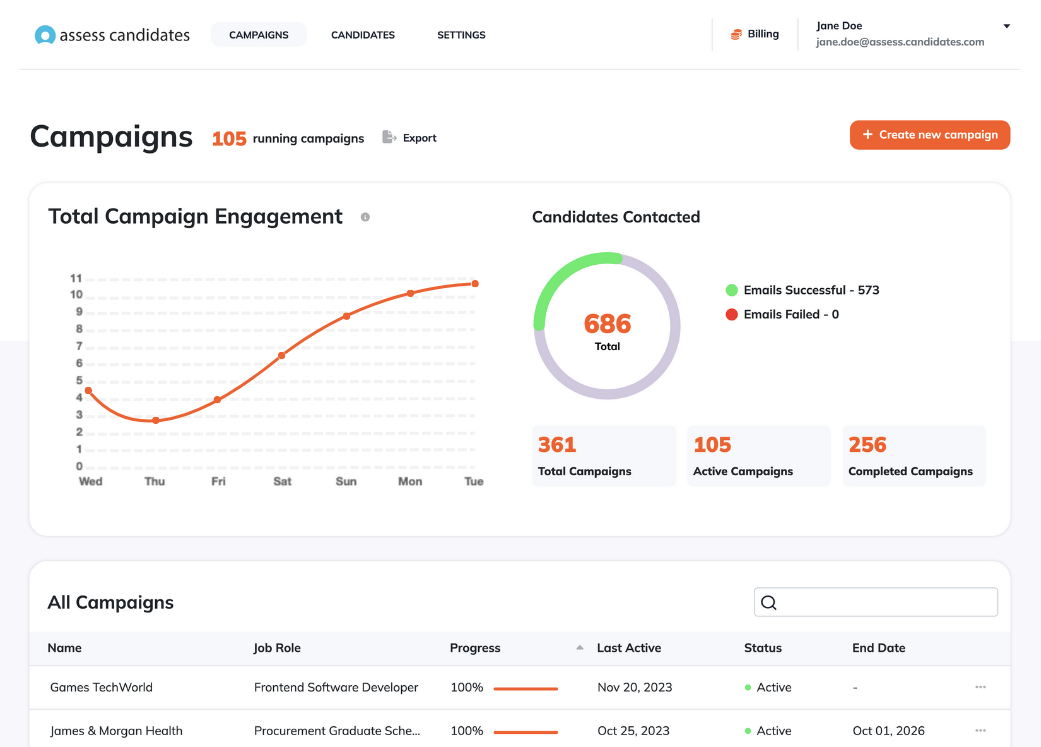
How does Assess Candidates provide a candidate-centric hiring ecosystem?
- Evidence-based screening: Instead of relying solely on resumes or first impressions, employers gain access to objective assessments of cognitive ability, technical proficiency, situational judgement, and personality traits, all validated and reliable. This ensures all applicants are evaluated fairly, and your recruitment team can easily spot high-potential applicants early on.
- Streamlined workflows for high-volume hiring: With the platform, your recruitment team can launch an assessment campaign in just a few clicks and consistently process a large candidate pool. This helps recruitment teams spend less time on repetitive tasks and more time on candidate-centric assessments, such as interviews and candidate engagement.
This maintains candidate experience by moving applicants through a structured process that eliminates unnecessary wait times.
- Alignment of role and cultural fit: Technical and cognitive assessments assess if a candidate can perform a role, while personality and situational judgement assessments assess if they will thrive in such an environment. Recruiters can therefore present hiring managers with candidates who are not only capable but also more likely to integrate well with the team and organisation.
- Transparent, fair, and inclusive candidate experience: All assessments are scientifically validated, accessible, and designed for fairness, including for candidates with disabilities. This leads to a higher completion rate and a stronger trust in your hiring process on the side of the candidate. It also enables your recruiters to uphold stronger employer–brand standards and reduce legal or reputational risk.
Quickly filter high volumes of candidates while ensuring a positive candidate experience with our team. VIEW PLANS
Interested in getting the latest insights and advice on candidate assessment? Keep reading for frequently asked questions, and sign up below with your email to get started.
Frequently Asked Questions
Is ghosting a problem in high-volume hiring?
Candidates often ghost at several stages of the hiring process, like the interview stage, assessment stage, and offer stage. This is often due to poor communication and lengthy processes, which tend to worsen during high-volume hiring. Transparent communication and candidate engagement are key to preventing ghosting.
Is manual screening 100% unreliable during high-volume hiring?
Not completely. However, reviewing hundreds to thousands of CVs is mentally exhausting, which often leads to inconsistency, unconscious bias, poor judgment, and missed talent. Providing structured tools eliminates these outcomes, improves efficiency, and maintains candidate experience.
When using automations, what candidate touchpoints should trigger automated communication?
To maintain candidate experience during high-volume hiring, candidates must always know their exact position in your hiring process. To achieve this, every action that changes their position should trigger an automated message. This includes application submission, interview completion, and other stages.
Does the length of my application form affect the candidate experience?
Yes, it does. Lengthy and complex application forms and processes turn off most candidates. This practice can affect the quality and volume of applicants you receive. A shorter and more focused application form will help to maintain candidate experience and encourage completion.
Where should assessment tests be placed in my high-volume hiring process?
Assessment tests help to filter unqualified candidates before recruiters spend time reviewing their profiles or scheduling interviews. For this reason, it’s best to place them as early as possible, such as immediately after the application.


 English
  Arabic