
Why Pre-employment Checking Tests are Essential for Hiring Smart Data Entry Talent



As the demand for skilled data entry professionals continues to rise, organizations face the challenge of efficiently identifying candidates with strong accuracy, precision, and attention to detail during the hiring process. In these data-heavy roles, where even small errors can have significant consequences, ensuring you hire the right people with the necessary skills is crucial.
This is why pre-employment checking tests are essential when hiring for data entry roles. These skill assessments not only help you save time and cost in the long run, but also improve assessment effectiveness while ensuring a positive candidate experience.
But how exactly do pre-employment checking tests fit into the recruitment process of large corporate giants such as Morgan Stanley and Amazon? And why are they so important for data entry hiring?
If want answers to these questions and the following:
- What core skills do error-checking tests measure in data entry candidates?
- How many questions are typically included in a data entry checking test?
- What type of questions can candidates expect in data entry assessments?
- Why are checking tests often called speed tests?
- How does a weighted scoring system evaluate accuracy and efficiency?
This article is definitely for you!
Whether you are a recruiter, hiring manager, or talent acquisition expert, explore the best candidate recruitment strategies to hire detail-oriented candidates for data entry jobs and the measurable benefits they can bring to your company. We will break down why error checking tests are becoming increasingly popular for data entry hiring.
Contents
- What are pre-employment checking tests for data entry?
- Key features that make checking tests effective in data entry hiring
- Why use pre-employment checking tests for data entry recruitment?
- Common challenges when using checking tests for data entry roles
- Beyond data entry: What other roles use pre-employment checking tests?
- Which employers use checking tests for data entry hiring?
- Why top companies choose Assess Candidates’ error checking tests to hire
- Checking tests for data entry roles: Success story
Now without further ado, let’s start by defining what checking tests for data entry are.
1. What are pre-employment checking tests for data entry?
A pre-employment checking assessment for data entry roles is an aptitude test designed to evaluate a candidate’s ability to spot errors in text or numerical information under time pressure.
These timed data accuracy assessments allow recruiters to assess essential skills such as accuracy, attention to detail, precision, and speed. Depending on the role, they may also assess written language proficiency or numerical ability.

Pre-employment testing using checking tests is a powerful strategic tool that enables employers to make faster, data-driven decisions, streamlining recruitment processes and improving hiring quality by selecting only the most detail-oriented and accuracy-driven candidates for data entry roles.
Hire smart and detail-oriented data entry talent with error-detection tests! HIRE FOR FREE
What are data entry roles?
Data entry roles involve using software such as spreadsheets, databases, or content management systems (CMS) to input, verify, update and sort numerical or written datasets.
There are over 140,000 data entry clerks currently employed in the United States (LinkedIn).
With organizations’ increased reliance on data-driven decision-making, the importance of accurate and precise data entry cannot be overstated.
How do checking tests work for data entry?
Data entry checking tests work by presenting candidates with two or more sets of information and asking them to spot errors. Candidates must effectively compare the given datasets and choose which match the original with complete accuracy.
These data entry job assessments typically consist of 30-40 questions, delivered on an online assessment platform and completed within a short time limit. Depending on the employer, these speed tests can be adaptive, starting with basic number-checking or word-checking questions and advancing to more difficult error-spotting challenges.
As these tests are often negatively marked, candidates must find the right balance between speed and accuracy, skillfully ensuring they finish the test while answering every question with precision.
But, what types of questions do candidates commonly find during data entry skills evaluation?
What are some popular questions for data entry checking tests?
Depending on the test type, common questions on data accuracy tests are the following:
- Identifying Identical Sets: This question type assesses whether candidates can identify which written or numerical set exactly matches the given data string.
Example question: “Which set is identical to the following: 2958471023?”
- Spot the Difference: These questions require candidates to analyze two or more sets and quickly identify any discrepancies.
Example question: “Are the two sets of numbers 127849029463 and 127849028463 “Alike” or “Different”?
- Spot Transpositions: In this question type, candidates must analyze numerical or written sequences to identify all swapped, missing, or added digits.
Example question: “Determine if there are any discrepancies in the column of numbers and specify the errors identified.”
- Spelling and Grammar: These questions evaluate a candidate’s attention to detail in written language by asking them to correct errors in spelling, punctuation, or grammar within given texts.
Example question: “Correct the grammatical and spelling errors in the following: “The dog chased it’s tale around the park.”
Here is an example of one type of error-checking test question that you will find at Assess Candidates!

But what makes pre-employment checking tests so effective for data entry hiring? Let’s find out in our next section.

2. Key features that make checking tests effective in data entry hiring
Pre-employment error checking tests are carefully designed to serve as powerful predictors of a candidate’s success in accuracy-driven roles like data entry. These scientifically validated data entry assessments stand out because of several features:

1. Speed Testing
Data entry assessments are speed tests, assessing candidates on their efficiency and how they work under pressure rather than their maximum performance. Scores are often influenced by time, with bonus points for early completion or penalties for exceeding time limits. This helps employers identify candidates who can combine speed with precision under strict deadlines.
Candidates who exceed 60–75 WPM with high accuracy are considered top-tier for data entry roles and high-volume input tasks.
2. Skills-Based Evaluation
Checking tests for data entry hiring simulate real on-the-job tasks such as proofreading spreadsheets or entering structured data. Unlike CV screening, these data accuracy tests improve predictive validity as they assess candidates for data-entry-relevant skills, reducing costly mis-hires.
Structured data entry checking assessments offer an objective and standardized evaluation of candidates’ attention to detail, helping organizations select professional-level performers while reducing hiring risk.
3. Anti-Cheating Measures
Reliable talent assessment platforms, such as Assess Candidates, prevent candidate cheating with randomized questions, item banks, IP tracking, and auto-shuffled options. Additionally, most standardized error-checking tests offer anti-cheating features such as screen monitoring, webcam proctoring, or behavioral monitoring to maintain integrity and fairness when pre-employment testing is online.
Modern platforms report over 90% accuracy in detecting and preventing cheating during remote assessments.
4. Adaptive Difficulty
Some error checking tests are adaptive, adjusting difficulty based on candidate performance and responses. This helps differentiate top candidates without overwhelming average ones.
Computerized adaptive testing (CAT) can reduce test length and time by up to 50% while providing a highly precise evaluation of true ability.
5. Weighted Scoring System
Employers can assign different point values to error checking tasks depending on the task complexity, making scoring more representative of real job demands. For instance, rewarding a higher score for catching duplicate entries than spotting a simple typo.
Effective data entry assessments use a weighted scoring formula, e.g., speed 30%, accuracy/errors 50%, and task complexity 20%. This allows for a nuanced skill evaluation based on role-critical skills.
6. Negative Marking
Most online error checking tests use a negative marking system that penalizes candidates for incorrect answers or actions. This encourages accuracy and avoids guesswork. However, if overused, cautious candidates are discouraged to attempt harder questions, resulting in less reliable results.
Example: A candidate guesses a field entry without knowing the correct format and is penalized, promoting precision.
7. Accuracy-First Evaluation
Accuracy remains the most critical factor in data entry. Pre-employment error-checking assessments allow employers to prioritize scoring based on error-free input. They evaluate a candidate’s ability to flag typos, misalignments, format mismatches, and missing fields, penalizing errors and mirroring the accuracy standards required for the job.
Example: If a data entry candidate misses 5 rows out of the total 50 rows, this should result in a deduction of points irrespective of the other rows being correct.
8. Manual Review Option
For fairness, employers can manually review data entry proficiency tests in cases when auto-checking fails to account for formatting quirks and acceptable alternatives. This feature ensures no candidate is unjustly disqualified due to the limitations of automation.
Example: A manual review can have the final say in whether to accept both“4,000” and “4000”. Though both represent four thousand, they differ in formatting, with acceptance of one over the other depending on context, region, and formality.
9. Error-Type Categorization in Reports
Beyond scoring, detailed reports for data accuracy tests highlight what types of errors were made, offering value for both recruiters and candidates. Employers gain insights into candidates’ training needs while candidates receive constructive feedback to help further improve for future evaluations.
Example: An employer selected a candidate strong in alphanumeric accuracy but weaker in detecting numerical errors as flagged in the report. As part of the probation period, they can be trained accordingly with numerical checking tests to improve.
Hire top data entry talent with our standardized error checking tests this hiring season. LEARN MORE
In the following section, we will discuss the benefits of using checking tests in hiring for data entry roles.
3. Why use pre-employment checking tests for data entry recruitment?
Error checking tests are reliable skill assessments for data entry recruitment. These aptitude tests help employers hire candidates with a good eye for detail and precision, essential for reliable data management and input.
Let’s now discuss the top 8 reasons why employers use checking tests globally in data entry candidate recruitment.
8 benefits of checking tests for data entry roles

- Enhanced Candidate Selection: Pre-employment checking tests contribute to a more thorough and objective evaluation of candidates. This enables organizations to identify top-performing candidates with strong attention to detail and accuracy essential for data entry roles. This leads to a more targeted and effective candidate selection process.
62% of employers use pre-employment testing to make better hiring decisions, resulting in a more efficient and predictive selection process. (Hiring Thing)
- Time Efficiency: Automated checking assessments streamline the initial stages of recruitment, reducing the time and resources spent on reviewing resumes and conducting extensive interviews. By efficiently filtering candidates based on predefined criteria, hiring managers can focus their attention on the most promising individuals.
Automated candidate screening can shorten the time to hire by up to 50%. (Ideal).
- Cost Savings: The implementation of pre-employment checking tests results in long-term cost savings for organizations. By identifying suitable candidates early in the process, companies minimize the need for extensive training and reduce the risk of hiring individuals who may not meet the job requirements.
Employers using pre‑employment testing see up to 39% lower employee turnover, leading to long‑term cost savings by reducing training, onboarding, and the risk of costly hiring mistakes.
- Objective Decision-Making: Automated checking assessments ensure a standardized and objective evaluation process by measuring candidates on error checking skills rather than subjective biases. This promotes fairness and equality in hiring decisions.
Diversity and inclusion in a workplace is ‘very important’ to over 75% of job candidates (Insight Global).
- Improved Quality of Hire: By assessing candidates against specific job-related criteria, error-checking tests help organizations make more informed decisions about potential hires. This improves the quality of hire and ensures their alignment with organizational demands and work culture, contributing to higher employee satisfaction and retention.
- Data-driven Insights: Pre-employment checking tests generate valuable data and insights into candidate performance. Analyzing this data allows organizations to refine their hiring processes continually, adapting to changing workforce needs and ensuring ongoing improvement in recruitment strategies.
Around 64% of recruiters report that data‑driven hiring helps reduce turnover within the first year. This demonstrates how pre‑employment error‑checking tests help improve hiring strategies to adapt to evolving workforce needs (Skillrobo).
- Risk Mitigation: Data accuracy assessments contribute to a thorough evaluation of a candidate’s capability to detect errors, reducing the risk of hiring individuals who may not be well-suited for the role. This proactive approach to risk mitigation enhances the overall stability and reliability of your workforce.
With 85% of hiring managers reporting encountering lies on resumes, as per Criteria Corp, traditional hiring becomes unreliable. Validated error‑checking assessments accurately predict a candidate’s on-the-job performance, thus lowering incidents of bad hires.
- Increased Productivity: By selecting candidates with the right skills and attributes, organizations can build a workforce that is more likely to be productive from the start. This positively impacts overall team efficiency and contributes to achieving organizational goals on time.
A single bad hire can cost up to US$240,000, including recruiting and project delays. Error‑checking tests help prevent such losses by improving candidate-job fit and boosting initial productivity from day one. (U.S. Department of Labor via eSkill).
Enhance your recruitment strategy for data entry hiring with our science-backed checking tests. HIRE FOR FREE
Checking tests are an efficient and cost-effective way to filter out ineligible candidates early on for data entry roles, streamlining the hiring process and improving hiring quality. However, for a holistic candidate evaluation, at Assess Candidates we always suggest using a combination of assessment tools to measure cognitive aptitude, behavioral tendencies, and personality traits which more accurately predict their potential to succeed in the role.
Let’s now explore the specific challenges of using error checking tests for data entry recruitment.
4. Common challenges when using checking tests for data entry roles
Pre-employment checking tests, like any other assessment, also have their own set of challenges. However, with the right expert advice and strategies, you can successfully prepare for and overcome any challenges to hire for your data entry roles.
7 common challenges when using error-checking tests in recruitment and their solutions:
1. Tests Don’t Reflect Real Work
Generic error checking tests that don’t simulate actual data entry job tasks risk lowering their predictive validity. This includes typing random numbers or gibberish words for data entry roles with no incorporation of real-world tools, such as Excel.
Solution: Customize the data entry tasks in your checking tests, including updating client information, proofreading spreadsheets for errors, copying data between formatted fields, and verifying entries from invoices, forms, and other sources.
2. Over-Reliance on Speed Over Accuracy
Error-checking tests, due to their strict time limits, can result in candidates rushing to complete tasks quickly. This leads to mistakes, which get overlooked if scoring heavily favors speed.
Solution: Ensure your data entry aptitude test scoring criteria is balanced so it accounts for both accuracy and speed, such as final score = (speed × accuracy%). Alternatively, prioritize scoring for accuracy over speed by assigning a maximum cap for speed.
3. Accessibility and Device Compatibility Issues
Online error checking tests can skew the final results if candidates take them on a phone, a low-performance laptop, or with poor internet. A lack of transparency in the communication of device requirements compromises the fairness of the assessment process.
Solution: Utilize reliable error checking tests, such as Assess Candidates’, that are fully optimized for both mobile and desktop. Ensure to convey the device requirements to the candidates well ahead of time to help keep the process seamless for candidates.
4. Test Anxiety and Negative Marking
As data entry skill validation assessments are speed tests, this may cause candidate anxiety. This can result in the frequent skipping of uncertain questions, leading to poor performance due to the time pressure and risk of penalties for incorrect answers, not due to a lack of skill.
Solution: Use a weighted scoring system and explain this clearly to candidates. Encourage them to become comfortable with testing conditions through practicing checking tests beforehand. Additionally, you can focus on using more task-based simulations rather than multiple-choice questions, where possible.
5. Difficult to Detect Partial Errors
Generic error checking tests that only support auto-checking can risk missing small format errors, hidden characters, and incorrect spacing or punctuation. Exaggerated by a lack of clear instructions, this seriously compromises hiring efficiency and risks mis-hires while losing out on other eligible data entry talent.
Solution: Ensure your data accuracy assessment is designed with flexible matching logic and also includes clear formatting rules in instructions. Additionally, choose assessment test providers that offer manual review for borderline cases to ensure no deserving candidate gets unfairly left out.
6. Lack of Feedback for Candidates
Many talent assessment platforms give only a final score, which doesn’t help the candidate understand their mistakes or improve. This risks losing the candidate’s trust in the testing process and taints their experience with the organization.
Solution: Ensure each candidate receives their automated error checking test report, which includes a clear breakdown of the types of errors made, the time taken per section, and correct vs incorrect entries. This helps candidates understand their areas of improvement while simultaneously maintaining their trust in the recruitment process and its transparency.
7. Prone to Test Fatigue
Data accuracy tests, if long and monotonous, cause fatigue, which results in unnatural errors, compromising the test’s ability to reflect a candidate’s real ability. This makes candidate profiling less reliable and valid.
Solution: Ensure you cap the time limit of your error checking tests irrespective of the type of role to under 15–20 minutes. Make the assessment engaging by using a combination of types of questions rather than relying on one or two to reduce test fatigue.
5. Beyond data entry: What other roles use pre-employment checking tests?
We have seen how pre-employment checking tests are a reliable tool for evaluating a candidate’s suitability for data entry roles, measuring precision, accuracy, speed, and attention to detail. However, these assessments are also beneficial when hiring for many other roles and industries.
Below we list some examples of other key roles and industries where checking tests are also commonly used.
Top roles which use checking tests for candidate assessment
- Data Analytics Positions:
Roles that involve extensive data handling, such as data analysts, database administrators, and research positions, benefit significantly from using checking tests during hiring. These assessments ensure that candidates possess the meticulousness and precision required for accurate data interpretation, analysis, and management.
- Administrative and Clerical Roles:
For administrative assistants, secretaries, and clerical positions, attention to detail and accuracy in tasks like documentation, scheduling, and record-keeping are critical. Pre-employment checking tests are tailored to assess how accurately candidates execute these tasks, ensuring they meet the demands of administrative roles.
- Quality Assurance Positions:
In industries where quality control is paramount, such as manufacturing or software development, checking tests are indispensable. These assessments evaluate a candidate’s ability to identify discrepancies, spot errors, and maintain a high level of accuracy, contributing to the overall quality assurance process.
- Finance and Accounting Professions:
Accuracy in financial reporting, attention to numerical detail, and the ability to spot discrepancies are vital for roles in finance and accounting. Checking tests in these sectors assess a candidate’s aptitude for precisely handling financial data, ensuring reliability in tasks such as budgeting, auditing, and economic analysis.
- Editing and Proofreading Roles:
In professions that require linguistic precision, like editors, proofreaders, and content curators, checking tests evaluate a candidate’s ability to spot grammatical errors, ensure consistency, and maintain high-quality written content. These assessments are tailored to the specific requirements of roles where linguistic accuracy is paramount.
- Compliance and Regulatory Positions:
Checking tests are also used to hire for roles in compliance, risk management, and legal professions, where adherence to regulations and attention to detail are critical. These assessments predict a candidate’s ability to comprehend and apply complex regulatory frameworks and ensure meticulous compliance with established guidelines.
- Information Technology (IT):
In the fast-paced IT sector, precision is key. Checking tests are used to assess coding skills, problem-solving abilities, and attention to detail, ensuring candidates are well-equipped for roles in software development, programming, and database administration.
- Health Information Management:
In healthcare administration roles, particularly those involving health information management, accuracy in maintaining patient records, attention to detail in billing, and error detection are crucial. Checking tests can assess a candidate’s aptitude for precision in managing sensitive health information.
- Customer Service:
For customer service positions, checking tests can be tailored to measure how candidates handle inquiries with precision, resolve issues accurately, and maintain a high standard of service quality.
- Entry-Level Positions Requiring Detail-Oriented Tasks:
Even in entry-level positions that involve tasks demanding attention to detail, checking tests play a pivotal role. These assessments help identify candidates who exhibit accuracy and precision in foundational tasks, laying the groundwork for successful career development within the organization.

Want to know more about checking tests for data entry hiring? Our assessment experts are happy to help! CONTACT US
So, which top companies are using checking tests to recruit candidates for data entry roles? Let’s find out below.
6. Which employers use checking tests for data entry hiring?
Pre-employment checking tests have increasingly been used in the recruitment processes of large multinational companies for decades. Small and medium-sized enterprises (SMEs) and startups are also increasingly leveraging data accuracy tests as part of their talent assessment process for data entry roles.
Here is a list of some of the top companies using pre-employment checking assessments for data entry:
- Morgan Stanley
- Amazon
- Accenture
- Deloitte
- PwC
- KPMG
- EY
- HSBC
- Macquarie
- Lockheed Martin
- Unilever
- IBM
- Capgemini
Are checking tests suitable for small and medium-sized enterprises (SMEs)?
Error-checking tests have been historically underutilized by SMEs due to the demanding infrastructure requirements. While larger organizations may have the technology and budget to set up candidate testing software in-house, smaller organizations do not. However, this infrastructure issue has been addressed in recent years with the advent of specialized third-party SaaS (software-as-a-service) solutions within recruitment.
Now, more and more businesses, regardless of size, are adopting online pre-employment testing services, such as checking tests, from third-party assessment providers as a cost-effective candidate selection tool.
Concerns about the cost of integrating an online error-checking assessment test into your recruitment strategy are common, but existing cost models are flexible and offer cost-efficient solutions for any recruitment requirement or volume. It has been proven that the cost of a bad hire or the inability to broaden and diversify the talent pool is significantly higher than the cost of pre-employment testing.
The availability of cost-effective candidate testing software and the ease of integrating a pre-employment error checking assessment platform into your existing recruitment campaign means that smaller businesses can also now benefit from modern online data entry proficiency tests that were previously limited to larger organizations with bigger budgets.
But who are the top candidate assessment software providers that you should consider for your assessment process? Let’s find out.
Who are the top candidate assessment software providers?
When selecting a candidate assessment platform for implementing your data entry accuracy assessments and error checking tests, you should evaluate the overall quality and functionality of the recruitment platform and assessments. Consider the following questions:
- Does the candidate assessment software efficiently accelerate skills evaluation?
- Can I assess the accuracy, precision, and attention to detail of multiple candidates simultaneously?
- Can I access candidate results and insights in a single click?
- Does the error-checking test assessment platform provide an objective evaluation of candidates?
- Can I customize my checking test and questions to fit my data entry role and organization?
- Is the talent assessment platform user-friendly, and does it ensure a positive candidate experience?
By addressing these questions, you can ensure the candidate assessment platform you choose for your data entry checking test meets your needs and enhances your recruitment process.
Here are the top 10 pre-employment error checking test providers to help you assess candidates’ competencies:
- Assess Candidates
- SHL
- Talent Q
- TestGorilla
- Cubiks
- Test Partnership
- Criteria Corp
- Thomas International
- Aon Assessment
- Saville Assessment
Here’s where our role comes in for top companies that use online pre-employment checking tests.
7. Why top companies choose Assess Candidates’ error checking tests to hire
At Assess Candidates, we specialize in a variety of pre-employment error checking tests along with other psychometric tests, to ensure a holistic candidate evaluation for culture and job fit. With us, you can build a recruitment campaign tailored to meet the unique hiring needs of your data entry recruitment.
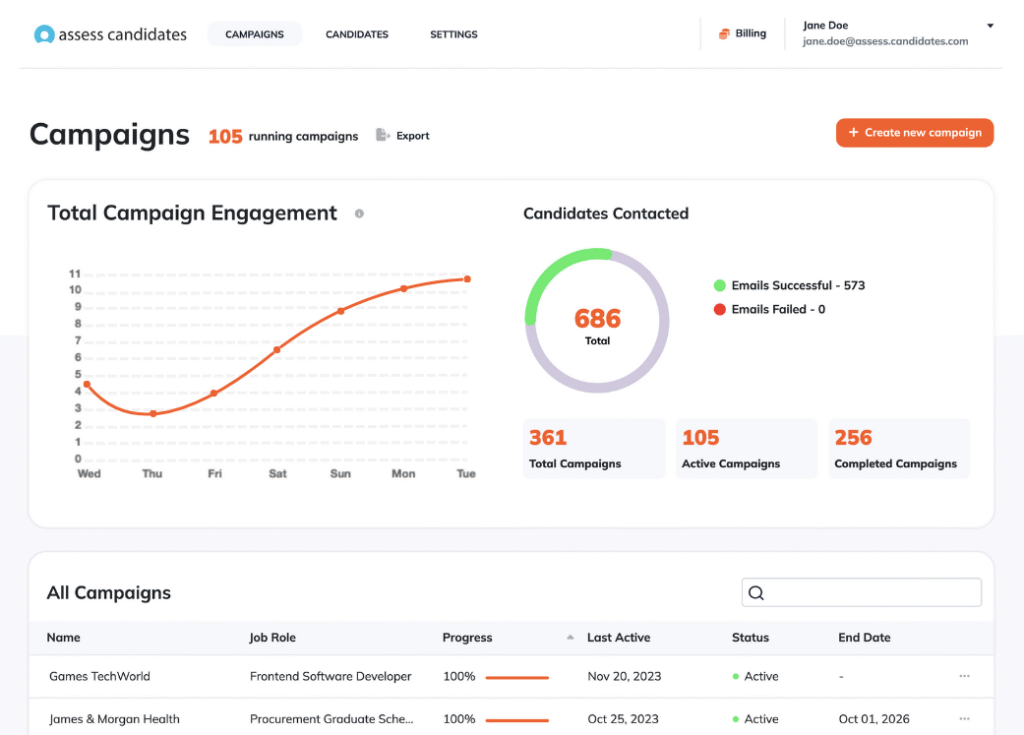
Below is an example of our campaign reporting dashboard available on Assess Candidates. This tool is accessible to hiring managers and talent acquisition professionals, providing valuable insights and easy-to-use sorting functions to streamline candidate assessment.
Top 5 reasons why you should use Assess Candidates’ error checking tests for your pre-employment testing:
1. Scientifically Validated Design: Assess Candidates’ pre-employment error-checking tests are developed by Chartered Scientists, Psychologists, and Psychometricians with decades of experience designing assessment solutions for companies like SHL and IBM Kenexa. Our checking tests have undergone rigorous testing and validation to accurately measure candidates’ error-checking skills and ability to work with utmost accuracy and precision. These tests have consistently proven successful in selecting and hiring top talent across various organizations and industries.
2. Streamlined Automated Processes: Time is of the essence in recruitment, and Assess Candidates is designed to optimize your hiring timeline. Our automated processes streamline the initial stages of candidate screening, alleviating the burden of manual resume reviews and freeing up valuable resources.
3. Expert Reporting: Assess Candidates’ user-friendly and easy-to-navigate assessment platform enables employers to analyze candidate reports in detail and make informed hiring decisions based on flexible criteria. Recruiters can easily view individual candidates’ performance on number and word checking tests, and then filter, rank, and shortlist candidates. Additionally, our talent assessment platform offers the option to integrate with your existing ATS for a seamless experience.
4. Positive Candidate Experience: Assess Candidates’ assessment platform is easily accessible from any device and features an aesthetic and easy-to-use interface for candidates. It provides clear assessment instructions and can be fully branded to match your organization. Our checking tests are designed to require minimal clicks to complete, with the assessment automatically moving to the next question once answered. This ensures a seamless and positive candidate experience, which they will associate with your brand.
5. Accessibility Support: Assess Candidates offers support for individuals with disabilities and visual impairments. All our assessments have the option to add extra time, include Zoom functionalities, and ensure the use of accessible color schemes and images in compliance with Web Content Accessibility Guidelines (WCAG) to ensure compatibility with screen readers.
Assess Candidates is one of the major pre-employment aptitude test providers proven to help small, medium, and large employers successfully hire top, best-fit candidates.
Elevate your hiring process by incorporating advanced technology, attract top-tier talent, and make data-driven decisions with confidence with Assess Candidates’ error-checking assessments and start hiring today!
8. Checking tests for data entry roles: Success Story
Client Problem Statement:
Imagine a fast-scaling e-commerce firm struggling to hire proficient data entry professionals. While the company receives numerous applications with strong typing speed and impressive resumes, its recruitment process lacks a structured method to evaluate data entry skills. These include attention to detail, accuracy, and error-spotting. Therefore, they are facing frequent input errors and costly delays in backend operations, slowing down workflow, creating bottlenecks in order processing, and leading to frustration across departments. The company thus urgently needs a reliable way to assess candidate precision before making hiring decisions.
Assess Candidates Proposal:
At Assess Candidates, we recommend incorporating error-checking assessments at the initial stage of the hiring funnel for data entry roles. These pre-employment tests help evaluate skills like detail orientation, input accuracy, and the ability to identify anomalies in data sets, core traits for any candidate handling sensitive information. The tests simulate real-world data entry tasks, enabling hiring teams to objectively identify top performers from large applicant pools. This approach not only speeds up the screening process but also ensures that only the most meticulous and reliable candidates move forward.
Result:
By embedding error-checking tests into their hiring process, the company now consistently identifies candidates who demonstrate exceptional attention to detail and input accuracy, significantly reducing operational mistakes and rework. This data-driven method empowers recruiters to make informed, consistent decisions while also streamlining onboarding and training. As a result, the organization experiences faster processing times, fewer manual corrections, and greater team efficiency, driving long-term productivity and data reliability in day-to-day operations.
Interested in learning more about effective candidate assessment and checking tests? Continue reading for frequently asked questions, and sign up with your email to get started.
Frequently Asked Questions
What are pre-employment checking tests, and why are they important in data entry recruitment?
Pre-employment checking tests are assessments that evaluate a candidate’s attention to detail, accuracy, and error checking skills before joining an organization. They provide valuable insights into the candidate’s ability to identify errors accurately under pressure, a key skill requirement for data entry roles. This enables employers to make objective and informed hiring decisions.
Why is precision crucial in data entry, and how do checking tests contribute?
Precision is paramount in data entry to maintain accuracy and data integrity. Checking tests evaluate a data entry candidate’s ability to spot errors, follow quality assurance protocols, and input data efficiently, ensuring reliable data management.
What benefits do pre-employment checking tests bring to the recruitment process?
Checking tests enhance candidate selection, save time and costs, ensure objective decision-making, improve the quality of hire, provide data-driven insights, mitigate risks, and increase overall productivity.
How does Assess Candidates ensure psychometric quality in checking tests?
Assess Candidates ensures psychometric excellence by crafting tests with industry experts, employing cutting-edge methodologies, and providing rigorous evaluations of candidates’ skills and competencies.
In which industries are pre-employment checking tests commonly used?
Pre-employment checking tests are commonly used in industries such as IT, healthcare, finance, data analysis, customer service, legal, and more, where roles and tasks demand precision, attention to detail, and speed.


 English
  Arabic