
Enneagram Personality Test: What it is and How Does it Work?


How often have you hired someone only to discover their personality was better suited to a different role? While not always a hiring mistake, this misalignment can impact performance and retention.
In recruitment, technical ability gets candidates hired. Motivation determines whether they succeed. The Enneagram personality test helps you understand your candidates’ motivations and core beliefs. It also helps you understand their unconscious patterns and how they can affect their work style.
Because personality influences how employees integrate into company culture, collaborate with colleagues, and approach their responsibilities, assessing personality adds depth to hiring decisions.
In this article, we will cover…
Contents
- What is the Enneagram personality test?
- How does the Enneagram personality test work?
- How is the Enneagram personality test used in recruitment?
- Enneagram vs. other personality tests
- Enneagram personality test best practices
- Why choose Assess Candidates for candidates’ personality testing
Now, without further ado, let’s understand what the Enneagram assessment is.
1. What is the Enneagram Personality Test?
The Enneagram personality test is a self-assessment framework that identifies an individual’s core motivations, fears, strengths, and behavioral patterns. Unlike surface-level personality tools, it explores the psychological drivers behind behavior, helping employers understand how candidates think, respond to stress, and engage at work.
Although most personality tests depend on exploring candidates’ behaviors, the Enneagram personality test does more. It touches on individuals’ thoughts, fears, perspectives, motivations, and stress and conflict management. Thus, as a self-assessment tool, it is detailed and thorough.
What does the Enneagram Personality Test measure?
The Enneagram personality test, like all other personality tests, measures an individual’s behavior. However, it goes deeper than most personality self-assessment tools. It examines not only a candidate’s behavioral patterns but also the reasons behind them. Its efficacy at unmasking your candidates’ deep-seated psychological constituents makes it a reliable assessment tool.
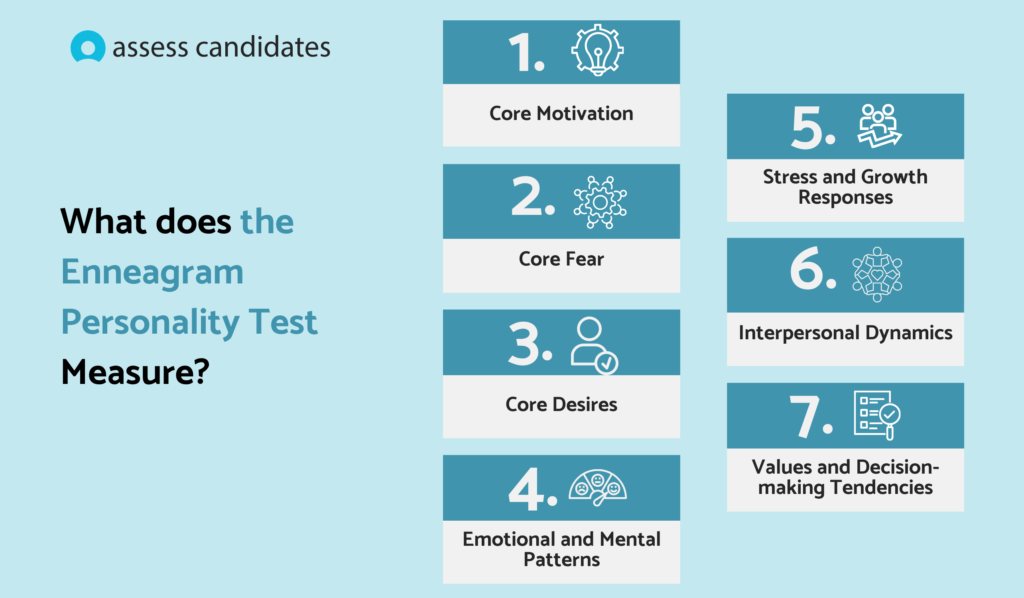
The Enneagram personality test helps you make better hiring decisions by measuring the following in your candidates:
- Core motivation
Your candidates apply to your job vacancy for a reason. Usually, it is because of their core motivation for success, security, autonomy, or structure.
The Enneagram personality test measures the fundamental drive behind your candidates’ choices and priorities. It exposes why your job description attracted them, and why they think your vacant role is the right choice.
- Core fear
While motivation drives an individual toward a goal, fear keeps them on the path towards it. Your candidates have chosen your company and that role because it helps them avoid fear.
The Enneagram measures the extent of your candidates’ fear and its influence on their decision-making. It helps you predict what drives a candidate’s decision.
- Core desires
Each Enneagram type has its desires. As you desire that your company flourishes, your candidates have desires that determine their suitability for your organization. Their desires determine their motivations and attitude toward work.
Can your candidates get their deepest desires from landing that role at your company? If they can, they are motivated to remain at your organization. If not, they can fill that position in the short term and move on when a desirable position becomes available.
- Emotional and mental patterns
Every individual has their way of handling stressful situations. In your workplace, such situations can stem from conflict or unfavorable feedback from superiors. How your candidate handles such situations can affect their productivity and your business.
The Enneagram framework evaluates how your candidates respond to conflict and stress. It also measures how they process emotions and react to challenges and feedback.
- Stress and growth responses
How your employees respond in stressful and growth situations differs. Generally, you expect that people respond positively in growth situations and negatively in stress situations. However, the Enneagram personality test shows that individuals’ reactions can differ.
While promotions connote career growth, they also bring more responsibilities, and some individuals find that stressful. Hence, the Enneagram personality test maps your candidates’ responses to stress and growth, to show their suitability for your organization.
- Interpersonal dynamics
Interpersonal relationships in your organization determine the effectiveness and productivity of teams and your company. Candidates who are excellent at collaboration help your company improve its productivity.
The Enneagram assessment evaluates your candidates’ communication, leadership, and followership skills, as well as their team interaction. These help you to determine the right fit for your company culture and role requirements.
- Values and decision-making tendencies
Leading organizations use structured personality insights to improve retention, leadership development, and team cohesion.
Whether they are under pressure or not, your employees’ decision-making skills will influence your organization’s output. Also, their values will determine their attitude to work and accountability.
With the Enneagram personality test, you can deduce what your candidates naturally prioritize when making decisions. Usually, it ranges from impact to efficiency, harmony, meaning, or certainty.
What does the Enneagram Personality Test not Measure?
The Enneagram Personality Test measures individuals’ behavioral and psychological drivers. It shows you how these drivers dictate your candidates’ actions and how they can influence your business. However, it does not measure the following:
- Mental health conditions: Your candidate’s tendency to lean towards specific personality markers does not label them as having a mental health condition. The Enneagram personality test measures core elements that form personalities, not mental health conditions.
- Skills or job competence: The Enneagram personality test does not measure job competence. It is also not a tool for skill assessment. Despite the Enneagram test portraying a candidate as “the individualist”, they can be your most effective employee in a team.
- Intelligence or aptitude: A candidate can be the fun-loving, scattered, and distractible one, but be the most capable one at the job simulation test. This means the Enneagram test does not measure a candidate’s aptitude or intelligence.
Hire the best-fit candidates with our accurate personality assessments. HIRE FOR FREE
Now that you understand what the Enneagram person test is and what it measures, let’s move on to how it works.

2. How does the Enneagram Personality Test work?
The Enneagram personality test works by posing questions or statements that prompt your candidates to reveal their deep psychological drivers in their answers. Your candidates’ answers show patterns that are consistent drivers of their emotions, thoughts, behaviors, and decisions. These patterns help the Enneagram typing system classify your candidates into personality types.
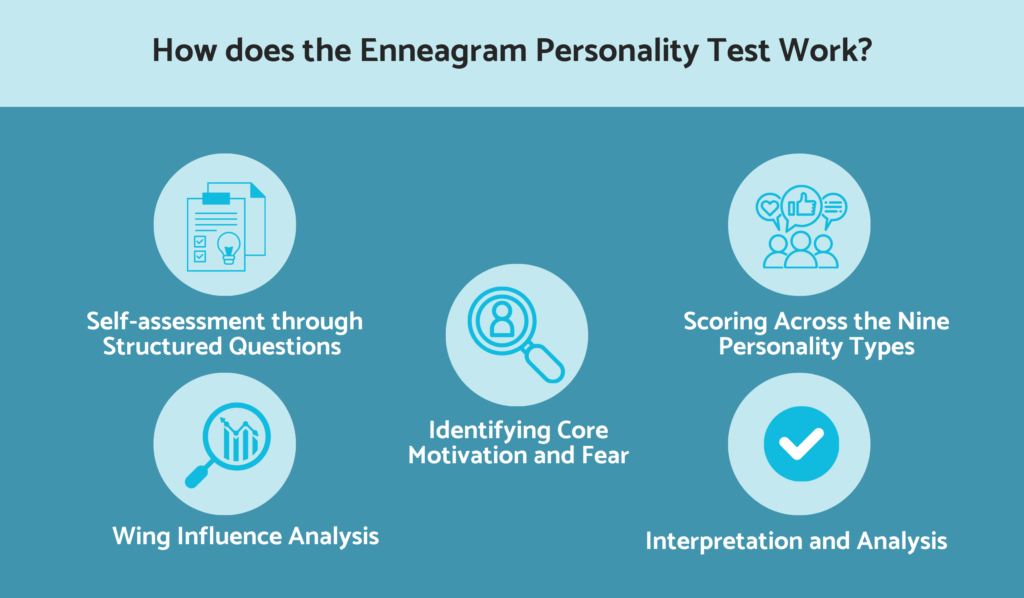
Here is how the Enneagram personality test works, step by step:
1. Self-assessment through structured questions
During the assessment, your candidates will answer a series of questions. These questions have the aim of extracting:
- What they fear most
- What motivates them
- How they respond to conflict, failure, and success
- What stresses them
- How they behave under stress
- How they thrive under healthy conditions
Your candidate’s answers are the most important aspect of the test. They determine the assessment’s accuracy.
2. Scoring across the nine personality types
The Enneagram typing system uses your candidate’s answers to place them in their most suitable personality type. It does this by scoring your candidate’s answers against each personality type and choosing a dominant type. The dominant type is the one whose psychological drivers your candidates are most aligned with.
The 9 Enneagram personality types are:
- Type 1 – The Reformer: also called the perfectionist, is motivated by being good and ethical. They fear being corrupt or defective. They are principled, disciplined, and focused on improvement, ensuring they have high standards, values integrity, and are process-driven.
- Type 2 – The Helper: wants to be loved and needed, and fears being unwanted. They are people-oriented, caring, and supportive. They excel at people-facing and service roles and are strong relationship builders.
- Type 3 – The Achiever: wants to be successful and admired but fears being a failure or worthless. They are goal-driven, competitive, adaptable, and result-oriented.
- Type 4 – The Individualist: loves being unique and fears a lack of identity. They are expressive, emotionally aware, and introspective. At work, they are creative thinkers and contributors.
- Type 5 – The Investigator: is motivated by being competent and knowledgeable but fears incapability or being overwhelmed. They are private, analytical, and independent, helping them become subject-matter experts and deep thinkers.
- Type 6 – The Loyalist: wants to feel secure and supported but fears abandonment or being unsafe. They are cautious, responsible, and committed, making them the risk-aware, long-term employees at your work.
- Type 7 – The Enthusiast: is motivated by freedom and satisfaction but fears being trapped in pain or limitations. They are innovative, optimistic, and visionary.
- Type 8 – The Challenger: wants to be strong and in control. They fear being vulnerable or controlled by others. They are natural leaders and direct communicators as dictated by their assertive and decisive traits.
- Type 9 – The Peacemaker: seeks to maintain harmony and stability. They fear conflict and loss of connection. They are calm, accommodating, and inclusive, making them the perfect mediators, steady performers, and consensus builders.
Note that your candidate can show traits of all nine personality types, but there is always a dominant one.
3. Identifying core motivation and fear
Based on your candidate’s answers, the Enneagram test identifies their motivations and fears. As each personality type is defined by a motivation and a fear, the test uses both to determine which one best explains your candidate’s emotional reactions and decision-making.
4. Wing influence analysis
Since personality expressions are nuanced, your candidate’s personality type can lean towards the traits of the neighboring personality types, called the wing.
The Wing influence analysis measures how much of your candidate’s traits fall into its neighboring personality type. It shows you that no individual’s personality is restricted to one type.
5. Interpretation and analysis
The final step of the Enneagram personality test is interpreting your candidate’s result and analyzing it. A good Enneagram test describes the healthy, unhealthy, and average expressions of your candidate’s personality, helping you better understand them. It also provides insights on what to focus on to help your candidate become a better version of themselves.
Identify your candidates’ personality types with our personality assessments. LEARN MORE
Understanding how the Enneagram personality framework works isn’t enough. You should also know how it is used in recruitment. Read on!
3. How is the Enneagram Personality Test used in recruitment?
As a recruiter, you want to ensure your candidates are the right fit for your vacant roles and the company. Although hard skill assessment helps you predict their technical proficiency, personality tests show you their soft skills competency.
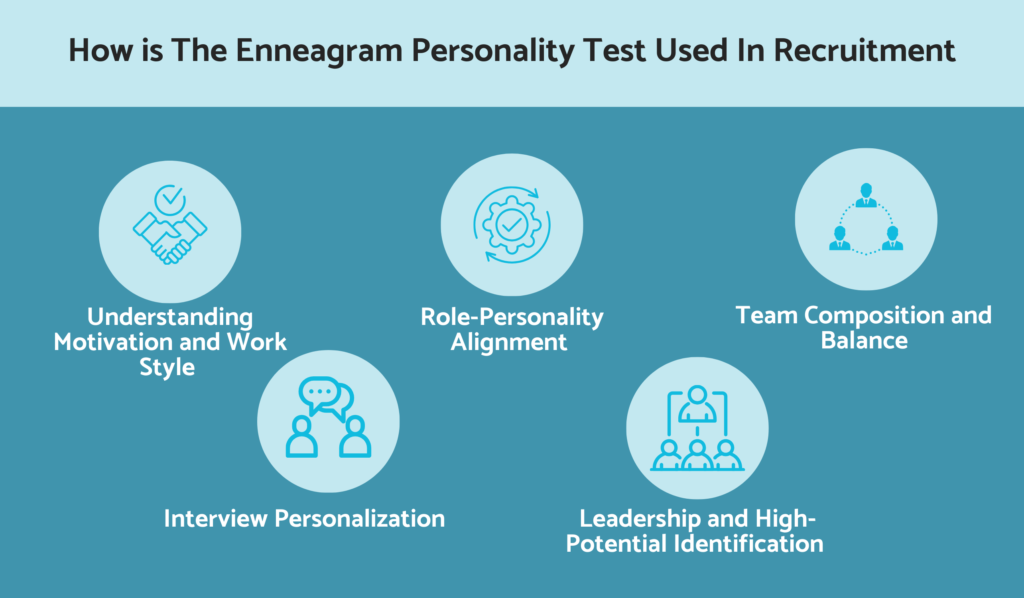
As a personality assessment tool, the Enneagram test is used to provide insight and support development. It gives you an insight into your candidates’ behaviours, motivations, and fears. It also shows you the areas of their personalities that need development. The Enneagram framework is used in recruitment for:
- Understanding motivation and work style
Your candidates’ motivation and work style can determine how effective they are at their roles when hired. Understanding what drives them, their approach to work, goals, and responsibilities, gives you insight into their productivity. Knowing how they make decisions helps you determine their suitability for their roles.
As an employer, the Enneagram personality test reveals your candidates’ preferred work styles. It tells you whether they are more productive as a remote or hybrid worker, so you can choose the better option.
- Role-Personality alignment
Some candidates have the hard skills for some roles but lack the personality and passion for success in that role. With the Enneagram personality test, you can identify candidates whose personalities best suit the role. Combined with hard skill assessments, you can get the right fit for that role.
You can also use the Enneagram assessment to identify employees in roles where their personalities don’t fit. The test can help you identify the best roles for these employees and plan their upskilling or reskilling. It can also aid in planning employee support, coaching strategies, or onboarding.
- Team composition and balance
The effectiveness of your teams depends on their collaboration and on their ability to resolve conflicts. Both skills demand that your team has a balance of personalities. The Enneagram personality test helps you identify each candidate’s personality, ensuring you group a mix of personalities that bring balance to a team.
Balanced teams typically resolve conflict faster, collaborate more effectively, and execute projects with greater consistency. By extension, your company will experience more productivity and profit.
- Interview personalization
Structured interviews are suited for balanced assessments. However, you can get more behavioral insights from each candidate by personalizing their interviews.
During the pre-screening interview phase of recruitment, candidates should answer the pre-screening interview questions. By the second interview, they should answer the structured interview questions. Pass the successful candidates through the Enneagram test and use their results to develop personalized questions for them. Use the personalized questions in their third interviews to ascertain their fit for the role or company.
- Leadership and high-potential identification
With the Enneagram test, you can track your high-potential candidates and put them on the right path to leadership from the start of their onboarding. The test helps you identify the natural leaders in your talent pool and provides insight into how to develop them. Using these insights will ensure you have a rich management and leadership pipeline in your company.
The test also helps you to identify blind spots in your high-potential candidates. You get to know their weaknesses early and develop them in those areas against the future.
Improve your quality of hire with our pre-employment personality assessments. HIRE FOR FREE
Combining personality and skills assessment improves your quality of hire. However, how does the Enneagram personality test compare to other personality tests?
4. Enneagram vs. Other Personality Tests
All type-based personality tests (Enneagram personality test, Myers-Briggs Type Indicator, Keirsey Temperament Sorter, and DISC Personality Test) help you to make better hiring decisions. However, they differ in aspects such as how they work, what they measure, and their strengths and limitations.
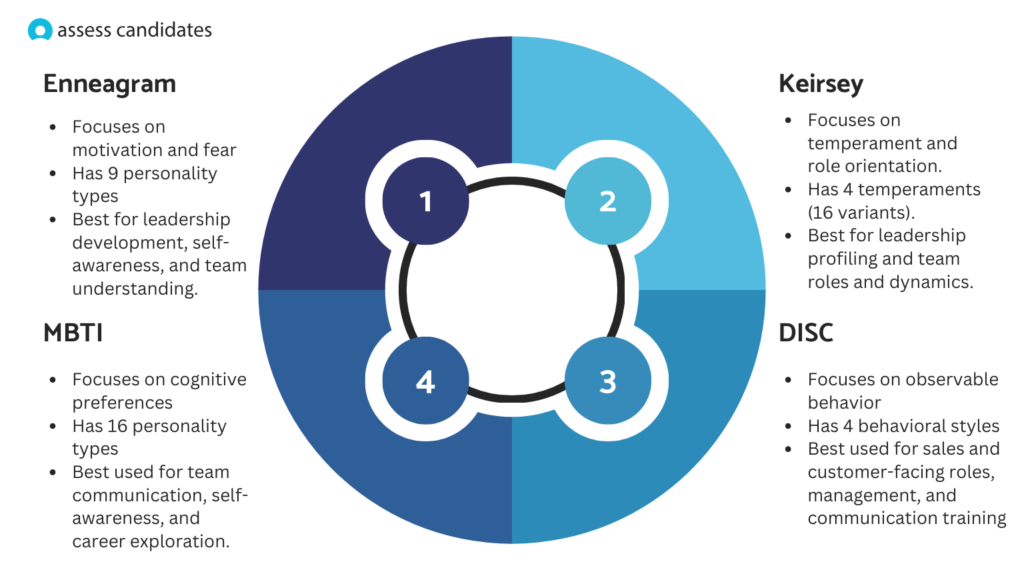
The top differences between the Enneagram personality test and other type-based personality tests are:
Choose the best candidate personality assessment from our extensive library. LEARN MORE
The Enneagram personality test is best used for self-awareness and leadership development. Yet, you can get more candidate personality insight with the Enneagram personality test best practices.
5. Enneagram Personality Test Best Practices
Hiring decisions carry financial and cultural risk. However, finding candidates who align with your company culture and have the required skill proficiency can be challenging. Personality insights from the Enneagram assessment can reduce that uncertainty through:
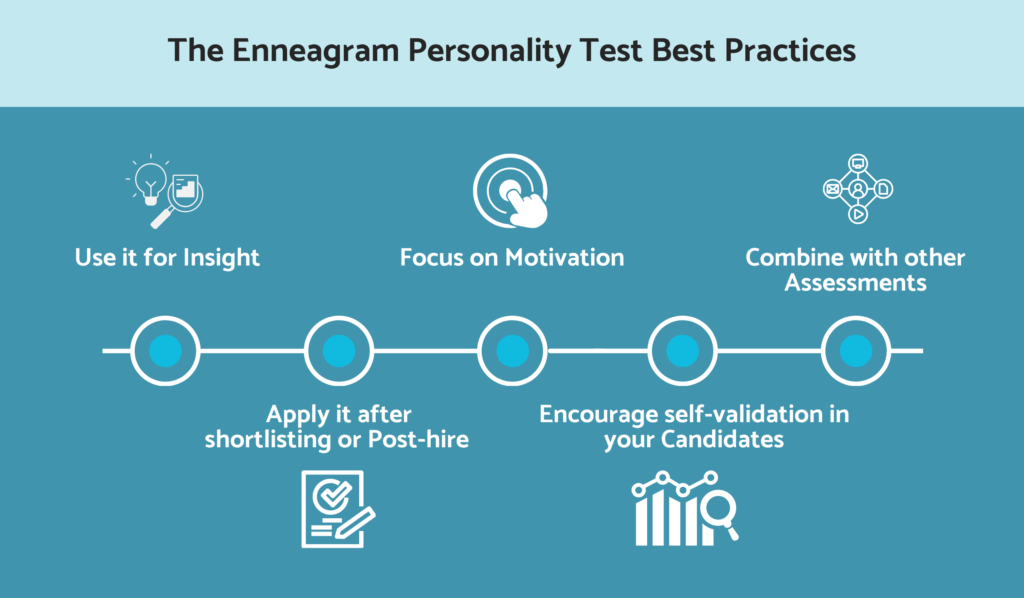
- Use it for insight, not selection
It is easy to think the Enneagram personality test will help you decide who to hire. However, unlike other candidate and employee assessments, it is best used for insight. It should help you understand your candidates better, not serve as a pass-or-fail recruitment filter. Remember that it aims to inform you of your candidates’ motivation, not their skills or competence.
- Focus on motivation, not labels
Labelling your candidates by their Enneagram personality types can distract you from the tool’s actual objective. Therefore, place less importance on personality types and focus more on your candidates’ motivations. Understand what drives them to strive for excellence, what causes them stress, and where they need improvement.
- Combine with other assessments
Since the Enneagram personality test is designed to help you better understand your candidates and employees, combine it with other assessments. While the Enneagram test focuses on inner drivers, other assessments can examine other personality models and their skills. Used together, these tools provide a multi-dimensional view of capability and behavioral fit.
- Apply it after shortlisting or post-hire
Although the Enneagram personality framework is considered a pre-employment assessment, you will get the best from it if it is used after shortlisting successful candidates for a role or during onboarding. It will give the new candidates a clear personal development and growth path and show you where to target their training.
As a pre-hire assessment tool, it may exclude strong candidates whose skills outweigh personality-style differences.
- Encourage self-validation in your candidates
Inform your candidates of the purpose of applying the Enneagram personality test, so they can answer the questions truthfully. Encourage them to see it as a self-awareness tool, to confirm their types and reflect on it, not just a test they should score high on. This approach will help you get their true personality type and influence their development targets.
- Use trained interpretation
You and your candidates can find interpreting the Enneagram personality types challenging. Therefore, allow trained personnel, such as your HR team, coaches, and managers, who understand the Enneagram framework interpret it for you. This will help you avoid oversimplifying the personality types and keep your focus on the traits that need development.
- Account for stress and growth states
Understand that, though less likely compared to behavior, your candidates’ personalities can change depending on prevailing conditions. Your candidate can shift from a type 2 to a type 3 personality, depending on whether they are under pressure or in a healthy state. Interpret the test results with this in mind, and you will have a quality talent pipeline that will serve your company for a long time.
6. Why Choose Assess Candidates for Candidates’ Personality Testing?
When you recruit new employees whose personalities you don’t know, they can disrupt their respective teams. On the other hand, they can also improve the productivity of their various teams. Therefore, testing your candidates’ personalities before introducing them to your teams is the right approach for your business.
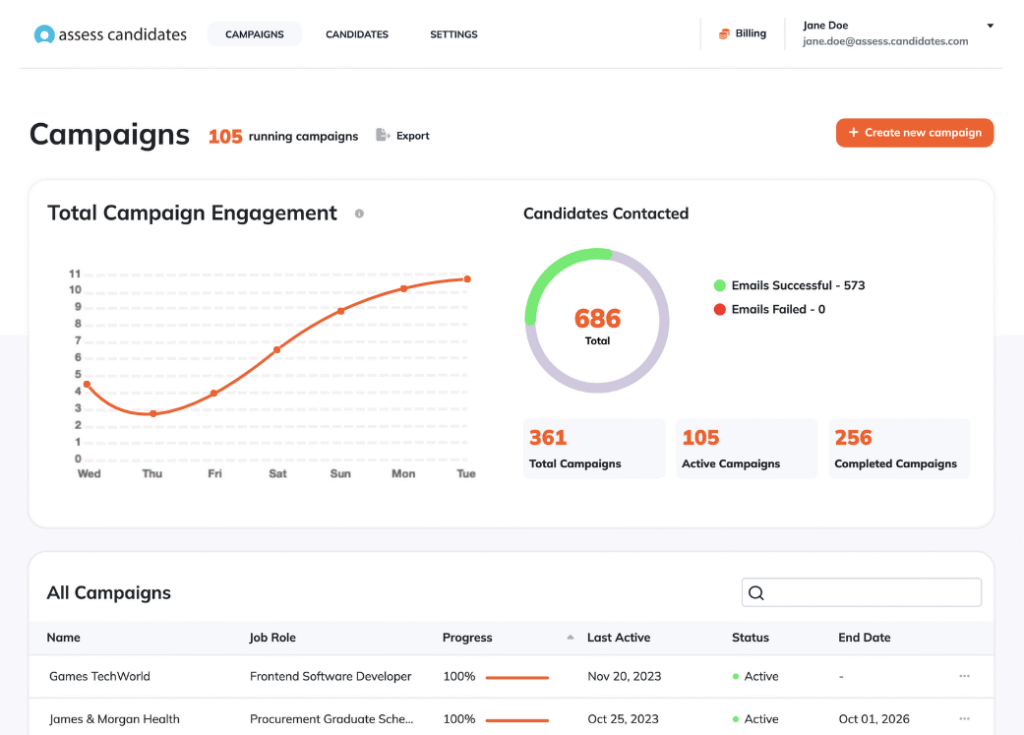
Assess Candidates helps companies assess their candidates’ personalities because they offer:
1. Expert-designed tests
Testing your candidates is great, but are you using the best assessment tools? An expert-designed personality assessment will help you gain a clear understanding of what motivates your candidates. You will understand their fears, what drives their decisions, and their potential for leadership positions in your company.
With recruitment, psychology, and career experts, Assess Candidates has well-designed personality assessments that use different model bases to evaluate your candidates’ behaviors. You can easily tell which of your candidates are a good fit for the vacant roles at your company.
2. Science and tech-backed evaluation process
Whether you choose to evaluate your candidates’ personalities through interviews, self-assessments, or game-based assessments, they need to go through a seamless process. This ensures that they remain engaged throughout the process, increasing the test’s accuracy and ensuring you make the correct hiring decisions. However, you won’t get these without a science and tech-backed evaluation system.
A seamless, technology-driven assessment experience improves engagement and response accuracy. Assess Candidates delivers science-backed evaluations through structured, timed, and gamified formats that measure relevant personality metrics efficiently.
3. Simplified, reliable, and accurate results
The accuracy of your candidates’ assessment results directly influences your hiring decisions. Therefore, you need the most reliable results to make confident recruitment conclusions. However, when you get your candidates’ results, and you can’t interpret them, what purpose does it serve?
Assess Candidates’ pre-employment assessment results are accurate and reliable, supporting your aim to improve hiring quality. These results are presented in easy-to-understand formats that help you make quick and easy hiring decisions.
4. Bias-proof assessment
A biased candidate evaluation process can undo all the positives you have recorded throughout your hiring journey. It makes your candidate shortlist unreliable and causes you to make the wrong hiring decisions. However, a bias-free assessment helps to improve the quality of hire.
Structured, bias-free assessments support fairer hiring decisions and strengthen diversity outcomes. Choose a candidate assessment platform that supports your fairness in recruitment.
5. Multi-assessment friendly
One way to ensure the accuracy of your candidate assessment is to test the same aspect with different tools. You can assess your candidates’ personalities using tools that target specific aspects. This gives you a robust idea of where your candidates fit in your company.
With the various personality assessment exercises, including the personality questionnaire and the SHL Personality OPQ available on Assess Candidates, you can explore multi-assessment. Use them to ascertain different behaviors that characterize your candidates and can influence their role-personality compatibility.
Make confident hiring decisions with our personality assessments. LEARN MORE
Conclusion: Key Takeaway
- The Enneagram personality test is a self-assessment tool that identifies your candidates’ core personality, motivation, strengths, weaknesses, and behavioral patterns. These psychological traits help you recognize your candidates’ development potential and suitability for your company.
- It measures candidates’ motivation, desires, fear, stress and growth responses, and interpersonal dynamics. However, it does not measure mental health conditions, skills or job competence, and intelligence or aptitude.
- The Enneagram personality test works by posing questions that your candidates must answer honestly. It uses your candidates’ answers to determine their motivations and fears, and place them in one of the 9 Enneagram personality types that best suit them. It also accounts for their traits that align with neighboring personality types through the wing influence analysis.
- When used correctly, the Enneagram personality test supports leadership development, team alignment, and deeper self-awareness. Combined with skills assessments, it strengthens hiring decisions by adding psychological insight to performance data.
- The Enneagram personality test differs from other type-based personality tests in its focus, orientation, model, structure, and workplace applicability. It focuses on your candidates’ motivations and fears through internal drivers, placing them into any of its 9 personality types. It is best used for your employees’ personal development and leadership growth planning.
- Apply practices such as using it for insight and focusing on motivation to your Enneagram personality test for the best result. Other practices that can help include combining it with other assessments and applying it after shortlisting.
- Assess Candidates delivers structured, science-backed personality assessments designed specifically for modern hiring teams. We provide simplified, accurate results, bias-free assessments, and multi-assessments.
Would you like to learn more about the Enneagram personality test? Continue to the frequently asked questions section and sign up below with your email to get started.
Frequently Asked Questions
How accurate is the Enneagram personality test?
The Enneagram personality test can provide useful insight into motivations and behavior patterns when candidates answer honestly and results are interpreted correctly. It is most effective as a developmental tool rather than a predictive performance measure.
Is Enneagram evidence-based?
Empirical validation of the Enneagram personality test is limited. However, you can use it for your employees’ leadership development and career coaching programs. Due to its explanatory power, it serves as an organizational psychology tool rather than a scientific diagnostic test.
How to use the Enneagram in the workplace?
In the workplace, you can use the Enneagram personality test to understand your candidates’ motivations, stress responses, and growth patterns. It is particularly effective at improving your employees’ self-awareness, team dynamics, leadership skills, and communication. Therefore, they are used in leadership programs, career coaching, and employee onboarding.
Is Enneagram more important than MBTI?
No, the Enneagram is not more important than MBTI; it is different. While the Enneagram focuses on your candidates’ emotional drivers and motivations, MBTI addresses their information processing and cognitive preferences. Therefore, they answer different questions and are often used together to provide a more comprehensive assessment of a candidate’s personality.
Which companies use Enneagram?
Companies such as Procter & Gamble, Google, Toyota, and Shell use the Enneagram personality test. However, you will find companies ranging from small and medium-sized enterprises to large conglomerates that use the Enneagram personality test for employee development.


 English
  Arabic