
How Flexible Internal Mobility Improves Retention And Reduces Turnover



Lack of growth is one of the main reasons employees leave. When people feel stuck, they start looking elsewhere. When they can see a credible path forward, they are more likely to stay.
Flexible internal mobility gives employees room to grow through new roles, projects, and skill development without leaving the organization. It turns careers from fixed ladders into more flexible pathways, which can strengthen loyalty, improve engagement, and reduce turnover.
Research and employer reporting consistently shows that limited internal mobility increases the risk of attrition, especially when employees cannot see a clear path to growth.
This guide explains why flexible internal mobility matters, the risks of limiting it, how it affects retention and engagement, and how assessments support smarter internal movement.
Contents
- What Is Flexible Internal Mobility?
- What Are the Risks of Limited Internal Mobility?
- How Does Flexible Internal Mobility Improve Employee Retention?
- How Does Flexible Internal Mobility Enhance Employee Engagement?
- How Do Assessments Support Flexible Internal Mobility?
We’ll begin by defining flexible internal mobility!
1. What Is Flexible Internal Mobility?
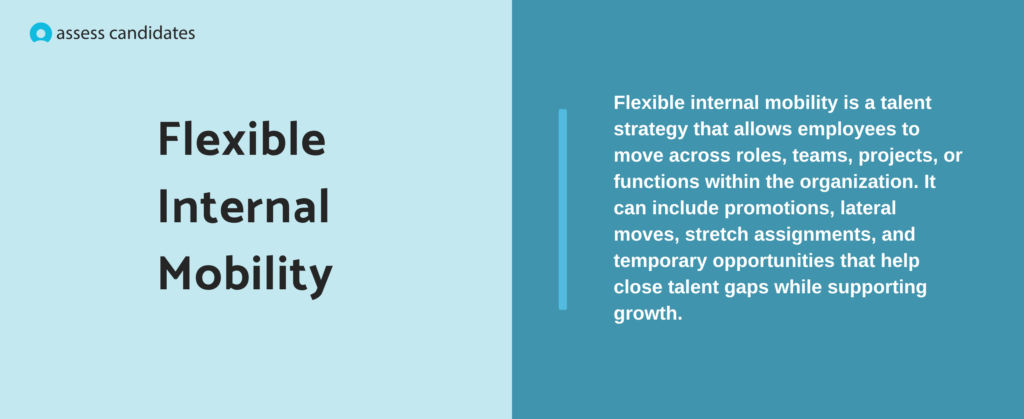
Flexible internal mobility is a talent strategy that allows employees to move across roles, teams, projects, or functions within the organization. It can include promotions, lateral moves, stretch assignments, and temporary opportunities that help close talent gaps while supporting growth.
LinkedIn data shows that employees at companies with high internal mobility stay 66% longer than at companies with low internal mobility.
Assess internal talent more accurately for mobility decisions. HIRE FOR FREE
Now that we know what flexible employee mobility is, let’s look at the risks of limited internal mobility.

2. What Are the Risks of Limited Internal Mobility?
Limited internal mobility is more than a frustration for employees. It creates real business risks that affect retention, engagement, capability, and long-term performance.
Top 7 Challenges to Overcome with Limited Internal Recruitment:
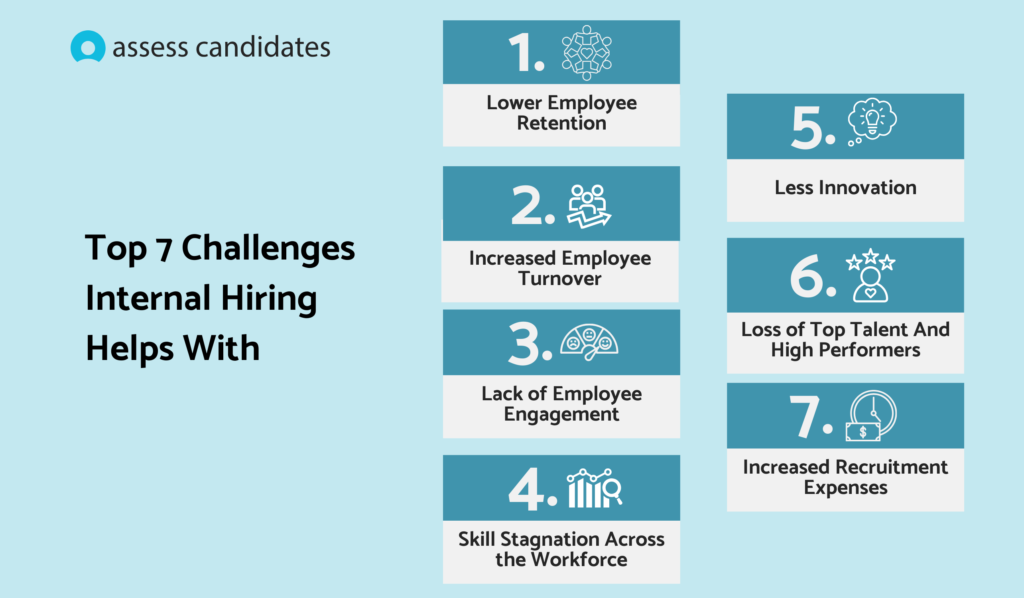
- Lower Employee Retention: Workers remain where they can see a future. When internal movement looks unfeasible, loyalty declines, and long-term retention suffers. People don’t quit because they want to; they quit because they don’t see a way forward.
- Increased Employee Turnover: Low in-house mobility drives employees to seek growth outside your company. When external offers are the only way to get promoted, this directly results in an increase in voluntary turnover.
- Lack of Employee Engagement: Employee engagement becomes low when employees are stagnant. Work turns transactional rather than purposeful, and this results in disengagement before they actually quit their jobs.
- Skill Stagnation Across the Workforce: Workers do not acquire new skills without internal mobility. Roles become redundant, learning slows, and your workforce struggles to adapt to new business needs.
- Less Innovation: Internal mobility contributes to innovation by exposing people to new teams, ideas, and challenges. In its absence, your organization may be exposed to silo thinking and slower problem-solving.
- Loss of Top Talent And High Performers: Your high-performing employees want to be challenged and gain new experiences. Without internal opportunities, your best employees leave first, and with them, valuable knowledge.
- Increased Recruitment Expenses: Recruiting employees is much more expensive than nurturing them internally. Low mobility increases external recruitment, hiring expenses, and time-to-productivity losses.
Studies indicate that over two-thirds (67%) of the working population would leave their company if they are unable to advance their careers within the company.
Strengthen your company’s internal mobility with our talent testing. Learn More
After considering the risks of limited internal movement, we shall now look at how flexible internal mobility improves employee retention.
3. How Does Flexible Internal Mobility Improve Employee Retention?
Employees are more likely to stay when they can see a future inside the organization. Flexible internal mobility turns career uncertainty into longer-term commitment by showing people they can grow without leaving.
Top Ways How Internal Recruitment Boosts Employee Retention:
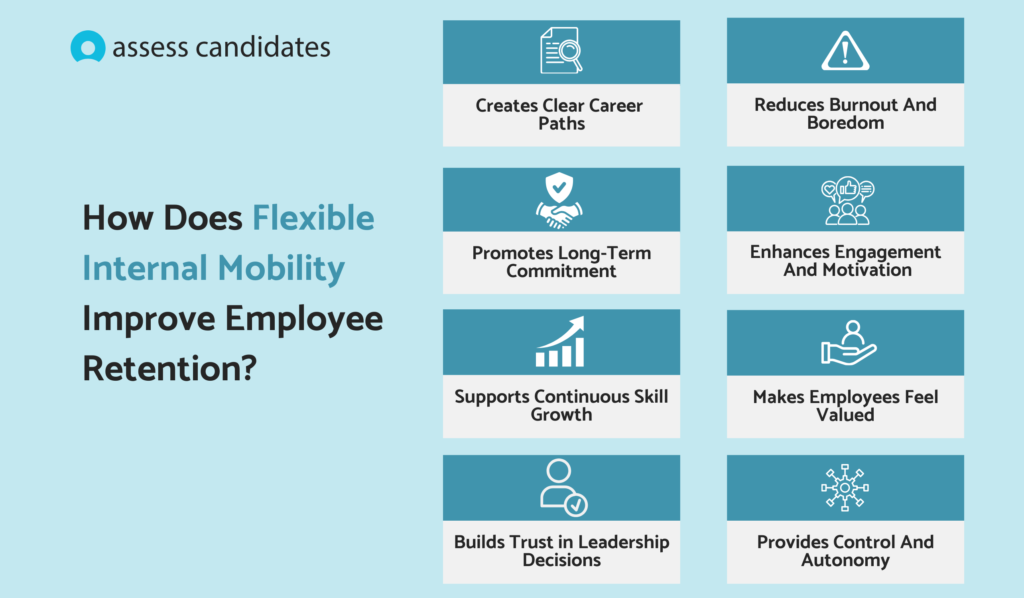
- Creates Clear Career Paths:
Flexible internal mobility shows your employees their next possible destination. Clear paths eliminate doubt and give your talent the assurance that staying will result in growth, not stagnation.
- Promotes Long-Term Commitment:
Employees put in more effort in an organization when they see opportunities within it. They will also remain longer because they believe that the company will help them achieve their future plans.
- Supports Continuous Skill Growth:
Flexible internal mobility leads to continuous learning. Ongoing development strengthens employee retention because people stay where their skills continue to grow and stay relevant.
- Builds Trust in Leadership Decisions:
Transparent internal flow develops a sense of trust. Your employees will also feel appreciated when you invest in them instead of introducing new replacements.
- Reduces Burnout And Boredom:
There is the risk of burnout and boredom with monotonous tasks. Internal mobility rejuvenates work routines and reduces employee boredom, keeping them energized and productive.
- Enhances Engagement And Motivation:
Transitions into new jobs or projects provide internal talent with new directions. Such energy increases motivation and makes individuals more dedicated to their job.
- Makes Employees Feel Valued:
Internal talent mobility shows that you are interested in your employees’ growth. When employees feel recognized and valued, they stay longer and work more consistently.
- Provides Control And Autonomy:
Internal mobility allows your employees to choose the next move. When they believe that they are in charge of their career choices, they feel more loyalty towards your organization.
According to LinkedIn, workers who have moved internally have a 64% chance of remaining with an organization after three years. Meanwhile, employees who haven’t moved internally only have a 45% chance of being around after three years.
Boost your employee retention by hiring the best-fit candidates. HIRE FOR FREE
Internal talent mobility only works at scale when managers can see where employees are likely to succeed next.
Other than contributing to employee retention, flexible internal mobility enhances employee engagement as well.
4. How Does Flexible Internal Mobility Enhance Employee Engagement?
Internal mobility can strengthen engagement because it connects day-to-day work with visible development opportunities. When employees can move, learn, and take on new challenges, they are more likely to stay motivated and involved.
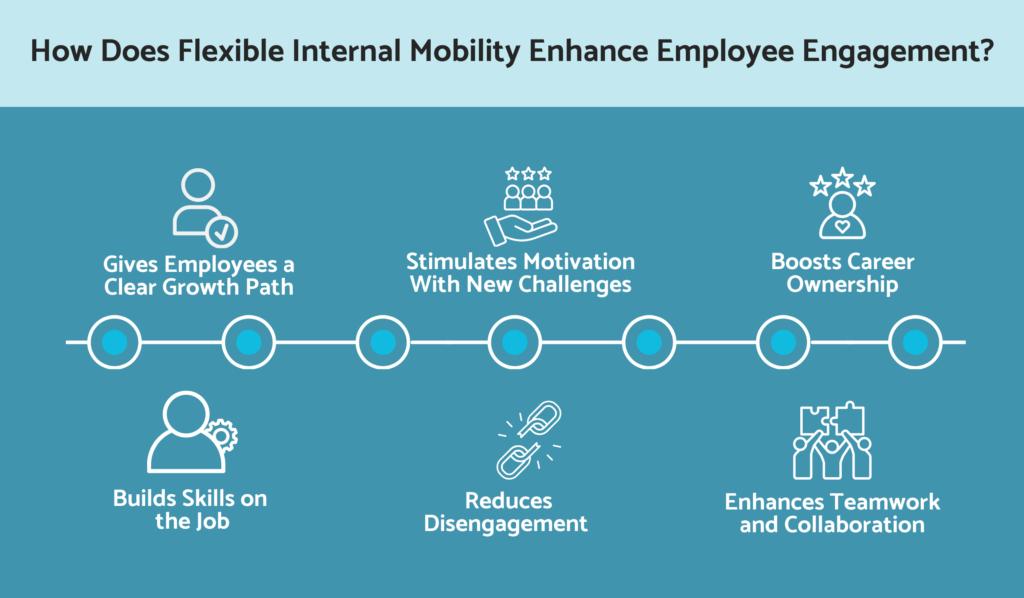
Top 6 Ways to Boost Employee Engagement with Internal Recruitment:
- Gives Employees a Clear Growth Path: Internal mobility shows employees that they have a future in the company. This ensures a higher level of participation and makes people feel that they have opportunities to achieve real career growth.
- Stimulates Motivation With New Challenges: New jobs or stretch assignments revitalize motivation. Internal talent is also active when there are new challenges and acquisition of new skills.
- Boosts Career Ownership: When your employees can manage their career, they will get more committed. Ownership increases commitment and loyalty to the firm.
- Builds Skills on the Job: Internal mobility involves learning. Employees will remain active with actual jobs and projects on skills improvement.
- Reduces Disengagement: Stagnation causes disengagement and quiet quitting. When your employees can move internally, they feel valued and stay more active and productive.
- Enhances Teamwork and Collaboration: Internal mobility makes talent cross-functional. Such cooperation enhances the level of interaction and a better corporate culture.
Internal moves are commonly associated with higher engagement because they create fresh challenge, visibility, and a stronger sense of career progress.
Use our assessments to match employees to roles that keep them engaged. View Plans
To make internal mobility work, you need the right tools to match people to roles accurately. One of the most useful tools for this is assessment.
5. How Do Assessments Support Flexible Internal Mobility?
Internal mobility works best when you have a clear view of employee strengths, skills, and potential. Assessments provide that visibility and help organizations make more confident internal placement decisions.
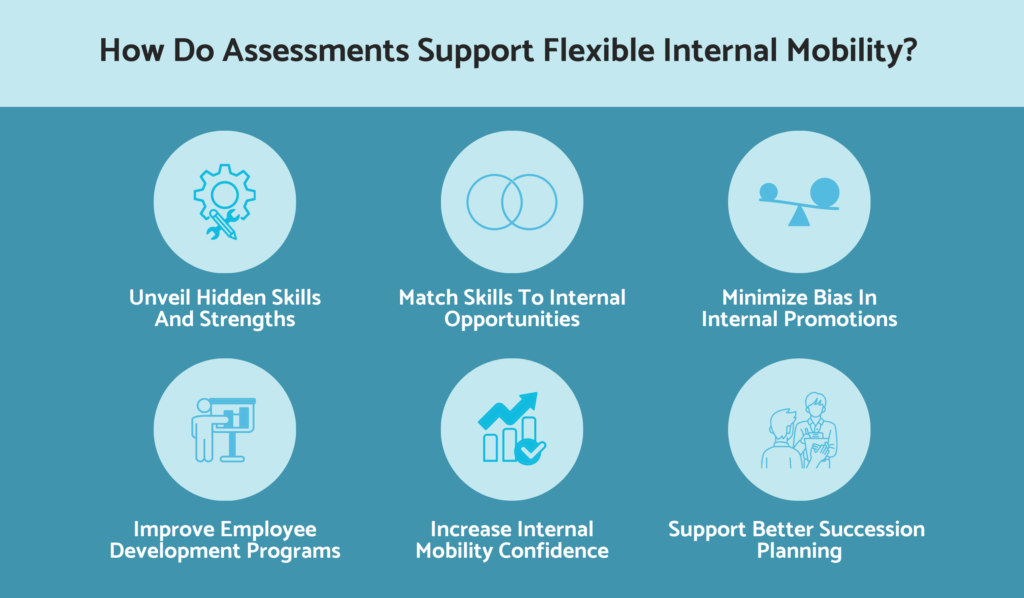
Common Ways Assessments Help in Flexible Internal Mobility:
- Unveil Hidden Skills And Strengths: Tests can identify the skills internal talent have but are not evident in their current jobs. Such knowledge will inform you of who will fit in new departments or positions.
- Match Skills To Internal Opportunities: Assessments aid in aligning people to job opportunities that suit them. This reduces poor role fits and increases the effectiveness of internal moves.
- Minimize Bias In Internal Promotions: Evaluations provide objective data for internal promotions. This alleviates biases, and ensures that promotions are done on a performance and potential basis rather than on favoritism.
- Improve Employee Development Programs: Analysis of assessments’ results shows skills gaps and development areas. Career paths and development plans can be devised based on those insights.
- Increase Internal Mobility Confidence: You will have more confidence in putting your employees in various roles when making decisions based on data. Such confidence accelerates internal movement and promotions.
- Support Better Succession Planning: Evaluations help you to identify future leaders and build internal pipelines. This makes internal mobility a strategic capability rather than a reactive fix.
This is where Assess Candidates comes in. Our assessment tools support smarter internal mobility by revealing your employees’ skills and potential beyond their current roles. That clarity helps you make better placement decisions that improve retention and reduce turnover.
Organizations utilizing assessments and skill data across the employee lifecycle saw lower turnover and faster time-to-role fit. This demonstrates the way assessments contribute to internal mobility by matching talent to the right job.
Use our science-backed assessments to support smarter internal moves. LEARN MORE
Conclusion: Key Takeaway
Used well, flexible internal mobility helps organizations retain talent, lower turnover, and make better internal movement decisions.
The most effective internal mobility schemes involve the use of tests to align people’s talent and ability with appropriate positions. That fact-based strategy guides you to make more intelligent and objective talent choices and create a more effective workforce.
Want more insights on how internal mobility boosts retention and lowers turnover? Explore the FAQs below and sign up with your email to get started!
Frequently Asked Questions
What is the difference between internal mobility and career development?
Internal mobility refers to moving your employees into new internal roles, while career development includes the skills and learning opportunities that make those moves possible. They work together to improve retention.
Why do employees often leave when there is no internal mobility at work?
Employees view lack of growth as stagnation. If they do not see a visible way up, they begin to question their future in the firm. This decreases loyalty and increases the possibility of them taking offers elsewhere. In the long run, low mobility within an organization leads to employee demoralization and stagnation, which result in turnover.
How can skill assessments improve internal mobility?
Skill assessments identify your employee’s strengths, skills, and future potential. They reveal abilities that may not show up in day-to-day performance. You can use this information to align employees with positions they will serve best. That minimizes risky moves and enhances successes in internal transfers and promotions.
What should companies track to measure the success of internal mobility?
Monitor internal mobility rate (number of employees that change jobs within the company) and retention rate of employees that switch jobs. Compare pre and post-internal move employee engagement scores. Also monitor time to fill internal positions, and the success rate of internal promotions relative to external recruitments.
How do you start an internal mobility program?
Begin with developing clear and transparent career paths. Create an internal job board and openly share opportunities. Use evaluations to match internal talent to the appropriate positions. Train and mentor employees to encourage growth. Next, track outcomes and make changes according to the feedback and data.


 English
  Arabic