
The Ultimate Guide To Hiring Top Marketing Professionals In 2026



Marketing professionals play a critical role in helping organizations build brands, engage customers, and drive revenue growth. As demand for digital, analytical, and creative talent continues to rise, employers need structured hiring strategies to identify and attract the strongest marketing candidates.
Did you know? According to the LinkedIn business report, companies with strong employer brands see an average 43% decrease in cost per hire compared to those with weaker brands. Additionally, these companies enjoy 28% lower turnover rates.
This guide explores the core principles of marketing recruitment, explains the most effective strategies, and highlights the tools recruiters use to attract and engage the right marketers.
Contents
- What is a marketing professional?
- What are the key roles within the marketing industry?
- Core skills to look for when hiring marketing professionals
- What are the essential tools used to hire marketing professionals?
- What are the strategies or best practices to hire the right marketing talent?
- Marketing: A Success Story
- Why hire marketing teams with Assess Candidates?
Now that we’ve outlined what this article covers, let’s find out what the marketing sector covers.
1. WHAT IS A MARKETING PROFESSIONAL?
Marketing professionals are employees responsible for promoting products, services, and brands through activities such as content creation, advertising, digital marketing, SEO, analytics, public relations, and customer engagement.
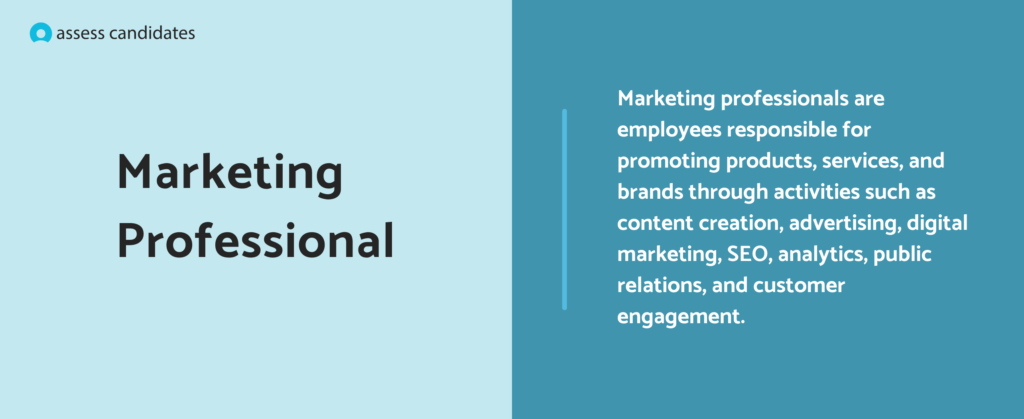
A marketing professional covers a wide range of activities, including market research, branding, advertising and promotion, digital marketing, public relations, communications & sales, and distribution.
Understanding the connection between marketing and talent attraction helps employers strengthen hiring outcomes.
WHY IS HIRING TALENT WITH THE RIGHT MARKETING IMPORTANT?
Marketing plays a crucial role in hiring by focusing on attracting, engaging, and retaining the right talent. Here are the 5 key reasons marketing strengthens the hiring process:
1. Employer Branding
Companies market themselves to potential employees just as they market products to customers. They build a strong employer brand through marketing, which shapes and manages how they are perceived. By defining their Employee Value Proposition (EVP), highlighting unique rewards such as culture, mission, or growth opportunities, organizations make themselves more appealing and stand out in a competitive job market.
Through marketing, organizations also take control of their narrative, showcasing an authentic culture on careers pages and social media rather than leaving the story to third-party review sites.
Did you know? LinkedIn reports that 72% of recruiting leaders worldwide believe employer branding plays a major role in hiring success.
2. Candidate-Driven Market
The modern job market operates in a candidate-driven manner, especially for high-demand roles and skilled professionals. Candidates often weigh multiple opportunities, and hence, companies cannot simply select the best applicant; they must also compete to win top talent.
By using effective marketing, organizations differentiate themselves from competitors and showcase their unique value to position themselves as the preferred employer.
3. Attracting The Right Talent
Recruiters move beyond a limited pool of applicants from generic job postings by using marketing strategies that expand and diversify their reach. They treat job postings, career pages, and recruitment campaigns like advertisements, applying marketing principles to ensure these messages reach the right audience with the right tone and attract candidates who align with company culture.
Companies also engage specific demographics and skill sets through targeted outreach on platforms like LinkedIn. In addition, they create compelling content, such as blog posts or team videos, to draw in passive candidates who are not actively searching but feel intrigued by the work, while using search engine optimization (SEO) to help active job seekers easily find open roles.
4. Improving Candidate Experience
The entire hiring process serves as a marketing opportunity that shapes how candidates perceive the company. Effective recruitment, which further improves candidate experience, relies on storytelling, personalization, and engagement, supported by clear communication, compelling content, and a seamless application process.
These practices present the organization as efficient and people–focused. In contrast, a poor experience can weaken the employer brand, as dissatisfied applicants may share negative feedback that discourages future hires and even customers.
Did you know? According to StandOutCV, 38% of candidates are more likely to accept a job offer after having a positive candidate experience.
5. Long-Term Retention
The principles of marketing play a vital role in long-term retention. When the daily reality of a role and workplace culture align with the brand promise made during recruitment, employees develop trust and genuine satisfaction. This consistency motivates them to stay and inspires them to act as brand ambassadors who naturally attract other skilled professionals.
Internal employer-brand initiatives, recognition programs, and transparent communication help reinforce employee engagement and retention.
Did you know? According to a LinkedIn Business Report, companies with a strong employer brand see up to 28% lower turnover, as employees are more likely to stay when brand promises match reality.
Improve your marketing recruitment strategy with our scientifically validated pre-employment tests. HIRE FOR FREE
In the following section, we will explore the key marketing jobs that are in demand within the marketing industry:

2. WHAT ARE THE KEY ROLES WITHIN THE MARKETING INDUSTRY?
Marketing careers span creative, analytical, technical, and leadership disciplines, making the function one of the most diverse areas within modern organizations.
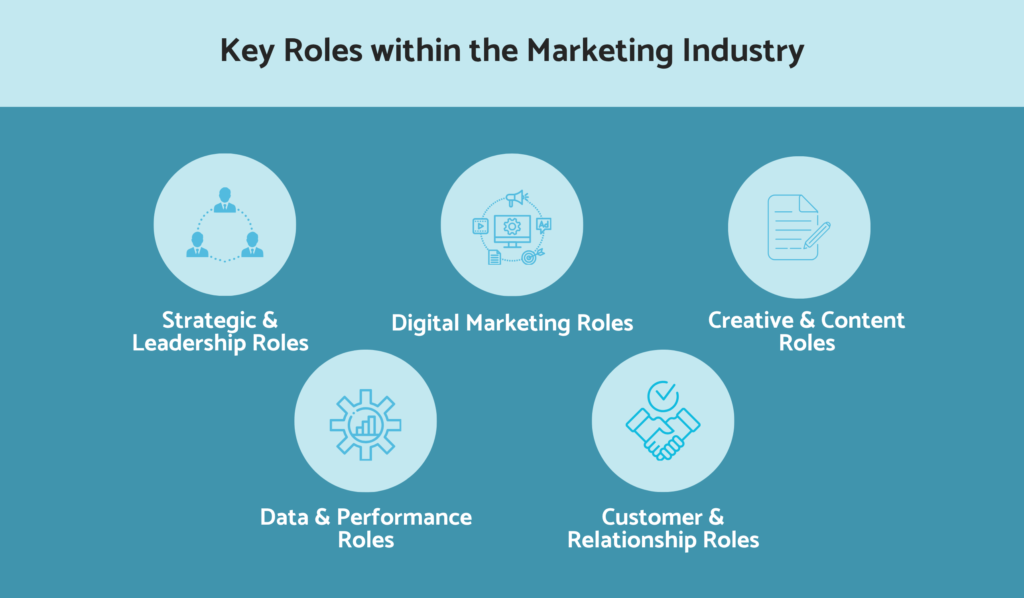
The following are some of the marketing jobs in demand across various sectors.
Strategic & Leadership Roles
- Chief Marketing Officer (CMO): The CMO sets the overall marketing vision and aligns it with business goals. They balance long-term brand building with short-term revenue growth and bridge the gap between executives and marketing teams by making strategic decisions that shape how the company competes in the market.
- Marketing Manager/Director: Marketing Managers/Directors oversee day-to-day operations, manage budgets, and coordinate campaigns across channels. They translate high-level strategies into actionable plans and ensure teams execute them with consistency and efficiency.
- Brand Manager: Brand Managers strengthen brand identity by aligning messaging, visuals, and customer perception. They build trust, recognition, and loyalty, which directly increase customer retention and long-term profitability.
Digital Marketing Roles
- Digital Marketing Manager: Digital Marketing Managers design and execute online strategies across SEO, paid ads, content, and social campaigns. They drive customer acquisition and engagement by ensuring digital channels deliver measurable growth and align with overall marketing goals.
- SEO/SEM Specialist: SEO/SEM Specialists optimize websites to rank higher on search engines and manage paid campaigns to capture targeted traffic. They increase visibility, attract qualified leads, and ensure the business reaches customers actively searching for its products or services.
- Social Media Manager: Social Media Managers build and manage a brand’s presence on platforms such as LinkedIn, Instagram, and X (formerly Twitter). They shape first impressions, foster community engagement, and respond in real time to maintain strong connections with audiences.
- Email Marketing Specialist: Email Marketing Specialists design and execute targeted email campaigns that deliver personalized communication. They nurture prospects through the sales funnel, strengthen customer loyalty, and generate high ROI by tailoring messages to specific audience needs.
Creative & Content Roles
- Content Marketer/Strategist: Content Marketers develop blogs, videos, guides, and other resources that attract, educate, and convert audiences. They drive inbound traffic, strengthen brand authority, and support every stage of the customer journey by aligning content with audience needs. This role ensures that the brand consistently provides value and maintains visibility in a competitive market.
- Copywriter: Copywriters craft persuasive messages for ads, websites, and campaigns. They sharpen brand voice, influence perception, and inspire audiences to act, whether that means clicking, subscribing, or purchasing. They make brand communication clear, consistent, and compelling.
- Graphic Designer/Creative Director: Designers create visuals and brand assets that define how campaigns look and feel. They communicate identity instantly, improve message retention, and deliver impact in a visually driven digital environment. Creative Directors extend this role by shaping overall creative strategy, ensuring that every design element aligns with business goals.
- Video Producer/Editor: Video Producers design and edit multimedia content for ads, websites, and social platforms. They translate complex ideas into engaging visual stories that capture attention quickly, drive engagement, and increase conversions. This role ensures brands remain relevant and memorable.
Data & Performance Roles
- Marketing Analyst/Researcher: Marketing Analysts collect, interpret, and apply data on customers, competitors, and markets. They provide insights that help businesses make informed decisions, optimize strategies, and reduce wasted spend. By grounding campaigns in evidence rather than guesswork, analysts ensure marketing efforts deliver measurable results.
- Performance Marketing Specialist: Performance Marketers plan and execute paid campaigns across channels like search, display, and social. They link every dollar spent directly to outcomes, such as leads, sales, or sign-ups. This accountability makes them vital in maximizing ROI and ensuring budgets deliver tangible business growth.
- Marketing Automation Specialist: Automation Specialists implement and manage platforms like HubSpot or Marketo. They streamline repetitive tasks, personalize customer outreach, and ensure consistent engagement across all touchpoints. By combining efficiency with personalization, they allow marketing teams to scale efforts without losing quality.
- Growth Marketer: Growth Marketers design and test experiments that accelerate customer acquisition and retention. They measure results, identify scalable strategies, and focus on sustainable growth. Their fast-paced, data-driven approach makes them crucial in industries where speed and adaptability determine success.
Customer & Relationship Roles
- Public Relations (PR) Manager: PR Managers build strong media relationships and shape how the public views a brand. They secure positive coverage, manage reputation, and step in during crises to protect credibility. This role ensures the brand’s image remains trustworthy and resilient.
- Community Manager: Community Managers engage directly with audiences in digital and offline spaces. They stimulate conversations, respond to feedback, and create a sense of belonging. By fostering loyalty and advocacy, they help brands grow organically through trusted relationships.
- Customer Experience (CX) Manager: CX Managers oversee all customer interactions across the journey. They identify friction points, improve satisfaction, and boost retention. By elevating customer experience, they increase lifetime value and transform buyers into repeat customers.
- Partnerships/Influencer Manager: Partnerships and Influencer Managers form collaborations with individuals, brands, and creators who expand reach and credibility. They tap into third-party trust to strengthen authenticity and connect with audiences that traditional marketing might miss. Their role ensures that the brand leverages external voices effectively to grow influence.
Advance your marketing-driven recruitment with a targeted hiring strategy. HIRE FOR FREE
Next up, we will look into the core skills that need to be looked out for when recruiting marketing professionals.
3. CORE SKILLS TO LOOK FOR WHEN HIRING MARKETING PROFESSIONALS
The strongest marketing professionals combine creativity with commercial thinking, allowing them to turn ideas into measurable business outcomes.
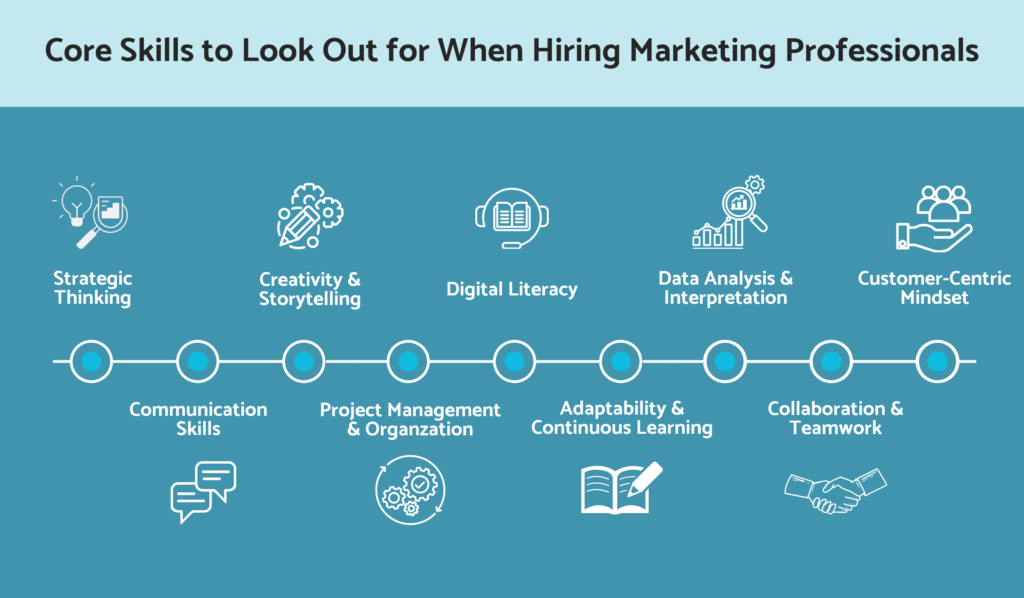
The following are the top 9 marketing skills that must be looked for when hiring marketing professionals
1. Strategic Thinking
Marketers demonstrate value when they think beyond short-term campaigns and design long-term strategies that align with business goals. They evaluate market trends, anticipate customer needs, and position the brand competitively. Strategic thinkers ensure every marketing effort contributes directly to business growth.
2. Creativity & Storytelling
Successful marketers generate original ideas and craft compelling narratives that resonate with audiences. They shape campaigns that stand out in crowded markets and make brand messaging memorable. By mastering storytelling, they connect emotionally with customers, build trust, and inspire action.
3. Digital Literacy
Modern marketers master digital tools, platforms, and channels to expand a brand’s online presence. They run SEO and SEM campaigns, manage social media engagement, and optimize paid advertising. By leveraging digital marketing strategies, they drive acquisition, strengthen brand visibility, and create meaningful engagement at scale.
4. Data Analysis & Interpretation
Effective marketers collect, analyze, and translate data into actionable insights. They measure ROI, identify performance gaps, and optimize campaigns based on evidence rather than guesswork. With strong analytical skills, they reduce wasted spend, predict customer behavior, and make smarter strategic decisions.
5. Customer-Centric Mindset
Marketers succeed when they put customers at the center of every decision. They study customer journeys, gather feedback, and personalize messaging to enhance satisfaction. By prioritizing customer needs, they build loyalty, increase retention, and maximize lifetime value.
6. Communication Skills
Marketers communicate clearly and persuasively, whether they are writing ad copy, building presentations, or pitching ideas to stakeholders. They adapt their tone to suit different audiences and ensure brand messaging stays consistent. Strong communicators strengthen collaboration and influence action.
7. Project Management & Organization
Marketing environments rarely stand still. Successful professionals balance competing priorities while maintaining quality, consistency, and commercial focus. Organized marketers keep projects on track and deliver results efficiently, ensuring campaigns run smoothly through the process.
8. Adaptability & Continuous Learning
The marketing industry evolves constantly with new technologies, tools, and consumer behaviors. Adaptable marketers embrace change, learn quickly, and adjust strategies without losing momentum. Their willingness to stay ahead of trends keeps brands relevant and competitive.
9. Collaboration & Teamwork
Marketers thrive when they collaborate with designers, analysts, sales teams, and PR professionals. They respect diverse perspectives and contribute to a shared vision. Strong team players ensure campaigns integrate seamlessly and reflect the brand’s identity across all channels.
Let’s dive into the essential tools used to hire marketing professionals.
4. WHAT ARE THE ESSENTIAL TOOLS USED TO HIRE MARKETING PROFESSIONALS?
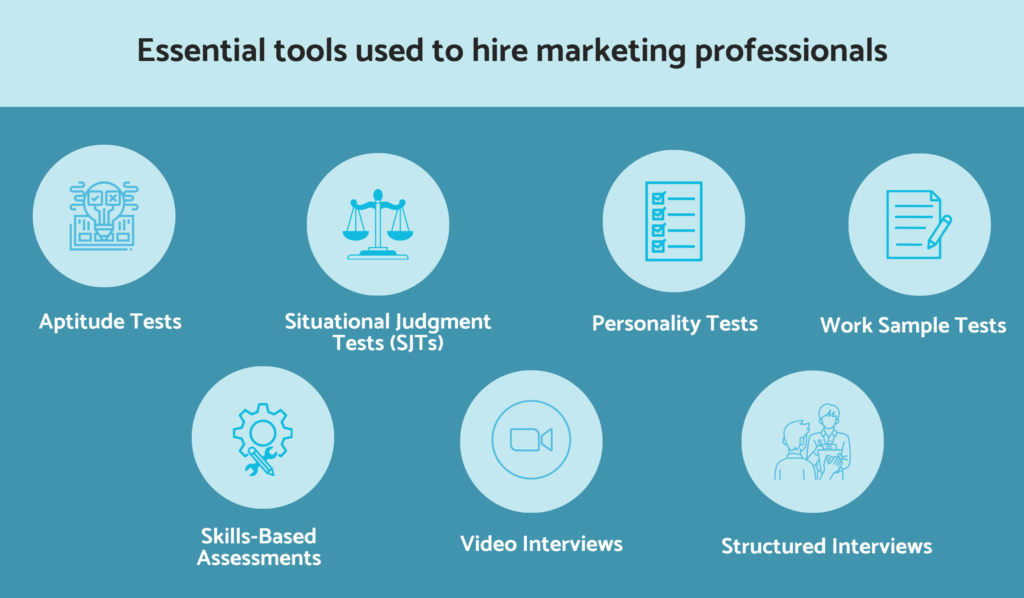
Employers use a wide range of tools to hire marketing professionals effectively. From psychometric and skills-based assessments to structured interviews and video evaluations, these tools help measure creativity, strategic thinking, and adaptability.
PSYCHOMETRIC ASSESSMENTS
Employers rely on psychometric assessments to evaluate candidates’ analytical thinking, creativity, and problem–solving ability. These tests identify marketing professionals who design effective strategies, interpret market data, and adapt to fast-changing consumer behavior.
- Aptitude Tests
Aptitude tests measure numerical, verbal, and logical reasoning skills that drive data-based marketing decisions. Employers use them to determine how effectively candidates analyze campaign metrics, optimize budgets, and interpret customer insights.
Major platforms offering aptitude tests include Assess Candidates, TestGorilla, and Vervoe.
- Situational Judgment Tests (SJTs)
Employers administer situational judgment tests (SJTs) to assess how candidates respond to real-world workplace scenarios. These tests present challenges such as handling negative customer feedback, managing client expectations, or prioritizing campaign deliverables under pressure. Candidates’ choices demonstrate their problem-solving ability, decision-making style, and cultural alignment.
Leading platforms offering SJTs include Assess Candidates, SHL, and Aon Assessment.
- Personality Tests
Organizations use personality tests to uncover candidates’ behavioral tendencies, motivations, and cultural fit. In marketing roles, these assessments highlight qualities such as creativity, openness to feedback, teamwork, and resilience under deadlines. Personality tests reveal how candidates collaborate with teams and adapt to evolving brand needs.
Top platforms offering personality assessments include Assess Candidates, Hogan Assessments, and Thomas International.
- Work Sample Tests
Hiring teams implement work sample tests to measure candidates’ ability to perform role–specific tasks. For marketing professionals, these tasks may include designing a social media strategy, optimizing a PPC campaign, creating an ad mockup, or writing a product launch press release.
Top platforms that offer work sample tests or job simulations include Assess Candidates, TestGorilla, and Vervoe.
SKILLS-BASED ASSESSMENTS
Hiring teams conduct skills-based assessments to measure candidates’ job-relevant abilities. Marketing professionals complete case studies, campaign design tasks, or content creation exercises that reflect real workplace demands. These simulations showcase practical expertise in areas such as SEO optimization, social media strategy, and brand positioning.
Leading platforms providing skills-based assessments include Assess Candidates, HireVue, and Cangrade.
VIDEO INTERVIEWS
Hiring teams use video interviews to evaluate communication skills, creativity, and cultural fit in real time. These interviews allow candidates to present campaign ideas, respond to brand-related scenarios, and demonstrate strategic thinking under pressure. Video interviews also give employers flexibility in screening large applicant pools while ensuring consistency and fairness.
Some significant platforms for video interviews include Assess Candidates, HireVue, and Spark Hire.
STRUCTURED INTERVIEWS
Hiring managers conduct structured interviews to assess cultural fit, creativity, and the application of marketing knowledge in real–world contexts. They ask standardized questions to ensure fairness and maintain consistency across all candidates.
Expect the following example questions in an interview for recruiting marketing professionals:
- Describe a campaign you led that exceeded expectations. What made it successful?
- Tell me about a time you handled negative feedback on a campaign. How did you resolve it?
- If a product launch underperforms, what immediate steps would you take to improve results?
- How would you reallocate the budget if analytics showed one channel was underperforming?
- What strategies do you use to improve SEO rankings?
Discover how our expert-backed psychometric tests can support your marketing-driven hiring strategy. LEARN MORE
In the next section, we will delve into the best practices for hiring the right marketing talent.
5. WHAT ARE THE STRATEGIES OR BEST PRACTICES TO HIRE THE RIGHT MARKETING TALENT?
Hiring the right marketing talent goes beyond filling a position. It requires a strategic approach that blends creativity, technical expertise, and cultural alignment. As marketing rapidly evolves with data, technology, and shifting consumer trends, recruiters must apply structured strategies that identify skilled professionals and secure long-term success for the organization.
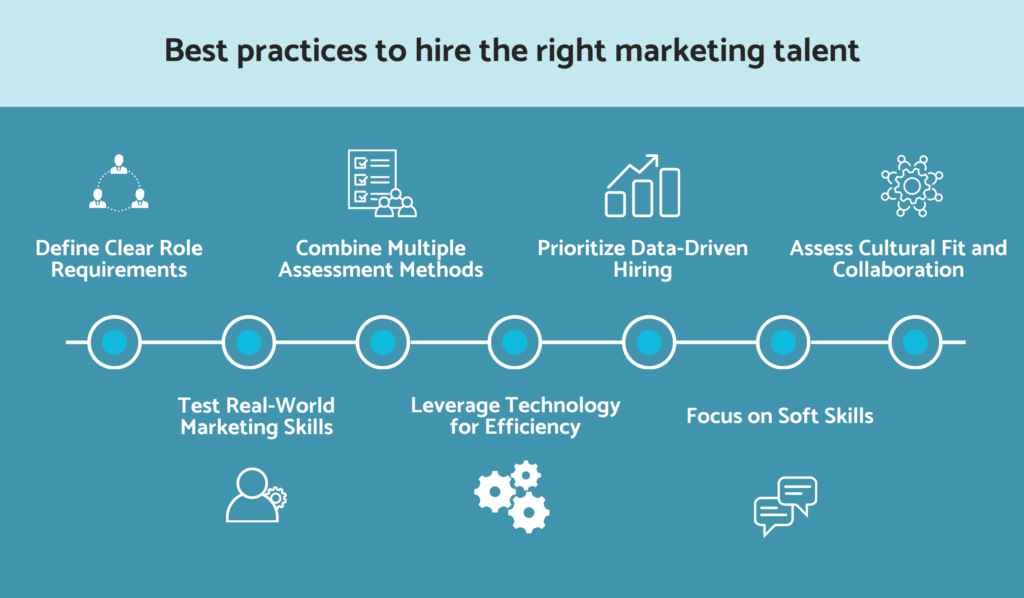
The following are the key 7 strategies that must be used to hire the right marketing talent:
- Define Clear Role Requirements
Recruiters create accurate job descriptions that outline technical skills, creative responsibilities, and performance expectations. A digital marketing role emphasizes SEO, analytics, and paid ads, while a brand strategist role highlights storytelling and positioning. Clear descriptions attract the right talent and set measurable benchmarks for evaluation.
- Combine Multiple Assessment Methods
Recruiters strengthen hiring accuracy by combining multiple assessments, including psychometric tests, skills–based tasks, structured interviews, and work samples. This layered approach evaluates technical marketing skills, strategic thinking, problem–solving ability, and personality traits such as adaptability and creativity.
- Prioritize Data-Driven Hiring
Recruiters eliminate bias by relying on data-driven insights from assessments, ATS dashboards, and candidate analytics. Campaign simulations, numerical reasoning scores, and portfolio metrics provide objective evidence that supports fair and consistent hiring decisions.
- Assess Cultural Fit and Collaboration
Hiring teams evaluate how candidates collaborate, communicate, and align with company values. By focusing on teamwork, openness to feedback, and leadership potential, recruiters ensure new hires integrate smoothly and strengthen cross-departmental relationships.
- Test Real-World Marketing Skills
Employers use work sample tests, case study presentations, and portfolio reviews to measure on-the-job performance. Candidates demonstrate campaign design, SEO strategies, or ad content creation in real-world contexts, giving recruiters a clear view of practical expertise.
- Leverage Technology for Efficiency
Recruiters streamline hiring with ATS platforms, video interview tools, and AI-powered assessments. These tools save time, improve candidate experience, and deliver deeper insights, making the recruitment process faster and more effective.
- Focus on Soft Skills
Hiring teams evaluate soft skills like creativity, adaptability, communication, and leadership potential alongside technical abilities. A content strategist who knows SEO but also demonstrates storytelling and collaboration delivers more impact than one with technical skills alone.
Optimize your marketing hiring process with our scientifically validated pre-employment assessments. LEARN MORE
6. MARKETING: A SUCCESS STORY
CLIENT PROBLEM STATEMENT:
Imagine a growing organization seeking experienced marketing professionals but struggling to attract candidates with the right mix of creativity, digital expertise, and commercial awareness. Despite receiving applications, hiring managers found it difficult to identify individuals capable of delivering measurable marketing outcomes.
ASSESS CANDIDATES’ PROPOSAL:
At Assess Candidates, we recommended adopting a marketing-driven recruitment approach that blends data with storytelling. This included showcasing the company’s values, culture, and career growth opportunities through tailored pre-employment assessments. These assessments serve as branded, interactive experiences that reflect the company’s identity.
By presenting a consistent message across job postings, candidate communications, and assessment touchpoints, the organization can market itself as a forward-thinking employer. The goal is to treat every candidate interaction as a marketing opportunity that builds trust and reinforces the employer brand.
RESULT:
By integrating marketing principles into recruitment, the company will transform hiring into a brand-building exercise. Candidates will experience a seamless, engaging, and value–driven journey that motivates them to complete the process and view the organization positively, regardless of outcome.
Leadership will see improved candidate quality, higher engagement, and reduced drop–offs. Most importantly, the firm will stand out in a competitive talent market, attracting top candidates while cultivating a strong reputation as an employer of choice.
Partner with us to advance your hiring process using our pre-employment assessments. VIEW PLANS
7. WHY HIRE MARKETING TEAMS WITH ASSESS CANDIDATES?
At Assess Candidates, we go beyond smarter hiring; we help you create a lasting, positive impression on your talent pool. Our tailored pre-employment assessment solutions align with your company’s values, business goals, and employee experience strategy. Every touchpoint strengthens your reputation as an innovative, candidate-focused employer.
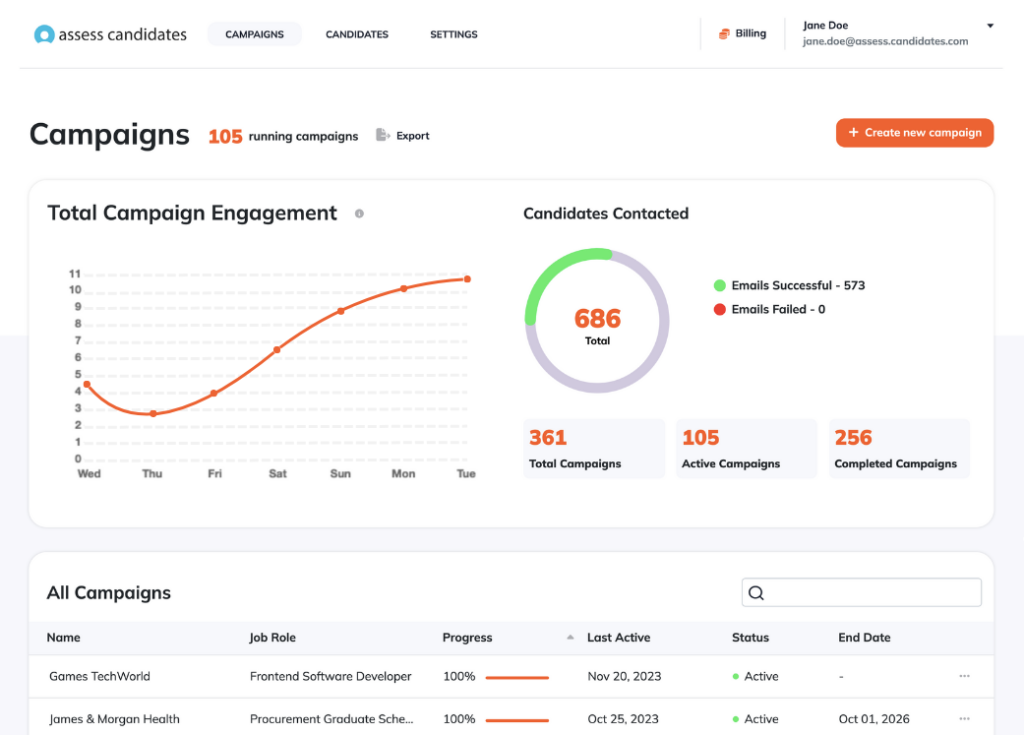
Below is a preview of the campaign reporting dashboard on the Assess Candidates Talent Assessment platform.
THE TOP 4 REASONS TO CHOOSE ASSESS CANDIDATES FOR RECRUITMENT
- Expertly Designed and Scientifically Backed: Our pre-employment tests are created by Chartered Scientists, Psychologists, and Psychometricians with backgrounds at leading firms like SHL and IBM Kenexa.
Every assessment undergoes strict validation to measure both role-specific competencies and practical skills. With this scientific foundation, your recruitment process stays data-driven, effective, and aligned with long-term talent goals.
- Actionable Insights for Smarter Hiring: Our platform generates clear, easy-to-read reports that highlight candidate strengths, gaps, and potential. Recruiters gain data to compare applicants fairly, shortlist faster, and predict future performance.
These insights enable you to match candidates not only to current roles but also to future opportunities within your organization.
- Candidate-Friendly, Engaging Experience: We design assessments to be interactive, mobile-friendly, and branded to your company’s tone. Candidates experience a seamless, positive hiring journey that reflects your employee value proposition.
By keeping assessments engaging and supportive, you improve completion rates, boost candidate motivation, and strengthen your employer brand.
- Inclusive and Accessible by Design: Our assessments support all candidates with features like extended time, zoom options, screen reader compatibility, and WCAG-compliant design. This accessibility ensures fairness, widens your talent pool, and reinforces your commitment to diversity and inclusion in hiring.
Assess Candidates is a trusted provider of pre-employment assessment solutions, delivering end-to-end tools for businesses of all sizes. Our intuitive platform empowers you to identify and hire top talent with confidence, using data-driven decisions that reduce bias and improve hiring outcomes.
Unsure if pre-employment assessments are right for your recruitment process? Get in touch with us for a free-of-charge analysis of your hiring needs.
Conclusion: Key Takeaway
Hiring high-performing marketing professionals requires a structured process that evaluates creativity, communication, analytical thinking, and digital expertise. Combining skills assessments, structured interviews, and data-driven hiring methods enables employers to identify marketing talent capable of delivering long-term business growth.
Interested in learning more about effective candidate assessment? Continue reading for frequently asked questions, and sign up with your email to get started.
Frequently Asked Questions
How does marketing contribute to business growth?
Marketing builds brand awareness, generates leads, and fosters customer loyalty to drive business growth. It applies data-driven strategies and creative campaigns to keep businesses visible and relevant, ultimately increasing revenue and strengthening long-term market positioning.
Why is cultural alignment important in marketing hires?
Cultural alignment ensures new hires share company values and communication styles. In marketing, it drives collaboration, maintains brand consistency, and supports retention. Without it, even skilled professionals struggle to contribute effectively to team goals.
How do assessments improve marketing recruitment?
Assessments measure candidates’ digital marketing, analytics, and creative skills objectively. They remove bias, highlight practical strengths, and provide data-driven insights, enabling recruiters to make fair, informed hiring decisions aligned with organizational needs.
What role does employer branding play in attracting marketers?
Employer branding shapes how candidates perceive a company. By showcasing culture, growth opportunities, and innovation, organizations attract top talent aligned with their values. Strong branding also builds trust, lowers hiring costs, and boosts engagement.
How do structured interviews benefit marketing recruitment?
Structured interviews apply standardized questions to evaluate cultural fit, creativity, and marketing knowledge. This process ensures fairness and consistency while helping recruiters identify professionals who can contribute strategically and thrive.


 English
  Arabic