
AI Skills To Look For In Candidates In 2026



Artificial intelligence is now embedded across business operations, from automation and analytics to decision-making and customer experience. As adoption accelerates, organizations are now hiring for AI capability, not as a niche skill, but as a core requirement across roles.
Did you know? Job postings requiring AI skills are growing 3.5× faster than all jobs, and for every AI-specialist job posting in 2012, there are now 7 today.
For recruiters, the challenge is not just finding talent who are skilled in AI but identifying which skills actually drive value in both technical and non-technical roles.
In this guide, we break down the most important AI skills to look for in candidates, how to assess them, and how to build a future-ready workforce that can work effectively alongside AI.
Contents
- What are AI skills?
- Top AI skills to look for in candidates in 2026
- What are the benefits of hiring candidates skilled in AI?
- How to assess AI skills in recruitment?
- How do organizations train their workforce in AI skills?
- Which roles and industries benefit from an AI-skilled workforce?
- What is the importance of AI skills for the future workforce?
- AI Skills: A success story
1. What are AI skills?
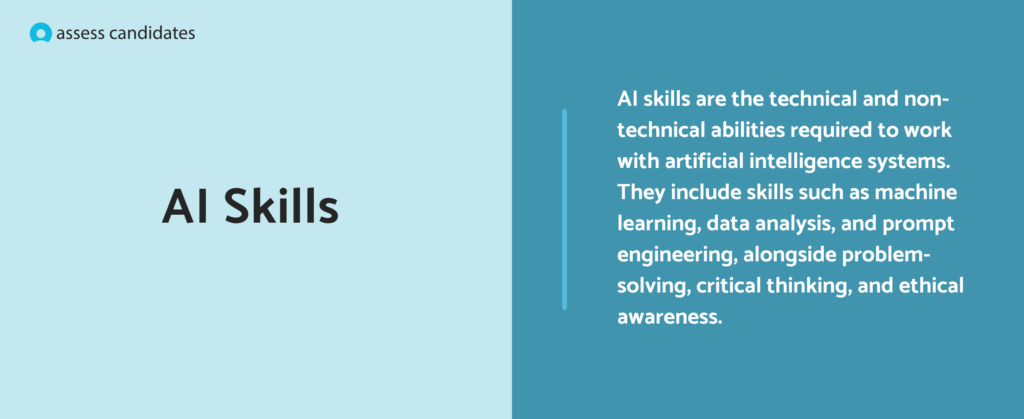
AI skills are the technical and non-technical abilities required to work with artificial intelligence systems. They include skills such as machine learning, data analysis, and prompt engineering, alongside problem-solving, critical thinking, and ethical awareness.
Assess AI skills in your candidates using a structured, reliable hiring strategy. HIRE FOR FREE
Next, we look at the most important AI skills in 2026.

2. Top AI Skills to Look for in Candidates in 2026
The most valuable AI skills combine technical expertise with the ability to apply AI in real business contexts. Recruiters should focus on capabilities that translate into measurable outcomes, not just theoretical knowledge.
The following are the best AI-related skills to learn in 2026 to acquire a job working with AI:
Core Technical AI Skills
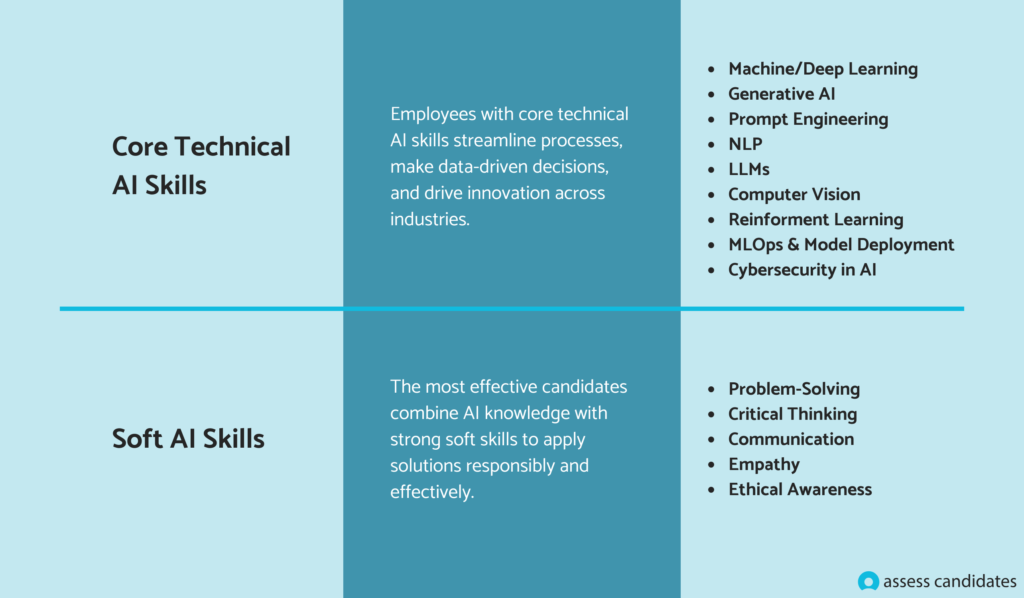
Employees with technical AI skills streamline processes, make data-driven decisions, and drive innovation across industries. Organizations that leverage these capabilities enhance efficiency, strengthen competitiveness, and achieve sustainable growth.
Here are the top 9 core technical AI skills:
1. Machine Learning and Deep Learning
Machine learning and deep learning form the foundation of AI. Candidates should understand core learning methods and be able to build, train, and optimize models using tools like Python, PyTorch, or TensorFlow.
Strong candidates go beyond using pre-trained models. They apply AI to real business problems such as forecasting, fraud detection, and automation.
2. Generative AI
Generative AI enables the creation of content such as text, images, code, and video. Organizations use it to improve productivity, automate workflows, and drive innovation. Candidates who can apply Gen AI effectively deliver faster outputs and unlock new business opportunities.
More than 80% of organizations are expected to use generative AI by 2026.
3. Prompt Engineering
Prompt engineering focuses on designing effective inputs for AI tools, such as ChatGPT, to produce accurate and relevant outputs aligned with business goals.
As businesses adopt Large Language Models (LLMs), this skill is critical for improving consistency, reducing errors, and maximizing AI performance in tasks like writing, coding, data analysis, customer service, and creative work.
4. Natural Language Processing (NLP)
NLP enables AI to understand and generate human language.
It is used in chatbots, document automation, and data analysis. Candidates with NLP skills improve communication, efficiency, and insight generation across teams.
5. Large Language Models (LLMs)
LLMs, such as GPT and LLaMA, power tasks such as summarization, translation, and conversational AI.
Candidates who can fine-tune and apply LLMs to business needs improve knowledge management, content workflows, and user experience.
6. Computer Vision
Computer vision enables AI to process and analyze visual data, performing tasks such as object detection, facial recognition, and video analytics.
It is used in areas such as quality control, security, and healthcare. Strong candidates apply it to automate processes and improve accuracy.
7. Reinforcement Learning (RL)
Reinforcement learning trains AI systems to make decisions through trial and error, and rewards and penalities.
It is commonly used in robotics, logistics, and autonomous systems. Candidates in this area build adaptive solutions that improve autonomously over time.
8. MLOps and Model Deployment
MLOps combines machine learning and DevOps practices to ensure AI models are scalable, reliable, and maintained in production.
Candidates with this skill manage deployment, monitoring, and continuous improvement of AI systems.
9. Cybersecurity in AI
AI cybersecurity protects models and data from threats such as data poisoning, model theft, or adversarial attacks.
Organizations value candidates who can secure AI systems, safeguard systems, and prevent costly disruptions.
Soft AI Skills
Technical expertise alone is not enough. The most effective candidates combine AI knowledge with strong soft skills to apply solutions responsibly and effectively.
Below are the top 5 soft AI skills:
1. Problem-Solving
Problem-solving and analytical thinking allow candidates to identify challenges, analyze data, and develop practical AI-driven solutions.
Strong candidates translate complex business challenges into practical AI solutions that improve outcomes and efficiency.
2. Critical Thinking
Critical thinking helps candidates evaluate AI outputs, identify bias, and decide when human judgment or oversight is needed.
3. Communication
Clear communication ensures AI insights are understood and broken down into simple, actionable terms across both technical and non-technical teams, driving alignment and facilitating informed decision-making.
4. Empathy
Empathy and emotional intelligence help candidates design AI solutions that are user-focused, inclusive, accessible, and aligned with real-world needs.
5. Ethical Awareness
Ethically minded candidates ensure AI is used responsibly, addressing risks such as bias, privacy, and compliance. Otherwise ethical gaps can trigger legal issues, reputational harm, and public backlash
Improve how you assess AI skills with structured, science-backed pre-employment assessments. LEARN MORE
Read on as we explore the key benefits of hiring AI-skilled employees.
3. What are the benefits of hiring candidates skilled in AI?
Hiring candidates with strong AI skills improves efficiency, strengthens decision-making, and supports innovation across the organization.
Top benefits of an AI-skilled workforce
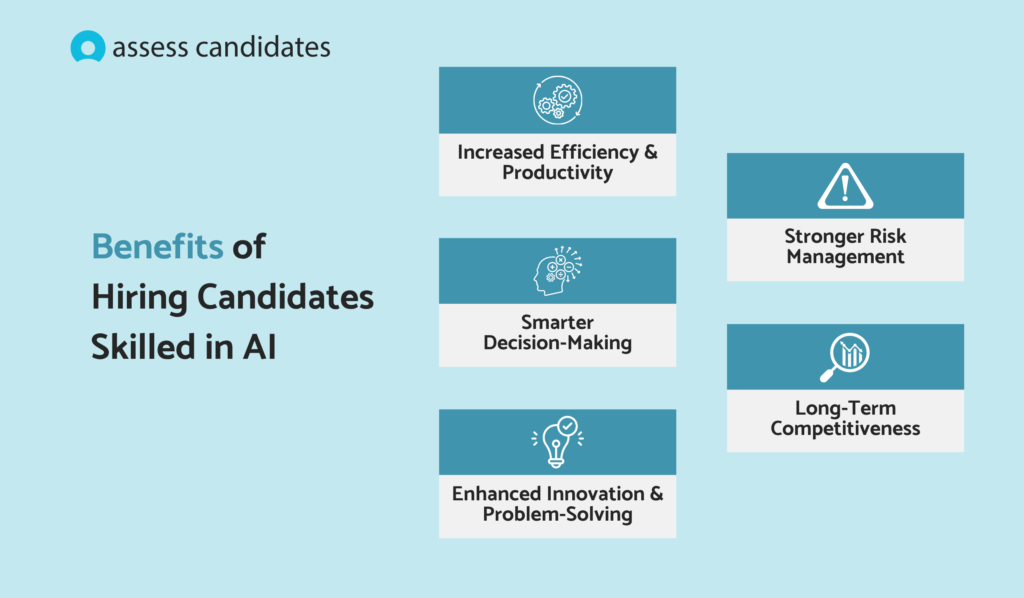
Increased Efficiency and Productivity
AI-skilled employees automate repetitive tasks, streamline workflows, and minimize errors. They enable organizations to scale processes effectively while freeing teams to focus on strategy, creativity, and customer engagement. As a result, businesses deliver faster turnaround, cut operational costs, and strengthen overall performance.
Smarter Decision-Making
Employees skilled in AI analyze massive, complex datasets and uncover trends that traditional methods overlook. They generate real-time, data-driven insights that empower leaders to make faster, evidence–based decisions. Their expertise directly improves profitability, customer satisfaction, and competitive positioning.
Enhanced Innovation and Problem-Solving
Employees with AI expertise design new products, services, and business models. They apply machine learning, natural language processing, and predictive analytics to tackle challenges in ways traditional methods cannot. Their skills fuel innovation and establish the organization as a forward-thinking industry leader.
Stronger Risk Management and Compliance
AI experts safeguard organizations by detecting fraud, monitoring compliance, and predicting potential risks. They implement AI responsibly, reducing algorithmic bias and protecting data privacy. Their work builds trust with customers, regulators, and stakeholders.
Long-Term Competitiveness
AI-skilled employees keep organizations adaptive and future-ready. They stay ahead of rapid technological change, integrate emerging tools, and help businesses remain resilient against market disruptions. Their expertise ensures the workforce continues to evolve with AI advancements.
What challenges do organizations face when building a AI-ready workforce?
Building an AI-skilled workforce is not straightforward. Organizations face several challenges when developing and maintaining AI capabilities.
The key challenges and considerations for developing an AI-skilled workforce are:
- Rapid Technological Obsolescence
AI technologies advance at an unprecedented pace, causing skills to become outdated quickly. Organizations must continuously refresh training programs to incorporate innovations such as new large language models (LLMs), emerging AI frameworks, and updated regulations. Without regular updates, employees risk mastering techniques that are no longer relevant.
Adopt agile learning frameworks with quarterly curriculum updates and collaborate with AI research groups to ensure training remains current and forward-looking.
- Shortage of Qualified Instructors
Many organizations struggle to find trainers who combine deep AI expertise with strong teaching skills. This shortage can result in training that is superficial or difficult to apply in real scenarios.
Develop internal AI champions through train-the-trainer programs and supplement with vendor-led training from cloud platforms like AWS or Microsoft.
- Employee Resistance and Fear
Workers often fear that AI will replace their jobs, creating resistance to learning. Some see AI skills as irrelevant to their roles, while others feel overwhelmed by technical complexity.
Present AI as a collaborative tool that enhances, rather than replaces, existing roles. Introduce low-code AI solutions for non-technical staff to build confidence and engagement.
- High Training Costs and Resource Demands
Quality AI training requires investment in platforms, tools, and time away from work. For small and medium enterprises (SMEs), these costs can be prohibitive.
Leverage scalable, cost–effective solutions such as microlearning modules, open-source resources, and government or industry-sponsored upskilling grants.
- Measuring ROI and Effectiveness
Quantifying the impact of AI training on business outcomes is challenging. Traditional metrics like course completion rates often fail to capture actual skill application.
Track both qualitative and quantitative indicators, such as productivity gains, innovation outputs, and employee retention rates among upskilled staff. This not only shows how training improves efficiency and innovation but also proves its role in strengthening loyalty and reducing hiring costs, giving leaders a clear view of ROI and long-term business value.
Let’s look into the ways organizations are assessing AI skills in recruitment.
4. How to assess AI skills in recruitment?
The biggest hiring risk is overestimating AI capability based on resumes alone. Without structured assessment, it is difficult to distinguish between theoretical knowledge and practical skill.
Top 5 strategies for assessing AI skills in recruitment
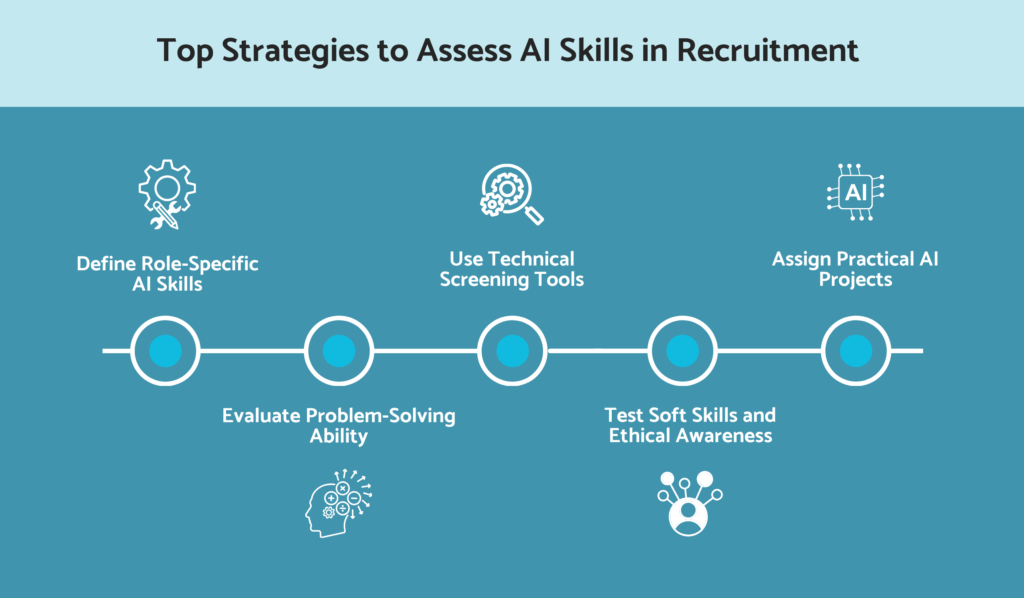
1. Define Role-Specific AI Skills
Start by mapping the key AI skills the position requires. For instance, a data scientist role may demand strong knowledge of supervised and unsupervised learning, while an NLP engineer might need experience with transformer-based models and text preprocessing techniques.
The clearer you define the technical and soft skills needed, the easier it becomes to design relevant assessments that filter for the right talent.
2. Use Technical Screening Tools
Incorporate pre-hire assessment platforms like Assess Candidates, HackerRank, Codility, or CodeSignal to evaluate candidates’ programming proficiency in AI-relevant languages like Python, R, or Java. Go beyond generic coding challenges, include AI-specific tasks such as implementing regression models, tuning hyperparameters, or working with PyTorch and TensorFlow. This ensures you measure skills that directly match real-world project demands.
3. Assign Practical AI Projects
Practical assignments are one of the most reliable ways to see how candidates operate in a near-real setting. Provide them with a dataset and ask them to complete the full workflow, data cleaning, feature engineering, model training, evaluation, and deployment.
Look for accuracy, efficiency, explainability, and their ability to document work so others can understand and build upon it.
4. Evaluate Problem-Solving Ability
AI professionals often face ambiguous challenges with no clear-cut solutions. Present candidates with business scenarios, like reducing customer churn, optimizing supply chains, or detecting fraud, and ask them to outline an AI-powered solution.
Use whiteboard or live problem-solving sessions to observe how they break problems into steps, justify their choices, and handle constraints such as limited data or strict compliance rules.
5. Test Soft Skills and Ethical Awareness
AI projects succeed when technical expertise is balanced with strong communication and ethical judgment. In interviews, ask candidates to explain complex AI concepts in simple language for non–technical stakeholders.
Pose ethical dilemmas, such as dealing with bias in predictive models or ensuring GDPR compliance, and evaluate how they balance innovation with fairness, privacy, and transparency.
Now, let’s dive into the role of organizations in AI skill development.
5. How do organizations train their workforce in AI skills?
Organizations play a key role in building an AI-skilled workforce by creating structured learning environments and aligning training with business needs.
Some ways in which employers push for an AI-skilled workforce include:
Upskilling and Reskilling the Workforce
Organizations develop AI capability through targeted upskilling and reskilling training programs.
This includes internal workshops for foundational skills like Python and machine learning, alongside advanced certifications in areas such as deep learning and NLP.
Access to AI tools, sandbox environments, and real-world projects helps employees apply knowledge in practice.
Creating a Culture of Continuous Learning
AI skill development requires ongoing learning.
Organizations support this through onboarding, mentorship, and knowledge-sharing initiatives, while incentivizing skill development through career progression and recognition.
Collaborating with External Ecosystems
Partnerships with universities, training providers, and technology platforms help organizations stay current.
Internships, vendor collaborations, and open-source contributions strengthen both talent pipelines and internal expertise.
Aligning AI Skills with Business Goals
AI training is most effective when closely tied to business needs and organizational strategy.
Organizations tailor learning by role and use workforce planning to anticipate future skill requirements, ensuring AI capabilities deliver practical value.
Measuring Impact and Refining the Tools
Organizations track and measure both skill development and business outcomes, such as improved productivity or innovation gains.
Regular feedback and curriculum updates ensure training stays relevant as AI technologies and methodologies evolve.
Improve your AI talent hiring with a carefully crafted assessment platform. HIRE FOR FREE
Let’s now take a look at the roles and industries that benefit immensely from an AI-skilled workforce.
6. Which roles and industries benefit from an AI-skilled workforce?
AI skills create value across industries by improving efficiency, decision-making, and innovation. Organizations that apply AI effectively gain measurable operational and competitive advantages.
Top 5 industries that benefit from AI-skilled workforce
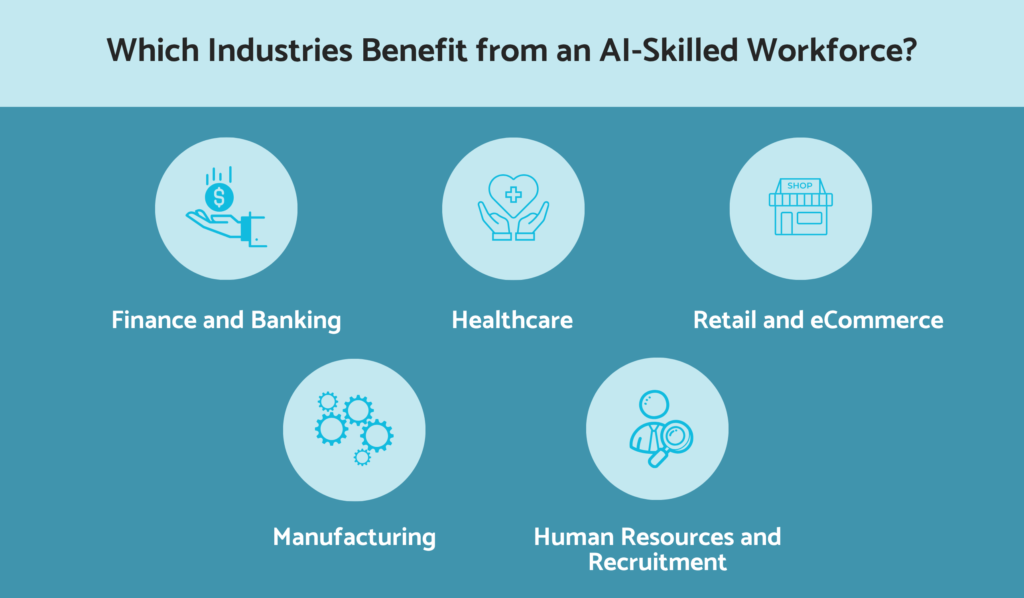
- Finance and Banking
AI-skilled employees strengthen fraud detection, ensure compliance, and improve credit risk analysis, enabling faster, more accurate decision-making. They also create personalized financial services, such as robo-advisors and intelligent customer support.
Without AI skills: Fraud teams manually check suspicious transactions, spending hours and flagging many false positives.
With AI skills: Analysts deploy anomaly detection algorithms to flag fraud instantly, saving millions in losses while ensuring legitimate transactions pass smoothly.
- Healthcare
AI supports faster medical diagnoses, workflow automation, and predictive care, improving both efficiency and patient outcomes.
Without AI skills: Radiologists manually review hundreds of scans daily, risking fatigue and delayed diagnoses.
With AI skills: Teams use AI-driven image recognition to highlight anomalies instantly, reducing errors and enabling faster treatment.
- Retail and eCommerce
Employees with AI expertise deliver hyper-personalized shopping experiences, streamline supply chain management, and forecast consumer demand accurately, improving customer experience and reducing waste.
Without AI skills: Retailers rely on historical sales reports, frequently overstocking slow-moving products.
With AI skills: Analysts apply machine learning models to predict demand, ensuring balanced inventory levels and higher satisfaction.
- Manufacturing
AI enhances production through predictive maintenance and automated quality control, reducing downtime and costs.
Without AI skills: Factories face unexpected machine breakdowns that halt production and inflate maintenance costs.
With AI skills: Engineers use AI-powered monitoring to predict failures in advance, preventing downtime and saving costs.
- Human Resources and Recruitment
AI-trained HR teams streamline recruitment, improve candidate matching, and support workforce planning and retention.
Without AI skills: Recruiters manually sift through thousands of resumes, often overlooking strong candidates.
With AI skills: AI-powered screening tools quickly identify top matches, allowing recruiters to focus on interviews and candidate experience.
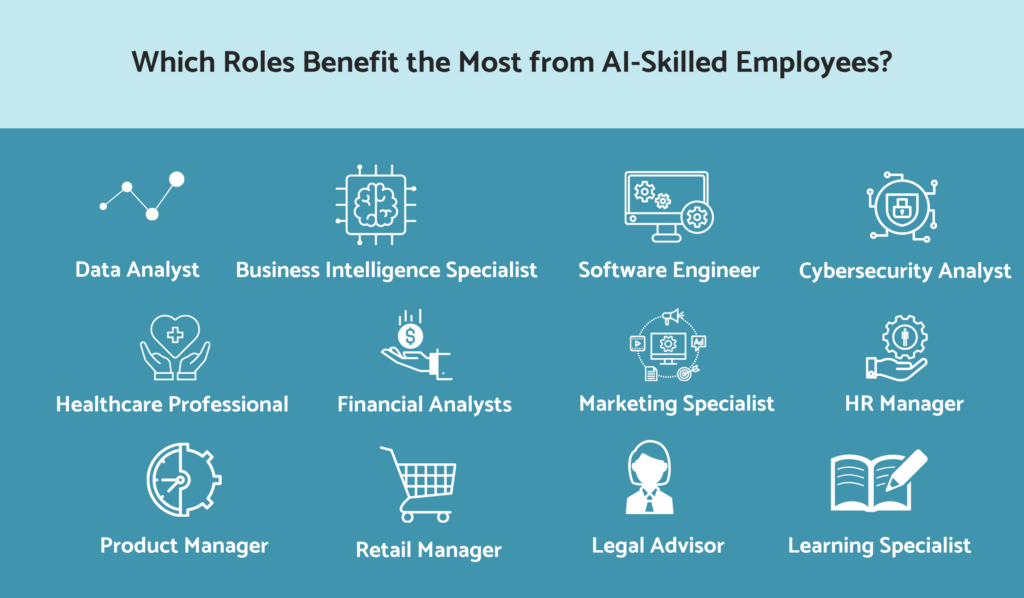
Key roles that benefit from AI-skilled employees
AI skills are increasingly valuable across both technical and non-technical roles, including:
- Data Analyst
- Business Intelligence Specialist
- Software Engineer
- Cybersecurity Analyst
- Healthcare Professional
- Financial Analyst
- Marketing Specialist
- Human Resources Manager
- Customer Service Manager
- Product Manager
- Operations Manager
- Manufacturing Engineer
- Retail Manager
- Legal Advisor or Compliance Officer
- Learning Specialist
Let’s dive into the importance of AI skills for the future workforce.
7. What is the importance of AI skills for the future workforce?
The value of AI skills for the future workforce stems from the fact that AI is no longer a niche technology; it has become a core driver of productivity, competitiveness, and innovation across nearly every industry.
5 key reasons why AI skills are essential for the future workforce
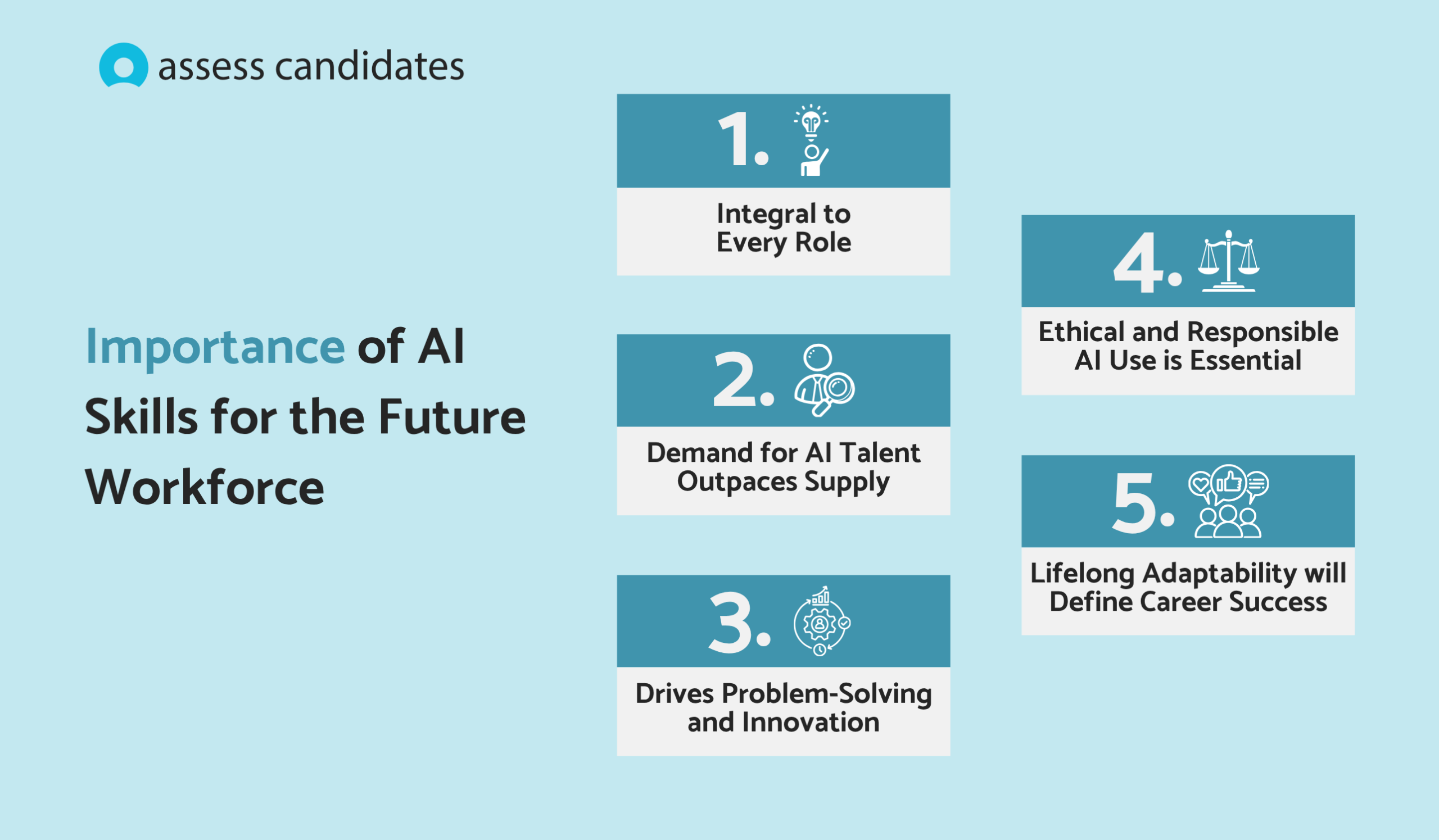
- AI is Integral to Every Role
From marketing and finance to healthcare and manufacturing, AI-powered tools streamline tasks, uncover insights, and enable faster decision–making. Even non-technical roles now require a basic understanding of AI to collaborate effectively with these systems.
- Demand for AI-Skilled Talent Outpaces Supply
Organizations struggle to find candidates who can build, manage, and optimize AI solutions. Professionals with expertise in machine learning, natural language processing, prompt engineering, and AI ethics gain a significant advantage in today’s job market.
- AI Fluency Drives Problem-Solving and Innovation
AI skills empower professionals to automate repetitive work, analyze complex datasets, and create innovative solutions. This boosts efficiency and frees time for strategic, creative thinking.
- Ethical and Responsible AI Use is Essential
As AI adoption grows, risks of bias, misinformation, and privacy breaches also rise. Professionals with strong ethical awareness and critical thinking ensure AI is applied responsibly and complies with regulations.
- Lifelong Adaptability Will Define Career Success
AI evolves rapidly, and tools that are cutting-edge today can become outdated in months. Workers who continuously learn and adapt to new AI capabilities stay relevant, while those who resist change risk falling behind.
Optimize assessing AI skills with our scientifically validated pre-employment assessments. LEARN MORE.
8. AI Skills: A Success Story
Client Problem Statement:
Imagine a mid-sized enterprise aiming to adopt AI solutions across its operations but struggling to develop the necessary in-house skills. While the company hired technically competent staff, managers noticed gaps in AI knowledge, limited ability to apply AI tools effectively, and inconsistencies in project implementation. Without a clear understanding of employees’ AI capabilities and learning needs, leadership found it difficult to assign AI-related projects or scale initiatives efficiently.
To address these challenges, the firm sought a solution to assess candidates for AI skills in recruitment, identify gaps, and upskill employees strategically, aiming to improve productivity, innovation, and overall AI adoption.
Assess Candidates’ Proposal:
At Assess Candidates, we recommended implementing a comprehensive assessment of AI skills using a framework that evaluates both technical proficiency and practical application. This approach allows the organization to gauge employees’ knowledge of machine learning, natural language processing, and AI tools, while also assessing their ability to apply these skills to real business challenges.
By integrating assessments of learning agility and problem–solving capabilities, the company will gain insights into which employees could quickly adapt to emerging AI technologies. This holistic understanding enables leadership to assign projects strategically, design personalized training programs, and build teams capable of leveraging AI effectively.
Result:
By adopting a structured AI skills assessment approach, the company will develop a workforce equipped to implement AI solutions efficiently and innovatively. Moreover, employees will receive clear guidance on skill development, boosting confidence and technical competence.
Organizations will be able to allocate resources more effectively, reduce project bottlenecks, and enhance AI-driven outcomes. Overall, the strategy will strengthen talent management, accelerate AI adoption, and foster a culture of continuous learning, positioning the organization to achieve measurable business impact.
Partner with us to advance your AI talent hiring using structured psychometric tests. VIEW PLANS
Not sure if pre-employment assessments are right for your recruitment process? Get in touch with us for a free-of-charge analysis of your hiring needs.
Key Takeaway
AI skills are becoming essential across both technical and non-technical roles. Organizations that hire and develop these capabilities gain a clear advantage in efficiency, innovation, and long-term growth.
The most effective approach is combining clear skill definitions with structured assessment methods to ensure hiring decisions are consistent, objective, and aligned with business needs.
Interested in learning more about effective candidate assessment? Continue reading for frequently asked questions, and sign up with your email to get started.
Frequently Asked Questions
Why should organizations prioritize hiring for AI skills?
Recruiting candidates with AI expertise enables organizations to harness emerging technologies, streamline operations, and drive smarter, data-backed decisions. As AI adoption accelerates, securing AI-capable talent safeguards long-term competitiveness and fuels digital transformation, ensuring your workforce stays ahead of evolving industry demands.
Which roles require AI skills?
AI skills are vital for positions like data scientists, AI engineers, business analysts, and product managers. Even non-technical roles benefit from AI literacy, enabling employees to work effectively with AI tools, interpret analytics, and contribute to data-informed strategies.
How can recruiters address the AI skills gap?
Recruiters can close the AI skills gap by targeting candidates with high learning agility and curiosity, even if they lack direct AI experience. Collaborating with L&D teams to deliver targeted AI training ensures new hires quickly adapt to technological advancements and meet evolving business needs.
Are AI skills only for technical roles?
No, while developers and data scientists need deep technical expertise, roles in marketing, HR, finance, and operations also benefit from AI literacy. Professionals who understand AI’s capabilities can collaborate seamlessly with technical teams and use AI tools to improve workflows, decision-making, and overall efficiency.
How can psychometric assessments support hiring for AI skills?
Psychometric assessments evaluate cognitive abilities, problem-solving styles, and adaptability, which are key traits for thriving in AI-driven environments. By offering objective, data-backed insights, these tests help recruiters identify candidates with strong learning potential and readiness to work with AI, reducing hiring risks and boosting long-term talent fit.


 English
  Arabic