
Top Graduate Recruitment Trends For 2026



Graduate recruitment is changing as employers respond to shifting candidate expectations, skills gaps, and rapid advances in hiring technology. The clearest shift is away from degree-led selection and toward skills, potential, fairness, and candidate experience.
For employers, graduate recruitment is not just about filling entry-level roles. It is a way to build future capability, shape professional standards early, and strengthen long-term workforce planning.
Did you know? According to LinkedIn’s Global Talent Trends Report 2024, skills-based hiring is becoming more common in early-career recruitment, with close to two-thirds of employers using it for entry-level hires.
This guide explains what graduate recruitment is, the major trends shaping it in 2026, the challenges employers face, and how to build a more effective assessment process.
Whether you are a recruiter, hiring manager, or talent acquisition expert, you may find yourself asking:
Contents
- What is graduate recruitment?
- Top 10 graduate recruitment trends of 2026
- How graduate recruitment will shape the future workforce
- What are the challenges with graduate assessments?
- Why do companies prefer Assess Candidates’ assessment tests?
Let’s start with what graduate recruitment means today.
1. What is graduate recruitment?
Graduate recruitment is the structured process employers use to attract, assess, and hire students and recent graduates into entry-level roles, graduate schemes, internships, and trainee programmes.
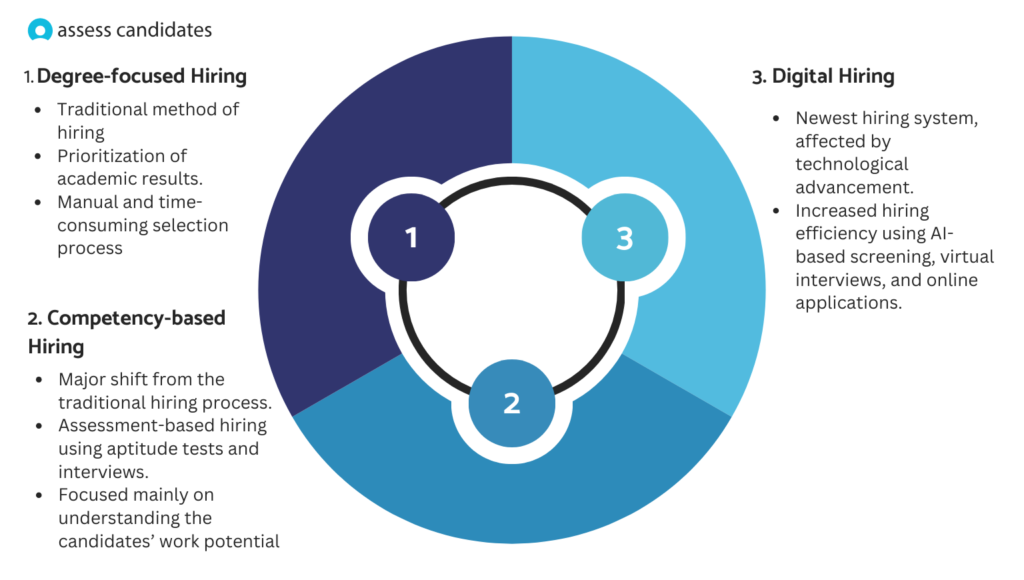
How graduate recruitment has evolved
- Degree-focused hiring: Graduate recruitment has shifted from a more degree-focused selection to broader assessment of potential, skills, and job readiness.
- Competency-based and behavioural assessment: Over-time, employers came to realize that it was difficult to ascertain work potential just using academic achievement. Hence this led to a shift to assessment based hiring using aptitude tests, assessment centers, and structured interviews.
- Digital and AI-based hiring: In recent years hiring has been largely affected by digital transformation. Online applications, virtual interviews, and AI supported screening has improved efficiency in hiring the best talent.
Without further ado, here are the trends shaping graduate hiring in 2026.

2. Top 10 Graduate Recruitment Trends of 2026
Graduate recruitment in 2026 is being shaped by skills-first hiring, AI-supported processes, virtual assessment, stronger employer branding, and greater pressure to make hiring fair, efficient, and scalable.
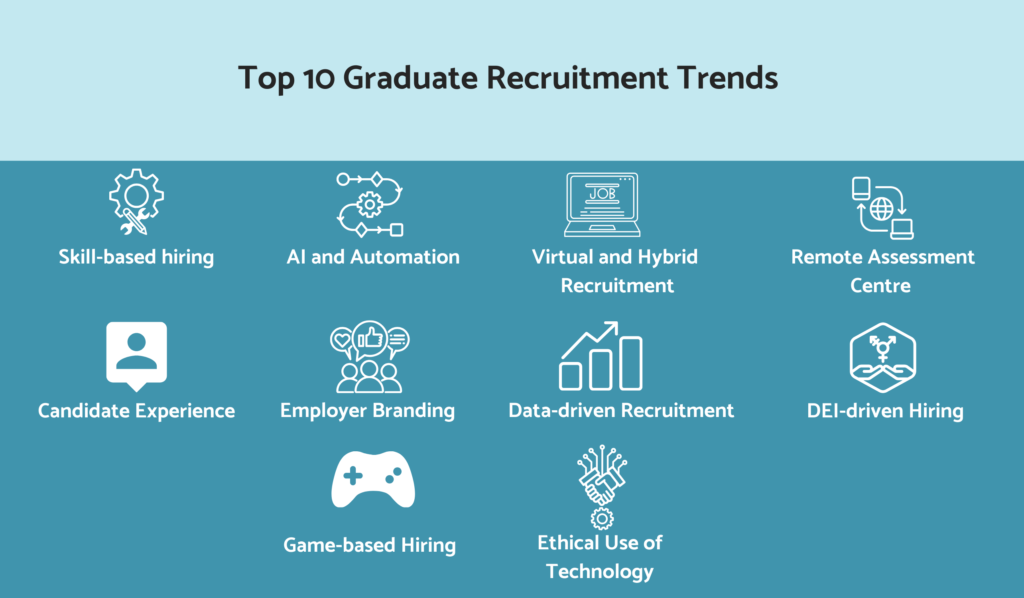
Let’s begin analyzing these upcoming graduate recruitment trends one by one.
1. Skill-based Hiring
Skill-based hiring is especially relevant in graduate recruitment because many candidates have limited work experience. Employers therefore focus more on transferable skills such as problem-solving, communication, teamwork, adaptability, digital literacy, and critical thinking.
2. Artificial Intelligence and Automation
AI and automation help graduate recruiters manage high application volumes more efficiently by supporting screening, scheduling, assessment administration, and candidate communication. However, these tools should support human judgment, not replace it.
Employers are largely shifting towards the use of artificial intelligence and automations as they help employers focus only on skills and potential instead of academics.
3. Virtual and Hybrid Recruitment
Virtual and hybrid recruitment models are the modern hiring approaches that help you hire graduates with digital technology. This online recruitment model utilizes online job applications, psychometric and aptitude tests, video interviews, situational judgement tests, and virtual assessment centers.
Hybrid graduate recruitment combines virtual and on-site recruitment activities. This means the early stages, such as job application, online assessments, and initial interviews, are typically conducted online. However, the remaining stages of assessments such as interviews, group exercise, etc., are conducted on-site.
Employers in today’s world are shifting towards this virtual-hybrid model of graduate recruitment to improve efficiency and flexibility in the graduate recruitment. Virtual recruitment helps organizations reach a larger talent pool without geographical or travel constraints.
4. Remote Assessment Centers
Remote assessment centers are digital versions of traditional assessment centres. They allow employers to evaluate candidates through structured online exercises such as group tasks, presentations, case studies, role plays, and structured interviews.
Companies are shifting towards remote assessment centers as they are a much more efficient, accessible, inclusive and scalable way to recruit graduates. Graduates globally can participate without worrying about barriers such as travel cost or personal circumstances.
5. Strong Focus on Candidate Experience
Candidate experience matters in graduate recruitment because applicants often compare several employers at once. Clear timelines, transparent communication, and user-friendly platforms can reduce withdrawal and improve offer acceptance.
6. Employer Branding and Organizational Purpose
Employer branding plays a growing role in graduate hiring because many candidates now compare employers on values, culture, development opportunities, and long-term meaning, not just salary.
7. Data-driven Recruitment and Predictive Analytics
Data-driven recruitment helps employers track what is working, identify bottlenecks, monitor fairness, and refine assessment design. In graduate hiring, this is particularly useful because high application volumes make intuition alone unreliable.
8. Diversity, Equity, and Inclusion (DEI)-driven Hiring
DEI-focused hiring aims to create a fairer and more inclusive recruitment process by widening access, reducing bias, and ensuring candidates from different backgrounds can demonstrate their potential equitably.
9. Game-based and Strength-based Hiring
Game-based and strengths-based assessments are popular in graduate recruitment because they can feel more engaging than traditional tests and may help employers assess potential beyond CVs and academic results.
10. Ethical and Transparent Use Of Technology
Ethical use of recruitment technology means being transparent about how digital tools are used, what data is collected, and how those tools influence decisions. Employers should also review systems regularly to monitor fairness and unintended bias.
When these assessment models will be put to use during graduate recruitment, the upcoming workforce will be very different from the traditional one. Let’s see the effects of graduate recruitment in the future workforce.
3. How Graduate Recruitment Will Shape the Future Workforce
Modern graduate recruitment is likely to create a workforce that is more adaptable, skills-focused, and diverse, while helping employers develop future leaders earlier.
Some other changes brought in the workforce by graduate recruitment are:
- Talent Development: Hiring graduates early on allows organizations to shape skills, behaviors, and mind sets of the candidates, in line with the goals, culture, and values of the business.
- Leadership Pipeline: Graduate programmes help organizations identify and develop future leaders from the very beginning of their careers.
- Innovation and Fresh Perspectives: Hiring graduates helps bring new perspectives, ideas, and creativity to the organization. They also bring great understanding of new technology and innovation.
- Skills over Credentials: Hiring managers today lay great focus on the skills, and strengths of the graduates to identify potential instead of just relying on academic results.
- Adaptability to Change: Graduates who are trained and developed through modern programmes have a better adaptability to the changing work environment, roles, technologies, and industries.
Find the best graduate talent fast with our aptitude tests offering fair, data-driven hiring decisions. HIRE FOR FREE
Besides the benefits graduate assessments can bring into the workforce, they also come with some challenges.
4. What are the Challenges with Graduate Assessments?
Graduate assessments can improve hiring quality, but they also create risks when employers rely on narrow, poorly matched, or inaccessible evaluation methods.
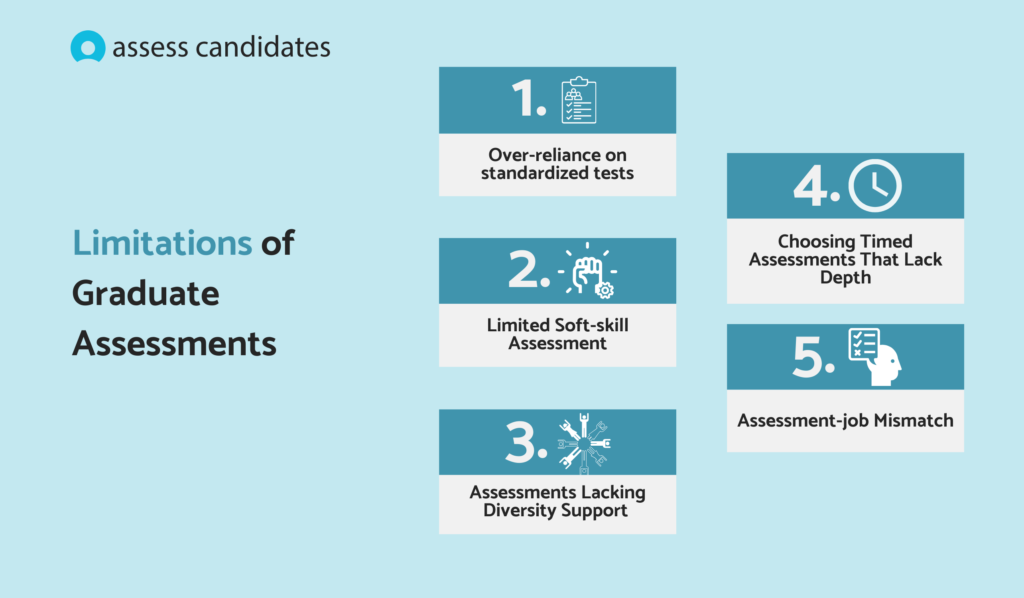
1. Using Standardized Assessments:
Over-reliance on standardized assessments that may not be accurate to reflect real workplace performance.
SOLUTION: You should aim to balance the standardized assessments with more job relevant evaluation methods for e.g., work-based tasks, realistic job simulations, structured interviews, and on the job exercises to assess better skills, behaviors, and real workplace performance.
2. Limited Soft-skill Assessment:
Choosing assessments that have limited ability to assess soft skills such as adaptability, resilience, and creativity.
SOLUTION: To ensure the assessments bring out the true personality of the candidates, you must use specific assessments specially designed to capture soft skills. Some tests that can be used are situational judgement tests, group exercises, scenario-based tasks, etc.
3. Assessments Lacking Diversity Support:
Using assessment formats that do not support diversity and inclusion.
SOLUTION: To achieve this, you must choose assessments that use culturally neutral language, are available in different languages, and offer reasonable adjustments. You must also run audits regularly to ensure that these assessments are fair, valid and inclusive. Providers like Assess Candidates may help you achieve these objectives.
4. Overly Timed Assessment:
Using timed assessments that do not allow candidates to demonstrate the depth of ability.
SOLUTION: To ensure your applicants can show their fullest of abilities, you may expand the time limits or use assessments that are partially timed and partly untimed. You can also include project-based and work-sample assessments.
5. Assessment-Job Mismatch:
Risk of selecting candidates who perform well in assessments but struggle in practical roles.
SOLUTION: To avoid selecting job-misfits, you might include work-sample tasks, realistic job previews, structured behavioural interviews. You can also include probationary or trial periods to ensure candidates can translate assessment performance into effective on-the-job capability.
Graduate hiring works best when high-volume screening is paired with fair, role-relevant assessment.
Explore our end-to-end pre-employment assessment library that supports graduate recruitment LEARN MORE
The above limitations can be reduced by using Assess Candidates assessments to hire the most suitable talent. So how does Assess Candidates offer a better approach?
5. Why Do Companies Prefer Assess Candidates’ Assessments for Graduate Hiring?
Employers use Assess Candidates to support graduate hiring because the platform combines structured assessment design, reporting, accessibility support, and a more consistent candidate experience.
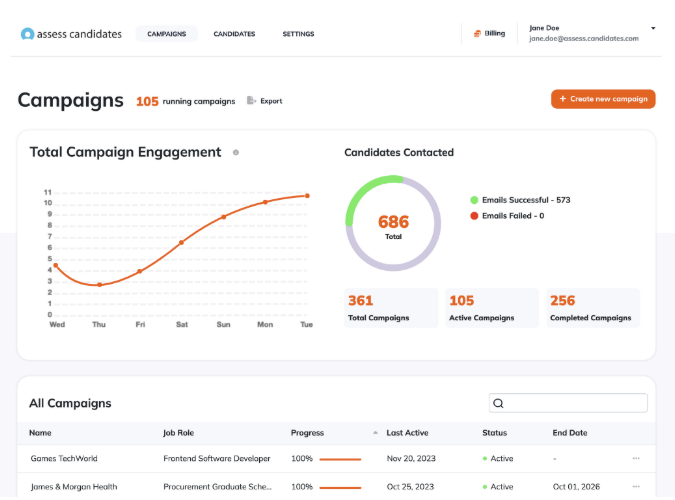
Why companies use Assess Candidates’ pre-employment tests in recruitment
- Scientifically Validated Design: Assess Candidates’ pre-employment tests are developed by Chartered Scientists, Psychologists, and Psychometricians with decades of experience designing assessment solutions for companies like SHL and IBM Kenexa. Our psychometric tests have undergone rigorous testing and validation to accurately measure candidates’ cognitive abilities and personality traits. These tests have consistently proven successful in selecting and hiring top talent across various organizations and industries.
- Expert Reporting: Assess Candidates’ user-friendly and easy-to-navigate assessment platform enables employers to analyze candidate reports in detail and make informed hiring decisions based on flexible criteria. Recruiters can easily view individual candidates’ performance on different aptitude and personality tests, and then filter, rank, and shortlist candidates. Additionally, our talent assessment platform also offers the option to integrate with your existing ATS for a seamless experience.
- Positive Candidate Experience: Assess Candidates’ assessment platform is easily accessible from any device and features an aesthetic and easy-to-use interface for candidates. The tests are designed to require minimal clicks to complete, with the assessment automatically moving to the next question once answered. This ensures a seamless and positive candidate experience, which they will associate with your brand.
- Accessibility Support: Assess Candidates offers support for individuals with disabilities and visual impairments. All our assessments have the option to add extra time, include zoom functionalities, and ensure the use of accessible color schemes and images in compliance with Web Content Accessibility Guidelines (WCAG) to ensure compatibility with screen readers.
- Maintains Quality Standards: Most organizations use Assess Candidates because we provide a platform to hire candidates who meet quality standards. Our psychometric tests ensure that all candidates meet the minimum requirement.
Use our pre-employment assessment platform to hire the right candidate for your company. LEARN MORE
Want to know more about the best graduate recruitment models? Keep scrolling to explore our frequently asked questions, and enter your email to get started today.
Frequently Asked Questions
What are the key graduate recruitment trends today?
Employers today are going with graduate recruitment models that are skill-based, focus on diversity and inclusion, consist of virtual assessments, and make good use of AI-driven tools to ensure the efficiency of the assessment process and fairness.
What is the importance of skill-based hiring in graduate recruitment?
Skill-based hiring is becoming more prominent in graduate recruitment as this recruitment model helps organizations assess candidates based on their capabilities instead of just relying on the academic background. This in turn leads to a better job fit and wider talent pool.
How is technology changing graduate recruitment?
Technology has allowed recruiters in a number of ways, some of which include conducting assessments online, such as numerical reasoning tests, verbal reasoning tests, situational judgement tests, etc. This helps recruiters reduce hiring time, cost of traveling, and makes the assessments more consistent and scalable.
Why is candidate experience a key focus in graduate recruitment?
Candidate experience during recruitment is important as a positive experience strengthens the employer branding and allows the employers to attract and retain high-quality graduates. When candidates feel respected and valued, they are more likely to accept offers.
How important is inclusivity in graduate recruitment?
Inclusivity in graduate recruitment has become very critical these days. To ensure there’s inclusivity and diversity, employers are redesigning their hiring processes to reduce bias, reach more diverse talent pools, and ensure assessments are accessible so that all the applicants have fair opportunity to demonstrate potential.


 English
  Arabic