
How To Assess And Hire For Apprenticeships



Hiring for apprenticeships can feel like a leap of faith. As candidates usually don’t have much experience, it can be difficult to tell who will actually succeed on the job, who has the right mindset to learn, and who will stay long enough for your investment to pay off.
Many employers struggle with the same challenges: unclear hiring criteria, selecting the right assessments that are fair and relevant for early-career candidates, and uncertainty around what “potential” really looks like. Traditional recruitment methods like CV screening and unstructured interviews often won’t provide enough insight.
If that sounds familiar, you’re not alone. Apprenticeship hiring requires a different approach. By focusing on skills, behaviors, and potential through simple, structured, and data-driven methods, you can identify the right candidates without slowing down your hiring process.
According to the U.S. Department of Labor, 93% of apprentices who complete a registered apprenticeship program stay employed afterwards, with an average annual salary of $77,000.
By the end of this guide, you’ll have a practical, streamlined roadmap for assessing and selecting apprenticeship candidates, helping you build a strong future talent pipeline.
Contents
- What are apprenticeships?
- Why is apprenticeship hiring different from graduate or experienced hiring?
- Key skills to look for in apprenticeship candidates
- What are the best assessment methods for apprenticeship recruitment?
- A step-by-step apprenticeship hiring process
- Case Study: How leading companies use structured apprenticeship hiring
- Why choose Assess Candidates for apprenticeship hiring?
Before learning how to assess and hire apprentices, let’s start with the basics: understanding what apprenticeships actually are and why they require a different hiring approach.
1. What are Apprenticeships?
Apprenticeships are work-based learning programs that combine hands-on, paid work with structured training. Rather than expecting candidates to be fully skilled from day one, you instead hire for potential and guide apprentices as they develop the necessary skills to succeed in their roles.
This approach is ideal for early-career talent or career changers, who have little or no prior work experience but are motivated to learn and grow.
Apprenticeships are widely used in industries where practical experience matters more than polished resumes, such as technical operations, customer support, engineering, creative fields, and skilled trades.
Did you know? According to the U.S. Department of Labor, over 808,000 apprentices were enrolled in Registered Apprenticeship programs in 2023, and employer participation continues to rise across sectors such as tech, healthcare, and advanced manufacturing.
Confident apprenticeship hiring starts here. Make smarter hiring decisions backed by science. HIRE FOR FREE
How Do Apprenticeships Work in Practice?
While programs can vary, most apprenticeships follow a simple, structured model:
Paid, Real Work
You hire apprentices as employees and involve them in real tasks from day one. They contribute to daily work while learning on the job, allowing you to build immediate value as you develop future-ready talent.
A Structured Learning Path
Apprentices follow a clear learning plan, instead of relying on trial and error. This typically includes defined training sessions, mentorship, coursework, or job shadowing, helping them progress steadily toward full role competency.
Continuous Skill Development
You track progress over time and give regular feedback and support. As apprentices grow, you help them build both technical skills and workplace behaviors in line with role expectations.
Why Do Apprenticeships Matter for Employers?
If you’re struggling to hire for roles that require practical skills, consistency, reliability, and long-term commitment, apprenticeships help you solve those problems directly. Rather than waiting for experienced “ready-made” candidates, you build the skills you need in-house.
Apprenticeships also attract individuals who are motivated, curious, committed, and eager to learn. While they may not have strong or long CVs, they often become some of your most loyal, high-performing employees because they grow with your organization.
A 2024 study by the National Governors Association found that 93% of employers who use apprenticeship programs report higher employee retention, stronger job readiness, and faster time-to-productivity compared to traditional hiring pathways.
Apprenticeships focus on potential, not polish, which means assessing and hiring apprentices works differently. In the next section, we’ll explore why apprenticeship recruitment needs a more tailored approach.

2. Why Is Apprenticeship Hiring Different from Graduate or Experienced
Hiring apprentices isn’t the same as hiring graduates or experienced professionals, and ignoring this often leads to poor outcomes. Apprenticeship hiring is more about future potential and less about what candidates have already done.
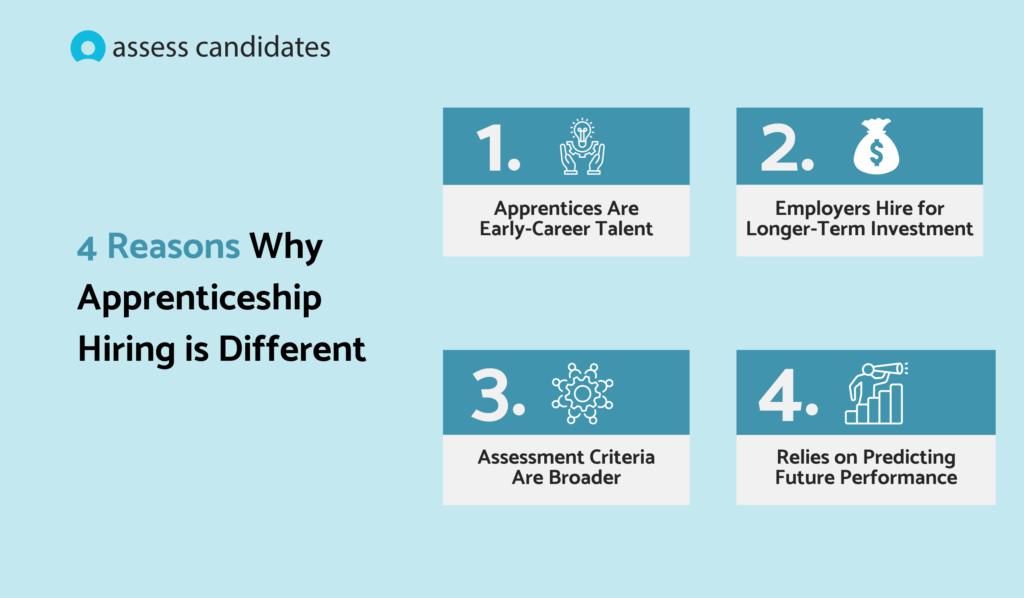
1. Apprentices Are Early-Career Talent, Not Fully Skilled Employees
Apprenticeship candidates rarely come with years of experience or developed technical skills. They’re learners first and employees second. That means your hiring process should be less about “Who has done this before?” and more about “Who can learn this quickly and commit to growing in the role?”
Effective apprenticeship hiring focuses on evaluating learning agility, coachability, motivation, and long-term interest in the field. This is very different from filling experienced roles where technical proficiency is the primary filter.
2. Employers Are Hiring for a Longer-Term Investment
When you recruit apprentices, you’re not just filling a short-term vacancy; you’re developing future talent. Apprentices require time, training, and mentorship, so a poor hiring decision has a wider impact than just short-term productivity. A mismatch can disrupt training plans, internal resources, team morale, workforce planning, and future talent pipelines.
That’s why apprenticeship hiring benefits from a more structured and thoughtful approach using behavioral, aptitude, and values-based assessments than in traditional hiring.
Research published by the OECD highlights that well-designed apprenticeship programs significantly strengthen workforce readiness by blending foundational skills, workplace behaviors, and hands-on experience, helping employers cultivate long-term talent internally.
3. Assessment Criteria Are Broader and More Holistic
Traditional hiring usually priortizes experience, past achievements, hard skills, and qualifications. Apprenticeship hiring looks at the wider picture, taking into account problem-solving skills, attitude, reliability, communication, willingness to learn, and cultural alignment.
Since apprentices learn on the job, cultural alignment and resilience matter just as much as raw ability, making soft-skills assessment a core part of the process.
4. Apprenticeship Hiring Relies on Predicting Future Performance, Not Past Experience
Since apprentices often have a limited work history, hiring depends on structured tools to measure potential rather than past experience and predict how candidates will likely perform in the role. Common assessments include:
- Cognitive Ability Tests
- Work-Readiness Assessments
- Personality and Behavioral Indicators
- Situational Judgment Tests (SJTs)
These tools help you identify candidates who will thrive in training-heavy roles.
Apprenticeships combine paid work with structured training, giving employers a practical way to build their talent pipeline while aligning skills with organizational needs.
Understand candidate potential better with structured apprenticeship assessments. LEARN MORE
Now that you know why apprenticeship hiring works differently, the next step is knowing what to assess. In the next section, we’ll break down the key skills and attributes to look for in apprenticeship candidates.
3. Key Skills to Look For in Apprenticeship Candidates
Most apprenticeship candidates don’t come with experience, and that’s okay. What matters is whether they have the raw potential to learn, adapt, and grow into the role. The right skills separate future high performers from those who may struggle.
Apprenticeship.gov reports that employers earn an average $1.40 in return for every $1 invested in apprenticeship training, emphasizing why hiring candidates with strong learning capacity and workplace readiness significantly boosts ROI.
The key skills you should look out for in apprenticeship candidates are:
- Learning Ability and Trainability
Learning ability and trainability show how quickly a candidate can pick up new skills, apply feedback, and grow into the role. This ability is critical as most of their learning happens on the job.
Indicators of learning ability and trainability:
- They understand instructions quickly
- They can explain what they’ve learnt
- They adapt when tasks change
- They stay curious and ask clarifying questions
- They show persistence when something is new or difficult
This soft skill helps you determine how fast they’ll progress in structured training.
- Motivation and Career Interest
Motivation and career interest indicate whether a candidate is committed to learning, staying engaged, and seeing the apprenticeship through, which is essential for long-term development and retention.
Signs of genuine motivation:
- They can explain why they want this pathway
- They’ve explored the field through short courses, volunteering, or personal projects
- They’re excited by the idea of learning by doing
- They show readiness for the discipline the apprenticeship requires
Motivated candidates stay engaged longer and are less likely to drop out.
SHRM notes that organizations prioritizing competencies like communication, teamwork, and reliability experience higher employee retention, reinforcing why these core behaviors should be central to assessing apprenticeship candidates.
- Reliability and Work Ethic
Reliability and work ethic are crucial because apprentices work alongside skilled employees. Unreliable apprentices increase supervision demands, disrupt workflows, and can slow down team performance, making trust and accountability essential from the start.
Signs of reliability and strong work ethic :
- Consistent punctuality
- Accountability
- Respect for rules and supervisors
- Steady focus on completing tasks properly
- A willingness to take responsibility for mistakes
A strong work ethic is more important than experience.
- Communication and Interpersonal Skills
Communication and interpersonal skills show how well a candidate can work with mentors, supervisors, and teammates, ask questions, and collaborate effectively in day-to-day apprenticeship work.
Important communication and interpersonal qualities to look for:
- Clear, respectful communication
- Ability to ask for help when needed
- Positive attitude with colleagues
- Ability to accept feedback without getting defensive
- Team-minded behavior
These skills keep training smooth and reduce workplace friction.
Research from the National Skills Coalition shows that 52% of U.S. jobs require “middle-skill” capabilities, skills often developed through apprenticeship programs. This makes it crucial to assess candidates for adaptability, communication, and problem-solving potential rather than technical mastery.
- Problem-Solving and Practical Thinking
Problem-solving and practical thinking show how a candidate handles everyday challenges, follows unclear instructions, and finds workable solutions while learning on the job.
Indicators of problem-solving and practical thinking ability
- They can think through simple problems
- They stay calm when something doesn’t work
- They attempt solutions before giving up
- They show logical reasoning
- They’re willing to try again
This predicts how they’ll function in real work scenarios.
LinkedIn’s Workplace Learning Report confirms that 89% of L&D professionals believe proactively identifying skills, not degrees, is vital to long-term workforce success, underscoring the importance of assessing apprentices for potential, not qualifications.
Assess apprentices more accurately with structured skills-based assessments. LEARN MORE
To choose the right candidates, you need a reliable way to assess their potential. In the next section, you’ll see the most effective assessment methods for apprenticeship hiring.
4. What Are the Best Assessment Methods for Apprenticeship Recruitment?
When hiring apprentices you need assessment methods that uncover potential, learning ability, work ethic, and job-readiness in a fair and structured way.
McKinsey reports that companies using practical job simulations in their hiring process improve the prediction of job performance by up to 32%.
Below are the most effective, research-backed methods used by employers who consistently hire strong apprentices.
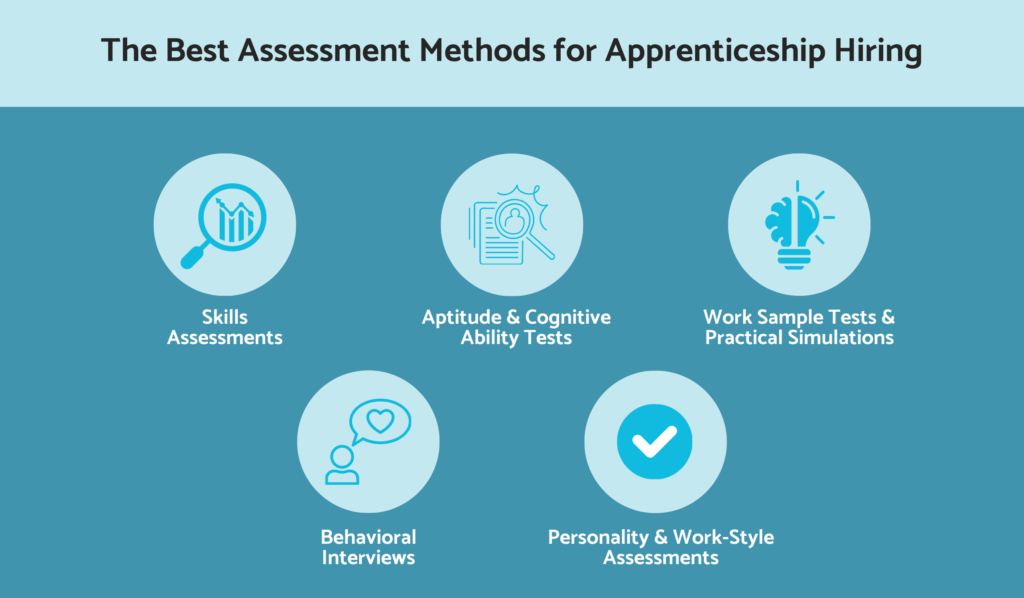
Skills Assessments (Technical and Foundational)
Skills-based assessments help you evaluate how quickly apprentice candidates understand instructions, apply basic knowledge, and build new skills, even when they lack prior experience. Instead of guessing potential from a CV, you use structured tasks to see learning ability, problem-solving, and job readiness in action.
What to Evaluate
- Basic technical understanding
- Ability to follow instructions
- Problem-solving approaches
- Accuracy and attention to detail
Skills tests provide objective data and reduce guesswork. They allow you to compare all candidates using the same rubric, which improves fairness and decision quality.
Research from the National Skills Coalition shows that 52% of job roles require skills that can be developed through apprenticeships, highlighting the importance of assessing foundational competencies rather than prior experience.
Aptitude and Cognitive Ability Tests
Aptitude and cognitive ability tests identify candidates who can learn quickly, reason through new problems, and grow into the role over time, which matters more than existing knowledge in long-term apprenticeship programs.
What Do These Tests Measure
- Logical reasoning
- Verbal and numerical aptitude
- Pattern recognition
- Learning speed
Aptitude is strongly correlated with job performance in training-heavy roles, making it one of the most predictive tools for apprenticeship.
Work Sample Tests and Practical Simulations
Work sample tests and practical simulations replicate real-life tasks the apprentice might face on the job. Examples include technical repair scenarios, customer interaction simulations, basic coding, or compliance-related exercises.
Work samples create a realistic view of candidate capability, especially useful when experience levels vary widely.
Structured Behavioral Interviews
Structured behavioral interviews help you assess how candidates have handled learning, teamwork, and challenges in the past, while keeping evaluations consistent and focused on real behaviors rather than polished answers.
Research by the Society for Industrial and Organizational Psychology (SIOP) indicates structured interviews are nearly twice as predictive as unstructured ones for early-career roles.
What You Should Ask
- The times they solved a simple problem
- Examples of teamwork in school or informal environments
- How they approach new or unfamiliar tasks
- Motivation for applying to the apprenticeship
Structured interviews reduce hiring bias and allow you to evaluate every candidate on the same behavioral competencies.
Personality and Work-Style Assessments
Personality and work-style assessments help you understand how a candidate is likely to collaborate, respond to feedback, and fit into your team and training environment.
A study by the Work Institute shows that career development opportunities are a top reason individuals pursue apprenticeships, making motivation assessments critical in hiring.
What They Provide
- Insights into motivation
- Adaptability levels
- Work ethic indicators
- Preferred communication style
When training someone from scratch, cultural fit, reliability, and coachability are major predictors of long-term success.
Avoid costly mis-hires with science-backed assessments built for early-career apprentices. VIEW PLANS
Once you’ve chosen the right assessment methods, the next step is putting them into a clear hiring process. In the next section, you’ll see a simple, step-by-step apprenticeship hiring workflow.
5. A Step-by-Step Apprenticeship Hiring Process
Hiring apprentices requires a structured, transparent process that helps you evaluate potential, not experience. Below is a clear, practical step-by-step workflow you can apply immediately.
A study by Harvard Business Review found that companies using structured hiring processes see up to 40% improvement in quality-of-hire metrics.
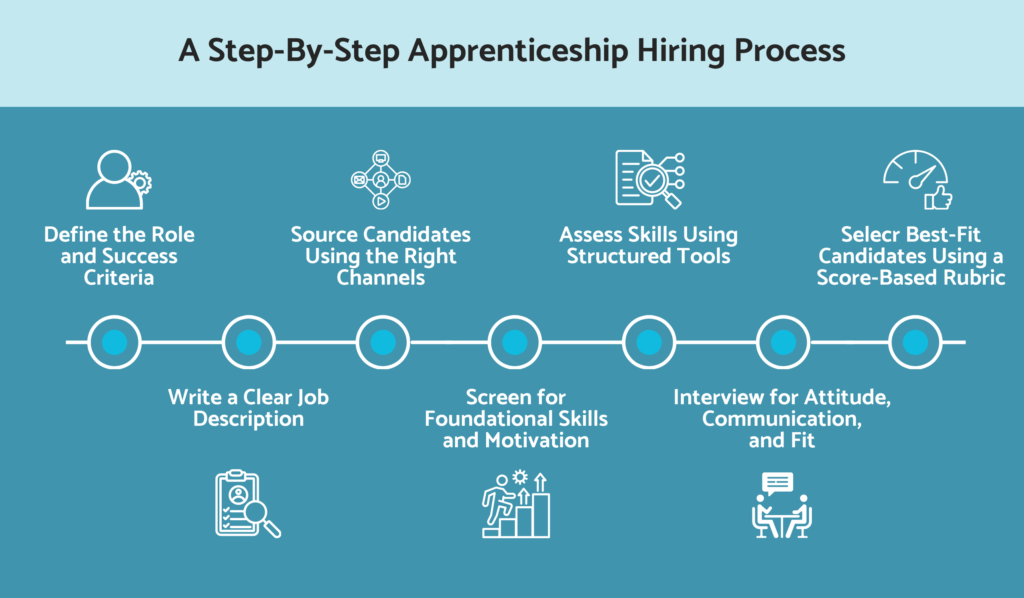
Step 1: Define the Role and Success Criteria
Most apprenticeship programs fail when employers aren’t clear on what “success” looks like. Start by outlining:
- Core responsibilities
- Skills the apprentice should develop
- Behavioral expectations
- Support and supervision structure
At this stage,
- Translate tasks into skills
- Identify which skills must be assessed before hiring vs. trained during the program
- Set expectations with hiring managers to reduce bias and guesswork
Step 2: Write a Clear, Inclusive Apprenticeship Job Description
Your job description should speak to early-career talent who may not understand industry jargon.
Your job description should have:
- A simple explanation of the apprenticeship
- Expected learning outcomes
- Realistic daily activities
- Required skills
- Growth path or conversion potential
Focus less on “requirements” and more on “what you’ll learn” and “skills that will help you succeed”.
Step 3: Source Candidates Using the Right Channels
Traditional job boards may not always effectively attract first-time job seekers. Expand sourcing into:
- Vocational schools and technical institutes
- Community colleges
- Government apprenticeship portals
- Youth employment programs
- Social media
- Local community groups
This ensures a diverse pipeline of candidates who reflect real potential.
The National Skills Coalition reports that 52% of U.S. jobs require skills training beyond high school but not a four-year degree, skills that apprenticeship programs help bridge.
Step 4: Screen for Foundational Skills and Motivation
Early-career candidates may not have portfolios or past experience. Instead, screen for:
- Ability to follow instructions
- Willingness to learn
- Interest in the field
- Communication basics
- Reliability indicators
The goal here is to filter out candidates who are likely to fail, not those who have simply never done the job before.
Step 5: Assess Skills Using Structured Tools
This is where you combine insights from aptitude tests, work simulations, group exercises, or behavioral assessments. Make assessments job-relevant, simple, fair, and predictive of learning potential. Structured assessments ensure every candidate is evaluated the same way.
Research from the World Economic Forum shows that 44% of skills required in the workplace will change by 2025, making structured training pathways like apprenticeships even more critical.
Step 6: Interview for Attitude, Communication, and Fit
Apprenticeship interviews should feel less like an interrogation and more like a conversation, evaluating curiosity and learning drive, coachability, team communication, problem-solving approach, and values alignment
Step 7: Select the Best-Fit Candidates Using a Score-Based Rubric
Combine assessment results, interview scores, and behavioral indicators into a decision matrix that removes guesswork.
What to Include
- Skills scores
- Behavioral competency scores
- Motivational indicators
- Overall readiness
- Cultural alignment
This ensures decisions are documented and defensible.
Data from NACE (National Association of Colleges and Employers) shows that competency-based hiring improves the prediction of job performance by up to 40%, supporting the use of assessments in apprenticeship recruitment.
Before we leave this section, let’s see some real-life examples of how companies use structured apprenticeship hiring.
6. Case Study: How Leading Companies Use Structured Apprenticeship Hiring
Several global companies have demonstrated how a structured apprenticeship hiring process leads to stronger talent pipelines and long-term workforce readiness:
IBM: New Collar Apprenticeships
IBM launched its well-known New Collar Apprenticeship Program, focusing on skills rather than degrees. By defining clear competency frameworks, using structured assessments, and integrating on-the-job learning, IBM successfully filled roles in cybersecurity, data analysis, and cloud operations. The company reports higher retention and faster productivity among apprentices compared to traditional hires.
Amazon: Mechatronics & Robotics Apprenticeship
Amazon uses a standardized, step-driven apprenticeship recruitment model: job analysis → skills screening → practical tests → paid training → certification. This program has produced thousands of technicians who now support operations across fulfillment centers. Their structured process reduced skills gaps while expanding internal career mobility.
Accenture: Apprenticeship Pathways Program
Accenture built a consistent nationwide apprenticeship framework in the US, combining competency-based interviews, skills tests, and structured onboarding. Today, apprentices make up a rapidly growing share of their entry-level hiring, especially in digital, cloud, and analytics roles. The company highlights the model as a key driver of workforce diversity and inclusive hiring.
Once you have a structured, evidence-based process, the final step is choosing the right platform to run it. In the next section, you’ll see why many employers rely on Assess Candidates.
7. Why Choose Assess Candidates for Apprenticeship Hiring?
Hiring apprentices is different, and your tools need to reflect that. Assess Candidates gives employers a streamlined, evidence-based way to evaluate potential, not just experience. Here’s why leading organizations choose Assess Candidates for apprentice recruitment:
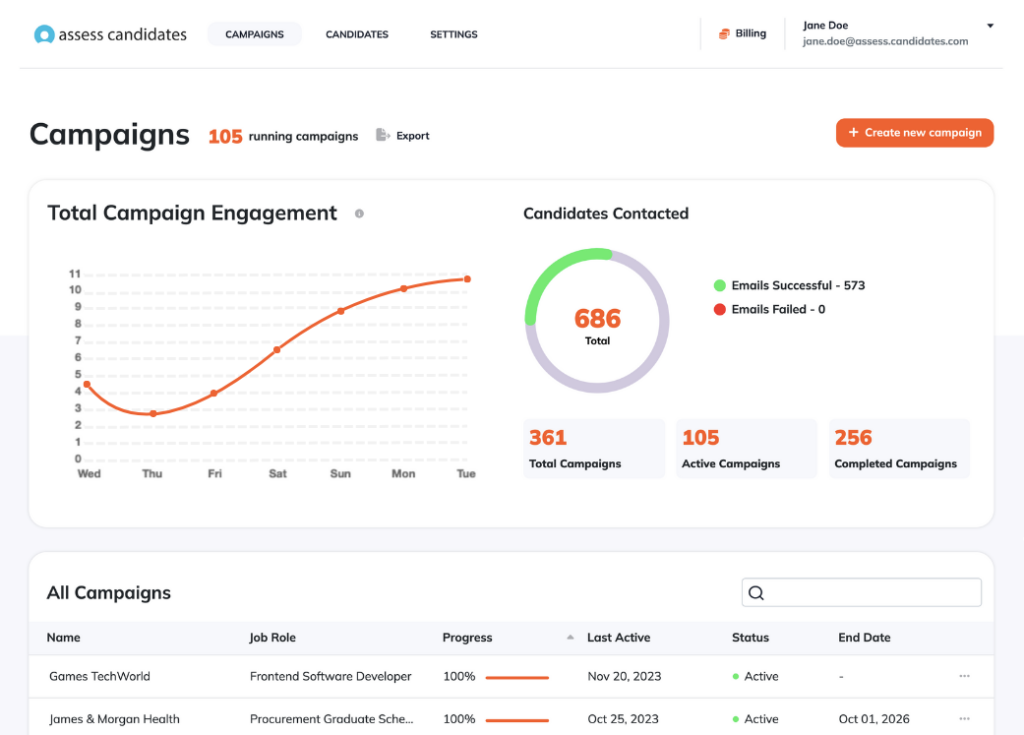
1. Purpose-Built Skills Assessments
Most general hiring tools were built for experienced professionals. Assess Candidates was designed from day one to measure foundational skills, coachability, problem-solving, and growth potential, the exact traits that predict success in early-career and apprenticeship roles.
Research by CareerBuilder found that 60% of employers struggle to find candidates with soft skills such as communication and problem-solving, key traits apprenticeships are designed to develop.
2. Objective and Fully Standardized Evaluation
With structured assessments, scoring rubrics, and automated evaluation, every applicant is measured on the same criteria, significantly reducing subjective bias. This ensures fairer and more consistent hiring decisions across teams and locations.
3. Fast Screening at Scale
Whether you receive 50 or 5,000 applicants, Assess Candidates helps you instantly shortlist candidates who match your baseline requirements. Recruiters save time, and hiring managers only interview candidates who are already vetted for readiness and potential.
4. Rich Insights for Better Hiring Decisions
Beyond scores, Assess Candidates provides detailed insights into each candidate’s strengths, weaknesses, and potential development areas. This gives hiring managers deeper confidence, especially when selecting candidates with little or no prior experience.
A report by Deloitte states that organizations investing in structured learning see 30-50% higher productivity, reinforcing why apprenticeships remain vital for long-term workforce development.
5. Better Predictors of Success Than Resumes or Interviews Alone
Traditional hiring methods lean heavily on experience-based evaluation. Assess Candidates strengthens your process with data-driven tools that highlight who can succeed, not just who has the most polished CV.
6. Proven Results for Early-Career Hiring
From trade programs to tech apprenticeships, organizations using Assess Candidates consistently see stronger hiring outcomes. You can screen candidates faster, select apprentices who perform better on the job, improve program completion rates, and build stronger long-term retention across your early-career roles.
Need expert support to improve your apprenticeship hiring decisions? CONTACT US
Want to improve how you hire and develop apprentices? Explore our most frequently asked questions below, and sign up with your email to get started with Assess Candidates.
Frequently Asked Questions
How is an apprenticeship different from an entry-level job?
An apprenticeship blends paid work with structured, employer-supported training, giving candidates the chance to learn while earning. Unlike entry-level roles, apprenticeships include formal skill development, mentorship, and a progression roadmap. They are designed to build long-term capability from the ground up, not just fill an immediate vacancy.
Why can’t companies use traditional hiring methods for apprenticeships?
Companies use apprenticeship-based hiring because traditional hiring favors candidates with experience, which most apprenticeship applicants typically lack. Instead, employers must evaluate potential, learning ability, and motivation. This requires tailored assessments, structured interviews, and screening methods that uncover teachability and work readiness, qualities that won’t appear in a standard CV-driven hiring process.
What core skills matter most when choosing an apprentice?
Key skills include problem-solving, communication, teamwork, time management, and openness to feedback. These abilities help apprentices adapt quickly to training demands and new environments. Because technical expertise is often taught during the program, transferable soft skills and a growth mindset are stronger predictors of long-term success.
Which assessments work best for evaluating apprentice potential?
Assessment methods that work best include cognitive ability tests, situational judgment tests, and behavioral assessments, which provide the strongest insight into an apprentice’s suitability. They objectively measure reasoning skills, decision-making, work style, and attitude, key predictors of early-career success. When combined with structured interviews or practical work samples, hiring decisions become far more accurate and bias-free.
What makes Assess Candidates a strong choice for apprenticeship recruitment?
Assess Candidates provides science-backed assessments designed specifically for early-career talent. The platform measures potential, not just experience, helping employers identify motivated, high-aptitude candidates. With automated scoring, clear reports, and reduced bias, hiring becomes faster, more accurate, and more consistent, leading to stronger apprentices and higher retention.


 English
  Arabic