
How Automation is Reshaping Recruiter Roles



Many recruitment professionals are questioning how automation will reshape recruiter roles.
However, recruiters who develop the skills to work alongside artificial intelligence (AI) and automation will remain essential to modern hiring teams.
According to Reed Talent Solutions (2023), the recruitment process still requires a hybrid approach of automation and human interaction to ensure accurate hiring outcomes.
Successful recruiters should not solely rely on AI and automation to do their jobs. Human interaction and skills remain essential for evaluating candidate qualities, such as emotional intelligence, communication, and cultural fit that technology cannot fully assess.
This article will help you understand what recruitment automation is, the impact of automation on recruiters in terms of productivity and skills demand, and the future of automation and AI in recruitment.
Contents
- What is automation in recruitment?
- What are the benefits of recruitment automation?
- How does automation improve recruiters’ productivity?
- What are the challenges of recruitment automation?
- What are the evolving recruiter roles and key skills in an automated hiring environment?
- How does Assess Candidates automate the hiring process?
- What is the future of automation in recruitment?
To understand this shift, we first need to define recruitment automation.
1. What is Automation in Recruitment?
Recruitment automation, or hiring automation, refers to the use of technology, including software and artificial intelligence, to run the recruitment processes with minimal human or external control. It involves attracting, evaluating, and hiring suitable candidates for an organization using artificial intelligence.
AI and automation in recruitment usually revolve around components central to the hiring process.
What are the key components of recruitment automation?
Recruitment automation components combine talent sourcing, candidate evaluation, communication, scheduling, reporting, and onboarding into one system that integrates the recruitment workflow. The core components of automation in recruiting include:
Candidate Sourcing
Automated candidate sourcing involves crafting compelling, inclusive job descriptions and simultaneously distributing them across job boards, social media channels, and professional networks. It eliminates the need to manually craft your job descriptions and post them to every job board and talent source that you use. Automated candidate sourcing also ensures you can track the talent source that delivers the highest-quality candidates.
Applicant Tracking
Central to recruitment automation is the Applicant Tracking System (ATS). As its name implies, it tracks every recruitment activity that each applicant undergoes. Modern ATS platforms go beyond screening applicants’ resumes; they redact candidates’ identifying details and assign new ones, communicate their recruitment progress, and report their suitability for the role to the hiring team. Applicant Tracking Systems are essential to recruitment processes that eliminate bias and prioritize skills.
Resume Screening
One of the most critical aspects of the hiring process is resume screening. Usually, depending on the number of applicants for a role, it takes a lot of time. However, with resume parsing automation, the time required to screen hundreds of CVs has decreased from weeks to hours.
Automated resume screening scans candidates’ CVs for keywords and matches their qualifications, relevant work experiences, and skills to the job requirements. In more advanced resume parsing systems, contextual understanding is possible, enabling greater qualification equivalence and better skill interpretation.
For example, Company Q sends an email to Candidate 050 inviting them to skills assessments after receiving their resume less than an hour ago. Automated resume screening makes this possible.
Candidate Assessment
Some years ago, job candidates had to be physically present to write tests that showed their skill level. However, with technological advancement, candidate assessment is accessible to candidates through their various internet-enabled devices.
Automated candidate assessment is usually tied to automated communication and resume screening. Successful candidates from the resume screening phase are invited, via automated communication, to take pre-employment assessments, including psychometric, personality, game-based, and video interviews. Despite the absence of human interaction in this recruitment phase, it curtails cheating through built-in anti-cheating tools such as eye-tracking and screen monitoring. The automated assessment platform scores the candidates and sends the successful ones automated invitations to the next hiring stage.
Interview Scheduling
Candidates who complete the skills assessment phase will receive invitations to a scheduled interview via automated communication. The interview may be with a human panel, or the candidate may do a video interview in which they answer standardized questions. Sometimes candidates can reschedule the interview, and the system automatically recognizes the change. Hiring managers and members of the interview panel get periodic alerts to remind them of the scheduled interviews.
Communication
Automated communication in the recruitment process informs the recruitment personnel and candidates of important details and steps expected of them. It is one of the most essential components of any automated recruitment process, as without it, a breakdown is inevitable. Although resume screening, candidate assessment, and interview scheduling in recruitment automation are essential, automated communication enhances their effectiveness.
Analytics and Reporting
The beauty of an automated recruitment system is that it allows the recruitment team to analyze their processes and determine which phases need improvement. In environments where diversity recruitment strategies are in place, an automated hiring system reports on their effectiveness.
Hire the best candidates with our range of automated candidate assessments. HIRE FOR FREE
Combining these components ensures you harness the recruitment automation benefits you will read about as you continue.

2. What are the Benefits of Recruitment Automation?
Despite the anxiety it is causing among some hiring professionals, recruitment automation offers many benefits to the employment process and recruiters.
Below, we discuss some of the top benefits of automating processes in recruitment.
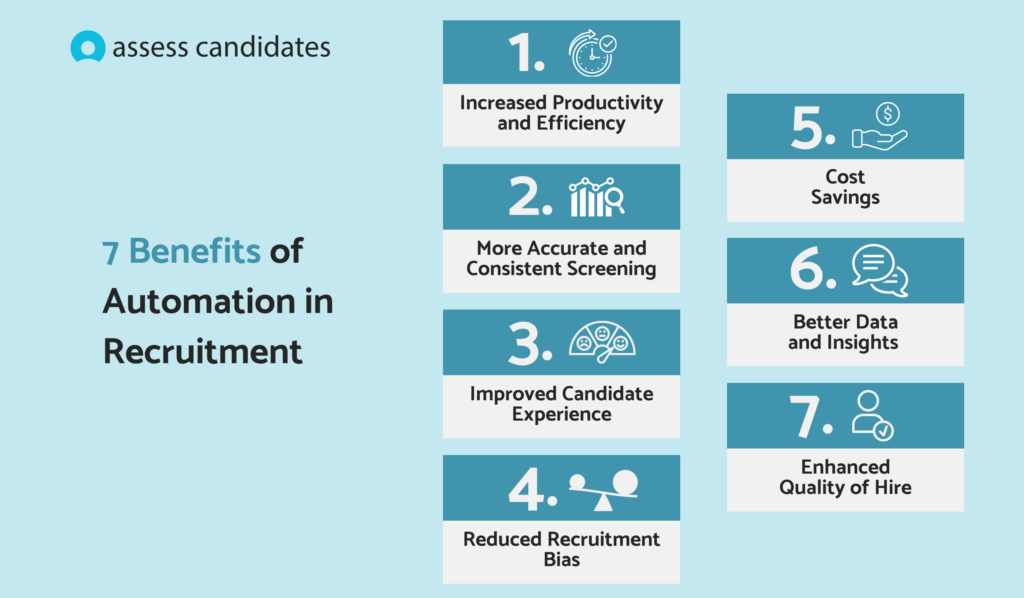
1. Increased Productivity and Efficiency
Before recruitment automation became widespread, recruiters spent a significant amount of time on repetitive administrative tasks such as sorting CVs, sending follow-up emails, and updating candidate records. This causes them to allocate inadequate thought and effort to other recruitment processes, such as candidate evaluation, recruitment strategy planning, and candidate experience.
With recruitment automation, recruiters now spend less time on repetitive tasks such as resume screening and candidate follow-up, leaving them to AI and automation. They focus more on planning their hiring strategies before the process begins, ensuring candidates have the best recruitment experience, and monitoring the system’s effectiveness in meeting their recruitment goals. The automated recruitment process now allows for more hiring cycles and ensures each step contributes to the set goal.
2. More Accurate and Consistent Screening
Candidate screening usually happens at the beginning of the recruitment process. However, recruiters often make hiring mistakes due to tiredness, the repetitive nature of the task, and differences in human understanding. Whether they’re screening candidates’ resumes or conducting a pre-screening interview, the enormity of the task wears them down, making them prone to errors. Also, each member of the hiring team understands the job qualification criteria differently.
Automation maintains the same level of scrutiny throughout the hiring process. It ensures consistency in the interpretation of the rules, scoring model, and qualification criteria for all candidates. Therefore, its results are more reliable in aligning candidates with job requirements and making candidate shortlists.
3. Improved Candidate Experience
One of the challenges that candidates face during the hiring process is communication and feedback. Usually, they either hear nothing from the recruitment team for a long time, which causes anxiety, or have no idea who to contact with their questions. Whichever category they can relate to, it reduces their experience as applicants.
With automation, candidates now get faster responses to their questions through chatbots designed to answer predicted applicant questions. Furthermore, automated tools such as email flows send fast recruitment updates to all candidates, and self-service allows applicants to reschedule interviews and assessments to a suitable time. Together, these recruitment automation tools show transparency, portray employers as professional, and ensure candidates’ convenience, improving their hiring experience.
4. Reduced Recruitment Bias
A significant flaw in human-conducted recruitment exercises is the presence of bias at every stage of the hiring process. Although recruiters undergo training to reduce bias, it still unconsciously persists, as it is part of human nature. According to a ResearchGate study, HR professionals unintentionally favor certain applicants. Furthermore, according to some experts through The Guardian, unconscious bias training alone will not stop recruitment discrimination.
In conjunction with human efforts to stop discrimination in recruitment, automation significantly reduces bias by enabling diversity hiring strategies. Automated hiring systems are designed to focus on skills, qualifications, and other job-relevant indicators to make the best candidate selection decision. They support blind hiring, which redacts candidates’ identifying information, reducing bias triggers and enabling more diverse, merit-based recruitment.
5. Cost Savings
The longer it takes to hire a suitable candidate for a role, the higher the hiring cost for that role is. Human-conducted recruitment incurs considerable costs due to its time-consuming nature. Repeated manual tasks, the use of external recruiters, and the hiring team working overtime increase overall hiring costs. However, you can save on these costs with automation.
Automating recruitment eliminates the need for external recruitment professionals, overtime, and repetitive manual tasks. In the short term, you will save on labor costs, and in the long term, you will save on time-to-hire. Your hiring team uses a few resources to meet your recruitment goals, improving your company’s bottom line.
6. Better Data and Insights
The decision to hire the right candidate depends on data. From the resume screening stage through the pre-employment assessment, all candidates’ data must be collected and updated, including their cumulative score and suitability for the role. However, when recruiters handle all the work manually, they can easily miss details in the data, negatively impacting their insights and final decision.
With recruitment automation, every phase of recruitment, such as candidate sourcing, screening, assessment, and interview, is analyzed independently, showing the efficacy of the strategies adopted for each stage. They show data on sourcing performance, funnel drop-off points, time-to-hire, quality-of-hire metrics, and more. Recruiters, and sometimes AI, use this data to make accurate predictive recruitment planning for the future, supporting better hiring decision-making.
7. Enhanced Quality of Hire
Manual recruitment has landed many quality talents, but it has overlooked many. Manually matching candidates to a role’s requirements can lead to errors, such as prioritizing their educational qualifications over performance indicators in similar roles.
Recruitment automation ensures accurate candidate-role matching by evaluating applicants against preferred skills, performance indicators, competency, and qualifications. Only qualified candidates move forward in the recruitment funnel, enhancing candidate selection quality. Also, when you combine automation’s candidate evaluation accuracy with its analytics, the likelihood of hiring retainable, high-quality talent increases.
Unlock the benefits of automating your recruitment process with the Assess Candidates platform. LEARN MORE
The benefits that accompany automating your recruitment process include improving recruiters’ productivity, but how does it do that?
3. How Does Automation Improve Recruiters’ Productivity?
Productivity to a recruiter can mean different things. However, whatever a recruiter takes productivity to mean, it must reflect positively on the organization. Therefore, recruiters’ productivity describes the timely and efficient use of resources to meet an organization’s recruitment targets.
Recruiters’ productivity
To understand how automation improves recruiters’ productivity, we must first know what determines it. They include:
- Process efficiency: It refers to how quickly and well the recruitment process, from sourcing to hiring, helps the organization reach its hiring goals.
- Technology: It dictates the tools available to execute the recruitment process in a timely and accurate manner.
- Skills: expose how well recruiters can use available tools to maximize the potential of the recruitment process.
- Organizational factors: determine the ease of accessing recruitment data and influence the speed at which hiring decisions can be made.
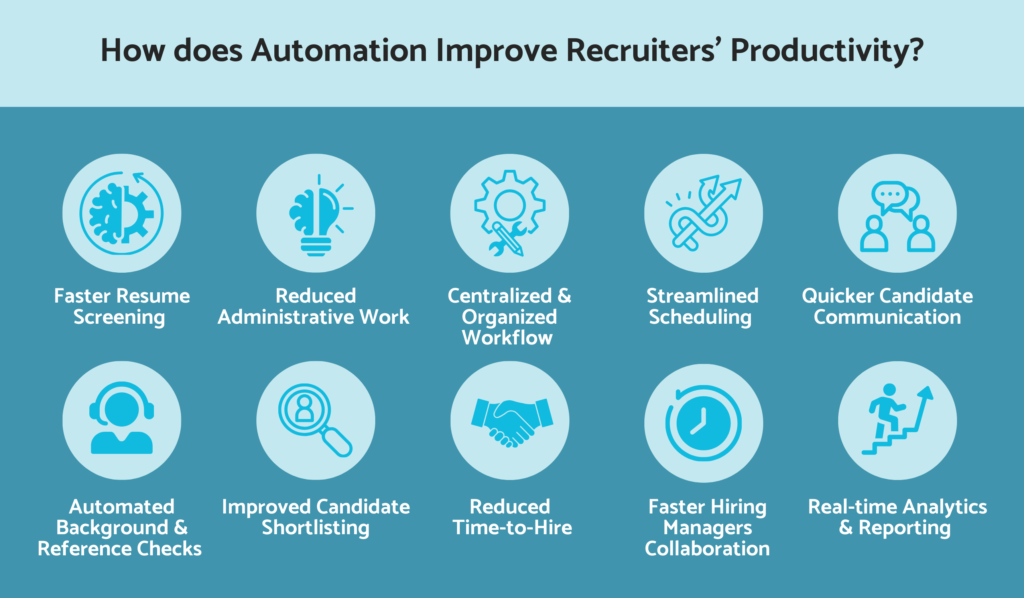
Recruiters’ productivity depends on all these factors. However, modern automation technology can enhance productivity in the following ways:
1. Faster Resume Screening
The volume of CVs recruiters have to sort through and evaluate to determine which candidates are suitable for the role they’ve applied for is enormous.
According to Greenhouse, certain job openings now receive an average of 244 applications. With the availability of AI, candidates now apply to more jobs than they used to, increasing the average number of resumes recruiters have to screen before shortlisting ideal candidates. But resume parsing automation has helped increase the number of CVs recruiters can evaluate per unit of time, with greater accuracy.
A controlled experiment has shown that their AI screening tool reduced resume processing time from 180 seconds to 2.5 seconds while maintaining about 92% accuracy.
2. Reduced Administrative work
Recruitment administrative work, such as data entry, candidate status recording and updating, and follow-ups, takes up a lot of time. These administrative works, despite their time-consuming nature, are repetitive and prone to human errors. However, recruitment automation can do these jobs quickly and with greater accuracy. The speed and accuracy of these operations increase the recruitment team’s efficiency, allowing them to focus on other tasks.
For example, imagine a 3-member team of recruiters that have to combine the administrative, evaluation, and organizational aspects of recruitment into a limited timeframe, and ensure the exercise produces the best quality hire.
3. Centralized and Organized Workflow
Organizing the entire recruitment process and documenting it accordingly can be laborious. Recruiters used to search through numerous files to find a particular candidate’s data and compare it with other candidates’ to determine which appeared more qualified. While the entire hiring process requires an organized workflow, it can be challenging to maintain that when there are numerous candidates for a job.
By automating recruitment, tools for tasks such as job posting, resume screening, and communication are integrated into the automated system to help recruiters work faster and stay organized, minimizing data loss.
4. Streamlined Scheduling
Exchanging emails with candidates to schedule an interview or assessment session wastes time and increases hiring costs. Also, the difficulty of evaluating all candidates before a set date and ensuring their schedules align with the hiring team’s is exhausting.
Automated hiring ensures that assessment and interview scheduling are seamless. The system automatically informs candidates of their interview date and allows them to reschedule it based on their availability. Recruiters also get candidates’ preferred dates and work their schedules around them, reducing manual workload and time waste.
5. Quicker Candidate Communication
One factor that shapes candidates’ experiences during the recruitment process is communication. Many applicants used to wonder why they didn’t receive any response from employers after submitting their applications. Recruiters can’t manually respond to each applicant to inform them of their status in the hiring process. However, they make sure to inform candidates who successfully pass each stage of the hiring process about their progress.
Automated messaging and chatbots in the recruitment system now make it easier and faster for recruiters to communicate with candidates. This is why applicants now get almost immediate responses after submitting their applications. The rapid communication reduces delays and time-to-hire.
6. Automated Background and Reference Checks
To ascertain the truth behind many candidates’ claims on their CVs, such as the existence of organizations they have worked for, recruiters had to run background checks manually in the past. With numerous applicants, background and reference checks can take weeks before the next stage of candidate evaluation can take place.
Automated hiring tools check candidates’ information across databases, such as criminal records, national ID, education, and employment records, to assess their suitability for employment at that organization. They also verify referees’ authenticity in a matter of seconds and synchronize their results into candidates’ profiles and dashboards for better organization.
7. Improved Candidate Shortlisting
Recruiters have a hard time compiling candidates’ evaluation results and creating a shortlist of successful candidates. Although you will expect that shortlisting successful candidates should be easier as the recruitment process progresses, it can become monotonous, and recruiters’ concentration slips, leading to errors. Also, personal bias can come into play, and less-qualified candidates can end up on the list.
Automation and AI in recruitment eliminates unqualified candidates from the shortlist by updating the candidate list as they progress in the recruitment funnel. It also ranks candidates based on specified metrics, making shortlisting easy and enabling quick decision-making.
8. Reduced Time-to-Hire
A manual recruitment process that takes a month can be significantly faster when it becomes automated. Because efficiency is determined by accuracy and speed, manual hiring takes too long and is therefore less efficient. The time-to-hire required for manual recruitment costs the organization more money.
However, automated hiring reduces time-to-hire to a minimum. The time-consuming recruitment tasks, such as data entry and communication, are completed quickly, effectively reducing time-to-hire and hiring costs.
9. Faster Collaboration with Hiring Managers
The efficacy of adopted recruitment strategies becomes apparent and measurable as soon as candidates move from one recruitment phase to the next. Manually creating strategy reports for hiring managers can slow the hiring process, and delays can prevent quick tweaks that could make strategies more effective, impeding recruiters’ productivity.
Automating recruitment processes now allows hiring managers to share a single dashboard with other team members, helping them see the impact of hiring strategies in real time. Additionally, automated notifications streamline team collaboration by alerting each member when their input is required.
10. Real-time Analytics and Reporting
Automated dashboards enable hiring managers to assess their team’s efficiency. Real-time analytics show them the measurable results of their strategies, skills, and efforts to understand the degree to which they need to make changes, if required.
Real-time reporting enables quick, data-driven decisions, increasing efficiency by reducing administrative work and time-to-hire.
Increase your hiring efficiency with our AI-powered, automated pre-employment assessments. VIEW PLANS
Automation and AI in recruitment improve recruitment productivity, but they have their challenges. The following sections explain these key challenges recruiters should consider.
4. What are the Challenges of Recruitment Automation?
An innovative, technical approach to recruitment brings many benefits; however, recruitment automation, with all the improvements it offers, also has its challenges. Ranging from technological to security and personal difficulties, it poses some risks.
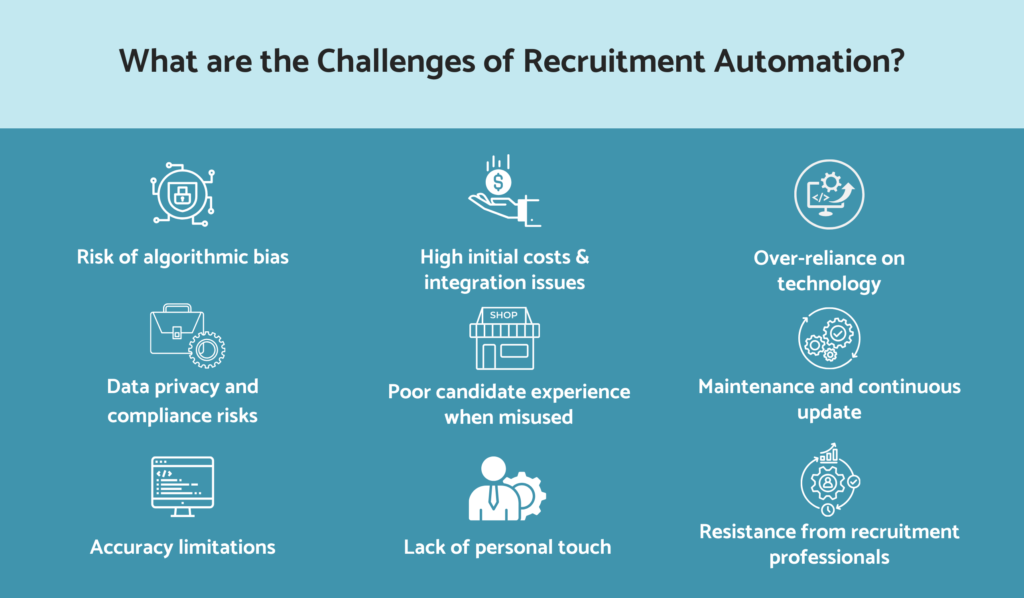
Some of them include the following:
Risk of algorithmic bias
The output quality of any automated recruitment system depends on the quality of the input. A faulty recruitment process fed into a computerized system will yield the same low-quality hire, only faster. In other words, unconscious human selection bias can be translated into algorithmic bias.
This means that to overcome recruitment bias, you must implement changes to policies that allow discrimination in your hiring process. Then, feed the revised, unbiased hiring instructions to the automated recruitment system to eliminate bias and achieve the best hiring results.
For example, Company V’s recruitment policy favors candidates from a specific non-diverse institution, but it wants a diverse workforce. Its recruitment process, without revision, is fed into an automated system. The result is the same homogenous workforce as in the past, only faster.
High initial costs and integration issues
The cost of transferring your manual recruitment process into an automated system is staggering. You’ll also incur additional costs for training your recruitment team to use the new technology, paying subscription and licensing fees, and covering support and maintenance. Not to mention the integration issues you may encounter that will cost more than you thought.
Solution: Start your recruitment automation with a few processes, such as resume screening, communication, and candidate assessment.
Over-reliance on technology
While AI in recruitment is great, there is a risk of over-reliance on automated systems to help recruiters make hiring decisions. Applicant tracking systems are great at providing data; however, they lack human, nuanced evaluation skills. AI will consider hard skills and facts on a candidate’s resume and ignore the applicability of their soft skills and unique backgrounds to the vacant role.
Solution: Use the automated system to evaluate candidates’ resumes for hard skills, grade their skill assessment scores, and perform other data-oriented tasks. Allow recruiters to manage soft skills evaluations and interviews, fostering human connection and enhancing the candidate experience.
Data privacy and Compliance risks
Automated hiring systems collect and store sensitive candidate data, which must be kept confidential. Also, it is compulsory to comply with the data regulations in your location. Mishandling of candidates’ personal data and failure to comply with personal data regulations such as GDPR, CPRA, and PIPEDA will result in legal consequences that negatively affect your brand.
Solution: Ensure strict adherence to global and local electronic personal data storage regulations by implementing organizational policies that protect candidates’ and employees’ personal data.
Poor candidate experience when misused
Candidate experience is an important marker of your hiring process’s effect on your employer brand. Despite the benefits you will gain from using AI in hiring, there is a high chance you will misuse it. The misuse of automation in recruitment stems from overdependence on it. It means from the beginning of the recruitment process to the end, candidates have limited or no human interaction. It can also mean you are careless with candidates’ personal data, which can lead to a leak.
Solution: Avoid recruitment automation misuse by guarding candidates’ personal data and preventing sensitive information from leaking. Combine AI and human input throughout the hiring process. For instance, while AI handles candidate assessments, humans should handle interviews.
Maintenance and continuous update
Though the initial cost of setting up and integrating an automated recruitment system is high, the recurring costs of maintaining and updating it to align with your evolving recruitment strategies and policies can add up quickly. Since maintenance is unavoidable, it is a compulsory expense that can negatively impact your organization’s financial performance, especially when your hiring strategies are not performing as well as you expect and you have high turnover.
Solution: Instead of owning an automated hiring system, outsource hiring to recruitment companies that possess the technology you desire to implement your recruitment strategies.
Accuracy limitations
Recruitment AI performs well at interpreting resumes; however, its accuracy is limited to certain formats. Many applicants’ resumes are not ATS-friendly; therefore, the system may mark them as unreadable or misinterpret them, even though the CVs show their qualifications for the vacant role. In some cases, the system can overlook unconventional work experiences and misrank candidates.
The limitations in the accuracy of automated hiring tools will cause your organization to miss out on quality hires and yield a lower return on your investment.
Solution: Avoid recruitment AI accuracy limitations by training the system correctly and monitoring its activities periodically, usually before moving to the next recruitment phase.
Lack of personal touch
Sometimes, all a candidate needs is a human conversation and connection to help them get over their anxiety. Although AI assesses candidates perfectly, your recruitment automation requires a personal touch to improve your employer brand and candidate experience. A personal touch shows that you care about candidates as people, not just their skills.
Solution: Introduce a personal touch into your recruitment process at strategic points. Note which candidates are likely to become bored with the process, and assign a recruiter to interact with them. Consider adding personal touches in both the pre-screening and interview phases.
Resistance from recruitment professionals
The growing concern that AI will take over recruitment professionals’ jobs is a significant reason for their resistance to recruitment automation. However, adherence to manual recruitment processes limits their productivity and encourages drudgery.
Solution: Train recruiters on how automation improves their productivity and upskill them to use AI in recruitment effectively.
After you’ve applied the suggested solutions to the above recruitment automation challenges, consider the emerging recruiter roles and the skills they need.
5. What are the Evolving Recruiter Roles and Key Skills in an Automated Hiring Environment?
Automation in the recruitment process is rapidly changing job titles and roles. Recruiters whose responsibilities are limited to screening candidates’ resumes are upskilling to become candidate assessment administrators, expanding their roles to include understanding the proper skill assessment tests to administer to candidates, depending on their roles.
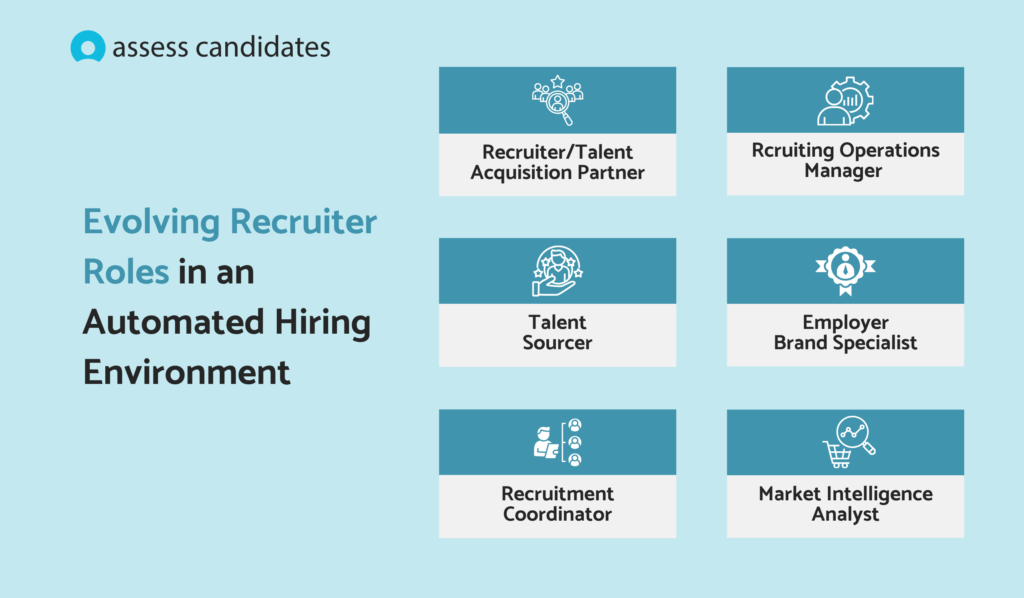
Generally, recruiter roles in an automated recruiting environment revolve around interpersonal, strategic, tech-focused, and analytical functions. Therefore, the evolving recruiter roles and the skills they need in such an environment include:
1. Recruiter/Talent Acquisition Partner
Talent acquisition partners, or recruiters, are the bedrock of the recruitment process. Before automation in the hiring sphere, they did repetitive tasks such as screening candidates’ resumes and scheduling interviews. However, with recruitment automation, they now oversee automated tools that do these tasks.
Their new roles include:
- Interpreting AI-generated shortlists by evaluating the screened candidates list that matches the job requirements before deciding which ones will move to the next recruitment phase.
- Using automated assessments to determine and deploy personality tests, video interviews, and skills tests that appropriately assess and score candidates.
- Managing AI-supported interview scheduling by overseeing scheduling tools and their interview bookings and noting schedule changes.
- Acting as talent advisors to provide hiring managers with insights into recruitment analytics based on dashboard data.
- Delivering human connection: Ensure AI-deficient areas such as candidate experience, engagement, and employer branding are covered.
Recruiters in this role require skills such as tech proficiency with ATS and scheduling tools, data interpretation, bias-free decision-making, and interviewing and evaluation.
2. Talent Sourcer
Talent sourcers focus on acquiring talent from different sources to fill the top of the recruitment funnel. With automation, they can mine thousands of candidate profiles from job boards, social media, and professional databases and bring them to your organization.
A talent sourcer in an automated hiring environment will:
- Use AI sourcing tools to find and rank potential candidates from different talent sources. This means they must understand how platforms like LinkedIn Recruiter AI and SeekOut work.
- Automate outreach campaigns to keep potential candidates in the pipeline through email sequences, personal messages, and follow-ups, using automated engagement tools such as Gem and Phenom.
- Research hidden talent by using AI to conduct Boolean searches, generating search strings, and identifying talents that would otherwise be hidden when searched for through normal means.
- Predict talent sourcing needs with automated predictive analysis; this approach will foresee talent shortages and surpluses and allow for proactive action.
Automated hiring talent sourcers will possess skills such as talent research and mapping, market awareness, pipeline strategy, AI-backed talent sourcing, and automated outreach personalization.
3. Recruitment Coordinator
Coordinators of the recruitment process oversee all activities that lead to the hiring of qualified candidates. They are usually knowledgeable about all the processes and can fill recruitment positions as needed. Therefore, their roles will include:
- Overseeing automated scheduling by monitoring the automated scheduling tool for its effectiveness and troubleshooting any issues. Also, they confirm interview schedules for candidates and interviewers.
- Workflow management to ensure no candidate is stuck in the hiring pipeline by monitoring the ATS system. They observe all candidates and processes to identify what needs improvement.
- Automated communication supervision: They cross-check the accuracy and clarity of automated messages sent to candidates via email and chatbots.
- Candidate experience oversight: Recruitment coordinators are responsible for ensuring the system functions fairly and that candidates have a positive experience using it.
- Compliance checks: They design automated reminders for background checks, policy alignment, and documentation.
As a recruitment coordinator, you will need problem-solving, communication, attention to detail, process management, and proficiency in tech (ATS, CRM, HRIS).
4. Recruiting Operations Manager
In an automated recruitment environment, the Operations Manager builds the technological infrastructure for the process. They dictate the type of tools to be used for specific tasks to ensure a smooth workflow across all processes. Also, they are responsible for maintaining the systems, processes, and data that ensure every recruitment exercise is successful. Other responsibilities include:
- Facilitating automation adoption: The operations manager helps recruiters adopt automation by training them to use the systems.
- Redesigning recruitment processes: They build streamlined workflows that allow automation integration at every phase of recruitment.
- Manage systems integration: They oversee the integration of recruitment automation tools and systems to ensure compatibility with the organization’s hiring goals.
- Ensure automated data handling: operations managers ensure that candidates’ sensitive data is automatically handled in accordance with local laws and regulations.
To successfully carry out their responsibilities, recruitment operations managers must possess skills such as project management, data analysis and reporting, technology evaluation, and automation strategy.
5. Employer Brand Specialist
An employer brand specialist focuses on aligning an organization’s recruitment reputation with candidates’ sentiments. They use automation to research what candidates seek in an employer, develop strategies to integrate candidates’ sentiments into the employer brand, and distribute content that highlights the alignment between candidate sentiment and the employer brand.
Employer brand specialists have the responsibility of:
- Sentiment analysis: They recognize what candidates desire in their employer, figure out how to incorporate it into their organization’s brand, and develop plans to fuse the two.
- Content personalization: They design and repurpose content to target candidates with varying sentiments that align with the organization’s employer brand.
- Automated social scheduling: Using AI marketing tools, they plan, create, and publish career content that announces the employer’s brand.
- Programmatic job ads placement: They support talent sourcing by strategically placing job ads to maximize reach and cost per click, using automation.
Skills such as branding and messaging, content development, candidate persona creation, data-driven audience insight, and marketing automation systems are necessary for an employer brand specialist.
6. Market Intelligence Analyst
A market intelligence analyst researches the recruitment landscape trends across industries to ascertain current competitor hiring trends, talent availability, salary levels, and future employee needs. This role requires excellent research skills, and with automation, a recruiter will have quick, data-rich analytics to support their analysis.
The core responsibilities of a market intelligence analyst include:
- Monitoring competitor hiring trends: The analyst uses AI to scan social media, job boards, LinkedIn, and other known talent-sourcing platforms for job posts to identify which roles they are seeking to fill and how this affects their organization.
- Talent market analysis: With automation, a market intelligence analyst can determine current talent density, where they are located, and the skills they possess and assess whether they suit what their organization will need in the near future.
- Predictive modeling: Is closely related to talent market analysis. It uses predictive analysis to forecast talent availability and emerging skills and to determine how they can benefit the organization.
- Salary benchmarking: Automated tools collect salary data from different sources to determine a reasonable compensation range for employees.
A market intelligence analyst requires trend forecasting, data analysis, research, competitive intelligence, and visualization and reporting skills to succeed in the role.
Leverage our AI-backed pre-hire assessments and hiring platform to streamline your recruitment processes. HIRE FOR FREE
The new recruiter roles in an automated hiring environment still require AI-leaning skills. Let us see how you can test recruitment automation skills.
6. How does Assess Candidates automate the hiring process?
Before you hire anyone who claims to have the necessary skills needed in recruitment automation, test their skills. Assess Candidates offers a collection of pre-employment tests to help you identify the best candidates for the recruitment automation roles you have.
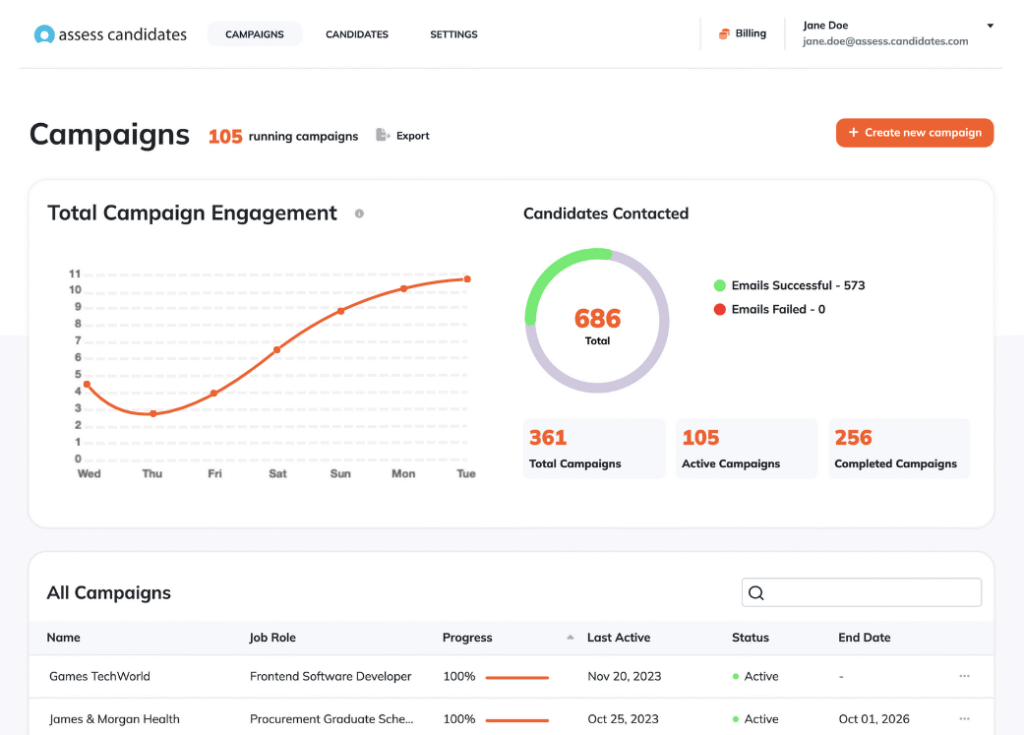
These pre-hire assessments focus on evaluating how well candidates can function in their preferred roles by exploring their skills. Some of the skills and the pre-hire assessment that adequately test them include the following:
- Talent Acquisition and Sourcing Competencies
Despite extensive automation in talent sourcing, candidates for such roles must be able to spot mistakes quickly. Therefore, the error-checking tests are ideal for assessing their use of this skill. Also, the talent acquisition and sourcing role requires evaluating outreach content for clarity and personalization, and matching profiles to job requirements. Hence, verbal reasoning tests and cognitive tests will test these skills in applicants, respectively.
Other skills and the appropriate tests for them, as provided by Assess Candidates, include emotional intelligence tests to measure empathy and tone when personalizing communication with candidates, and selective attention tests to determine candidates’ ability to handle large datasets.
- Technical and Digital Competencies
The technical and digital roles in recruitment automation require candidates to possess at least one of the following skills: technical proficiency, data analysis, data reporting, technology evaluation, or trend forecasting.
Assess Candidates offers logical reasoning tests to determine whether candidates have the skills to understand system thinking, automation logic, and select appropriate recruitment automation tools for your system. You can also use the cognitive ability tests to know if they can learn and use new and complex tools, and selective attention tests to ascertain their ability to navigate multiple dashboards and handle numerous technical tasks simultaneously. Numerical reasoning tests assess candidates’ data analysis, reporting, and trend interpretation skills.
- Communication and Branding Skills
The communication and branding roles require candidates to represent organizations in their personal and general communications. Therefore, a high level of communication skills is needed. Also, to understand candidates’ sentiment and ensure the employer brand meets them, candidates must possess empathy.
Emotional intelligence assessments, such as the I-EQ game-based assessment, identify candidates who can understand others’ sentiments. In contrast, verbal reasoning tests identify those with the ability to communicate those sentiments through employer branding. Situational judgment tests put candidates in real-world scenarios to assess their communication skills. Also, because these skills depend on candidates’ personalities, personality assessments such as the SHL Personality OPQ, Hogan Personality Inventory, and Assess Candidates’ Work Personality Questionnaire will identify those with the traits for roles that require these skills.
- Strategic and Analytical Skills
Recruitment automation roles that require strategic and analytical competencies include those that involve research, decision-making, problem-solving, and market awareness. Their importance lies in recognizing problems, analyzing causes and possible solutions, and choosing the best solution for the organization. Candidates to fill these roles must genuinely understand how their analytical disposition affects the organization’s quality of hire. Therefore, assessing them is compulsory.
One of the most effective pre-hire assessments for strategic and analytical skills is the situational judgment test. It allows you to see how each candidate responds to the organization’s recruitment problem, including their analysis of the problem and the solutions they provide. Another assessment, the logical reasoning test, measures candidates’ analytical thinking and information interpretation abilities. Other assessments for strategic and analytical roles in an automated recruitment environment include the BART game-based assessment, which tests risk-taking, and numerical reasoning tests.
- Operational and Process Management Skills
The managerial and operational roles in the automated recruitment system favor focus, resilience, and organization. Candidates for these roles must be tested for their attention span, ability to categorize activities by priority, and decision-making skills.
At Assess Candidates, the Flanker Task game-based assessment tests for selective attention. The Cognition-A and Cognition-M game-based assessments evaluate candidates’ planning, structural, and problem-solving abilities. The MTA-TRAY game-based assessment allows you to test applicants for their organizational and prioritization skills, while the situational judgment tests let you see how they can respond to real workplace situations.
Explore our end-to-end library of automated pre-employment assessments. LEARN MORE
Read on to find out what the future holds for automation and AI in recruitment!
7. What is the Future of Automation in Recruitment?
In the future, recruitment automation will become more mainstream as many organizations depend on its accuracy and speed to hire the best candidates. However, the prevalence of automation in hiring does not imply total automation of the hiring process. Humans will remain relevant in the hiring process as they combine their unique human qualities with AI’s efficiency to land the perfect candidates for target roles.
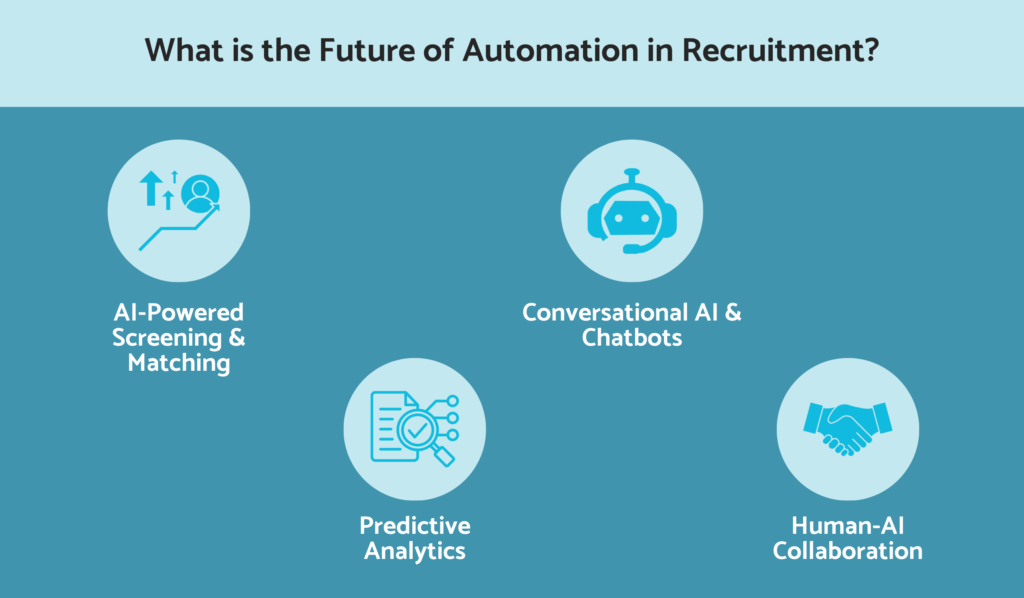
Recruitment automation in the future will encompass the following:
1. AI-Powered Screening and Matching
Although recruitment automation systems already use AI to screen and match candidates to roles, they will become more sophisticated in the future. Talent-role matching and resume screening will go beyond keyword matching to include understanding candidates’ potential, recognizing their transferable skills, and assessing their cultural fit within the organization.
Also, it will become better at reducing bias by relegating traditional credentials for skills and competence.
2. Conversational AI and Chatbots
Employer-candidate relationships will improve significantly with the use of chatbots and AI to drive conversations. Emails will no longer be the sole means of communicating recruitment progress to candidates. But candidates can easily reach employers to ask questions and seek clarifications via conversational AI.
In some cases, AI will handle pre-screening interviews and interview scheduling, allowing humans to focus on relationship building and complex evaluations.
3. Predictive Analytics
Organizations will require proactive solutions to their hiring problems, and the only means to do that is through data analysis via AI. The automated hiring system will analyze organizations’ recruitment data, competitors’ recruitment activities, talent availability, and employee attitude to predict hiring needs and flight risks.
With predictive analysis, employers can identify employees who need replacement before they leave, reducing time-to-hire. Also, they remain competitive by creating roles that their competitors do not have.
4. Human-AI Collaboration
Despite concerns that humans will lose their jobs to AI, only collaboration between AI and humans will ensure hiring the best candidates. While AI parses resumes, checks candidates’ references, schedules interviews, and generates offer letters, humans will:
- Build candidate relationships and employer brand.
- Handle sensitive negotiations such as salary and work-mode agreements.
- Assess candidates’ soft skills and cultural nuances.
- Ensure the ethical use of AI and curtail algorithm bias.
- Make the final hiring decisions on complex roles.
The future of recruitment lies in the hands of recruiters with the technical knowledge to leverage AI to hire capable candidates.
Conclusion: Key Takeaway
- Recruitment automation, or hiring automation, refers to the use of technology, including software and artificial intelligence, to run the recruitment processes with minimal human or external control. Its components include talent sourcing, applicant tracking, candidate evaluation, scheduling, communication, and analytics and reporting.
- The benefits of recruitment automation include increased productivity and efficiency, more accurate and consistent screening, improved candidate experience, cost savings, and better quality hires.
- Automation in hiring improves recruiters’ productivity by reducing administrative work, streamlining scheduling, speeding up resume screening, and reducing time-to-hire.
- Some of the challenges of recruitment automation are high initial cost and integration issues, poor candidate experience, risk of algorithmic bias, lack of personal touch, and resistance from recruitment professionals.
- The evolving roles of recruiters in an automated hiring environment include talent acquisition partner, talent sourcer, recruitment coordinator, recruiting operations manager, employer brand specialist, and market intelligence analyst.
- Assess Candidates provides pre-employment tests for assessing recruitment automation skills.
- Automation in recruitment does not aim to make recruitment professionals jobless. Instead, it will make them more productive. However, only those who upskill in the skills required in an automated recruitment environment will reap its benefits.
Interested in learning more about how automation is reshaping recruitment roles and its impact on businesses? Continue reading for frequently asked questions and sign up below with your email to get started.
Frequently Asked Questions
Which AI tool is best for recruitment?
The best AI tool for recruitment depends on your needs, and they include Eightfold for talent sourcing, Assess Candidates for candidate assessment and structured video interviews, and Mantal for its combined ATS and CRM features.
How is AI impacting recruitment?
AI’s impact on recruitment has been positive so far, as it has significantly improved recruiters’ productivity by reducing their administrative tasks and employers’ hiring costs. However, care must be taken to check for algorithmic bias and data compromise risks.
How to automate the recruitment process?
To automate your recruitment process, start with talent sourcing. Use AI to source talents suitable for your business, then move on to resume screening, candidate assessment, and candidate shortlisting. You could consider outsourcing the process to an assessment centre.
What is ATS in recruitment?
ATS, also known as Applicant Tracking System, is an integral part of an automated recruitment system that tracks applicants’ progress through the recruitment process to ensure data accuracy and hiring fairness, and equity.
What ATS system do most companies use?
The most common ATS systems in use include Greenhouse, BambooHR, Lever, and Workday Recruiting. Although there are other ATS systems, most companies choose these for their suitability for mid-sized companies, except for Workday Recruiting, which is more common among Fortune 500 companies.


 English
  Arabic