
Using Case Study Exercises to Hire Better Candidates



Case study exercises and interviews allow employers to assess how candidates analyze information, approach workplace problems, and explain their recommendations, typically within an assessment center stage. They are particularly useful when a role requires structured reasoning, commercial judgment, or decision-making under realistic constraints.
This guide explains the different formats, the competencies case studies can assess, common challenges, and how to design and score these exercises consistently.
Contents
- What is a case study exercise?
- What do case study exercises measure?
- Why do employers use case study exercises?
- Examples of case study exercises
- Challenges of case study exercises
- Best strategies to implement case study exercises
First, let’s explore what a case study exercise is.
1. What is a case study exercise?
A case study exercise is a structured recruitment assessment in which candidates review a realistic or hypothetical workplace scenario and recommend a course of action. Depending on the format, candidates may present their findings in writing, discuss them in an interview, or work through the problem with others.
Hire skilled candidates with our assessment tools. HIRE FOR FREE
A useful case study exercise does not simply ask candidates for the right answer. It reveals how they interpret evidence, weigh competing priorities, and explain a practical recommendation.
So what do case study tests look like? Continue reading as we cover the most common formats employers use in recruitment.
Formats of case study exercises
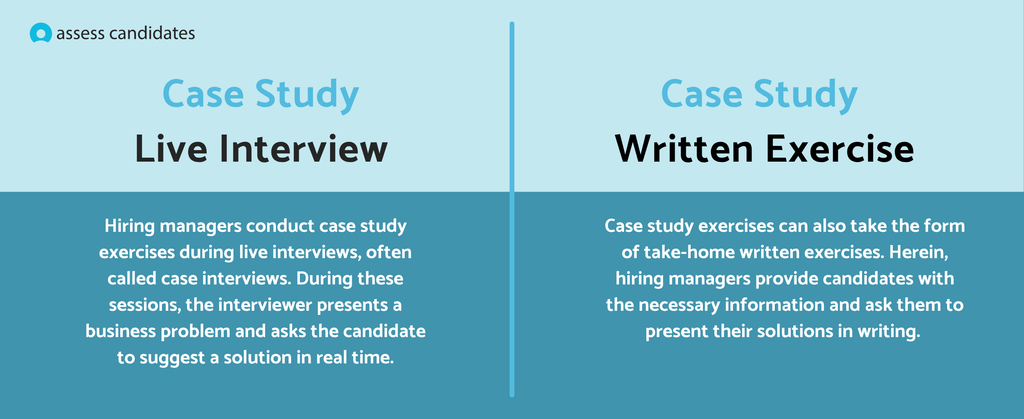
Case study exercises can be presented to candidates in two formats, which are:
- Live interview
- Written exercise
Case study as a live interview
Hiring managers conduct case study exercises during live interviews, often called case interviews. During these sessions, the interviewer presents a business problem and asks the candidate to suggest a solution in real time.
Case study as a written exercise
Case study exercises can also take the form of take-home written exercises. Hiring managers provide candidates with the necessary information and ask them to present their solutions in writing. Candidates can complete these exercises remotely as part of a virtual assessment center.
Depending on the skills required for the role and the scenario used, the case study exercise or interview may be conducted individually or as part of a group of candidates working together.
What skills do case study exercises measure in your candidates? Keep reading as we explore these top skills.

2. What do case study exercises measure?
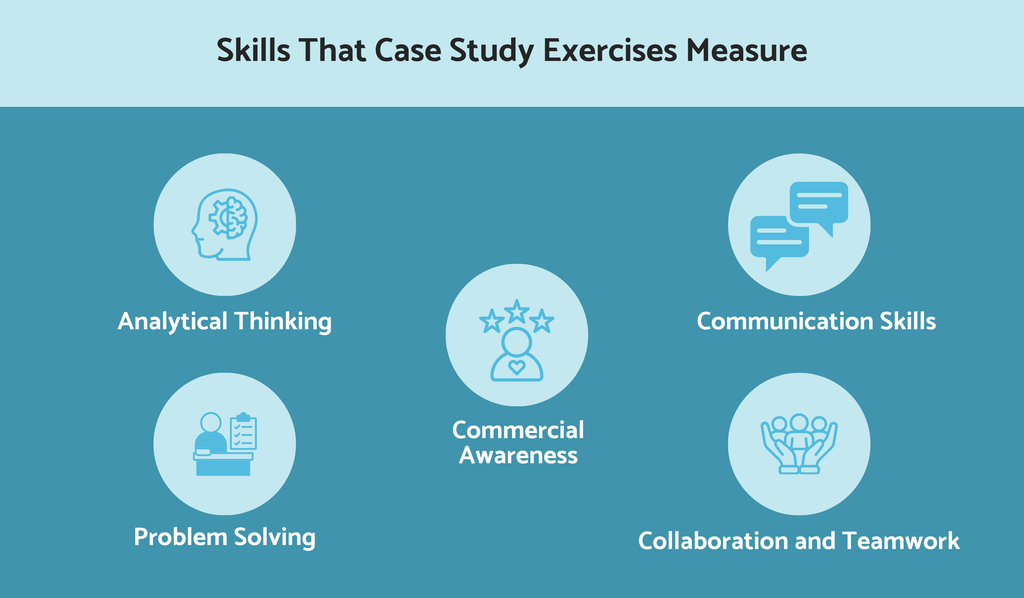
Case study exercises can provide evidence of several job-relevant competencies, depending on how the task is designed and scored. These may include analytical thinking, problem-solving, commercial judgment, and communication. Collaboration can also be assessed when candidates complete the exercise as a group.
According to the University of Calgary, case study exercises effectively help support and evaluate the candidates’ critical and flexible thinking in light of complex realities.
Skills that case study exercises measure
- Analytical Thinking
During a case study exercise, hiring managers provide candidates with large amounts of information, including customer feedback, market trends, and internal business challenges. They assess candidates on their ability to identify the most relevant information rather than treat every detail as equally important.
- Problem Solving
Hiring managers often present candidates with incomplete or ambiguous situations to reflect the uncertainty they may face in a real role. Problem-solving measures how effectively candidates define a problem, consider possible solutions, and recommend a practical course of action.
- Commercial Awareness
In the hiring process, employers use case study exercises to assess candidates’ understanding of how companies create value, manage resources, compete, and make decisions. Employers also evaluate candidates’ ability to see beyond their immediate task.
- Communication Skills
Case study interviews assess how well candidates explain their thinking. This is why you should look for candidates who arrange their ideas clearly, use simple language, explain evidence, and provide a logical recommendation. Your candidates should be able to adapt their communication to the audience.
- Collaboration and Teamwork
Group case study exercises can help employers observe how candidates listen, contribute ideas, manage disagreements, and work toward a shared recommendation. These behaviors cannot be evaluated directly through an individual written exercise, so employers should choose the format according to the competencies they need to assess.
Recruit the best-fit talent with our assessment library. LEARN MORE
Many companies use case studies for different reasons; let us take a look at some of them.
3. Why do employers use case study exercises?
According to Bright Network, employers use assessment center exercises, such as case studies, to evaluate the abilities and competencies of multiple candidates while judging their on-paper experience.
Why employers use case study exercises
1. Predict Job Performance
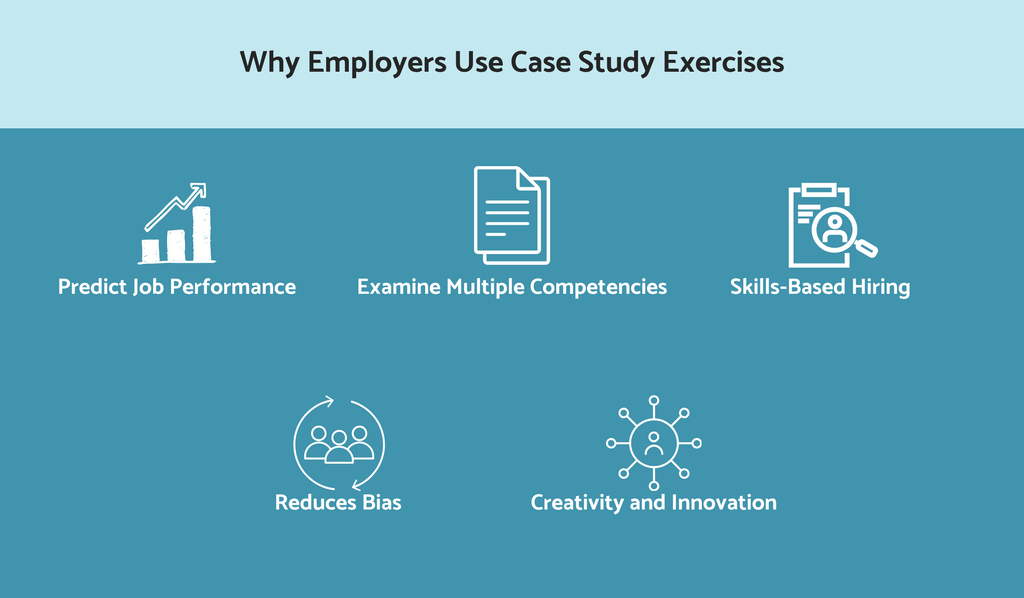
Case study exercises can provide evidence of how candidates approach tasks similar to those required in a role. Their value depends on how closely the scenario reflects the work and whether the scoring criteria measure relevant competencies. Results should be interpreted alongside other hiring evidence.
2. Examine Multiple Competencies
A single case study can measure your candidates’ cognitive abilities, behavioral tendencies, and communication skills simultaneously. This gives you a more complete picture of your candidate’s potential than a single interview question or psychometric test.
3. Skills-Based Hiring
Case study exercises are an effective part of skills-based hiring because they allow employers to evaluate candidates’ abilities through practical, job-related scenarios. Rather than relying solely on CVs and qualifications, employers can observe how candidates analyze information, solve problems, make decisions, and apply their knowledge to real-world business challenges.
4. Reduces Bias
Using the same case scenario, instructions, and predefined scoring criteria can support more consistent candidate evaluation. Employers should also train assessors, review accessibility requirements, and monitor whether the exercise introduces unnecessary barriers or disadvantages.
5. Creativity and Innovation
Many companies’ challenges do not have a single correct answer, which is why case studies evaluate how your candidates create ideas, consider alternative methods, and develop innovative solutions. The candidates who demonstrate creativity while remaining practical often stand out in competitive recruitment processes.
Let’s delve deeper into the structure of these case study exercises and how they assess these key areas.
4. Examples of case study exercises
The activities used within a case study exercise will differ depending on the role and the scenario selected. Candidates may be asked to review a set of documents and produce a written report, draft responses to emails, or deliver a short presentation outlining their recommendations.
According to Elite Human Capital (2020), case study exercises are a hiring method that employers use to assess candidates’ competencies during recruitment.
In a case study interview, candidates are typically presented with a fictional scenario or a real organizational challenge previously encountered by the employer. Assessors then explore the candidate’s reasoning, decision‑making and relevant competencies through a series of targeted questions.
Some example case study interview questions you could ask your candidates include:
Type of Case Study Interview Questions
- Why are customers leaving, and how can the company improve retention?
- Where should a company invest limited resources for maximum impact?
- How can a business reduce costs without damaging quality or customer experience?
- Advise a retail organization on why its revenues have declined over the past two years.
- If a company were to enter a new market, what factors should be considered?
During or after a case study interview, you can ask your candidates any of the following follow-up questions.
- What do you see as the main problem in this scenario?
- How would you implement your recommendation in practice?
- How would you measure whether your solution is working?
Recruit the best-fit talent with our assessment tool platform. LEARN MORE
When using case study exercises, it is essential to keep in mind the following common case study challenges.
5. Challenges of case study exercises
Recruiters have often shared concerns about the challenges case study exercises present in hiring processes, and we will address some of them so they do not impact your recruitment.
5 Common challenges of case study exercises
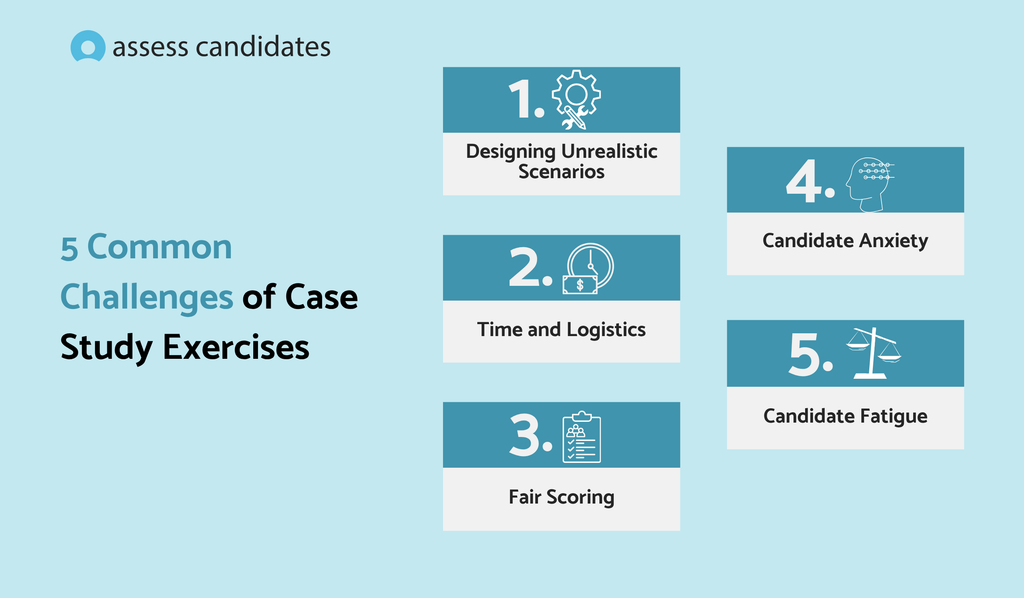
1. Designing Unrealistic Scenarios
Case study exercises should reflect the actual work candidates will perform in your organization. However, when your exercise is too abstract, too easy, or unrelated to the role, you may find it difficult to distinguish between strong and weak candidates.
2. Time and Logistics
Case studies can be time-consuming to administer, especially when they involve written reports, presentations, or group discussions. Your recruiters may have difficulty coordinating candidates, recruitment locations, or virtual platforms.
3. Fair Scoring
Without clear scoring criteria present in your assessment process, different hiring managers may interpret your candidate performance differently. This can create inconsistency and reduce the fairness of your recruitment process.
4. Candidate Anxiety
Case studies can be high-pressure, especially for candidates unfamiliar with the format. As a result, candidate anxiety may affect your candidates’ performance and their true capabilities in the hiring process.
5. Candidate Fatigue
Having too many complex exercises on a single assessment day can cause candidate fatigue. This will further reduce performance quality and the quality of the candidate experience.
Discover assessments created by Chartered Scientists to hire top candidates. VIEW PLANS
To successfully recruit skilled candidates and overcome the key challenges above, let’s explore the top strategies you can use to effectively implement case study exercises.
6. Best strategies to implement case study exercises
Effective case study assessments begin with a clear purpose. Employers should define the competencies they want to observe, select a realistic scenario, establish consistent scoring criteria, and give candidates appropriate instructions and preparation time.
Top practices to implement case study exercises
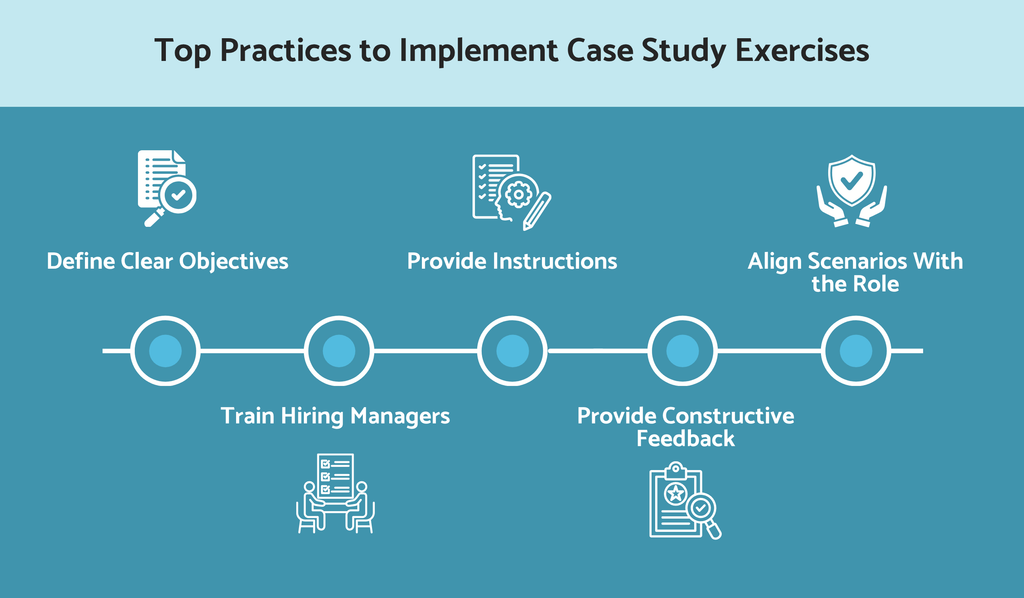
- Define Clear Objectives
Before introducing a case study to your candidates, clarify what you want to measure. Is the focus on analytical thinking, commercial judgment, communication, or a combination of competencies? Having clear objectives will guide your scenario design and scoring criteria, helping you choose the most qualified candidates.
- Provide Instructions
Your candidates should be able to receive clear written instructions that explain the task, time limits, deliverables, and any constraints that they might encounter in the assessment center exercise. Being vague about your expectations can create unnecessary stress and reduce the quality of evidence.
- Align Scenarios With the Role
Your case study interviews should always reflect the type of work your candidates will perform in your company. A strategy role may require market analysis and investment recommendations, while a customer operations role may focus on process improvement and customer retention. This should allow you to better design the scenarios that you will hand to your candidates.
- Train Hiring Managers
Your hiring managers should be taught to understand the purpose of the exercise, the structured scoring criteria, and how to observe and record behaviors objectively. Training them helps reduce inconsistency and improves the reliability of assessments as well as the quality of recruits.
- Provide Constructive Feedback
We suggest that you provide candidates with feedback on their case study performance whenever and wherever it is possible. This proves that your organization supports a positive candidate experience and helps candidates understand their strengths and areas for development, even if they are not successful.
The quality of a case study assessment depends as much on its scoring criteria as on the scenario itself. An interesting business problem is not automatically a reliable hiring exercise.
Case study exercises provide practical evidence of how candidates approach realistic workplace problems. Assess Candidates’ pre-employment assessments can provide additional evidence about relevant skills and abilities, helping employers build a more structured evaluation process.
Hire your best-fit candidates with our assessment tool platform. LEARN MORE
Conclusion: Key Takeaway
Case study exercises and interviews can provide useful evidence of how candidates analyze problems, evaluate options, and communicate recommendations. Their value depends on realistic scenarios, clear instructions, job-relevant scoring criteria, and trained assessors.
Employers should use the results alongside other relevant hiring evidence rather than treating one exercise as a complete prediction of job performance.
Interested in including a case study exercise in your assessment process to ensure that you recruit skilled candidates? Keep reading to see our frequently asked questions, and sign up with your email to get started today.
Frequently Asked Questions
What is the difference between a case study and a case interview?
A case study exercise is often a written or presentation-based task completed at an assessment center. A case interview is a live, interactive session in which an interviewer presents a business problem and the candidate walks through their reasoning in real time.
Can case study exercises be done remotely?
Yes. Case study exercises can be delivered remotely through video interviews, secure document-sharing tools, or suitable assessment platforms. Employers should provide clear instructions, reasonable time limits, accessible materials, and a reliable method for submitting or presenting responses.
Should case studies be used for all roles?
Case study exercises are mostly useful for roles that require problem-solving, analysis, decision-making, and communication. They may be less relevant for highly transactional or routine roles where you can use other assessment methods during your recruitment process.
What should I look for in a strong case study answer?
When reviewing your candidates’ responses, a strong answer should identify the main issue, use the evidence provided, consider realistic options, and make a clear recommendation. Your candidate should explain their reasoning rather than simply state a conclusion.
Should I give candidates the case study before the interview?
Giving your candidates the case study before the interview depends on what you want to assess; it allows them to research, prepare, and produce a more detailed answer. This is useful when the role you are recruiting for involves planning, report writing, or preparing recommendations over time.


 English
 Arabic